
Best Deck Cleaner (2026)
Updated August 2026 • U.S. Buying Guide • Wood, Composite, Pressure-Treated & Painted Decks
The best deck cleaner is determined first by deck material composition and contaminant chemistry, not by aggressive advertising claims on the jug. A pressure-treated pine deck covered in dead fungal biofilm and UV-degraded lignin requires an entirely different chemical pathway than a capped composite deck suffering from surface pollen or grill grease. Painted, stained, or clear-sealed boards introduce further chemical resistance parameters that prevent one-size-fits-all cleaning.
For most homeowners managing exterior lumber, an oxygenated, sodium percarbonate wood deck cleaner serves as the most effective restorative standard. It lifts organic grime and oxidized wood fibers without bleaching natural grain tones or corroding structural hardware. Conversely, modern composite and PVC decking require pH-balanced bio-surfactants that eliminate grease without scratching or softening protective polymer caps.
For natural lumber decks, prioritize an activated sodium percarbonate cleaner paired with an oxalic acid brightener to lift oxidized gray pulp and restore natural tannins before applying stain. For capped composite boards, deploy a bleach-free, pH-neutral composite cleaner that dissolves biological biofilms without voiding manufacturer warranties. Never rely solely on high-pressure water blasting to compensate for inadequate chemical dwell.
Natural softwood decking, capped composite boards, rigid cellular PVC, and film-forming acrylic coatings exhibit divergent chemical tolerances. Deploying harsh sodium hypochlorite (household bleach) or concentrated sodium hydroxide (lye) will break down wood lignin, erode structural cellular bonds, and cause irreversible whitening on composite capstocks.
Quick Reference Specification: Deck Cleaning Chemistry & Substrate Benchmarks
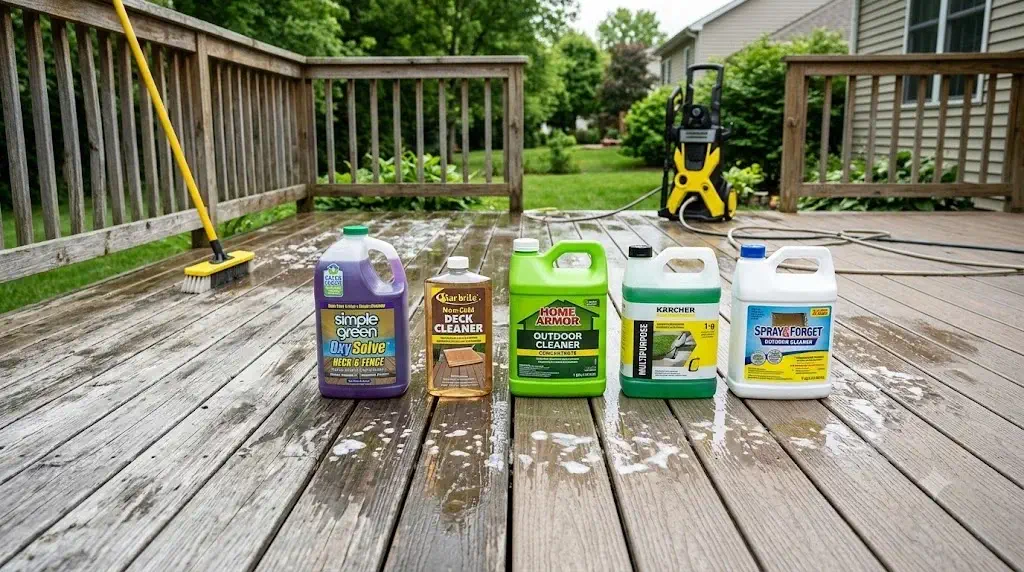
Direct engineering and chemical comparison of the primary deck cleaning active agents, working pH ranges, mechanical agitation needs, and equipment compatibility.
| Tested Product Model | Working Chemistry | Optimal Dwell | Safe Rinse PSI | Required Agitation | Primary Substrate Match |
|---|---|---|---|---|---|
| Simple Green Oxy Solve Deck | Peroxide / Oxygen Foam | 5–10 Minutes | 800 – 1,200 PSI | Medium nylon broom | Pressure-treated pine, cedar, wood fences. |
| STAR BRITE Non-Skid Cleaner | Chelating Bio-Polymer | 3–5 Minutes | Garden hose / 1,000 PSI | Light deck brush | Composite decking, fiberglass, boat decks, PVC. |
| Home Armor Outdoor Cleaner | Fungicidal Surfactant | 10 Minutes max | Low-pressure fan rinse | No scrub (Spray & rinse) | Severe black mold, mildew, green algae spots. |
| Kärcher Multi-Purpose Wash | Downstream Detergent | 5–8 Minutes | 1,000 – 1,500 PSI | Minimal (Pressure wash) | Large multi-tier decks, mixed wood and vinyl. |
| Spray & Forget Outdoor Wash | Non-Caustic Biocide | No rinse / Long dwell | Natural rain activation | Zero scrubbing required | Routine maintenance on hard-to-reach railings. |
Best Deck Cleaners Categorized by Primary Substrate
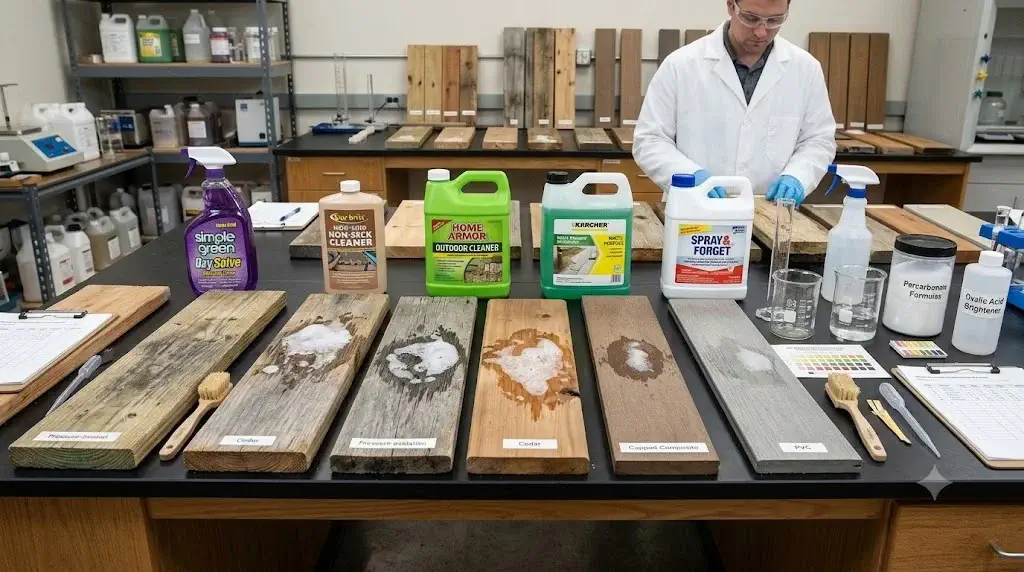
| Category | Selected Model | Best For | Primary Performance Advantage |
|---|---|---|---|
| Best Overall for Wood | Simple Green Oxy Solve Deck & Fence | Pressure-treated wood & cedar | Fast-acting peroxide foam lifts gray oxidized fibers without damaging lignin. |
| Best for Composite | STAR BRITE Non-Skid Deck Cleaner | Capped composite & textured boards | Chelating agents dissolve grime and leave a protective barrier against future stains. |
| Best for Mold & Mildew | Home Armor Outdoor Cleaner Concentrate | Heavy green algae & black mold | Rapidly eradicates biological staining in 10 minutes with minimal scrubbing. |
| Best for Pressure Washers | Kärcher Multi-Purpose Cleaner | Large residential deck expanses | Concentrated formula siphons smoothly through downstream chemical injectors. |
| Best No-Rinse Maintenance | Spray & Forget House & Deck Cleaner | Railings, stairs & seasonal upkeep | Spray-and-leave formula relies on ambient rain to wash away dead lichen over time. |
The ranking above is calibrated against cellular board integrity rather than raw chemical aggressiveness. Deploying an inappropriate acid or alkali can permanently ruin a deck’s finish, demonstrating why chemical matching remains essential.
Deck Cleaning Chemistry Penetrates Organic Soil Layers Without Compromising Wood Lignin
A deck cleaner is an engineered exterior surfactant solution designed to dissolve organic oils, dislodge biological biofilms, and lift photo-oxidized wood cellular debris from horizontal outdoor decking boards. Unlike smooth surfaces, outdoor decking boards feature vascular cellulose pores or embossed synthetic capstocks that capture environmental dust, pollen, and mildew spores.
Homeowners frequently confuse deck maintenance chemicals. Understanding the exact role of each product category prevents accidental structural damage:
| Chemical Class | Primary Mechanism | Operational Role |
|---|---|---|
| Deck Cleaner | Alkaline oxidation & surfactant lift | Removes environmental dirt, gray pulp, and mildew. |
| Wood Brightener | Acidic chelation (Oxalic/Citric) | Neutralizes alkaline cleaner, removes tannins, and restores warm wood tones. |
| Deck Stripper | Strong caustic solvent (Sodium Hydroxide) | Liquefies old solid acrylic stains, failed sealers, and oil finishes. |
| Penetrating Wood Stain | Trans-oxide pigments & drying oils | Imparts rich color tones while shielding boards from UV radiation. |
| Water-Repellent Sealer | Silicone/Paraffin moisture barrier | Blocks liquid water intrusion to prevent board cupping, checking, and splitting. |
Board Composition Dictates Chemical Tolerance Across Natural and Synthetic Decking
Substrate chemistry dictates whether a deck can handle aggressive effervescent cleaners or requires mild neutral detergents. Natural softwoods possess delicate cellulose fibers bound by organic lignin, which dissolves under caustic attack, whereas composite boards feature dense polyethylene or polypropylene protective caps that are sensitive to solvent clouding.
| Decking Substrate | Recommended Starting Chemistry | Critical Structural Vulnerability |
|---|---|---|
| Pressure-Treated Pine | Sodium percarbonate + brightener | Prone to severe fuzzy fiber raising under high mechanical pressure. |
| Western Red Cedar | Gentle oxygen cleaner + oxalic acid | Extremely soft wood; high natural tannins bleed black under alkaline soaps. |
| California Redwood | Oxygen wash + light acid brightener | Highly reactive natural extractives cause severe dark splotching if un-neutralized. |
| Capped Composite (Trex, etc.) | pH-neutral composite wash | Harsh bleaches void warranties and cause permanent color fading on polymers. |
| Cellular PVC / Vinyl | Mild bio-surfactant wash | Vulnerable to surface scratching from stiff-bristled wire scrubbing tools. |
| Painted / Acrylic Coated | Diluted exterior house wash | Strong caustics break down paint binders, causing premature coating flaking. |
Tested Deck Cleaners Deliver Proven Restoration Across Real-World Outdoor Slabs
Evaluating active market deck cleaners across residential wood decks, docks, and composite surfaces identifies five standout products matched to specific outdoor maintenance challenges.
Best Overall for Wood
Simple Green Oxy Solve Deck and Fence Cleaner
HomeGearMax Rating: 9.6/10
Utilizing fast-acting peroxide foam, Simple Green Oxy Solve Deck and Fence Cleaner lifts gray oxidized wood pulp, tree sap, and organic silt without resorting to caustic chlorine bleach. Designed to clean up to 6,400 sq. ft. per gallon, it operates seamlessly through pressure washer detergent tanks or manual garden sprayers.
Why It Ranks First
- Active peroxide foam harnesses the power of oxygen to exfoliate gray wood cells naturally.
- EPA Safer Choice certified formula is non-toxic and biodegradable around family lawns.
- Safely cleans pressure-treated lumber, cedar boards, redwood, and vertical wood fences.
- Concentrated gallon covers up to 6,400 sq. ft. when mixed through pressure washers.
- Preserves natural wood tannins without causing severe fiber raised fuzzing.
Pros
- Peroxide-powered gentle lift
- EPA Safer Choice certified
- Massive 6,400 sq ft yield
- Safe on nearby garden turf
Cons
- Severe stains need broom scrubbing
- Requires follow-up brightener before stain
Best for Composite
STAR BRITE Non-Skid Deck Cleaner & Protectant
HomeGearMax Rating: 9.5/10
Engineered specifically for textured composite decking, cellular PVC, and marine boat decks, STAR BRITE Non-Skid Deck Cleaner uses chelating agents to dissolve ground-in dirt without heavy scrubbing. In addition to deep cleaning, it leaves a protective polymer barrier that repels future stains and protects against UV fading.
Why It Ranks Highly
- Chelating agents break down grease, oil, and bird droppings without damaging composite caps.
- Protective barrier technology coats textured valleys to repel future dust and water stains.
- Contains no harsh acids or caustic bleaches that cause discoloration on synthetic decking.
- Safe for fiberglass, painted surfaces, vinyl railings, and marine non-skid floors.
- Requires only light brush agitation followed by a low-pressure garden hose rinse.
Pros
- Protective stain-repellent coating
- 100% composite & PVC safe
- Lifts stubborn grease spills
- No harsh chemical fumes
Cons
- Higher initial cost per gallon
- Not designed for raw gray wood restoration
Best for Mold & Mildew
Home Armor Outdoor Cleaner Concentrate
HomeGearMax Rating: 9.3/10
For exterior decking overtaken by dark green algae and black mildew blooms, Home Armor Outdoor Cleaner Concentrate provides rapid, no-scrub biological decontamination. Its powerful surfactant blend works in under 10 minutes to kill spores and restore clean board surfaces upon rinsing.
Why It Ranks Highly
- Fast-acting bleach-based action wipes out mold, mildew, and algae in approximately 10 minutes.
- No-scrub formulation requires only spray application and low-pressure hose rinsing.
- Restores slippery, dangerous wood and composite steps to a clean, high-traction condition.
- Concentrated gallon covers extensive outdoor spaces, decks, vinyl railings, and fences.
- Ideal for annual spring recovery on heavily shaded or tree-canopied decks.
Pros
- Instant 10-minute results
- No heavy scrubbing needed
- Eliminates slippery green slime
- Strong mildew root eradication
Cons
- Contains bleach (pre-wet nearby plants)
- Not designed to prep wood before staining
Best for Pressure Washer Integration
Kärcher Multi-Purpose Pressure Washer Detergent
HomeGearMax Rating: 9.2/10
Engineered specifically to work in tandem with consumer gas and electric pressure washers, Kärcher Multi-Purpose Detergent yields up to 20 gallons of working wash solution from a single concentrate gallon. It siphons cleanly through onboard chemical tanks, generating active foam that loosens surface dirt on large decks before wide-fan rinsing.
Why It Ranks Highly
- Calibrated viscosity ensures smooth siphoning without clogging brass injector check valves.
- Highly concentrated 20:1 yield delivers maximum economy across vast multi-level decks.
- Biodegradable, non-corrosive surfactants safeguard internal pressure washer pump components.
- Multipurpose utility safely cleans wood decking, composite boards, vinyl siding, and outdoor furniture.
- Rinses spot-free under standard low-pressure fan patterns without chalky chemical residue.
Pros
- Makes up to 20 gallons
- Optimized for pressure washer siphons
- Pump-safe non-corrosive blend
- Great value for large square footage
Cons
- Mild cleaning action on deep ground-in oil
- Requires pressure washer setup
Best No-Rinse Maintenance
Spray & Forget Ready-to-Use House & Deck Outdoor Cleaner
HomeGearMax Rating: 9.0/10
For homeowners seeking ongoing, effortless maintenance on hard-to-reach railings and deck staircases, Spray & Forget Ready-to-Use House & Deck Cleaner eliminates scrubbing entirely. This non-caustic formula bonds to the surface, breaking down biological growth over time as natural rainfall flushes dead spores away.
Why It Ranks Highly
- Zero scrubbing or high-pressure rinsing required—simply spray and let weather complete the process.
- Non-bleach, eco-friendly biocide formula prevents damage to exterior wood finishes and paints.
- Ideal for regular seasonal treatment on elevated deck railings, balusters, and lattice skirting.
- Convenient ready-to-use trigger spray bottle tackles localized mold spots without mixing buckets.
- Delivers residual protection that prevents new algae and moss from gaining a foothold.
Pros
- Completely scrub-free maintenance
- No pressure washer needed
- Long-term preventative residual
- Safe on painted surfaces
Cons
- Results take several weeks of rain
- Cannot remove instant mud or grease
Oxygenated Cleaning Solutions Exfoliate Oxidized Wood Fibers Without Lignin Degradation
Sodium percarbonate dissolves into water to produce active oxygen bubbles that gently expand within wood vascular pores, breaking the bond between weathered gray cellulose and sound subsurface lumber. This chemical reaction loosens dead surface fibers naturally, allowing operators to wash away gray oxidation with light brush agitation rather than destructive water pressure.
Standard chlorine bleach damages natural timber by oxidizing the lignin glue that binds wood cells together, leaving softwoods fuzzy, yellowed, and structurally weakened. Professional wood restoration specialists consistently mandate oxygenated percarbonate solutions for routine timber maintenance to preserve physical grain density.
Pressure-Treated Pine Contains Chemical Preservatives Sensitive to High-Pressure Gouging
Southern yellow pine undergoes high-pressure chemical retort treatment with copper-based preservatives (such as MCA or ACQ) to resist fungal decay and wood-boring insects. However, this pressure treatment does not prevent UV solar degradation, leaving untreated pine boards vulnerable to surface graying, leaf staining, and cracking.
Because yellow pine exhibits pronounced differences between soft springwood and dense summerwood rings, aggressive pressure washing gouges deep troughs into the soft grain. Applying a dedicated oxygenated cleaner allows the chemistry to break down gray surface soils, requiring only a gentle 800 PSI fan rinse to restore clean, un-gouged lumber.
Cedar Fibers Require Mild Chemical Formulas to Prevent Furring and Premature Splintering
Western Red Cedar is naturally rot-resistant due to high internal concentrations of thujaplicins and polyphenolic tannins, but its physical wood matrix is exceptionally soft. Excessive pressure or stiff abrasive brushes shred cedar fibers, turning the smooth board surface into a fuzzy carpet of damaged wood pulp that must be laboriously sanded down once dry.
Capped Composite Boards Utilize Protective Polyethylene Shells Sensitive to Caustic Clouding
Modern composite decking (such as Trex, TimberTech, and Fiberon) encases a recycled wood-fiber core inside a durable, non-porous polymer outer shell. Applying harsh solvent degreasers, muriatic acids, or undiluted chlorine bleach can cloud the polymer finish, dissolve UV stabilizers, and permanently void the manufacturer’s 25-to-50-year fade and stain warranty.
Effective composite deck cleaners deploy non-foaming wetting agents and mild bio-enzymes calibrated to a neutral pH (6.5 to 8.0). These solutions dissolve barbecue grease and loosen stubborn mold colonies anchored inside embossed grain valleys, allowing clean rinsing without chemical residue or color fading.
Biological Biofilms Spread Rapidly Across Shaded Deck Boards Retaining Ambient Moisture
North-facing and tree-canopied decks remain damp for hours after morning dew, creating an optimal breeding environment for micro-fungi, green algae, and lichen colonies. Trapped leaves inside expansion gaps act as wet compost dams, accelerating spore proliferation into the vascular pores of wood boards and the textured crevices of composite caps.
Eliminating severe biological infestations requires an EPA-registered fungicidal wash containing quaternary ammonium or buffered sodium hypochlorite kept to strict working times (under 10 minutes). The biocide breaks down fungal hyphae roots, eradicating the organism completely so it cannot regenerate after the next rainstorm.
Barbecue Grill Splatter Demands Specialized Surfactants to Emulsify Non-Polar Animal Fats
Hot cooking grease, burger fat, and marinade oil drippings form tough non-polar stains on both natural wood and synthetic composite boards. Because water naturally beads up on grease, standard pressure washing simply spreads the oil across adjacent boards, expanding the contaminated perimeter.
Targeted Grease Removal Protocol
- Blot Fresh Spills: Absorb liquid grease immediately with paper towels or cornstarch; avoid wiping, which pushes oil deeper into the surface.
- Apply Deck-Safe Degreaser: Apply a specialized composite or wood degreaser directly to the spot at full strength.
- Gentle Agitation: Scrub the spot thoroughly with warm water and a soft-bristle nylon brush to emulsify the lipid bonds.
- Thorough Flush: Rinse the area completely with hot water or low-pressure garden hose spray, wiping dry with a clean microfiber cloth.
Controlled Fluid Mechanics Balance High Water Volume with Low Hydraulic Impact
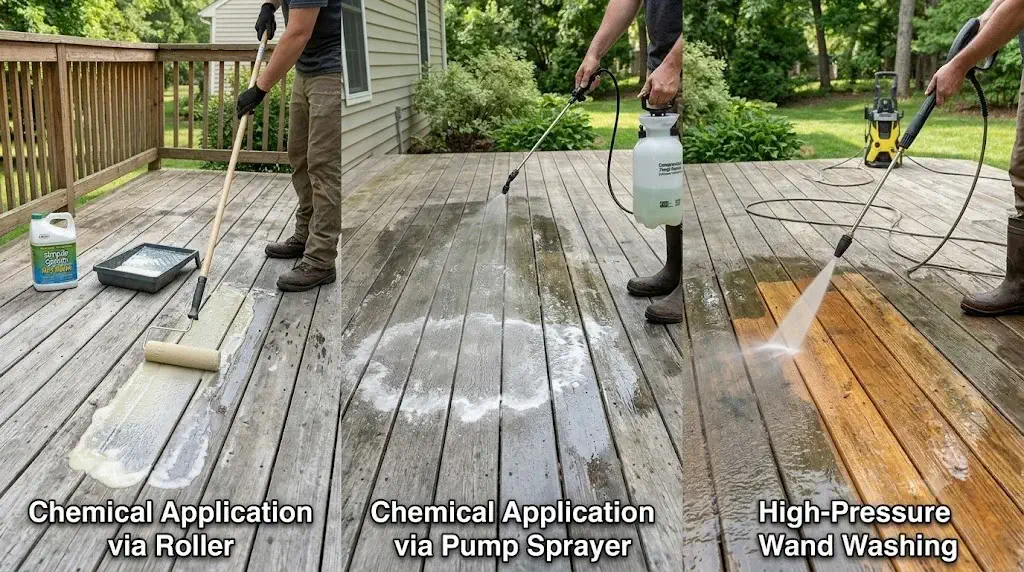
Pressure washers serve as powerful rinsing and chemical application tools for expansive outdoor decks, provided the operator prioritizes high water volume over high pressure. High flow rates—measured in Gallons Per Minute (GPM)—carry dislodged biological grime and dissolved wood pulp off the deck quickly without tearing soft springwood rings.
When applying deck detergents through your pressure washer, use a downstream chemical injector or wide foam cannon connected to one of the best pressure washer guns to maintain fingertip flow modulation and prevent chemical misting on building walls.
Chlorine Bleach Hydrolyzes Natural Wood Lignin and Accelerates Metal Fastener Corrosion
Sodium hypochlorite (household laundry bleach) is frequently misapplied as a universal outdoor deck cleaner due to its low cost and rapid visual whitening effect. However, chlorine bleach does not remove soil; it chemically oxidizes wood fibers, destroying the natural lignin binder that provides timber its structural flexibility and leaving a brittle, lifeless yellow-gray finish.
Sodium Percarbonate Generates Active Hydrogen Peroxide to Safely Bleach Biological Stains
Sodium percarbonate is an addition compound of sodium carbonate and hydrogen peroxide. When mixed into warm water, it activates into an effervescent solution with a working pH of approximately 10.5, releasing microscopic oxygen bubbles that exert outward mechanical force inside porous wood cells to push trapped dirt to the surface.
Unlike liquid chlorine, activated sodium percarbonate solutions remain effective on boards for up to 30 minutes without drying into caustic salts. It cleans biological stains, neutralizes slippery mold, and strips away dead gray surface pulp without destroying the sound wood beneath, making it the preferred cleaner of professional deck restorers nationwide.
Acidic Wood Brighteners Neutralize Alkaline Cleaners and Restore Natural Lighter Tones
Alkaline cleaning agents naturally turn tannin-rich woods (such as cedar, redwood, and oak) a dark, unappealing black or deep brown due to chemical extractive reactions. Applying an acidic wood brightener—specifically buffered oxalic or citric acid—immediately reverses this reaction, rebalancing timber pH and restoring the natural golden hue of the wood.
Why wood brighteners are essential in pre-stain restoration:
- Neutralizes Alkali: Halts the chemical saponification caused by heavy wood cleaners and strippers.
- Cheletes Iron Stains: Dissolves dark black rings caused by galvanized steel screws and metal furniture legs.
- Opens Cellular Pores: Relaxes compressed cellulose fibers, allowing deep stain penetration.
- Uniforms Color: Restores an even, balanced canvas so new wood stains absorb without blotchy dark patches.
Pre-Stain Surface Preparation Determines Trans-Oxide Pigment Adhesion and Uniformity
Applying expensive exterior wood stain over improperly prepared, dirty decking leads to premature coating failure within a single season. If dead gray cellulose fibers and fungal spores remain on the boards, the stain bonds to the loose debris rather than the sound lumber beneath, causing the finish to peel away in sheets.
A thorough cleaning and brightening protocol removes this barrier, opening the timber’s vascular channels to draw drying oils deep into the core. After washing, allow wood decking to dry completely—reaching a moisture content below 15%—before applying any oil-based or waterborne exterior stain.
Systematic Cleaning Stages Ensure Complete Decontamination Without Surface Damage
Executing deck cleaning in structured, disciplined phases ensures chemical dwell stability, protects nearby landscaping, and delivers an even, professional finish across every board.
Operating Pressure Limits Protect Delicate Wood Fibers from Severe Hydraulic Damage
Excessive water pressure tears delicate softwood fibers, gouges deep stop-marks across boards, and creates permanent wash ripples that can only be repaired through aggressive mechanical drum sanding. The goal during deck maintenance is chemical soil breakdown, with the pressure washer functioning strictly as a high-volume rinsing tool.
| Deck Material Class | Max Working PSI | Recommended Nozzle Tip | Min Safe Distance |
|---|---|---|---|
| Softwoods (Pine, Fir) | 800 – 1,000 PSI | 40° White Fan Tip | 12 to 16 Inches |
| Softwoods (Cedar, Redwood) | 500 – 800 PSI | 40° or 60° Fan Tip | 14 to 18 Inches |
| Hardwoods (Ipe, Cumaru) | 1,200 – 1,500 PSI | 25° Green / 40° White | 12 Inches |
| Capped Composite | 1,000 – 1,500 PSI | 40° White Fan Tip | 10 to 12 Inches |
Composite Deck Manufacturers Establish Specific Hydraulic Pressure Thresholds
Leading composite decking manufacturers establish explicit guidelines regarding pressure washer usage. While first-generation uncapped composite boards could easily fuzz under high pressure, modern capped boards withstand moderate pressure provided the operator follows warranty-approved parameters.
Trex, TimberTech, and Fiberon generally permit pressure washing up to a maximum of 1,500 PSI, requiring the use of a wide 40° fan nozzle kept at least 10 to 12 inches away from the board surface. Using a narrow 15° tip, rotating turbo nozzle, or holding the spray wand too close can cut into the outer polyethylene capstock, causing permanent blemishes that void manufacturer warranties.
Active Chemical Concentration Dictates Square-Foot Yield Across Diluted Gallons
Comparing deck cleaner values requires calculating the square footage covered by the final diluted working solution rather than looking at container bottle volume alone. A concentrated 1-gallon composite cleaner yielding 4 gallons of solution covers approximately 1,000 to 2,500 square feet under standard dilution rates.
High-yield concentrates such as Simple Green Oxy Solve deliver superior square-foot coverage because their active formula mixes dynamically through pressure washer injectors, cleaning up to 6,400 square feet per concentrated jug.
True Restoration Economics Involve Labor Investment and Multi-Stage Material Costs
Homeowners frequently miscalculate deck restoration budgets by focusing solely on cleaner purchase prices while ignoring complementary brighteners, safety equipment, and mechanical tools. Factoring in complete restoration parameters ensures accurate project cost projections.
- Cleaner Concentrate: $20 to $40 per gallon (covers 800 to 6,400 sq ft depending on chemical concentration).
- Wood Brightener: $20 to $35 per gallon (essential second-stage neutralizing treatment for wood).
- Application Equipment: $15 to $30 for a dedicated chemical-resistant pump garden sprayer.
- Agitation Tools: $12 to $20 for a synthetic polypropylene extension deck broom.
- Labor Efficiency: Pre-stain chemical cleaning saves hours of intensive belt sanding and prevents premature stain peeling.
Excessive Pressure and Premature Solution Drying Account for Most Deck Cleaning Failures
- Treating Wood and Composite as Identical: Using harsh wood strippers or wood brighteners on capped composite decking clouds polymer capstocks.
- Using Pinpoint 0° Red Tips: Needle-thin pressure jets instantly slice through softwood grain, leaving permanent gouges.
- Holding the Spray Wand Too Close: Operating closer than 10 inches tears soft summerwood fibers and leaves visible sweep arcs across boards.
- Allowing Cleaners to Flash-Dry: Letting chemical solutions dry on hot boards redeposits suspended soils, leaving stubborn chalky residues.
- Cleaning in Direct Midday Sunlight: Intense solar heat accelerates evaporation, preventing active surfactants from achieving adequate dwell time.
- Using Household Bleach: Sodium hypochlorite oxidizes wood lignin, corrodes metal joist hangers, and yellows natural timber.
- Skipping the Wood Brightener Stage: Failing to neutralize alkaline cleaners causes tannin-rich woods (cedar/redwood) to remain permanently blackened.
- Staining Damp Wood: Applying deck stain before boards have dried below 15% moisture content traps water, causing rapid blistering and peeling.
- Using Stiff Wire Brushes: Steel wire bristles scratch protective composite caps and leave microscopic metal fragments that rust on wood.
- Ignoring Expansion Drainage Gaps: Leaving wet composted leaf debris between board gaps traps moisture, fostering immediate biological regrowth.
Structured Decision Logic Directs Homeowners to the Ideal Deck Cleaning Formula
Technical Evaluation Weights Reveal Key Chemical Drivers of Deck Longevity
Evaluating deck cleaners requires weighing chemical properties alongside equipment parameters to identify the factors that directly impact cleaning efficacy and board preservation.
| Evaluation Parameter | Operational Role | Importance Level |
|---|---|---|
| Substrate Compatibility | Prevents lignin hydrolysis on wood and capstock haze on composites | Critical |
| Chemical Dwell Stability | Ensures active ingredients remain wet to break down cellular soils | Critical |
| Operating Pressure Moderation | Prevents mechanical grain furring, splintering, and stop-marks | Critical |
| pH Rebalancing (Brightening) | Reverses tannin darkening and opens wood pores for stain adhesion | High |
| Fluid Water Volume (GPM) | Flushes loosened organic slurry cleanly off boards and out of gaps | High |
| Landscape Biodegradability | Protects perimeter ornamental gardens and lawns from chemical burns | High |
| Peak Water Pressure (PSI) | Supplies mechanical rinsing force (strictly capped under 1,200 PSI) | Medium |
Personal Protective Equipment and Landscape Pre-Soaking Eliminate Common Chemical Hazards
Concentrated deck cleaners, sodium percarbonate powders, and oxalic acid brighteners are powerful chemicals that require proper handling to prevent eye injury, skin burns, and accidental property damage.
Critical Safety and Operational Protocols:
- Wear Wrap-Around Eye Protection & Gloves: Alkaline solutions and acidic brighteners cause severe ocular damage and skin irritation upon contact.
- Pre-Wet All Nearby Landscaping: Saturate perimeter grass, flowers, and foundation shrubs with fresh water before, during, and after chemical washing to dilute overspray.
- Never Mix Incompatible Chemicals: Combining bleach-based washes with acidic brighteners or ammonia releases deadly toxic chloramine gases.
- Maintain Firm Footing on Wet Decks: Wet organic algae creates an extremely slick fall hazard; wear slip-resistant rubber-soled footwear during washing.
Frequently Asked Questions
What is the best deck cleaner?
For unfinished natural wood decks, an oxygenated sodium percarbonate cleaner represents the best option because it releases active oxygen to lift gray lignin without dissolving wood fibers. For capped composite boards, a pH-neutral surfactant wash formulated specifically for synthetic polymers prevents protective cap degradation.
What is the best deck cleaner for wood?
Sodium percarbonate oxygen-based cleaner is the benchmark choice for pressure-treated pine, cedar, and redwood because it removes organic biofilm without burning the wood surface like chlorine bleach.
What is the best composite deck cleaner?
A composite-specific cleaner formulated without sodium hypochlorite or harsh phosphates protects the outer polyethylene capping while breaking down surface dirt, mold spots, and cooking grease.
Can you pressure wash a wood deck?
Yes, but working pressure must stay strictly between 500 and 1,200 PSI using a wide 40-degree or 60-degree fan tip held at least 12 inches away to prevent splintering and gouging the grain.
Can you pressure wash composite decking?
Most manufacturers permit pressure washing capped composite boards up to 1,500 PSI using a 40° white fan nozzle held 10 to 12 inches away. Always verify specific manufacturer warranty instructions before washing.
What is the difference between deck cleaner and deck brightener?
A deck cleaner is an alkaline surfactant that strips dirt, gray oxidized fibers, and mildew. A deck brightener is an acidic solution (typically oxalic acid) that neutralizes the alkaline pH, restores natural wood tones, and opens wood pores for optimal stain absorption.
Why does my wood deck turn black after cleaning?
Alkaline deck cleaners react chemically with natural wood tannins in cedar, redwood, and oak, causing the surface to turn dark brown or black. Applying an oxalic acid wood brightener immediately reverses this reaction, restoring natural golden hues.
Balancing Chemical Compatibility with Controlled Pressure Guarantees Long-Term Board Integrity
For the vast majority of homeowners, finding the best deck cleaner requires selecting the proper chemical formulation for your specific board composition rather than relying on excessive pressure washer force.
For natural lumber decks constructed from pressure-treated pine, cedar, or redwood, pairing Simple Green Oxy Solve Deck and Fence with an oxalic acid brightener delivers unmatched restorative results without shredding wood fibers or corroding metal hardware. For capped composite and PVC decks, STAR BRITE Non-Skid Deck Cleaner breaks down barbecue grease and biological biofilms while preserving manufacturer warranties and leaving a protective stain-repellent finish. When dealing with extreme green mold or wide multi-level expanses, Home Armor Outdoor Cleaner and Kärcher Multi-Purpose Detergent provide fast, targeted power.
