
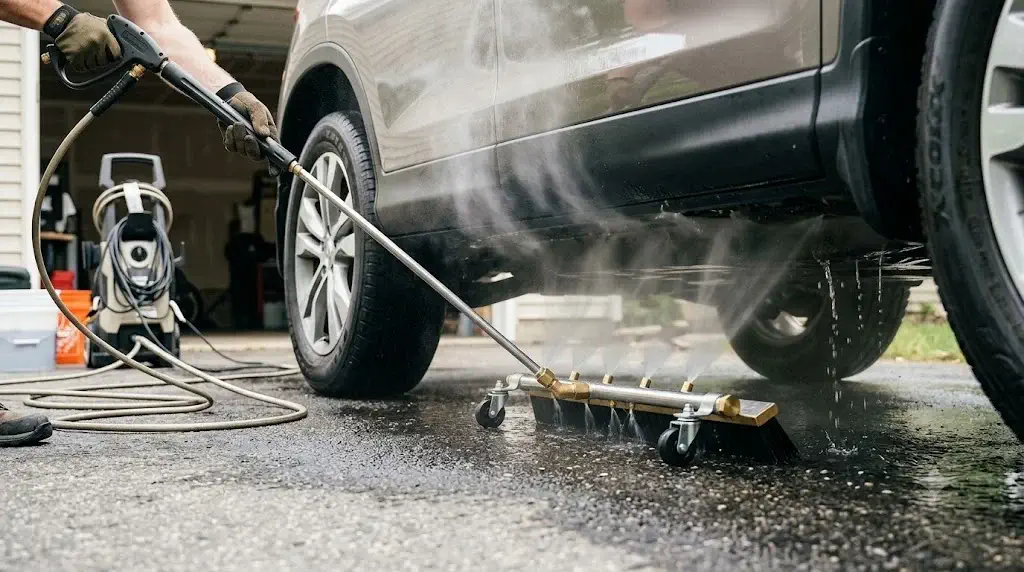
Best Undercarriage Cleaners (2026)
Updated August 2026 • U.S. Buying Guide • PSI, GPM, Clearance & Nozzle Analysis
The best undercarriage cleaner is not simply the attachment with the highest advertised PSI rating. A useful underbody washer has to distribute pressurized water across the entire chassis width while maintaining adequate mechanical clearance, volume flow (GPM), upward nozzle spray angles, and smooth rolling maneuverability to flush away abrasive road salt, mud, sand, and corrosive winter grime.
For most U.S. vehicle owners, a 16- to 21-inch wheeled undercarriage cleaner with multiple upward-facing fan nozzles provides the ideal balance between ground coverage and push-pull maneuverability. However, the optimal hardware configuration changes substantially when washing lowered sports cars, lifted off-road trucks, large commercial haulers, or electric pressure washers constrained by low water volume.
A multi-nozzle wheeled undercarriage water broom is the most effective general-purpose platform for cleaning the chassis of cars, trucks, and SUVs. Looking beyond marketing labels reveals that delivered GPM, individual nozzle orifice sizing, cleaning manifold width, minimum ground clearance, caster wheel bearing quality, and quick-connect compatibility determine whether the attachment functions effectively with your specific pressure washer.
An undercarriage cleaner is an open-spray hydraulic flushing tool designed to remove loose surface dirt and soluble salts. It is not an abrasive mechanical rust remover and cannot eradicate flaking oxidation or repair structurally deteriorated frame rails.
Quick Reference Specification: Undercarriage Cleaner Architectural Benchmarks
Direct engineering comparison contrasting key mechanical specifications across leading residential and commercial underbody water broom platforms.
| Cleaner Architecture | Inlet Coupling | Rated Pressure (PSI) | Flow Range (GPM) | Min. Height Clearance | Primary Workload Match |
|---|---|---|---|---|---|
| 16″ Dual-Function Water Broom | 1/4″ Quick-Connect | 1,500 – 4,400 PSI | 1.8 – 3.5 GPM | 5.0 Inches | All-around residential cars, SUVs, and driveway sweeping. |
| 21″ Wide-Chassis Assembly | 1/4″ Quick-Connect | 2,000 – 4,000 PSI | 2.2 – 4.0 GPM | 5.5 Inches | Pickup trucks, large SUVs, work vans, and fleet bays. |
| 3″ Low-Profile Detailer Bar | 1/4″ Quick-Connect | 1,500 – 5,000 PSI | 2.0 – 8.0 GPM | 3.0 Inches | Sports cars, modified vehicles, and lowered sedans. |
| Commercial Stainless Swivel Bar | 3/8″ QC / NPT Thread | 3,500 – 5,000+ PSI | 4.0 – 10.5+ GPM | 6.0 Inches | Heavy industrial transport, farm machinery, and municipal fleets. |
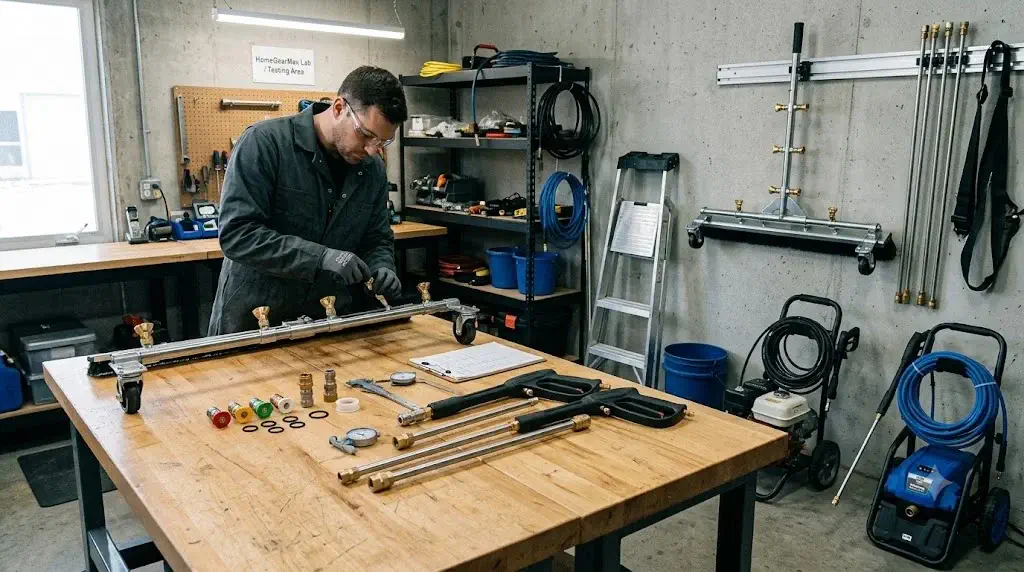
Undercarriage Cleaners Grouped by Primary Application
| Category | Recommended Design | Best For | Key Reason |
|---|---|---|---|
| Best Overall | 16-inch multi-nozzle wheeled cleaner | Most passenger cars and SUVs | Optimal balance of ground clearance, spray density, and maneuverability. |
| Best Premium | 21-inch wide-track undercarriage cleaner | Large pickup trucks and commercial vans | Wide sweep path reduces total passes beneath long wheelbases. |
| Best for Road Salt | Four-nozzle upward spray manifold | Winter road de-icing brine flushing | High-volume vertical spray dissolves sodium chloride film quickly. |
| Best for Mud | Heavy-duty high-PSI multi-nozzle bar | Off-road 4x4s, ATVs, and work trucks | Heavy water volume dislodges clay dams packed around crossmembers. |
| Best for Low Cars | 3-inch ultra-low-profile caster unit | Sports cars and lowered chassis | Rolls beneath low front splitters without scraping bodywork. |
| Best Value | 16-inch 2-in-1 convertible water broom | DIY residential property owners | Reversible spray bar cleans vehicle underbodies and sweeps driveways. |
The ranking above is structured by functional chassis geometry and hydraulic compatibility rather than isolated pressure peaks. A 16-inch cleaner is the superior tool for compact sedans, whereas a 21-inch bar significantly accelerates truck washing.
Undercarriage Cleaners Direct Pressurized Streams Upward Beneath Low-Clearance Vehicle Chassis
An undercarriage cleaner is a specialized pressure washer attachment that arranges multiple upward-facing fan nozzles across a rigid wheeled manifold. Instead of forcing the operator to crouch, kneel, and blindly aim a standard wand beneath rocker panels, the rolling platform glides smoothly across the ground to sweep continuous water curtains against suspension linkages, fuel tanks, and subframes.
This upward hydraulic geometry effectively flushes corrosive contaminants that cause accelerated underbody degradation:
- Crystalline road salt and liquid magnesium chloride de-icing brine.
- Abrasive road sand and silica dust that grind down steering seals.
- Packed clay and wet mud that trap moisture against boxed frame rails.
- Corrosive winter street slush accumulated in rocker panel crevices.
- Loose soil, organic debris, and general driving grime.
Industrial undercarriage washers operate at vastly higher water volumes than residential accessories. Commercial fleet rigs frequently demand upwards of 4,000 PSI and 10.5 GPM, demonstrating how physical fluid requirements scale from homeowner wash bays to industrial wash terminals.
Horizontal Manifolds Distribute Hydraulic Energy Across Multiple Elevated Spray Nozzles
Most residential undercarriage washers route incoming pressurized water through a central distributor pipe that branches into three or four upward-aimed spray orifices. The chassis remains stationary while smooth-rolling caster wheels enable the user to sweep the water broom back and forth beneath the vehicle floorpans.
Why Multiple Nozzles Are Required
A single conventional spray tip concentrates force into a narrow contact point, which is effective for spot-cleaning concrete but hopelessly inefficient for sweeping a 70-inch-wide vehicle underbody. Splitting the flow across multiple nozzles provides an overlapping fan pattern that flushes broad swathes of metal in a single stroke.
Because the incoming water supply is divided among all active orifices, your pressure washer must produce sufficient total volume. When coupled with an undersized machine, a four-nozzle bar experiences an immediate pressure drop, reducing high-velocity jets to ineffective low-pressure fountains.
Tested Undercarriage Washer Platforms Deliver Proven Reliability Across Chassis Profiles
Analyzing real-world undercarriage cleaner designs highlights how manifold width, caster bearing quality, and nozzle configuration impact everyday cleaning performance.
Best Overall Value
Westinghouse 16-Inch Undercarriage Cleaner & Water Broom
HomeGearMax Rating: 9.2/10
The Westinghouse 16-inch undercarriage cleaner stands out as a highly versatile dual-function platform. Built to handle operating pressures up to 4,400 PSI, it features an innovative pivoting spray bar that rotates 180 degrees, allowing users to alternate between upward vehicle undercarriage washing and downward flatwork sweeping.
Why It Ranks Highly
- 16-inch cleaning width navigates effortlessly between vehicle tires.
- Dual-function swivel head transforms from underbody washer to driveway water broom.
- Universal 1/4-inch quick-connect plug connects seamlessly to standard extension wands.
- Compatible with both residential electric units and high-output gas pressure washers.
- Four brass fan nozzles produce an overlapping 40-degree spray curtain.
Pros
- Dual-purpose functionality
- 4,400 PSI pressure tolerance
- Sturdy caster wheels
- Standard 1/4″ QC fitment
Cons
- Requires 2.0+ GPM for optimal force
- 5-inch height tight on slammed cars
Best Premium / Wider Coverage
Kärcher 21-Inch Undercarriage Cleaner Kit
HomeGearMax Rating: 9.0/10
The Kärcher 21-inch undercarriage cleaner kit is purpose-engineered for expansive vehicle platforms. Rated up to 4,000 PSI with a calibrated operating range of 1.0 to 2.5 GPM, this extra-wide assembly sweeps large floorpans rapidly, making it particularly effective on full-size pickup trucks, commercial vans, and wide-stance SUVs.
Why It Ranks Highly
- Expansive 21-inch manifold sweeps full chassis width in fewer passes.
- Optimized internal flow routing functions smoothly on machines from 1.0 to 2.5 GPM.
- Includes two 20-inch extension lances for deep centerline reach beneath long wheelbases.
- Pivoting guide caster allows effortless multi-directional steering around exhaust pipes.
- Heavy-duty polymer housing resists impacts with chassis crossmembers.
Pros
- Extra-wide 21″ cleaning path
- Operates on low-GPM electric units
- Includes extended rigid lances
- Fluid steering maneuverability
Cons
- Bulkier storage footprint
- Higher investment cost
Best Low-Profile Detailer Design
Adam’s Undercarriage Cleaner (Ultra-Low 3-Inch Clearance)
HomeGearMax Rating: 8.9/10
Engineered specifically for low-clearance performance vehicles, Adam’s undercarriage cleaner utilizes an ultra-compact chassis requiring only 3 inches of clearance. Equipped with four 45-degree upward fan nozzles, it glides underneath low body kits, front splitters, and dropped suspension setups without contacting bodywork.
Why It Ranks Highly
- Ultra-low 3-inch profile rolls beneath aggressively lowered passenger cars.
- Four precisely angled 45° fan nozzles target hidden crevices behind subframes.
- Solid brass central caster and heavy-duty rubberized wheels provide smooth tracking.
- Wide operating window handles pressure outputs from 1,500 to 5,000 PSI.
- Rugged aluminum spray bar resists harsh automotive de-greasing chemicals.
Pros
- Industry-leading 3″ ground clearance
- Smooth rubberized rolling wheels
- Up to 5,000 PSI capacity
- Heavy-duty brass swivel caster
Cons
- Narrower spray width requires more passes
- Demands 2.5+ GPM for maximum jet lift
Working Pressure Ratings Prevent Ruptures Without Risking Delicate Underbody Wiring
Continuous operating pressure between 1,500 and 3,500 PSI is ideal for undercarriage washing because it generates sufficient force to dislodge road silt without cutting into ABS sensor harnesses or rubber CV boot seals. While manufacturers frequently tout peak burst pressures above 4,400 PSI, effective cleaning depends on continuous working pressure delivered directly at the spray manifold.
Connecting an undercarriage cleaner to an excessively powerful gas machine without monitoring spray distance can force high-pressure water past differential vent breathers and transmission seals. Always pair your setup with an ergonomic controller from our best pressure washer guns testing guide to ensure precise, fatigue-free shutoff control.
Water Flow Volume Determines Hydraulic Flushing Velocity Across Multi-Nozzle Manifolds
Gallons per minute (GPM) represents the single most critical performance metric for underbody water brooms because total pump flow is split simultaneously across all active spray nozzles. A multi-nozzle attachment connected to a machine delivering only 1.2 GPM forces each nozzle to operate at an anemic 0.3 GPM, drastically reducing jet velocity.
When water volume drops below 1.5 GPM, upward-directed water curtains lack the mass and momentum required to flush heavy sand and dissolved road salt out from boxed chassis sections. For maximum cleaning efficiency, prioritize machines delivering at least 2.0 to 3.0 GPM.
Multi-Nozzle Configurations Balance Surface Coverage Against Individual Spray Impact Force
Selecting between two-nozzle, four-nozzle, and rotary undercarriage heads requires balancing horizontal sweep area against the hydraulic density delivered to contaminated components.
| Nozzle Configuration | Chassis Coverage | Flow Consumption (GPM) | Optimal Workload |
|---|---|---|---|
| Single Fan Nozzle | Very Narrow (4 to 6 inches) | Low (1.0 – 1.5 GPM) | Spot-flushing isolated suspension knuckles and hitches. |
| Dual Fan Nozzles | Moderate (8 to 12 inches) | Moderate (1.5 – 2.0 GPM) | Compact electric washers with limited fluid output. |
| Four 40° Fan Nozzles | Broad (16 to 21 inches) | High (2.2 – 4.0 GPM) | Rapid whole-chassis winter salt and mud flushing. |
| Twin Rotary Turbo Jets | Medium Overlapping Sweep | High (3.0 – 5.0 GPM) | Scouring dried off-road clay from boxed truck frames. |
Manifold Dimensions Determine Pass Efficiency and Tight Wheel-Well Maneuverability
Choosing between a compact 16-inch manifold and an expanded 21-inch chassis cleaner involves a direct tradeoff between sweep speed on open driveways and nimble navigation around steering components.
| Feature | 16-Inch Water Broom | 21-Inch Water Broom |
|---|---|---|
| Single-Pass Sweep Coverage | Standard (Approx. 16 inches) | Expansive (Approx. 21 inches) |
| Steering in Confined Spaces | Exceptional nimble tracking | Requires wider garage clearance |
| Compact Passenger Cars | Optimal fit between tires | Can bind against tire inner walls |
| Full-Size Trucks & Suburbans | Requires 6 to 8 longitudinal passes | Cleans full floorpan in 4 to 5 passes |
| Tool Storage Footprint | Hangs easily on wall hooks | Requires dedicated shelf bay |
Chassis Ride Height Determines Caster Wheel and Manifold Clearance Feasibility
Measuring the lowest physical point of your vehicle—often an exhaust flex-pipe, suspension crossmember, or catalytic converter heat shield—is mandatory before purchasing an undercarriage attachment. Standard water brooms measure 5 to 6 inches in overall height, making them too tall to roll beneath low sports cars.
For sports sedans or vehicles with aftermarket coilover suspension, choose dedicated low-profile platforms measuring 3.0 to 3.5 inches tall. Attempting to force an oversized cleaner underneath a low vehicle risks gouging painted rocker panels and tearing rubber air dams.
Winter De-Icing Brine Demands High-Volume Fluid Flushing to Prevent Galvanic Corrosion
Modern highway departments treat winter roads with liquid calcium chloride and magnesium chloride brines that atomize into fine mists, coating subframe crevices and electrical connectors. Removing these hygroscopic salt residues requires high fluid volume rather than aggressive pressure.
Optimal Salt Decontamination Protocol
- Sweep the cleaner slowly from front to rear in overlapping 2-foot increments.
- Ensure water volume is at least 2.0 GPM to continuously carry dissolved salts out onto the driveway.
- Flush fuel tank mounting straps, rear subframe pockets, and brake line junction blocks thoroughly.
- Optionally introduce a salt-neutralizing detergent using a chemical injector or foam cannon. For dedicated vehicle foaming chemistry, see our analysis of the best pressure washer soap.
Off-Road Mud and Silt Require High-Impact Hydraulic Streams to Break Structural Dams
Dried clay and compacted trail mud bake against hot exhaust piping and form structural dams inside boxed frame rails. Dislodging these hardened deposits requires high hydraulic impact combined with robust metal attachment hardware.
For trucks and off-road 4x4s, choose all-aluminum or stainless-steel undercarriage cleaners with durable swivel casters that roll across textured concrete without binding. If heavy clay has baked onto skid plates, pre-soak the chassis with water for 10 minutes prior to making high-pressure flushing passes.
Passenger Sedans Require Compact 16-Inch Platforms Matched to Narrow Track Widths
Standard passenger sedans feature track widths between 58 and 62 inches, leaving limited room between inside tire edges. A 16-inch multi-nozzle cleaner fits between these boundaries easily, allowing operators to clean along rocker seams without bumping tires.
Full-Size Trucks Benefit from Wide-Manifold Assemblies and Extended Reach Lances
Full-size pickup trucks and body-on-frame SUVs present generous vertical ground clearance but wide chassis footprints that require extended wands. Utilizing a 21-inch water broom cuts total wash time in half while delivering broad water curtains capable of reaching high transfer cases.
When cleaning elevated trucks, connect two straight extension wands together to guide the rolling manifold past the spare tire carrier and rear differential from a comfortable standing posture.
Electric Pressure Washers Require Calibrated Low-Orifice Nozzles to Preserve Jet Velocity
Residential electric pressure washers typically produce between 1.2 and 1.8 GPM. When paired with standard multi-nozzle undercarriage cleaners, total flow divides among four orifices, which can cause operating pressure to collapse below 800 PSI.
To ensure effective performance on electric machines, select cleaners equipped with smaller 1.0 to 1.2 mm nozzle orifices. This hydraulic restriction restores back-pressure, keeping spray velocity high enough to strip road film effectively.
Gas Pressure Washers Supply Abundant Flow Rates Capable of Powering Commercial Assemblies
Gas-powered pressure washers commonly deliver between 2.5 and 4.0 GPM at 3,000 to 4,000 PSI, providing the robust hydraulic volume required to power 21-inch four-nozzle spray manifolds without pressure drop. The resulting high-volume water curtain sweeps away heavy sand, wet sludge, and gravel instantly.
Ensure all quick-connect fittings and extension wands are rated for at least 4,000 PSI to handle the hydraulic hammer shock generated when releasing the trigger valve on gas machines.
Standard One-Quarter-Inch Quick-Connect Fittings Facilitate Rapid Wand Integration
Most residential undercarriage cleaners utilize an industry-standard 1/4-inch male quick-connect plug on the inlet tube. This connects directly to standard 1/4-inch brass quick-connect couplers found on extension lances and trigger guns.
Before purchasing, verify these mechanical interfaces:
- Cleaner Inlet: Standard 1/4″ male quick-connect plug.
- Extension Wand: 45-degree or 90-degree curved lance to provide correct ground-to-chassis attack angle.
- Gun Fitting: M22-14mm, M22-15mm, or 3/8″ quick-connect hose interface.
- Pressure Rating: Ensure attachment working pressure meets or exceeds pump output.
Ground-Level Operation Eliminates Hazardous Under-Vehicle Crawling During Cleaning
Operating an undercarriage cleaner keeps you safely outside the vehicle’s physical perimeter, eliminating the severe risk of crawling beneath machinery supported by hydraulic floor jacks or jack stands. High-pressure water should never be operated while lying underneath a vehicle.
Essential Vehicle Washing Safety Precautions:
- Allow Exhaust Systems to Cool: Spraying cold high-pressure water onto glowing catalytic converters or hot exhaust manifolds can cause thermal shock and crack metal housings.
- Wear Eye Protection: Water bouncing off curved subframes deflects grit and debris back toward the operator.
- Avoid Direct Electrical Blasting: Guide the water broom across broad floorpans; avoid lingering directly beneath exposed wiring harnesses.
- Manage Contaminated Runoff: Wash vehicles where runoff can be routed into gravel traps or municipal drainage compliant with local environmental guidelines.
Ignoring Volume Output and Vehicle Clearance Accounts for Most Attachment Returns
- Buying by Peak PSI Alone: Advertised 4,000 PSI means nothing if the machine lacks sufficient GPM to power four nozzles simultaneously.
- Ignoring Minimum Ground Clearance: A 5.5-inch tall cleaner cannot roll beneath a sports car with 4 inches of clearance.
- Selecting an Overly Wide Manifold: 21-inch cleaners can bind against tire walls on narrow-track compact sedans.
- Neglecting Angled Extension Lances: Attempting to push an undercarriage cleaner with a straight wand forces awkward, low-angle stooping.
- Expecting Rust Removal: High-pressure water flushes loose surface salt; it cannot reverse structural oxidation.
- Using Pinpoint 0° Nozzles: Concentrated needle jets risk slicing through rubber CV boots, brake flex-lines, and wiring harnesses.
- Leaving Water Inside During Freezing Weather: Residual moisture trapped inside manifold pipes expands and cracks brass fittings during winter storage.
Post-Wash Rinsing and Nozzle Debris Clearing Prevent Caster Seizing and Uneven Spray Patterns
Fine silica sand and road salt slurry can enter nozzle orifices and caster wheel ball bearings during cleaning passes. Rinsing the unit with fresh water after each use prevents binding and extends hardware longevity.
Standard Maintenance Procedure
- Inspect individual brass nozzle tips for mineral scale or grit blockage; clear obstructions using a fine nozzle cleaning needle.
- Rinse caster wheel swivels and spray a light silicone lubricant onto axle pins to prevent salt corrosion.
- Inspect inlet 1/4-inch quick-connect O-rings for cracking or tearing; replace worn seals immediately to prevent pressure leaks.
- Drain all water from the manifold pipes prior to storing in unheated garages during winter months.
Structured Decision Logic Directs Vehicle Owners to the Ideal Undercarriage Cleaner
Performance Criteria Weightings Demonstrate Why Flow and Clearance Supersede Peak PSI
Evaluating an undercarriage cleaner requires separating marketing claims from the mechanical parameters that dictate real-world cleaning efficacy.
| Evaluation Factor | Operational Role | Importance Level |
|---|---|---|
| Minimum Ground Clearance | Determines physical fit beneath vehicle | Critical |
| System Flow Rate (GPM) | Determines jet velocity across multi-nozzles | Critical |
| Connection Standard | Ensures secure, leak-free wand coupling | Critical |
| Operating Pressure (PSI) | Provides energy to loosen adhered silt | High |
| Caster Bearing Quality | Controls steering smoothness under vehicle | High |
| Cleaning Manifold Width | Controls total surface area swept per pass | High |
| Peak Burst PSI | Maximum rated material burst pressure | Medium |
Frequently Asked Questions
What is the best undercarriage cleaner?
For most homeowners, a multi-nozzle wheeled undercarriage cleaner in the 16- to 21-inch range offers the best combination of coverage, access, and maneuverability.
Are undercarriage pressure washer attachments worth it?
Yes. They are particularly useful for flushing road salt, mud, sand, and road grime from accessible vehicle underbody surfaces without requiring the operator to crawl underneath the vehicle.
How much PSI do I need for an undercarriage cleaner?
There is no universal PSI requirement. Follow the attachment’s specified operating range (typically 1,500 to 4,000 PSI) and use a pressure washer that provides sufficient continuous pressure and volume.
How much GPM do I need for an undercarriage cleaner?
Residential four-nozzle brooms typically require a minimum of 1.5 to 2.5 GPM, whereas commercial units can require 4.0 to 10.5 GPM to prevent pressure drops across multiple spray orifices.
Is a 16-inch or 21-inch undercarriage cleaner better?
A 16-inch cleaner is generally easier to maneuver and works well for many passenger vehicles, while a 21-inch cleaner provides more coverage per pass for wide-chassis trucks and SUVs.
Can I use an undercarriage cleaner with an electric pressure washer?
Yes, provided the electric pressure washer meets the attachment’s minimum flow requirements (ideally 1.5+ GPM) and uses appropriately sized nozzle orifices.
Can I use an undercarriage cleaner with a gas pressure washer?
Yes. Gas machines supply excellent water volume (2.5 to 4.0 GPM), but verify that the attachment’s maximum pressure rating exceeds your pump’s output.
Will an undercarriage cleaner remove road salt?
Yes, it effectively flushes loose crystalline salt and dissolved liquid de-icing brine from accessible chassis surfaces, though it cannot reverse existing structural rust.
Will an undercarriage cleaner remove mud?
It readily washes away fresh and moderately adhered mud. Heavily compacted, sun-baked clay may require pre-soaking before high-pressure sweeping passes.
Can pressure washing damage a car’s undercarriage?
Improperly concentrated spray can cause damage. Using broad 40-degree fan nozzles prevents harm; avoid deliberately targeting rubber CV boots, sensors, and wiring harnesses at close range.
Matching Manifold Dimensions to Chassis Ground Clearance Guarantees Thorough Decontamination
For the vast majority of U.S. vehicle owners, the best undercarriage cleaner is a compact multi-nozzle wheeled pressure washer attachment that glides beneath your specific vehicle’s lowest point while fully utilizing your pump’s available water volume.
The 16-inch class remains the most practical recommendation for passenger cars and crossovers due to its nimble maneuvering between tires. A 21-inch wide-track assembly provides superior efficiency for pickup trucks, full-size SUVs, and commercial vans. If you maintain sports cars, prioritize a dedicated 3-inch low-profile caster design over peak pressure ratings.
