
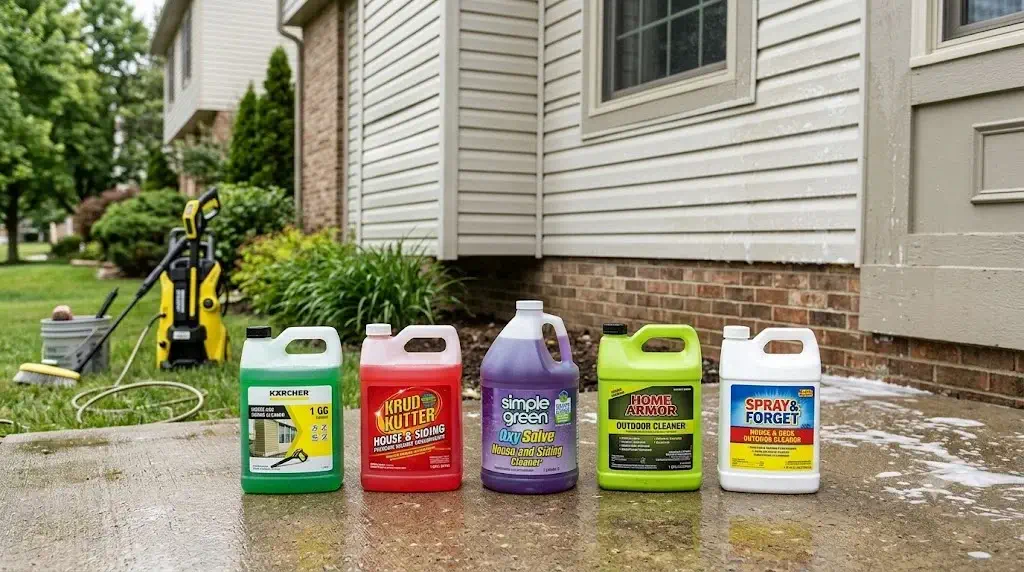
Best House Wash Detergent (2026)
Updated August 2026 • U.S. Buying Guide • Siding, Stucco, Brick, Wood & Painted Exteriors
The best house wash detergent is determined first by cladding chemical compatibility and contaminant makeup, not by raw caustic power alone. Selecting the best house wash detergent requires matching surfactant chemistry, active dilution yield, vertical dwell cling, and siphon delivery mechanics to your home’s specific exterior facade.
A vinyl-sided home with aggressive green algae requires a different cleaning approach from painted wood lap, porous acrylic stucco, unsealed red brick, or factory-enameled aluminum panels. Using the best house wash detergent allows your pressure washer to act as a gentle rinsing tool rather than an aggressive blaster that risks gouging boards or stripping paint.
For most residential siding applications, the best house wash detergent is a concentrated exterior siding wash engineered with high-cling wetting agents, dependable downstream injector dilution, and substrate safety. Applying the best house wash detergent lifts stubborn traffic films and organic mildew without compromising exterior paint binders, window weatherstripping, or perimeter landscaping.
Always verify your cladding manufacturer’s maintenance manual before choosing the best house wash detergent for your property. Major cladding producers mandate low-pressure chemical soft-washing techniques, warning that close-range high PSI can drive water behind weep holes, soak internal wall cavities, and void product warranties.
Quick Reference Specification: Best House Wash Detergent Formulations Tested
Direct engineering and chemical benchmark comparison of each best house wash detergent candidate across dwell time, chemical delivery, and cladding safety.
| Best House Wash Detergent | Working Chemistry | Typical Yield | Optimal Dwell | Application Method | Primary Substrate Match |
|---|---|---|---|---|---|
| Kärcher House and Siding | Mild Alkaline Builders | Makes 40 Gal/Jug | 5–10 Minutes | Downstream injector / soap tip | Vinyl siding, painted wood, fiber cement, gutters. |
| Krud Kutter House & Siding | Bleach-Free Spall-Gard | Makes 20 Gal/Jug | 3–5 Minutes | Pressure siphon / pump sprayer | Aluminum siding, painted wood, vinyl, stucco. |
| Simple Green Oxy Solve Siding | Active Peroxide Foam | Makes 11 Gal/Jug | 3–5 Minutes | Downstream tank / foam cannon | Weathered wood, vinyl, terra-cotta tile. |
| Home Armor Outdoor Cleaner | Fungicidal Surfactant | Covers 4,500 sq. ft. | 10 Minutes max | Low-pressure fan application | North-facing walls, heavy black algae, green moss. |
| Spray & Forget Outdoor Wash | Non-Caustic Biocide | Ready-to-Use Trigger | Extended (Rain-off) | Direct spray (No rinse) | Second-story trim, railings, shutters, spot mildew. |
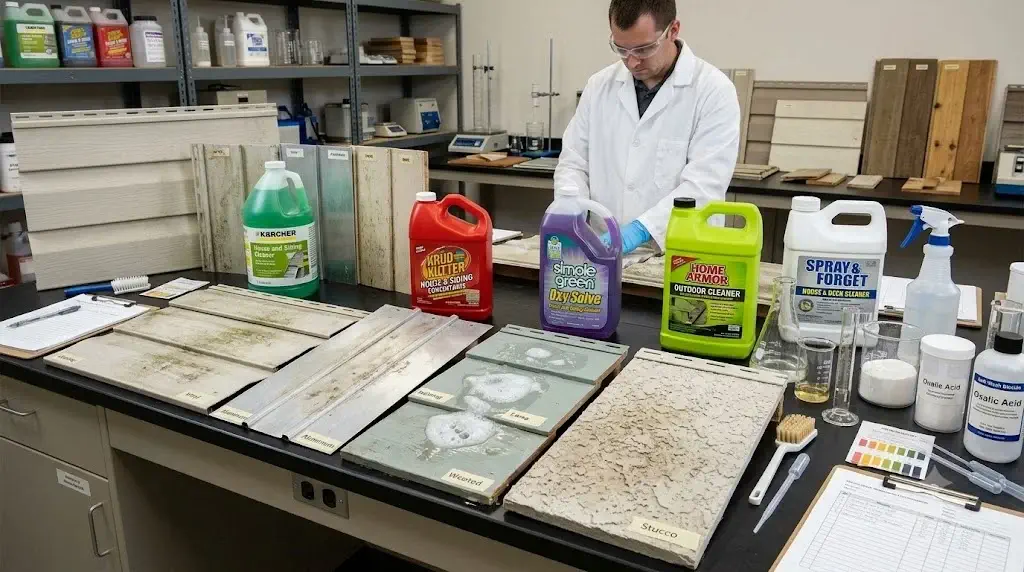
Best House Wash Detergents Categorized by Exterior Application
| Category | Selected Model | Best For | Primary Performance Advantage |
|---|---|---|---|
| Best Overall | Kärcher House and Siding Cleaner | General residential cladding | High 40:1 concentrate yield engineered for downstream injection and multi-surface versatility. |
| Best Bleach-Free Option | Krud Kutter House & Siding Concentrate | Homes with delicate landscaping | Non-bleach, eco-friendly surfactant matrix safe for pets, shrubs, and aluminum trim. |
| Best for Routine Maintenance | Simple Green Oxy Solve House and Siding | Vinyl, painted wood & stucco | Active effervescent micro-bubbles lift environmental road grime without caustic etching. |
| Best for Mold & Mildew | Home Armor Outdoor Cleaner Concentrate | Heavy green algae & black spots | Ruptures biological spore walls rapidly, eliminating slippery algae within 10 minutes. |
| Best No-Rinse Maintenance | Spray & Forget House & Deck Cleaner | Railings, shutters & spot treatment | Spray-and-leave biocide breaks down organic growth over time using natural rainfall. |
The ranking above is calibrated around vertical surface tension reduction and coating preservation rather than raw caustic power. Selecting the best house wash detergent ensures that your walls are thoroughly sanitized without etching protective coatings or clouding anodized aluminum trim.
Specialized House Wash Detergents Loosen Organic Biofilms Across Vertical Cladding Panels
The best house wash detergent utilizes specialized wetting surfactants, chelating mineral binders, and mild alkaline builders engineered specifically to penetrate vertical exterior claddings. Unlike non-porous glass or horizontal concrete driveways, vertical siding presents unique cleaning challenges: wash solutions quickly succumb to gravity runoff, while wind and solar heat cause rapid evaporation.
Homeowners frequently misidentify exterior cleaning products. Understanding how the best house wash detergent differs from other formulations prevents costly accidental surface damage:
| Product Class | Primary Active Chemistry | Intended Application Scope |
|---|---|---|
| Best House Wash Detergent | Amphiphilic surfactants & mild builders | Vertical vinyl, stucco, fiber cement, and painted wood siding. |
| Automotive Wash Soap | pH-neutral polymers & lubricity agents | Automotive clear coats; lacks strength to dissolve heavy house mildew. |
| Concrete Degreaser | High-alkaline solvents (pH 12+) | Porous concrete flatwork; will strip paint and burn vinyl siding. |
| Deck Cleaner / Brightener | Sodium percarbonate / Oxalic acid | Horizontal lumber and composite; unnecessary on synthetic siding. |
| Roof Cleaner / Algaecide | Concentrated sodium hypochlorite (3–4%) | Asphalt shingles; requires strict isolation from siding to prevent run marks. |
Amphiphilic Surfactants Lower Water Surface Tension to Emulsify Airborne Environmental Grime
The best house wash detergent breaks the electrostatic bond between vertical cladding panels and airborne environmental pollution. Water alone has high surface tension (approximately 72 dynes/cm), causing it to bead up and run off vertical vinyl or wood siding without wetting the grime beneath; adding amphiphilic surfactants drops surface tension below 30 dynes/cm, allowing the solution to spread into a continuous sheeting film.
By chemically softening electrostatically bound grime, the best house wash detergent eliminates the need for dangerous close-range pressure washing. Gentle low-pressure rinsing carries suspended dirt off the wall without lifting siding seams or blowing water behind flashing.
Cladding Substrates Exhibit Divergent Chemical Tolerances Across Synthetic and Masonry Panels
Selecting the best house wash detergent requires analyzing your home’s substrate physical properties to prevent irreversible cosmetic etching. Vinyl expands and contracts under heat, painted wood requires moisture control, acrylic stucco traps moisture within aggregate voids, and aluminum claddings suffer from chalky surface oxidation.
| Cladding Substrate | Best House Wash Detergent Base | Critical Structural Risk |
|---|---|---|
| Vinyl Siding | Alkaline surfactant / Oxygen foam | Water intrusion behind lap seams if sprayed at upward angles. |
| Aluminum Siding | Bleach-free neutral wash | Harsh alkalis etch oxidized paint, leaving chalky white streaks. |
| Painted Wood Lap | Gentle bio-surfactant | High pressure shears loose paint films and drives moisture into bare wood. |
| Synthetic Stucco (EIFS) | Mild foaming masonry wash | Pressure gouging tears the exterior finish coat and saturates foam backing. |
| Brick & Mortar | Masonry-compatible surfactant | Concentrated pressure wands blow out soft or historic lime mortar joints. |
| Fiber Cement (Hardie) | pH-balanced house cleaner | Excessive mechanical force damages factory-applied baked acrylic coatings. |
Tested House Wash Concentrates Meet Rigorous Exterior Maintenance Performance Benchmarks
Evaluating each best house wash detergent contender across real-world residential facades reveals five standout products matched to specific exterior cladding profiles.
Best Overall
Kärcher House and Siding Pressure Washer Cleaner
HomeGearMax Rating: 9.7/10
Recognized as the best house wash detergent for general residential homes, Kärcher House and Siding Cleaner yields an impressive 40 gallons of working wash solution from a single concentrate jug. It breaks down traffic film, tree pollen, and organic mildew across vinyl, aluminum, wood, stucco, brick, and gutters without requiring caustic additives.
Why It Ranks First
- Massive 40:1 dilution ratio makes it the best house wash detergent for overall square-foot value.
- Biodegradable, non-corrosive chemistry protects pressure washer pump valves and brass fittings.
- Cleans mixed residential facades (vinyl siding, gutters, brick water-tables, and soffits) seamlessly.
- Optimized viscosity flows through downstream injectors without clogging siphon screens.
- Rinses spot-free under low pressure, leaving zero chalky surfactant film on exterior window glass.
Pros
- Unmatched 40-gallon working yield
- Safe on multiple building surfaces
- Pump-safe non-corrosive blend
- Streak-free window rinsing
Cons
- Severe green algae needs extended dwell
- Slightly thin vertical foam profile
Best Bleach-Free Option
Krud Kutter House & Siding Pressure Washer Concentrate
HomeGearMax Rating: 9.6/10
As the best house wash detergent for homes surrounded by sensitive shrubs, Krud Kutter House & Siding Concentrate uses biodegradable, bleach-free Spall-Gard technology. One gallon mixes to yield up to 20 gallons of working solution, treating up to 5,800 sq. ft. of vinyl, aluminum siding, gutters, roofing, and stucco.
Why It Ranks Highly
- 100% bleach-free, non-toxic formula safeguards foundation flowers, landscaping, and pets.
- Treats up to 5,800 sq. ft. per container, providing high square-foot coverage.
- Formulated to lift tough stains caused by mildew, mold, algae, fungus, and environmental moss.
- Contains anti-corrosive agents that protect aluminum siding paint from chalking.
- Works equally well through pressure washer detergent reservoirs or manual pump sprayers.
Pros
- 100% bleach-free safety
- Large 5,800 sq ft coverage
- Gentle on ornamental plants
- Effective on oxidized aluminum
Cons
- Must not dry on siding (rinse fast)
- Heavier bottle than powder concentrates
Best for Routine Maintenance
Simple Green Oxy Solve House and Siding Cleaner
HomeGearMax Rating: 9.5/10
Frequently rated as the best house wash detergent for regular spring cleaning, Simple Green Oxy Solve House and Siding Cleaner releases active micro-bubbles to lift environmental grime, chimney soot, and pollen without caustic soda or acids. Making up to 11 gallons of wash solution to cover up to 3,300 sq. ft., it meets strict EPA Safer Choice standards for residential safety.
Why It Ranks Highly
- Peroxide action foams actively across vinyl, aluminum siding, stucco, and painted wood.
- EPA Safer Choice certified formula guarantees non-toxic environmental breakdown.
- Rapid 3 to 5 minute dwell time speeds up overall whole-house washing workflows.
- Non-caustic chemistry will not strip exterior latex house paints or damage window screens.
- Lifts tough tree sap, pollen film, and road dust without requiring abrasive scrubbing.
Pros
- Fast-acting peroxide lift
- EPA Safer Choice certified
- Non-caustic and non-acidic
- Rapid 3-5 minute dwell
Cons
- Covers 3,300 sq ft (smaller yield)
- Ineffective on deep black lichen roots
Best for Mold & Mildew
Home Armor Outdoor Cleaner Concentrate
HomeGearMax Rating: 9.4/10
For properties plagued by biological discoloration, the best house wash detergent is Home Armor Outdoor Cleaner Concentrate, which provides rapid, no-scrub chemical eradication. Its powerful biocide formula breaks down spore cell structures within 10 minutes, allowing operators to rinse away years of organic neglect using low water pressure.
Why It Ranks Highly
- Targeted biocide action kills green algae, moss, and fungal spores at the microscopic root level.
- Zero scrubbing required on heavy organic growth—spray on, dwell 10 minutes, and rinse clean.
- Restores heavily shaded north-facing siding, brick chimneys, and painted soffits quickly.
- Delivers visible bleaching of dark fungal pigments within minutes of surface contact.
- Concentrated formula treats large residential exteriors when diluted through pump garden sprayers.
Pros
- Instant 10-minute spore kill
- No scrubbing required
- Eradicates deep black mold
- Ideal for north-facing walls
Cons
- Strong bleach odor requires masks
- Demands thorough landscape pre-wetting
Best No-Rinse Maintenance
Spray & Forget Ready-to-Use House & Deck Outdoor Cleaner
HomeGearMax Rating: 9.1/10
For homeowners seeking ongoing, effortless upkeep on high architectural details, the best house wash detergent is Spray & Forget Ready-to-Use Cleaner, which eliminates scrubbing and rinsing entirely. This non-caustic biocide formula bonds to vertical cladding, breaking down biological growth over time as natural rainfall washes dead spores away.
Why It Ranks Highly
- Zero scrubbing or high-pressure rinsing required—simply spray onto dry surfaces and let weather complete the process.
- Non-bleach, eco-friendly biocide prevents color fading on painted wood, vinyl trim, and brick veneers.
- Ideal for regular seasonal treatment on elevated second-story gables, roof fascia, and decorative shutters.
- Convenient ready-to-use trigger spray bottle tackles localized mold spots without mixing buckets or running pressure hoses.
- Delivers residual protection that prevents new algae, moss, and lichen spores from gaining a foothold.
Pros
- Completely scrub-free and rinse-free
- No pressure washer setup needed
- Long-term preventative residual
- Safe on painted trims and brick
Cons
- Results take several weeks of rain
- Cannot remove immediate road mud or grease
Vinyl Claddings Benefit from Mild Surfactants Applied at Controlled Low Hydraulic Pressures
Applying the best house wash detergent for vinyl siding protects polyvinyl chloride (PVC) profiles featuring loose interlocking seams with integrated weep holes designed for natural condensation drainage. When an operator directs high-pressure water upward under vinyl panels, water bypasses flashing and floods internal wood framing, creating hidden mold reservoirs inside wall cavities.
Washing vinyl siding requires relying on chemical action rather than high water pressure. Applying the best house wash detergent for vinyl from the bottom upward allows the chemicals to dissolve road film and pollen, requiring only a gentle top-down rinse from at least 3 feet away to wash the grime clean.
Aluminum Siding Suffers from Photo-Chemical Chalking That Demands Non-Caustic Detergents
Decades of intense solar ultraviolet radiation degrade factory enamel coatings on aluminum siding, creating a powdery layer of oxidized white pigment known as chalking. Introducing harsh caustic chemicals or high-pressure spray tips unevenly strips this chalk layer, leaving permanent, discolored lap marks across the entire wall.
Painted Wood Siding Requires Gentle Wetting to Safeguard Delicate Acrylic Resin Films
Exterior acrylic latex house paints form a micro-thin, flexible protective film over natural cedar, redwood, or pine clapboards. Blasting painted wood with high pressure or harsh caustic chemicals shears micro-cracks in the paint layer, forcing moisture deep into timber vascular pores and causing subsequent paint blistering, peeling, and wood rot.
For painted wood surfaces, deploy the best house wash detergent for wood such as Simple Green Oxy Solve using low-pressure chemical nozzles. Keep water pressure under 800 PSI, maintaining a wide 40° fan spray pattern to flush loosened surface dirt without disturbing the paint’s underlying adhesion layer.
Porous Stucco Textures Entrap Atmospheric Airborne Soot Inside Aggregate Fissures
Traditional cementitious stucco and synthetic EIFS (Exterior Insulation and Finish Systems) feature rough, pebbled aggregate finishes that act like microscopic filters, trapping road soot, vehicle exhaust, and mold spores. Because stucco is naturally porous, aggressive mechanical scrubbing or narrow pressure washer nozzles can easily gouge and dislodge the textured finish coat.
Effective stucco decontamination relies on using the best house wash detergent with foaming agents that cling to vertical aggregate crevices for 8 to 10 minutes. The active foam emulsifies embedded soot deposits, which are then rinsed away using a gentle wide-fan sweep held at a consistent 45-degree angle to avoid water penetration into structural hairline cracks.
Masonry Mortar Joints Weaken Under Acidic Attack and Require Buffered Surfactants
Exterior brick facades withstand significant weather exposure, but their structural mortar joints are vulnerable to chemical erosion. Unbuffered acid cleaners dissolve the calcium carbonate binder in cement mortar, turning joints sandy, crumbly, and prone to water leaks.
For routine residential brick washing, use an alkaline formulation recognized as the best house wash detergent for masonry to break down organic moss and dirt films. Reserve specialized acidic cleaners strictly for treating white mineral efflorescence or new construction mortar smears, and thoroughly pre-saturate brick with fresh water to prevent chemical absorption into dry clay cores.
Biological Organisms Proliferate Rapidly Across Shaded North-Facing Siding Elevations
Black mold, green algae (Gloeocapsa magma), and lichens anchor their cellular root systems inside cladding micro-fissures, feeding on humidity, airborne moisture, and organic dust. Merely blasting biological growth with high-pressure water shears off the visible surface slime while leaving microscopic spore roots alive inside the siding, leading to rapid regrowth within weeks.
Deploying the best house wash detergent for mildew breaks down fungal spore proteins, neutralizing biological growth at the cellular root level. Once neutralized, the dead organic residue rinses away easily under low pressure, keeping home siding clean up to four times longer than pressure washing with plain water.
Downstream Chemical Injectors Protect Internal High-Pressure Pump Valves from Corrosion
Professional exterior house washing utilizes downstream chemical injection, introducing the best house wash detergent into the water line after the high-pressure pump rather than pulling soap into the pump manifold. This isolates the pressure washer’s brass pistons, unloader valve, and ceramic seals from corrosive cleaning chemicals.
Critical equipment parameters for soft-washing siding:
- Downstream Injector: Siphons the best house wash detergent concentrate at fixed 10:1 to 20:1 ratios when low-pressure soap tips are engaged.
- Soap Application Nozzle: Wide-bore brass or plastic black soap nozzle (65° fan) drops line pressure below 250 PSI to activate the siphon.
- Soft-Wash Rinse Tip: 25° green or 40° white nozzle held at a safe 3 to 4 foot working distance for rinsing.
- Ergonomic Spray Gun: Use a commercial-grade spray trigger from our best pressure washer guns testing guide to minimize hand strain during multi-story washing.
Chemical Concentration Levels Determine Storage Space and Cost Per Cleaned Square Foot
Purchasing pre-diluted ready-to-use house wash means paying primarily for shipping water weight. Using a concentrated best house wash detergent formula yields up to 40 gallons of working solution per single jug, providing significant packaging savings and allowing operators to calibrate dilution based on siding soiling levels.
For large suburban two-story homes (2,500 to 4,500 sq. ft. of wall area), high-yield concentrates such as Kärcher or Krud Kutter offer the most cost-effective solution, providing sufficient cleaning volume to wash all four elevations without requiring mid-project supply runs.
Accurate Coverage Calculations Depend on Stated Dilution and Vertical Surface Drag
Comparing the best house wash detergent options by container price alone is misleading. A $25 gallon of concentrate that yields 40 gallons of working solution and cleans 5,000 square feet costs just $0.005 per square foot, whereas an inexpensive $12 bottle that covers only 1,000 square feet costs more than double to use.
Always review manufacturer dilution specifications and real-world square foot yields before purchasing, ensuring your chemical investment matches the square footage of your exterior facade.
Chemical Delivery Hardware Influences Final Surface Surfactant Concentrations Directly
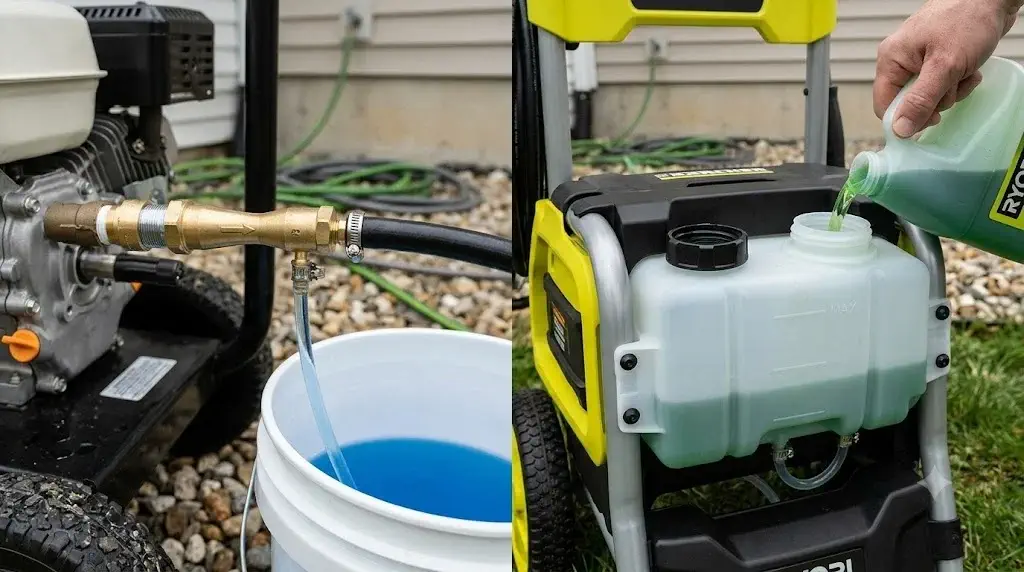
The physical delivery mechanism determines the actual chemical ratio that contacts vertical siding. Onboard plastic detergent tanks rely on internal pump vacuum, limiting chemical options to mild formulas that won’t damage pump seals.
Downstream brass venturi injectors tap into the high-pressure hose outlet, creating a vacuum that draws the best house wash detergent directly from a 5-gallon pail into the low-pressure water stream. This setup prevents chemical backflow into the pump, allows rapid switching between soap and rinse nozzles at the spray gun, and keeps equipment operating smoothly.
Aerated Foam Volume Operates as a Chemical Carrier Rather than a Metric of Cleaning Power
Dense foam blankets often contain disproportionate ratios of trapped air relative to active chemical surfactants. While thick lather looks impressive on camera, overly thick foam can slide off vertical vinyl siding under its own weight, pulling active surfactants off the wall prematurely.
The best house wash detergent often produces a thin, velvety sheeting film that wets the surface evenly rather than ultra-thick suds. Focus on finding formulas with reliable surface dwell times that keep active ingredients working on grime rather than judging a cleaner by bubble thickness alone.
Working Pressure Settings Must Remain Below 1,200 PSI to Eliminate Cladding Damage
Residential pressure washers frequently generate 2,800 to 4,000 PSI—pressure levels designed for stripping concrete and preparing industrial metal. Directing this intense pressure at residential siding can crack vinyl panels, peel exterior paint, puncture window screens, and blow out perimeter caulk seals.
Pairing the best house wash detergent with soft-washing protocols limits working surface pressure to between 300 and 800 PSI, using wide 40° white tips or specialized long-distance soap nozzles held 3 to 4 feet away. The detergent dissolves the grime, allowing gentle water flow to rinse the wall clean safely.
Fluid Water Flow Volume Controls Rinsing Speed and Evacuates Suspended Dirt Slurry
While PSI represents hydraulic impact force, Gallons Per Minute (GPM) represents the cleaning volume that flushes dirt off the house. A machine producing 1.2 GPM requires excessive sweeping passes to rinse a two-story wall, increasing the risk that detergent dries on upper panels.
A pressure washer delivering 2.5 to 4.0 GPM flushes dislodged silt, dead algae, and soap residue four times faster than low-flow units, helping prevent dry streaks and cutting total project time in half. For large multi-story homes, prioritizing GPM over peak PSI is the best way to improve exterior washing productivity.
Systematic Bottom-Up Application and Top-Down Rinsing Prevent Unsightly Siding Streaks
Following a disciplined, section-by-section washing workflow prevents premature detergent drying, eliminates vertical chemical streaks, and ensures thorough decontamination across every wall elevation.
Natural Wood Shingles and Cladding Demand Controlled Non-Caustic Detergents
Exterior cedar shake shingles, board-and-batten sidings, and architectural wood claddings contain natural extractives and vascular cellulose pores that react poorly to harsh synthetic chemicals. Applying aggressive vinyl siding cleaners containing caustic lye can permanently blacken cedar tannins and break down wood lignin binders.
When washing natural wood claddings, use specialized oxygenated wood cleaners or mild bleach-free bio-surfactants recognized as the best house wash detergent for timber. Always rinse strictly parallel to the wood grain at low pressures (under 800 PSI), allowing the timber to dry completely before applying protective stains or sealers.
Roof Cleaning Chemicals Differ Structurally from Exterior Wall Siding Formulations
Asphalt fiberglass roof shingles are coated with ceramic granules designed to shield the asphalt base from UV solar radiation. Even the best house wash detergent lacks the chemical strength to eradicate stubborn Gloeocapsa magma roof algae, while high pressure dislodges the protective ceramic granules, shortening roof lifespan.
Roof cleaning requires specialized soft-wash equipment that applies stronger biocide mixes (3% to 4% sodium hypochlorite) at garden-hose pressures under 100 PSI. Never apply high-pressure water wands to asphalt roofs, and always rinse siding thoroughly if strong roof cleaning chemicals run down exterior walls.
Exterior Gutter Tiger Striping Demands Electrostatic Surfactants for Complete Removal
Dark vertical streaks on aluminum gutters—commonly called “tiger striping”—occur when airborne asphalt oils and roof tannins wash over gutter lips, bonding electrostatically to the aluminum enamel under solar heat. Standard house wash soaps often fail to break this chemical bond.
Lifting tiger stripes requires a specialized butyl-based exterior cleaner or non-caustic citrus degreaser applied directly to gutter faces. Agitating gently with a soft-bristle extension brush breaks the electrostatic grip, allowing dirt to rinse away without stripping the underlying gutter paint.
Improper Spray Trajectories and Wand Proximity Cause Severe Facade Water Damage
- Spraying Upward Under Siding Seams: Directing pressurized water upward forces moisture behind vinyl panels and into interior insulation.
- Using Pinpoint 0° Red Nozzle Tips: Needle-thin pressure streams instantly slice through vinyl, scar wood, and shatter window seals.
- Letting Chemical Detergents Dry on Walls: Surfactants that dry under hot sun bake onto siding, leaving cloudy white chemical residue.
- Using Dishwashing Liquid: Household dish soaps contain high-foaming agents that cause pump cavitation and lack mildew-fighting biocides.
- Operating Too Close to the Surface: Holding the spray wand closer than 18 inches strips paint and damages cladding finishes.
- Skipping Landscape Pre-Soaking: Applying chemicals near dry foundation plantings allows roots to quickly absorb toxic overspray.
- Washing Hot Siding in Direct Midday Sun: High surface heat accelerates chemical evaporation, causing premature drying and streaking.
- Applying Soap from the Top Down: Spraying detergent downward creates vertical drip channels that leave permanent streak marks.
- Neglecting Safety Goggles: Caustic detergents and chemical mist blow back easily in gusty outdoor winds.
- Relying on Pressure Instead of the Best House Wash Detergent: Using high pressure instead of proper chemical dwell tears up siding and increases fatigue.
Targeted Chemical Formulations Direct Homeowners to the Optimal House Wash Solution
Selecting the best house wash detergent begins by matching chemical properties to your home’s exterior cladding and specific cleaning challenges.
Technical Evaluation Weights Reveal Key Chemical Drivers of Exterior Restoration
Evaluating the best house wash detergent requires weighing chemical properties alongside equipment parameters to identify the factors that directly impact cleaning efficacy and building preservation.
| Evaluation Parameter | Operational Role | Importance Level |
|---|---|---|
| Substrate Compatibility | Prevents paint stripping, vinyl warping, and aluminum chalking | Critical |
| Vertical Dwell Stability | Keeps active surfactants working on grime before gravity runoff | Critical |
| Downstream Siphon Flow | Draws smoothly through chemical injectors without pump damage | Critical |
| Fluid Water Volume (GPM) | Flushes loosened dirt slurry completely off walls and gutters | High |
| Biodegradability & Turf Safety | Protects foundation landscaping and lawn turf from chemical burns | High |
| Square-Foot Dilution Yield | Determines real-world chemical cost across large properties | High |
| Peak Water Pressure (PSI) | Supplies mechanical rinsing force (strictly capped under 1,000 PSI) | Medium |
Personal Protective Equipment and Landscape Pre-Soaking Eliminate Chemical Hazards
Even the best house wash detergent options, alkaline builders, and fungicidal solutions require proper handling to prevent eye irritation, chemical burns, or accidental landscape damage during washing.
Critical Safety and Handling Protocols:
- Wear Wrap-Around Eye Goggles & Gloves: Protects eyes from airborne chemical mist and overspray blown by wind gusts.
- Pre-Wet All Nearby Landscaping: Saturate perimeter grass, flowers, and foundation shrubs with fresh water before, during, and after washing to dilute chemical runoff.
- Never Mix Incompatible Chemicals: Combining bleach solutions with ammonia or acidic cleaners releases toxic chloramine gases.
- Tape Over Exterior Outlets & Fixtures: Seal exterior electrical outlets, doorbells, and outdoor light fixtures with plastic and painters tape before spraying water.
Frequently Asked Questions
What is the best house wash detergent?
For most homeowners, the best house wash detergent is a dedicated house-and-siding concentrate like Kärcher or Krud Kutter because it is formulated specifically for exterior building surfaces and integrates smoothly with pressure washer siphon systems.
What is the best detergent for pressure washing a house?
The best house wash detergent for pressure washers is an exterior siding concentrate designed for downstream injectors, protecting internal pump components while providing sufficient vertical dwell time.
What detergent removes mildew from house siding?
The best house wash detergent for mildew is a fungicidal formulation such as Home Armor Outdoor Cleaner that eradicates mold hyphae at the root level rather than just washing surface soot.
What is the best house wash detergent for vinyl siding?
The best house wash detergent for vinyl siding is a non-caustic, neutral or oxygenated formula that lifts grime safely without damaging the vinyl’s factory plasticizers or UV inhibitors.
Can I use pressure washer soap on house siding?
Yes, provided it is explicitly labeled as the best house wash detergent for your specific cladding material. Always confirm siding manufacturer instructions before washing.
Can I use dish soap in a pressure washer?
No. It is far better to use the best house wash detergent engineered for exterior equipment. Household dish soaps create excessive foaming that can damage pumps and leave stubborn streak films.
Does more foam mean a better house wash detergent?
No. Foam is primarily a visual carrier. The best house wash detergent prioritizes active surfactant wetting tension, chemical dwell, and clean rinsing over sheer foam thickness.
How long should house wash detergent sit?
Follow the manufacturer’s specified dwell time. The best house wash detergent typically requires 3 to 8 minutes of wet contact time before low-pressure rinsing.
Should you apply house wash detergent from top to bottom?
Professional cleaners always apply the best house wash detergent from the bottom upward to prevent dry runoff streaking, followed by thorough rinsing from the top downward.
Balancing Chemical Compatibility with Controlled Pressure Protects Home Value
For the vast majority of homeowners, finding the best house wash detergent requires selecting the proper chemical formulation for your home’s exterior cladding rather than relying on raw water pressure.
For multi-surface residential siding, Kärcher House and Siding Cleaner remains the best house wash detergent for overall economy with its 40-gallon yield and multi-surface versatility. If your home is framed by delicate landscaping or features oxidized aluminum trim, Krud Kutter House & Siding Concentrate is the best house wash detergent for proven bleach-free safety. For routine spring maintenance across vinyl, wood, or stucco, Simple Green Oxy Solve lifts road film with active peroxide action, while Home Armor Outdoor Cleaner stands as the best house wash detergent to quickly eradicate persistent green algae and black mold blooms. When maintaining second-story trim and hard-to-reach gables without high-pressure equipment, Spray & Forget Outdoor Cleaner provides continuous, weather-activated protection.
