
What Is the Best Pressure Washer for Home Improvement?
The best pressure washer for home improvement is a versatile machine with enough working pressure and water flow for concrete and exterior cleaning, but enough control to safely handle siding, decks, fences, patios, and vehicles.
For most homeowners, the sweet spot is not the pressure washer with the biggest PSI number. A better choice balances working PSI, GPM, electrical or engine power, pump design, nozzle selection, portability, hose length, duty cycle, and the surfaces you actually plan to clean.
If your home-improvement workload includes driveways, sidewalks, patios, fences, and siding, a high-output electric pressure washer is an excellent all-around option when electrical access is available. For tested recommendations, explore our guide to the best electric pressure washers. If you regularly clean very large concrete areas or need long periods of sustained operation, a gas pressure washer can make more sense.
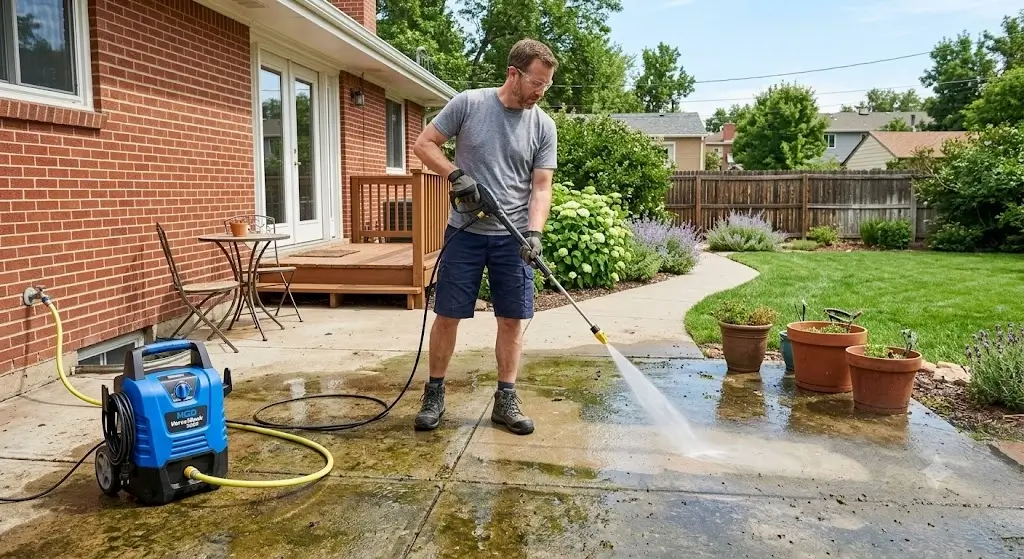
This guide evaluates pressure washers by real-world home-improvement requirements rather than ranking machines solely by advertised maximum PSI. The objective is to match hydraulic output and machine design to the job.
Quick Answer: Which Pressure Washer Is Best for Home Improvement?
For the typical U.S. homeowner, the best all-around home-improvement pressure washer is a mid- to high-output electric model with useful flow, appropriate working pressure, and good accessory compatibility.
A practical target is a machine capable of handling routine residential cleaning while giving you enough hydraulic output for concrete, patios, and other hard surfaces. If your projects routinely involve large driveways, extensive concrete, or prolonged operation, step up to a higher-flow machine or consider gas.
The most important specifications to compare are:
- Working PSI rather than peak PSI alone.
- GPM because water flow affects cleaning speed.
- PSI × GPM (Cleaning Units) as a simple hydraulic-output comparison.
- Motor or engine design.
- Pump construction.
- Nozzle and surface-cleaner compatibility.
- Duty cycle for larger projects.
What Does “Home Improvement” Mean for a Pressure Washer?
“Home improvement” covers a much wider range of pressure-washing jobs than simply washing a car. A homeowner may use the machine to prepare a deck for staining, clean a concrete driveway before sealing, remove dirt from siding before exterior painting, clean a patio, wash fences, restore outdoor furniture, or remove loose debris from masonry.
Those jobs do not all require the same pressure. That is why a pressure washer for home improvement should be selected as a multi-surface tool, not as a machine optimized for one maximum-pressure task.
Driveways, sidewalks, concrete patios, and masonry generally benefit from more useful hydraulic output.
Decks and fences require pressure control to reduce the chance of gouging or damaging the surface.
Siding needs controlled spray pressure and appropriate technique.
Cars require substantially more care than concrete because paint and trim can be damaged by improper pressure or spray technique.
Best Pressure Washer Type for Home Improvement
There are three broad choices for residential pressure washing: corded electric, gas-powered, and battery-powered.
| Type | Best Use | Advantages | Limitations |
|---|---|---|---|
| Corded Electric | Most routine residential projects | Low maintenance, convenient starting, relatively quiet, no gasoline | Requires suitable electrical access and is limited by electrical power |
| Gas | Large surfaces and heavy-duty work | Higher sustained output and no electrical cord | Fuel, engine maintenance, noise, and exhaust |
| Battery | Small jobs and portability | Highly portable and no power cord | Limited runtime and generally lower sustained output |
Best Overall: High-Output Electric Pressure Washer
For many homeowners, a high-output electric pressure washer provides the best compromise between capability and ownership simplicity. Modern electric machines can provide enough pressure for many residential surfaces while avoiding gasoline-engine maintenance. For a detailed breakdown of benefits and trade-offs, read our guide on whether electric pressure washers are a good choice.
This makes them particularly attractive when the machine will be used for a mixture of patios, walkways, siding, fences, furniture, vehicles, and moderate concrete cleaning. The limitation is electrical input: a residential electric machine cannot simply create unlimited hydraulic power due to motor input, current limits, pump efficiency, and system losses.
Do not compare a small electric pressure washer with a gas machine solely by the maximum PSI printed on the packaging. Look at working pressure and GPM together.
Best Gas Pressure Washer for Heavy Home Improvement
A gas pressure washer becomes more attractive when the homeowner’s projects involve large areas and long cleaning sessions. Gas machines can deliver greater sustained hydraulic output because the engine is not constrained by a typical residential electrical circuit in the same way a corded electric machine is.
This can make a substantial difference when cleaning large concrete driveways, extensive walkways, large patios, or other surfaces where cleaning speed matters. The trade-off is greater ownership complexity: fuel, engine oil, spark plugs, fuel-system maintenance, winter storage, and engine noise all become part of ownership.
PSI vs. GPM: The Most Important Pressure Washer Decision
Two specifications dominate pressure-washer discussions: PSI and GPM. PSI (pounds per square inch) describes pressure, while GPM (gallons per minute) describes water flow. Pressure provides force at the spray surface, while water flow determines how much water is moving through the system.
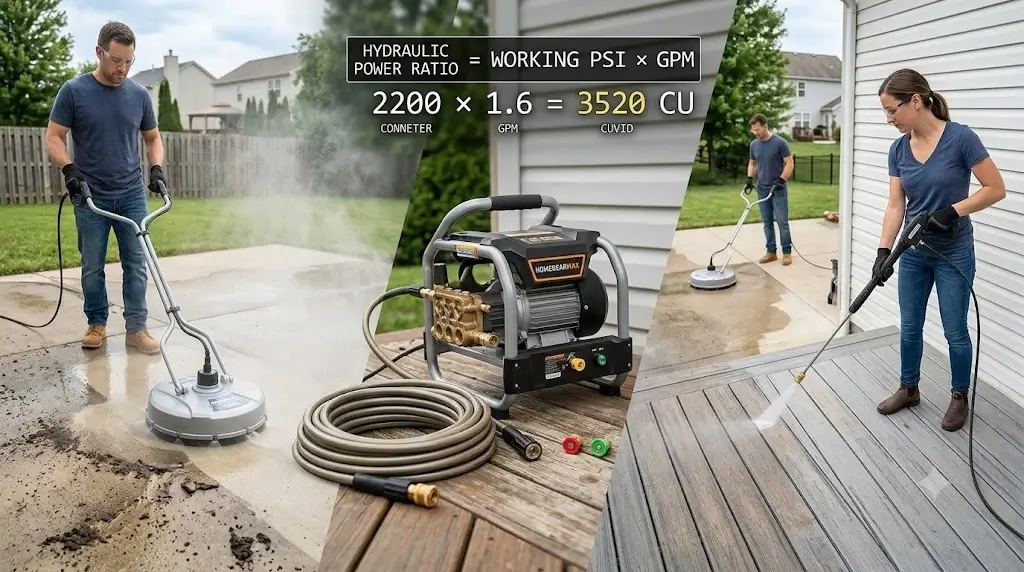
Cleaning Units (CU) = Working PSI × Delivered GPM
For example, a hypothetical machine delivering 2,000 PSI at 1.5 GPM produces:
2,000 PSI × 1.5 GPM = 3,000 CU
This is not a complete measurement of real cleaning performance, but it provides a useful way to understand why PSI alone is insufficient.
Why GPM Matters So Much for Home Improvement
GPM becomes especially important when the surface is large. Imagine cleaning a small patio and then cleaning an entire driveway. The patio may not expose the limitations of a low-flow machine because the total area is small.
On a large driveway, however, the operator must remove and rinse dirt over a much greater area. Higher useful flow can improve productivity. This is one reason two machines with similar PSI ratings can produce very different real-world cleaning times.
Why Peak PSI Should Not Decide Your Purchase
Pressure-washer manufacturers do not always present pressure ratings in identical ways. A maximum or peak PSI number may describe a condition that does not represent the pressure maintained during normal cleaning.
For an informed comparison, prioritize:
- Working PSI.
- Operating GPM.
- Independent certification when available.
- Pump design.
- Electrical input or engine capacity.
- Actual intended application.
A machine with a lower headline PSI and higher useful flow can be more productive on a large surface than a machine with a much higher headline PSI and very low flow. Consult our main pressure washer buying guide for full evaluation benchmarks.
Recommended Pressure Range by Home-Improvement Job
| Job | Typical Starting Range | Primary Concern |
|---|---|---|
| Vehicle washing | Moderate pressure (1,000–1,400 PSI) | Surface safety and spray control |
| Outdoor furniture | Moderate pressure (1,200–1,500 PSI) | Material sensitivity |
| Vinyl siding | Moderate pressure (1,300–1,600 PSI) | Avoiding water intrusion and surface damage |
| Wood deck | Low to moderate pressure (1,000–1,400 PSI) | Preventing wood-fiber damage |
| Fence | Low to moderate pressure (1,200–1,500 PSI) | Wood condition and spray distance |
| Brick patio | Moderate to higher pressure (1,800–2,200 PSI) | Mortar condition |
| Concrete walkway | Moderate to higher pressure (2,000–2,500 PSI) | Cleaning speed and evenness |
| Concrete driveway | Higher useful output (2,500–3,200+ PSI) | PSI + GPM + surface-cleaner compatibility |
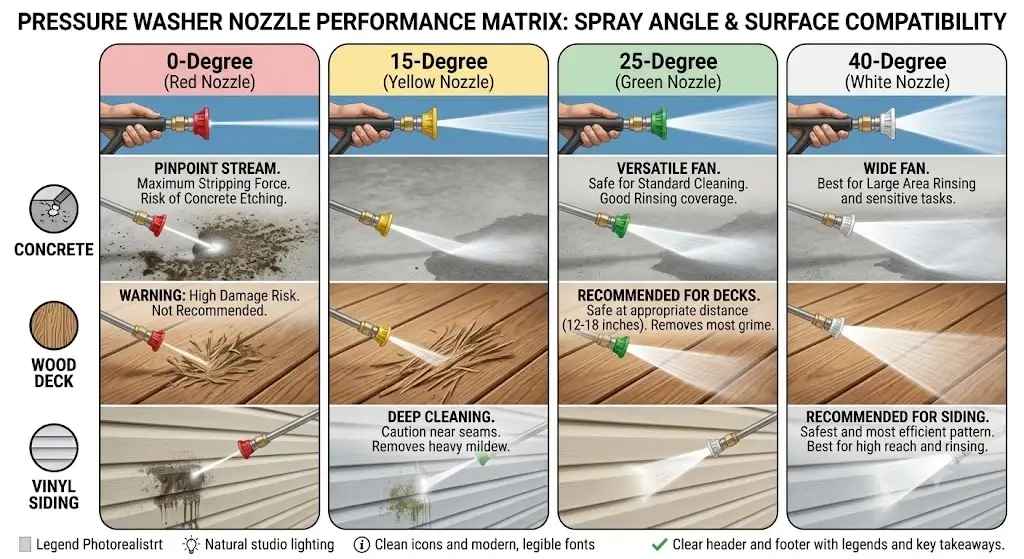
Surface age, coating condition, material hardness, nozzle angle, spray distance, and contamination level can change the appropriate pressure substantially.
Best Pressure Washer for Driveway Cleaning
For driveway cleaning, prioritize working pressure, GPM, and surface-cleaner compatibility. Concrete is much more tolerant of pressure than automotive paint or soft wood, but that does not mean maximum pressure is always the best approach.
A surface cleaner can produce a more uniform result than a narrow spray tip because it distributes the cleaning action across a controlled area. For large driveways, GPM becomes particularly important because it affects how quickly you can move through the surface.
Best Setup for a Concrete Driveway
- Pressure washer with useful working pressure (2,200–3,000+ PSI).
- Enough GPM to maintain reasonable cleaning speed (≥ 1.5 GPM).
- Surface cleaner sized appropriately for the machine’s flow (typically 4 inches per 1 GPM).
- Correct nozzle orifice.
- Long enough high-pressure hose.
- Suitable detergent when needed.
Best Pressure Washer for Deck Cleaning
Deck cleaning is different from driveway cleaning because wood can be damaged by concentrated pressure. A powerful machine can still be useful, but the operator should use the appropriate nozzle, stand farther away when necessary, and keep the spray moving.
The objective is to remove contamination without cutting into the wood fibers. If the deck will later be stained or sealed, even cleaning is more important than simply maximizing pressure.
Best Pressure Washer for Composite Decking
Composite decking varies by manufacturer and product generation. Some composite materials tolerate pressure washing well, while aggressive cleaning can damage the surface or create visible differences in texture. Always follow the decking manufacturer’s cleaning instructions. For general maintenance, prioritize a pressure washer that offers good control rather than extreme output.
Best Pressure Washer for Siding
For vinyl and similar siding, the pressure washer should be treated as a controlled cleaning tool rather than a paint stripper. Use an appropriate spray pattern and avoid directing water upward into seams, vents, or openings. The machine should provide enough pressure to remove surface contamination without requiring the operator to hold the nozzle dangerously close to the siding.
Best Pressure Washer for Fences
Fence cleaning often involves wood, paint, or older coatings. A moderate-pressure approach is generally safer than immediately using the narrowest, highest-pressure nozzle. Older wood deserves particular caution because weathered fibers can be much easier to damage.
Best Pressure Washer for Patio Cleaning
For concrete or masonry patios, an electric pressure washer with useful flow is often sufficient for residential work. For large patios, a surface cleaner can improve consistency and reduce visible striping. For stone or delicate masonry, check the material manufacturer’s cleaning guidance before using high pressure.
Best Pressure Washer for Home Exterior Cleaning
A versatile home-exterior machine should handle vinyl siding, brick, concrete, fences, patios, outdoor furniture, and walkways. This is why an adjustable and accessory-friendly pressure washer can be more useful than a machine designed around one maximum-pressure specification.
Best Pressure Washer for Preparing a House for Painting
Pressure washing can help remove dirt, mildew, and loose surface contamination before exterior painting, but the pressure washer should not be treated as a substitute for proper surface preparation. Loose paint, damaged coatings, and substrate defects still need to be handled appropriately. The best machine for this job is one that provides enough cleaning force while allowing controlled spraying around windows, trim, vents, and vulnerable areas.
Electric vs. Gas for Home Improvement
| Factor | Electric | Gas |
|---|---|---|
| Routine homeowner use | Excellent | Good |
| Car washing | Excellent | Good with careful control |
| Small patio | Excellent | More power than necessary for many users |
| Small driveway | Very good | Excellent |
| Large driveway | Good to very good depending on model | Excellent |
| Large concrete areas | Model dependent | Better suited |
| Noise-sensitive neighborhood | Better | Less ideal |
| Maintenance simplicity | Better | More maintenance |
| No electrical outlet | Not practical | Better |
| Long-duration heavy work | Model dependent | Generally better suited |
How Much Power Does a Pressure Washer Need?
Pressure washer power should be evaluated from the hydraulic output backward rather than from the marketing PSI number forward. A useful theoretical relationship is:
Hydraulic Horsepower ≈ (PSI × GPM) ÷ 1714
This equation estimates hydraulic horsepower before accounting for pump and motor losses. For example, a hypothetical machine producing 2,500 PSI at 2.0 GPM would calculate:
(2,500 × 2.0) ÷ 1714 ≈ 2.92 Hydraulic HP
That does not mean the electric motor only needs to consume the equivalent of 2.92 horsepower. Real systems have mechanical and electrical losses, which is why input power and hydraulic output cannot be compared as identical numbers.
Why Some “5,000 PSI” Electric Washers Deserve Scrutiny
A very high PSI claim on a small 120-volt electric machine should immediately trigger a basic engineering question: Can the electrical input realistically support the claimed pressure and flow simultaneously?
Pressure and flow are both hydraulic outputs. Increasing both substantially requires more power. If a product claims extreme PSI and GPM while using a small household electrical input, compare the actual working specifications carefully.
A high PSI number paired with low useful flow may produce less practical cleaning productivity than a machine with more balanced pressure and flow.
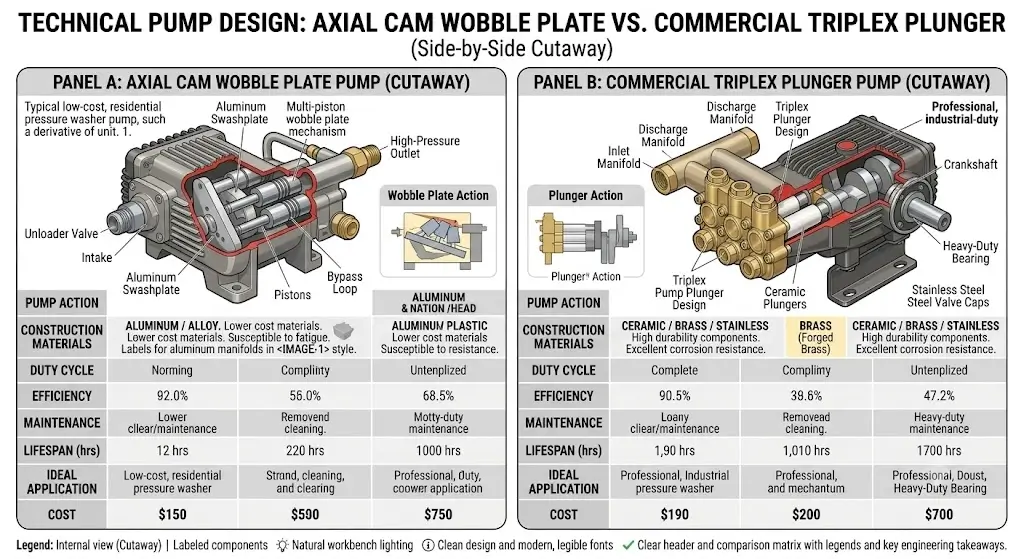
Pressure Washer Pump Types
The pump is one of the most important mechanical components in a pressure washer.
Axial Cam Pumps
Axial cam pumps are common in residential pressure washers because they can provide useful output in a relatively compact package. They are well suited to many homeowner applications, but pump life depends on construction, operating conditions, water quality, maintenance, and duty cycle.
Wobble Plate Pumps
Wobble plate designs are also common in smaller residential machines. They are compact and economical, making them suitable for light-duty applications.
Triplex Plunger Pumps
Triplex plunger pumps are commonly associated with commercial equipment. Their architecture can support demanding workloads, but the pump alone does not determine whether a machine is appropriate. The engine or motor, frame, valves, seals, and overall system design also matter.
Brass Pump vs. Aluminum Pump
Brass components provide superior corrosion resistance and fatigue durability under high pressure, while aluminum components reduce weight and manufacturing cost. However, pump architecture, internal packings, operating pressure, water quality, and maintenance matter just as much as manifold metal.
Why Nozzles Matter as Much as PSI
The nozzle controls how the pressure washer’s water is distributed. A narrow spray concentrates energy over a smaller area, while a wider spray distributes the water over a larger area.
| Spray Pattern | Typical Use | Risk |
|---|---|---|
| Wide-angle (40° White) | General cleaning and sensitive surfaces | Lower cleaning force |
| Moderate-angle (25° Green) | General exterior cleaning | Requires correct distance |
| Narrow-angle (15° Yellow) | Heavy contamination on durable surfaces | Higher surface-damage risk |
| Turbo / Rotary | Hard-surface concrete cleaning | Can damage sensitive materials |
Why a Surface Cleaner Is One of the Best Home-Improvement Accessories
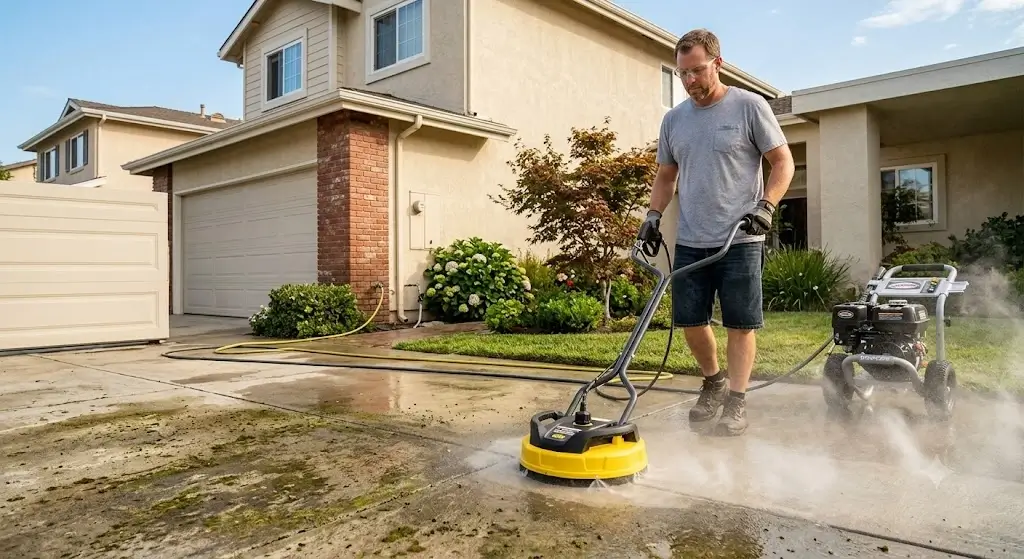
If your main goal is cleaning concrete, a surface cleaner can be more valuable than buying a pressure washer with a much higher headline PSI. A surface cleaner uses multiple spray jets beneath a rotating housing to clean a wider area more consistently, eliminating zebra striping while speeding up flatwork coverage.
Pressure Washer Hose Length and Portability
Hose length affects usability more than many buyers expect. A short 20-foot hose forces constant machine repositioning, whereas a 25- to 50-foot hose allows complete freedom around vehicles and foundations. When evaluating machines, also assess wheel diameter (10-inch flat-free wheels roll best over turf), center of gravity, and frame balance.
Duty Cycle: The Hidden Specification
Duty cycle is particularly important for home-improvement projects because a homeowner may use the machine for an extended cleaning session. A pressure washer designed for short residential tasks should not automatically be treated like commercial equipment. Follow manufacturer cooling intervals and avoid running consumer universal motors continuously without breaks.
Water Supply Requirements
A pressure washer cannot perform properly if its water supply is inadequate. Before buying a high-flow machine, confirm that your spigot and garden hose can deliver sufficient flow to prevent pump cavitation.
- Confirm water supply delivers at least 2.0 GPM open flow.
- Use a heavy-duty 5/8-inch or 3/4-inch supply garden hose.
- Check the inlet filter screen for debris.
- Remove obvious hose kinks.
- Prime and purge air according to manufacturer instructions.
- Never operate a pump without the required water supply.
Pressure Washer for Home Improvement: Size Guide
| Homeowner Profile | Recommended Direction | Why |
|---|---|---|
| Apartment or small property | Compact electric | Easy storage and adequate for light jobs |
| Typical suburban home | Mid/high-output electric | Good balance of power and convenience |
| Large property | High-output electric or gas | More flow reduces cleaning time |
| Large concrete driveway | High-flow electric or gas | Productivity becomes important |
| Frequent heavy cleaning | Gas or commercial-duty equipment | Better suited to sustained workload |
| Occasional car washing | Compact electric | Control and convenience matter more than maximum power |
What Is the Best Pressure Washer for a New Homeowner?
For a first pressure washer, avoid buying based solely on the highest available specification. A balanced electric machine is often easier to learn with because it provides enough capability for common residential jobs without adding gasoline-engine maintenance. Ensure it features standard quick-connect nozzles, durable hose connections, and reliable mobility.
What Is the Best Pressure Washer for a DIY Homeowner?
A DIY homeowner who performs regular maintenance projects should prioritize versatility. The machine should be capable of cleaning concrete while still allowing controlled work on wood, siding, and vehicles. That makes a machine with a useful range of nozzles and accessories more valuable than one designed solely around maximum pressure.
What Is the Best Pressure Washer for Home Renovation Projects?
Home renovation can involve unusual cleaning requirements such as removing loose dirt before painting, cleaning masonry, preparing concrete, washing decks before refinishing, cleaning fences, and removing construction dust from exterior surfaces. A versatile electric model is often the better homeowner tool when electrical access is available, while gas models excel on remote job sites.
Pressure Washer Safety for Home Improvement
Pressure washers can cause serious surface damage and physical injury when used incorrectly. Always follow the protocols detailed in our pressure washing safety guide.
High-pressure water can penetrate skin (injection injury) and propel dangerous flying debris.
Personal Safety Rules
- Always wear safety glasses or face shields.
- Wear heavy closed-toe boots—never sandals or canvas shoes.
- Always test spray patterns on an inconspicuous area first.
- Always connect electric washers to certified GFCI outlets.
Common Pressure Washer Buying Mistakes
- Choosing the Highest PSI: Maximum PSI is not the same as maximum cleaning productivity.
- Ignoring GPM: Low flow can make large surfaces take much longer to clean.
- Buying Gas for Light Chores: Engine maintenance and noise provide little benefit for occasional car washing.
- Buying Underpowered Units for Huge Driveways: Cleaning time becomes excessively slow.
- Using the Wrong Nozzle: Concentrated 0° tips can splinter wood or gouge concrete.
- Ignoring Water Supply Flow: Inadequate incoming flow causes pump cavitation and seal destruction.
- Neglecting Winterization: Residual water freezes and cracks pump manifolds. Review our pressure washer storage guide to winterize correctly.
Best Pressure Washer Setup for Common Home Projects
| Project | Machine Priority | Accessory Priority |
|---|---|---|
| Car wash | Moderate controlled output (1,200 PSI) | Wide 40° nozzle + foam cannon |
| Deck preparation | Controlled pressure (1,200–1,400 PSI) | Wide 25°/40° spray tip + wood cleaner |
| Concrete driveway | High useful PSI + GPM (≥ 2,500 PSI, 2.0 GPM) | Rotary surface cleaner (12″–15″) |
| Patio cleaning | Moderate/high useful flow | Surface cleaner or 15° yellow tip |
| Siding | Controlled pressure (1,300–1,500 PSI) | Soap-shooter nozzle + downstream siphon |
| Fence cleaning | Moderate controlled output | 25° green spray tip |
| Outdoor furniture | Low/moderate pressure | 40° white spray tip |
Is a 2,000 PSI Pressure Washer Enough for Home Improvement?
Yes, for many household tasks. A 2,000 PSI-class machine handles vehicles, siding, furniture, patios, and moderate hard-surface cleaning. The limitation is often flow rather than pressure: a low-flow machine will clean concrete, but it requires slower passes.
Is a 2,500 PSI Pressure Washer Enough?
A 2,500 PSI-class machine provides a practical middle ground for homeowners wanting more capability than entry-level washers without stepping up to industrial commercial rigs.
Is a 3,000 PSI Pressure Washer Too Powerful for Home Use?
Not necessarily. A 3,000 PSI machine is very useful for concrete and durable masonry flatwork. The key is operator control: using wide-angle nozzles and keeping proper working distance prevents surface damage.
Frequently Asked Questions
What is the best pressure washer for home improvement?
For most homeowners, a versatile mid- to high-output electric pressure washer is the best starting point. It handles vehicle detailing, siding, patios, and fences while requiring minimal maintenance compared to gas units. Large acreage and heavy commercial flatwork justify a gas pressure washer.
What PSI is best for home improvement?
There is no single ideal PSI. Residential cleaning ranges from 1,200 PSI for cars and wood decks to 2,500–3,000 PSI for concrete driveways. Select a machine with adjustable tips to match different material tolerances.
What GPM is best for home improvement?
Aim for at least 1.2 to 1.5 GPM for electric units, and 2.0 to 2.5+ GPM for gas units. Higher GPM rinses away dislodged debris faster, drastically reducing cleaning time on flat concrete.
Is electric or gas better for home improvement?
Electric is superior for convenience, low noise, and zero engine upkeep on typical suburban lots. Gas is better when you need maximum water volume, large driveway speed, or complete portability away from wall outlets.
Is 2,000 PSI enough for home improvement?
Yes. A genuine 2,000 working PSI handles vehicles, siding, fences, decks, and patios safely. Driveways can be cleaned effectively, though work speed depends on water volume (GPM).
Is 2,500 PSI enough for a driveway?
Yes. 2,500 PSI paired with at least 1.5 GPM and a rotary surface cleaner strips surface grime, moss, and oil spots from residential concrete efficiently.
Is 3,000 PSI good for concrete?
Yes. 3,000 PSI provides commercial-grade stripping force for durable concrete flatwork. Always use a 25° nozzle or rotary surface cleaner rather than a 0° pin-point tip to prevent surface etching.
What pressure washer is best for a driveway and deck?
A multi-pressure machine delivering 2,000–2,500 working PSI is ideal. Use a 25° or 40° tip at 12 inches for delicate cedar decking, and attach a rotary surface cleaner for the concrete driveway.
What is more important, PSI or GPM?
Both matter equally. PSI provides the hydraulic force to break surface bonds, while GPM carries the loosened debris away. Multiplying them yields Cleaning Units (CU), the true metric of cleaning productivity.
Is a higher PSI pressure washer always better?
No. Excessive pressure damages softwoods, chips mortar, lifts automotive clear coats, and forces water behind siding. Proper nozzle choice and technique are far more important than raw PSI.
Do I need a surface cleaner for my driveway?
While not strictly required, a rotary surface cleaner cuts driveway cleaning time by over 50% and eliminates the uneven zebra striping left behind by standard spray wands.
Can an electric pressure washer handle a whole house?
Yes. Combined with a downstream soap nozzle and extension wand, electric units clean single- and two-story vinyl or aluminum siding effectively without damaging insulation or paint.
Can I use a pressure washer to prepare my house for painting?
Yes. Pressure washing removes chalking, mildew, and loose paint flakes. Allow surfaces to dry for at least 48 to 72 hours before applying exterior primer or paint.
What is the best pressure washer for DIY homeowners?
A high-output electric pressure washer with a brushless induction motor and standard M22-14mm quick-connect fittings offers the best balance of longevity, power, and low maintenance.
How long should a pressure washer last?
Entry-level wobble-plate electric units last 50 to 100 operating hours; axial cam units last 150 to 300 hours; and commercial triplex plunger pumps last 500 to 1,500+ hours with regular pump oil maintenance.
Final Verdict
The best pressure washer for home improvement is a balanced, versatile machine—not simply the most powerful one.
For most U.S. homeowners, a quality electric pressure washer is the logical starting point because it provides enough capability for common projects while avoiding gasoline-engine maintenance. For large driveways, extensive concrete, repeated heavy cleaning, or long operating sessions, a higher-flow electric machine or gas pressure washer becomes more attractive.
Match the machine to the largest surface you regularly clean, and confirm it can be operated gently enough for your most delicate project.
Prioritize working PSI, GPM, surface control, accessories, pump design, portability, and duty cycle. Buy enough hydraulic output for your hardest recurring project, but do not confuse maximum PSI with overall cleaning performance.
