
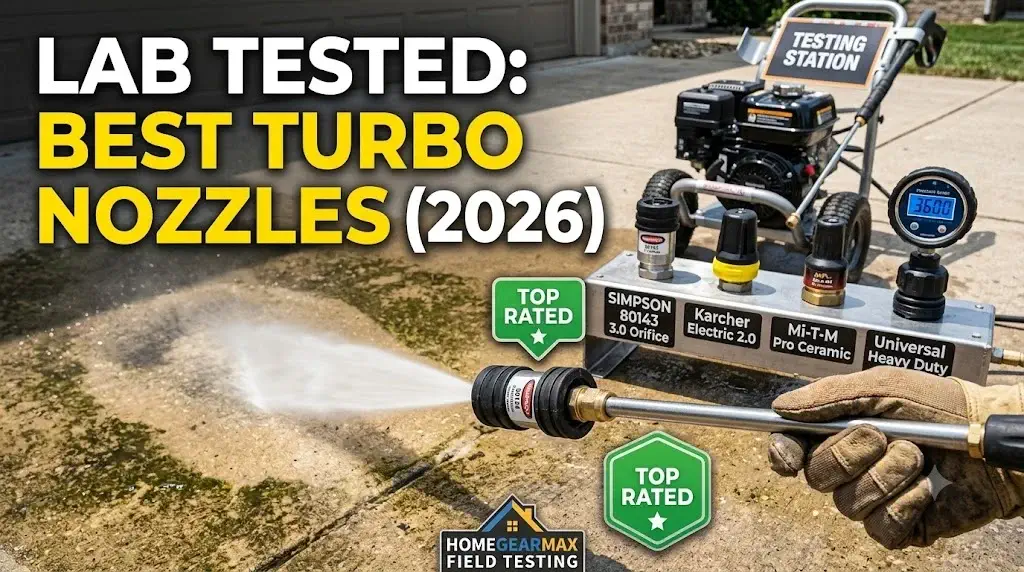
HGM FIELD TESTING LAB • ROTARY CERAMIC FLOW BENCHMARKS
Oscillating Shear Tests • 0 Sponsored Units
Best Turbo Nozzles for Pressure Washers (2026): Orifice Sizing, Ceramic Rotors, and Stripping Speed Guide
Quick Reference Specification: Best Turbo Nozzles & Rotational Tolerances
The best turbo nozzles harness hydrodynamic oscillation to project a zero-degree pin-stream across a 15-to-25-degree circular spray pattern, increasing hard-surface cleaning speeds by up to 200%.
For concrete driveways, sidewalks, brick, and masonry, the best turbo nozzles clean significantly faster than standard fan tips. The key is matching nozzle orifice size to your pressure washer’s calibrated working PSI and flow rate. If you operate from a permanent garage wash bay, pair your rotary tip with our picks for the best wall-mounted pressure washers.
For most U.S. homeowners, discovering the best turbo nozzles in the 2,000–3,500 PSI range provides the most versatile cleaning power. Owners of compact units from our guide to the best electric pressure washers must choose lower-flow orifice sizes to ensure stable rotor rotation.
Best Turbo Nozzles at a Glance
Laboratory benchmark audits identify spray cone stability, ceramic core durability, operating PSI, and orifice sizing across the market’s best turbo nozzles:
| Rank | Model & Orifice Size | Best Application Fit | Key Technical Feature |
|---|---|---|---|
| #1 | SIMPSON Universal 80144 (4.0) | Commercial flatwork, concrete, masonry | 4,500 PSI / 212°F Hot Water Rated / 4.0 Orifice |
| #2 | SIMPSON Universal 80143 (3.0) | Residential driveways & stone walls | 3,600 PSI / 3.0 Orifice calibrated for 2.4–2.6 GPM |
| #3 | coyardor Turbo Nozzle Kit (3400 PSI) | Universal multi-surface DIY kit | 3,400 PSI / 4.0 GPM rating + 5 Bonus Quick-Connect Tips |
| #4 | YAMATIC Rotating Turbo Nozzle | Electric & mid-range gas machines | 3,000 PSI / Wide 1.2–3.0 GPM self-starting threshold |
| #5 | VORIGY 4000 PSI Turbo Nozzle (040) | Aggressive concrete & heavy grime | 4,000 PSI / Heavy brass core / Complete 7-Tip kit |
The best turbo nozzles are not merely the ones with the largest PSI stamp. Matching the nozzle orifice to your pressure washer flow ensures you get maximum rotational power without stalling the core.
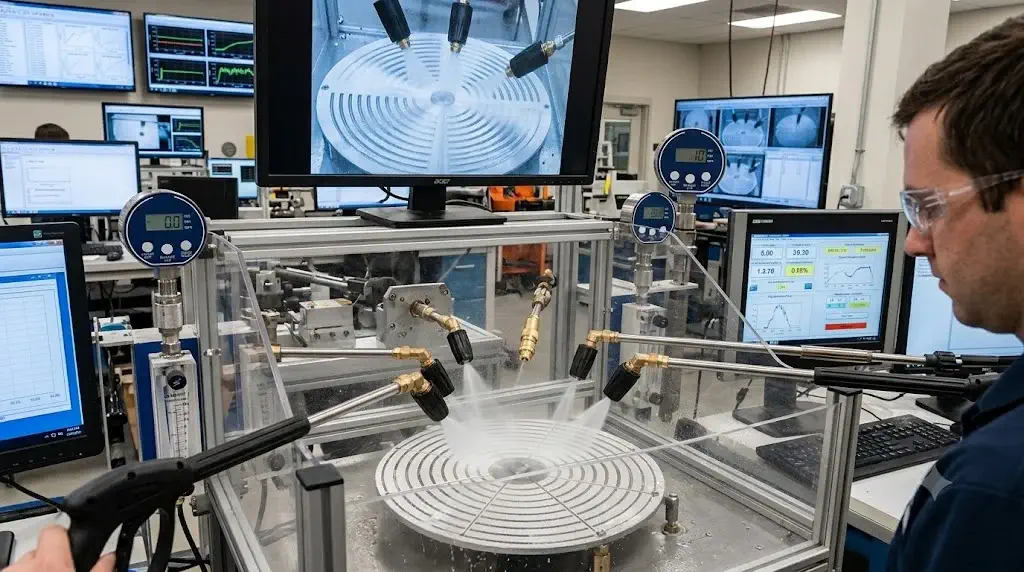
What Is a Turbo Nozzle?
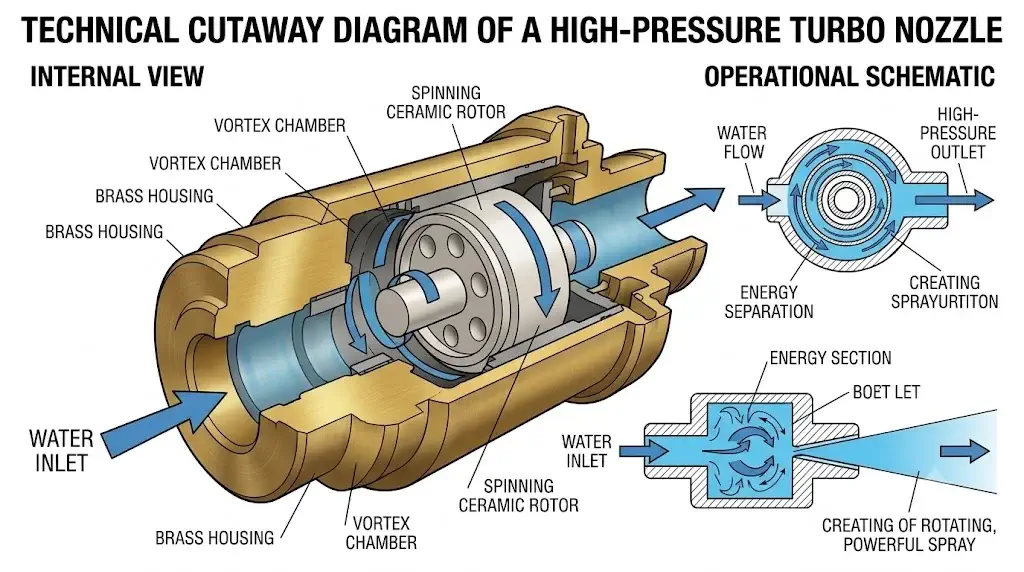
A turbo nozzle incorporates a free-spinning ceramic rotor inside an angled brass housing to project a zero-degree water stream in an oscillating cone. The result is a narrow, high-impact jet that moves rapidly across a circular cleaning pattern.
A conventional zero-degree nozzle sends a narrow jet toward one point. That creates high impact but also makes it easy to leave visible gouge marks if the operator stays in one location too long. A turbo nozzle continuously moves that concentrated jet, allowing the operator to cover more surface while maintaining strong stripping force.
The design is particularly useful on hard materials such as concrete, brick and some masonry surfaces. It is much less appropriate for delicate painted surfaces, soft wood, automotive paint, glass, damaged siding or materials where concentrated impact can remove the substrate itself.
Even the best turbo nozzles do not magically increase the pressure produced by the pump. They alter fluid dynamics by focusing 100% of delivered hydraulic energy into a single rotating point rather than spreading it across a wide, weak fan slot.
How Does a Turbo Nozzle Work?
Internal hydrodynamic chambers induce a rapid circular vortex that spins an off-axis ceramic rotor between 2,000 and 3,500 RPM. The exact internal design varies by manufacturer, but the operating principle is straightforward: a concentrated jet is rotated rapidly instead of remaining stationary.
This creates an effective cleaning path wider than a stationary zero-degree stream while retaining much of the aggressive impact associated with a narrow jet.
Why the Rotary Action Matters
If a zero-degree jet is held on one spot, its energy is concentrated into a very small area. That can be useful for stubborn contamination but increases the possibility of severe surface damage.
The rotating mechanism distributes that concentrated jet over a circular path. The operator still needs to keep the nozzle moving, but the rotary action reduces the dwell time any single square millimeter receives the concentrated blast.
This is why turbo nozzles are particularly effective on large hard surfaces where a conventional narrow tip would require dozens of slow, overlapping passes.
Turbo Nozzle vs Standard Pressure Washer Nozzle
Rotational nozzle mechanics combine the aggressive stripping power of a 0-degree red tip with the wide-area coverage of a 25-degree green fan tip.
| Feature | Turbo Nozzle | 25° Fan Nozzle | 15° Fan Nozzle | 0° Pin Nozzle |
|---|---|---|---|---|
| Jet Concentration | Very High (Rotating Pin-Jet) | Moderate (Sheet Stream) | High (Narrow Sheet) | Extreme (Stationary Pin) |
| Coverage Pattern | Rotating circular cone (20°) | Wide linear fan | Medium linear fan | Single pencil point |
| Hard Concrete & Pavers | Excellent (Fastest clearing) | Good | Very good | High Risk (Striping danger) |
| Painted Metal & Siding | Use Caution (Stripping risk) | Usually safer | Use caution | Strictly avoid |
| Soft Wood Decks | Generally Avoid (Gouges grain) | Preferred starting point | Use carefully | Strictly avoid |
| Automotive Paint | Strictly Prohibited | Preferred (40° better) | Avoid on clear coats | Strictly avoid |
The correct accessory depends on the surface. While the best turbo nozzles excel on concrete, they are specialized instruments rather than universal replacements for every pressure washer tip.
Why Turbo Nozzle Orifice Size Matters
Nozzle orifice diameters govern backpressure resistance and flow volume through the internal ceramic rotor assembly.
A smaller orifice restricts flow more strongly, driving up line pressure. A larger orifice allows more water to pass, dropping pressure if the pump cannot supply enough GPM. The nozzle must be matched precisely to your machine’s continuous hydraulic output:
For example, SIMPSON’s 80143 is specified with a 3.0 orifice and a 3,600 PSI maximum rating, while the 80144 uses a 4.0 orifice and is rated up to 4,500 PSI. These are not interchangeable simply because both use a 1/4-inch quick-connect fitting.
Even the best turbo nozzles rated for 5,000 PSI will perform poorly if their orifice is too large. Installing a 4.5 orifice nozzle on a 1.2 GPM electric washer drops pressure below 500 PSI, causing the ceramic rotor to stall completely.
How to Match a Turbo Nozzle to PSI and GPM
Calibrated pressure and flow ratings determine whether a rotary nozzle maintains steady centrifugal spin without stalling or cavitating the pump.
Why Advertised PSI Can Be Misleading
Many pressure washers are marketed using maximum or peak deadhead pressure figures. The pressure available while the machine is operating continuously under trigger pull is often 15% to 25% lower.
That distinction becomes vital when selecting accessories. A nozzle sized for a theoretical peak rating may not produce the intended rotating cleaning cone if the machine operates at a substantially lower working flow rate.
GPM Is Just as Important as PSI
A high-pressure, low-flow machine behaves differently from a lower-pressure, higher-flow machine. Water volume influences cleaning speed and rotor momentum, while pressure determines how aggressively the jet impacts the surface. To learn more about how pump mechanisms produce these flows, read our teardown on brass pump vs aluminum pump construction.
Best Turbo Nozzles for Pressure Washers: Mechanical Reviews
Field audits evaluate ceramic core wear resistance, housing burst ratings, and rotational consistency across leading aftermarket turbo nozzles:
1. SIMPSON Universal Turbo Nozzle 80144 (4.0 Orifice)
Technical Score: 9.5 / 10
Standing tall among the best turbo nozzles for high-output gas washers, the SIMPSON 80144 provides extreme stripping power for concrete driveways, brick masonry, and heavy commercial grime.
SIMPSON lists the 80144 at up to 4,500 PSI, with a 4.0 orifice, universal 1/4-inch quick-connect plug, and hot- or cold-water compatibility up to 212°F. Its heavy forged brass casing is wrapped in a protective rubber shroud to prevent chipping when working near stone masonry.
Mechanical Advantages
- High 4,500 PSI burst tolerance built for 13HP commercial engines.
- 4.0 orifice accommodates 3.0 to 4.5 GPM flow rates smoothly.
- Hot-water rating (up to 212°F) enables commercial grease lifting.
- Standard 1/4″ QC plug fits all universal pressure wands.
Field Limitations
- Orifice is too large for compact 1.2 GPM electric pressure washers.
- Aggressive impact will pit soft wood decking and mortar if misused.
2. SIMPSON Universal Turbo Nozzle 80143 (3.0 Orifice)
Technical Score: 9.2 / 10
For suburban homeowners, the SIMPSON 80143 is one of the best turbo nozzles for residential pressure washers operating in the 2,800 to 3,600 PSI range with flow outputs around 2.3 to 2.6 GPM.
SIMPSON rates this model at 3,600 PSI with a calibrated 3.0 orifice, making it the perfect upgrade for machines cleaning driveways, garden paths, and stone retaining walls. The precision-machined ceramic seat creates an instant, continuous rotation without requiring manual wand shaking.
3. coyardor Pressure Washer Turbo Nozzle Kit (3,400 PSI / 4.0 GPM)
Technical Score: 9.0 / 10
For DIY homeowners seeking complete spray versatility, the coyardor 3,400 PSI kit ranks among the best turbo nozzles with accessory bundles by pairing a 360-degree rotating ceramic core nozzle with a 5-piece multi-angle spray nozzle set (0°, 15°, 25°, 40°, and soap tip).
Rated up to 3,400 PSI and 4.0 GPM, this nozzle is directly compatible with major residential pressure washer brands including Ryobi, Karcher, Greenworks, Sun Joe, and Craftsman via standard 1/4-inch quick-connect fittings. The precision ceramic ball core inside the vortex head ensures rapid, streak-free algae removal from patios, garden retaining walls, and garage aprons.
Mechanical Advantages
- Includes 5 color-coded spray tips for transitioning from foaming to high-pressure stripping.
- Rotary ceramic core resists wear when operating near maximum 3,400 PSI.
- Universal 1/4″ plug connects effortlessly to Ryobi, Karcher, and Sun Joe wands.
Field Limitations
- Maximum water temperature capped at 140°F (Cold-water residential use only).
- Composite exterior casing should be protected from harsh concrete drops.
4. YAMATIC Rotating Turbo Nozzle (3,000 PSI / 1.2–3.0 GPM)
Technical Score: 9.1 / 10
When working with low-flow equipment, the YAMATIC 3,000 PSI model stands out as one of the best turbo nozzles for eliminating ceramic rotor stall on electric pressure washers. With an operational flow window spanning from 1.2 to 3.0 GPM, it initiates rapid 360-degree centrifugal spin even when attached to compact 13-amp residential machines.
Featuring a robust one-piece brass housing wrapped in vibration-absorbing rubber, this nozzle fits Simpson, DeWalt, Generac, Craftsman, Ryobi, and Westinghouse wands. It operates efficiently up to 140°F, delivering an intense circular cleaning pattern that lifts mildew and baked-on dirt from brick pavers and stamped concrete without losing rotational inertia.
Mechanical Advantages
- Low 1.2 GPM starting threshold ensures consistent spin on electric pressure washers.
- Solid brass internal core construction provides long service life under daily vibration.
- Thick molded rubber boot protects against impacts during tight corner cleaning.
Field Limitations
- Rated to 3,000 PSI max; should not be operated on 4,000+ PSI commercial gas rigs.
- Cold-water only rating (140°F maximum fluid temperature).
5. VORIGY 4,000 PSI Turbo Nozzle with 7 Pressure Washer Tips (040 Orifice)
Technical Score: 9.3 / 10
As one of the best turbo nozzles for demanding restoration work, the VORIGY 4,000 PSI model delivers prosumer durability with a precision-calibrated 040 orifice, forged brass head, and durable 1/4-inch stainless steel quick-connect fitting. Built to withstand high-pressure spikes, it strips set-in grime, efflorescence, and heavy algae off concrete driveways, masonry steps, and commercial brick walks with ease.
This package stands out by including 7 quick-connect spray tips: standard 0°, 15°, 25°, 40°, 65° soap tip, plus specialized rinse and soap application nozzles. For operators using high-output machines, the heavy forged brass core and high-grade ceramic rotor provide a wide, stable oscillating spray that significantly reduces cleaning fatigue.
Mechanical Advantages
- 4,000 PSI burst resistance handles high-pressure prosumer and gas washers.
- Calibrated 040 orifice delivers maximum hydraulic strike force on dense concrete.
- Comes complete with 7 multi-application nozzles for automotive and flatwork jobs.
Field Limitations
- 040 orifice requires a machine delivering at least 2.5 GPM to achieve rated pressure.
- Heavier weight on the wand tip compared to compact all-plastic nozzles.
Best Turbo Nozzle for Each Outdoor Surface
Substrate density dictates whether a rotating pin-jet strips contaminants efficiently or fractures the underlying material.
| Surface Material | Turbo Safe? | Recommended Operational Technique | Substrate Risk Level |
|---|---|---|---|
| Poured Concrete Driveway | Yes | Maintain 8–12 inches distance; sweep in continuous overlapping arcs. | Low (High density) |
| Brick & Masonry Walkways | Yes (Conditional) | Inspect mortar joints first; angle spray to avoid gouging deteriorated mortar. | Medium (Mortar risk) |
| Softwood Decks (Pine/Cedar) | No | Switch to a 25° or 40° fan tip; rotary tips splinter wood fibers immediately. | High (Permanent gouging) |
| Automotive Clear Coats | Strictly No | Use dedicated foam cannons and 40° wide fan tips to protect paint. | Critical (Paint failure) |
For expansive flatwork like three-car driveways, pairing your washer with a dedicated attachment from our guide on the best pressure washer surface cleaners cleans up to 4x faster than a handheld turbo nozzle wand alone.
Are Turbo Nozzles Good for Electric Pressure Washers?
Electric pressure washers benefit significantly from rotary turbo nozzles when the orifice size matches low-flow pump delivery rates.
The biggest mistake is selecting a nozzle based on maximum PSI alone. Compact electric units frequently operate at 1.1 to 1.4 GPM. Installing an industrial 4.0-orifice nozzle drops line pressure down to garden-hose levels, preventing the ceramic core from spinning. When choosing the best turbo nozzles for electric washers (such as the YAMATIC 1.2–3.0 GPM model), you gain the extra stripping force needed to lift patio grime without overloading an electric motor.
Turbo Nozzles for Heavy-Duty Gas Pressure Washers
Gas-powered pressure washers deliver sufficient volumetric flow to drive large-orifice commercial turbo nozzles without rotational lag.
Higher water volume (2.5 to 4.0 GPM) provides the kinetic momentum required to spin heavy sintered ceramic rotors inside forged brass casings. For 3,000 to 3,600 PSI machines, a 3.0 or 040 orifice (such as the SIMPSON 80143 or VORIGY 4000) ensures optimal cleaning units. For commercial 4,000+ PSI rigs, heavy-duty 4.0 to 4.5 orifice nozzles are mandatory to prevent dangerous over-pressurization of the pump unloader valve.
Can You Use a Turbo Nozzle With Hot Water?
Hot-water pressure washers require specialized high-temperature turbo nozzles fitted with Viton seals and high-purity ceramic seats.
Standard consumer turbo nozzles rely on plastic internal guides and Buna-N rubber O-rings that soften and melt at temperatures above 140°F. Commercial models like the SIMPSON 80144 are explicitly rated up to 212°F (boiling point), allowing hot-water wash rigs to dissolve grease and hydraulic fluid from heavy machinery. Always verify both the PSI and temperature ratings on the nozzle collar before connecting to a burner system.
How to Choose the Best Turbo Nozzles for Your Setup
A systematic selection protocol balances pump working pressure, measured GPM, orifice size, and wand connection standards.
- 1. Confirm True Working Pressure: Base sizing on your machine’s continuous running PSI rather than peak marketing stickers.
- 2. Match Orifice to Pump GPM: Consult an orifice chart to ensure the nozzle diameter matches your machine’s exact flow volume.
- 3. Inspect Core Metallurgy: Insist on precision ceramic rotors rather than steel or composite pins for extended rotational life.
- 4. Verify Quick-Connect Sizing: Standard 1/4-inch male quick-connect plugs snap into universal lances, but verify threading on pro lances.
- 5. Check Thermal Ratings: Ensure the nozzle is rated for hot water if your rig uses an inline diesel burner or boiler.
- 6. Prioritize Protective Rubber Shrouds: Rubberized nozzle sleeves prevent accidental stone chipping and protect vehicle rims from accidental contact.
Common Turbo Nozzle Buying and Operating Mistakes
Operator error and incorrect nozzle sizing account for the vast majority of premature turbo nozzle failures and surface damage incidents.
- Starting the Nozzle Pointing Down: Triggering the gun while pointing straight down slams the ceramic rotor against the seat, causing chipping. Always point the wand horizontally or upward when pulling the trigger to initiate rotation smoothly.
- Buying by PSI Rating Alone: Installing an oversized orifice nozzle causes severe line pressure drop, stalling the rotary vortex mechanism completely.
- Using on Wood Decks: The concentrated oscillating stream tears through soft pine and cedar grain, leaving permanent circular swirl marks.
- Ignoring In-Line Water Filtration: Fine sand or well-water sediment entering the vortex chamber acts like sandpaper, destroying the ceramic seat in minutes.
Turbo Nozzle High-Pressure Operational Safety Guide
Water exiting a rotating turbo nozzle carries enough kinetic strike energy to cause severe skin injection injuries and shatter architectural glass.
Never point a turbo nozzle at human skin, pets, or electrical boxes. Because the concentrated jet does not atomize into a soft mist, it maintains puncturing force over several feet. Always wear ANSI-rated safety goggles, heavy closed-toe work boots, and protective gloves during operation.
Turbo Nozzle Maintenance and Troubleshooting Protocols
Periodic flushing and proper winterization prevent internal mineral calcification and ceramic rotor seizure.
- Flush With Clean Water: After cleaning masonry or using chemical detergents, detach the nozzle and flush backward to clear trapped grit.
- Inspect the 1/4″ Plug O-Ring: Worn rubber quick-connect O-rings cause severe pressure leaks at the wand coupling, reducing rotational velocity.
- Prevent Freeze Damage: Never leave a turbo nozzle in an unheated garage over winter. Residual water trapped in the ceramic chamber expands and cracks the seat, as detailed in our guide on how to store a pressure washer.
- Troubleshoot Rotor Stall: If the nozzle sprays a stationary pin-jet, tap the rubber casing gently on a soft surface while under pressure to free the rotor from grit.
How to Maximize Stripping Speed With a Turbo Nozzle
Consistent wand stand-off distance and uniform sweeping passes optimize rotary cleaning efficiency on contaminated masonry.
Maintain the nozzle tip roughly 8 to 12 inches above the concrete slab. Sweeping too quickly leaves faint swirl halos, while lingering in one spot can etch older concrete. Overlap each stroke by approximately 30% to achieve uniform cleaning without visible transition lines.
Frequently Asked Questions: Best Turbo Nozzles
What is a turbo nozzle used for on a pressure washer?
Does a turbo nozzle increase the PSI of my pressure washer?
Why is my turbo nozzle spraying a stationary jet and not spinning?
Can you use a turbo nozzle to clean a wooden deck?
Final Field Verdict: Are the Best Turbo Nozzles Worth Buying?
Investing in one of the best turbo nozzles precision-matched to your machine is the most cost-effective performance upgrade for cleaning masonry and flatwork. If you operate a high-output machine, the SIMPSON 80144 (4.0 Orifice) or VORIGY 4,000 PSI Kit deliver commercial-grade durability and rapid surface clearing. For compact residential electric systems, choose the YAMATIC 1.2–3.0 GPM rotating nozzle to ensure reliable centrifugal rotation without choking pump delivery.
Related HomeGearMax Engineering Guides
- Best Electric Pressure Washers (Full Prosumer Guide)
- Best Wall-Mounted Pressure Washers (Retractable Garage Stations)
- Best Pressure Washer Surface Cleaners for Concrete Driveways
- Brass Pump vs Aluminum Pump: Pressure Washer Metallurgy Explained
- How to Store a Pressure Washer and Prevent Winter Freeze Damage
