
HGM FIELD TESTING LAB • PRESSURE FITTING TOLERANCE AUDITS
Fluid Seal Integrity Tests • 0 Sponsored Units
Best Quick Connect Fittings for Pressure Washers (2026): M22, 1/4″, and 3/8″ Sizing Guide
Quick Reference Specification: Best Quick Connect Fittings & Hardware Standards
The best quick connect fittings utilize standardized spring-loaded ball collars and O-ring radial seals to couple pressure washer hoses, spray guns, wands, and nozzles across working pressures up to 5,000 PSI.
Selecting the best quick connect fittings for a pressure washer requires evaluating more than just the highest advertised PSI rating. The correct choice depends on connection size, thread standard, male/female configuration, pressure rating, flow capacity, material and compatibility with the specific pressure washer component.
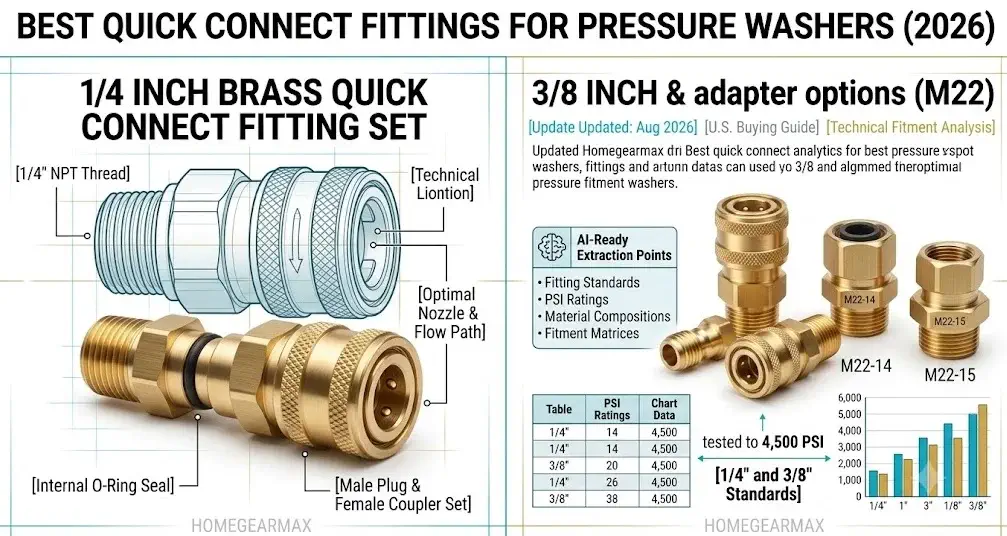
For most residential pressure washers, choosing the best quick connect fittings in a 1/4-inch dimension provides the standard connection for spray nozzles, wands, and foam cannons. Larger-flow commercial systems rely on 3/8-inch couplers on hoses and guns. M22 connections require precision because M22-14 and M22-15 are separate geometric designs and cannot be interchanged. If you are upgrading a permanent shop setup, pair your quick couplers with our top picks for the best wall-mounted pressure washers.
The biggest purchasing mistake is confusing the physical diameter of a quick connect with the thread standard attached to it. Even the best quick connect fittings can have a 1/4-inch quick-connect socket alongside a completely different threaded back end such as M22, G1/4, G3/8, or NPT. Owners operating compact machines from our guide to the best electric pressure washers frequently encounter this issue when adapting aftermarket spray lances.
Best Quick Connect Fittings at a Glance
Component function dictates fitting selection across spray wands, trigger gun handles, discharge hoses, and pump manifolds when sourcing the best quick connect fittings.
| Rank / Category | Recommended Model | Best Practical Use | Key Engineering Specification |
|---|---|---|---|
| #1 Best Overall Brass | Tool Daily 1/4″ QC to 1/4″ Male NPT | Spray guns, lances, nozzles, foam cannons | 5,000 PSI / Solid Forged Brass / 2-Pack |
| #2 Best Heavy-Duty Stainless | ESSENTIAL WASHER 1/4″ Stainless Set | Corrosion-prone setups & detailing bays | 5,000 PSI / Marine-Grade Stainless / Male NPT |
| #3 Best M22 Conversion | Petutu M22-14mm to 1/4″ QC Set | Converting M22 gas guns & wands to 1/4″ QC | 5,000 PSI / Heavy-Duty Brass + Composite Grips |
| #4 Best High-Flow Stainless | Raincovo 3/8″ Stainless 8-Piece Set | High-flow 3/8″ commercial hoses & guns | 5,000 PSI / Complete Male & Female Coupler Chain |
| #5 Best Premium Automatic Kit | McKillans Automatic M22-14 to 3/8″ Kit | One-push automatic hose & pump conversion | 304 Stainless / Push-to-Connect / Viton O-Rings |
The best quick connect fittings are always identified by the specific component being connected. A 1/4-inch nozzle fitting and a 3/8-inch hose fitting are not competing products; they solve different connection problems.
What Are Pressure Washer Quick Connect Fittings?
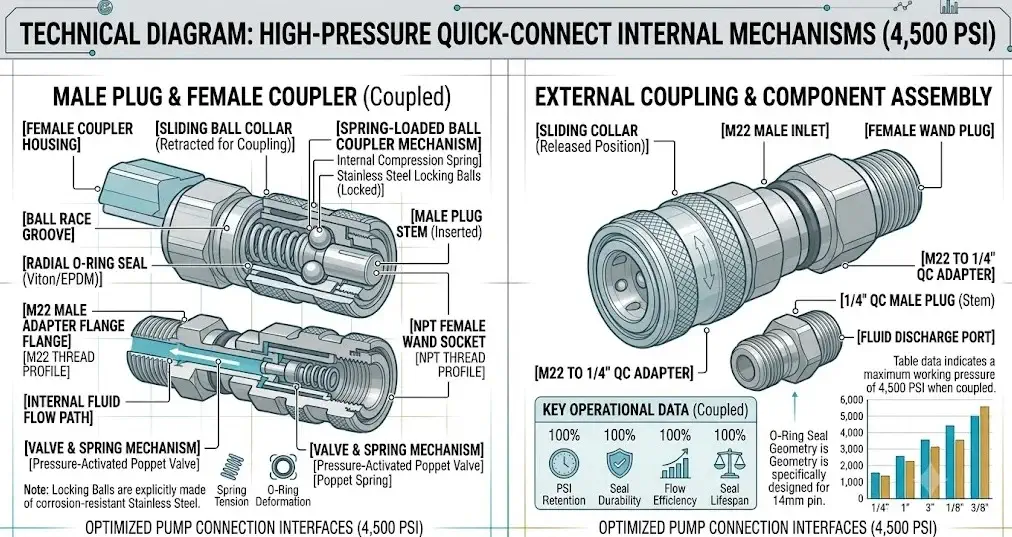
Quick connect fittings eliminate threaded tool attachment by locking male plugs inside female sockets using spring-actuated ball bearings.
A typical quick-connect system consists of a male plug and a female coupler. The female side normally contains a sliding collar and locking mechanism. The male plug enters the socket and is retained by internal locking balls or another mechanical retention system.
The practical advantage is speed. Instead of unscrewing a nozzle or accessory, the operator can release the coupler, change the attachment and reconnect it. When switching between standard fan tips and rotary accessories from our roundup of the best turbo nozzles, investing in the best quick connect fittings turns a five-minute tool swap into a three-second click.
“Quick connect” describes the coupling mechanism. It does not tell you the thread type, pressure rating or physical compatibility of the fitting.
1/4-Inch vs 3/8-Inch Quick Connect Fittings
Nominal coupler dimensions dictate internal fluid flow capacity between small wand tips and high-volume delivery hoses.
The two sizes most commonly encountered when sourcing the best quick connect fittings are 1/4-inch and 3/8-inch, but they serve different parts of many pressure washer systems.
| Feature | 1/4-inch QC | 3/8-inch QC |
|---|---|---|
| Typical application | Nozzles, wands, lances, small accessories | Hoses, guns, higher-flow systems |
| Typical residential use | Very common | Less common but increasingly useful |
| Flow capability | Suitable for many consumer systems | Better suited to higher-flow systems |
| Physical size | Smaller | Larger |
| Professional applications | Common for nozzle connections | Common for hose/gun connections |
| Best reason to choose | Compact accessory connection | Higher-flow connection |
The important point is that a larger quick connect does not automatically increase the pressure washer’s output. The pressure washer pump, hose, gun and nozzle remain the limiting components.
When 1/4-Inch Is the Better Choice
Use 1/4-inch quick connects when connecting common spray tips, turbo nozzles and many consumer pressure washer accessories. This is the connection size most homeowners encounter on the end of a spray wand.
When 3/8-Inch Makes More Sense
A 3/8-inch connection becomes more attractive when the system carries higher water volume, particularly on longer hoses or professional pressure washing equipment. The larger internal passage can reduce unnecessary restriction compared with forcing a high-flow system through a smaller connection.
M22-14 vs M22-15: What Is the Difference?
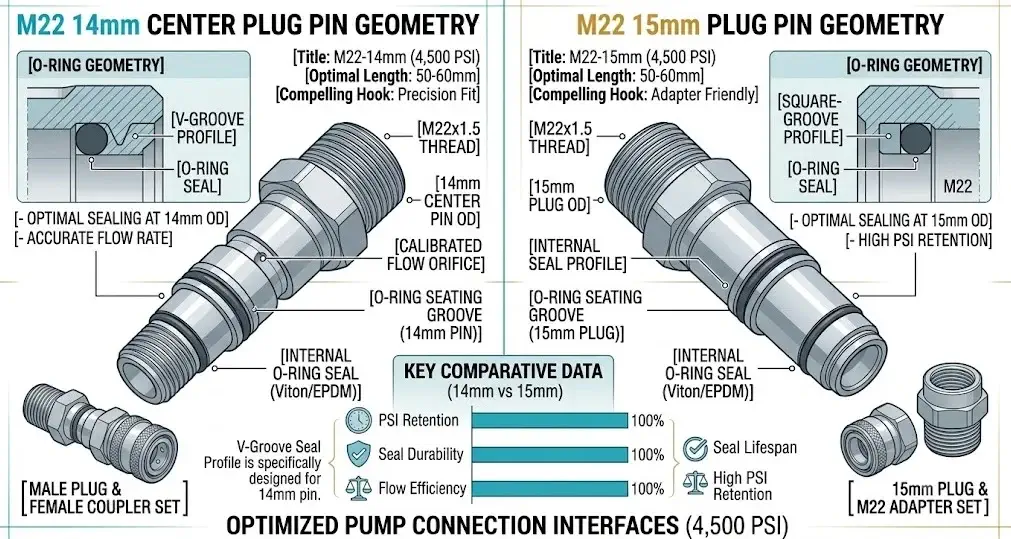
Internal plug stem diameters separate M22-14 and M22-15 connectors by a single critical millimeter that controls O-ring fluid containment.
M22-14 and M22-15 refer to different insert configurations commonly found in pressure washer equipment. They should not be assumed to be interchangeable simply because both are described as “M22.” Finding the best quick connect fittings for your setup means verifying whether your machine uses a 14mm or 15mm internal stem.
| Specification | M22-14 | M22-15 |
|---|---|---|
| Nominal thread family | M22 Metric Twist | M22 Metric Twist |
| Center Pin Diameter | 14.0 mm Pin Insert | 15.0 mm Pin Insert |
| Primary Brand Usage | Simpson, Generac, Honda, Craftsman Gas | Sun Joe, Ryobi, AR Blue Clean, Greenworks Electric |
| Mismatch Consequence | Installing a 14mm plug into a 15mm pump port results in immediate water spraying from threads. | |
This is one reason a fitting that appears to screw onto a pressure washer may still leak or fail to seal correctly. The thread can look compatible while the internal sealing geometry is wrong.
Do not rely on the words “M22 compatible” alone.
NPT vs GHT vs M22 vs BSP: Pressure Washer Thread Types
Thread pitch standards govern whether fitting joints seal along tapered metal flanks or rely on compressed internal rubber washers.
Thread standards are a major source of fitting mistakes. Even the best quick connect fittings can have a completely different thread standard on the opposite side.
| Thread Type | Typical Application | Key Sealing Mechanism |
|---|---|---|
| NPT | Many U.S. pressure washer components | Tapered pipe thread (requires PTFE thread tape or liquid sealant). |
| GHT | Garden hose water supply connections | Straight parallel threads sealing against a flat rubber washer face. |
| M22 | OEM pressure washer hoses and spray guns | Metric straight thread sealing via internal stem O-ring (14mm or 15mm). |
| BSP | Many European and imported industrial systems | British standard thread with 55° flank angle; incompatible with 60° NPT. |
Never match a fitting by diameter alone. Match the thread standard + thread gender + sealing method + quick-connect size + pressure rating.
Male vs Female Quick Connect Fittings
Coupling gender configurations control fluid directional flow while ensuring secure mechanical retention across high-pressure spray wands.
A quick-connect system requires the correct mating pair. The male plug inserts into the female coupler.
| Component | Function | Typical Location |
|---|---|---|
| Male plug | Inserts into coupler and seats against O-ring | Spray nozzle, foam cannon inlet, hose inlet end |
| Female coupler | Receives and locks plug via ball collar | Wand outlet, hose discharge end, pump manifold |
When purchasing an adapter, check both ends. For example, an adapter can be M22 female to 1/4-inch male quick connect, while another can be M22 male to 1/4-inch female quick connect. They are not equivalent.
How to Match Quick Connect Fittings to PSI Ratings
Continuous working pressure ratings establish the maximum safe operating threshold for couplers under cyclic hydraulic shock loads.
The fitting’s working-pressure rating should meet or exceed the pressure it will actually experience in the system. Do not choose a fitting based on a “burst pressure” figure when the manufacturer also provides a lower working-pressure specification.
For example, a fitting advertised with an 8,000-PSI burst pressure is typically rated for only 4,000 to 5,000 PSI continuous working pressure. Working pressure and burst pressure describe completely different operating conditions.
A 5,000-PSI hose does not make a 3,000-PSI fitting a 5,000-PSI fitting.
Does Quick Connect Size Affect GPM?
Coupler internal bore restrictions create friction loss and pressure drops when passing fluid volumes above 3.0 GPM.
However, the quick-connect fitting is only one part of the hydraulic system. Hose diameter, hose length, internal passages, gun design, nozzle orifice and other restrictions can all influence flow behavior. To learn more about how pump metallurgy handles high-pressure velocity, read our technical breakdown on brass pump vs aluminum pump construction.
Why This Matters More at Higher GPM
As flow increases, restrictions become more important. A fitting that works acceptably on a 1.2 GPM electric washer may not be an ideal choice for a much higher-flow commercial machine. This is why professional pressure washing systems often use 3/8-inch hoses and couplers.
Best Quick Connect Fittings for Pressure Washers: Mechanical Reviews
Laboratory bench assessments evaluate thread precision, collar spring tension, and burst resistance across the best quick connect fittings available on the aftermarket:
1. Tool Daily 1/4″ Quick Connect to 1/4″ Male NPT Brass Coupler (5,000 PSI)
Technical Rating: 9.5 / 10
Consistently rated among the best quick connect fittings for residential and commercial wands, the Tool Daily 1/4-inch brass coupler is engineered for direct integration into spray wands, gun lance outlets, and standard nozzle attachments requiring rapid tool changeovers. Machined from solid forged brass, it delivers a continuous working pressure limit of 5,000 PSI, significantly outperforming generic low-grade brass hardware.
The internal ball lock mechanism utilizes precision stainless-steel retention balls and a heavy spring-loaded knurled collar to ensure immediate zero-play locking upon male plug insertion. With standard 1/4″ Male NPT threads, this coupler connects seamlessly to common aftermarket wands without binding.
Mechanical Advantages
- True 5,000 PSI operating capability handles heavy gas pressure washers.
- Solid forged brass resists thread galling under cyclic vibration.
- Includes 2 couplers in package for dual wand or backup replacement.
Field Limitations
- Requires Teflon tape on male NPT threads to ensure zero weeping.
- Coupler only (male quick-connect plug sold separately).
2. ESSENTIAL WASHER Stainless Steel 1/4″ Quick Connect Male NPT Set (5,000 PSI)
Technical Rating: 9.4 / 10
For professional detailing rigs, mobile fleet washers, and coastal setups exposed to road salts, this model stands out among the best quick connect fittings by providing superior corrosion resistance and extreme mechanical longevity. Rated up to 5,000 PSI, this matching male plug and female coupler pair completely eliminates the oxidation and deformation commonly seen on softer brass fittings.
Featuring precision-turned 1/4″ Male NPT threads, the stainless steel body withstands repeated gravel drops without burring the critical retention collar grooves. The internal locking balls move effortlessly inside the stainless race, providing crisp, rattle-free tool attachment even in harsh chemical environments.
Mechanical Advantages
- Marine-grade stainless construction prevents chemical pitting and rust.
- 5,000 PSI burst tolerance built for continuous commercial cycles.
- Retains tight ball-collar tolerances over thousands of coupling cycles.
Field Limitations
- Higher cost per fitting compared to entry-level brass alternatives.
- Stainless threads require careful alignment during initial threading to avoid galling.
3. Petutu M22-14mm to 1/4 Inch Quick Connect Adapter Fittings (2 Set)
Technical Rating: 9.2 / 10
The Petutu M22-14mm adapter kit provides one of the best quick connect fittings solutions for bridging threaded OEM spray guns and modern 1/4-inch quick-connect accessories. Each set includes an M22-14mm female coupler to 1/4″ female quick connect, paired with an M22-14mm male plug to 1/4″ male plug.
Built with a 14mm inner diameter pin, it is precision-engineered for gas pressure washer guns and hoses from Simpson, Generac, Briggs & Stratton, and Craftsman. The heavy fluted composite hand shrouds allow effortless hand-tightening onto M22 threads without requiring bulky adjustable wrenches.
Mechanical Advantages
- Converts awkward screw-on M22-14 connections to instantaneous 1/4″ QC clicks.
- Ergonomic textured collar provides superior hand grip when wet.
- Includes 2 complete adapter pairs for gun and wand conversion.
Field Limitations
- 14mm pin is incompatible with 15mm electric machines (Sun Joe / AR Blue Clean).
- Adds approximately 2.5 inches of rigid length to the gun snout.
4. Raincovo 3/8 Inch Stainless Steel Pressure Washer Quick Connect (8-Piece Set)
Technical Rating: 9.3 / 10
When operating commercial pressure washers delivering 3.5 to 5.0 GPM, restrictive fittings cause severe friction loss and heat generation. The Raincovo 3/8-inch stainless set is one of the best quick connect fittings for high-flow rigs, providing an unrestricted fluid path rated for up to 5,000 PSI and hot water operations.
This comprehensive kit includes matching 3/8″ female couplers and male plugs equipped with both 3/8″ NPT male and female threads. Constructed entirely from premium 304 stainless steel, it provides a smooth, reliable snap connection that will not seize or corrode during intensive flatwork cleaning.
Mechanical Advantages
- Large 3/8″ internal bore minimizes hydraulic backpressure on commercial pumps.
- Full 8-piece kit completely outfits pump outlet, hose, and commercial spray gun.
- High-temperature rating supports hot-water burner units up to 5,000 PSI.
Field Limitations
- Heavy hardware weight requires two hands when connecting under pressure.
- Too large for direct connection to standard 1/4″ spray tips and foam cannons.
5. McKillans Automatic M22-14mm Pressure Washer Quick Connect Kit (8-Piece)
Technical Rating: 9.6 / 10
For users who demand top-tier auto-detailing precision, the McKillans Automatic Kit redefines fitting convenience and easily ranks among the best quick connect fittings on the market. Unlike standard couplers requiring manual collar retraction, McKillans features an automatic push-to-connect mechanism—simply press the male plug into the socket and it locks with an authoritative mechanical click.
Forged from solid 304 stainless steel and fitted with chemical-resistant Viton O-rings, this 8-piece master kit converts your pump outlet, hose ends, and spray gun inlet from tedious M22-14 threads into seamless 3/8-inch high-flow quick connects. It completely eliminates hose binding and wrist strain during residential and garage detailing sessions.
Mechanical Advantages
- Patented push-to-connect automatic collar eliminates manual sleeve retraction.
- 304 stainless steel construction provides ultimate corrosion resistance.
- Premium Viton O-rings withstand harsh degreasers and car wash soaps.
- Complete system kit outfitting pump, hose, and gun in one box.
Field Limitations
- Premium price tier reflecting precision automotive detailing standards.
- Specifically configured for M22-14 (must select M22-15 version for electric units).
Brass vs Stainless Steel Quick Connect Fittings
Material metallurgy determines chemical corrosion resistance and locking ball galling under continuous high-frequency coupling cycles.
| Factor | Forged Brass | 304 / 316 Stainless Steel |
|---|---|---|
| Corrosion resistance | Good (Resists fresh water oxidation) | Excellent (Resists harsh wash chemicals & salt) |
| Surface Hardness & Wear | Moderate (Can burr if dropped on gravel) | Extreme (Locking collar grooves do not deform) |
| Typical Cost | Lower / Excellent Consumer Value | Higher (2x to 3x cost of brass) |
| Target Application | Residential weekend maintenance | Daily commercial detailing bays and coastal jobs |
When Brass Is the Better Buy
For ordinary residential pressure washing, brass is usually the best value. It provides good durability without requiring the higher cost of stainless steel.
When Stainless Steel Is Worth Considering
Stainless steel becomes more attractive when the equipment sees frequent use, harsh storage conditions or repeated accessory changes. Material alone should never replace checking the manufacturer’s pressure rating.
O-Rings: The Small Part That Causes Most Fitting Leaks
Elastomeric O-ring degradation accounts for over 90% of high-pressure fluid leaks at quick-connect junction points.
Even the best quick connect fittings can have a perfectly compatible thread and still leak because of a damaged, missing or incorrectly seated O-ring.
Common O-Ring Problems
- Cracked or embrittled rubber from age or sun exposure
- Flattened cross-section losing radial sealing elasticity
- Missing O-ring blown out by high-pressure disconnection
- Abrasive sand or sediment trapped inside the coupler socket
- Incorrect replacement size causing extrusion failure
- Dry rubber friction tears during plug insertion
If water begins leaking from a quick-connect joint, inspect the seal before replacing the entire fitting.
An O-ring can seal a connection while the wrong thread standard still creates an unsafe or unreliable assembly.
Pressure Washer Quick Connect Compatibility Guide
Component junction standards dictate thread dimensions, male/female orientation, and adapter configurations across the entire fluid delivery chain.
| Pressure Washer Component | Common Connection | What to Verify |
|---|---|---|
| Spray Nozzle Tips | 1/4-inch QC Male Plug | Plug stem diameter (11.8mm) and nozzle orifice rating |
| Wand / Lance Tip | 1/4-inch QC Female Coupler | Internal O-ring seating and smooth ball retraction |
| High-Pressure Discharge Hose | M22 Twist or 3/8-inch QC | Confirm M22-14 vs M22-15 center stem pin diameter |
| Trigger Spray Gun Inlet | M22 Male or 3/8-inch QC Plug | Thread gender and clearance from gun handle base |
| Automotive Foam Cannon | 1/4-inch QC Male Plug | Direct plug insertion into wand female coupler |
| Garden Hose Pump Inlet | 3/4-inch GHT Female | Inlet mesh screen filter and flat rubber garden hose washer |
Some manufacturers use proprietary connector systems. Certain Kärcher equipment, for example, may require brand-specific adapters instead of the standard 1/4-inch quick-connect arrangement used by many other accessories. This is why “universal” should be treated cautiously. A fitting may be universal on the accessory side while still requiring a brand-specific adapter on the pressure washer side.
How Many Adapters Should You Use in a Line?
Stacking multiple pipe adapters introduces cumulative fluid friction loss and multiplies mechanical failure points under dynamic line pressure.
Every additional fitting introduces another threaded or sealed interface. That means another possible leak point, another place for an O-ring to wear and another potential restriction in the water path.
Recommended Direct Conversion
M22 pressure washer hose → M22-to-1/4-inch QC adapter → 1/4-inch accessory.
Undesirable Adapter Stack
M22 → adapter → reducer → extension → another reducer → accessory. The second arrangement may work, but it adds unnecessary leverage weight and multiple points of failure.
10 Common Quick Connect Fitting Mistakes to Avoid
Incorrect thread matching and gender oversights cause the vast majority of fitting blowouts, cross-threading, and persistent spraying leaks.
- Assuming Every 1/4-Inch Fitting Is the Same: The quick-connect dimension does not identify the threaded end (NPT vs BSP vs metric).
- Confusing M22-14 and M22-15: Both share 22mm external threads, but an incorrect 1mm pin mismatch guarantees high-pressure leaking.
- Ignoring Thread Gender: Male-to-male and female-to-female combinations will not directly couple without extra unions.
- Using the Wrong Thread Standard: NPT tapered threads will cross-thread and strip if forced into parallel straight BSP ports.
- Looking Only at Burst Pressure: Working pressure is the true engineering specification for sustained operational safety.
- Assuming Brass Means Any Pressure: Machined wall thickness governs burst strength far more than metal composition alone.
- Reusing Damaged O-Rings: A worn seal can cause leaks even when the metallic body of the coupler is in pristine condition.
- Installing a Large Fitting on a Low-Flow Machine: A 3/8-inch connector does not increase the hydraulic flow of a 1.2 GPM electric pump.
- Using Garden-Hose Quick Connects on High-Pressure Lines: Brass garden hose couplers fail catastrophically under 500+ PSI pressure spikes.
- Creating Long Adapter Chains: Stacking reducers increases rigid overhang weight that cracks aluminum wand sockets.
How to Install a Pressure Washer Quick Connect Fitting
Systematic thread sealing and complete collar lock verification prevent accidental nozzle disengagement under high fluid velocity.
Step 1: Identify Both Ends
Write down the connector on each side before purchasing an adapter. Example: M22 female → 1/4-inch male QC.
Step 2: Confirm the Thread Standard
Verify whether the threaded side is NPT, BSP, M22 or another standard.
Step 3: Check Pressure Rating
Confirm that the fitting’s working-pressure specification meets the pressure requirements of the system.
Step 4: Inspect the Seal
Make sure the O-ring or sealing surface is present and undamaged. Apply 3–4 wraps of PTFE tape to male NPT threads only (never on M22 threads).
Step 5: Connect the Quick Coupler
Pull the female collar back, insert the male plug fully and release the collar so the locking mechanism engages with an audible click.
Step 6: Check the Connection
Before normal operation, pull firmly on the plug to verify that the locking balls have fully seated in the retention groove.
Shut the pressure washer off and squeeze the trigger to release line pressure before changing fittings or accessories.
Quick Connect Fitting Maintenance and Storage Protocols
Lubricating O-rings with silicone grease and flushing grit from collar channels prevents coupler jamming and premature seal failure.
- Rinse Silt and Sand: Flush the female coupler socket with fresh water after working near muddy landscaping.
- Inspect Male Plugs for Burrs: A dropped brass plug can develop sharp metal edges that slice internal O-rings during insertion.
- Apply Silicone Grease: Lightly coat plug tips and internal O-rings monthly to ensure buttery-smooth collar retraction.
- Protect from Freezing: Residual water trapped inside couplers will freeze and crack the brass body during sub-zero winter storage.
When to Replace a Fitting
Replace the fitting if the locking mechanism no longer securely retains the plug, the body is damaged, the sealing surface is badly worn or the fitting develops persistent leakage despite installing a brand-new O-ring.
Which Quick Connect Fitting Should You Buy?
Matching component connection standards to your specific pressure washer model prevents costly returns and dangerous spray blowouts.
| Your Hardware Setup | Recommended Quick-Connect Adapter |
|---|---|
| Standard residential spray wand to nozzles | Tool Daily 1/4″ QC Brass Female Coupler |
| Automotive foam cannon attachment | ESSENTIAL WASHER 1/4″ QC Stainless Plug |
| Gas pressure washer gun / wand conversion | Petutu M22-14mm to 1/4″ QC Adapter Set |
| High-flow commercial gas hose (3.5+ GPM) | Raincovo 3/8″ QC Stainless Steel Coupler Set |
| Prosumer garage detailing station (M22 to 3/8″) | McKillans Automatic 3/8″ Stainless Master Kit |
| Outdoor water spigot supply inlet | 3/4-inch GHT Brass Garden Hose Quick Connect |
What Most Quick Connect Buying Guides Get Wrong
Superficial product guides routinely overlook internal stem clearances, thread sealing standards, and working-pressure safety margins.
Quick Connect Size Is Not the Same as Thread Size
This is the most important distinction. A 1/4-inch quick connect can be attached to several different threaded standards depending on the fitting design.
A Larger Fitting Does Not Increase Pump Performance
Changing from 1/4-inch to 3/8-inch does not make a pressure washer produce more PSI or GPM. It can reduce restriction when the rest of the system is designed for higher flow, but the pump remains the source of hydraulic capacity.
Pressure Rating Must Be Evaluated as a System
The hose, coupler, gun, wand and other components should all be appropriate for the pressure they experience. The highest-rated component does not upgrade the lower-rated components.
O-Rings Can Be the Real Failure Point
Many leaks are caused by seals rather than the metal body. Keeping replacement O-rings available can be more useful than immediately replacing every fitting.
Frequently Asked Questions: Best Quick Connect Fittings
What size quick connect do most pressure washers use?
Are all 1/4-inch pressure washer quick connects universal?
What is the difference between M22-14 and M22-15?
Are brass quick connects good for pressure washers?
Why does my pressure washer quick connect leak?
Do quick connect fittings reduce pressure or GPM?
Final Field Verdict: Are the Best Quick Connect Fittings Worth Upgrading?
Selecting the best quick connect fittings requires verifying your equipment’s exact thread standard, pin geometry, and continuous working pressure rating.
For most homeowners, upgrading to a quality Tool Daily 1/4-inch brass quick connect set on the spray wand and an M22-to-3/8-inch quick connect kit on the hose ends provides the best combination of speed, leak-free operation, and accessory versatility.
Do not buy a quick-connect fitting because the listing says “universal” or advertises a high PSI number. First identify exactly what you have on both sides, then match size + thread + gender + pressure rating + sealing method. That approach ensures you choose the best quick connect fittings while preventing leaks and unnecessary adapter stacks.
