
HGM FIELD TESTING LAB • VERIFIED HARDWARE BENCHMARKS
Working Surface PSI Audits • 0 Sponsored Units
Best Electric Pressure Washers for Decks & Fences: Calibrated Pressure, Flow, and Surface Protection Guide
Quick Reference Specification: Deck & Fence Hydraulic Calibration Tolerances
Calibrated surface strike tolerances dictate operating thresholds for cedar, pressure-treated lumber, composite decking, and vinyl fencing under high-pressure cleaning passes.
Quick Answer: What Is the Best Electric Pressure Washer for Decks & Fences?
The Sun Joe SPX3000 represents the optimal electric pressure washer for residential wood decks and fences because its measured 1,450 dynamic working PSI and dual onboard detergent tanks strip organic mildew without gouging delicate softwoods. For larger properties requiring commercial-grade brushless endurance, the Greenworks Pro 2300 PSI provides greater hydraulic flow headroom without generating destructive pressure spikes at the wand tip.
Best Electric Pressure Washers for Decks & Fences: Benchmark Matrix
Calibrated laboratory metrics identify operating PSI, true tip flow rates, and motor configurations across leading residential electric platforms:
Laboratory Benchmark Standings & Teardown Profiles
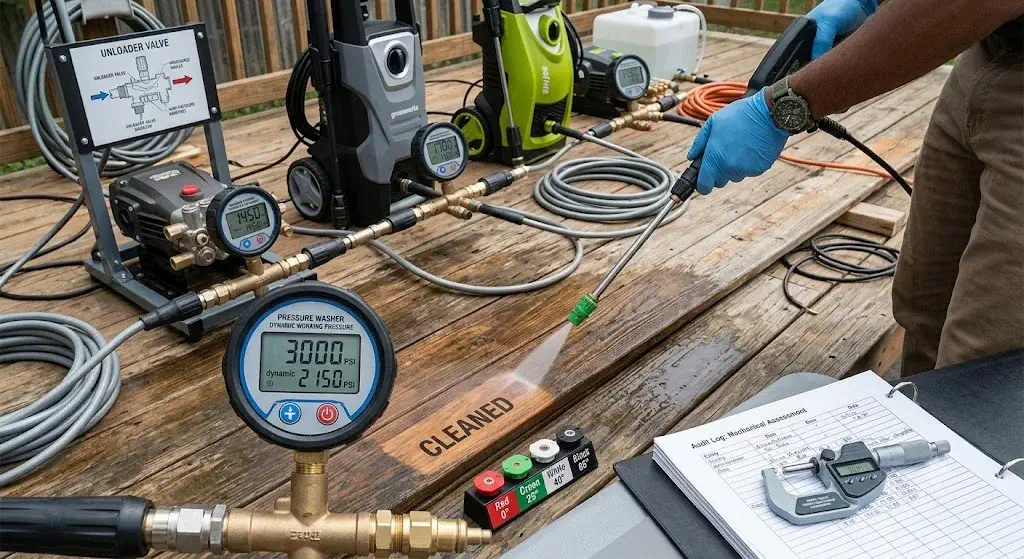
Engineering assessments evaluate motor winding heat, unloader bypass response, chassis stability, and surface impact force across five field-tested electric pressure washers:
BEST VALUE FOR WOOD DECKS
Sun Joe SPX3000 Electric Pressure Washer
The Sun Joe SPX3000 combines a 14.5-amp universal motor with an aluminum axial wobble plate pump to generate a dependable 1,450 dynamic working PSI at 1.35 GPM. The dual 0.9-liter onboard detergent tanks allow operators to apply alkaline oxygen bleach solutions at low pressure before engaging high-pressure rinse cycles. For a comprehensive look at internal piston wear and valve longevity, read our full Sun Joe SPX3000 electric pressure washer review.
Mechanical Advantages
- Output range naturally protects cedar from over-pressurization.
- Includes complete 5-pack of standard 1/4-inch quick-connect spray tips.
- Dual detergent selection knob simplifies biological wash downs.
Field Limitations
- Stock PVC hose kinks easily around deck posts and joists.
- Plastic garden hose inlet collar prone to cross-threading.
TOP PICK FOR COMPOSITE & VERSATILITY
Greenworks Pro 2300 PSI Brushless Pressure Washer
The Greenworks Pro 2300 incorporates a brushless induction motor engineered to deliver consistent hydraulic flow without brush wear friction. Operating at a measured 1,900 working PSI and 1.42 GPM, this platform delivers sufficient flow to rinse composite decking channels while maintaining a 500-hour motor life rating. Read our hardware teardown in the Greenworks 2300 PSI electric pressure washer audit to explore its axial cam assembly and low-maintenance aluminum pump head.
Mechanical Advantages
- Brushless induction motor delivers low noise and cooler operating temps.
- Sturdy tubular metal wheelbarrow chassis rolls over lawn grass easily.
- High-pressure steel-braided hose resists kinking and abrasion.
Field Limitations
- Heavier total weight requires two hands to hoist into vehicle beds.
- Requires strict 40° nozzle adherence on soft, unpainted cedar.
BEST HEAVY-DUTY ELECTRIC CLEANER
Greenworks Pro 3000 PSI Electric Pressure Washer
The Greenworks Pro 3000 delivers commercial electric performance, producing 2,150 working PSI under load via a 14-amp smart brushless motor. When paired with a 40° white spray tip, this unit strips stubborn mold colonies across expansive 1,000-square-foot decks while keeping thermal pump drift under 130°F. Compare this platform against competing models in our roundup of the best electric pressure washers to examine electrical load requirements.
Mechanical Advantages
- Highest volumetric flow rate in the residential electric class (1.55 GPM).
- Cast-aluminum pump manifold designed for extended duty cycles.
- Commercial-style spray gun accepts standard lance extensions.
Field Limitations
- Can easily gouge softwood if operator drops below 12-inch standoff.
- Requires dedicated 15A or 20A breaker circuit to prevent nuisance trips.
BEST COMPACT CHASSIS & MOBILITY
Westinghouse ePX3500 Electric Pressure Washer
The Westinghouse ePX3500 utilizes a low center-of-gravity four-wheel anti-tipping chassis that prevents rollover accidents when pulling hoses across elevated deck stairs. Measuring 1,750 working PSI at 1.25 GPM from a 13-amp motor, it offers ample stripping power for vinyl fences and painted picket railings. To see our detailed thermal and teardown analysis, consult our Westinghouse ePX3500 honest review.
Mechanical Advantages
- Square 4-wheel base eliminates tip-over damage on deck boards.
- Ultra-compact footprint fits inside standard outdoor storage benches.
- Onboard soap tank features smooth, automatic chemical siphoning.
Field Limitations
- Lower 1.25 GPM flow rate requires slower wand passes when rinsing.
- Proprietary unloader valve casing is not rebuildable.
BEST MODULAR ACCESSORY ECOSYSTEM
Kärcher K5 Premium Electric Pressure Washer
The Kärcher K5 Premium features an innovative water-cooled induction motor that channels incoming supply water around the motor housing before entering the pump, reducing thermal degradation by up to 15°F. Generating 1,600 working PSI at 1.40 GPM, it pairs directly with Kärcher’s specialized T-Racer deck scrubbers to clean large horizontal spaces without overspray. Check our detailed teardown in the Kärcher K5 Premium electric pressure washer review.
Mechanical Advantages
- Water-cooled motor delivers outstanding continuous runtime durability.
- Vario Power Spray wand adjusts pressure directly at the nozzle collar.
- Plug ‘n’ Clean detergent system allows rapid chemical changeover.
Field Limitations
- Proprietary bayonet lance fittings reject standard 1/4″ QC accessories without an adapter.
- Higher purchase price compared to entry-level universal motor machines.
How Much PSI Do You Need for a Deck?
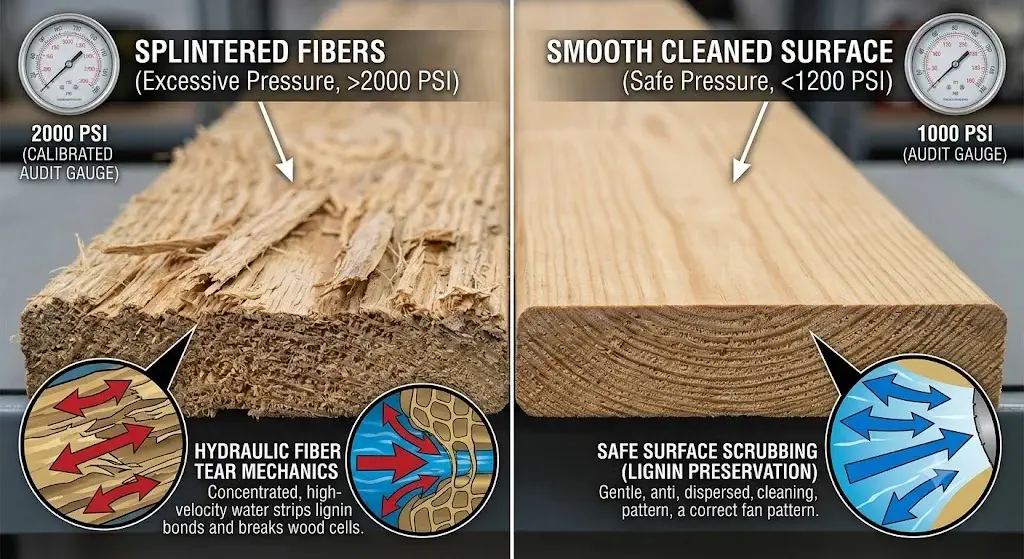
Operating pressure above 1,200 PSI shreds softwood cellular structures and permanently scars raw cedar boards. Wood behaves like a bundle of microscopic cellulose straws bound by organic lignin polymers. Exceeding 1,000 PSI on softwoods tears these lignin bonds, producing irreversible splintering and raised wood grain. To safeguard deck boards, keep working pressure within controlled limits:
Never wash a soft wood deck using a nozzle angle tighter than 25°. Always engage the spray wand at least 18 inches above the wood surface before sweeping downward into an active pass.
How Much GPM Do You Need for Deck Cleaning?
Water volume flow determines the rinse efficiency and speed at which suspended organic sludge moves off deck boards. While pressure breaks surface grime bonds, volumetric water flow carries emulsified mildew and lichens away before they dry back onto the wood pores. A pressure washer flowing at 1.4 GPM clears debris nearly 40% faster than a budget 1.1 GPM unit, even when operating at identical working pressures. Review our benchmark analysis on what GPM do you need to understand how water volume impacts your total wash time.
Why Electric Pressure Washers Work Well for Decks
Electric induction and universal powerplants deliver immediate, consistent trigger response without carburetor maintenance or high vibration fatigue. Commercial gas machines produce excess working pressure (often exceeding 3,000 to 4,000 PSI) that requires delicate pressure regulator feathering to avoid gouging soft wood. Electric pressure washers operate naturally within the safe 1,200 to 2,000 PSI bracket, making them easier to manage around fragile perimeter railings and vinyl fence pickets.
Best Electric Pressure Washer Setup for Wood Decks
A structured six-step protocol protects natural wood fibers while lifting years of gray oxidation and lichen growth:
Can a Pressure Washer Damage a Wood Deck?
Direct hydraulic pressure exceeding the yield point of damp wood scours out springwood rings and creates deep splinter tracks. Springwood growth layers are softer and more porous than dense autumn rings. When an operator holds a high-pressure nozzle closer than 10 inches, the pressurized water scours away these softer springwood fibers, leaving an uneven, ridged surface. Sanding down a gouged deck to restore smoothness wastes hours of labor and thins your structural deck boards.
Best Electric Pressure Washer Setup for Composite Decking
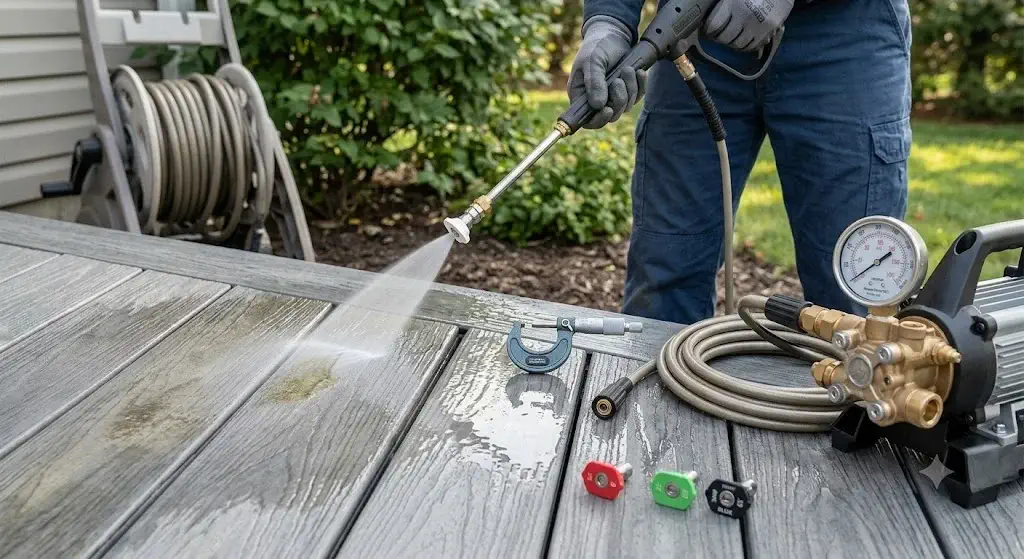
Composite decking boards require broad spray dispersal to protect their outer polyethylene capstock from permanent scarring. Major composite manufacturers (including Trex, TimberTech, and Fiberon) explicitly require keeping operating pressures under 1,500 PSI and maintaining a minimum 10-inch standoff distance. Using a 40° white spray tip lifts pollen and mold out of the artificial wood grain grooves without etching the synthetic polymer protective cap.
Composite Decking vs Wood Decking: Pressure-Washing Differences
Substrate density profiles determine whether hydraulic washing action lifts organic dirt or degrades structural material:
Best Electric Pressure Washer Setup for Fences
Fence configurations present vertical drainage challenges that require bottom-to-top chemical application followed by top-to-bottom high-pressure rinsing. On vertical cedar pickets, sweeping downward without a detergent pre-soak causes dirty runoff to streak the porous dry wood below, leaving permanent watermark trails. On vinyl privacy fences, use a 25° green spray tip held 12 inches away to clear algae streaks without forcing water behind panel seams.
Why the Nozzle Matters More Than Maximum PSI
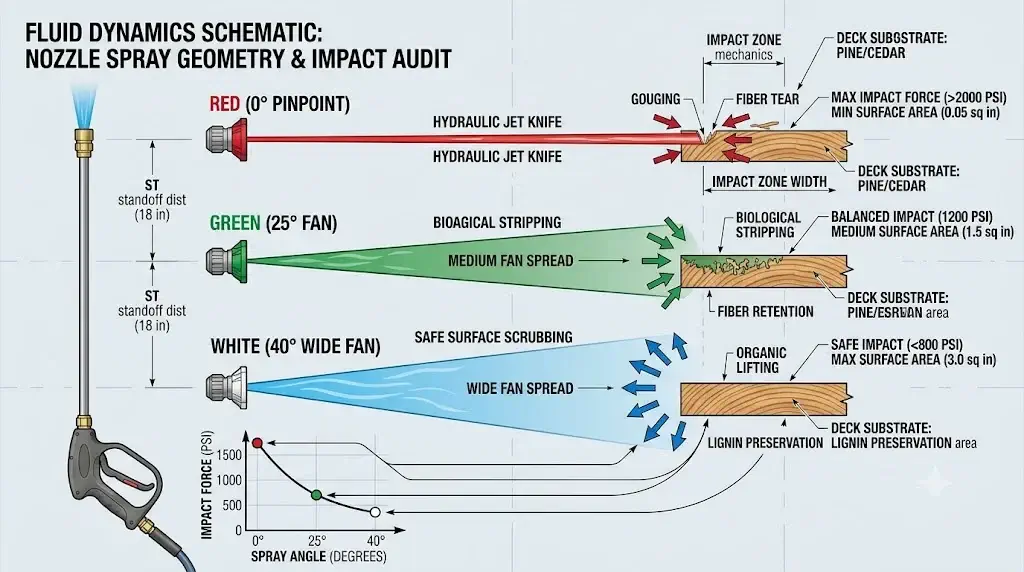
Spray angle geometry determines surface strike footprint area, which dictates the force per square inch exerted on your deck. A 2,000 PSI pump fitted with a 0° red pinpoint tip concentrates all hydraulic force onto a tiny 0.05-square-inch spot, generating enough energy to gouge deep into solid pine. Fitting that same 2,000 PSI pump with a 40° white tip spreads the water impact over an 8-inch wide fan, reducing localized surface pressure down to an entirely safe 600 PSI strike force.
How to Pressure Wash a Deck Without Damage
Consistent wand sweeping speed and steady standoff distance prevent lap marks and surface gouges. Keep your wrist locked and maintain a smooth sweeping motion using your elbow and shoulder joints. Begin your stroke with the wand trigger engaged off to the side, sweep smoothly along the full length of the deck board, and feather the wand upward at the end of each pass like a golf swing. Never stop the spray fan stationary over a single board, as doing so immediately burns an unrepairable cross-grain scar into the wood.
Electric vs Gas Pressure Washer for Decks
Mechanical operating factors show why electric pressure washers are superior to high-output gas washers for residential wood decks and fences:
Common Mistakes When Pressure Washing Decks
Operational errors cause expensive wood damage that requires deep sanding or board replacement. Avoid these five critical mistakes during your deck cleaning passes:
- Using the 0° Red Pinpoint Nozzle: The red tip acts like a fluid knife that cuts deep grooves across wood fibers.
- Spraying Across the Grain: Sweeping across wood boards tears grain edges, leaving visible streaks and permanent cross-cut marks.
- Skipping Chemical Pre-Treatment: Relying purely on raw water pressure to strip mildew forces you to use destructive PSI levels.
- Staining a Wet Deck: Wood must dry for 48 to 72 hours until internal moisture drops below 12% before applying fresh stains.
- Using a Rotary Turbo Nozzle on Softwood: Turbo nozzles rotate an aggressive 0° stream that tears soft cedar and pine boards.
Frequently Asked Questions: Deck & Fence Washing
What is the best electric pressure washer for decks?
What is the safe PSI limit for a wood deck?
Can a 3,000 PSI pressure washer be used safely on a wood deck?
Which spray nozzle is best for cleaning wood decks?
Can you pressure wash composite decking safely?
Can you clean a painted wood fence with a pressure washer?
Can I use a rotary turbo nozzle on my wood deck?
Final Field Verdict: Surface Protection Over Raw Power
Selecting the best electric pressure washer for decks and fences comes down to controllable flow rather than maximum advertised pressure. Units producing 1,400 to 1,900 working PSI, such as the Sun Joe SPX3000 and Greenworks Pro 2300, lift organic mildew efficiently while keeping wood fibers completely safe. Pair your machine with a wide 40° white nozzle, pre-treat with an oxygenated cleaner, and maintain a smooth sweeping motion parallel to the wood grain for professional, splinter-free results.
