
Are Battery-Powered Pressure Washers Worth It?
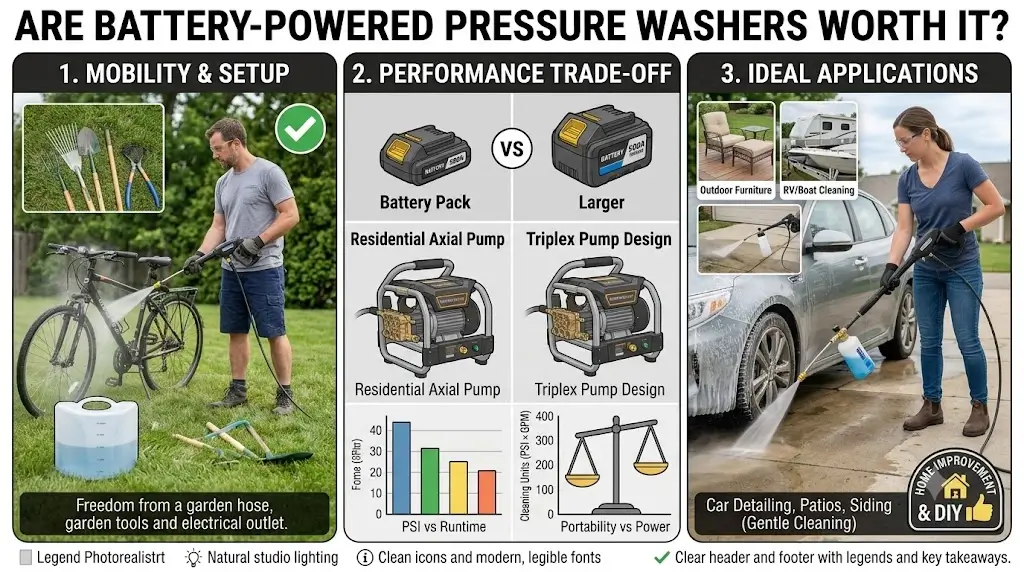
Battery-powered pressure washers are worth it when portability, quick setup, and freedom from electrical outlets matter more than maximum continuous cleaning power.
They are particularly useful for washing cars, boats, RVs, outdoor furniture, bicycles, garden equipment, and small patios. They also make sense when the cleaning location has no convenient outdoor electrical outlet or when managing a 50-foot power cord in wet conditions creates a safety hazard.
For large concrete driveways, heavily embedded grime, or long continuous cleaning sessions, a corded electric or gas pressure washer is usually the better tool. The deciding factors are not just PSI and GPM; battery runtime, battery platform replacement costs, water-source flexibility (siphon intake vs. pressurized hose), and project area dictate whether cordless delivers genuine value.
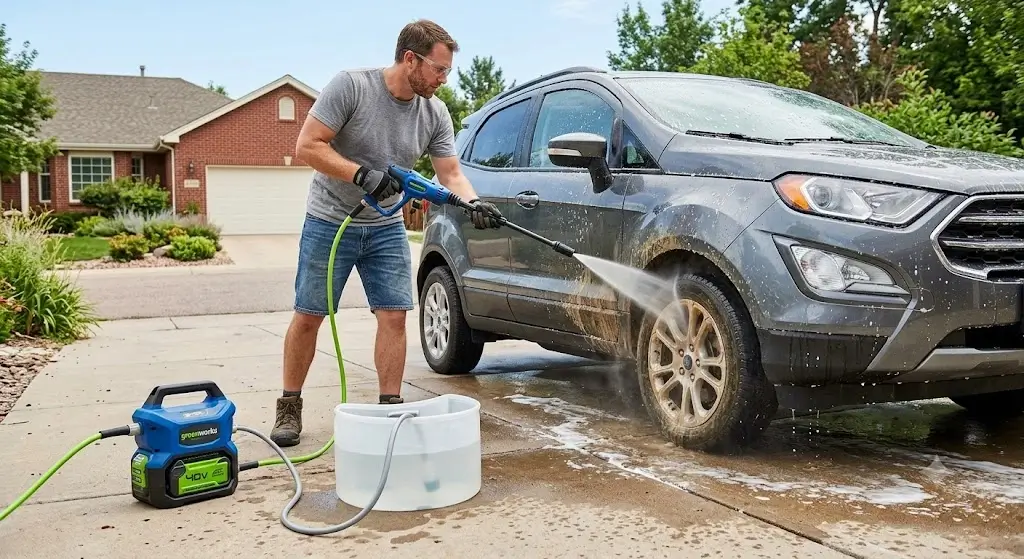
This guide evaluates cordless pressure washers by the jobs they can realistically perform under dynamic load, rather than laboratory “peak” or “initial discharge” ratings. Battery pressure washers occupy a distinct operational tier from full-size corded and gas machines, evaluated by hydraulic output, runtime curves, and total ecosystem cost.
Quick Answer: Are Battery-Powered Pressure Washers Worth It?
Yes—but only for the right workload.
A battery-powered pressure washer is a strong choice if you value mobility and mainly clean vehicles, outdoor furniture, boats, RVs, bikes, equipment, small patios, or areas without convenient electrical access. If you already own compatible 18V, 20V, 40V, or 56V tool batteries, tool-only platforms offer exceptional convenience.
It is usually a poor replacement for a full-size pressure washer when your main jobs are multi-car concrete driveways, extensive sidewalks, or long-duration heavy restoration. To compare cordless models against standard corded picks, review our tested selections in the best electric pressure washers guide.
- Need portability & remote cleaning? Battery wins.
- Need unlimited runtime on residential flatwork? Corded electric wins.
- Need high sustained hydraulic output (>2.5 GPM)? Gas usually wins.
- Already own compatible tool batteries? Battery becomes significantly more attractive.
- Starting a new battery platform? Factor the steep cost of dual battery packs and fast chargers into your budget.
What Is a Battery-Powered Pressure Washer?
A battery-powered pressure washer uses a rechargeable lithium-ion battery pack to power an electric motor coupled to a miniature pump. Unlike a traditional corded electric pressure washer, it operates completely independent of household AC wall outlets during cleaning.
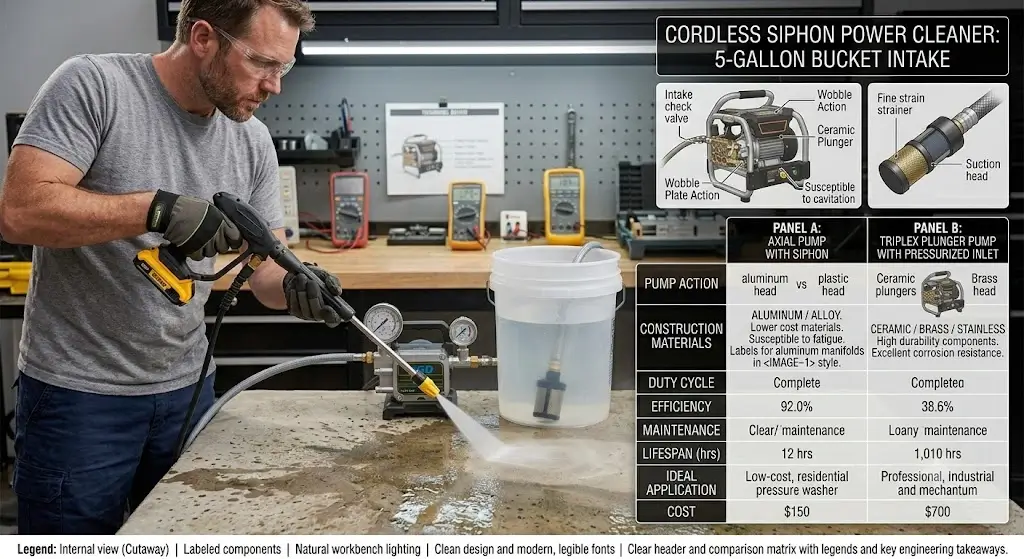
Depending on the mechanical configuration, the machine may connect directly to a standard garden hose or utilize a self-priming siphon hose to draw water from an open bucket, tank, or natural freshwater source. This separates the cleaning zone from fixed residential infrastructure.
The engineering trade-off is finite stored energy. Higher water pressure (PSI) and higher water volume (GPM) demand rapid electrical discharge, causing heavy battery drain during sustained high-load spraying.
Why Battery Pressure Washers Are Different From Corded Electric Models
A corded electric pressure washer draws continuous power from a 15A or 20A branch circuit. A cordless machine must carry its entire fuel supply inside onboard lithium cells. This creates a direct physical trade-off among six core variables:
High PSI and GPM draw high wattage, creating rapid battery depletion.
Larger capacity (Ah) extends runtime but adds substantial chassis weight and battery pack cost.
Instant setup makes 10-minute tasks effortless, but multi-hour projects require rotating battery pairs.
Siphon capability allows off-grid cleaning, but suction heads reduce nozzle working pressure by 10–15%.
The Biggest Advantage: Pure Mobility
The primary advantage of cordless cleaning is not raw hydraulic output—it is where the machine can physically operate.
Corded pressure washers require careful cord management to prevent electrical shocks in standing water. Gas pressure washers provide off-grid power but introduce engine exhaust, pull cords, volatile fuel storage, and heavy steel frames. A cordless unit eliminates these boundaries.
Wash cars curbside or in apartment carports without trailing long extension cords across sidewalks.
Rinse hulls and boat decks right at the marina or storage slip where 120V power outlets are inaccessible.
Eliminate setup friction: clean muddy lawnmower decks and patio sets in under 5 minutes.
Rinse mountain bikes, muddy off-road vehicles, and camping equipment using a standard 5-gallon water bucket.
Battery Pressure Washer vs. Corded Electric
| Evaluation Factor | Battery-Powered Washer | Corded Electric Washer |
|---|---|---|
| Portability & Range | Unlimited (Operates anywhere) | Limited to ~60 ft (35-ft cord + 25-ft hose) |
| Continuous Runtime | 15–40 minutes per battery charge | Continuous (Unlimited wall power) |
| Typical Working Pressure | 500–1,800 PSI (Model dependent) | 1,400–2,100 PSI (Consistent output) |
| Typical Water Flow (GPM) | 0.8–1.2 GPM | 1.1–1.6 GPM |
| Operating Sound Profile | 65–74 dB(A) (Whisper quiet) | 72–85 dB(A) |
| Water Intake Options | Garden hose, bucket, or lake siphon | Pressurized municipal spigot required |
| Suitability for Concrete Driveways | Poor to fair (Slow coverage rate) | Good (Especially with surface cleaners) |
| Initial Purchase Cost | High ($250–$600+ with batteries) | Moderate ($100–$250 complete) |
Battery Pressure Washer vs. Gas
| Evaluation Factor | Battery-Powered Washer | Gasoline-Powered Washer |
|---|---|---|
| Mobility Over Open Terrain | Lightweight & highly portable | Portable, but heavy (60–100+ lbs) |
| Sustained Heavy Output | Limited by cell capacity and heat | Exceptional (2,800–4,000 PSI @ 2.5–4.0 GPM) |
| Exhaust & Neighborhood Noise | Zero emissions / Conversational noise | Combustion exhaust / 85–100+ dB(A) noise |
| Routine Powertrain Maintenance | None (Lithium battery charging only) | Oil changes, spark plugs, carburetor cleaning |
| Indoor Storage Safety | Safe for basements and closets | Unsafe indoors due to fuel vapors |
| Large Masonry Stripping Speed | Slow (Requires repeated passes) | 3x to 5x faster cleaning coverage |
To evaluate how gas and electric systems match broad residential demands, consult our comprehensive guide on the best pressure washer for home improvement.
PSI Is Not Enough: Understand GPM and Cleaning Units
Comparing battery pressure washers solely by PSI numbers printed on the box leads to poor buying decisions. PSI provides the hydraulic stripping force to dislodge dirt, while GPM carries the dislodged debris away.
Cleaning Units (CU) = Working PSI × Working GPM
Compare two cordless configurations:
- Compact 20V Power Cleaner: 500 PSI × 0.8 GPM = 400 CU
- High-Voltage 56V Platform (e.g., EGO HPW2100): 1,600 PSI × 1.1 GPM = 1,760 CU
While a 400 CU tool rinses mud from bike tires effectively, stripping algae from a flagstone patio requires at least 1,500 to 2,000 CU to maintain a practical work pace.
How Much PSI Do Battery Pressure Washers Need for Common Tasks?
| Application | Target Working PSI | Target Flow (GPM) | Critical Operational Consideration |
|---|---|---|---|
| Automotive Detailing | 1,000–1,400 PSI | 1.0–1.2 GPM | Paint clear coat safety; foam cannon support |
| Bicycle & Trail Gear | 400–800 PSI | 0.6–0.9 GPM | Avoid forcing water into sealed bearings |
| Patio Furniture | 800–1,200 PSI | 0.8–1.1 GPM | Prevent stripping paint on wicker or soft metals |
| Boat & RV Detailing | 1,200–1,500 PSI | 1.0–1.2 GPM | Battery runtime and bucket siphon capability |
| Small Deck Detailing | 1,200–1,400 PSI | 1.0–1.2 GPM | Maintain 12-inch distance to prevent wood gouging |
| Concrete Walkways | 1,600–1,800+ PSI | 1.1–1.3 GPM | Requires turbo nozzle or compact surface cleaner |
What Jobs Are Battery Pressure Washers Actually Good At?
1. Vehicle Washing & Foam Cannons
Car washing is the premier use case for battery pressure washers. Painted automotive clear coats require moderate working pressures (1,000–1,400 PSI) to prevent damage. A cordless unit paired with a dedicated foam cannon provides complete mobility around the car without an extension cord catching under tires.
2. Outdoor Patio Furniture
Cleaning resin, vinyl, or powder-coated aluminum furniture requires quick rinses rather than extreme stripping force. Cordless units eliminate the hassle of uncoiling heavy hoses and power cords for a 10-minute cleanup.
3. Boats and Watercraft at Docks
Cleaning lake boats, kayaks, and jet skis right at the slip is simple with a cordless washer. Siphoning freshwater directly from a container allows immediate washdowns without municipal plumbing connections.
4. Recreational Vehicles (RVs)
RVs have fragile silicone seam seals and exterior window gaskets that high-pressure gas washers can easily damage. Battery units provide gentle, controllable flow for rinsing road grime and bugs from large vertical sidewalls.
5. Bicycles and Power Equipment
Washing lawnmower decks, weed trimmers, and mountain bikes after use prevents dried grass and mud buildup. Keep the nozzle at least 15 inches away from bottom brackets, suspension seals, and electrical switches.
Are Battery Pressure Washers Good for Driveways?
Generally, no. Cleaning concrete driveways efficiently requires both continuous high pressure and significant water flow to flush dislodged silt away. A battery washer operating at 1.0 GPM takes three times longer to clear a slab than a standard 120V corded model, quickly draining battery packs before completing a single-car driveway.
If your primary cleaning project is washing a large two-car driveway, do not choose a battery-powered pressure washer as your primary tool.
Understanding Battery Runtime and Electrical Capacity
Battery capacity is measured in amp-hours (Ah). To determine the actual energy stored in a battery pack, calculate its nominal Watt-hours (Wh):
Energy (Watt-hours) = Voltage (V) × Capacity (Amp-hours)
For example, a dual 56V, 5.0 Ah battery system contains:
56V × 5.0 Ah = 280 Wh per pack
Total Energy (2 Packs) = 560 Watt-hours
If the brushless motor draws 1,500 Watts continuously under high-pressure Turbo mode, the maximum theoretical runtime before cell cutoff is:
(560 Wh ÷ 1,500 W) × 60 minutes ≈ 22.4 minutes of continuous trigger time
Because trigger pulls during vehicle washing are intermittent, a 22-minute continuous runtime typically translates into 40 to 50 minutes of real-world detailing time.
The Battery Ecosystem Advantage
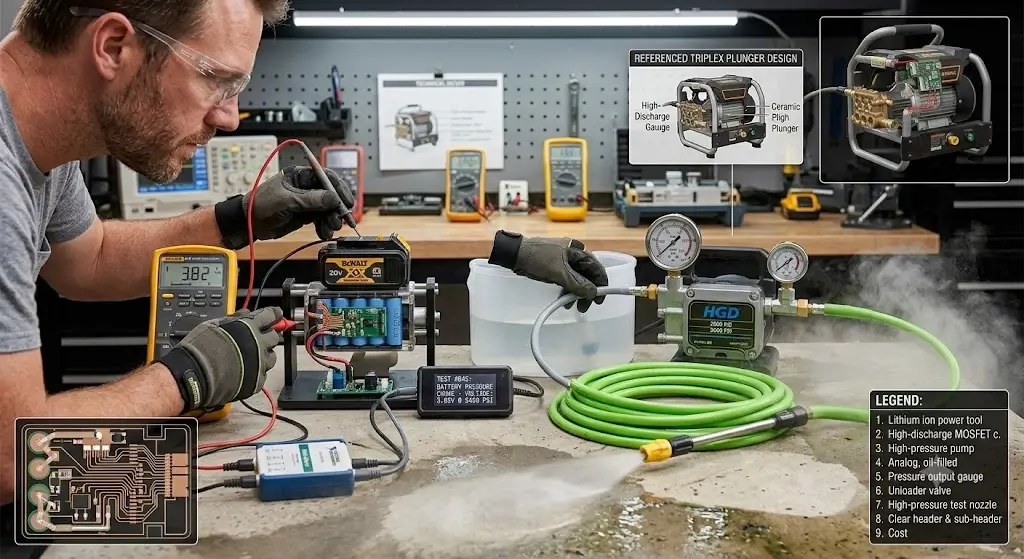
Battery pressure washers are most cost-effective when purchased as “bare tools” within an existing tool ecosystem (such as Milwaukee M18, DeWalt 20V/60V, Ryobi 18V/40V, or EGO 56V). If you already own compatible battery packs and fast chargers, you avoid the heavy markup of bundled batteries.
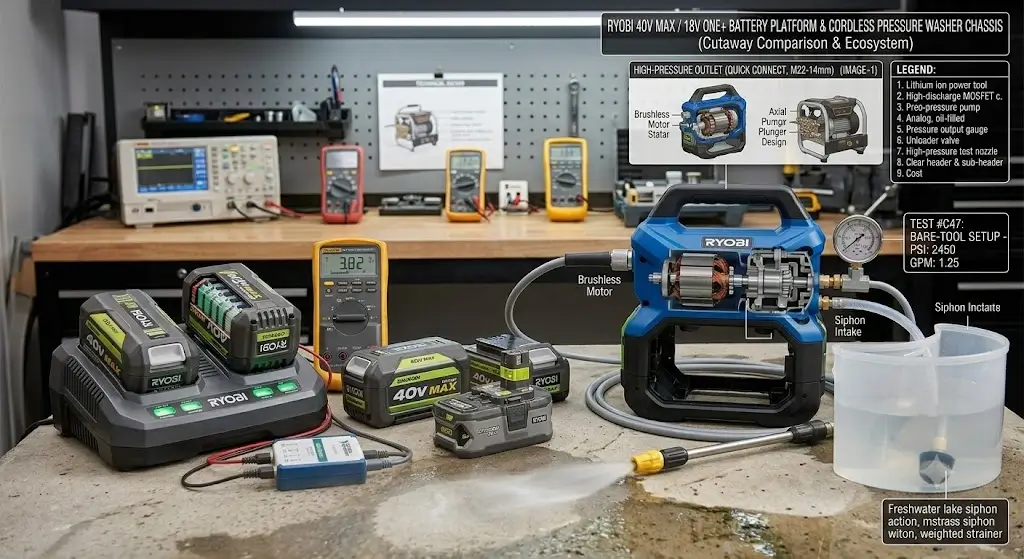
The Battery Ecosystem Decision Rule
- Already own compatible platform batteries? A bare-tool cordless washer delivers exceptional value and low ownership friction.
- Starting from scratch? Compare the full kit price (unit + two batteries + dual charger) against a commercial-grade corded electric washer before investing.
Water Source Flexibility: Garden Hose vs. Bucket Siphon
One of the strongest technical advantages of modern cordless pressure washers is self-priming siphon capability.
| Water Source | Primary Advantage | Primary Limitation |
|---|---|---|
| Pressurized Garden Hose | Delivers maximum machine PSI and GPM | Restricts operation to locations with outdoor faucets |
| 5-Gallon Water Bucket | Enables washing anywhere (parking lots, docks) | Empties in 4 to 6 minutes of continuous spraying |
| Freshwater Lake / River | Unlimited water volume for marine gear | Requires weighted intake filter to block sand and silt |
Water Consumed (Gallons) = Operating GPM × Trigger Minutes
Example: 0.9 GPM × 5 Minutes = 4.5 Gallons used
Long-Term Maintenance and Cold Weather Storage
Cordless pressure washers eliminate internal combustion engine maintenance, but their pumps and lithium cells require specific care:
- Never Store Batteries in Freezing Temperatures: Sub-freezing temperatures degrade lithium cell chemistry and reduce discharge capacity. Store batteries indoors between 50°F and 70°F.
- Winterize the Pump Chamber: Residual water trapped inside plastic or alloy pump heads expands when frozen, cracking the manifold. Use an anti-freeze pump protector before winter storage. Follow our complete guide on how to store a pressure washer.
- Clean the Siphon Intake Screen: Always rinse the weighted intake filter after siphoning from buckets or open water to prevent debris from reaching internal check valves.
Frequently Asked Questions
Are battery-powered pressure washers worth it?
Yes, for the right applications. They excel at portable cleaning, automotive detailing, outdoor patio furniture, boats, RVs, and jobs in areas without convenient electrical outlets. For large concrete flatwork, corded electric or gas machines are more practical.
Are cordless pressure washers as powerful as corded ones?
High-voltage battery platforms (such as 56V systems) deliver working pressures comparable to mid-tier 120V corded machines (1,500–1,800 PSI). However, compact handheld power cleaners (18V/20V) operate at substantially lower output (350–600 PSI) designed primarily for light rinsing.
How long does a battery pressure washer run?
Runtime ranges from 15 to 25 minutes of continuous trigger time on maximum power, and up to 40 to 50 minutes on low/Eco modes. Because vehicle detailing involves intermittent spraying, a single charge can complete a full car wash.
Can a battery pressure washer clean a driveway?
High-output cordless units can clean small sections or spot stains using a turbo nozzle, but they are inefficient on broad driveways due to low water volume (GPM) and finite battery life.
Can a battery pressure washer wash a car?
Yes. Vehicle detailing is the ideal use case for cordless washers. Their working pressure (1,000–1,400 PSI) cleans paint, glass, and wheels safely without clear coat damage, while foam cannon compatibility produces rich cleaning foam.
Can a cordless pressure washer draw water from a bucket?
Yes, provided the machine includes a self-priming pump and a dedicated siphon hose with a weighted check valve. Always verify self-priming capability before purchase, as some models require pressurized water feeds.
Do battery pressure washers need a garden hose?
No. Self-priming models can draw directly from buckets, rain barrels, or portable water jugs, allowing completely off-grid operation away from household faucets.
Is a battery pressure washer better than a gas pressure washer?
For quick residential washdowns and mobile car detailing, battery units are superior because they eliminate exhaust fumes, engine oil maintenance, and loud operating noise. Gas remains the right tool for sustained, heavy-duty commercial flatwork.
Is a battery pressure washer better than a corded electric pressure washer?
Battery is better for mobility and remote locations where cords are hazardous or out of reach. Corded electric is better for continuous runtime, higher sustained flow rates, and lower upfront equipment costs.
Do battery pressure washers use less water?
Yes. Delivering between 0.8 and 1.2 GPM, battery pressure washers consume up to 80% less water than an unrestricted residential garden hose flowing at 5 to 8 GPM.
Does higher PSI mean a better battery pressure washer?
No. PSI must be evaluated alongside GPM, nozzle orifice size, battery runtime, and the target surface. A balanced 1,200 PSI / 1.2 GPM unit cleans faster than a 1,800 PSI / 0.7 GPM unit.
Is a cordless pressure washer good for camping?
Yes. Compact battery washers paired with a collapsible water bucket are ideal for cleaning muddy hiking boots, mountain bikes, kayaks, and off-road vehicles at remote campsites.
Are cordless pressure washers good for RVs?
They are well-suited for RV detailing because their moderate pressure will not compromise delicate exterior window seals, roof seams, or side vents.
Should I buy a cordless pressure washer if I already own a corded one?
Yes, as a secondary tool. Many homeowners keep a heavy corded machine for seasonal driveway cleaning and use a light cordless unit for weekly vehicle detailing and quick patio touchups.
Are high-voltage cordless pressure washers worth the extra money?
Yes, if you need true pressure washing capability (1,500+ PSI) rather than light rinsing, and require complete cord-free mobility across large properties or commercial job sites.
Final Verdict: When Is a Battery Pressure Washer Worth It?
Battery-powered pressure washers are worth the investment when cordless mobility solves an everyday problem.
If you regularly wash vehicles in an apartment parking space, clean boats at a marina slip, rinse camping gear, or want to clean outdoor furniture without untangling 50-foot extension cords, a cordless model delivers unbeatable convenience.
If your primary workload consists of wide concrete driveways, moss-covered brick patios, or multi-hour exterior stripping, choose a corded electric platform or gas equipment to ensure continuous runtime and high water volume.
Buy cordless for portability, instant setup, and light residential detailing. Buy corded electric for continuous patio and siding maintenance. Buy gas for large-area concrete flatwork.
