
Are Pressure Washers Quiet?
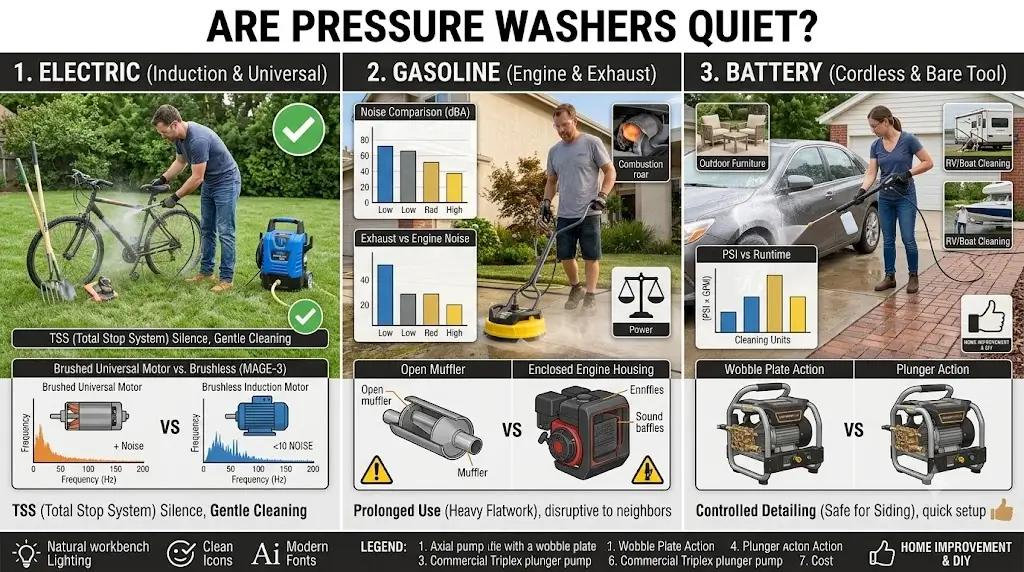
Pressure washers are not usually quiet, but electric pressure washers are generally much quieter than gas-powered models.
The actual noise depends on the motor type, pump design, operating pressure, water flow, chassis enclosure, surface being cleaned, and distance from the machine. A compact electric pressure washer can be relatively unobtrusive for residential use, while a gasoline pressure washer can produce substantially more engine and mechanical exhaust noise.
If low noise is important, do not choose a pressure washer by PSI alone. Look for a published dBA rating measured at a stated distance (typically 3 feet or 1 meter), then consider the machine’s motor architecture, pump design, and how you plan to use it. Explore our tested picks in the best electric pressure washers guide to see verified decibel ratings across top machines.
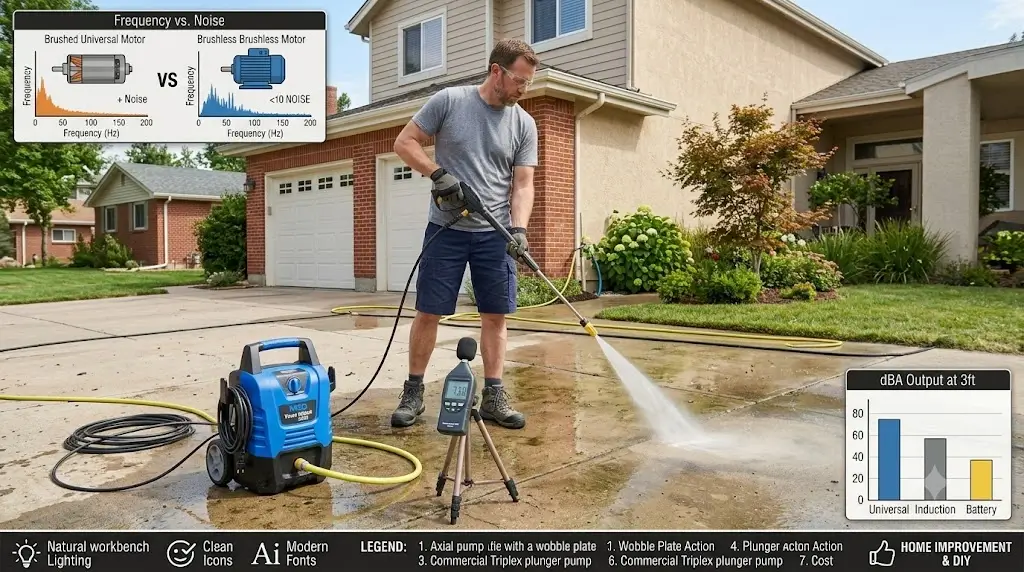
This guide treats pressure washer noise as an acoustic engineering and use-case issue rather than assigning one universal decibel number to an entire product category. Sound pressure varies with operating load, measurement distance, surface reverberation, and pump architecture.
Quick Answer: Are Pressure Washers Quiet?
Not generally. Pressure washers are mechanical systems that combine an electric motor or combustion engine, a reciprocating piston pump, and high-velocity fluid dynamics.
However, there is a substantial acoustic difference between categories:
- Gas pressure washers: Usually the loudest (85–100+ dBA) due to internal combustion, open mufflers, and heavy structural vibration.
- Corded electric pressure washers: Substantially quieter (72–84 dBA), eliminating combustion noise and making them well-suited for suburban neighborhoods.
- Battery pressure washers: Frequently the quietest category (68–74 dBA), emitting only a low-pitch motor hum. Review our guide on whether battery pressure washers are worth it.
- Induction motor electric models: The gold standard for low fatigue, replacing the high-pitched screaming whine of brushed motors with a low-frequency hum.
How Loud Is a Pressure Washer?
Pressure washer noise is documented in decibels, written as dB or dBA. The A-weighted decibel scale (dBA) is standard for power equipment because it matches human hearing sensitivity across high and low frequencies.
A dBA number is meaningful only when you know the exact measurement distance. A machine rated at 74 dBA at 10 feet is significantly louder than a machine rated at 74 dBA at 3 feet. Always look for distance parameters.
| Pressure Washer Category | Tested Noise Level (at 3 ft / 1 m) | Acoustic Pitch & Sound Character | Suburban Neighborhood Suitability |
|---|---|---|---|
| Cordless Battery (e.g., EGO HPW2100) | 68 – 74 dBA | Very quiet fan whir; low hum | Outstanding (Any time of day) |
| Brushless Induction Electric (e.g., Westinghouse WPX3000e) | 72 – 76 dBA | Deep low-frequency thrum | Excellent (Low operator fatigue) |
| Universal Brushed Electric (e.g., Sun Joe SPX3000) | 82 – 86 dBA | High-pitched electric whine | Good (Noticeable across yards) |
| Residential Gas (OHV 4-Stroke Engine) | 86 – 92 dBA | Loud combustion thrum & exhaust roar | Fair to Poor (Hearing protection required) |
| Commercial Gas / Triplex Diesel Rig | 94 – 102+ dBA | Extreme industrial combustion roar | Unsuitable (Violates residential HOA rules) |
Why Are Gas Pressure Washers So Loud?
Gasoline pressure washers combine several independent noise generators running simultaneously:
- Internal Combustion: Rapid fuel-air ignition cycles inside the cylinder head produce high-energy acoustic pressure pulses.
- Muffler & Exhaust Flow: High-temperature exhaust gases exiting the muffler port create a continuous, sharp bark.
- Mechanical Engine Vibration: Reciprocating pistons and rotating crankshaft counterweights transmit vibration into the steel tubular frame.
- Forced-Air Cooling Fans: Flywheel cooling fins pull large volumes of air across cylinder cooling fins, generating air turbulence.
- Pump Reciprocation & Unloader: Ceramic plungers cycling at 3,400 RPM generate mechanical clicking and fluid displacement hammer.
Why Are Electric Pressure Washers Quieter?
Electric pressure washers eliminate combustion entirely. A solid-state rotor spins smoothly inside an electromagnetic stator field, producing zero combustion shockwaves, zero exhaust noise, and significantly less mechanical vibration. For residential workload recommendations, see our guide on the best pressure washer for home improvement.
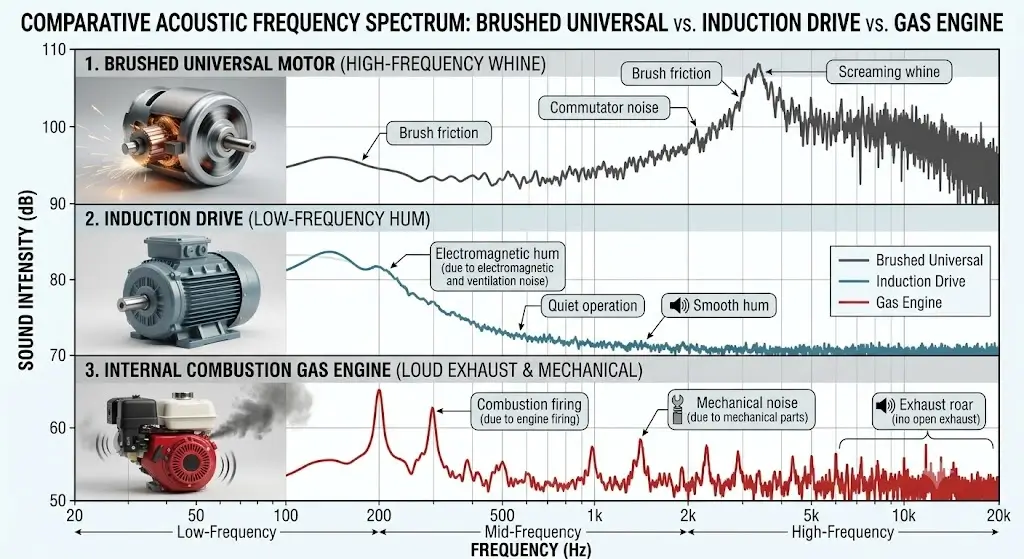
Zero combustion strokes means the primary high-decibel acoustic source is completely gone.
Without hot exhaust gases expanding through an open muffler, neighborhood acoustic footprint drops by over 10 dB.
Electric motors shut off instantly when releasing the trigger, providing total silence between cleaning passes.
Commercial-style brushless induction drives operate around 1,750–2,800 RPM, producing an easy-to-tolerate hum.
What Makes a Pressure Washer Loud?
- Motor or Engine Type: Brushed universal motors spin up to 15,000–20,000 RPM through reduction gearboxes, producing a screaming whine. Brushless induction drives spin at lower RPMs with minimal whine.
- Pump Architecture & Piston Count: Axial cam wobble-plate pumps create rapid pressure pulses. Commercial triplex plunger pumps displace water in smooth, overlapping 120-degree strokes, reducing water hammer.
- Chassis Vibration & Surface Contact: Uninsulated steel frames sitting on flat concrete amplify mechanical vibration like a tuning fork.
- High-Velocity Fluid Exit: Water exiting a tiny 0° or 15° nozzle orifice at 2,000+ PSI shears through ambient air, producing a loud supersonic hiss.
- Surface Reverberation: When high-pressure jets hit rigid concrete or metal siding, the physical impact creates secondary acoustic waves that bounce between walls.
Why Site Acoustics and Distance Change Perceived Noise
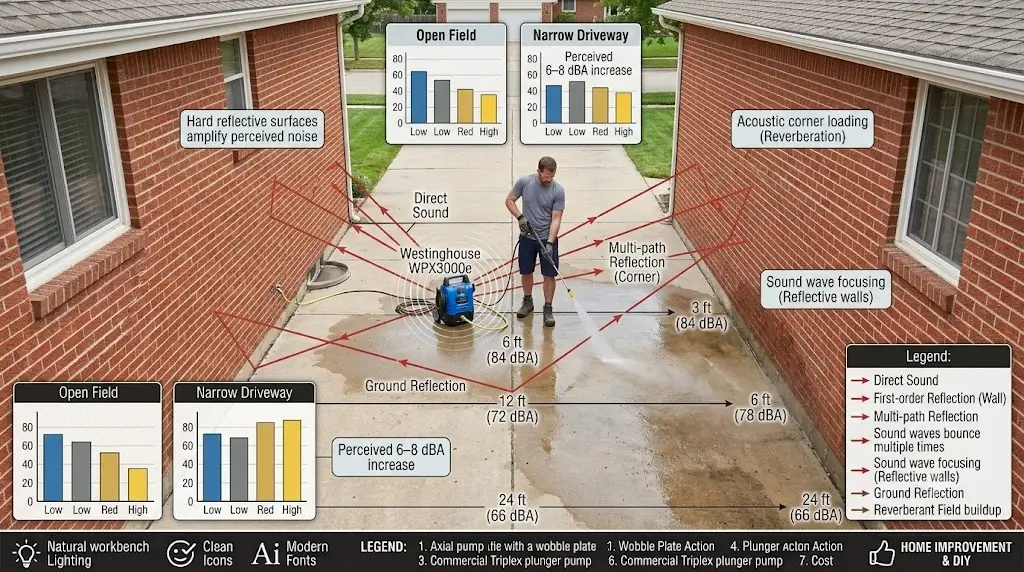
Sound behaves differently in open turf compared to enclosed driveways. The Inverse Square Law dictates that in an open free-field environment, sound pressure drops by approximately 6 dBA every time distance from the source doubles.
Sound Drop-off ≈ 20 × log10(Distance 2 ÷ Distance 1)Example: An 80 dBA washer at 3 ft drops to ≈ 74 dBA at 6 ft, and ≈ 68 dBA at 12 ft
However, when a pressure washer operates in a narrow suburban breezeway between two homes, hard brick and vinyl walls prevent sound dispersion, reflecting acoustic waves back and forth. This can make an electric machine sound up to 6–8 dBA louder than it would in an open yard.
Does Higher PSI or GPM Mean a Louder Machine?
Not directly, but hydraulic power requires motor horsepower. Hydraulic output is defined by hydraulic horsepower:
Hydraulic HP = (Working PSI × Working GPM) ÷ 1714
A machine delivering 3,000 PSI at 2.0 GPM requires roughly 3.5 hydraulic horsepower, demanding a large engine or high-draw electric motor that naturally creates more sound. However, a well-insulated, water-cooled electric motor delivering 2,000 PSI will run significantly quieter than an open-frame 1,600 PSI brushed universal motor.
Pressure Washer Noise Across Different Cleaning Surfaces
| Surface Material | Impact Acoustic Profile | Recommended Noise Management Technique |
|---|---|---|
| Concrete Driveways & Sidewalks | Sharp, highly reflective impact slap | Use an enclosed rotary surface cleaner to trap water spray noise |
| Wood Decks & Fences | Dull, low-frequency absorption thud | Use 25° or 40° wide fan tips at a 12-inch distance |
| Automotive Paint & Glass | Muffled, soft water cascade | Operate with wide 40° nozzle or tip-mounted foam cannon |
| Hollow Vinyl or Metal Siding | Loud drumming reverberation | Avoid spraying directly into hollow corners; use low-pressure soap tips |
How to Make a Pressure Washer Quieter
- Isolate Ground Vibration: Set the machine on a rubber stall mat or thick turf instead of bare concrete to stop frame vibration transmission.
- Keep the Machine Away from Wall Corners: Place the washer in the open driveway rather than up against garage doors or masonry walls to minimize acoustic reflections.
- Use an Enclosed Rotary Surface Cleaner: For flat concrete, surface cleaners enclose spinning jets beneath a rigid plastic or steel dome, muffling water jet noise significantly.
- Maintain Inlet Water Flow: Water starvation causes severe internal cavitation, making the pump clatter and rattle violently. Ensure your supply spigot delivers at least 2.0 GPM.
- Store Properly to Avoid Component Chatter: Winterize your pump to avoid bent valves or loose connecting rods that produce knocking sounds. Review our pressure washer storage guide.
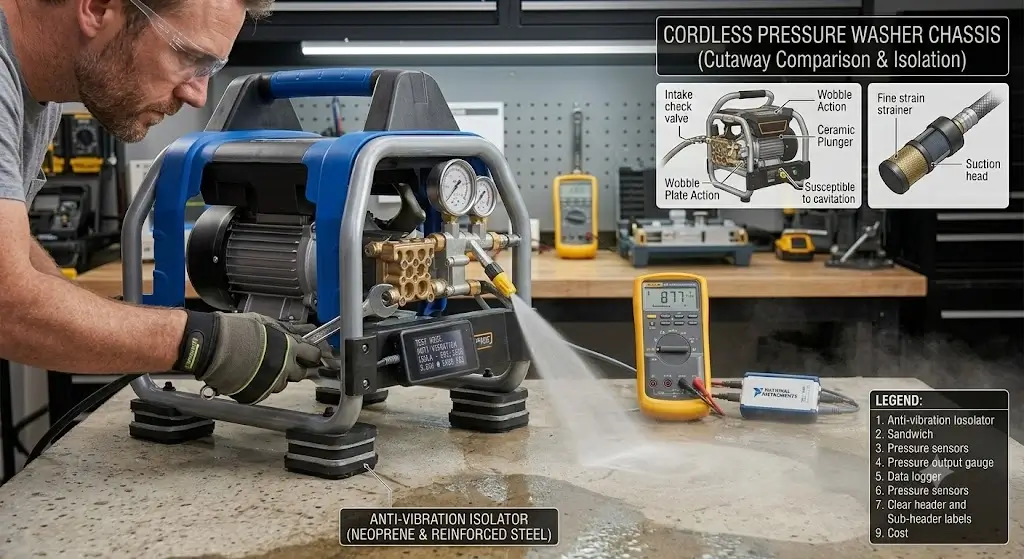
Do not cover a pressure washer with acoustic foam, blankets, or wooden boxes while running. Electric motors overheat within minutes, and gasoline engines produce lethal, odorless carbon monoxide while creating a severe fire hazard.
Frequently Asked Questions
Are pressure washers quiet?
Most pressure washers are not silent, but electric and battery-powered models are generally much quieter than gasoline machines. Total noise depends on motor type, pump architecture, nozzle angle, surface reflectivity, and distance from the equipment.
Are electric pressure washers quiet?
Electric pressure washers are substantially quieter than gas models because they eliminate engine combustion, spark plugs, and open exhaust. They emit between 72 and 84 dBA at 3 feet, producing either a low hum or an electric whine.
Are battery pressure washers quiet?
Yes. Battery pressure washers are typically the quietest platforms on the market, operating between 68 and 74 dBA. Their brushless DC motors generate very little mechanical chatter, making them ideal for noise-restricted neighborhoods.
Are gas pressure washers loud?
Yes. Gas pressure washers operate between 86 and 100+ dBA, comparable to walk-behind lawnmowers and chainsaws. Prolonged exposure without hearing protection can lead to permanent hearing damage.
What is the quietest type of pressure washer?
Compact cordless battery pressure washers and corded electric machines equipped with low-RPM brushless induction motors are the quietest categories available.
How many decibels is a pressure washer?
Sound output ranges from 68 dBA for compact cordless power cleaners to over 100 dBA for commercial gas machines. Standard residential electric washers typically measure between 74 and 84 dBA at a 3-foot test distance.
Does PSI affect pressure washer noise?
PSI does not directly measure acoustic energy. However, higher PSI requires higher motor wattage, which often leads to larger motors and pumps that generate more mechanical and fluid shear sound.
Does GPM affect pressure washer noise?
Higher GPM moves larger volumes of water across the surface, increasing the rushing sound of water impact. However, the machine’s motor and pump remain the dominant acoustic sources.
Are pressure washers too loud for neighbors?
Gas pressure washers can easily trigger neighborhood complaints or violate local noise ordinances if run early in the morning. Electric and battery washers are generally quiet enough for close-quarter suburban lots during daylight hours.
Can I make my pressure washer quieter?
You can reduce noise by placing the unit on a rubber isolation mat, setting it away from reflective brick walls, using an enclosed surface cleaner, and preventing pump cavitation with adequate water supply.
Does a surface cleaner reduce pressure washer noise?
Yes. A rotary surface cleaner encloses high-pressure water jets inside a heavy bristle skirt and dome, noticeably dampening the sharp spray hiss compared to an open spray wand.
Does a foam cannon make a pressure washer quieter?
No. A foam cannon aerates cleaning soap at the spray wand tip. While the spray landing on the vehicle is soft and muffled, the pressure washer motor and pump continue running at full decibel output.
Are brushless pressure washers quieter?
Generally yes. Brushless motors eliminate carbon brush friction and operate with precise digital timing, producing a lower, smoother sound frequency than brushed universal motors.
Is a quiet pressure washer better for car washing?
Yes. Vehicle detailing requires working near the car for 30 to 60 minutes. A quiet electric or cordless washer reduces operator fatigue and allows listening to car panels and foam coverage without hearing protection.
Can pressure washing damage hearing?
Yes. Any machine producing 85 dBA or greater (including almost all gas pressure washers and some brushed electric models) can cause cumulative hearing damage over extended operating sessions. Hearing protection is strongly recommended.
Final Verdict: How to Choose a Quiet Pressure Washer
Do not choose a pressure washer based on vague marketing claims like “whisper quiet.” Every pressure washer contains high-pressure mechanical pumps that produce audible sound.
For quiet residential cleaning:
- Best for Pure Neighborhood Quiet: Choose a cordless battery platform (68–74 dBA).
- Best for Low-Pitch Operator Comfort: Choose an electric washer with a brushless induction motor (72–76 dBA).
- Best for Budget Residential Use: Choose a compact corded universal electric washer (82–84 dBA).
- Avoid for Noise-Sensitive Lots: Gas-powered pressure washers (86–100+ dBA).
If low noise is your priority, select a brushless electric or battery-powered pressure washer with a verified dBA rating under 76 dBA at 3 feet. You eliminate engine exhaust and neighborhood friction while retaining all the cleaning power required for residential chores.
