
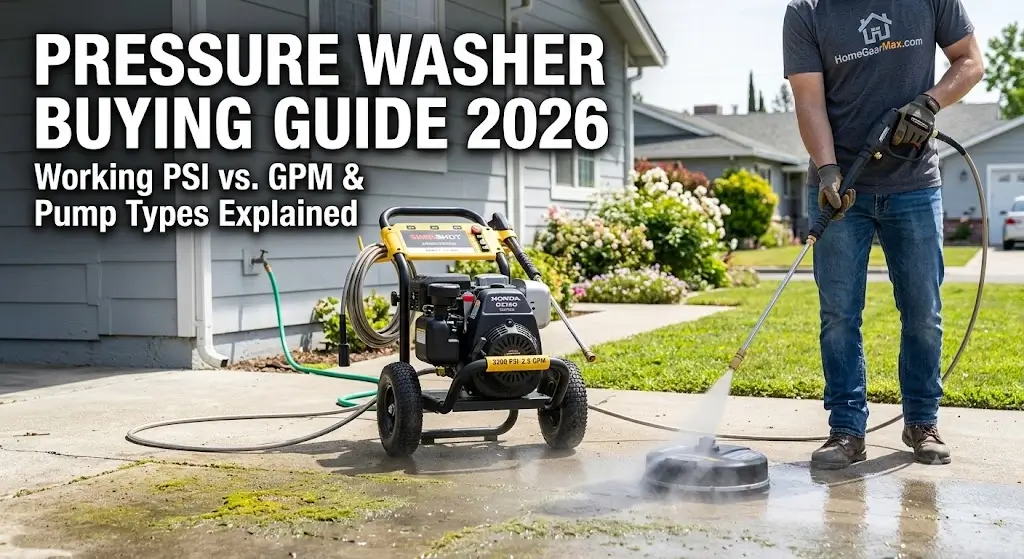
Pressure Washer Buying Guide 2026: PSI vs. GPM, Pump Types & How to Choose
When shopping for a pressure washer, most buyers fall into a common marketing trap: focusing solely on the bold PSI rating printed on the box. Relying on peak pressure alone often leads to purchasing an underpowered or inefficient machine that turns a routine driveway wash into a slow, tedious chore.
This guide evaluates pressure washers through mechanical design, pump construction, flow rates, and real-world practical tradeoffs to help you make an informed purchase decision.
1. Engineering Metrics: Working PSI vs. GPM
Understanding machine performance requires distinguishing between pressure force and water volume:
- Working PSI: The pressure delivered during normal operation. When a manufacturer publishes both working and peak PSI, use working PSI for performance comparisons because peak figures may not represent sustained operating pressure. Working PSI contributes to stripping force, but actual surface impact also depends on nozzle orifice size, spray angle, nozzle distance, and flow rate.
- GPM (Gallons per Minute): Water flow volume delivered per minute. GPM dictates rinsing capacity and cleaning speed. Higher GPM allows dislodged debris to wash away quickly and powers broader cleaning attachments such as surface cleaners.
Example A: 1,000 Working PSI × 2.0 GPM = 2,000 CU
Example B: 3,200 Working PSI × 2.5 GPM = 8,000 CU
Technical Note on CU: Cleaning Units (CU) serve as a useful comparative heuristic between models, but CU is not a direct physical measurement of cleaning speed. A higher CU score does not automatically mean faster cleaning on every surface. Real-world performance also depends on nozzle orifice size, spray pattern angle, surface cleaner diameter, detergent chemistry, and substrate condition.
2. What Specifications Matter Most?
| Specification | Why It Matters | What to Look For |
|---|---|---|
| Working PSI | Determines impact force for breaking bonds on tough grime | Focus on continuous working pressure, not peak burst ratings |
| GPM Flow Rate | Determines water throughput and rinsing speed | Higher flow can reduce rinse time; match flow to the machine, hose, water supply, and attachment |
| Pump Architecture | Dictates mechanical durability and serviceability options | Triplex for extended duty; Axial for moderate residential use; Wobble for light occasional tasks |
| Hose Diameter & Construction | Affects pressure loss, flexibility, and handling | Consider inside diameter, hose length, construction material, and fittings rather than diameter alone |
| Water Supply | Prevents pump starvation and unstable operation | Verify adequate inlet flow and pressure under operating conditions; avoid restrictive hoses, fittings, or partially opened valves |
3. Recommended Setup Matrix by Cleaning Task
| Cleaning Task | Target Working PSI | Flow Priority | Recommended Pump Type | Recommended Setup & Nozzle | What to Avoid |
|---|---|---|---|---|---|
| Car Washing / Detailing | 1,000 – 1,200 PSI | High (2.0 GPM) | Axial or Wobble Electric | 40° wide nozzle or foam cannon setup; see our guide on electric pressure washers | Avoid narrow, high-impact nozzles (0° or 15°) that damage clear coats |
| Patio Furniture & Wood Decks | 1,200 – 2,000 PSI | Moderate | Axial Electric or Small Gas | 25° or 40° nozzle; test distance on wood | Avoid holding nozzle closer than 12 in. to timber to prevent gouging fibers |
| Vinyl House Siding | 1,500 – 2,500 PSI | Moderate–High | Axial Cam Gas or High-End Electric | 25° nozzle or soft-wash downstream chemical application | Avoid spraying high pressure directly into soffit vents or under lap siding seams |
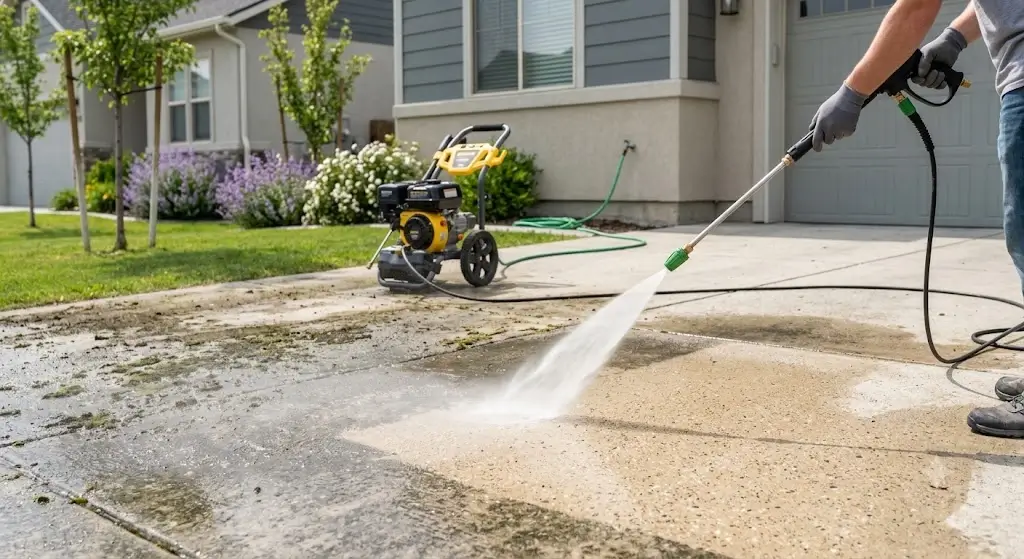
| Concrete Driveways & Masonry | 2,800 – 3,500 PSI | High (2.3+ GPM) | Axial Cam or Triplex Gas | Gas unit paired with a 12 in.–15 in. surface cleaner; see our guide on driveway pressure washers | Avoid excessive pressure or pinpoint 0° tips on cracked, spalled, or newly cured concrete |
4. Pump Architecture & Serviceability
The motor or engine provides drive power, but the pump architecture dictates serviceability and operational durability over time.
| Architecture | Serviceability Profile | Mechanical Design Characteristics |
|---|---|---|
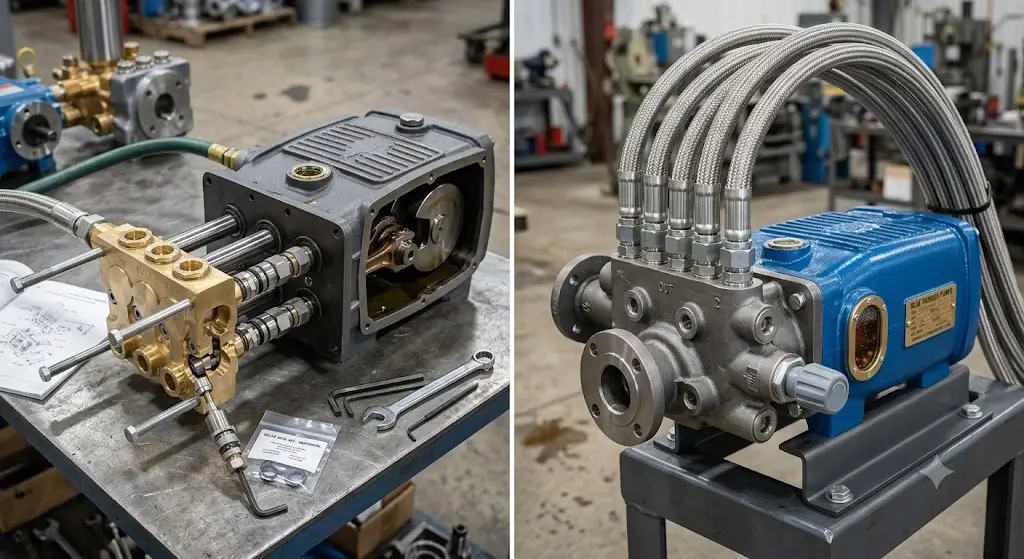
| Wobble Plate Pump | Usually replaced rather than rebuilt | Rotary swashplate actuates spring-loaded pistons in light housings. Common on entry-level electric washers. |
| Axial Cam Pump | Limited serviceability | Pistons run parallel to the drive shaft. Direct engine-speed rotation creates higher thermal load; sealed oil baths are rarely drainable. |
| Triplex Plunger Pump | High serviceability (Rebuildable) | Many commercial triplex designs use ceramic plungers and brass manifolds with replaceable seals and valves driven by a crankshaft. |
5. Gas vs. Electric Mechanical Comparison
| Feature | Electric Pressure Washer | Gas Pressure Washer |
|---|---|---|
| Typical Output Profile | Light–medium residential (1,000–1,400 Working PSI typical) | Medium–heavy residential & commercial (2,800–4,000+ Working PSI) |
| Flow Characteristics | Often lower (1.1 – 2.0 GPM) | Often higher (2.3 – 4.0 GPM) |
| Noise & Emissions | Quiet operation; zero local emissions | Loud engine noise (85+ dBA); exhaust emissions |
| Maintenance Requirements | Low (Plug-and-play, electrical safety checks) | Moderate (Engine oil, spark plug, air filter, fuel treatment) |
| Electrical Capacity Limit | A 120V / 15A branch circuit has a nominal electrical capacity of 1,800 VA; usable mechanical output is lower after losses. | Gasoline engines (160cc to 390cc+) generate substantially higher mechanical horsepower. |
| Mobility Constraints | Cord and outlet limited | Fuel dependent; highly mobile outdoors |
6. Recommended Models Overview
| Category | Model | Engine / Motor | Pump Type | Rated Specs | Key Application | Primary Constraint |
|---|---|---|---|---|---|---|
| Residential Gas | Simpson MegaShot MSH3125 | Honda GC190 | Axial Cam | 3,200 PSI / 2.5 GPM | Concrete driveways & residential siding | Axial pump requires bypass idle management |
| Heavy-Duty Gas | Simpson PowerShot PS3228 | Honda GX200 | Triplex Plunger | 3,300 PSI / 2.5 GPM | Contractor use & heavy property maintenance | Frame mass (77 lbs) and initial footprint |
| Electric Detailing | Active 2.0 Electric | 120V Electric Motor | 5-Piston Axial | 1,000 Working PSI / 2.0 GPM | Automotive washing & foam cannon application | Lower working PSI for unsealed concrete stripping |
| Compact Electric | Kärcher K2 Plus | Universal Electric | Wobble Plate | 1,600 Peak PSI / 1.25 GPM | Light patio furniture & small balcony tasks | Non-serviceable pump architecture |
7. Critical Operational Pitfalls & Prevention
| Operational Pitfall | Mechanical Consequence | Corrective Action |
|---|---|---|
| 1. Over-indexing on Peak PSI | Slow cleaning pace due to insufficient water volume (GPM) | Evaluate Working PSI alongside GPM flow rates. |
| 2. Operating Pump Dry | Rapid friction damage to rubber seals and internal packings | Ensure water supply is fully connected and purge trapped air prior to startup. |
| 3. Excessive Bypass Idling | Water recirculates internally, building heat in the pump manifold | Avoid prolonged bypass operation and follow manufacturer idle time guidance. |
| 4. Undersized Extension Cords | Voltage drop causing electric motor overheating | Use the cord gauge and maximum length specified by the manufacturer for high-amp equipment. |
| 5. Storing Stagnant Ethanol Fuel | Carburetor gumming and fuel system corrosion | Use ethanol-free fuel or add fuel stabilizer prior to storage. |
| 6. Freezing Storage Without Prep | Trapped water expands, risking pump housing cracks | Flush pump with a compatible pump protection/antifreeze fluid to help protect from freeze damage. |
| 7. Incorrect Nozzle Selection | Surface gouging on soft timber or automotive paint damage | Use wider spray angles (25° or 40°) and test on an inconspicuous area first; see our pressure washer nozzle guide. |
| 8. Wrong Pressure Setting for Detergent | Downstream injector fails to siphon soap solution | Apply low-pressure detergent setting (Black nozzle) paired with appropriate pressure washer soap. |
8. US Buyer Considerations: CARB, Climate & Water Conditions
- California (CARB Compliance): Some gas pressure washer configurations are sold as 49-state models and are not available for California sale. For example, Simpson currently lists the MSH3125(-S) and PS3228(-S) as 49-state products. Verify the exact model number and emissions compliance before purchasing.
- Hard Water Areas: Mineral scaling from hard water can accumulate inside pump manifolds and unloader assemblies over time. In hard-water regions, inspect inlet screens regularly and follow manufacturer descaling recommendations.
- Freeze-Thaw Regions: Storage in unheated garages during freezing temperatures risks severe pump housing damage from expanding ice. Following a winterization procedure with pump antifreeze helps protect components.
- High-Altitude Operation: At high elevation, gasoline-engine performance can decline because of reduced air density. Some naturally aspirated small engines may require high-altitude carburetor adjustment according to engine manufacturer specifications.
9. Maintenance & Winterization Guidelines
Winterization procedures vary by pump design. Use a pressure-washer pump-protection product compatible with the pump and follow both the product instructions and the pressure washer manufacturer’s storage procedure.
General Pre-Operation Checklist
- Connect a 5/8 in. minimum diameter garden hose to the pump inlet filter.
- Turn the water supply valve fully open.
- Squeeze the spray gun trigger to purge trapped air from the hose and pump system until a steady stream emerges.
- Start the motor or engine while holding the trigger squeezed to relieve starter cord backpressure.
General Winterization Sequence
- Disconnect spray wands, high-pressure hoses, and water supply lines.
- Attach a bottle of pressure washer pump shield/antifreeze to the pump inlet connection according to product directions.
- Cycle the pump according to the antifreeze product instructions until protective fluid exits the outlet port.
- Treat remaining gasoline with stabilizer and run the engine until the carburetor bowl is emptied, if applicable.
10. Frequently Asked Questions
How much PSI do I need for cleaning concrete driveways?
For large residential concrete surfaces, a pressure washer with roughly 2,800–3,500 PSI and 2.3–2.5 GPM provides a strong combination of impact and water volume. Actual requirements vary with surface condition, cleaning chemistry, nozzle selection, and whether a surface cleaner is used. Start with the lowest effective pressure and increase only when necessary.
Can I run hot water through a standard cold-water pressure washer?
Do not exceed the maximum inlet-water temperature specified by your pressure washer manufacturer (for example, Active rates the 2.0 for water up to 104°F / 40°C). Standard cold-water pump seals and check valves can deform under high thermal loads. Hot-water pressure washers are specifically designed for higher-temperature operation.
What is the function of an unloader valve?
An unloader valve routes water flow back into the pump inlet loop when the spray gun trigger is released, preventing dangerous pressure buildup while the drive motor continues running.
How do I clear a clogged quick-connect spray nozzle?
Shut off the machine and release trapped line pressure. Remove the nozzle from the spray wand. Use the nozzle-cleaning tool supplied by the manufacturer, or follow the manual’s nozzle-cleaning procedure to clear debris from the orifice.
Is a surface cleaner attachment necessary for large flat areas?
A surface cleaner uses dual rotating nozzles beneath a protective housing to cover a uniform cleaning path. It can substantially reduce striping and operator passes on large flat surfaces compared with a handheld wand.
Final Editorial Verdict
- For General Homeowners: The Simpson MegaShot MSH3125 (Gas) offers a strong combination of cleaning flow, Honda engine reliability, and overall value.
- For Auto Detailers & Light Duty: The Active 2.0 (Electric) provides high GPM flow tailored for automotive washing without gasoline exhaust or maintenance.
- For Heavy-Duty & Commercial Work: The Simpson PowerShot PS3228 (Gas) provides an industrial Honda GX engine and a rebuildable Triplex plunger pump built for extended service lives.
