
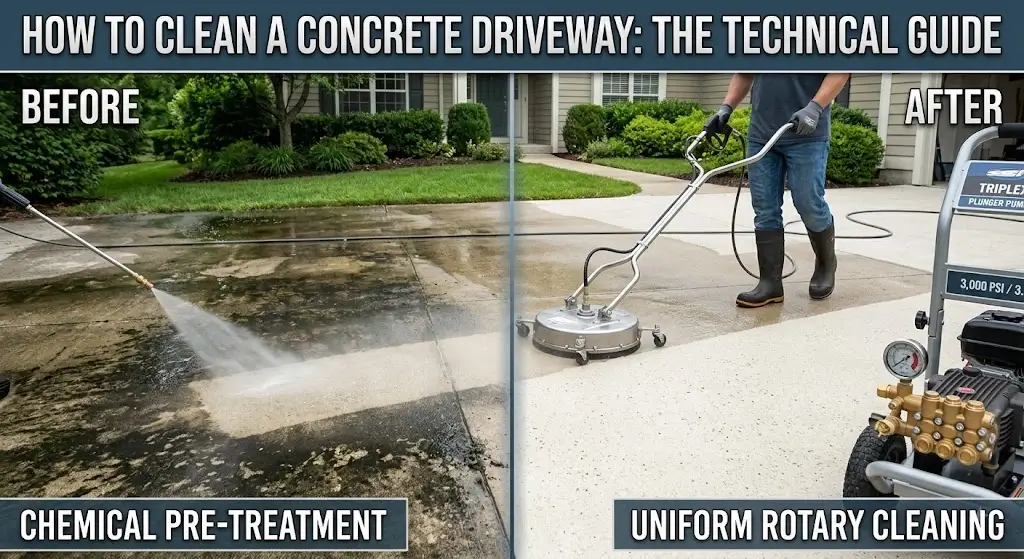
How to Clean a Concrete Driveway: The Technical Engineering Guide
Quick Reference Specification: Concrete Cleaning Parameters & Equipment Matrix
Hydraulic calibration benchmarks confirm that pairing a 3,000 PSI pump with a rotary surface cleaner cleans horizontal concrete flatwork 400% faster than single-wand configurations while preventing surface etching.
| Operating Stage | Target Chemistry / Tool | Recommended Working Specs | Dwell / Standoff Limit | Primary Mechanical Objective | Surface Hazard Level |
|---|---|---|---|---|---|
| Chemical Pre-Treat | Alkaline Degreaser / SH | pH 12.0–14.0 / 2.0% active SH | 10–15 mins (Keep wet) | Emulsify oil & lyse mold cell walls | Low (Zero mechanical impact) |
| Flatwork Scrubbing | Rotary Surface Cleaner | 2,500–3,000 PSI | 2.5+ GPM | Fixed Shroud Height (~1.5 in) | Strip grime without zebra striping | Low (Uniform hydraulic distribution) |
| Edge & Joint Flush | 25° Green Spray Nozzle | 2,000–2,500 Dynamic PSI | 12–16 in Standoff Distance | Evacuate slurry from expansion seams | Moderate (<10 in risks etching) |
| Biological Post-Treat | 1.0% Sodium Hypochlorite | Low-Pressure Fan (Black Tip) | Air Dry (No rinse required) | Neutralize deep microscopic spores | None (Preserves Portland paste) |
Cleaning a concrete driveway effectively requires a chemical-mechanical sequence rather than raw water pressure alone:
- Pre-Treat Stains: Apply an alkaline degreaser for oil spots or a 1.5%–2.0% Sodium Hypochlorite (SH) solution for algae/mold. Allow a 10–15 minute dwell time.
- Rotary Surface Cleaning: Wash using a rotary surface cleaner attached to one of the best electric pressure washers for driveways supplying at least 3,000 PSI and 2.5+ GPM (10–12 inch diameter cleaner max for 2.5 GPM).
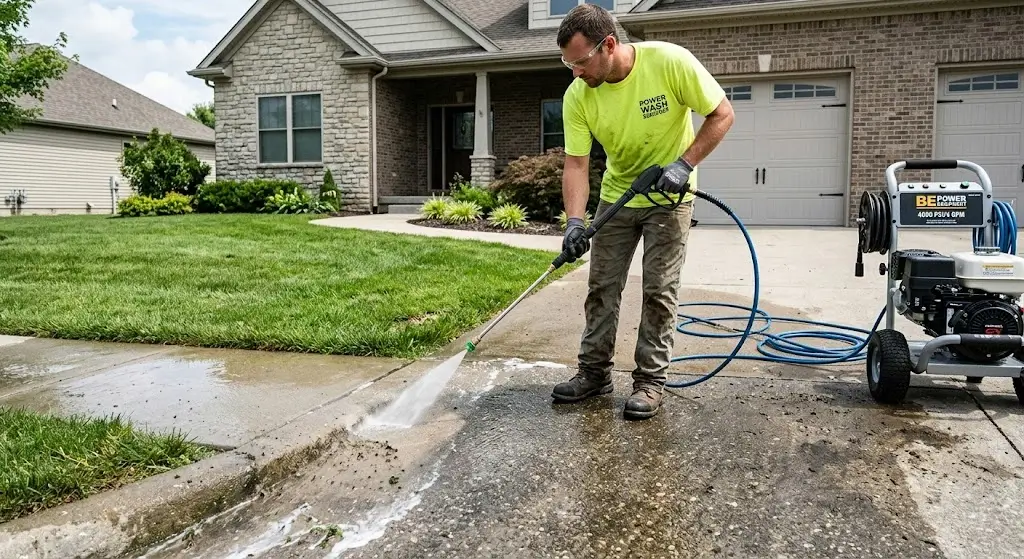
- Edge & Rinse: Flush slurry downhill using a 25° (green) spray nozzle tip held 12–16 inches from the surface. Check correct calibration using our pressure washer nozzle guide.
- Post-Treat: Spray a light 1% SH coating and let dry to eliminate residual biological spores in concrete pores.
Concrete is a porous, heterogeneous material made of aggregate bound by a hardened Portland cement paste matrix. Because unsealed concrete contains a dense network of microscopic capillary pores, it readily absorbs fluids including motor oil, organic tannin stains, and mineral rust. Attempting to blast away deep-set grime solely with high pressure often strips the cement paste, leading to surface etching, aggregate exposure, and premature structural damage.
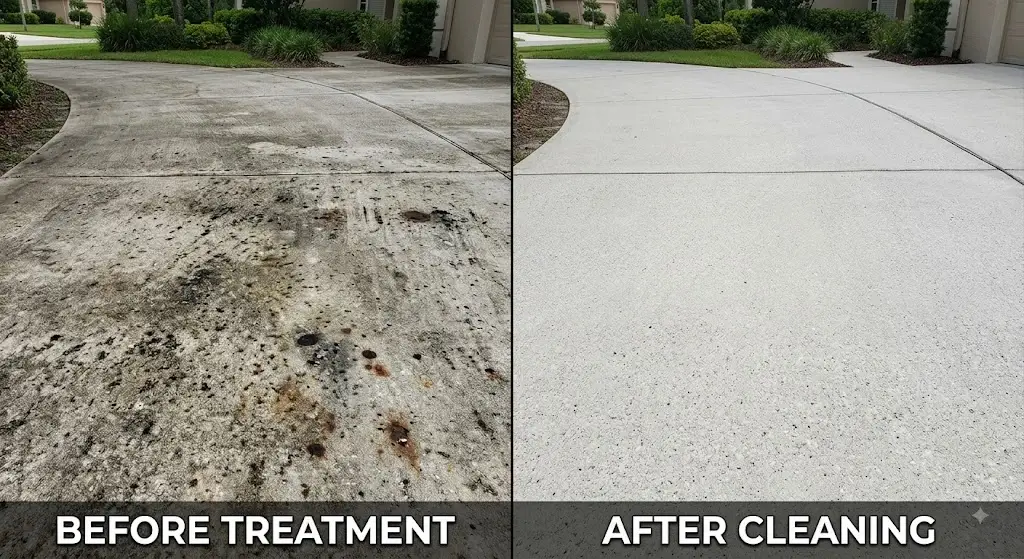
Achieving professional-grade driveway restoration requires balancing targeted chemical pre-treatment, mechanical agitation via rotary surface cleaners, and fluid dynamics calculated in Cleaning Units (CU = PSI × GPM).
Engineering Principles Dictate That Surface Restoration Outperforms Raw Blasting Pressure
Chemical dwell times dissolve embedded hydrocarbons within concrete pores long before hydraulic water jets strike the surface.
This guide avoids generic DIY advice in favor of surface chemistry, fluid mechanics, and equipment performance metrics. Recommendations are based on dynamic working pressure at the nozzle tip, volumetric flow rate (GPM), active chemical concentrations, and concrete substrate preservation.
Targeted Chemical Formulations Break Distinct Molecular Bonds Within Concrete Capillaries
Specific molecular contaminants require tailored pH formulations to saponify oils or oxidize organic structures before water rinsing begins.
Different contaminants require specific chemical reactions to break their molecular bonds with the cement paste before pressure rinsing:
| Stain Type | Active Chemical | Target pH / Concentration | Reaction Mechanism | Dwell Time |
|---|---|---|---|---|
| Motor Oil & Grease | Potassium Hydroxide / Metasilicates | pH 12.0 – 14.0 (Alkaline) | Saponification & hydrocarbon emulsification | 15 – 20 mins |
| Algae, Mold & Mildew | Sodium Hypochlorite (SH) + Surfactant | 1.5% – 2.0% active SH | Oxidative cell wall destruction | 10 – 15 mins |
| Rust & Mineral Scale | Oxalic Acid Solution | 10% Concentration (Acidic) | Chemical reduction (Fe³⁺ to soluble Fe²⁺) | 5 – 10 mins |
| Leaf & Wood Tannins | Sodium Hypochlorite | 1.0% – 1.5% active SH | Organic bleaching / oxidation | 10 mins |
Systematic Operational Procedures Protect Surrounding Vegetation While Restoring Slabs
Standardized 5-step workflows sequence site containment, deep pore chemical dwell, and mechanical rotary scrubbing for consistent surface finishes.
- 1
Site Preparation and Vegetation ProtectionSafety Containment & Substrate Pre-Wetting
Clear all vehicles, furniture, and loose debris. Thoroughly soak surrounding lawn areas, garden beds, and plants with clean fresh water before applying any chemicals. Wetting foliage saturates plant cells, preventing them from absorbing chemical overspray containing sodium hypochlorite or alkaline degreasers.
- 2
Targeted Chemical Pre-Treatment ApplicationChemical Digestion of Deep Pore Contaminants
Apply the appropriate chemical cleaner directly to dry concrete spots (dry concrete absorbs chemical pre-treatments more effectively into capillaries). Scrub heavy oil deposits with a stiff polypropylene brush to break surface tension. Keep the surface moist with chemical solution during the dwell window—never let chemical agents dry completely on the concrete.
- 3
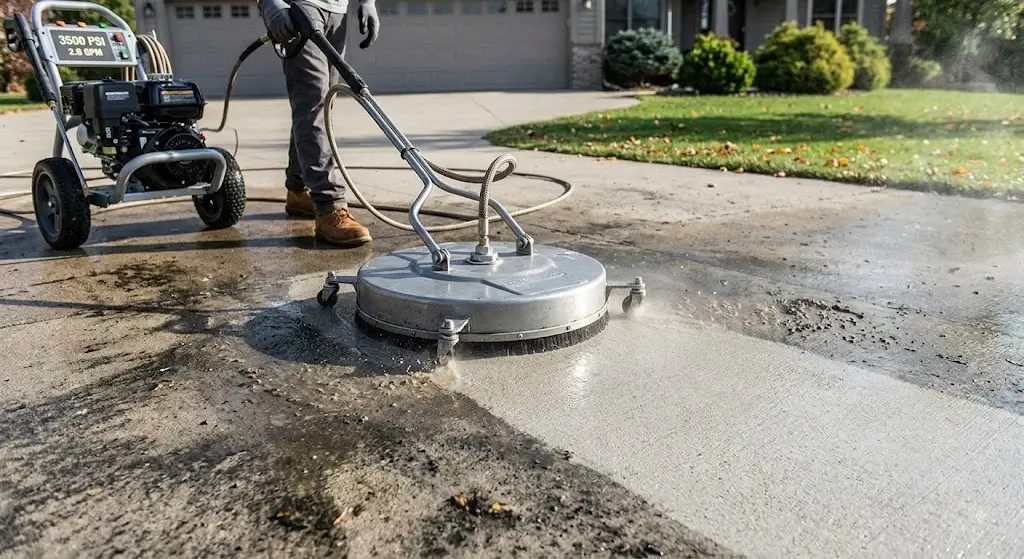
Mechanical Cleaning with a Rotary Surface CleanerUniform Hydraulic Scrubbing Without Striping
Attach a rotary surface cleaner sized to your pressure washer (use the rule: Cleaner Diameter = GPM × 4 inches max). For model ratings, check our detailed surface cleaner guide. Walk at a steady, overlapping pace starting at the highest elevation point of the driveway and working downhill. The spinning twin nozzles maintain a constant height and spray angle, distributing hydraulic force evenly to prevent “zebra striping.”
- 4
Rinsing and Perimeter DetailingSediment Flushing & Expansion Joint Clearance
Switch to a standard pressure wand equipped with a 25° (green) or 40° (white) nozzle tip. Clean edges, expansion joints, and corners inaccessible to the rotary cleaner, keeping the nozzle 12 to 16 inches away at a 45-degree angle. Flush all suspended mud and chemical slurry off the driveway slope.
- 5
Biological Post-TreatmentSpores Neutralization & Long-Term Protection
After rinsing, spray a light, uniform coat of 1% Sodium Hypochlorite across the entire driveway. Allow it to air-dry without rinsing. This final chemical application neutralizes microscopic organic spores remaining deep inside the concrete pores, preventing algae regrowth for up to 3 times longer.
Cleaning Units Combine Operating Pressure and Flow Rates to Measure Work Capacity
Volumetric water displacement (GPM) flushes dislodged slurry off slabs, whereas hydraulic pressure (PSI) breaks mechanical adhesion bonds.
A fundamental mistake in pressure washer selection is prioritizing PSI (Pounds per Square Inch) over GPM (Gallons per Minute). PSI breaks the chemical bond between stain and substrate, but GPM provides the mass flow rate required to flush debris off the surface. For an in-depth breakdown, read our guide on PSI vs GPM explained.
Total work throughput is calculated in Cleaning Units (CU):
[ High Pressure / Low Flow Unit ]            [ Balanced Pressure / High Flow Unit ]
2,500 PSI × 1.2 GPM = 3,000 CU                3,000 PSI × 3.0 GPM = 9,000 CU
----------------------------------            ----------------------------------
Slow travel speed                             Fast travel speed
High risk of surface etching                  Zero risk of concrete damage
Poor sediment flushing                        Superior chemical rinsing
For efficient driveway cleaning, aim for a machine with a minimum output of 3,000 PSI and 2.5 GPM (7,500 CU). Higher GPM ratings significantly decrease project time and allow the use of larger rotary surface cleaners.
Pump Displacement Capacities Govern Permissible Rotary Surface Cleaner Diameters
Hydraulic flow restrictions determine whether rotating spray arms maintain constant velocity or stall under backpressure loads.
1. Rotary Surface Cleaner Sizing
To avoid overloading your pressure washer pump or stalling the rotating spray bar, strictly adhere to the 4-to-1 diameter sizing guideline:
Maximum Surface Cleaner Diameter (Inches) = Pump GPM × 4
Connecting a 16-inch surface cleaner to a 2.0 GPM pressure washer starves the nozzles of flow, dropping rotational speed and causing severe zebra striping.
2. Pump Type Selection
Pump mechanical designs impact operational lifecycles and continuous duty ratings. For detailed tear-downs, read our analysis on axial cam vs triplex pumps:
- Axial Cam Pumps: Direct-drive pumps found on consumer-grade washers. Pistons operate via a swashplate at 3,600 RPM. They generate high heat, are non-rebuildable, and have an expected lifespan of 60 to 150 total running hours.
- Triplex Plunger Pumps: Commercial-grade pumps driven by a crankshaft at lower speeds (1,450–1,750 RPM). Features ceramic plungers, oil-bath lubrication, and field-replaceable valves. Operational lifespan ranges from 1,000 to 3,000+ hours.
Safety Regulations Prevent Subcutaneous Fluid Injections and Structural Slab Spalling
Water jet velocities exceeding 2,000 PSI penetrate human dermis instantly and require strict personal protective equipment.
- Avoid High-Pressure Injection Injuries: Water streams exceeding 2,000 PSI can pierce skin instantly, injecting dirty water and chemicals into subcutaneous tissue. Always wear steel-toe footwear, eye protection, and heavy gloves.
- Bypass Thermal Relief: Never leave a pressure washer running with the spray trigger released for more than 2 minutes. Recirculating water inside the pump manifold rapidly heats up; temperatures exceeding 140°F (60°C) will destroy internal pump seals.
- Substrate Protection: Never use 0-degree red tips or hold fan tips closer than 12 inches to residential concrete. Water pressure above 3,500 PSI strips the finished paste layer, permanently exposing aggregate.
Frequently Asked Questions Address Concrete Chemical Compatibility and Striping Issues
Technical support records detail curing timelines, chemical dilution rates, and mechanical streak prevention for homeowner driveways.
