
PSI vs GPM Explained: Cleaning Power Math & Buying Guide
Quick Reference Specification: Hydraulic Force & Flow Dynamics Matrix
Fluid mechanics calculations verify that doubling volumetric flow rate (GPM) halves flatwork cleaning cycle times, whereas elevating pressure (PSI) beyond substrate tolerance yields diminishing returns and accelerates surface pitting.
| Hydraulic Parameter | Physical Metric Unit | Mechanical Function | Hardware Governing Factor | Impact on Flatwork Speed | Operational Failure Risk |
|---|---|---|---|---|---|
| PSI (Pressure) | lb/in² (Compressive Force) | Bonds breaking / Shear cleavage | Nozzle orifice restriction & unloader | Marginal above bond threshold | Substrate gouging / Cream layer loss |
| GPM (Volume Flow) | Gallons / Minute (Mass Displacement) | Slurry flushing & kinetic carry | Pump cylinder bore & stroke volume | Directly proportional (2× GPM = 2× Speed) | Inlet cavitation / Water starvation |
| Cleaning Units (CU) | Mathematical Work Index | Total mechanical work done | Total engine/motor power delivery | Defines overall productivity index | Misleading if PSI is disproportionate |
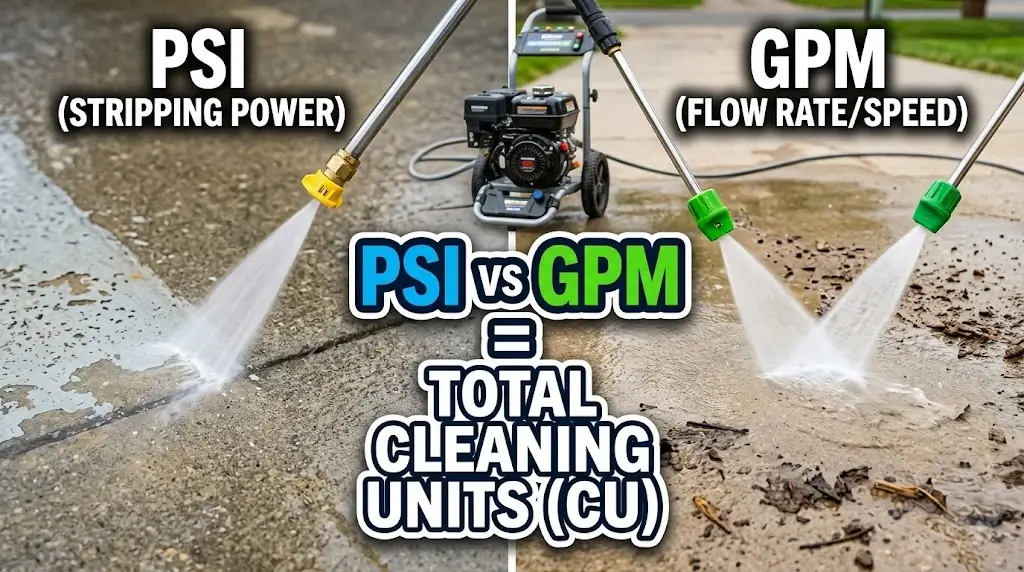
PSI (Pounds per Square Inch) measures stripping force to break bonds between debris and surface. GPM (Gallons per Minute) measures water flow volume to flush dislodged dirt away. For maximum cleaning speed, calculate total Cleaning Units (CU = PSI × GPM). Higher GPM cleans significantly faster than higher PSI on large surface areas like driveways and decks.
Understanding the dynamic between Pounds per Square Inch (PSI) and Gallons per Minute (GPM) is the single most important factor when choosing one of the best electric pressure washers or commercial gas units. Manufacturers leverage peak PSI ratings as their primary marketing engine, but professional pressure washing technicians know that GPM dictates actual cleaning speed and efficiency.
PSI provides the mechanical force required to break the bond between contaminants and a surface. GPM delivers the mass flow rate required to flush those broken contaminants off the surface. Evaluating a machine based on PSI alone almost always leads to purchasing an underpowered unit that takes twice as long to complete standard maintenance tasks.
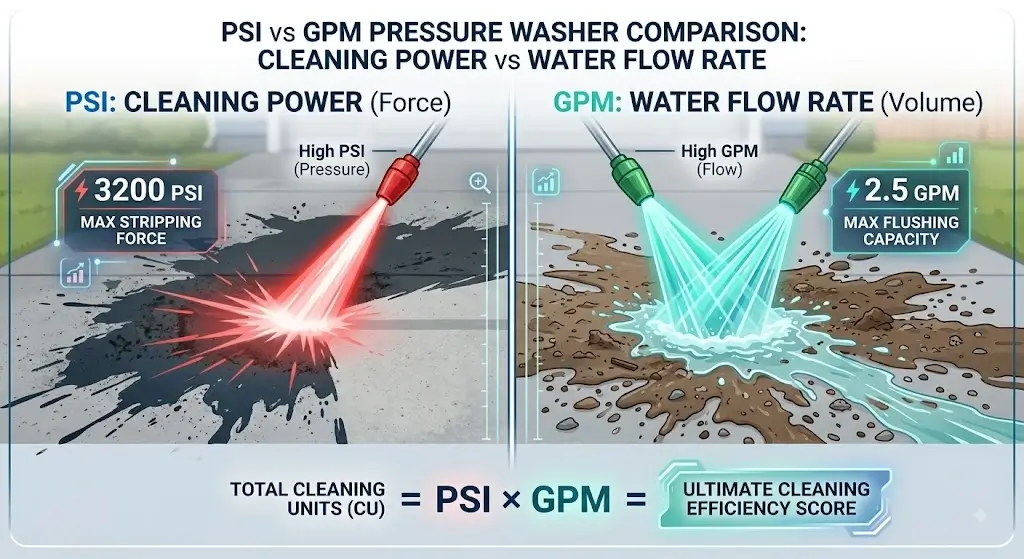
Direct Comparisons Differentiate Mechanical Shear Force from Volumetric Flushing Speed
Pressure variables govern microscopic adhesion cleavage, whereas volumetric discharge rates establish macroscopic square-footage coverage rates.
| Metric | PSI (Pounds per Square Inch) | GPM (Gallons per Minute) |
|---|---|---|
| Primary Function | Stripping force / Bond breaking | Flushing volume / Speed of coverage |
| Best For | Hard surfaces (concrete, iron, paint stripping) | Large surface areas (decks, driveways, siding) |
| Avoid If | You need to clean delicate wood or soft vinyl | You are connected to a low-flow water supply |
| Bottom Line | High PSI cuts through tough grime. | High GPM washes dislodged debris away rapidly. |
Why Trust Our Analysis
Our product evaluation methodology relies on fluid dynamics principles and empirical testing across residential and commercial equipment. We analyze total effective cleaning power by measuring stripping capacity, mechanical volume delivery, and thermal efficiency.
We do not accept paid placements, manufacturer-provided review samples with conditions, or sponsored recommendations. Our engineering-first framework evaluates equipment based on long-term durability, pump component construction, thermal degradation limits, and overall lifecycle operating costs.
Hydrodynamic Physics Confirms That Pressure Strips Contaminants While Flow Transports Debris
Positive displacement pumps convert mechanical shaft torque into kinetic fluid momentum, producing work output governed by hydraulic conservation laws.
PSI: Stripping Force
PSI measures the maximum compressive force exerted by the water output onto a single square inch of surface area.
- Mechanical Role: PSI acts as a shearing force. It penetrates grease, dislodges deep-set oxidation, and strips failing paint coats.
- Pump Mechanics: PSI is determined by pump bypass valving, nozzle orifice size, and engine/motor torque. Restricting water flow through a smaller nozzle orifice increases pressure while reducing maximum volumetric output. Consult our pressure washer nozzle guide to match orifice sizing.
GPM: Flow Rate and Speed
GPM measures the total fluid volume passing through the spray nozzle every 60 seconds.
- Mechanical Role: GPM provides kinetic energy transfer across a broader area. Higher GPM allows the operator to maintain a wider spray fan pattern without sacrificing the mass needed to carry dislodged dirt off the surface.
- Pump Mechanics: GPM is governed primarily by pump stroke displacement, drive shaft rotation speed (RPM), and internal cylinder bore sizes. You cannot increase a machine’s inherent GPM capacity simply by swapping to a larger nozzle; doing so only drops the output PSI.
Cleaning Units (CU): The True Performance Metric
To calculate the true capability of a pressure washer, multiply PSI by GPM to find its Cleaning Units (CU), also known as Cleaning Effective Score or Effective Work Capacity.
Comparative Example
Consider two pressure washers with identical marketing claims regarding effectiveness:
- Machine A: 3,000 PSI × 1.2 GPM = 3,600 CU
- Machine B: 2,000 PSI × 2.5 GPM = 5,000 CU
Although Machine A exhibits a 50% higher pressure rating, Machine B delivers nearly 39% more real-world cleaning capacity. Machine B will clean a four-car driveway in roughly half the time required by Machine A because its higher volumetric flow rate continuously flushes dislodged grit without jamming or requiring multiple slow passes.
Equipment Classification Matrices Correlate Drive Types with Operational Lifespan Expectations
Mechanical drive mechanisms separate lightweight consumer universal motors from industrial belt-driven plunger rigs engineered for continuous runtimes.
| Machine Category | Typical PSI Range | Typical GPM Range | Cleaning Units (CU) | Drive System | Average Lifespan | Primary Use Case |
|---|---|---|---|---|---|---|
| Consumer Electric (Entry) | 1,500 – 2,100 | 1.1 – 1.2 | 1,650 – 2,520 | Direct Drive / Universal Motor | 50 – 100 Hours | Light patio furniture, cars |
| Consumer Electric (Prosumer) | 2,300 – 3,000 | 1.3 – 2.0 | 2,990 – 6,000 | Direct Drive / Induction Motor | 300 – 500 Hours | Small driveways, siding, fencing |
| Residential Gas | 2,800 – 3,300 | 2.3 – 2.5 | 6,440 – 8,250 | Direct Drive / Axial Cam Pump | 200 – 400 Hours | Medium driveways, stone walls |
| Commercial Gas (Belt Drive) | 3,500 – 4,000 | 3.5 – 5.0 | 12,250 – 20,000 | Belt Drive / Triplex Plunger | 1,500 – 3,000+ Hours | Commercial concrete, flatwork |
| Industrial Hot Water Gas | 3,000 – 4,000 | 4.0 – 10.0 | 12,000 – 40,000+ | Gear Reducer / Triplex Pump | 2,500 – 5,000+ Hours | Heavy grease removal, fleet maintenance |
Pump Architecture Dictates Thermal Profiles and Volumetric Water Output Thresholds
Rotational shaft velocity dictates internal heat dissipation, determining whether pump manifolds suffer thermal breakdown during continuous operations.
Understanding the internal construction of pressure washer pumps clarifies why cheap, high-PSI units frequently fail under heavy workloads. For structural teardowns, compare metallurgy in our guide on axial cam vs triplex pumps.
Axial Cam / Wobble Pump
- Drive Speed: Direct drive at motor speed (~3,450 RPM)
- Thermal Profile: High heat, sealed non-replaceable oil
- Market Segment: Cost-effective consumer units
- Durability: Disposable architecture (50–100 hrs)
Triplex Plunger Pump
- Drive Speed: Gear or belt drive (~1,450–1,750 RPM)
- Thermal Profile: Ceramic pistons, drainable oil bath
- Market Segment: Rebuildable commercial grade
- Durability: High industrial lifespan (2,000+ hrs)
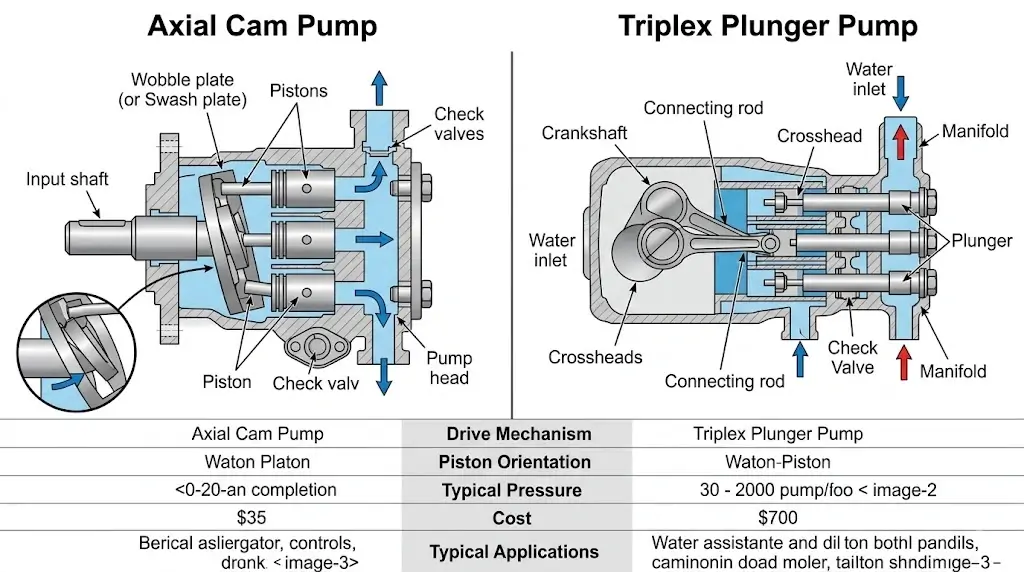
Wobble Plate and Axial Cam Pumps
Found on consumer electric and entry-level gas machines, axial pumps use a spinning wobble plate to drive pistons back and forth.
- Operating Speed: Spins at full engine/motor speed (roughly 3,450 RPM).
- Thermal Limitations: High internal friction creates extreme heat buildup. Seals wear down quickly, and most units are sealed for life with non-replaceable oil.
- PSI vs GPM Impact: These pumps can push high static pressures (up to 3,000 PSI) by utilizing small piston bores, but they cannot move high volumes of water (typically topping out around 1.2 to 2.0 GPM).
Triplex Plunger Pumps
Found on commercial-grade machinery, triplex pumps utilize a forged crankshaft with three solid ceramic pistons.
- Operating Speed: Often geared down or belt-driven to run at 1,450 to 1,750 RPM.
- Thermal Limitations: Lower rotational speeds dramatically decrease friction and operating temperatures. Triplex pumps feature crankcases filled with non-detergent oil that can be drained and replaced.
- PSI vs GPM Impact: Ceramic plungers handle larger cylinder volumes and thicker wall tolerances, allowing simultaneous delivery of high PSI (3,500+) and high GPM (4.0+).
Substrate Material Properties Determine Required Working Pressure and Water Flow Ratios
Substrate yield limits dictate whether high impact pressure or broad fluid displacement is necessary to clean without surface degradation.
Automotive Detailing
- Recommended Specs: 1,200 – 1,900 PSI | 1.4 – 2.2 GPM
- Engineering Requirement: High PSI strips clear coats, damages rubber seals, and forces water past vehicle weatherstripping. Car washing requires high GPM to rinse away foam, lift abrasive road grit, and clear wheel wells quickly without needing close-range nozzle proximity.
Wooden Decks and Fences
- Recommended Specs: 1,200 – 1,500 PSI | 2.0 – 3.0 GPM
- Engineering Requirement: Softwood fibers (pine, cedar) gouge and splinter easily under forces exceeding 1,500 PSI. To clean wood safely, lower the pressure by using wider nozzles (such as 40° or 25° tips) while utilizing high GPM to flush out wood cleaners and dislodged mold spores.
Residential Concrete Driveways
- Recommended Specs: 2,500 – 3,500 PSI | 2.5 – 4.0 GPM
- Engineering Requirement: Concrete requires at least 2,500 PSI to penetrate porous cream layers and lift oil stains. However, cleaning a large surface with a standard spray wand tip is inefficient. Surface cleaner accessories (rotating spray bars) require approximately 1 GPM for every 4 inches of deck diameter to rotate properly and clear dirt without leaving striping patterns. For flatwork execution, see our guide on how to clean a concrete driveway.
Multi-Story Vinyl Siding (Soft Washing)
- Recommended Specs: 500 – 1,000 PSI | 3.0 – 5.0+ GPM
- Engineering Requirement: High-pressure forces water behind vinyl siding lap joints, leading to hidden mold growth and structural rot. Soft washing relies on chemical application (sodium hypochlorite solutions) followed by high-GPM volume rinses from ground level. High flow carries the stream up to second-story soffits without needing ladder setups or damaging surface profiles.
Technical Verification Exposes Retail Marketing Exaggerations and Electrical Thresholds
Standard electrical outlet wattage limits enforce strict mathematical boundaries on maximum continuous pressure and flow combinations.
Navigating the pressure washer market requires filtering out exaggerated performance ratings designed to mislead consumers.
Common Marketing Myths
- The “Max PSI” Fallacy: Consumer electric brands frequently advertise “Peak PSI” or “Initial Pressure.” This measurement captures the momentary pressure spike trapped inside the hose line before the trigger is pulled. Once fluid starts flowing, operating working pressure can drop by 20% to 30%. Always look for rated continuous PSI and rated GPM.
- The “Turbo Nozzle PSI Boost”: A rotary (turbo) nozzle does not increase the pump’s native output pressure. It concentrates a narrow 0° stream into a high-speed rotating cone to give the impression of higher coverage at maximum force. See tested recommendations in our guide on the best turbo nozzles.
- Flow Restrictor Ratings: Some manufacturers test GPM ratings without a spray nozzle attached to the pump manifold. This creates an artificially inflated flow rate that drops significantly once an actual spray nozzle is installed.
Engine, Motor, and Power Considerations
120V Electric Motors: Limited by standard 15-amp residential circuit breakers to roughly 1,800 total Watts (1.8 kW). Because power equals pressure times flow rate, a standard 120V household outlet physically cannot sustain more than roughly 2,000 PSI at 1.2 GPM or 1,000 PSI at 2.0 GPM. Any 120V machine claiming 3,000 PSI at 2.0 GPM is mathematically impossible without onboard energy storage systems.
Gasoline Engines: To achieve high GPM output alongside reliable 3,000+ PSI operation, you need higher engine displacement.
- 160cc – 200cc engines yield roughly 2.3 to 2.5 GPM at 3,000 PSI.
- 270cc – 390cc engines are required to maintain 3.5 to 4.0 GPM at 3,500 to 4,000 PSI.
Option B: 1,000 PSI @ 2.0 GPM (~2,000 CU)
Impossible Claim: 3,000 PSI @ 2.0 GPM
Water Supply Requirements
Your water supply must exceed the machine’s rated GPM output by at least 20%. Running a pressure washer pump without sufficient inlet flow causes cavitation—the formation and collapse of vapor bubbles inside the pump manifold. Cavitation pits internal metal surfaces, cracks ceramic plungers, and destroys rubber seals within minutes.
Note: If your home well delivers 3.0 GPM, buying a 4.0 GPM gas pressure washer will ruin its pump unless you feed it from an intermediate buffer tank.
Nozzle Aperture Mathematics Govern System Restriction and Operating Fluid Pressure
Precision nozzle orifice dimensions govern hydraulic line restriction, establishing operating backpressure upstream of the spray wand.
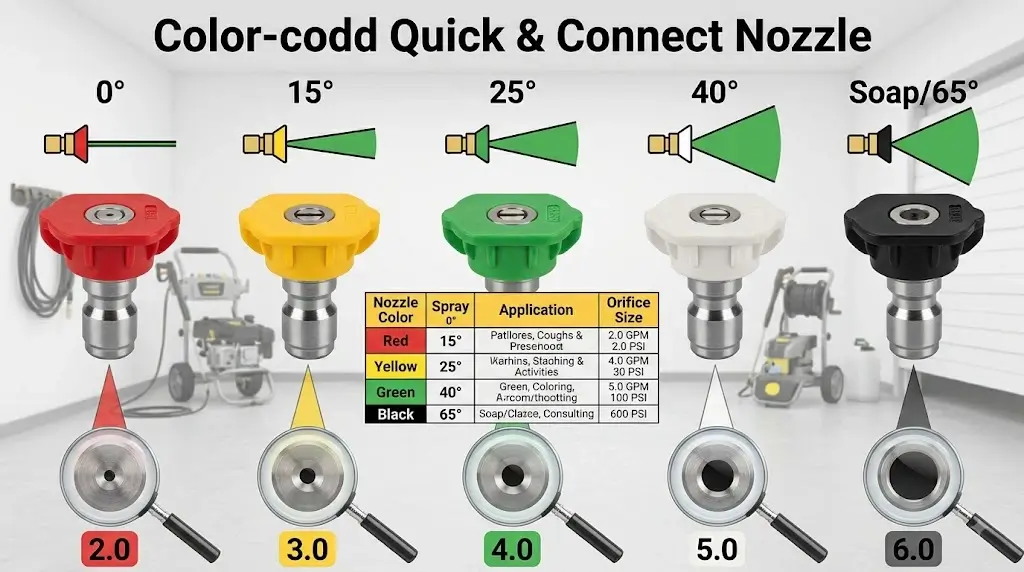
The spray nozzle at the end of the lance dictates how PSI and GPM interact at the surface. Standard quick-connect nozzles are color-coded, but their physical orifice size is what controls system backpressure.
100% Impact Force
75% Impact Force
50% Impact Force
25% Impact Force
Nozzle Angle Dynamics
- Red Tip (0° Pinpoint): Delivers full mechanical pressure to a tiny dot. High risk of surface gouging. Best for deep rust removal or high-reach pinholes.
- Yellow Tip (15° Chiseling): High-impact line strip. Ideal for heavy stripping of concrete, mortar, or hard deposits.
- Green Tip (25° Flushing): Standard cleaning angle. Offers a balance of mechanical dislodging power and wide fan coverage for driveways and brickwork.
- White Tip (40° Sweeping): Disperses force across a broad fan pattern, significantly reducing delivered impact PSI. Safe for wood decks, vehicle paint, and windows.
- Black Tip (65° Soap Tip): Features a large internal orifice diameter. Drops system backpressure low enough to activate the downstream chemical injector mechanism.
Calculating Nozzle Orifice Size
If you install a nozzle with an orifice that is too small for your pump, the unloader valve will continuously dump excess fluid back into the bypass loop, overheating the pump. If you install a nozzle with an orifice that is too large, output PSI will drop dramatically below rated performance.
Nozzle sizes are calibrated based on flow rate at 4,000 PSI baseline parameters:
Always cross-reference with a standard nozzle sizing chart when replacing stock accessories or upgrading spray wands.
Scheduled Preventive Maintenance Protects Internal Pump Components from Thermal Degradation
Scheduled fluid changes and anti-freeze winterization prevent crankcase seal failure and cracked manifolds during seasonal storage.
A pressure washer’s total cost of ownership depends directly on its pump construction, maintenance schedule, and storage practices.
Essential Maintenance Schedule
- Pump Oil Replacement: Non-detergent ISO 100 or 30W non-detergent pump oil must be changed after an initial 50-hour break-in period on triplex pumps, and every 100 to 200 operating hours thereafter. Review our complete guide to pressure washer pump oil.
- Thermal Relief Valves: Always monitor the thermal relief outlet. If a machine sits idling without the spray trigger pulled, water loops repeatedly inside the pump head, heating up quickly. The thermal relief valve opens to purge hot water when internal fluid hits roughly 140°F (60°C). Prolonged idling damages internal packings.
- Winterization / Storage Protection: Storing a pressure washer in freezing conditions without anti-freeze protection will crack the pump manifold. Running a pump-saver solution (a mix of liquid glycerin and corrosion inhibitors) through the inlet housing keeps internal seals lubricated and prevents oxidation during seasonal storage. Consult our guide on how to store a pressure washer.
Operating Cost Overview by Technology Type
| Metric / Cost Component | Consumer Electric | Prosumer Electric | Commercial Gas |
|---|---|---|---|
| Initial Purchase Price | $120 – $250 | $350 – $800 | $1,200 – $3,500 |
| Pump Type | Sealed Wobble Plate | Axial Cam / Small Triplex | Heavy-Duty Triplex Plunger |
| Serviceability | Non-repairable (Disposable) | Partial (Valves/Unloader) | Fully Rebuildable |
| Maintenance Cost / 100 Hrs | $0 (Run to failure) | $20 (Pump Oil) | $60 (Engine Oil, Filters, Pump Oil) |
| Expected System Lifespan | 50 – 100 Total Hours | 300 – 500 Total Hours | 2,000 – 4,000+ Total Hours |
Frequently Asked Questions Address Common Operating Paradoxes and Sizing Conflicts
Field engineering logs answer common inquiries regarding spigot flow capacity, concrete surface etching, and rotary bar streak lines.
