
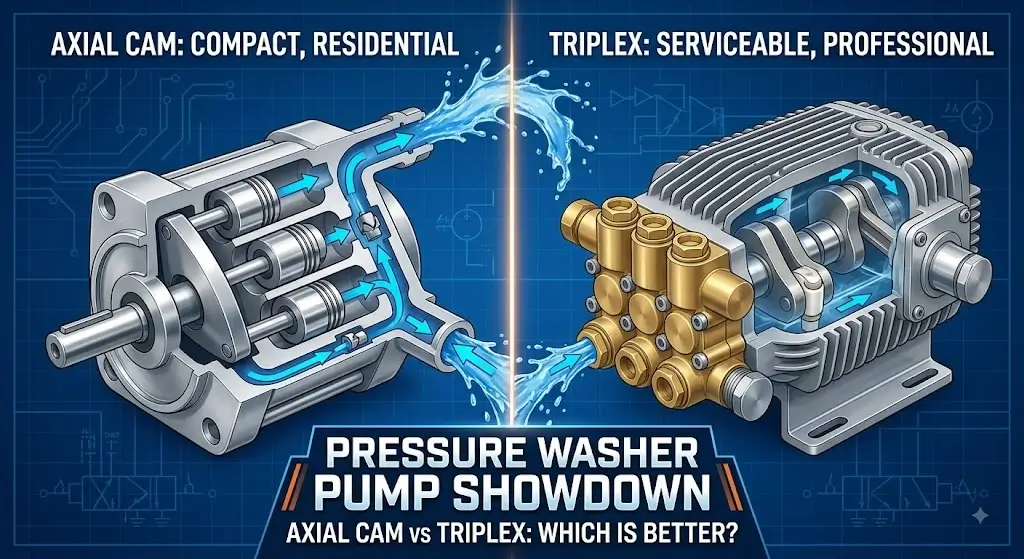
Axial Cam vs Triplex Pump: Which Pressure Washer Pump Is Better?
Quick Reference Specification: Pump Kinematic & Reliability Matrix
Hydraulic teardown evaluations confirm that crankshaft-driven triplex plunger pumps deliver up to 10× greater operating lifespans than swash-plate axial pumps through lower stroke RPM, serviceable ceramic packings, and dedicated crankcase oil cooling.
| Engineering Parameter | Axial Cam Pump (Swash Plate) | Triplex Plunger Pump (Crankshaft) | Primary Decision Driver |
|---|---|---|---|
| Drive Mechanism | Angled rotating wobble/swash plate | Forged crankshaft with connecting rods | Direct rotational coupling vs crank throw |
| Operating Speed | Direct-drive 3,400 – 3,450 RPM | 1,450 – 1,750 RPM (Gear/Belt) or 3,400 RPM | Stroke velocity and friction cycles |
| Piston / Plunger Metallurgy | Stainless steel reciprocating pistons | Solid ceramic or ceramic-sleeved plungers | Thermal expansion & abrasion resistance |
| Lubrication Architecture | Factory-sealed oil / synthetic grease | Drainable oil bath with sight glass | Serviceable oil change maintenance |
| Expected Service Lifespan | 100 – 250 Total Operating Hours | 500 – 2,000+ Total Operating Hours | Duty-cycle limits before complete rebuild |
| Repair & Field Serviceability | Disposable (Full replacement: $70–$150) | Fully rebuildable (Valves $30, Seals $40) | Long-term commercial ownership cost |
Choose an axial cam pump for most occasional residential cleaning when low cost, compact size and simple ownership are priorities. Choose a properly sized triplex plunger pump when frequent operation, long cleaning sessions, serviceability and long-term repair economics matter more.
Neither architecture automatically produces better cleaning performance: compare working PSI, GPM, pump RPM, engine or motor power, duty cycle, thermal protection and service parts for the exact machine.
Axial cam vs triplex pump is primarily a comparison of pump architecture, duty cycle and ownership economics—not simply maximum PSI. Axial cam pumps generally emphasize compactness, lower cost and residential portability, while many professional triplex plunger pumps emphasize serviceability, long operating hours and rebuildable components.
Compact, swash-plate driven system optimized for residential portability and affordable direct-drive machines.
Crankshaft-driven 3-plunger architecture engineered for heavy-duty cycles, rebuildability, and long operating life.
Select based on annual operating hours, serviceability access, and water flow (GPM) requirements.
Practical Application Guidelines Direct Users Toward Optimal Pump Mechanical Configurations
Equipment duty cycles distinguish occasional residential pressure washing from sustained commercial operations.
The simplest distinction is that axial cam pumps are commonly optimized for compact residential equipment, while triplex plunger pumps are commonly used where serviceability and sustained operation are more important.
That distinction is a market tendency, not a rigid rule. Commercial manufacturers often list both axial cam and triplex pumps across their product lines, demonstrating why pump architecture cannot be used as the only measure of equipment quality.
| Question | Better Starting Point | Why |
|---|---|---|
| Occasional homeowner use | Axial cam | Lower cost and compact packaging are often more valuable than rebuildability. |
| Vehicle washing | Axial cam | Usually sufficient for intermittent residential cleaning. |
| Weekly property maintenance | Either | Working PSI, GPM, duty cycle and exact pump design become more important. |
| Frequent professional use | Triplex | Serviceability and long-duration operation become more valuable. |
| Large concrete areas | Triplex | Professional machines often combine higher flow with commercial-duty components. |
| Lowest purchase cost | Axial cam | Compact consumer pump systems commonly cost less. |
| Long-term repairability | Triplex | Many professional models use replaceable seals, valves and other service components. |
| Portability | Axial cam | Compact pump packaging can reduce machine size and weight. |
Comparative Overviews Contrast Engineering Strengths and Ownership Realities
Physical construction trade-offs separate compact disposable residential assemblies from heavy industrial plunger equipment.
| Category | Axial Cam | Triplex Plunger |
|---|---|---|
| Primary strength | Compact, affordable hydraulic package | Serviceability and professional-duty capability |
| Typical market | Residential and light-duty equipment | Commercial, professional and industrial equipment |
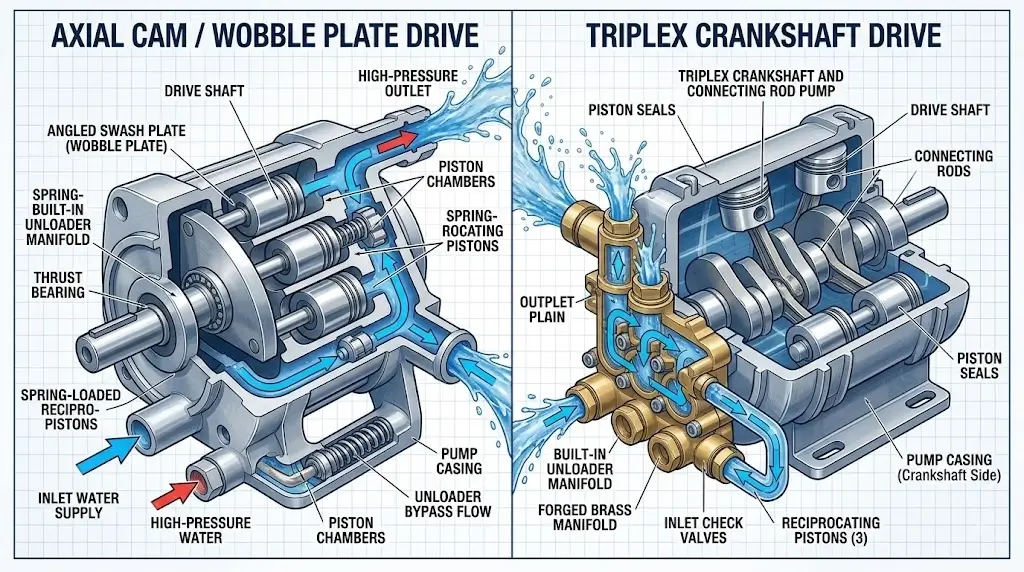
| Drive mechanism | Cam, swash plate or related plate-driven piston mechanism | Crankshaft, connecting rods and three plungers |
| Purchase cost | Usually lower | Usually higher |
| Weight | Usually lower (5–10 lbs) | Usually higher (15–30+ lbs) |
| Maintenance | Often limited on consumer models | More service-oriented (Periodic oil changes) |
| Repairability | Model-dependent; replacement may be more economical | Often designed around replaceable wear components |
| Durability potential | Good when properly matched and maintained | Strong in properly designed professional systems |
| Best ownership model | Low-to-moderate annual operating hours | Higher annual operating hours |
| PSI advantage | Can reach high pressure | Can also reach high pressure |
| GPM potential | Model-dependent (typically ≤2.5 GPM) | Often available in higher-flow configurations (4.0+ GPM) |
These are architecture-level tendencies. Always verify the manufacturer’s specifications for the exact pump before making a purchase or replacement decision.
Kinematic Mechanisms Differentiate Swash Plate Actuation from Crankshaft Rod Throws
Drive kinematics dictate whether reciprocal motion stems from an angled rotating swash plate or a traditional forged crankshaft with connecting rods.
An axial cam pump converts shaft rotation into reciprocating piston movement through a cam or angled swash plate. A triplex plunger pump uses a traditional crankshaft and connecting rods to drive three separate plungers.
The mechanical difference affects more than the number of moving parts. It influences pump packaging, operating speed, lubrication, heat management, service access, replacement economics and suitability for repeated operation.
The advantage of an axial cam pump is not simply lower price. Compact construction makes a pressure washer significantly lighter, easier to store, and more economical for homeowners who do not run machines for hundreds of hours per season. When paired with standard residential units, compare models in our guide on the best electric pressure washers.
Axial Cam Pumps Maximize Portability Through Compact Direct-Drive Packaging
Swash plate geometry aligns pistons parallel to the drive shaft, creating a compact footprint that mounts directly to consumer engine shafts.
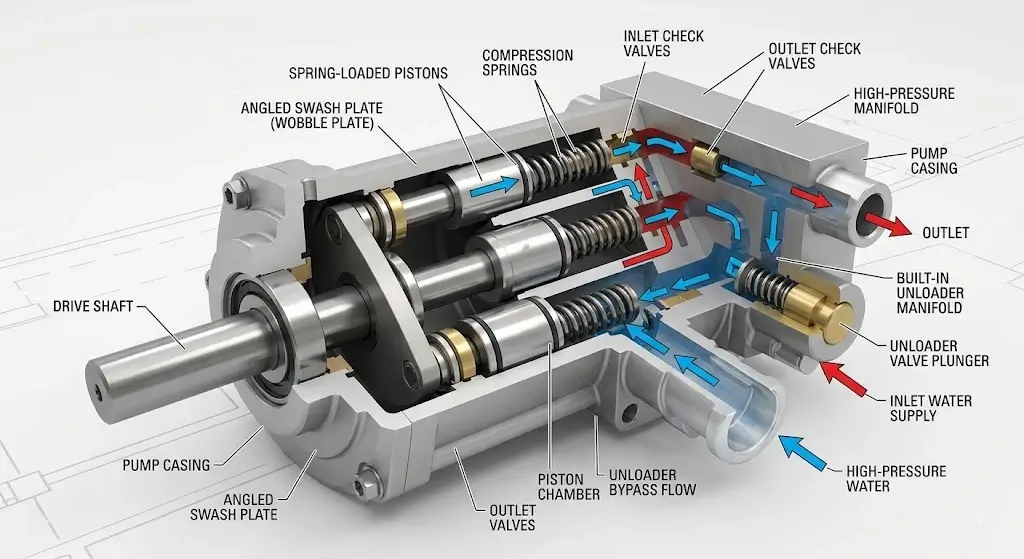
An axial cam pump is a positive-displacement pump in which multiple pistons are arranged parallel around the drive shaft and stroked back and forth by an angled rotating plate (swash plate/cam).
In consumer pressure washers, axial cam pumps are frequently packaged as compact direct-drive assemblies bolted straight to the motor or engine output shaft.
Typical Axial Cam Characteristics
- Compact physical dimensions and lightweight construction
- Relatively low equipment acquisition cost
- Direct-drive configuration matching motor/engine RPM (often ~3,400 RPM)
- Strong fit for portable residential pressure washers
- Sealed lubrication on many consumer models requiring zero oil changes
- Complete pump replacement is often more economical than internal rebuilding
Axial cam does not mean low performance. Commercial brands offer heavy-duty axial cam replacement pumps delivering 3,000 to 3,400 PSI and up to 2.5 GPM, proving that materials and engineering matter just as much as architecture.
Triplex Plunger Pumps Provide Rebuildable Field Serviceability via Crankshaft Mechanics
Crankshaft mechanisms drive three sequential ceramic plungers in staggered phases to deliver high-pressure fluid flow with minimal mechanical pulsation.
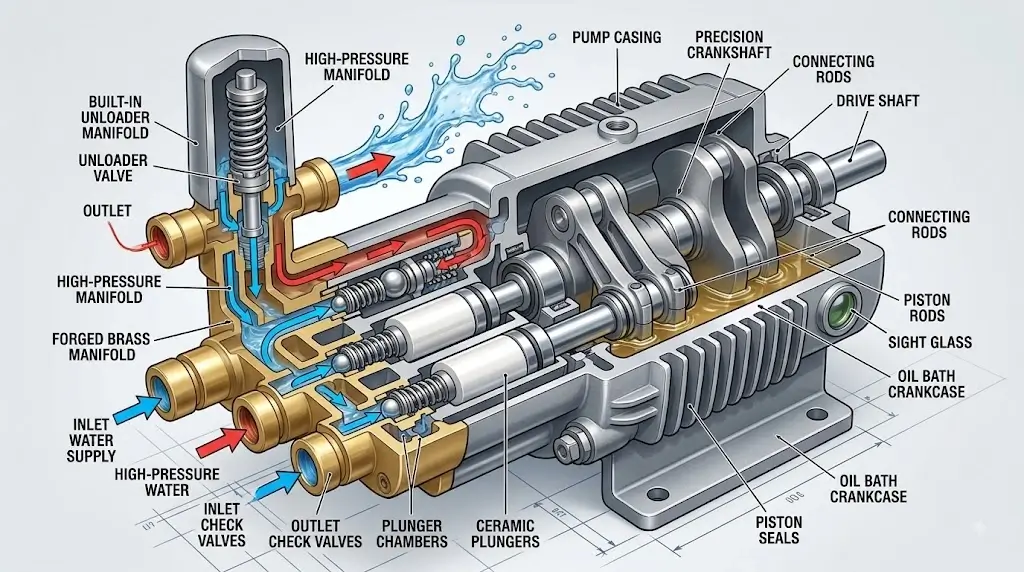
A triplex plunger pump uses a precision-machined crankshaft to drive three ceramic or solid ceramic-coated plungers via connecting rods. Each plunger operates in sequence within its own manifold chamber.
Typical Triplex Characteristics
- Three-phase pumping plungers providing smooth, continuous hydraulic flow
- Heavy-duty crankshaft and connecting rod architecture
- Independent oil-bath crankcase with sight glass and drain plug
- Field-serviceable valve caps, packings, and water seals
- Superior heat dissipation via finned aluminum crankcases and forged brass heads
- Standard equipment on commercial, industrial, and daily-use wash rigs
Detailed Component Teardowns Compare Metallurgy, Seals, and Crankcase Duty Cycles
Hardware inspections identify key metallurgical variances in plunger compositions, crankcase castings, and check valve seating.
| Feature | Axial Cam Pump | Triplex Plunger Pump |
|---|---|---|
| Mechanical architecture | Plate/cam-driven reciprocating pistons | Crankshaft-driven three-plunger system |
| Packaging & Size | Compact and integrated | Larger, heavier footprint |
| Weight | Usually 5 to 10 lbs | Usually 15 to 30+ lbs |
| Initial cost | Budget-friendly | Higher initial investment |
| Operating RPM | Typically high speed (3,400–3,450 RPM) | Direct drive (3,400 RPM) or Gearbox/Belt-reduced (1,450–1,750 RPM) |
| Routine maintenance | Minimal or sealed lifetime lubrication | Periodic crankcase oil changes & seal inspections |
| Rebuildability | Limited internal service parts | Fully rebuildable (valves, packing kits, plungers) |
| Hydraulic output | Up to 3,400 PSI / 2.5 GPM typical | Up to 5,000+ PSI / 4.0–10.0+ GPM |
| Continuous run duty | Intermittent (1–2 hours per session) | Continuous (all-day commercial operation) |
Mechanical Principles Explain How Swash Plate Angulation Powers Axial Cam Cylinders
Piston spring returns compress water sequentially as the angled swash plate converts rotational input into horizontal displacement.
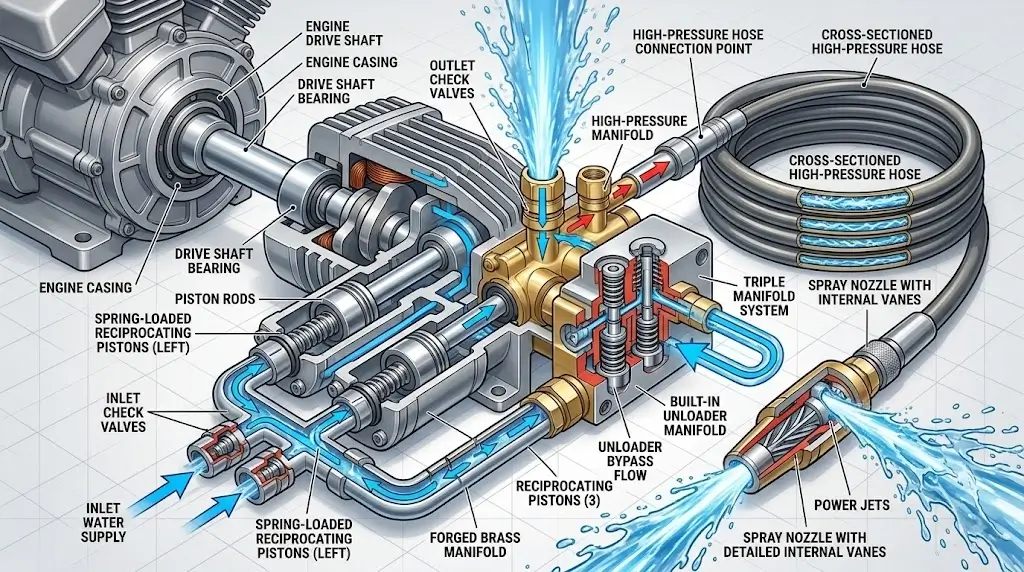
The motor or engine rotates the pump input shaft. Attached to this shaft is an angled plate (the wobble or swash plate). As the shaft spins, the angle of the plate forces the spring-loaded pistons to stroke back and forth sequentially.
During the backward stroke, low pressure draws water past the inlet check valve into the chamber. On the forward stroke, water is compressed past the outlet check valve into the high-pressure manifold.
Crankshaft Dynamics Explain Why Triplex Plungers Deliver Smooth Hydraulic Flow
Crankshaft connecting rods push three ceramic plungers in 120-degree phases, minimizing harmonic pulsation in the manifold.
In a triplex pump, input shaft rotation turns a precision crankshaft inside an oil-filled crankcase. Connecting rods attached to the crankshaft throw push and pull three hardened plungers in staggered 120-degree phases.
Because the three plungers stroke in alternate cycles, pressure pulsation is reduced compared to single or double-piston configurations, delivering stable hydraulic output.
Cleaning Units Math Determines Real Hydraulic Stripping Power and Work Productivity
Volumetric water flow (GPM) multiplies operating pressure (PSI) to establish empirical cleaning speed benchmarks across surfaces.
Pump architecture should never replace actual hydraulic specifications when comparing equipment. Understanding the practical balance in PSI vs GPM explained clarifies why flow rate often dictates cleaning speed far more than peak pressure.
Cleaning Units
To measure true cleaning capability, calculate total Cleaning Units (CU):
For example:
A residential axial cam machine at 3,000 PSI and 2.0 GPM produces 6,000 CU, whereas a commercial triplex setup delivering 3,000 PSI at 4.0 GPM generates 12,000 CU—doubling the cleaning speed on large flat surfaces.
Pump Shaft Rotational Speeds Directly Govern Seal Friction and Thermal Dissipation
Rotational shaft speed dictates thermal seal degradation rates, separating high-friction direct-drive pumps from low-RPM belt-driven units.
Pump operating speed directly impacts heat generation, seal wear, and bearing longevity.
- Direct-Drive Axial Pumps (3,400 RPM): Spin at engine speed for maximum compactness. Piston seals make thousands of contact strokes per minute, creating higher friction heat.
- Direct-Drive Triplex Pumps (3,400 RPM): Compact commercial units that pair directly with gas engines.
- Belt-Drive & Gearbox Triplex Pumps (1,450–1,750 RPM): Crankshaft speed is geared down. Plungers stroke half as fast, dramatically lowering heat and extending seal life up to several thousand operating hours.
Metallurgical Material Selection Dictates Long-Term Pump Durability and Corrosion Resistance
Ceramic plungers and forged brass manifolds resist chemical erosion and dynamic thermal fatigue far more effectively than aluminum castings.
In comparable applications, a properly maintained professional triplex pump provides a superior long-term durability and repairability advantage. However, durability is heavily dictated by maintenance quality, thermal control, and water supply purity.
| Durability Factor | Axial Cam Pump | Triplex Plunger Pump |
|---|---|---|
| Piston / Plunger material | Stainless steel pistons | Solid ceramic or ceramic-sleeved plungers |
| Manifold material | Aluminum alloy or cast brass | Heavy forged brass or nickel-treated brass |
| Crankcase lubrication | Sealed synthetic grease or non-serviceable oil | Serviceable oil bath with dipstick & sight glass |
| Thermal dissipation | Lower thermal mass, heats faster in bypass | Large finned crankcase, slower thermal rise |
Operating Lifespan Estimates Reflect Thermal Stress and Routine Service Intervals
Manufacturer duty ratings indicate expected run hours before internal seals require servicing or total pump replacement.
While no single lifespan number applies to all units, typical engineering duty expectations under proper operating conditions are:
- Residential Axial Cam Pumps: 100 to 250 total operating hours (representing 5–10 years of typical homeowner maintenance).
- Commercial Triplex Pumps: 500 to 2,000+ total operating hours between major seal and valve rebuilds.
Thermal Bypass Management Protects Elastomeric Seals from Friction Overheating
Unloader bypass recirculation loops heat trapped manifold water rapidly, warping plastic check valves within minutes if left idling.
When the spray trigger is released, the unloader valve diverts pressurized water back to the pump inlet in a continuous loop. The spinning pistons continually impart friction energy into this trapped water, raising water temperature rapidly.
Inlet Water Cavitation Causes Catastrophic Piston Pitting and Valve Fractures
Water supply starvation causes microscopic vapor bubbles to implode violently inside pump chambers, eroding ceramic plungers and brass seats.
Cavitation occurs when the inlet water supply cannot supply the pump’s displacement demand, causing local pressure to drop below water vapor pressure. Vapor bubbles form and violently collapse against internal metal and ceramic surfaces, pitting plungers and destroying valves within minutes.
- Always ensure supply hose GPM exceeds pump rated GPM by at least 20%.
- Clean the water inlet mesh filter before every wash session.
- Avoid excessively long or kinked 1/2-inch garden supply hoses (use 5/8-inch or 3/4-inch supply lines).
Operating Duty Cycles Dictate Required Mechanical Pump Robustness Across Use Cases
Project durations determine whether intermittent consumer axial pumps or continuous-duty commercial triplex systems are required.
| Workload Type | Preferred Pump Architecture | Key Reason |
|---|---|---|
| Occasional vehicle washing | Axial cam | Short run sessions, lightweight setup, budget-friendly. |
| Seasonal home siding & deck cleaning | Axial cam | Adequate hydraulic power for 1–2 hour cleaning blocks. |
| Weekly property maintenance | Heavy-duty Axial or Triplex | Depends on required working GPM and user downtime tolerance. |
| Daily commercial detailing or fleet washing | Triplex Plunger | Sustained duty cycle, rebuildable wear components, ceramic plungers. |
Scheduled Preventative Maintenance Protocols Distinguish Sealed Systems from Serviceable Pumps
Maintenance procedures differ fundamentally between factory-sealed residential pumps and rebuildable commercial oil-bath crankcases.
Axial Cam Maintenance
Most residential axial cam pumps are factory-sealed. Maintenance is primarily preventative: flushing winterizing pump protector fluid, cleaning inlet screens, and avoiding dry running.
Triplex Pump Maintenance
Triplex pumps require structured preventative maintenance, including:
- Initial crankcase break-in oil change after 50 operating hours (non-detergent ISO 68 / SAE 30 pump oil).
- Subsequent oil changes every 200–300 operating hours or annually.
- Periodic inspection of high-pressure packing seals and ceramic plungers for hairline fractures.
Replacement Economics Balance Complete Swaps Against Individual Seal Rebuilds
Field serviceability economics separate disposable $100 pump assemblies from rebuildable commercial valve kits.
When an axial cam pump fails internally, replacing the entire pump assembly (usually costing $70 to $150) is typically more economical than paying labor for disassembly.
With a commercial triplex pump, individual valve kits ($30–$60) and packing seal kits ($40–$80) allow technicians to fully restore hydraulic compression without purchasing a new pump head.
Total Cost of Ownership Balances Purchase Price Against Maintenance Downtime
Ownership accounting evaluates initial purchase costs against long-term maintenance and replacement frequency over hundreds of operating hours.
For a homeowner running 20 hours per year, an axial cam machine yields the lowest overall cost. For a commercial contractor operating 400 hours annually, a rebuildable triplex pump costs dramatically less per operating hour.
Electric Pressure Washers Favor Compact Axial Pumps Within Residential Circuit Limits
Residential circuit limitations restrict 120V electric pressure washers to approximately 1,800 Watts of total electrical power.
Electric pressure washers operating on standard 120V / 15A residential outlets are restricted to approximately 1.8 kW of electrical power. Pairing a heavy triplex pump with a small electric motor provides negligible cleaning advantage unless designed as a dedicated high-voltage commercial rig. When choosing the best electric pressure washers for houses, compact axial cam configurations offer the ideal balance of weight and hydraulic output.
Furthermore, the electrical drive mechanism plays a critical role in sustained pressure-washer performance. Comparing a universal motor vs induction motor reveals how rotational speed, brush wear, and duty ratings directly influence which pump architecture best matches your electrical machine.
Gasoline Pressure Washers Deliver the Horsepower Needed to Drive Heavy Triplex Crankshafts
Combustion engines supply the continuous shaft torque required to operate high-flow triplex plunger configurations effectively.
Gasoline engines provide the mechanical horsepower (6.5 HP to 15+ HP) necessary to drive high-flow commercial triplex pumps (3.0 to 5.0+ GPM), where the heavy-duty crankshaft architecture truly shines.
Task-Specific Guidelines Direct Equipment Selection Across Automotive and Concrete Jobs
Surface cleaning requirements determine whether compact axial units or high-GPM triplex rigs are optimal for vehicle care and driveway restoration.
Best for Washing Cars
Axial cam: Perfectly suited for 1,200–1,800 PSI and 1.2–2.0 GPM vehicle detailing using 40-degree wide spray nozzles and foam cannons.
Best for Driveways and Flatwork
For seasonal residential driveways, axial cam works reliably. However, when mastering how to clean a concrete driveway with a 15-inch surface cleaner, a triplex pump delivering 3.0 to 4.0 GPM cuts cleaning time in half by rapidly flushing away dislodged debris.
Mechanical Retrofitting Protocols Define Compatibility Standards for Triplex Upgrades
Upgrading from an axial to a triplex pump requires verifying engine shaft keyways, mounting flange patterns, and frame clearance.
Yes, provided physical and mechanical compatibility is strictly matched:
- Engine shaft diameter: 3/4-inch (common up to 6.5 HP) vs 1-inch (8 HP to 15 HP).
- Shaft keyway and bolt mounting circle (e.g., SAE J609a flange pattern).
- Available engine horsepower to support the replacement pump’s PSI and GPM ratings.
- Sufficient frame clearance for the deeper triplex crankcase.
Structured Selection Criteria Match Pump Architecture to Project Scope and Operating Frequency
Engineering purchase criteria balance annual run hours against flow requirements and rebuild part availability.
- Assess Annual Operating Hours: Under 50 hours/year → Axial Cam; Over 100 hours/year → Triplex.
- Verify Required GPM: Choose higher flow (2.5+ GPM) for flatwork surface cleaners.
- Inspect Manifold Materials: Forged brass offers superior corrosion and pressure fatigue resistance over cast aluminum.
- Check Parts Availability: Ensure valve and packing seal rebuild kits are stocked by the manufacturer.
Technical Fact-Checking Dispels Common Pump Pressure and Durability Fallacies
Engineering facts refute common marketing myths regarding pump pressure ceilings, consumer quality, and commercial maintenance needs.
Myth 1: Triplex Pumps Always Produce More PSI
False. Pump PSI is determined by displacement, engine horsepower, and nozzle orifice size. Many axial pumps produce 3,300+ PSI.
Myth 2: Axial Cam Pumps Are Poor Quality
False. Axial cam pumps are sophisticated, highly efficient direct-drive mechanisms optimized specifically for residential portability and convenience.
Myth 3: Triplex Pumps Are Maintenance-Free
False. Triplex pumps require regular crankcase oil changes, valve cap torquing, and seal replacements to achieve their multi-thousand-hour lifespan.
Frequently Asked Questions Address Critical Pump Selection and Replacement Queries
Operational logs answer common inquiries regarding pump longevity, retrofitting compatibility, and pressure capabilities.
