
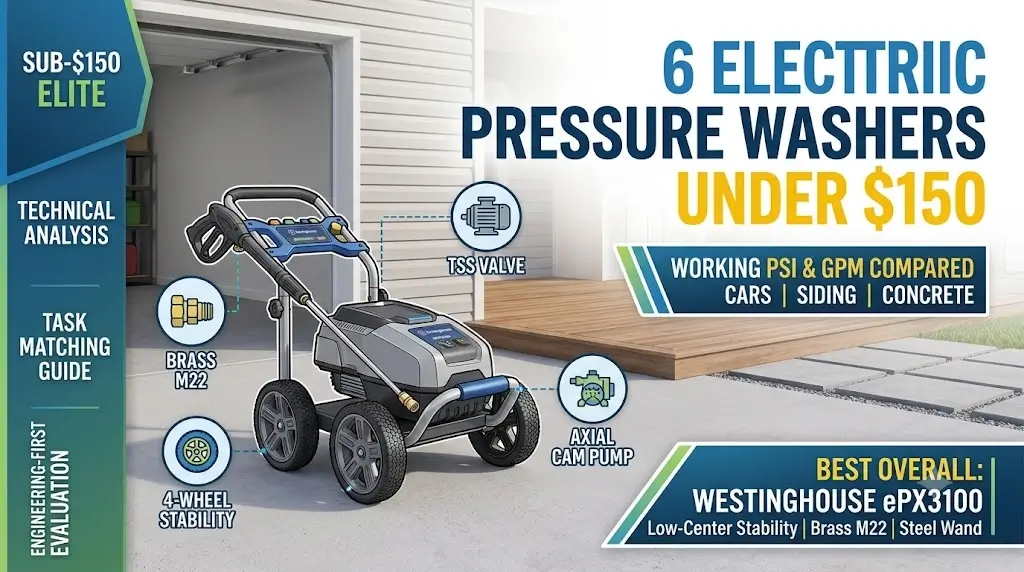
Compare 6 electric pressure washers under $150 by working PSI, GPM, cleaning power, stability, and real-world cleaning tasks—from cars and siding to concrete.
6 Best Electric Pressure Washers Under $150 (2026): PSI, GPM & Cleaning Power Compared
Selecting a durable, effective electric pressure washer under $150 requires cutting through aggressive marketing claims and examining core mechanical engineering limits. The budget power washer market is heavily saturated with inflated performance claims. Manufacturers frequently promote “Maximum Initial Static Burst Pressure” or theoretical limits rather than continuous, usable working output under standard operating load.
A machine advertised with a “5000 Max PSI” or “2300 Max PSI” badge often delivers a continuous working output of only 1200 PSI to 1900 PSI when spraying through standard nozzles. Evaluating machines by manufacturer-published working specs or verified ratings ensures realistic expectations. For a broader overview of high-performing models across all price brackets, check out our comprehensive guide to the best electric pressure washers.
The primary engineering challenge in the sub-$150 price category is balancing motor thermal limits, pump manifold durability, and accessory quality. At this price point, units utilize 13-amp to 14.5-amp universal brushed motors paired with axial cam or wobble-plate pumps. Understanding how these internal components manage thermal stress, hydraulic pressure surges, and continuous duty cycles is essential for selecting a machine that lasts for multiple seasons rather than failing after minimal use.
This technical guide evaluates six widely available electric pressure washers under $150 based on continuous pressure output, fluid dynamic efficiency, pump design, frame stability, and practical usability across common residential cleaning tasks.
Quick Verdict & Summary Picks
Price Eligibility Window: All listed models were evaluated based on retail pricing at or below $150 during the July 2026 review window. Prices fluctuate across retailers and promotional cycles.
| Category / Placement | Model | Working Output | Cleaning Units (CU) | Data Confidence | Primary Advantage |
|---|---|---|---|---|---|
| 🏆 Best Overall (#1) | Westinghouse ePX3100 | 1,900 PSI / 1.24 GPM | 2,356 CU* | Manufacturer-Listed | Low-center 4-wheel stability, steel wand, brass M22 fittings. |
| 🧳 Best for Compact Storage (#2) | Westinghouse ePX3100v | 1,800 PSI / 1.20 GPM | 2,160 CU* | Manufacturer-Listed | Portable wheel-less design with foam cannon; ideal for stairs & elevated work. |
| 🛞 Best for Yard Mobility (#3) | Westinghouse ePX3050 | 1,800 PSI / 1.20 GPM | 2,160 CU* | Manufacturer-Listed | Classic 26″ upright frame with 5″ solid wheels for lawn and paver mobility. |
| 💰 Best Budget Light-Duty (#4) | Craftsman CMEPW1700 | 1,300 PSI / 1.20 GPM | 1,560 CU* | Manufacturer-Listed | Lightweight 16-lb frame with 3-year warranty for light maintenance. |
| 🧵 Hose-Reel Convenience (#5) | Yeryork YE005 | Not Disclosed (*5000 Max) | Unverified | Unverified Claim | Integrated 33-ft retractable hose reel and stainless steel spray lance. |
| 🚗 Best Light Vehicle Wash (#6) | Greenworks PW-1600 | 1,200 PSI / 1.20 GPM | 1,440 CU* | Manufacturer-Listed | Dual horizontal/vertical stance, ultra-compact storage footprint. |
*Note: Cleaning Units (CU) are calculated directly from manufacturer-published working specifications and have not been independently laboratory tested by our editorial team.
Evaluation Methodology & Data Provenance
Our evaluation methodology analyzes manufacturer-published specifications, electrical input physics, fluid dynamic formulas, and product construction details. We maintain strict transparency regarding data sources by categorizing specifications into four clear tiers:
- Tier 1 — Independently Measured Specification: Performance metrics verified directly via inline fluid gauges and calibrated collection vessels.
- Tier 2 — Manufacturer-Listed Working Specification: Published continuous working pressure (Listed Working PSI) and water flow (Listed Working GPM) provided in manufacturer documentation.
- Tier 3 — Manufacturer Maximum Claim: Peak static burst pressure (“Max PSI”) recorded the moment the spray trigger is pulled before fluid flow stabilizes.
- Tier 4 — Unverified Marketplace Claim: Third-party advertising figures that lack published rated continuous metrics or independent laboratory verification.
How We Rank
Category placements and rankings are calculated based on weighted performance criteria:
| Evaluation Criterion | Weight | Primary Factors Assessed |
|---|---|---|
| Listed Cleaning Output (CU) | 30% | Manufacturer-listed working PSI × Listed working GPM. |
| Chassis Stability & Mobility | 20% | Center of gravity, wheel diameter/type, resistance to tipping during hose pulls. |
| Hose, Wand & Coupler Quality | 15% | Steel vs. composite spray lances, brass M22 fittings vs. proprietary connectors, hose material. |
| Portability & Storage Design | 15% | Unit weight, onboard storage rails, compactness, carry handle ergonomics. |
| Warranty & Support | 10% | Manufacturer warranty terms, brand reputation, component availability. |
| Specification Transparency | 10% | Clear disclosure of rated continuous working specs vs. misleading burst claims. |
Product Comparison Table
| Product | Placement | Listed Working PSI | Listed Working GPM | Calculated CU | Power Cord / Hose | Weight | Data Confidence |
|---|---|---|---|---|---|---|---|
| Westinghouse ePX3100 | #1 Best Overall | 1,900 (2300 Max) | 1.24 (1.76 Max) | 2,356 CU | 35 ft GFCI / 25 ft Hose | 19.0 lbs | Manufacturer-Listed |
| Westinghouse ePX3100v | #2 Best Compact | 1,800 (2100 Max) | 1.20 (1.76 Max) | 2,160 CU | 35 ft GFCI / 20 ft Hose | 17.6 lbs | Manufacturer-Listed |
| Westinghouse ePX3050 | #3 Best Upright | 1,800 (2100 Max) | 1.20 (1.76 Max) | 2,160 CU | 35 ft GFCI / 20 ft Hose | 17.0 lbs | Manufacturer-Listed |
| Craftsman CMEPW1700 | #4 Best Budget | 1,300 (1700 Max) | 1.20 GPM | 1,560 CU | 35 ft GFCI / 20 ft Hose | 16.0 lbs | Manufacturer-Listed |
| Yeryork YE005 | #5 Hose Reel | Unverified (*5000 Max) | Unverified (*2.5 Max) | Not Calculated | 35 ft GFCI / 33 ft Reel | 17.6 lbs | Unverified Claim |
| Greenworks PW-1600 | #6 Best Light-Duty | 1,200 (1600 Max) | 1.20 GPM | 1,440 CU | 35 ft GFCI / 20 ft Hose | 16.1 lbs | Manufacturer-Listed |
Product Reviews
1. Westinghouse ePX3100 — Best Overall Electric Pressure Washer
Overview
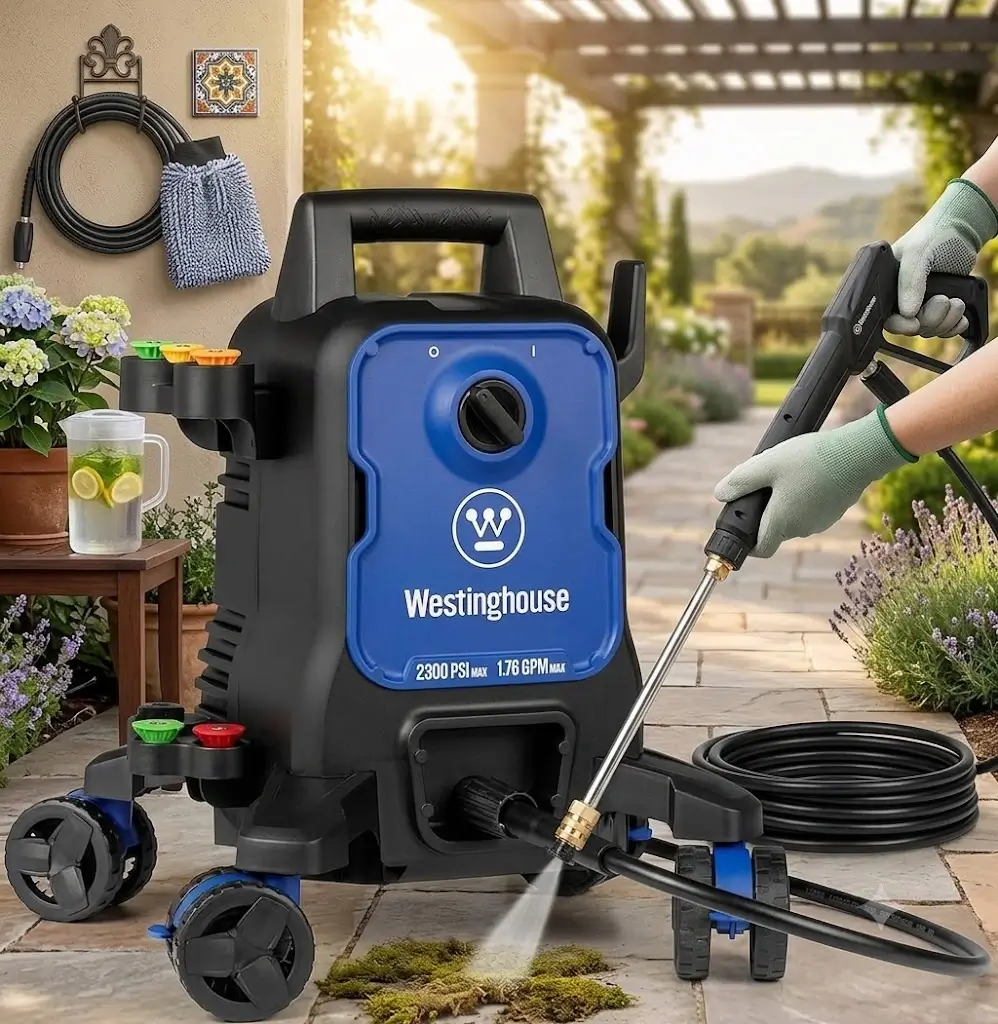
The Westinghouse ePX3100 is engineered around a 4-wheel chassis with 360-degree caster steering. Standing 16.5 inches tall, its low center of gravity reduces the likelihood of tipping compared with taller upright designs when the hose is pulled across driveways. Operating on a 13-amp universal motor, it delivers a manufacturer-listed continuous working pressure of 1,900 PSI at 1.24 GPM (2,356 Cleaning Units).
Specifications
- Motor & Power: 13.0-Amp Universal Brushed Motor
- Pump Architecture: Aluminum Axial Cam Pump with Total Stop System (TSS)
- Manufacturer-Listed Output: 1,900 Working PSI @ 1.24 Working GPM
- Peak Claim: 2,300 Max PSI @ 1.76 Max GPM
- Calculated Cleaning Units (CU): 2,356 CU
- Hose & Fittings: 25 ft Nylon-Braided Hose, Brass M22-14mm Quick-Connects
- Weight & Power Cord: 19.0 lbs; 35 ft Cord with GFCI
Engineering Analysis
Motor Draw & Circuit Efficiency: The 13.0-amp rating places it within the same general electrical range as many consumer electric pressure washers in this category, operating within standard 15-amp residential circuit capacity.
Pump & TSS Valve: Features an aluminum axial cam pump paired with an integrated Total Stop System (TSS). The Total Stop System shuts the motor off when the trigger is released, reducing unnecessary motor runtime and limiting the amount of time the pump remains in thermal bypass mode.
Chassis Dynamic Stability: The four quick-lock 360° caster wheels distribute weight broadly across a wide footprint, making the unit significantly more resistant to tipping during hose movement.
Pros
- Low center of gravity reduces the risk of tipping during hose pulls
- Highest manufacturer-listed cleaning output (2,356 CU) among the models reviewed
- Includes extendable steel spray wand and brass M22 couplers
- Includes 5 quick-connect tips (0°, 15°, 25°, turbo, soap) and onboard soap tank
Cons
- Caster wheels roll slower over deep lawn grass or loose gravel
- Slightly wider rectangular footprint for shelf storage
2. Westinghouse ePX3100v — Best for Compact Storage & Elevated Work
Overview
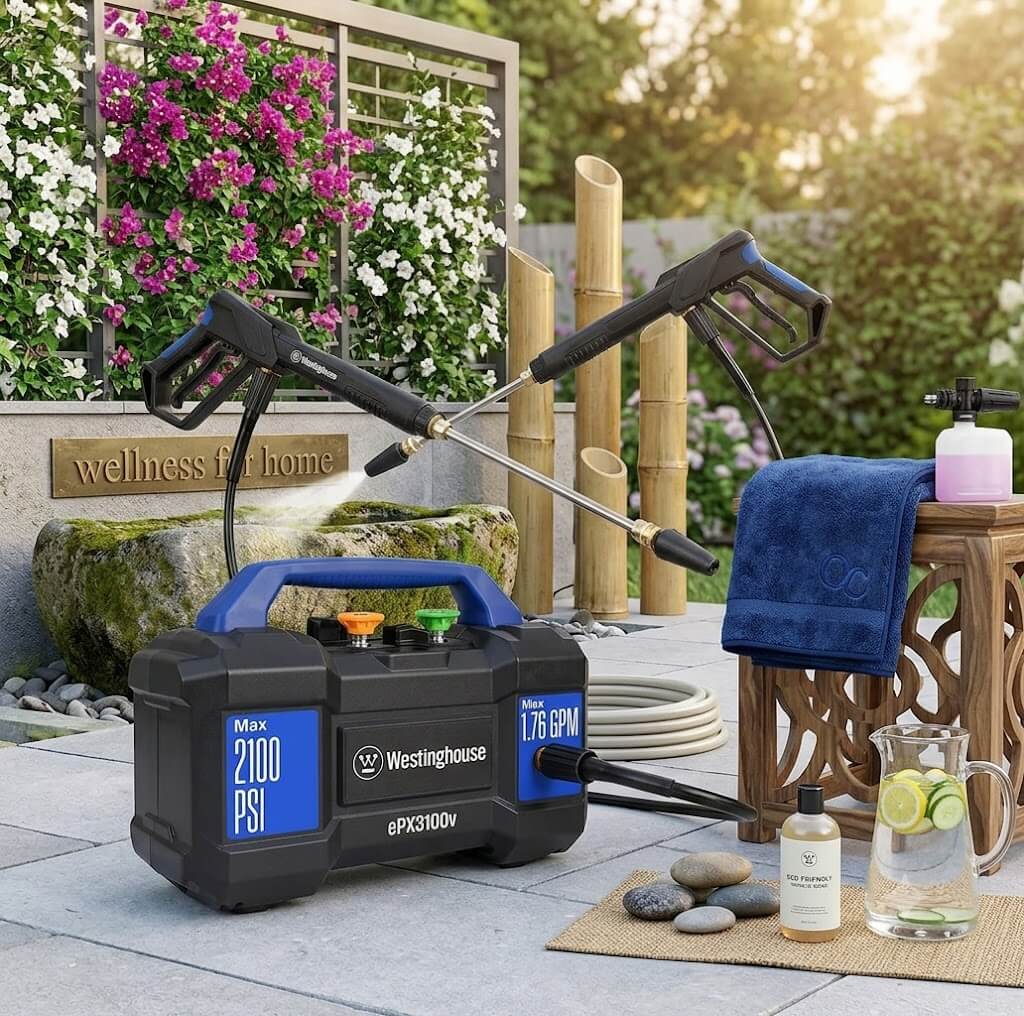
The Westinghouse ePX3100v packages the ePX motor-and-pump configuration into a wheel-less form factor. Weighing 17.6 pounds with a top carrying handle, it delivers a manufacturer-listed 1,800 working PSI at 1.20 working GPM (2,160 Cleaning Units).
Specifications
- Motor & Power: 13.0-Amp Universal Brushed Motor
- Pump Architecture: Aluminum Axial Cam Pump with TSS
- Manufacturer-Listed Output: 1,800 Working PSI @ 1.20 Working GPM
- Peak Claim: 2,100 Max PSI @ 1.76 Max GPM
- Calculated Cleaning Units (CU): 2,160 CU
- Hose & Foam Cannon: 20 ft Nylon-Braided Hose, External Foam Cannon Attachment
- Weight & Power Cord: 17.6 lbs; 35 ft Cord with GFCI
Engineering Analysis
Portability Architecture: Eliminating the wheeled cart allows a compact casing centered under a top handle. This makes moving the unit convenient when navigating stairs, elevated decks, or narrow pathways.
Foam Delivery System: Includes an external foam cannon attachment that connects directly to the end of the steel spray wand, delivering detergent without routing soap chemicals through the internal pump manifold.
Pros
- Convenient wheel-less design for elevated deck work and stairs
- Includes foam cannon attachment for soap application
- Durable pro-style steel spray wand with brass quick-connects
- Solid 1,800 listed PSI output in a space-saving chassis
Cons
- Lacks wheels; must be lifted manually across large yards
- 20-foot high-pressure hose is 5 feet shorter than the ePX3100
3. Westinghouse ePX3050 — Best for Yard Mobility
Overview
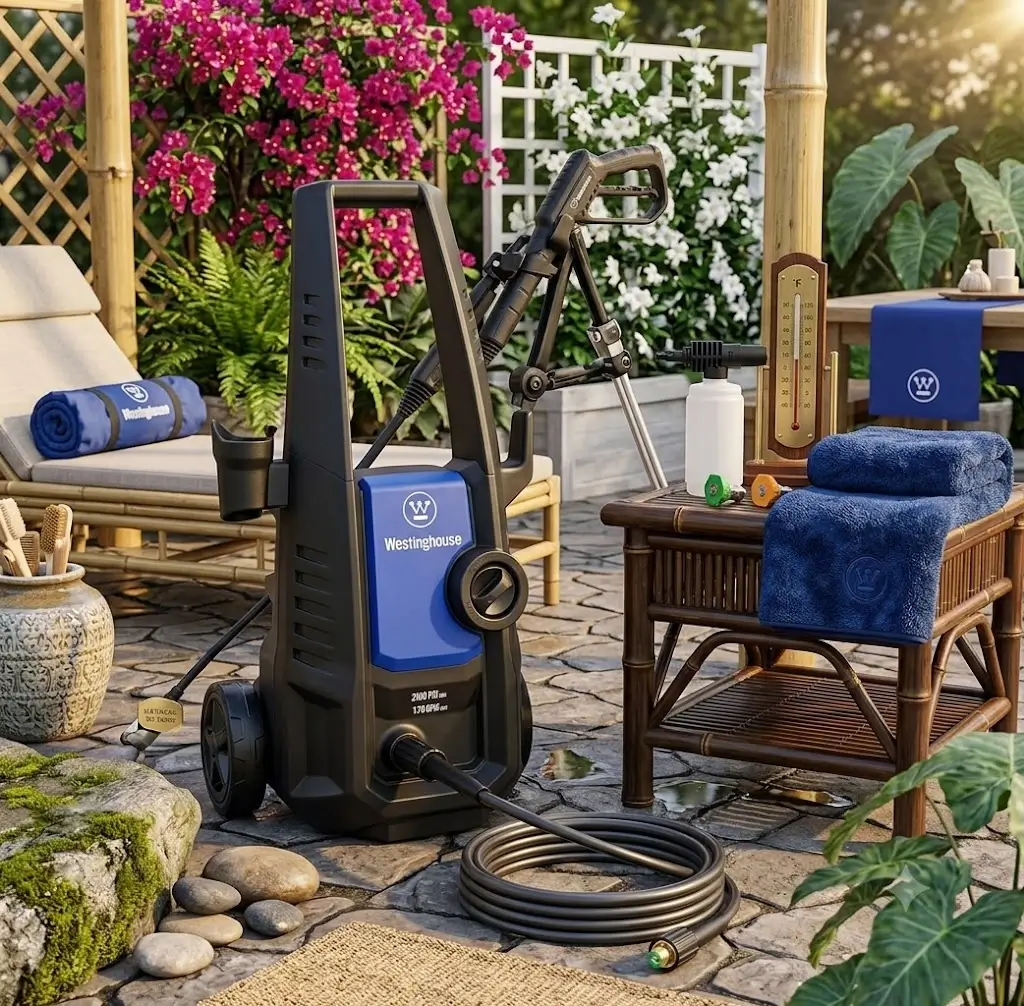
The Westinghouse ePX3050 offers a traditional upright wheeled frame for budget-conscious buyers. Delivering a manufacturer-listed 1,800 working PSI at 1.20 working GPM (2,160 Cleaning Units), it features 5-inch solid plastic wheels designed for mobility across unpaved surfaces.
Specifications
- Motor & Power: 13.0-Amp Universal Motor
- Pump Architecture: Axial Cam Pump with TSS
- Manufacturer-Listed Output: 1,800 Working PSI @ 1.20 Working GPM
- Calculated Cleaning Units (CU): 2,160 CU
- Hose & Wheels: 20 ft Super-Flex Hose, 5-inch Solid Wheels
- Weight & Power Cord: 17.0 lbs; 35 ft Cord with GFCI
Engineering Analysis
Upright Chassis Ergonomics: The 26-inch tall frame with 5-inch solid wheels should handle lawn turf and uneven outdoor surfaces more easily than small caster wheels.
Plastic Spray Wand Construction: Uses a composite spray wand assembly. While lightweight and corrosion-resistant, composite lances exhibit higher flex under continuous high pressure compared to steel wands.
Pros
- 5-inch wheels roll smoothly across grass, pavers, and gravel
- Solid 1,800 listed working PSI for siding and outdoor furniture
- Includes foam cannon and turbo nozzle attachments
Cons
- Composite spray wand flexes more than steel lances
- Upright stance can tip if the high-pressure hose is pulled hard at an angle
4. Craftsman CMEPW1700 — Best Lightweight Budget Option
Overview
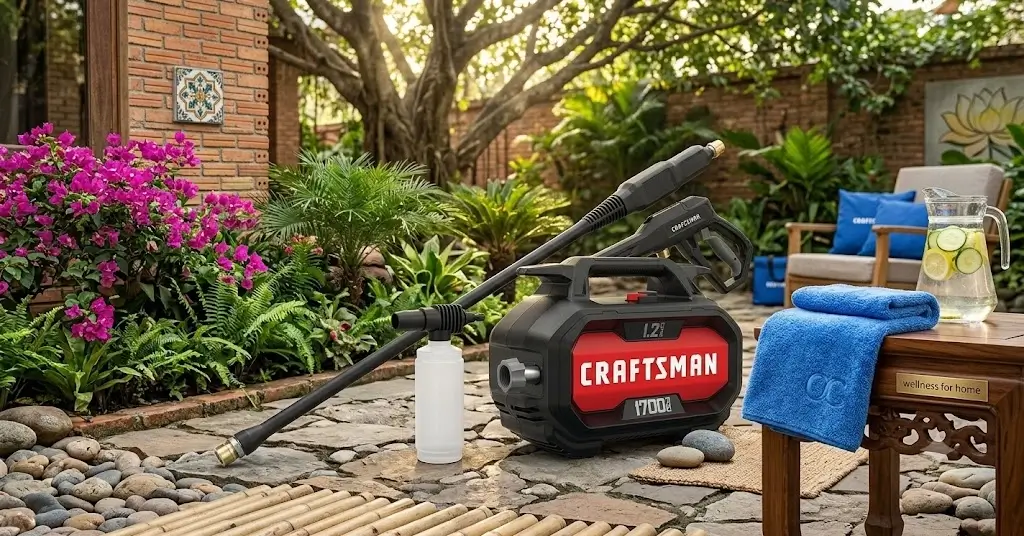
The Craftsman CMEPW1700 is built for lightweight handling and compact storage. Weighing 16 pounds, this unit generates a listed working pressure of 1,300 PSI at 1.20 GPM (1,560 Cleaning Units), making it well-suited for light residential maintenance and car washing.
Specifications
- Motor & Power: 13.0-Amp Universal Motor
- Pump Architecture: Axial Cam Pump
- Manufacturer-Listed Output: 1,300 Working PSI @ 1.20 Working GPM
- Peak Claim: 1,700 Max PSI
- Calculated Cleaning Units (CU): 1,560 CU
- Hose & Frame: 20 ft PVC High-Pressure Hose; Compact Storage Rail Frame
- Weight & Power Cord: 16.0 lbs; 35 ft Cord with GFCI
Engineering Analysis
Electrical Load & Circuit Compatibility: Its 13-amp rating may be easier to accommodate on a properly sized residential circuit than higher-draw models, although other loads on the same circuit still matter.
Compact Storage Footprint: Integrated side rails store the spray gun, power cord, high-pressure hose, and nozzles neatly within the machine’s primary outer boundary.
Pros
- Ultra-lightweight 16-lb frame is easy to transport
- Compact chassis has a low profile, which may reduce the likelihood of tipping
- Backed by a 3-year limited warranty and broad brand recognition
Cons
- Lower continuous output (1,300 PSI / 1,560 CU) slows deep concrete cleaning
- PVC hose retains coil memory and can kink if pulled tight
5. Yeryork YE005 — Hose-Reel Convenience (Unverified Specs)
Overview
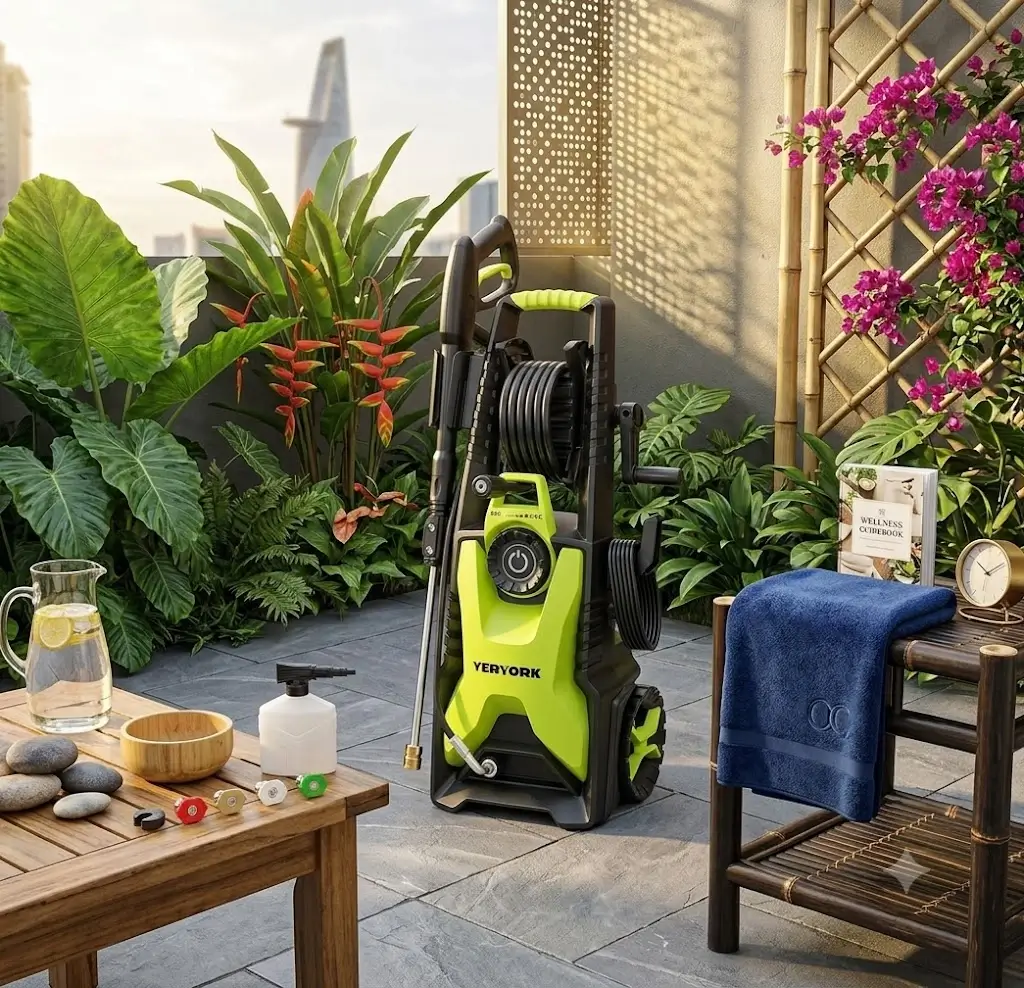
The Yeryork YE005 features an integrated 33-foot retractable spring-loaded hose reel and stainless steel spray lance. While advertised with a “5000 Max PSI” marketing badge, continuous working specifications are not independently published or verified by standard testing bodies.
Specifications
- Motor & Power: 1900W Universal Motor (~15A peak load)
- Pump Architecture: Axial Cam Pump
- Manufacturer-Listed Output: Not Disclosed / Unverified
- Marketing Claim: 5,000 Max PSI / 2.5 Max GPM (*Unverified burst claim)
- Calculated Cleaning Units (CU): Not Calculated (Unverified)
- Hose Reel & Wand: 33 ft Retractable Hose Reel, Stainless Steel Spray Lance
- Weight & Power Cord: 17.6 lbs; 35 ft Cord with GFCI
Engineering Analysis
Physical Electrical Limits & Marketing Claims: Standard 120V / 15A household circuits provide a nominal capacity of 1,800W, with 1,440W representing the 80% continuous-load reference. Generating a continuous 5,000 PSI at 2.5 GPM requires roughly 5.4 kW of hydraulic power alone (5,000 × 2.5 / 1714 ≈ 7.29 HP ≈ 5,438W). Accounting for motor and pump efficiency losses (typically 60–75%), electrical input power would need to reach 7.2 kW to 9.1 kW. A continuous 5,000 PSI at 2.5 GPM output is not physically plausible for a typical 120V consumer pressure washer operating from a standard residential circuit. Without independent hydraulic measurements, the unit’s actual working output should be treated as unverified.
Retractable Hose Reel Mechanics: The internal spring-loaded reel neatly stores 33 feet of hose. However, the internal swivel seal inside the hub adds an additional mechanical seal wear point over extended usage.
Pros
- 33-foot retractable hose reel eliminates manual hose wrapping
- Includes stainless steel spray lance and brass M22 fittings
- Integrated pressure adjustment knob for delicate surfaces
Cons
- Unverified 5,000 PSI marketing claims can mislead buyers
- Higher 1900W peak motor draw approaches 15A breaker limits
- Hose reel hub swivel adds a potential long-term leak point
6. Greenworks PW-1600 — Best Light-Duty Vehicle & Tool Washer
Overview
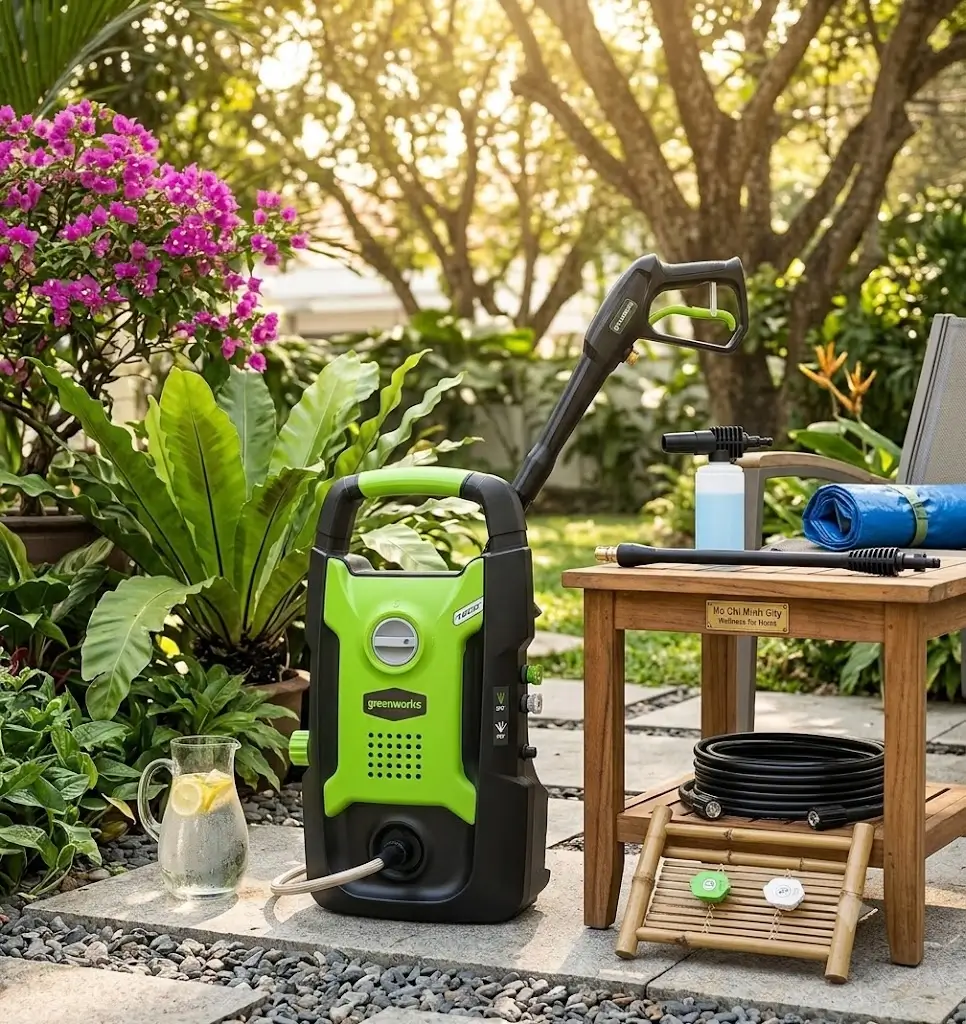
The Greenworks PW-1600 is an entry-level pressure washer designed for light residential chores. Operating on a 13-amp motor, it delivers a manufacturer-listed 1,200 working PSI at 1.20 GPM (1,440 Cleaning Units) in a stable dual-orientation frame.
Specifications
- Motor & Power: 13.0-Amp Universal Motor
- Pump Architecture: Wobble Plate Axial Pump
- Manufacturer-Listed Output: 1,200 Working PSI @ 1.20 Working GPM
- Peak Claim: 1,600 Max PSI
- Calculated Cleaning Units (CU): 1,440 CU
- Hose & Frame: 20 ft High-Pressure Hose, Dual Horizontal/Vertical Stance
- Weight & Power Cord: 16.1 lbs; 35 ft Cord with GFCI
Engineering Analysis
Dual-Stance Chassis Stability: Designed to operate lying flat horizontally or standing vertically, providing a low center of gravity that resists tipping when pulled across driveways.
Light-Duty Cleaning Target: Generating 1,440 Cleaning Units, its main advantage is specification transparency and brand support relative to many low-cost marketplace alternatives. The lower working pressure can be easier to control on vehicles, lawn mowers, bicycles, and patio furniture. However, users should still maintain appropriate spraying distance and use a wide spray pattern to prevent delicate surface damage.
Pros
- Dual horizontal/vertical operating positions resist tipping
- Ultra-compact body takes up minimal storage shelf space
- Clear specification transparency from an established power-tool brand
Cons
- Lower continuous working pressure (1,200 PSI) slows concrete cleaning
- Includes basic detergent applicator rather than a pressurized foam cannon
What Can You Actually Clean With a $150 Pressure Washer?
Understanding which surface cleaning tasks match budget electric pressure washers prevents user frustration and surface damage. Pressure alone does not determine cleaning speed. Surface age, contamination type, nozzle distance, flow rate, and whether concrete is sealed also affect results. Lower-output units can still clean concrete, but cleaning speed and the ability to remove embedded grime will be reduced.
| Cleaning Task | Practical Working PSI Range | Useful GPM | Best Spray Nozzle / Tip | Recommended Model Match |
|---|---|---|---|---|
| Cars, Trucks & Motorcycles | 1,100 – 1,500 PSI | 1.20+ GPM | 40° (White) or Foam Cannon | Greenworks PW-1600 / ePX3100v |
| Patio Furniture & Lawn Mowers | 1,200 – 1,400 PSI | 1.20 GPM | 25° (Green) or 40° (White) | Craftsman CMEPW1700 |
| Vinyl Siding & Window Shutters | 1,300 – 1,800 PSI | 1.20+ GPM | 25° (Green) or Soap Nozzle | Westinghouse ePX3050 |
| Wooden Decks & Fences | 1,200 – 1,500 PSI | 1.20 GPM | 25° (Green) or 40° (White) | Craftsman CMEPW1700 / ePX3100v |
| Light Concrete & Paver Cleaning | 1,300 – 1,600 PSI | 1.20 GPM | 25° (Green) or Turbo Nozzle | Craftsman CMEPW1700 / ePX3050 |
| Heavier Grime & Concrete | 1,600 – 1,900+ PSI | 1.24 GPM | 15° (Yellow) or Turbo Nozzle | Westinghouse ePX3100 |
Buying Guide: Key Engineering Factors Under $150
1. Understanding Pressure Metrics: PSI, GPM, and Cleaning Units
Pressure washer performance is governed by fluid dynamic work output: water pressure (Pounds per Square Inch / PSI) and flow volume (Gallons per Minute / GPM). Multiplying these yields Total Cleaning Units:
- Working PSI: Provides the mechanical stripping force to break bonds between dirt, algae, or grime and the substrate.
- Working GPM: Provides the fluid volume needed to wash away loosened debris. Higher GPM dramatically speeds up overall cleaning time.
2. Electrical Physics & Branch Circuit Limits
Standard North American residential outlets operate on 120 volts with 15-amp branch circuit breakers. A 15A, 120V circuit has a nominal capacity of 1,800W. Under the commonly applied 80% continuous-load guideline, 1,440W represents the recommended continuous load reference for circuits subject to that rule. Actual equipment operation depends on the appliance’s listed rating and applicable electrical code requirements.
| 120V / 15A Branch Circuit Parameter | Power Capacity / Technical Limit |
|---|---|
| Circuit Nominal Capacity | ~1,800 Watts (15.0 Amps) |
| 80% Continuous-Load Reference | ~1,440 Watts (12.0 Amps) |
| Typical Rated Output (Reviewed Models) | ~1.2 to 1.24 GPM @ ~1200–1900 PSI |
| Claimed 5,000 PSI @ 2.5 GPM Output | Requires ~5.4 kW Hydraulic (~7.2–9.1 kW Electrical Input) |
Maximum PSI is a peak or maximum-pressure figure used in manufacturer marketing and specifications. It is not necessarily equivalent to the pressure maintained during normal spraying. Always rely on realistic manufacturer-published working specs or verified independent data.
3. Frame Architecture & Anti-Tipping Stability
A frequent annoyance during pressure washing is having the unit tip over when pulling the high-pressure hose. Low-slung 4-wheel caster frames position the motor and pump horizontally near the ground, providing higher resistance to tipping when dragging the hose across concrete surfaces.
4. Extension Cord Safety & Voltage Drop
Operating electric pressure washers on thin, undersized extension cords causes voltage drops that increase motor current draw, overheating universal motor windings. Follow these extension cord rules:
- Always follow the manufacturer’s extension-cord specification first.
- If the manual permits an extension cord, use a grounded outdoor-rated cord of the specified gauge and keep the run as short as practical.
- For higher-draw 13–15A machines, heavier-gauge cords such as 12 AWG can reduce voltage drop over longer runs (up to 50 feet), but the correct gauge depends on the tool’s rated current and cord length.
- Avoid undersized cords (e.g., 16 AWG) and never use damaged or indoor-only extension cords outdoors.
5. Maintenance & Seasonal Protection
Budget universal motors and axial cam pumps rely on proper maintenance to maximize service life:
- Pump Conditioner / Saver Fluid: Before winter storage, draw anti-freeze pump saver fluid through the inlet to lubricate seals and protect against internal freeze cracking.
- Thermal Bypass Prevention: Avoid leaving the unit powered on with the trigger released for extended periods. The Total Stop System shuts the motor off when the trigger is released, reducing unnecessary motor runtime and limiting pump idle heat.
- Inlet Filter Screen: Clean the garden hose inlet screen regularly to prevent sediment from scoring aluminum pump pistons.
Frequently Asked Questions
- What is the difference between Working PSI and Max PSI?
Maximum PSI is a peak or maximum-pressure figure used in manufacturer marketing and specifications. It is not necessarily equivalent to the pressure maintained during normal spraying. Working (or rated) PSI represents continuous operating pressure during active spraying. - Can electric pressure washers under $150 clean concrete driveways?
Yes. Units delivering 1,800 to 1,900 listed working PSI (such as the Westinghouse ePX3100) have sufficient force to clean dirt, grime, and surface algae from concrete, especially when paired with a turbo nozzle or compact surface cleaner. Lower-PSI units can also clean concrete, though at a slower pace. - Can I connect these pressure washers to a hot water tap?
Most consumer electric pressure washers in this price range are designed primarily for cold-water use. Check the specific model’s manual for its maximum permitted inlet-water temperature before connecting a warm-water supply. - Why does my pressure washer pulse on and off rapidly?
Pulsing can result from restricted inlet flow, trapped air inside the pump chamber, a partially blocked nozzle, or pressure loss caused by leaks in the spray gun, hose, or fittings, causing the unloader valve to cycle continuously. - What size extension cord should I use?
Follow the manufacturer’s manual. As a general rule, a 12 AWG outdoor-rated cord is the safer choice for longer runs and higher-draw equipment to prevent voltage drop, but the manual’s specifications should take priority. - Do budget electric pressure washers require routine pump oil changes?
Most consumer electric pressure washers in this price range feature permanently lubricated axial cam pumps that do not require user-performed oil changes. Always verify maintenance requirements in the owner’s manual for your specific model.
Final Verdict & Buyer Recommendations
Selecting the optimal electric pressure washer under $150 depends on matching chassis stability and continuous cleaning power to your specific property layout:
- Top Pick Overall: The Westinghouse ePX3100 provides the best combination of 4-wheel anti-tipping stability, 1,900 listed working PSI (2,356 CU), steel spray wand, and standard brass M22 fittings.
- Best for Compact Storage: The Westinghouse ePX3100v delivers 1,800 listed PSI in a lightweight, wheel-less 17.6-lb body with an included foam cannon, ideal for elevated decks and stairs.
- Best for Yard Mobility: The Westinghouse ePX3050 offers smooth mobility over lawn turf and pavers with its 5-inch wheels and solid 1,800 listed PSI output.
- Best Lightweight Budget Option: The Craftsman CMEPW1700 offers a low-profile 16-lb frame, 3-year limited warranty, and moderate electrical draw for easy maintenance cleaning.
Editorial Method: We compare manufacturer-published working specifications, maximum claims, electrical requirements, warranty terms, and product construction details. We do not treat maximum PSI marketing claims as equivalent to continuous working output.
Data Provenance Status: Unless explicitly labeled as independently measured, PSI and GPM figures are manufacturer-published working specifications or retailer-listed claims.
Review Window: July 2026. Retail prices and promotional availability fluctuate by retailer and season.
