
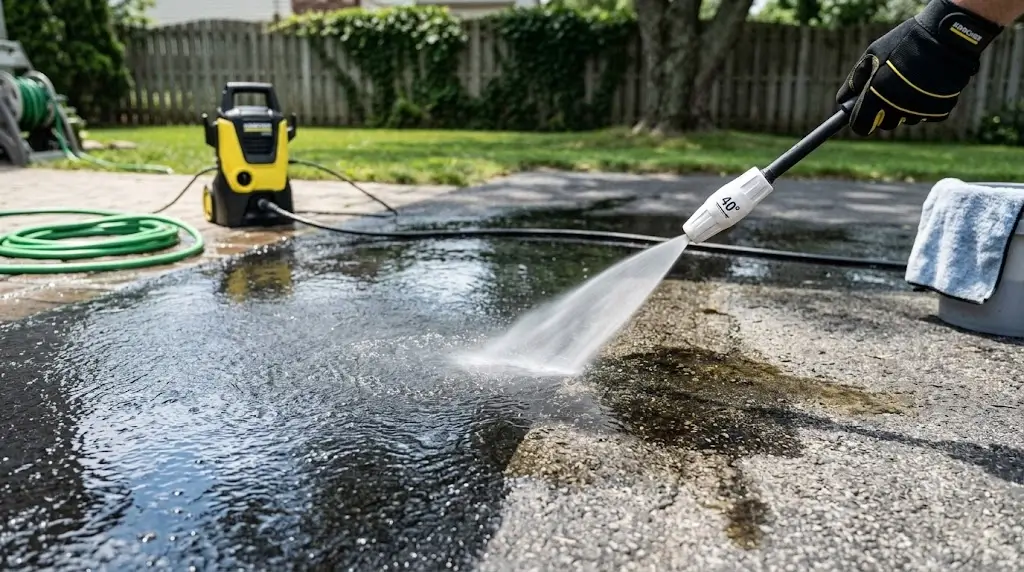
How to Clean an Asphalt Driveway: Oil, Dirt, Mold, Moss & Stain Removal
Cleaning an asphalt driveway requires completely different mechanical and chemical parameters than concrete. Asphalt is a flexible, petroleum-bound pavement composed of aggregate bonded with bitumen. Excessive hydraulic pressure, concentrated rotary nozzles, petroleum-based solvents, or harsh acid cleaners strip surface emulsion, dislodge aggregate, and accelerate structural alligator cracking.
This engineering-backed guide details how to clean residential blacktop driveways safely using garden hoses, electric washers, or commercial gas units—including proven methods for oil stains, moss, mold, mildew, tire marks, rust, and crack preparation.
Asphalt-Safe Methods
Pressure Washer
Oil Stains
Mold & Moss
Rust Removal
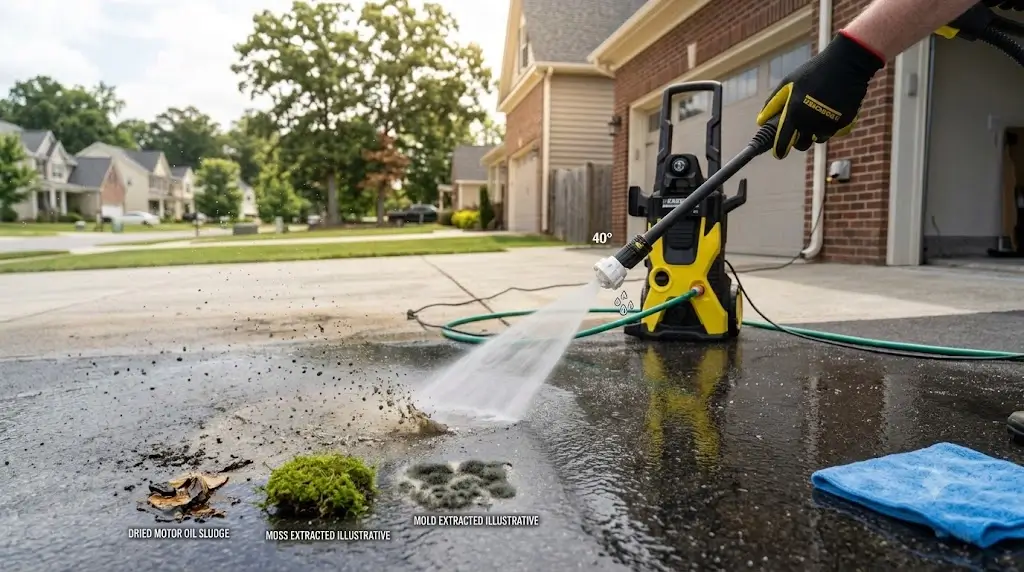
Direct Answer: What Is the Safest Way to Clean an Asphalt Driveway?The safest method to clean an asphalt driveway without stripping binder or dislodging aggregate follows this verified 4-step sequence:
- Dry Debris Removal: Sweep surface grit, leaves, and winter sand with a stiff push broom to eliminate abrasive particles.
- Targeted Pre-Treatment: Treat motor oil with dry absorbent powder followed by a microbial bio-degreaser; treat algae/moss with an asphalt-safe non-bleach surfactant.
- Controlled Low-to-Medium Wash: Pressure wash using a 40° white fan nozzle at 1,300 to 1,800 PSI max, maintaining a 12–18 inch wand distance from the surface.
- Drainage-Directed Rinse: Flush emulsified dirt from the highest elevation toward street runoff or lawn swales, avoiding stationary nozzle dwell on aged pavement.
Why Asphalt Requires Different Cleaning Than Concrete
Concrete is a rigid hydraulic cement composite that cures harder with moisture and withstands pressures up to 3,500+ PSI with rotary turbo nozzles. In contrast, asphalt (blacktop) is an elastomeric composite consisting of 90–95% aggregate held together by only 4–8% asphalt cement (bitumen). Bitumen softens under ambient heat, oxidizes under UV light, and dissolves when exposed to petroleum distillates like gasoline, kerosene, or harsh citrus solvents.
Information Gain: Asphalt vs. Concrete Hydraulic Tolerance. Exceeding 2,000 PSI or holding a narrow nozzle under 12 inches on asphalt shears the bitumen film directly off the stone aggregate. Once this binder breaks down, loose stones ravel into potholes under vehicle tire torque.
Inspect the Driveway Before Cleaning
Walk the entire perimeter before connecting equipment. Structural pavement flaws determine the allowable water pressure:
- Transverse & Longitudinal Cracks: Cracks wider than 1/4 inch require dry leaf-blowing instead of pressurized injection.
- Alligator Cracking: Interconnected hexagonal fatigue patterns signify base failure; avoid all high-pressure washing on these zones.
- Raveling Aggregate: Loose pebbles on the surface indicate oxidized binder; restrict washing to broad fan nozzles only.
- Edge Crumbles: Unsupported driveway edges shear off if washed with rotary surface cleaners.
Never inject pressurized water into base asphalt fissures. High-pressure streams forced into alligator cracks saturate the underlying subbase aggregate, eroding compacted gravel and causing localized sinkholes or frost heaves.
What You Need to Clean an Asphalt Driveway
Matching equipment output to asphalt hardness is essential. If selecting machinery for residential hardscapes, review our engineering-focused pressure washer buying guide to balance pump flow rate against pavement age.
| Equipment / Material | Specification / Type | Primary Function on Asphalt |
|---|---|---|
| Stiff Push Broom | Coarse polypropylene bristles | Removes heavy loose aggregate and dirt before wetting |
| Pressure Washer | Electric or throttled Gas (1,200–1,800 PSI, 1.5–2.5 GPM) | Hydraulic rinsing and deep biological removal |
| Spray Nozzle | 40-Degree White Quick-Connect Tip | Spreads hydraulic energy widely to avoid cutting pavement |
| Oil Remediation | Bentonite clay / Microbial bio-remediation degreaser | Extracts embedded engine oil without softening bitumen |
| Spot Scrub Brush | Nylon bristles (No wire bristles) | Manual agitation for tire marks and heavy grime |
| Surface Cleaner | 14 to 16-inch dual-nozzle rotary deck (Optional) | Uniform, streak-free surface cleaning across large driveways |
Can You Pressure Wash an Asphalt Driveway?
Yes, provided the machine’s effective pressure at the pavement remains below the shear threshold of the bitumen binder. Electric pressure washers chosen from our tested best electric pressure washers provide ideal performance (1,500 to 1,900 PSI) with smooth, constant water volume that will not gouge aggregate.
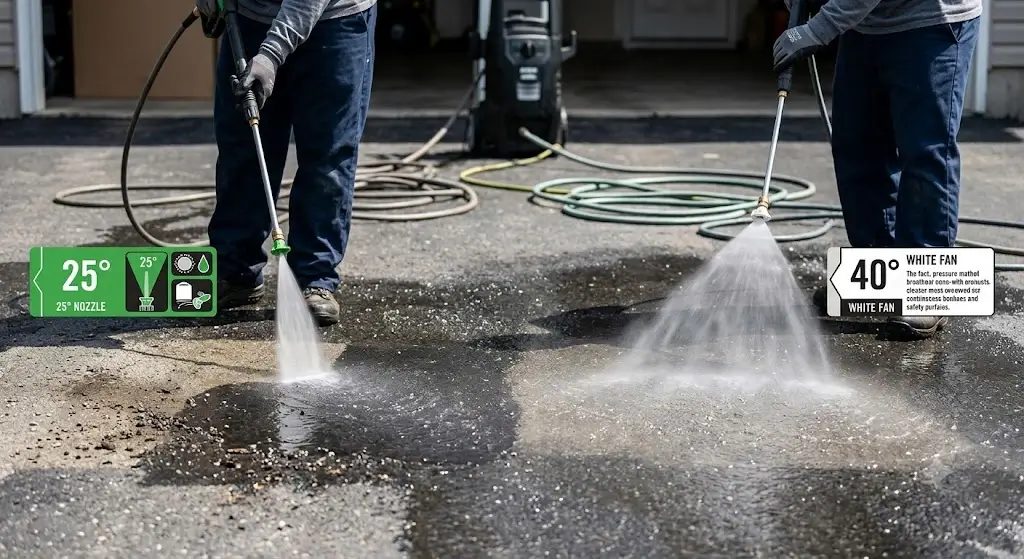
Red 0° and Rotary Turbo Nozzle Ban: Never use a 0-degree red pencil jet or a rotating turbo nozzle on asphalt. The concentrated rotational cutting force instantly carves circular grooves and strips the top sealcoat layer.
Optimal PSI, GPM, and Nozzle Calibration for Asphalt
Use this technical specification matrix to calibrate your pressure washer based on the age and condition of your blacktop:
| Asphalt Age / Condition | Target Operating PSI | Minimum GPM | Recommended Nozzle | Safe Wand Distance |
|---|---|---|---|---|
| Recently Sealed (< 1 Year) | 1,000 – 1,300 PSI | 1.8 – 2.0 GPM | 40° (White) or Low-Pressure Rinse | 15 – 18 Inches |
| Mature Sound Asphalt (1–5 Years) | 1,300 – 1,700 PSI | 2.0 – 2.5 GPM | 40° (White) / 25° (Green with caution) | 12 – 15 Inches |
| Aged / Oxidized Pavement (> 5 Years) | 1,000 – 1,200 PSI | 2.2 – 3.0 GPM | 40° (White Fan) only | 16 – 20 Inches |
| Fissured / Alligator Cracking | Garden Hose Pressure Only | 4.0+ GPM (Hose) | Standard brass garden nozzle | Direct wash |
Which Pressure Washer Nozzle Should You Use?
The 40-degree white fan tip is the universal standard for residential asphalt cleaning. It disperses the water impact over an expansive triangular fan, maintaining high flow for moving debris while drastically reducing downward impact force.
Check Water, Runoff, and Environmental Safety
Asphalt wash water frequently carries suspended hydrocarbons, heavy metals from brake dust, and cleaning chemicals. When operating electric pressure equipment near pools of runoff, always adhere to the immersion protocols in our pressure washing safety guide to ensure GFCI shock prevention.
Additionally, prevent oily runoff from draining directly into municipal storm sewers. Use sand berms or absorbent socks to redirect rinse water toward adjacent grass areas or permeable gravel swales that act as natural soil bio-filters.
Step 1: Sweep the Asphalt Driveway
Never spray water onto a dry, debris-covered driveway. Use a wide commercial push broom to clear all sand, pebbles, and tree litter. Loose quartz sand acts like sandblasting media under high pressure, scuffing the blacktop’s protective sealant.
Step 2: Pre-Wet the Surface
Pre-wetting asphalt cools down hot surface bitumen during summer and prevents chemical cleaners from soaking too deeply into microscopic pavement pores before they emulsify surface oils.
Step 3: How to Remove Oil and Grease Stains From Asphalt
Petroleum motor oil dissolves asphalt binder almost immediately because they share identical chemical hydrocarbon bases. Motor oil breaks down bitumen into soft, gummy sludge that must be handled systematically:
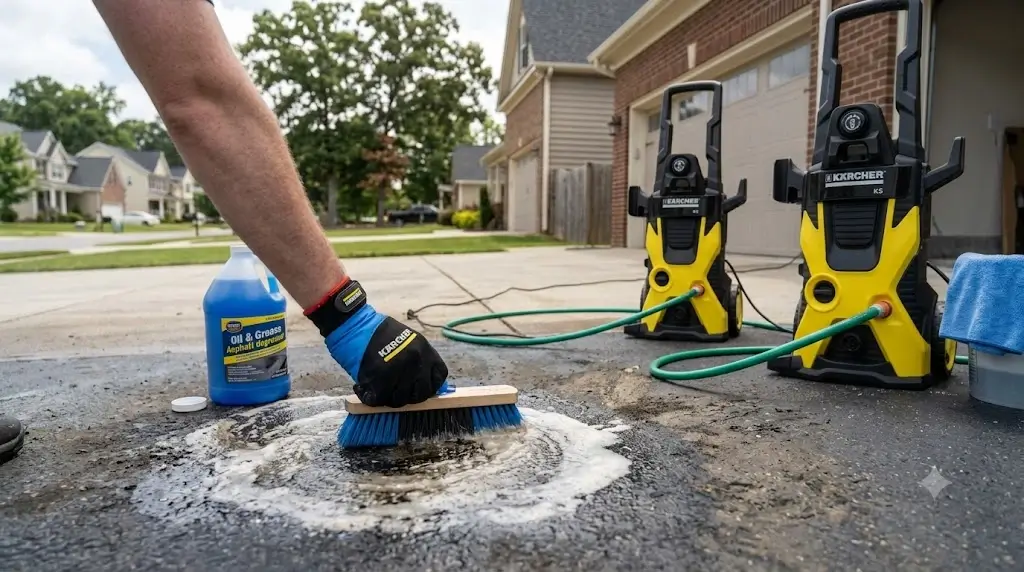
Step-by-Step Oil Extraction:
- Blot Fresh Spills: Cover fresh oil with clay cat litter, bentonite clay powder, or baking soda. Press the absorbent down and let it sit for 6–12 hours to wick up free liquid.
- Sweep Dry Residue: Discard oil-saturated clay in household trash.
- Apply Bio-Enzymatic Cleaner: Pour an asphalt-compatible microbial cleaner over the remaining stain. Enzymes consume hydrocarbon chains without harming bitumen.
- Agitate Gently: Scrub in small circular motions using a stiff nylon deck brush. Never use a wire bristle brush, which cuts grooves into the asphalt.
- Rinse With Low Pressure: Flush with warm or cold water at low pressure into a designated drainage trap.
Step 4: How to Remove Mold, Mildew, and Algae
Damp, shaded driveways develop green algae and slippery black lichen. Avoid concentrated chlorine bleach, which whitens asphalt aggregate and kills lawn borders. Instead, apply specialized formulas from our guide to the best pressure washer soap to eliminate spores at the root while leaving the pavement emulsion intact.
Allow a 10-minute dwell time before rinsing with a 40° fan nozzle at 1,500 PSI.
Step 5: How to Remove Moss From Asphalt
Moss anchors its root-like rhizoids directly into aggregate voids, prying stones apart over winter freeze-thaw cycles. Scrape off top cushions using a square flat-edge shovel, taking care not to gouge the blacktop. Spray the residual root zone with a dilute potassium salt fatty acid cleaner, let dry for 48 hours, and wash away dead root matter.
Step 6: How to Remove Rust Stains From Asphalt
Rust stains from fertilizer iron or lawn furniture require oxalic acid or sodium gluconate-based rust converters. Strong muriatic (hydrochloric) acid used on concrete will dissolve the asphalt binder. Apply the solution, wait 5–8 minutes, scrub with a nylon brush, and rinse immediately.
Step 7: How to Remove Tire Marks
Tire friction transfers plasticizers and unvulcanized rubber onto driveway sealer. Spray an alkaline driveway detergent, agitate with a stiff nylon broom, and rinse with sweeping lateral strokes at 1,500 PSI.
Step 8: Clean General Dirt and Road Grime
For general seasonal film, coat the driveway in a blanket of high-lubricity detergent. Working in 10×10 foot sections prevents soap scum from drying before the final rinse passes.
Step 9: Systematic Pressure Washing Technique
- Position yourself at the highest incline point.
- Maintain a continuous 12 to 18-inch clearance between the nozzle tip and asphalt.
- Keep the wand moving at a steady lateral rate of approximately 1 foot per second.
- Overlap each cleaning swath by 30–50% to prevent “zebra striping.”
- Wash debris steadily downward toward the curb or drainage collector.
Can You Use a Rotary Surface Cleaner on Asphalt?
Yes, but with strict caveats. Rotary surface cleaners prevent zebra striping through balanced dual-nozzle spinning arms. However, you must verify that the cleaner nozzles do not drop the operating distance below 4 inches from the pavement.
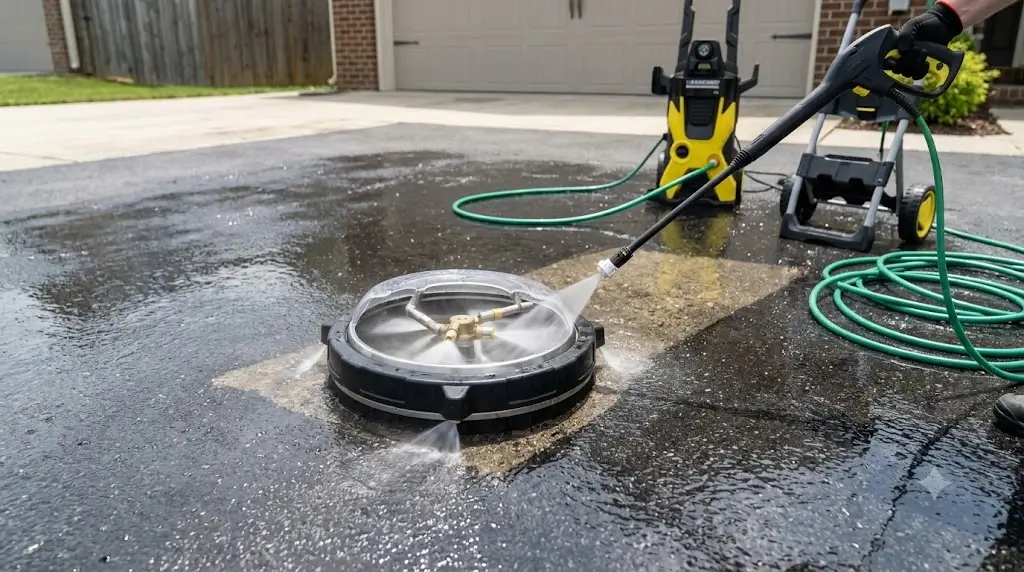
Keep the surface cleaner gliding continuously. Stopping in place for even 3 seconds with active high pressure will carve circular ring scars into blacktop.
Cleaning Driveway Edges and Retaining Berms
Driveway shoulders lack lateral support. Avoid pointing high-pressure streams directly at asphalt edges where base gravel can be washed away. Use a broad fan pattern angled inward toward the center of the driveway.
Cleaning Cracked Asphalt and Weed Removal
Prior to applying hot-pour or cold-applied crack sealant, cracks must be free of soil and organic roots. Use a high-velocity leaf blower or compressed air lance to blast out dry debris. If washing is necessary, allow 24–48 hours of full sun drying before pouring asphalt sealant.
Asphalt Stain Identification Matrix
| Visual Characteristic | Probable Contaminant | Recommended Chemistry | Application Method |
|---|---|---|---|
| Black, tacky puddle | Fresh engine oil / ATF | Bentonite clay + Bio-enzyme | Absorb liquid first, then enzyme soak |
| Slick dark-green film | Algae / Mildew | Alkyl dimethyl ammonium chloride | Low-pressure spray, 10-min dwell, rinse |
| Thick green carpet | Established moss | Potassium salts of fatty acids | Manual scrape, spray roots, wait 48 hrs |
| Reddish-orange streaks | Iron irrigation / Fertilizer | Oxalic acid rust remover | Targeted brush application, quick rinse |
| Gray, dull chalky finish | Bitumen oxidation (Age) | None (Structural condition) | Pavement sealcoating required |
Should You Seal Asphalt After Cleaning?
Cleaning cleans the surface; sealcoating protects it. Driveway sealcoat should be reapplied every 2 to 3 years to shield bitumen from oxidation, gasoline drips, and winter de-icing salts. Always ensure the pavement dries for at least 24 hours after pressure washing before laying down coal-tar alternative or asphalt emulsion sealer.
Temperature and Weather Constraints
- Optimal Conditions: 65°F to 85°F with overcast skies to prevent premature detergent drying.
- Hot Weather Warning: Above 90°F, blacktop softens; vehicle tires and pressure washer wheels can leave permanent indentations.
- Freezing Weather: Never wash asphalt when nighttime temperatures drop below 38°F. Water seeping into micro-fissures freezes, expands by 9%, and pops aggregate loose.
Warning Signs You Are Damaging the Asphalt
Cease pressure washing immediately if you detect any of the following indicators:
- Loose gravel stones accumulating in the water runoff stream.
- Black-tinted water indicating stripped bitumen emulsion.
- White streaks or stripes where the top protective sealcoat has been carved off.
- Subbase soil bubbling up through hairline pavement cracks.
Asphalt Driveway Cleaning Checklist
Pre-Cleaning Phase
- Park vehicles in garage or on the street.
- Sweep entire pavement with stiff push broom.
- Inspect surface for alligator cracking and edge raveling.
- Apply clay absorbent to fresh oil leaks; let dwell.
- Verify water supply flow rate and check GFCI electrical outlets.
Active Washing Phase
- Pre-wet driveway surface with garden hose.
- Apply asphalt-safe bio-cleaner to stains; scrub with nylon brush.
- Connect 40° white nozzle to pressure wand.
- Maintain wand height at 12–18 inches from pavement.
- Wash from top elevation downward in overlapping passes.
Post-Cleaning Phase
- Rinse all residual sludge into grass/swale collection zones.
- Inspect cracks for remaining sediment.
- Allow 24–48 hours drying time before applying crack filler or sealer.
Frequently Asked Questions
What is the best way to clean an asphalt driveway?
The best method is to sweep away all dry debris, spot-treat oil with an absorbent clay powder and microbial degreaser, and wash with an electric pressure washer calibrated to 1,300–1,800 PSI using a wide 40° white fan nozzle held 12–18 inches away from the surface.
Can you pressure wash an asphalt driveway without damaging it?
Yes, provided you avoid 0° red nozzles, rotary turbo nozzles, and pressures above 2,000 PSI. Using a 40° fan nozzle and sweeping laterally without pausing stationary on the blacktop prevents binder damage and aggregate raveling.
What PSI is safe for asphalt?
The safe working limit for sound residential asphalt is 1,300 to 1,800 PSI with a minimum flow of 2.0 GPM. For older, heavily oxidized, or cracked blacktop, reduce pressure to 1,000–1,200 PSI or use a standard garden hose with detergent.
How do you get oil stains out of an asphalt driveway?
Extract fresh oil using absorbent clay or baking soda. Once dry powder is swept away, scrub the spot with an asphalt-safe enzymatic bio-degreaser and a stiff nylon brush. Avoid gasoline, kerosene, or harsh citrus solvents that dissolve the bitumen binder.
Does bleach hurt an asphalt driveway?
Yes. Concentrated chlorine bleach breaks down petroleum bitumen, causes aggregate discoloration, and leaves permanent light gray blotches on blacktop while killing adjacent lawn borders in rinse runoff.
Can you use a surface cleaner attachment on asphalt?
Yes, if the surface cleaner has a wide spray deck (14–16 inches) and is kept gliding smoothly across the surface. Leaving a surface cleaner stationary on asphalt for even a few seconds will carve circular swirl scars into the pavement.
Why does asphalt turn gray after pressure washing?
Asphalt turns gray due to normal UV oxidation of the top bitumen layer. Washing removes surface grime that masked this oxidation. To restore the deep black luster, apply a quality coal-tar alternative or asphalt emulsion driveway sealer after cleaning.
How often should an asphalt driveway be washed?
Clean your asphalt driveway once or twice per year—typically in spring to remove winter de-icing salts and sand, and in autumn before applying seasonal crack filler or driveway sealer.
Bottom Line: Control Hydraulic Energy to Protect Bitumen
Cleaning asphalt is a balance between sufficient fluid flow and controlled mechanical pressure. Unlike concrete, blacktop cannot tolerate concentrated point-source impact. By pairing microbial stain pretreatment, wide 40° fan nozzles, conservative pressure settings (under 1,800 PSI), and proper drainage redirection, you can strip away years of grime, grease, and biological growth without compromising the underlying structural foundation of your driveway.
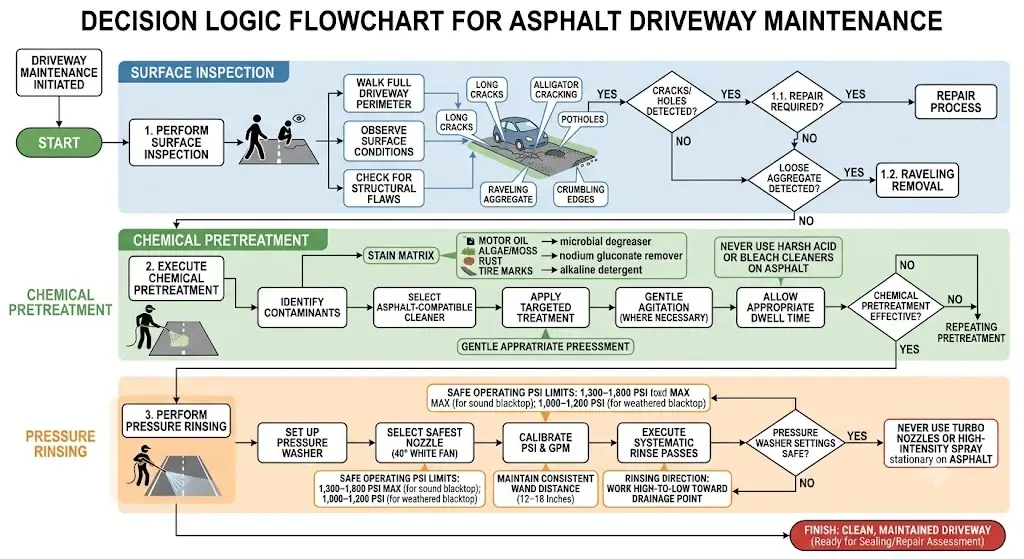
HomeGearMax Core Rule for Blacktop: Chemistry breaks the bond; flow carries the dirt. Pressure should only assist—never force.
