
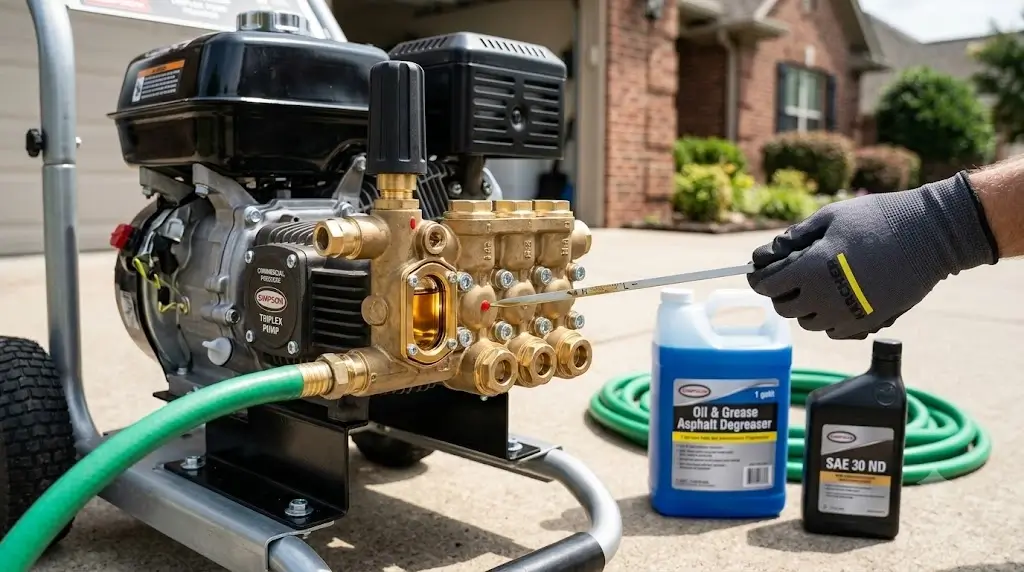
Pressure Washer Pump Oil Guide: Type, SAE Grade, Capacity & Change Interval
Pressure washer pump oil is chemically and functionally distinct from engine oil, and pump lubrication systems vary drastically across residential and commercial equipment. Maintenance requirements depend on the internal pump design (triplex plunger vs. axial-cam) and the equipment manufacturer’s engineering specifications.
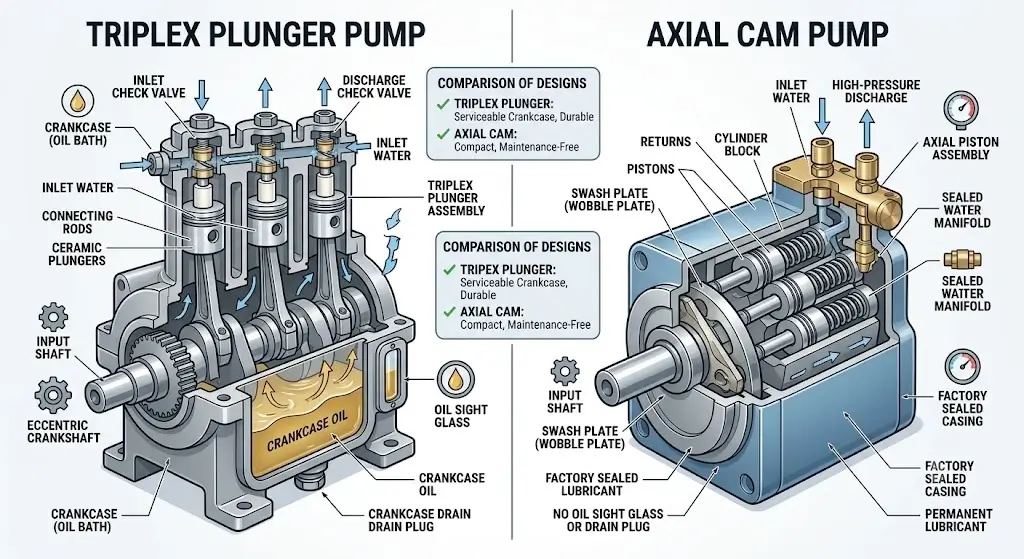
Professional triplex plunger pumps require scheduled crankcase oil changes to protect ceramic pistons and bronze connecting rods. In contrast, standard residential axial-cam pumps are factory-sealed with permanent synthetic lubricant designed to operate without maintenance. Generac explicitly identifies axial-cam pumps as sealed and maintenance-free on applicable models, while its triplex-pump guidance specifies oil types and scheduled changes. This guide provides exact oil grades, viscosity ratings, sight glass calibration, and drain procedures for serviceable pumps.
SAE 15W-40
ISO 68
Triplex Pumps
Axial-Cam Pumps
Crankcase Capacity
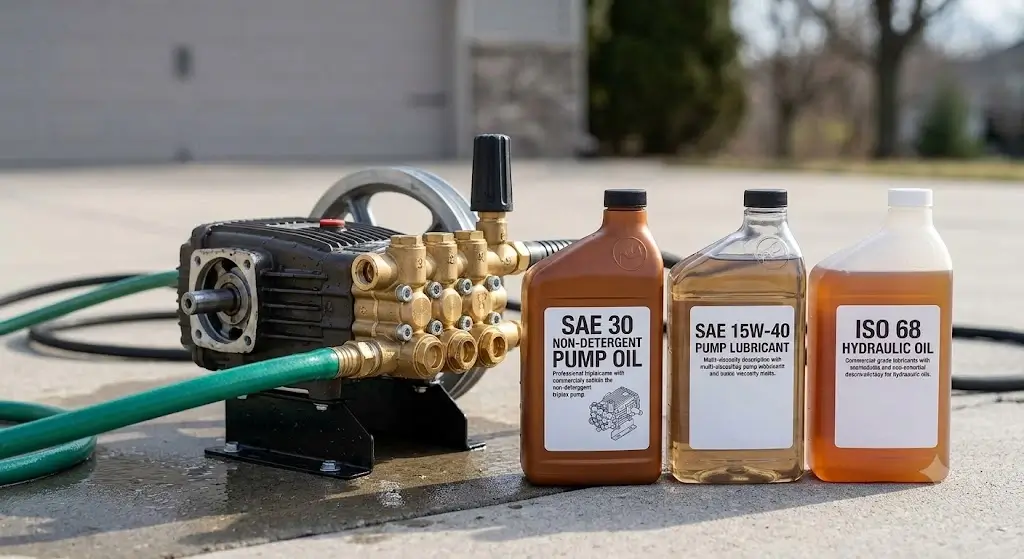
- Many standard triplex pumps: SAE 30 non-detergent pump oil is commonly specified.
- Some belt-drive pumps: SAE 15W-40 non-detergent oil may be specified.
- Some CAT Pumps models: ISO 68 hydraulic oil may be specified.
- Many residential axial-cam pumps: factory sealed and require no routine oil change.
Generac’s triplex-pump guidance specifies SAE 30 non-detergent oil for standard triplex pumps, SAE 15W-40 non-detergent oil for belt-driven models, and ISO 68 hydraulic oil for certain models. It also states that axial-cam pumps are sealed and do not require oil maintenance.
What Is Pressure Washer Pump Oil?
Pressure washer pump oil lubricates the mechanical components inside an oil-filled water pump. Depending on the pump design, these components can include bearings, plungers, crankcase components, and other moving parts.
The pump operates under repeated mechanical loading while converting engine or motor rotation into high-pressure water flow. Correct lubrication reduces friction and helps control wear.
The important distinction is that pump oil belongs to the water-pump lubrication system. It does not lubricate the gasoline engine.
Briggs & Stratton states that water pumps require the oil recommended by the manufacturer and warns against adding special additives or detergents unless the owner’s manual specifically calls for them.
Pressure Washer Pump Oil vs. Engine Oil
A gasoline pressure washer contains two separate oil systems: the engine and the water pump. When selecting the right unit using our detailed pressure washer buying guide, understanding this distinction ensures proper long-term maintenance.
| Characteristic | Engine Oil | Pump Oil |
|---|---|---|
| Lubricates | Gasoline engine | Pressure washer water pump |
| Located in | Engine crankcase | Pump crankcase, if oil-filled |
| Oil grade | Specified by engine manufacturer | Specified by pump manufacturer |
| Maintenance interval | Engine schedule | Pump schedule |
| Can they be substituted? | No | No |
Does Every Pressure Washer Need Pump Oil?
No. This is one of the most important facts in pressure-washer maintenance.
Many residential machines use axial-cam pumps that are sealed at the factory. If you are operating one of the compact units from our top-rated best electric pressure washers, it almost certainly relies on a maintenance-free wobble plate system where adding oil or disassembling the pump voids warranty coverage.
Generac states that axial-cam pumps are factory sealed and do not require oil maintenance, while triplex pumps on applicable professional models require periodic oil service. Briggs & Stratton also markets pressure washers with maintenance-free axial-cam pumps.
Which Pressure Washer Pumps Use Oil?
1. Triplex Plunger Pumps
Triplex pumps are common on professional and commercial pressure washers. They use a crankcase and mechanical components that require lubrication. These pumps typically have an oil fill point and either a sight glass or dipstick. Because the pump is serviceable, the manufacturer’s oil grade and maintenance interval matter.
2. Belt-Drive Triplex Pumps
Belt-driven machines isolate the pump from the engine through a belt-and-pulley system. The pump still requires its own lubrication when designed as an oil-filled pump. Some belt-driven pump configurations specify SAE 15W-40 non-detergent oil. Generac lists this grade for applicable belt-driven pressure-washer pumps.
3. Axial-Cam Pumps
Axial-cam pumps are common on residential pressure washers. Many are factory sealed and designed as maintenance-free assemblies. Do not assume that a gas pressure washer automatically has a serviceable pump.
4. Other Commercial Pump Designs
Some commercial pumps use manufacturer-specific lubrication requirements. CAT Pumps, for example, can specify hydraulic oil such as ISO 68 on particular applications.
Pressure Washer Pump Oil Types
Pump oil should be selected by the pump specification, not by the pressure washer’s advertised PSI.
| Oil Type | Typical Application | Key Point |
|---|---|---|
| SAE 30 non-detergent | Many standard triplex pumps | Common pump-oil specification |
| SAE 15W-40 non-detergent | Some belt-drive pumps | Use only when specified |
| ISO 68 hydraulic oil | Specific pump models | Not a universal replacement |
| Manufacturer-specific pump oil | Many commercial pumps | Follow pump manufacturer |
| Engine oil | Engine crankcase | Not automatically suitable for pump |
SAE 30 Pump Oil: When Is It Used?
SAE 30 non-detergent oil is a common specification for standard triplex pressure-washer pumps. Generac’s triplex guidance specifies SAE 30 non-detergent oil for standard triplex pumps.
The critical word is non-detergent. Do not interpret “SAE 30” alone as permission to use any SAE 30 engine oil.
SAE 15W-40 Pump Oil: When Is It Used?
SAE 15W-40 is specified by some pump manufacturers for particular belt-drive and commercial pressure-washer pump applications. SIMPSON’s Premium Pump Crankcase Oil 80138 is a proprietary 15W-40 formulation, and SIMPSON recommends it for compatible pumps.
SIMPSON documentation for applicable AAA pumps also specifies its Premium Pump Crankcase Oil, with SAE 15W-40 as an alternative for certain models.
ISO 68 Hydraulic Oil for Pressure Washer Pumps
ISO 68 is a viscosity classification used for industrial hydraulic oils. It is not a universal pressure-washer pump oil.
Generac identifies ISO 68 hydraulic oil for specific CAT Pumps applications such as certain XC-series models. If your manual specifies ISO 68, use a compatible hydraulic oil meeting the required specification. If the manual specifies SAE 30 non-detergent oil, do not substitute ISO 68 simply because both are lubricants.
Why Does Non-Detergent Oil Matter?
Some pressure-washer pumps are designed around non-detergent lubrication. Detergent additives are formulated for particular lubrication systems and should not be assumed appropriate for a pressure-pump crankcase.
Briggs & Stratton specifically warns against using special oil additives or detergents unless the owner’s manual calls for them.
How Much Pump Oil Does a Pressure Washer Need?
There is no universal pressure-washer pump-oil capacity. Pump capacity varies by pump model, crankcase design, and manufacturer. Some pumps use a sight glass with a specified fill level. Others use a dipstick. Some manufacturers specify a measured quantity of oil.
For this reason, never fill a pump based on a generic ounce-per-PSI rule. SIMPSON’s pump maintenance instructions tell users to fill to the correct level shown in the sight glass or to the maximum level indicated on the dipstick, depending on the pump.
How to Find Your Pressure Washer Pump Oil Capacity
Use this order of evidence:
- Pump manufacturer’s manual
- Pressure washer owner’s manual
- Pump model number
- Manufacturer parts documentation
- Oil sight glass or dipstick marking
If the pump is an aftermarket replacement, identify the replacement pump rather than relying on the original pressure washer model. SIMPSON explicitly notes that illustrations in its manuals may not represent every specific model and directs users to the pump manufacturer for the recommended oil and intervals.
How to Read a Pressure Washer Pump Oil Sight Glass
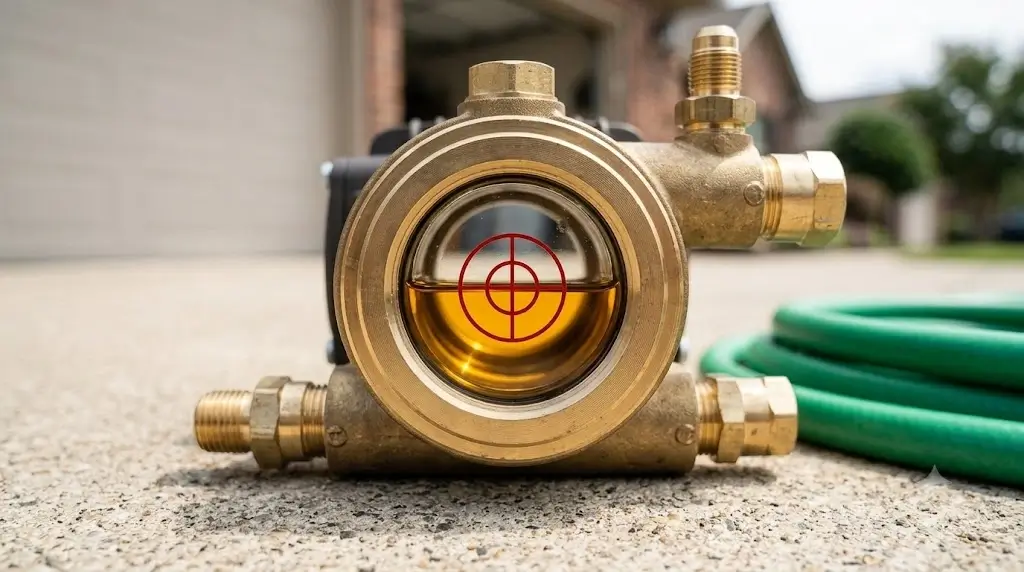
A sight glass allows the oil level to be checked visually. On compatible SIMPSON pumps, the correct level is at the center reference point of the sight glass.
General Procedure
- Place the pressure washer on a level surface.
- Turn the engine off and allow components to cool.
- Clean the outside of the sight glass.
- Look at the oil level through the sight glass.
- Compare the level with the manufacturer’s reference mark.
- Add only the specified oil if the level is below the required mark.
How to Check Pump Oil With a Dipstick
Some serviceable pumps use a dipstick rather than a sight glass. Follow the manufacturer’s instructions for whether the dipstick should be threaded in or simply inserted during measurement.
Generac’s triplex-pump procedure specifies checking the oil between the “L” and “H” marks and warns not to overfill. The measurement method matters because dipsticks can be calibrated for a particular installation and cap design.
How Often Should You Change Pressure Washer Pump Oil?
The correct interval depends on the pump manufacturer. A common commercial-pump pattern is an initial oil change after the break-in period followed by periodic changes based on operating hours.
For example, SIMPSON specifies an initial 50-hour change and then 100-hour intervals or three months for certain AAA pump configurations. Another SIMPSON industrial pump manual specifies the first change at 50 hours and every 100 hours thereafter, while older guidance for some belt-drive and direct-drive configurations uses different intervals.
Why the First 50 Hours Can Matter
The initial operating period can generate wear particles as mechanical components settle into their working surfaces. That is why some commercial pump manufacturers specify an early oil change after the initial operating period.
SIMPSON specifies a first pump-oil change after 50 hours on applicable pumps. The purpose is not to imply that every new pressure washer needs an immediate oil change. Sealed residential pumps are a different category.
The 100-Hour Pump-Oil Interval
A 100-hour interval appears in several serviceable pump specifications, but it should not be treated as a universal rule. SIMPSON lists 100-hour service intervals for certain pump families, while Generac’s applicable triplex guidance specifies a 50-hour interval.
The correct interpretation is simple: use the interval printed for your pump.
Should Pump Oil Be Changed by Months or Hours?
Some manufacturers specify both operating hours and calendar time. This prevents lightly used equipment from remaining on the same oil indefinitely.
SIMPSON’s applicable pump guidance uses both hours and a three-month interval. If your manual says “100 hours or three months, whichever comes first,” follow the first condition reached.
Factory-Sealed Pressure Washer Pumps
A factory-sealed pump changes the maintenance strategy completely. If the manufacturer states that the axial-cam pump is sealed and maintenance-free, routine oil changes are not part of normal owner maintenance.
Generac explicitly states that its applicable axial-cam pumps are factory sealed and require no oil maintenance for their operational life. Trying to open a sealed pump can damage the assembly and potentially create warranty or service problems.
Signs of Low or Bad Pressure Washer Pump Oil
On serviceable oil-filled pumps, lubrication problems can appear as mechanical symptoms:
- Oil level below the manufacturer’s minimum mark
- Visible oil leakage around the crankcase
- Unusual pump noise
- Oil with abnormal contamination
- Repeated loss of oil level
- Visible metal particles in severe cases
- Oil appearing milky or emulsified
These symptoms do not automatically prove that the pump itself has failed. Water supply, inlet restrictions, valves, unloader operation, and other components can also cause pressure-washer problems.
What Does Pressure Washer Pump Oil Leakage Mean?
Oil leakage is not normal on a properly sealed oil-filled pump. Possible causes include:
- Loose or damaged oil plug
- Damaged seal
- Worn pump components
- Overfilled crankcase
- Damaged sight glass
- Crankcase gasket failure
If the oil level repeatedly falls, topping it off without finding the leak only postpones the underlying problem.
Why Is Pressure Washer Pump Oil Milky?
Milky or cloudy oil can indicate that water has entered the oil system. On an oil-filled pump, water contamination reduces the quality of the lubricant and can contribute to corrosion and bearing damage.
If the oil is visibly emulsified, stop treating the issue as a normal oil-level adjustment. The pump should be inspected and serviced according to the manufacturer’s procedure.
Why Is Pressure Washer Pump Oil Dark?
Oil darkening alone does not provide enough information to determine whether a pump is healthy or damaged. Used lubricant can change color during operation.
The more useful indicators are manufacturer service intervals, oil viscosity, water contamination, metal particles, unusual odor, and visible leaks. When in doubt, follow the pump manufacturer’s replacement interval rather than judging oil condition only by color.
What If You See Metal in the Pump Oil?
Small amounts of wear material may occur during mechanical operation, particularly during break-in, but visible metal particles should not be ignored. If the drained oil contains obvious metallic debris, inspect the pump according to the manufacturer’s service procedure.
A sudden increase in metal contamination combined with abnormal noise, leakage, or pressure loss is more concerning than normal oil discoloration.
How to Change Pressure Washer Pump Oil
The exact procedure depends on the pump, but most serviceable oil-filled pumps follow the same basic sequence: drain, replace the drain plug, refill with the specified oil, and set the correct level.
Before working on any pressurized equipment, always review the operator precautions detailed in our pressure washing safety guide to safely release pressure and handle hot mechanical assemblies.
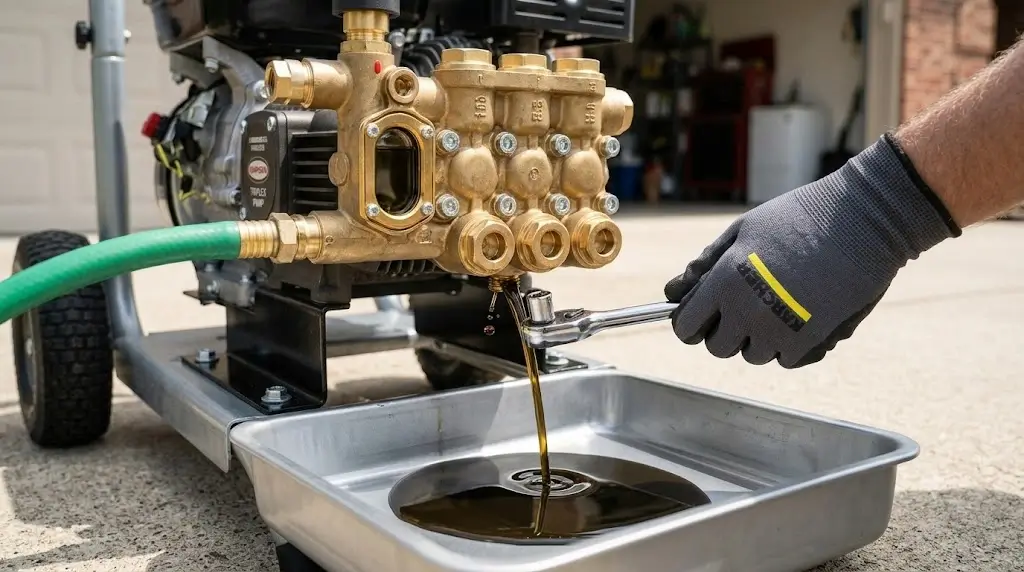 Figure 4: Draining used pump oil from the lower crankcase port into a disposal basin with the top breather plug removed.
Drain the Old Pump Oil
- Place the pressure washer on a stable, level surface.
- Shut down the machine.
- Allow hot components to cool.
- Relieve water pressure.
- Place an approved container beneath the pump drain point.
- Remove the pump oil fill plug or vent cap if the manufacturer’s procedure calls for it.
- Remove the oil drain plug or open the drain hose.
- Allow the oil to drain completely.
Briggs & Stratton describes removing the pump oil cap, tilting the pressure washer to drain the used pump oil, and then returning the unit to its upright position before refilling. SIMPSON’s serviceable pump procedure similarly uses the pump drain point and an approved collection container.
Refill With the Correct Pump Oil
Use the oil specified by the pump manufacturer. Do not select oil based solely on viscosity; the formulation requirement also matters.
For example, a pump may specify SAE 30 non-detergent oil, while another may specify a proprietary 15W-40 pump formulation or ISO 68 hydraulic oil.
Set the Correct Pump Oil Level
Fill until the oil reaches the manufacturer’s specified level. For sight-glass pumps, use the reference mark. For dipstick pumps, use the specified range. For pumps requiring a measured volume, use the exact amount listed by the pump manufacturer.
SIMPSON specifies filling to the center reference point of the sight glass on applicable pumps and warns against exceeding the specified level.
Why You Should Not Overfill the Pump
More oil does not automatically mean better lubrication. Overfilling can create abnormal internal conditions and may contribute to leakage or aeration depending on the pump design.
The correct target is the manufacturer’s specified oil level, not a completely full crankcase. SIMPSON and Generac both explicitly instruct users not to exceed the specified pump-oil level.
Pressure Washer Pump Maintenance Schedule
| Maintenance Item | Serviceable Triplex Pump | Sealed Axial-Cam Pump |
|---|---|---|
| Check pump oil | Yes | Not applicable as routine oil service |
| Change pump oil | According to pump manual | No routine oil change |
| Inspect water inlet screen | Yes | Yes |
| Inspect high-pressure hose | Yes | Yes |
| Flush detergent system | Yes | Yes |
| Winterize pump | Yes when freezing conditions apply | Yes when freezing conditions apply |
Pump-oil maintenance is only one part of pressure-washer care. Water filtration, hoses, detergent systems, and freeze protection can be equally important to long-term reliability.
Pressure Washer Pump Oil and Winterization
Pump oil and pump winterizer perform different jobs:
| Product | Purpose |
|---|---|
| Pump oil | Lubricates mechanical components in serviceable oil-filled pumps. |
| Pump guard / pump saver | Protects water-side components and seals during storage and freezing conditions. |
| Engine oil | Lubricates the gasoline engine. |
| Fuel stabilizer | Helps preserve gasoline during storage. |
SIMPSON recommends Pump Guard for applicable equipment when storing for more than 30 days or when freezing temperatures are expected, while pump oil remains a separate lubrication system.
Common Pressure Washer Pump Oil Mistakes
- Assuming every pump needs oil: Many residential axial-cam pumps are sealed.
- Using engine oil automatically: Pump lubrication specifications can differ from engine specifications.
- Using detergent oil when non-detergent oil is specified: Follow the pump manual.
- Choosing oil based on PSI: Pump pressure does not determine oil viscosity.
- Filling by guesswork: Use the sight glass, dipstick, or specified volume.
- Overfilling: The correct level is not necessarily the top of the crankcase.
- Ignoring the pump model: Replacement pumps can have different oil requirements from the original pump.
- Confusing pump oil with pump saver: They perform completely different functions.
- Changing oil too frequently without reason: Follow the manufacturer’s interval.
- Ignoring oil leakage: Repeated oil loss can indicate a seal or crankcase problem.
- Using automotive additives: Do not add detergents or special additives unless specified.
- Assuming dark oil means pump failure: Color alone is not a sufficient diagnostic test.
How to Choose the Right Pressure Washer Pump Oil
If you are buying replacement pump oil, follow this 5-step decision process:
Step 1: Identify the Pump
Find the pump model, manufacturer, and pressure-washer model number.
Step 2: Determine Whether the Pump Is Serviceable
Look for an oil sight glass, fill plug, dipstick, or explicit pump-oil maintenance procedure.
Step 3: Find the Oil Specification
Look for SAE grade, non-detergent requirement, proprietary formulation, or ISO viscosity specification.
Step 4: Confirm the Capacity
Use the manufacturer’s stated volume or level mark.
Step 5: Confirm the Interval
Check whether the manufacturer specifies operating hours, calendar months, or both.
Pressure Washer Pump Oil Comparison Chart
| Oil / Lubricant | Typical Use | Universal Replacement? | Important Note |
|---|---|---|---|
| SAE 30 non-detergent | Standard triplex pumps | No | Use where specified |
| SAE 15W-40 non-detergent | Some belt-drive pumps | No | Manufacturer-specific |
| ISO 68 hydraulic oil | Specific pump models | No | Follow pump specification |
| Proprietary pump oil | Specified pump families | No | Often easiest OEM choice |
| Automotive engine oil | Engine lubrication | No | Do not substitute automatically |
| Pump Guard / Pump Saver | Winterization/storage | No | Not a substitute for pump crankcase oil |
Pressure Washer Pump Oil Maintenance Checklist
Before Buying Oil
- Identify pressure-washer model.
- Identify pump manufacturer.
- Identify pump model.
- Determine whether pump is sealed.
- Check oil specification.
- Check oil capacity.
- Check service interval.
Before Changing Oil
- Shut down machine.
- Relieve water pressure.
- Allow hot components to cool.
- Prepare an approved waste-oil container.
- Confirm the correct replacement oil.
- Read the pump maintenance procedure.
After Changing Oil
- Confirm correct oil level.
- Do not overfill.
- Tighten drain and fill plugs correctly.
- Clean spilled oil.
- Inspect for leaks.
- Dispose of used oil according to local requirements.
- Record the service date and operating hours.
Frequently Asked Questions
What oil should I use in a pressure washer pump?
Use the oil specified by the pump manufacturer. Common specifications include SAE 30 non-detergent oil for some triplex pumps, SAE 15W-40 non-detergent oil for some belt-drive pumps, and ISO 68 hydraulic oil for certain pump models.
Can I use SAE 30 motor oil in a pressure washer pump?
Not automatically. Some pressure-washer pumps specify SAE 30 non-detergent oil, which is not the same instruction as “use any SAE 30 motor oil.” Follow the pump manufacturer’s exact specification.
Can I use 15W-40 in a pressure washer pump?
Some pumps specify SAE 15W-40 pump oil, including certain SIMPSON pump configurations. It is not a universal replacement for SAE 30 or other pump oils.
Is pressure washer pump oil the same as engine oil?
No. The engine and pump are separate lubrication systems. Their oil specifications can be different.
Do all pressure washers need pump oil?
No. Many residential axial-cam pumps are factory sealed and maintenance-free. Serviceable triplex pumps generally have a pump-oil maintenance procedure.
How often should I change pressure washer pump oil?
Follow the pump manufacturer’s interval. Some commercial pumps specify an initial change after 50 hours followed by changes every 100 hours or a specified calendar period. Other pumps have different schedules, and sealed axial-cam pumps may not require oil changes at all.
How much oil goes in a pressure washer pump?
There is no universal capacity. Use the manufacturer’s specified quantity or fill to the correct sight-glass or dipstick mark.
How do I know if my pressure washer pump needs oil?
Check the owner’s manual and identify the pump. An oil sight glass, fill plug, dipstick, or explicit oil-change procedure generally indicates a serviceable oil-filled pump. A manufacturer-described sealed axial-cam pump does not require routine oil service.
Can I add oil to a sealed pressure washer pump?
No. If the manufacturer identifies the pump as sealed and maintenance-free, do not attempt to add oil or disassemble it as routine maintenance.
What is SAE 30 non-detergent pump oil?
It is a lubricant specified for certain pressure-washer pump designs. “Non-detergent” refers to the formulation requirement; SAE 30 refers to its viscosity grade.
What is ISO 68 pump oil?
ISO 68 identifies a viscosity grade used in hydraulic lubrication applications. Certain pressure-washer pumps specify ISO 68 hydraulic oil, but it should not be treated as a universal pump-oil substitute.
Why is my pressure washer pump oil milky?
Milky oil can indicate water contamination. On an oil-filled pump, investigate the source of contamination and follow the manufacturer’s service procedure rather than repeatedly topping off the oil.
Why is my pressure washer pump oil dark?
Oil color alone does not establish pump failure. Use the manufacturer’s service interval and inspect for contamination, metal particles, abnormal noise, oil loss, and leakage.
What happens if a pressure washer pump is low on oil?
On an oil-filled serviceable pump, insufficient lubrication can increase mechanical wear and operating temperature. If the oil level is below the specified range, correct it with the manufacturer’s recommended oil and investigate any repeated oil loss.
Can too much pump oil damage a pressure washer?
Overfilling can create problems, which is why pump manufacturers specify a particular sight-glass or dipstick level. Do not fill the crankcase simply to the top.
Does PSI determine pressure washer pump oil type?
No. Oil specification is determined by pump design and manufacturer requirements, not simply by the machine’s advertised PSI.
Does GPM determine pressure washer pump oil type?
No. GPM describes water flow and does not by itself determine the required pump lubricant.
Is pump oil the same as pump saver?
No. Pump oil lubricates the crankcase of a serviceable pump. Pump saver or pump guard is used to protect the water-side components and seals during storage and freezing conditions.
Do electric pressure washers need pump oil?
Some electric pressure washers use sealed maintenance-free pumps, while other pump designs can be serviceable. Check the exact pump rather than assuming the power source determines the oil requirement.
Do gas pressure washers need pump oil?
Some gas pressure washers use serviceable triplex pumps and require pump oil. Many residential gas models use sealed axial-cam pumps. The engine being gasoline-powered does not determine whether the water pump needs oil.
Can I change pressure washer pump oil myself?
If the pump is designed for owner maintenance and the manufacturer provides an oil-change procedure, the task can generally be performed according to that procedure. If the pump is sealed or the manual directs service to a qualified technician, follow that instruction.
Should I change pump oil before winter?
Not automatically. Follow the pump’s normal maintenance schedule. Winterization itself is a separate procedure focused on protecting the water system from freezing.
Can I use pump oil to winterize a pressure washer?
No. Pump crankcase oil and pump winterizer serve different purposes. Use the manufacturer’s recommended pump-guard or pump-saver procedure when freeze protection is required.
What is the best pressure washer pump oil?
The best pump oil is the one that matches the pump manufacturer’s specification for viscosity and formulation. OEM or manufacturer-recommended pump oil is the safest choice when available.
Bottom Line: Identify the Pump Before You Buy the Oil
The biggest mistake in pressure-washer pump maintenance is treating all pumps as if they use the same lubricant.
They do not.
A serviceable triplex pump may require scheduled oil changes, while a residential axial-cam pump may be sealed for life. Among serviceable pumps, one model may specify SAE 30 non-detergent oil, another SAE 15W-40, and another ISO 68 hydraulic oil.
Do not choose pump oil from PSI alone. Do not substitute engine oil automatically. Do not overfill. And do not attempt to service a factory-sealed pump simply because another pressure washer has a visible oil reservoir.
