
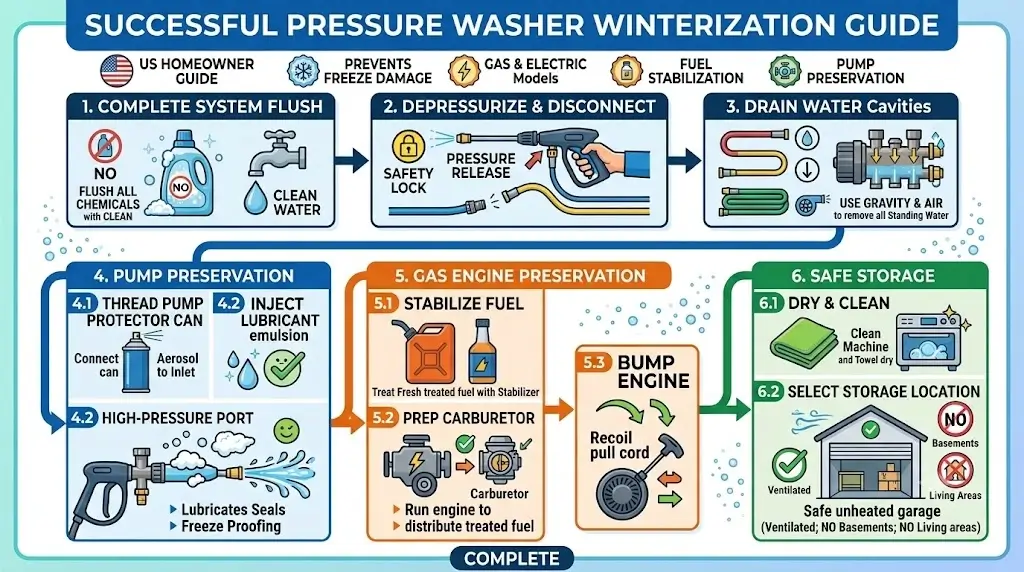
How to Winterize a Pressure Washer: Complete Winter Storage Guide
Winterizing a pressure washer requires purging all residual water, protecting internal brass manifold chambers and rubber seals with anti-freeze lubricant, stabilizing or draining the gasoline fuel system, and storing accessories in an environment matched to the equipment’s engineering specifications.
Water expands by approximately 9% upon freezing. Trapped moisture inside high-pressure cylinder blocks produces micro-cracks in brass castings, distorts ceramic plungers, and tears elastomeric check valves. Engineering standards from Briggs & Stratton, SIMPSON, and Generac prioritize positive-displacement pump preservation whenever ambient temperatures approach freezing (32°F / 0°C) or during seasonal downtime exceeding 30 days.
Pump Saver Injection
Freeze-Proofing
Fuel Stabilization
Hose Storage
Spring De-Winterization
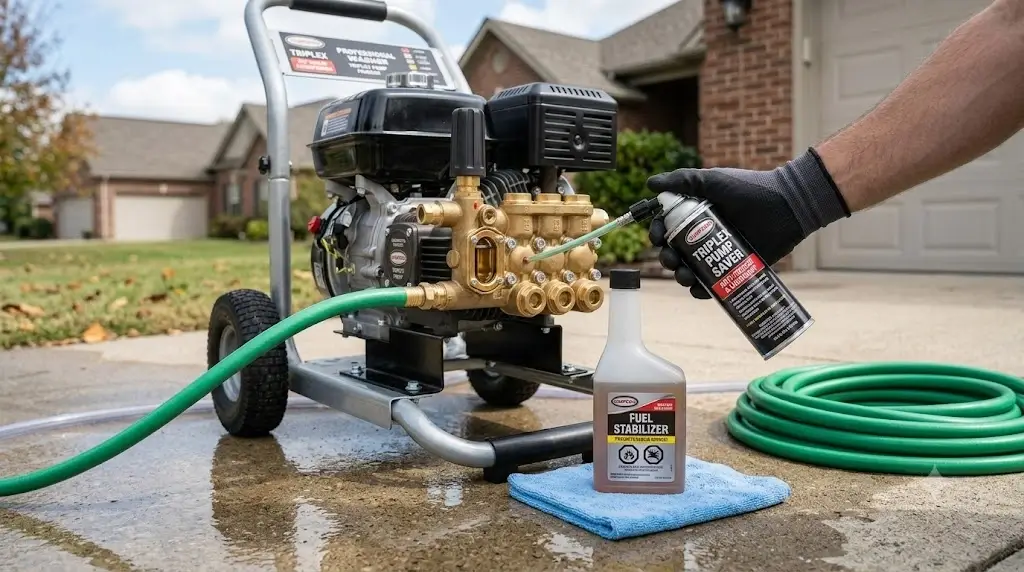
Quick Decision Matrix: How to Winterize Any Pressure Washer in 60 Seconds
- Clear Chemicals: Run fresh water through the detergent siphon for 60 seconds to clear caustic residues.
- Depressurize & Disconnect: Turn off water supply, shut off engine/motor, and squeeze the trigger gun to vent trapped internal pressure.
- Drain Lines: Detach and elevate both garden hose and high-pressure hose to let gravity drain all standing water.
- Inject Pump Saver: Thread an aerosol pump protector canister into the pump water inlet. Depress the valve (or pull recoil 3–5 times) until foamy lubricant exits the high-pressure brass discharge port.
- Stabilize Gas Engines: Add fuel stabilizer to fresh non-ethanol gasoline, run for 2 minutes to treat carburetor jets, then shut the fuel petcock.
- Dry & Shelter: Store in a climate-controlled, dry indoor location shielded from humidity and freezing drafts.
Universal Safety Mandate: An unheated residential garage does not guarantee freeze protection. If garage ambient temperatures fall below 32°F (0°C), unconditioned pump chambers will fracture.
Why Does a Pressure Washer Need to Be Winterized?
Pressure washer manifolds hold residual moisture within internal check valves, piston bores, and unloader chambers long after water hoses are detached. When liquid water freezes, thermal expansion generates hydraulic pressures exceeding 2,000 PSI inside closed metallic pump cavities.
Manufacturer protocols from SIMPSON and Generac stress that frozen standing water induces irreparable structural failure. Winterization fulfills two distinct engineering objectives: absolute freeze defense (displacing water with low-temperature glycols) and mechanical preservation (coating seals with synthetic lubricants to halt vulcanization and surface dry rot).
Information Gain:Draining the lines by gravity alone leaves up to 40% of residual water pooled inside pump check-valve pockets. Positive fluid displacement via pressurized pump saver is the only field-proven method to guarantee zero ice expansion.
What Happens if a Pressure Washer Freezes?
Ice expansion acts as an unyielding hydraulic ram within the pump block. Common structural failures resulting from neglected winterization include:
- Manifold Ruptures: Hairline fractures along brass or aluminum casting seams, resulting in high-pressure water jets erupting from the pump body.
- Ceramic Plunger Fractures: Thermal shock and lateral ice compression shatter brittle high-precision ceramic pistons.
- Unloader Valve Seizure: Brass unloader pistons freeze within bypass passages, preventing pressure bypass cycling on spring restart.
- Check Valve Dislodgement: Plastic poppet cages deform, causing loss of priming and rapid pressure surging.
Never run or test a frozen pressure washer.Forcing an engine to turn over while ice locks the pump plungers will sheer engine drive keys, snap connecting rods, or burn out electric drive motors instantly.
When Should You Winterize a Pressure Washer?
Initiate winterization procedures before regional night temperatures drop below 40°F (4.4°C). Cold snaps often penetrate uninsulated storage structures overnight without warning.
SIMPSON specifies pump treatment whenever equipment sits idle for more than 30 consecutive days, regardless of ambient season, to prevent chemical scaling and seal adhesion.
Winterize Immediately If:
- Daily forecast indicates overnight lows approaching 32°F (0°C).
- Equipment is placed in an unheated garage, shed, or crawlspace.
- Seasonal pressure washing tasks are concluded for the autumn.
- The unit must be transported across geographic regions subject to freezing weather.
Electric vs. Gas Pressure Washer Winterization
Gasoline and electric configurations require different maintenance steps. Before winterizing, review our mechanical analysis in the pressure washer buying guide to confirm your model’s drive architecture.
| Maintenance Operation | Electric Pressure Washers | Gasoline-Powered Pressure Washers |
|---|---|---|
| Water Manifold Purge | Mandatory (Pump Saver injection) | Mandatory (Pump Saver injection) |
| Hose & Wand Drainage | Mandatory gravity drain & dry | Mandatory gravity drain & dry |
| Fuel System Treatment | Not Applicable | Stabilizer circulating run or complete carburetor drain |
| Engine Crankcase Oil | Not Applicable | Change if operating hour service interval is reached |
| Battery Maintenance | Not Applicable | Disconnect & place on smart trickle maintainer |
| Permitted Storage Location | Heated basement, utility closet, garage | Ventilated shed or detached garage (vapor hazard) |
If you maintain a compact unit from our verified best electric pressure washers, storage is straightforward: purge the water cavity and store the machine indoors away from freeze zones.
What You Need to Winterize a Pressure Washer
| Tool / Chemical | Recommended Specification | Function |
|---|---|---|
| Pump Saver / Guard | Pressurized aerosol (SIMPSON 80130 / Briggs 6151) | Expels residual water; lubricates seals with synthetic oil |
| Fuel Stabilizer | Non-alcohol hydrocarbon treatment (STA-BIL Storage) | Prevents gum/varnish degradation in fuel circuits |
| Silicone Dielectric Grease | 100% pure silicone paste | Conditions rubber O-rings and quick-connect seals |
| Lint-Free Microfiber Towels | Industrial grade | Dries brass fittings to prevent external oxidation |
| Catch Basin | 1-quart shallow pan | Collects expelled antifreeze foam during purging |
Avoid generic automotive coolants.Automotive ethylene glycol contains silicates and additives harmful to pump rubber elastomers. Always use manufacturer-certified pump guard or non-toxic propylene glycol solutions.
Check the Owner’s Manual Before Winterizing
Every pump architecture—from direct-drive axial wobble plates to industrial belt-drive triplex setups—has exact mechanical clearance specifications. Always verify manufacturer-specific venting and torque specifications in your original equipment documentation before winterizing.
Before You Winterize: Finish the Last Cleaning Job Correctly
Never conclude seasonal operations with chemical detergent remaining in the injection lines. Surfactants dry into crystalline salts that foul ball check valves and corrode internal brass injector orifices over winter downtime.
Flush the Detergent Injection System
- Pull the detergent siphon pick-up tube out of the cleaning solution container.
- Submerge the weighted chemical filter into a bucket of clean, warm freshwater.
- Install the low-pressure black soap nozzle into the wand lance.
- Run the pressure washer under active flow for 60 to 90 seconds until the discharge stream is completely clear of suds.
Shut Down the Pressure Washer Safely
Follow strict operator protocols outlined in our pressure washing safety guide before servicing high-pressure components:
- Turn off the gasoline engine switch or depress the electric motor OFF toggle.
- Turn the garden water supply tap completely clockwise to stop incoming water.
- Point the spray wand in a safe direction and squeeze the trigger to discharge residual internal line pressure.
- Engage the spray-gun trigger mechanical safety latch.
Disconnect and Drain the Garden Hose
Unthread the garden hose from the pump brass inlet swivel. Stretch the hose along a descending grade to purge all water volume, coil it in loose loops (minimum 24-inch diameter) to prevent memory kinking, and hang it on a wall bracket off concrete flooring.
Drain the High-Pressure Hose
Disconnect the high-pressure line from the pump discharge fitting and trigger handle base:
- Lay the steel-braided hose flat along an inclined surface.
- Elevate one coupling end, walking the hose along its length to allow gravity to evacuate internal water pockets.
- Optionally blow clean low-pressure compressed air (under 25 PSI) through the line to displace clinging condensation.
- Coil without tight bends and store away from UV exposure.
Inspection Milestone:Examine the wire jacket for blistering, kinking, or exposed steel threads. Discard worn hoses before spring startup.
Drain the Spray Gun and Wand Extension
Disassemble the lance from the trigger assembly. Hold the gun vertically with the brass threaded inlet facing down and cycle the trigger repeatedly. Remove individual quick-connect spray tips, blow clear debris from the internal orifices with compressed air, and store in a protective grommet caddy.
Protect the Pressure Washer Pump (The Critical Step)
Pump protector aerosol canisters contain a pressurized emulsion of non-toxic propylene glycol and synthetic anti-wear lubricants designed to coat plungers, lubricate high-pressure packings, and stop oxidation.
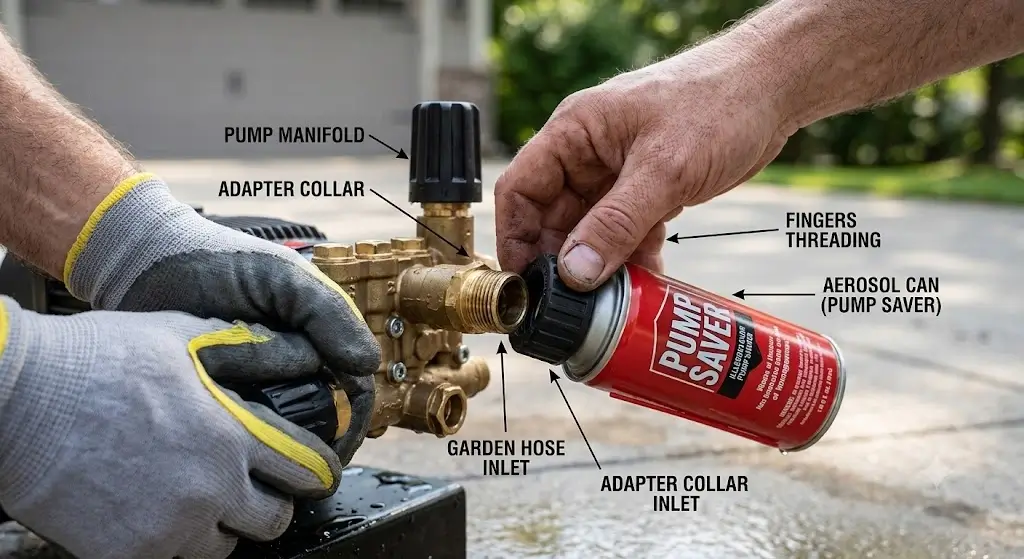
Aerosol Pump Saver Injection Sequence:
- Shake the pump saver canister vigorously for 10 seconds.
- Thread the canister’s threaded plastic adapter firmly onto the pump’s 3/4-inch garden hose water inlet.
- Turn the knurled valve knob on the can to open flow.
- For Gas Units: Turn engine ignition switch to OFF. Slowly pull the engine recoil starter cord 4 to 6 times until foamy liquid squirts from the high-pressure water outlet port.
- For Electric Units: Turn the power switch ON for exactly 2 seconds, then OFF immediately. Repeat once until foam exits the high-pressure outlet.
- Unthread the aerosol canister, cap both brass pump ports with shipping plugs or clean rags, and wipe away excess fluid.
Pump Saver vs. Pump Oil: Understanding Mechanical Boundaries
Confusing water-path chemicals with crankcase lubricants is a critical homeowner error. Review our comprehensive pressure washer pump oil guide to correctly identify and service crankcase lubrication ports.
| Lubricant / Treatment | Operating System | Chemical Profile | Seasonal Function |
|---|---|---|---|
| Pump Saver / Guard | Wet fluid manifold (valves, plungers, water path) | Propylene glycol + synthetic seal conditioners | Prevents water freezing; inhibits internal mineral corrosion |
| Pump Crankcase Oil | Dry mechanical crankcase (eccentric shaft, bearings) | SAE 30 Non-Detergent or ISO 68 Hydraulic Oil | Continuous lubrication of crankshaft and wrist pins |
| Engine Motor Oil | Gasoline engine block (piston rings, cylinder) | SAE 10W-30 Detergent Motor Oil | Internal combustion lubrication |
| Fuel Treatment | Fuel tank, fuel lines, carburetor | Hydrocarbon stabilizers and antioxidants | Prevents gasoline gum and varnish polymerization |
Can You Use RV Antifreeze in a Pressure Washer?
Yes, provided it is non-toxic, alcohol-free RV Propylene Glycol Antifreeze. Standard automotive ethylene glycol must never be used because its chemical formula corrodes Buna-N rubber pump packings and creates toxic disposal issues.
To apply RV antifreeze without an aerosol can, attach a short 2-foot section of garden hose to the pump inlet, hold a small funnel elevated above the pump, pour in 12 ounces of fluid, and cycle the recoil cord slowly until colored antifreeze discharges from the pump outlet.
How to Winterize a Gas Pressure Washer Fuel System
Modern ethanol-blended gasoline (E10/E15) absorbs atmospheric moisture through phase separation. Within 30 days, stale fuel forms acidic gums that corrode carburetor jets and fuel control needle valves.
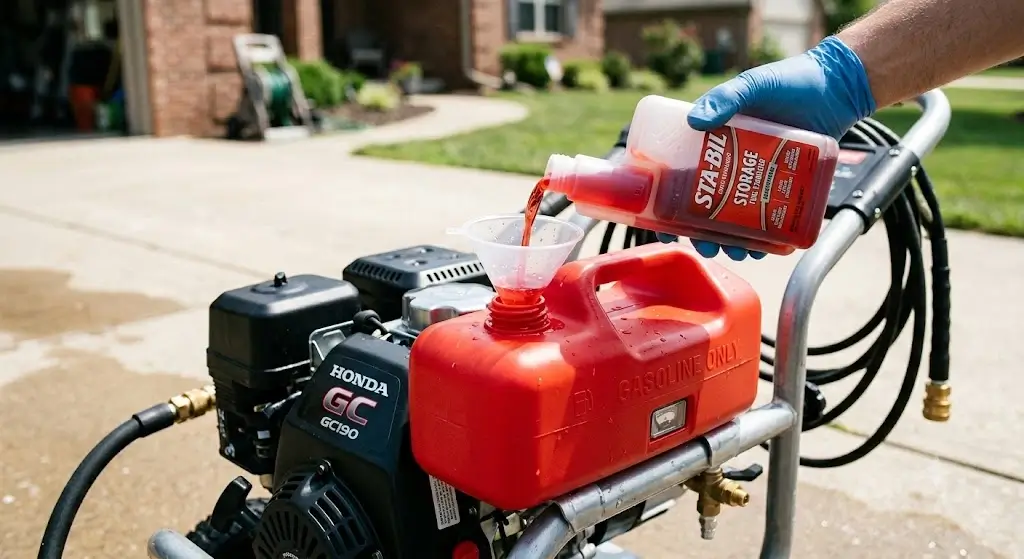
Protocol A: Stabilized Fuel Storage (Preferred for 30–90 Day Storage)
- Fill the fuel tank to 95% capacity with fresh non-ethanol fuel (leaves thermal expansion headspace).
- Add the manufacturer-recommended dosage of fuel stabilizer.
- Connect water supply, start engine, and run for 3 minutes to circulate stabilized fuel through the carburetor bowl and jet passages.
- Shut down engine, release water pressure, and close fuel shutoff petcock.
Protocol B: Dry Carburetor Storage (Mandatory for >90 Day Storage)
- Add stabilizer to tank and run the engine for 3 minutes.
- Turn the fuel shutoff valve to the OFF position with engine still running.
- Allow engine to run until it stalls from fuel starvation, emptying the carburetor bowl.
- Open the carburetor bowl brass drain screw (if equipped) over a rag to purge the final remaining drops of stale fuel.
Never store gasoline equipment in living areas.Never house gas pressure washers in basements, laundry utility rooms, or near water heaters with open pilot flames. Volatile fuel vapors sink to floor levels and create severe explosion risks.
Fuel Stabilizer vs. Empty Fuel System Comparison
| Storage Strategy | Recommended Storage Duration | Primary Advantage | Potential Risk |
|---|---|---|---|
| Full Tank + Fuel Stabilizer | 30 to 90 Days (Winter Season) | Prevents air/moisture condensation inside metal tanks | Stabilizer loses efficacy after 12 months |
| Completely Drained Fuel System | Over 90 Days (Multi-Season) | Zero risk of varnish clogging microscopic carburetor orifices | Dry fuel gaskets and rubber diaphragms may shrink or crack |
Should You Change the Engine Oil Before Winter Storage?
Perform the engine oil change before seasonal storage rather than waiting until spring. Spent engine oil contains acidic combustion byproducts, soot, and moisture that settle during long downtime, pitting crankshaft journals and bearing faces.
Battery Care for Electric-Start Models
Sub-freezing temperatures degrade 12-volt lead-acid and lithium starter batteries:
- Disconnect negative (-) black battery terminal to eliminate parasitic key-switch draw.
- Unmount the battery and store in a dry location above 40°F (4.4°C).
- Connect a microprocessor-controlled trickle charger/maintainer every 6 weeks to maintain a healthy float charge (12.6V to 13.2V).
How to Winterize an Electric Pressure Washer
- Unplug electrical cord from GFCI wall receptacle; wind cord neatly around integrated frame hooks.
- Depress spray gun trigger to release internal line pressure.
- Disconnect and gravity-drain garden hose and high-pressure hose.
- Inject approved pump protector into the inlet; bump motor switch for 1 to 2 seconds to distribute lubricant across wobble-plate plungers.
- Store the unit inside a heated basement, crawlspace, or heated utility area maintained above 40°F (4.4°C).
Chemical Line Maintenance
Residual detergents degrade low-pressure vinyl tubing over long downtime. Clean chemical lines by cycling warm water through the pickup tube. Inspect the foot-valve mesh screen for algae or crystalline deposit clogs, replacing crushed siphon tubes before storage.
How to Store Pressure Washer Hoses
Store rubber and thermoplastic hoses elevated off bare concrete floors. Concrete pulls moisture and cold into rubber compounds, accelerating dry rot. Loop hoses loosely in a large 24- to 30-inch diameter circle and hang across curved wall-mounted saddles.
How to Store Pressure Washer Nozzles
Store spray tips (0°, 15°, 25°, 40°, and soap) in an organized rubber nozzle caddy. Coat quick-connect detent grooves with silicone spray. Clean dried dirt or lime scale from the nozzle orifice using a fine steel cleaning pin.
Protecting O-Rings and Quick-Connect Fittings
Coat all rubber O-rings on high-pressure couplings, wands, and pump discharge ports with pure silicone grease. Do not use petroleum-based grease (like axle grease), which softens and swells nitrile and EPDM seals, leading to blowouts during spring pressure cycles.
Best Storage Location Analysis
| Storage Location | Electric Unit Suitability | Gas Unit Suitability | Required Environmental Precautions |
|---|---|---|---|
| Heated Basement / Utility Room | Ideal | Prohibited | Absolute prohibition on fuel vapors in occupied living quarters |
| Heated Garage / Workshop | Excellent | Excellent | Ensure distance from water heater pilot lights or open flames |
| Unheated Detached Garage | Acceptable | Acceptable | Mandatory full pump saver injection and battery removal |
| Unheated Outdoor Shed | Acceptable | Acceptable | Elevate equipment off soil/concrete; use rodent-proof bait traps |
| Exterior Yard Under Tarpaulin | Not Recommended | Not Recommended | Tarpaulins trap condensation, causing rust and rapid electrical corrosion |
Can You Store a Pressure Washer in an Unheated Garage?
Yes, provided the pump has been treated with pump protector fluid. An unheated garage shields equipment from rain, snow, and wind, but offers minimal thermal resistance against prolonged sub-freezing spells. Treat the water system with pump protector regardless of whether the machine is stored indoors or outdoors.
Can You Store an Electric Pressure Washer in a Basement?
A heated basement is an ideal storage location for an electric pressure washer. The warm, dry air protects plastic pump housings and rubber components from freeze cycles. In contrast, never store gasoline equipment in a basement due to hazardous fuel vapor buildup.
Can You Store a Pressure Washer Outside?
Avoid outdoor winter storage. Snow, driving rain, and condensation accelerate frame corrosion, corrode pump check valve springs, and ruin electrical switchgear. If outdoor storage is unavoidable, apply pump protector, drain the fuel system completely, elevate the frame on wood pallets, and cover with a ventilated canvas tarp.
Should You Cover a Pressure Washer During Winter?
Use loose-fitting, breathable canvas covers that let trapped moisture escape. Avoid non-breathable plastic sheets, which trap condensation underneath and cause metal components to rust. Ensure the engine and muffler have cooled completely before covering.
Short-Term Storage (Under 30 Days)
For mid-season downtime, relieve line pressure, drain both hoses, and store the machine under shelter. If unpredictable cold fronts are forecast, inject pump saver or relocate the unit to a freeze-free space overnight.
Long-Term Storage (Entire Winter Off-Season)
Follow full winterization procedures: chemical line flushing, high-pressure line drainage, pressurized pump saver injection, fuel system stabilization/drainage, fresh engine oil change, O-ring silicone conditioning, and storage in a dry, covered space.
What If the Pressure Washer Has Already Frozen?
If you discover a machine frozen solid with unpurged water, do not force the pull cord, switch on the motor, or use an open flame torch. High heat can crack chilled castings. Follow this recovery protocol:
- Move the pressure washer into a heated space (65°F to 70°F / 18°C to 21°C) for a minimum of 24 hours.
- Place a dry tray beneath the pump to detect water leaking from cracked seals as internal ice thaws.
- Once fully thawed, connect a garden hose under normal house pressure (do not start engine) to check for leaks around manifold bolts.
- If no external leaks appear, inject pump saver immediately to displace thawed moisture.
Signs of Freeze Damage
- Water weeping from hairline cracks along the brass manifold body.
- Water pushing through the split plastic body of the unloader valve.
- Pulsing high-pressure spray wand delivery caused by deformed internal check valves.
- Engine recoil cord locked solid, unable to rotate the pump drive shaft.
- Pump fails to build operating pressure despite engine running at full governed RPM.
How to Restart a Pressure Washer After Winter Storage (Spring Startup)
Proper spring recommissioning prevents dry-seal friction damage:
- Fluid Checks: Inspect engine oil dipstick and pump crankcase oil sight glass for correct levels.
- Clear Antifreeze: Connect garden hose, turn on water supply fully, and squeeze spray gun trigger for 60 seconds (with engine/motor OFF) to flush pump protector fluid through the open wand lance.
- Fuel Prep: Inspect the fuel tank. Top off with fresh high-octane non-ethanol gasoline; open fuel petcock.
- Purge Air: Hold spray gun trigger open until water flows in a steady stream with zero trapped air bubbles.
- Power Up: Start the engine or switch on the electric motor, install the 25° green nozzle, and test operating pressure.
Common Pressure Washer Winterization Mistakes
- Relying solely on hose draining: Emptying hoses leaves residual water inside pump cavities.
- Assuming unheated garages are freeze-proof: Temperatures inside unheated garages drop below freezing during cold snaps.
- Using automotive ethylene glycol: Car antifreeze damages pump seals; use only non-toxic propylene glycol solutions.
- Storing gasoline units indoors: Fuel vapors in living spaces create fire and explosion hazards.
- Leaving ethanol gasoline untreated: Untreated ethanol fuel degrades into corrosive varnish within 30 days.
- Applying non-breathable plastic tarps: Trapped condensation rusts frames, fasteners, and engine components.
- Starting the pump dry in spring: Always flush residual antifreeze and prime the pump with water before starting.
Comprehensive Seasonal Winterization Checklist
System 1: Water Delivery & Pump Manifold
- Siphon clean water through detergent intake tube for 60 seconds.
- Turn off water supply; squeeze trigger to bleed remaining pressure.
- Disconnect and gravity-drain garden hose and high-pressure hose.
- Drain water wand and spray gun; remove and store nozzle tips.
- Thread pump protector can into water inlet; inject until foam exits outlet.
System 2: Engine & Fuel Storage (Gas Models Only)
- Add fuel stabilizer to fuel tank filled to 95% with non-ethanol gas.
- Run engine 3 minutes to circulate stabilized fuel into carburetor.
- Shut fuel petcock; run carburetor dry or drain via bowl screw.
- Change engine oil if routine service threshold is met.
- Disconnect starter battery; hook up to smart float maintainer.
System 3: Fittings & Environment
- Lubricate coupling rubber O-rings with 100% silicone grease.
- Coil high-pressure hose loosely; hang off concrete floors.
- Drape breathable canvas dust sheet over cool machinery.
- Confirm storage location meets safety guidelines (ventilated for gas; warm for electric).
Frequently Asked Questions
Do I really need to winterize a pressure washer?
Yes. If stored where ambient temperatures fall below 32°F (0°C), residual water inside the pump will freeze and expand, cracking the brass manifold and ruining internal seals. Winterization is also required for storage periods exceeding 30 days to lubricate rubber packings and keep them from drying out.
What is the most important part of winterizing a pressure washer?
Protecting the pump with a pressurized pump saver/guard solution. While draining hoses removes external water, only pump protector displaces trapped water from internal check-valve cavities and coats metal surfaces with anti-corrosive lubricant.
Can a pressure washer freeze in an unheated garage?
Yes. Unheated garages track external ambient temperatures closely during prolonged freezes. Without pump protector fluid, trapped residual water inside the pump head will freeze and crack the casting.
Can I leave water in my pressure washer pump during winter?
No. Water expands by roughly 9% upon freezing. This expansion generates internal hydraulic forces that crack brass pump heads, bend check valve springs, and fracture ceramic plungers.
Should I use pump saver when winterizing?
Yes. Manufacturers such as SIMPSON, Generac, and Briggs & Stratton strongly recommend pump saver. It provides dual protection by lowering the freezing threshold and conditioning internal rubber seals to prevent dry rot over winter.
Can I use RV antifreeze in a pressure washer?
Yes, provided it is non-toxic, alcohol-free RV Propylene Glycol Antifreeze. Pour it into the water inlet with a funnel while turning the pump over slowly until colored fluid exits the high-pressure outlet port.
Can I use automotive antifreeze in a pressure washer?
No. Automotive ethylene glycol coolant contains corrosion additives and silicates that damage rubber pump seals and create an environmental hazard when flushed out in the spring.
How do I winterize an electric pressure washer?
Flush out remaining detergents, disconnect hoses, squeeze the gun trigger to release line pressure, and inject pump protector into the water inlet while briefly bumping the motor switch for 1 to 2 seconds. Store the machine indoors above 40°F (4.4°C).
How do I winterize a gas pressure washer?
In addition to purging the water system and injecting pump saver, gas models require fuel stabilization. Add stabilizer to fresh fuel, run the engine to treat the carburetor, shut off the fuel valve, and store the unit in a well-ventilated, unheated garage or shed away from open flames.
Should I drain the gas from my pressure washer?
For storage periods longer than 90 days, drain the fuel system completely or run the carburetor dry with the fuel valve shut. For shorter winter storage (30–90 days), fill the tank to 95% with non-ethanol gas treated with fuel stabilizer to prevent interior tank condensation.
Should I change pressure washer oil before winter?
Change engine oil before winter storage if it has reached its recommended operating-hour service interval. Spent engine oil contains acidic combustion byproducts that can pit internal bearing surfaces during long off-season storage.
Can I store a gas pressure washer in my basement?
No. Gasoline pressure washers must never be stored in basements or living quarters. Volatile gasoline vapors can settle near floor level and ignite from furnace or water heater pilot flames.
Can I store an electric pressure washer in a basement?
Yes. Electric pressure washers produce no fuel vapors, making a warm, dry basement an ideal storage environment that keeps pump components safe from freezing temperatures.
Can I store a pressure washer outside in winter?
Outdoor storage is not recommended. Temperature swings, rain, and snow cause condensation, frame corrosion, and seized check valves. If outdoor storage is unavoidable, apply pump saver, drain fuel, elevate the frame off bare ground, and cover with a breathable canvas tarp.
Should I cover my pressure washer for winter?
Yes, use a breathable canvas equipment cover to keep out dust and rodents. Avoid non-breathable plastic sheets, which trap moisture and promote metal rusting.
How long can a pressure washer sit unused?
Without fuel stabilizer, fuel can degrade in as little as 30 days. Untreated pumps left with standing water can suffer seal dry rot and mineral corrosion within 60 to 90 days. Always apply pump saver for downtime exceeding one month.
What temperature is too cold for a pressure washer?
Temperatures below 32°F (0°C) cause unprotected water inside pump manifolds to freeze and crack components. Most manufacturers advise keeping storage areas above 40°F (4.4°C) for untreated equipment.
What should I do if my pressure washer froze?
Bring the machine into a warm room (65°F to 70°F) and let it thaw slowly for at least 24 hours. Do not use open flames or heat guns. After thawing, hook up a garden hose to check for casting leaks before starting the engine.
Do I need to winterize a pressure washer in warm southern states?
Yes. Unexpected cold snaps can bring sub-freezing temperatures to southern regions. Applying pump saver also lubricates seals and prevents internal corrosion during months of seasonal inactivity.
Do pressure washers need winterization in northern states?
Winterization is mandatory in northern regions. Sustained sub-freezing winter temperatures will destroy an untreated pressure washer pump left in an unheated space.
Does draining the hose prevent pump freeze damage?
No. Gravity-draining the hoses clears the lines, but water remains trapped inside the pump manifold’s check valve chambers. This internal moisture must be displaced with pump protector.
Can I use compressed air to winterize a pressure washer?
Low-pressure compressed air (under 25 PSI) can help clear water lines, but it will not replace the seal lubrication provided by pump saver. Relying exclusively on compressed air can also blow out internal pump seals if high air pressure is applied.
Bottom Line: Clear the Water, Protect the Pump, Seal the Fuel
Winterizing a pressure washer takes under 15 minutes, but skipping it often leads to expensive pump replacements come spring. Successful winter protection rests on three rules: purge every drop of water from internal circuits using an approved pump saver, protect the fuel system against ethanol degradation, and store the machine in a dry space suited to its power source.
HomeGearMax Winterization Rule:Purge and condition the pump with pump saver, stabilize or drain gasoline fuel lines, coat quick-connect O-rings with silicone grease, and store electric models in heated areas and gas models in well-ventilated dry spaces.
