
Pressure Washer Won’t Start? 15 Causes & How to Fix It
A pressure washer that will not start usually has an isolated failure in one of four operating domains: fuel delivery, ignition, engine safety controls, or electrical circuit integrity. Gasoline engines most frequently fail due to stale ethanol fuel, a closed shutoff petcock, an incorrect choke sequence, an ungrounded spark plug wire, or a low-oil shutdown sensor. Electric models fail across the power delivery path: tripped GFCI plugs, blown household breakers, thermal overload cutoffs, or unloader pressure locks.
Accurate troubleshooting begins by isolating machine architecture: determine whether the unit is gasoline-powered or electric, then pinpoint whether it remains completely inert, cranks without firing, starts then immediately stalls, or runs normally while lacking pump pressure.
Electric Motor Circuit
Carburetor & Fuel Gum
Spark Plug & Ignition
GFCI & Thermal Cutoff
Pump Pressure Release
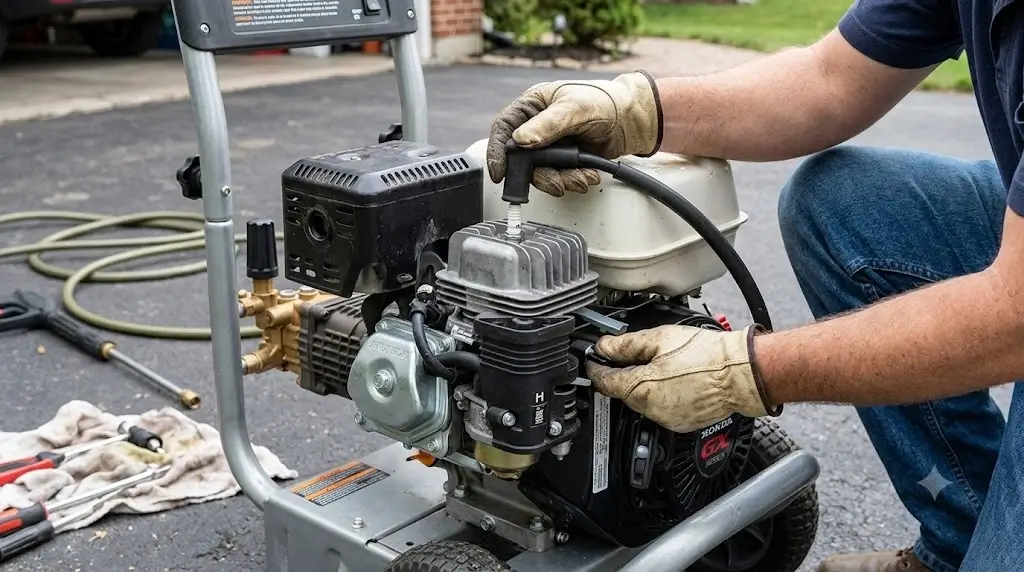
- Gas Pressure Washer (Won’t Crank or Hard Pull): Squeeze the spray gun trigger to vent hydraulic pressure locks within the pump manifold. Check crankcase oil level to satisfy the low-oil shutdown sensor.
- Gas Pressure Washer (Cranks But Won’t Fire): Verify fuel valve is ON, ignition toggle is RUN, choke is closed for a cold start, fuel is fresh (under 30 days old), and the spark plug wire is seated firmly.
- Gas Pressure Washer (Starts Then Dies): Open the choke gradually as the block warms; inspect the carburetor pilot jet for gummy ethanol varnish or clean the air filter element.
- Electric Pressure Washer (Dead / No Sound): Press the RESET button on the inline GFCI plug, test the 15A/20A wall breaker, eliminate lightweight extension cords, and allow thermal overloads 20 minutes to cool.
Generac, Briggs & Stratton, and SIMPSON engineering documentation separates starting system faults from water pressure faults. If the motor or engine runs at governed speed but water stream is weak, the issue lies in the pump manifold or spray nozzle, not the power plant.
Quick Diagnosis: What Is the Pressure Washer Doing?
The generic complaint “won’t start” represents distinct mechanical states. Pinpointing the physical reaction saves substantial diagnostic time.
| Observed Machine Symptom | Underlying Mechanical Cause | Immediate Corrective Path |
|---|---|---|
| Completely inert; zero sound or rotation | Broken power path, tripped GFCI, blown breaker, or disconnected switch | Wall receptacle → GFCI reset → breaker panel → power toggle |
| Recoil starter cord locked or stiff to pull | Hydraulic back-pressure lock or dry cylinder friction | Squeeze trigger gun to vent line pressure → check crankcase oil |
| Engine cranks briskly but never fires | Absence of fuel, lack of spark, or flooded combustion chamber | Fresh non-ethanol fuel → choke position → spark plug gap |
| Engine fires for 2–3 seconds then stalls | Lean fuel mixture, clogged main carburetor jet, or air restriction | Choke lever adjustment → clean air filter → carburetor bowl drain |
| Electric motor hums or buzzes without spinning | Low input voltage, undersized extension cord, or seized pump | Direct 120V connection → inspect pump unloader bypass |
| Engine runs at full RPM but produces low pressure | Water inlet restriction, worn nozzles, or stuck unloader valve | Check garden hose GPM → clear nozzle orifice → inspect pump seals |
Gas vs. Electric Pressure Washer Architecture
When selecting your equipment via our pressure washer buying guide, understanding drive system architecture dictates how failures must be addressed.
| Engineering Subsystem | Gasoline-Powered Pressure Washer | Electric-Powered Pressure Washer |
|---|---|---|
| Prime Mover | Internal combustion 4-stroke engine (OHV) | Universal brush motor or induction motor |
| Fuel & Energy Delivery | Vented tank, gravity line, bowl carburetor | Heavy-gauge copper conductor, 15A/20A branch circuit |
| Ignition & Safety Controls | Flywheel magneto, spark plug, low-oil sensor | Integrated GFCI plug, motor thermal cutoff switch |
| Starting Interface | Manual recoil pull rope or 12V starter motor | Rocker power switch with Total Stop System (TSS) |
Pressure Washer Does Nothing When You Try to Start It
If an electric pressure washer exhibits zero signs of life, investigate the electrical delivery route before touching internal wiring. If you are operating one of our evaluated best electric pressure washers, most units incorporate a Total Stop System (TSS): the motor remains silent when switched on until the operator squeezes the spray gun trigger to initiate flow.
- Inspect the Integrated GFCI: The indicator window on the cord module must show green or illuminated red. If tripped, press RESET firmly.
- Verify Receptacle Current: Test the wall outlet with an alternate appliance (such as a shop light). Avoid multi-outlet adapters.
- Inspect Breaker Panels: Ensure the branch circuit breaker has not thrown into the center trip position.
- Eliminate Extension Cords: Plug directly into an exterior outlet to avoid terminal voltage drop.
- Allow Thermal Reset: If the unit cut out during previous use, wait 20 minutes for the internal bi-metallic thermal switch to cool and reset.
Pressure Washer Cranks but Won’t Start
When the recoil starter spins the crankshaft smoothly but the combustion cycle never initiates, systematic isolation follows the core combustion formula:
Pressure Washer Starts Then Dies
An engine that catches briefly before dying indicates functional ignition but inadequate fuel continuity or safety sensor tripping. Common culprits include:
- Choke Inversion: Leaving the choke fully closed (START) once the engine fires floods the spark plug with liquid gasoline.
- Clogged Carburetor Pilot Jet: The engine starts on residual choke priming fuel but starves when transitioning to the idle/run circuit.
- Low-Oil Sensor Shutoff: The engine starts, but fluid inertia splashes oil away from the low-oil float switch, cutting the primary ignition circuit to ground.
- Vapor-Locked Fuel Cap: A clogged atmospheric tank vent creates a vacuum inside the plastic tank, stopping downward gravity fuel flow.
Electric Pressure Washer Troubleshooting Sequence
Systematic Electrical Path Inspection
- Verify dedicated 15-amp or 20-amp non-shared branch circuit.
- Reset the inline cord GFCI module.
- Bypass any homeowner extension cords.
- Squeeze the trigger gun to drop manifold pressure and actuate the TSS microswitch.
- Allow 20 minutes of resting time to clear thermal overload locks.
Gas Pressure Washer: 15 Primary Causes & Step-by-Step Cures
1. Empty or Contaminated Fuel Tank
Check that fresh 87-octane fuel reaches minimum tank levels. Look for floating debris or water stratification bubbles at the base of the tank.
2. Degraded, Gummy Fuel (Stale Ethanol)
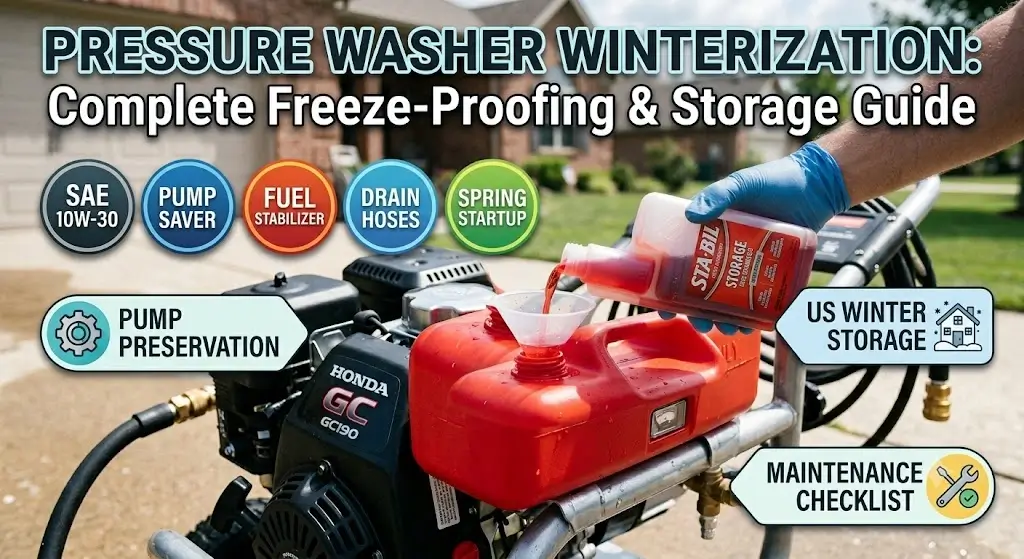
Untreated gasoline with 10% ethanol (E10) begins oxidizing within 30 days, leaving lacquer deposits across carburetor passages. Drain degraded fuel and refill with fresh non-ethanol fuel treated according to our pressure washer winterization guide.
3. Closed Fuel Petcock Valve
Confirm the fuel line shutoff lever is turned fully parallel to the fuel line (ON position). A perpendicular valve blocks fuel delivery entirely.
4. Engine Toggle Switch in OFF Position
The rocker or rotary switch on the engine cowl must be toggled to ON or RUN. In the OFF position, the ignition coil primary winding is grounded directly to the engine block, preventing spark creation.
5. Incorrect Choke Sequencing
Engage the choke fully (CLOSED) when starting a cold engine. As the block fires and runs for 5–10 seconds, feather the choke lever halfway, then slide it completely to the OPEN or RUN position.
6. Low Engine Oil Safety Cutoff
Gas pressure washers employ low-oil level switches. If the crankcase oil falls below safe operating levels, the sensor grounds the ignition coil. Replenish oil to the cross-hatch marker on the dipstick (distinguishing engine motor oil from pump fluid, as detailed in our pump oil guide).
7. Loose or Grounded Spark Plug Boot
The high-tension rubber spark plug boot must be seated firmly onto the spark plug terminal. Ensure internal terminal clip tension has not loosened from engine vibration.
8. Fouled, Carbon-Scored, or Wet Spark Plug
Unthread the plug using a 5/8-inch or 13/16-inch socket. If the electrode is covered in black carbon or soaked in liquid fuel, clean with a brass wire brush or replace with the specified NGK or Champion OEM plug gapped to 0.028–0.030 inches.
9. Restricted or Oil-Soaked Air Filter
Remove the air box cover. If the paper element or foam pre-cleaner is saturated with dirt or crankcase oil (frequently caused by tipping the unit on the wrong side), air velocity drops and suffocates the combustion chamber.
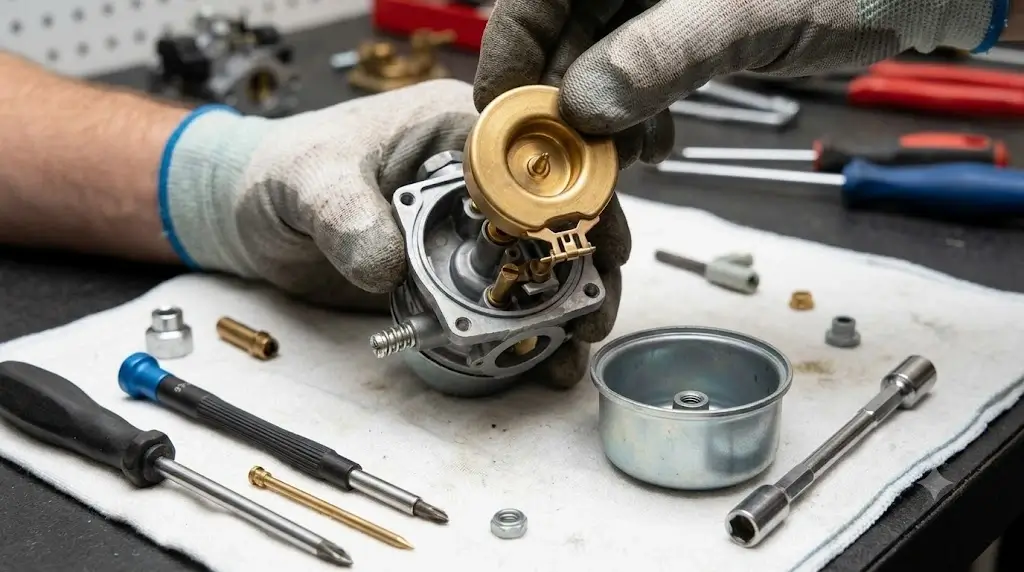
10. Clogged Carburetor Float Bowl & Main Jet
Remove the 10mm bowl bolt at the base of the carburetor. Clean the tiny brass orifice running through the center of the bolt using a fine carburetor jet wire, spray carb cleaner through the emulsion tube, and clear gummy deposits.
11. Water Contamination in Fuel Bowl
Because water is denser than gasoline, condensation settles directly in the carburetor bowl. Drain the bowl contents into a clean clear jar; if water droplets form beads at the bottom, flush the fuel tank completely.
12. Flooded Combustion Chamber
If fuel smell is strong after multiple unsuccessful pulls, move the choke to RUN, unthread the spark plug, pull the recoil cord 6 times to expel raw fuel vapor, dry the plug electrode, reinstall, and restart.
13. Hydraulic Pump Pressure Lock
Standing water in the high-pressure hose creates hydraulic head-pressure that resists pump piston movement. Always squeeze the trigger handle while pulling the recoil cord to relieve manifold back-pressure.
14. Undersized or Overheated Extension Cord (Electric Units)
Long 16-gauge cords produce major voltage drops under motor startup loads, stalling universal motors. Utilize minimum 12-gauge or 10-gauge heavy-duty cords under 50 feet if direct connection is impossible.
15. Tripped Inline GFCI Module
High moisture around electrical connections trips GFCI plugs. Dry the plug housing completely, insert firmly into a weatherproof receptacle, and press RESET until a distinct mechanical click confirms continuity.
How Hydraulic Pressure Lock Stalls Recoil Starters
When an operator connects the garden hose with water turned ON, city water pressure (40–60 PSI) enters the pump manifold and equalizes. As the engine cycles, the plungers compress trapped water against closed unloader check valves. Because water is incompressible, the pump locks up, resisting the manual pull cord.
Won’t Start vs. Starts but Has No Pressure
| Operational Diagnosis | Primary Symptom | Subsystems to Inspect |
|---|---|---|
| Starting System Fault | Engine or electric motor does not rotate or maintain idle | Carburetor, ignition coil, spark plug, switches, GFCI, breakers |
| Hydraulic Delivery Fault | Engine runs at 3,400 RPM, but spray stream lacks high pressure | Water inlet filter screen, spray nozzle orifice, unloader valve, pump packings |
Master Troubleshooting Decision Matrix
| Observed Machine Failure | Probable Fault Source | Immediate Service Action |
|---|---|---|
| Recoil rope resists pulling entirely | Hydraulic back-pressure / low engine oil | Squeeze trigger gun; check crankcase oil level |
| Electric motor produces silence on switch ON | Tripped GFCI / circuit breaker | Reset GFCI module; verify non-shared 15A/20A wall outlet |
| Electric motor hums without rotating | Voltage drop / seized pump plunger | Remove extension cords; lubricate pump plungers |
| Gas engine cranks; dry spark plug | Closed fuel valve / clogged carburetor jet | Open fuel petcock; clean carburetor main brass jet |
| Gas engine cranks; wet fouled spark plug | Flooded cylinder / bad ignition coil | Vent cylinder; test spark plug gap with inline tester |
| Runs 5 seconds on choke, then stalls | Main jet restriction / stale ethanol fuel | Drain fuel bowl; clear varnish from emulsion tube |
Overcoming Cold-Weather Starting Problems
In colder temperatures, gasoline vaporizes poorly and engine oil thickens, creating severe mechanical drag. To start in temperatures below 50°F (10°C):
- Switch to manufacturer-approved multi-viscosity engine oil (such as synthetic SAE 5W-30).
- Ensure the choke lever is fully engaged to supply a fuel-rich mixture.
- Store the machine in an above-freezing environment for 2 hours before firing the engine.
Troubleshooting Hot-Restart Failures
If a hot engine refuses to restart after refilling the fuel tank, the issue is typically vapor lock or ignition coil thermal failure. Liquid gasoline in the fuel line can boil into vapor bubbles that fuel pumps cannot prime. Let the machine cool for 10 minutes in the shade with the fuel cap loosened to vent internal pressure, and do not engage the choke on a hot engine.
Starting a Pressure Washer After Seasonal Storage
If the machine sat across autumn or winter without fuel stabilizer, follow this rehabilitation procedure:
- Siphon out the dark, sour-smelling stale gasoline completely.
- Drop the 10mm carburetor bowl screw to drain degraded fuel varnish.
- Spray aerosol carburetor cleaner directly up the central brass emulsion tube.
- Fill the fuel tank with fresh 87+ octane ethanol-free gasoline.
- Inspect the engine oil dipstick to ensure fuel has not thinned the crankcase oil.
When to Stop Troubleshooting and Consult a Certified Technician
- Fuel continuously drips from the carburetor body or fuel line connections (severe fire risk).
- The recoil pull cord kicks back with violent force (indicating a sheared flywheel timing key).
- The GFCI module or wall circuit breaker trips instantly every time the switch is touched.
- The engine emits loud mechanical knocking or metallic scraping sounds.
- The high-pressure pump head exhibits visible cracks or sprays high-velocity water from manifold casting seams.
Frequently Asked Questions
Why won’t my pressure washer start?
A pressure washer that won’t start usually suffers from fuel starvation, lack of spark, or safety interlocks. On gas units, check the fuel shutoff valve, fuel freshness, choke position, low-oil sensor, and spark plug. On electric models, check the GFCI plug, circuit breaker, master switch, and thermal overload cutoff.
Why won’t my gas pressure washer start?
The most common cause is stale ethanol fuel that has gummed the internal carburetor jets. Other frequent causes include a closed fuel petcock, an ignition toggle set to OFF, low engine oil tripping the shutdown switch, or a disconnected spark plug boot.
Why won’t my electric pressure washer start?
Electric pressure washers fail to start when their inline GFCI trips, the household breaker panel throws, or the motor thermal protector shuts down due to overheating. Many units also feature a Total Stop System (TSS), meaning the motor remains silent until you squeeze the spray gun trigger.
Why does my pressure washer crank but not start?
If the recoil rope pulls smoothly but the engine will not ignite, the problem is an absence of fuel or spark. Verify that the spark plug produces a bright blue spark against the engine block and that the carburetor bowl contains fresh, water-free fuel.
Why does my pressure washer start and then immediately die?
This typically indicates a dirty carburetor main jet, an incorrectly positioned choke lever, or low crankcase oil. The engine starts on initial priming fuel but starves when fuel demands increase, or cuts out when oil splashes away from the low-oil safety switch.
Can low engine oil prevent a pressure washer from starting?
Yes. Most modern small engines include an automatic low-oil shutdown float switch. If oil levels drop below the minimum threshold, the switch grounds the ignition circuit, cutting electrical flow to the spark plug.
Can old gas cause a pressure washer not to start?
Yes. Untreated fuel degrades within 30 days. The volatile light ends evaporate, leaving a heavy varnish that clogs microscopic carburetor fuel jets and prevents proper combustion.
Why is my pressure washer pull cord hard to pull?
The high-pressure water inside the pump manifold creates hydraulic head-pressure that locks the pump plungers. Squeezing the spray gun trigger to release line pressure while pulling the recoil cord immediately frees the starter rope.
Can an extension cord prevent an electric pressure washer from starting?
Yes. Thin, lightweight extension cords cause major voltage drops during high-amperage motor startups. This voltage drop trips the GFCI or triggers the motor thermal protector. Always use a 12-gauge or 10-gauge cord under 50 feet, or plug directly into a wall receptacle.
Does a pressure washer need water connected before starting?
Yes. Running a pressure washer pump dry without water causes rapid friction buildup that melts internal plastic valves and burns rubber packings within 30 seconds. Always establish active water flow and purge trapped air before firing the engine.
Bottom Line: Systematic Diagnostics Beats Guesswork
Do not replace parts randomly when your pressure washer refuses to start. Isolate the drive architecture, confirm whether you are confronting an electrical supply failure or an engine combustion fault, and check the simplest items first: vent hydraulic line pressure, confirm the fuel petcock is OPEN, satisfy the low-oil cutoff sensor, and reset your GFCI module. Following this logical sequence resolves over 90% of equipment starting faults without expensive shop repairs.
