
Are Electric Pressure Washers a Good Choice?
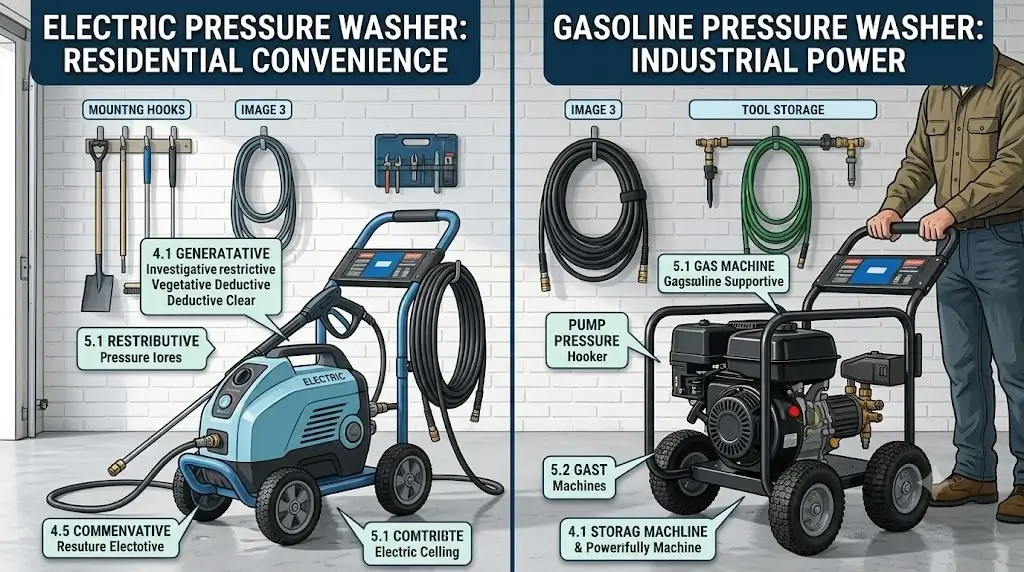
Yes—an electric pressure washer is an exceptional choice for the vast majority of homeowners whose cleaning routines focus on vehicles, outdoor patio furniture, paver walkways, wood decks, exterior siding, and routine seasonal property maintenance.
Determining whether an electric model fits your needs depends on aligning your specific cleaning surface requirements with realistic hydraulic output parameters: working pressure (PSI), water volume (GPM), residential branch circuit capacity (15A vs. 20A at 120V), and pump duty cycles.
Electric units eliminate the complications of internal combustion engines: no oil checks, no spark plugs, no gummed carburetors, and zero exhaust emissions. However, they face real physical constraints imposed by standard North American wall outlets. This engineering guide evaluates whether an electric unit matches your actual property demands or if your workload requires a commercial gasoline platform.
This guide evaluates electric pressure washers based on sustained working pressure and water flow under dynamic load, rather than laboratory “peak” or “initial discharge” ratings. We follow testing standards compliant with the Pressure Washer Manufacturers’ Association (PWMA PW101).
Quick Answer: Should You Buy an Electric Pressure Washer?
Choose an electric pressure washer if: You clean primarily around the perimeter of your home (within 100 feet of an electrical outlet), value push-button startup, want near-silent idling, want to avoid gasoline storage, and prioritize car washing, patio detailing, and deck maintenance. Review our lab-tested top picks in our curated guide to the best electric pressure washers.
Choose a gas pressure washer if: You have extensive concrete driveways (>1,500 sq. ft.), need to run professional rotary surface cleaners faster than 15 minutes per 100 sq. ft., require mobility far from electrical outlets, or need commercial-grade stripping power (>3,000 continuous PSI at >2.5 GPM).
Are Electric Pressure Washers Good for Homeowners?
For over 85% of suburban homeowners, an electric pressure washer is not merely a compromise—it is the mechanically superior choice. Gasoline pressure washers frequently fail not from mechanical wear, but from fuel neglect: ethanol phase separation, gummed carburetor jets, and oil breakdown during long winter storage.
Residential washing tasks are limited far more by chemical dwell time, brush agitation, and nozzle spray angle than raw hydraulic force. Modern universal and induction electric units provide between 1,500 and 2,300 working PSI at 1.1 to 1.7 GPM, which sits in the safe operating window for painted vehicle clear coats, soft cedar decking, vinyl siding, and outdoor fabrics.
Automotive washing, foam cannon detailing, composite decks, patio furniture, concrete walkways, residential vinyl siding.
Multi-acre driveways, deep oil stain removal on aged porous concrete, second-story brick reaching, commercial paint prep.
Instantaneous start/stop operation (TSS), zero combustion maintenance, silent idle, indoor storage capability.
Strict mechanical ceiling governed by residential 120V electrical circuits (typically capped at 1.8 to 2.4 kW).
Electric vs. Gas Pressure Washers: Technical Comparison
| Operational Parameter | Electric Pressure Washer | Gasoline Pressure Washer |
|---|---|---|
| Starting Mechanism | Instant electric rocker switch / trigger pull | Manual recoil pull-cord or 12V battery starter |
| Power Source & Fuel | Standard 120V AC household circuit | 87+ octane ethanol-free or stabilized gasoline |
| Idling Characteristics | Total Stop System (motor halts when trigger released) | Engine idles continuously; unloader bypass heats up |
| Operational Noise Level | 65–78 dB(A) (Runs only while spraying) | 85–100+ dB(A) (Continuous engine roar) |
| Routine Maintenance | Inlet filter clean, O-ring lube, winter pump saver | Engine oil changes, air filter, spark plug, carb drain |
| Mobility Range | 35-ft power cord + 25-ft hose (~60 ft radius) | Unlimited terrain mobility (hose length only) |
| Average Working Output | 1,500–2,100 PSI @ 1.2–1.6 GPM | 2,800–4,000 PSI @ 2.4–4.0 GPM |
| Winter Storage Complexity | Simple: pump saver injection + store indoors | Complex: fuel stabilization, carb drain, pump saver |
| Equipment Lifespan | 100–300 hrs (Universal) / 500–1,000 hrs (Induction) | 300–500 hrs (Consumer) / 1,500–3,000 hrs (Commercial) |
For an in-depth breakdown of pressure ratings, pump geometries, and drive systems, read our comprehensive pressure washer buying guide.
Why Are Electric Pressure Washers So Popular?
1. Total Stop System (TSS) Convenience
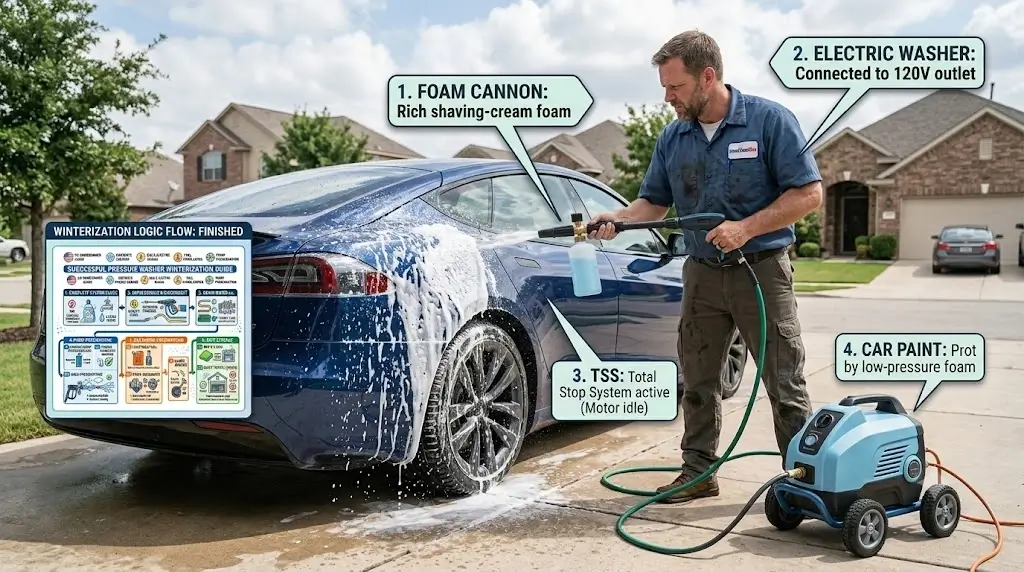
Unlike gas machines that run their engines continuously when you let go of the spray trigger, most electric washers integrate a Total Stop System (TSS). The TSS utilizes a pressure-actuated microswitch that cuts power to the motor immediately upon trigger release. This eliminates pump bypass overheating and delivers silent operation between cleaning passes.
2. Freedom From Gasoline Degeneration
Modern pump gasoline blended with 10% ethanol (E10) begins degrading in as little as 30 days, attracting moisture and forming acidic varnish inside small carburetor passages. Electric power eliminates fuel stabilizers, drained float bowls, oil changes, and fouled spark plugs.
3. Compact Footprint & Safe Indoor Storage
Because electric washers emit no exhaust fumes and contain no volatile fuels, they can be safely stored inside basements, heated utility rooms, or closets. This eliminates the risk of sub-freezing manifold damage common in unheated sheds. Review our guide on how to winterize a pressure washer for cold-climate storage steps.
4. Neighborhood-Friendly Acoustic Profile
Gas engines generate high decibel levels that require hearing protection under OSHA guidelines. Electric washers operate at conversational noise levels and produce sound only when the trigger is actively depressed.
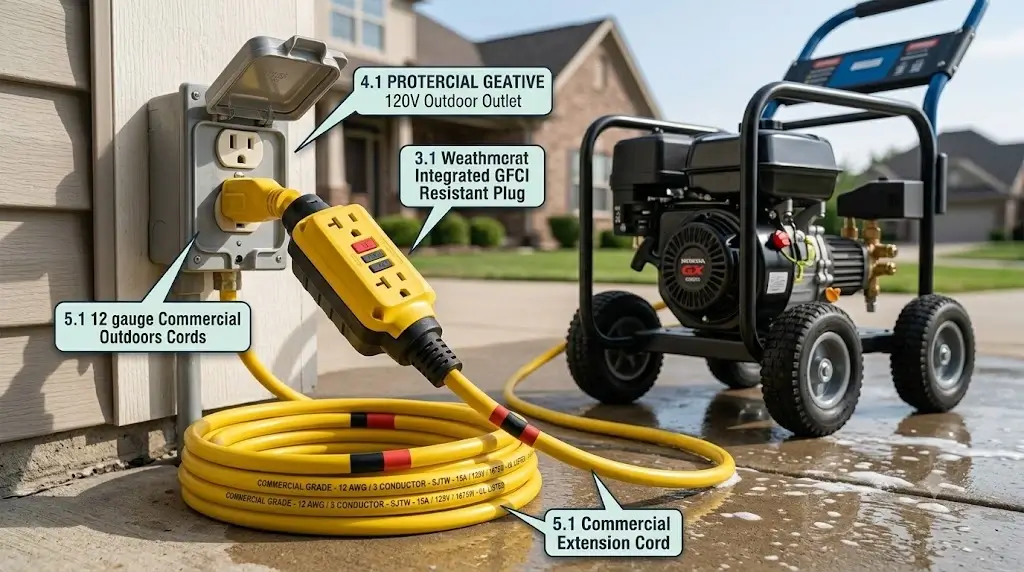
Electric pressure washers require care around water. Always plug into a dedicated, GFCI-protected outlet and never submerge or spray the machine housing directly. Review our pressure washing safety guide before operation.
What Are the Disadvantages of Electric Pressure Washers?
The primary constraint of an electric pressure washer is physics: standard North American residential circuits restrict continuous electrical output.
1. The 120V / 15-Amp Wall Outlet Power Ceiling
Standard residential wall outlets in the United States operate at 120 volts on 15-amp or 20-amp breakers. The National Electrical Code (NEC) specifies that a continuous electrical load must not exceed 80% of the breaker rating:
120 Volts × 15 Amps × 0.80 = 1,440 WattsMaximum Continuous Electrical Load (20A Circuit):
120 Volts × 20 Amps × 0.80 = 1,920 Watts
Accounting for typical electric motor efficiency (80–85%) and axial wobble-plate pump mechanical losses (10–15%), a standard 15A wall outlet can physically produce only about 1.5 to 1.8 theoretical hydraulic horsepower under continuous operation. This hard physical limit prevents genuine, continuous 3,000 PSI output at useful flow rates on a standard 120V household plug.
2. Lower Water Flow (GPM) Extends Cleaning Times
While pressure (PSI) dislodges dirt, water volume (GPM) carries the dislodged grit away. A 1.2 GPM electric pressure washer will clean a heavily soiled, moss-covered concrete driveway at approximately one-third the speed of a 3.5 GPM commercial gas unit.
3. Extension Cord Restrictions
Electric pressure washers pull high continuous amperage during startup and peak loading. Using light-gauge 16 AWG household extension cords causes voltage drop, motor overheating, and tripped circuit breakers. If an extension cord is needed, use a heavy-duty 12 AWG or 10 AWG outdoor cord rated for 50 feet or less.
PSI vs. GPM: What Actually Determines Cleaning Performance?
The total cleaning capability of any pressure washer is measured in Cleaning Units (CU), calculated as working pressure multiplied by delivered volume:
Cleaning Units (CU) = Working PSI × Delivered GPM
Compare two common configurations:
- Standard Electric Unit: 1,800 PSI × 1.3 GPM = 2,340 CU
- Mid-Tier Gas Unit: 3,200 PSI × 2.5 GPM = 8,000 CU
The gas unit provides over three times the cleaning units, primarily through its higher flow rate (GPM). On broad horizontal surfaces like long driveways, flow rate dictates your work speed.
Why Advertised PSI Can Be Deceptive
Many consumer electric pressure washers highlight “Peak PSI” or “Maximum Initial Discharge PSI.” This figure reflects the brief pressure spike recorded when the trigger is first pulled from a closed unloader, rather than the sustained pressure maintained during cleaning.
Always inspect the machine’s specification plate for PWMA-certified working pressure. A machine rated honestly at 1,800 working PSI and 1.4 GPM cleans better and lasts longer than a unit advertising “3,000 MAX PSI” that drops to 1,200 PSI at 0.9 GPM under continuous load.
| Rating Category | Engineering Measurement | Practical Meaning for Homeowners |
|---|---|---|
| Peak / Max PSI | Internal pressure spike upon trigger release | Marketing metric; does not reflect working pressure |
| Working / Rated PSI | Sustained pressure at the nozzle during spraying | The actual force applied to the surface during use |
| Rated Flow (GPM) | Gallons delivered per minute under working load | Determines rinsing speed and surface cleaner capacity |
| Cleaning Units (CU) | Rated PSI multiplied by Rated GPM | Best comparative metric for total cleaning productivity |
Surface-by-Surface Suitability Guide
1. Vehicles & Foam Cannons: Excellent Match
Automotive detailing benefits from lower pressure and moderate flow. Excess pressure (>1,900 PSI) can strip clear coat, damage window seals, or force water past door gaskets. An electric washer paired with a wide 40° nozzle or a quality foam cannon operating at 1,200–1,500 PSI produces rich shaving-cream foam while protecting painted finishes.
2. Wood Decks & Fences: Very Good (With Proper Technique)
Softwoods like pressure-treated pine and cedar gouge easily above 1,200–1,500 PSI. The lower pressure window of electric units makes them well-suited for washing decks without feathering the wood grain. Use a 25° or 40° tip and maintain a consistent 12-inch distance.
3. Vinyl & Aluminum Siding: Very Good
Combined with downstream detergent injection or an upstream soap nozzle, electric washers clean residential siding without forcing water behind panel weep holes. For reaching second-story peaks, you may need an extension lance or dedicated soap-shooter nozzle.
4. Concrete Walkways & Patios: Good
Paver walkways, aggregate flagstone, and small patios clean easily with an electric unit. Pairing an electric washer with a compact 10- or 11-inch surface cleaner speeds up cleaning while preventing wand striping.
5. Large Concrete Driveways: Fair to Poor
Cleaning an expansive two- or three-car concrete driveway with an electric washer can take several hours due to limited flow rate (GPM). If your primary goal is washing large driveways multiple times per year, a gas unit delivers far better efficiency.
| Surface / Cleaning Task | Recommended Working PSI | Recommended Nozzle Degree | Electric Unit Suitability |
|---|---|---|---|
| Automotive Washing & Wheels | 1,000–1,400 PSI | 40° (White) or Foam Cannon | Optimal (Preferred over Gas) |
| Outdoor Patio Furniture | 1,200–1,500 PSI | 40° (White) or 25° (Green) | Optimal |
| Wood & Composite Decking | 1,200–1,500 PSI | 25° (Green) / Keep 12″ distance | Very Good |
| Vinyl / Hardie Board Siding | 1,300–1,600 PSI | 25° (Green) or Soap Nozzle | Very Good |
| Concrete Walkways & Pavers | 1,800–2,100 PSI | 15° (Yellow) or 10″ Surface Cleaner | Good |
| Expansive 2-Car Driveways | 2,500–3,200+ PSI | Turbo Nozzle or 15″ Surface Cleaner | Fair (Slow coverage rate) |
Motor Architectures: Universal vs. Brushless Induction
The motor design inside an electric pressure washer dictates its lifespan, noise level, and duty cycle:
- Universal (Brushed) Motors: Lightweight and inexpensive, these motors power most budget consumer units under $180. They run at high RPMs, generate a high-pitched whine, and wear down their carbon brushes over 100 to 250 operating hours. Ideal for occasional use (4 to 8 times per year).
- Brushless Induction Motors: Found in mid-tier and premium electric washers. They operate at lower RPMs (typically 1,750 or 3,400 RPM), run quietly, generate less heat, and deliver operating lifespans of 500 to 1,000+ hours. Recommended for frequent car washers and larger suburban properties.
Operating Cost Breakdown: Electricity and Water
Electric pressure washers are inexpensive to run compared to gas-powered alternatives.
Electricity Consumption
A typical 1,800-watt electric washer running under full continuous load draws 1.8 kWh per hour. Based on the 2026 U.S. average residential electricity rate of ~$0.17 per kWh:
1.8 kWh × $0.17 = $0.31 per hour of trigger time
Water Consumption
A standard residential garden hose flows at roughly 5 to 8 GPM under household pressure. An electric pressure washer restricts that flow through its pump and nozzle to 1.2–1.5 GPM, reducing water consumption by up to 75% while boosting cleaning impact force.
Electric Pressure Washer Maintenance Protocols
While simpler than gas engines, electric pumps require regular care to prevent premature failure. Incorporate these habits into your pressure washer maintenance schedule:
Routine Maintenance Checklist
- Clean the Inlet Screen: Rinse the stainless steel mesh filter before each connection to stop silt from damaging check valves.
- Inspect the Power Cord & GFCI: Check cord insulation for cuts and test the built-in GFCI switch before every wash.
- Lubricate Quick-Connect O-Rings: Apply pure silicone grease to nozzle and hose O-rings monthly to prevent leaks.
- Discharge Residual Pressure: Squeeze the trigger after turning the unit off to bleed internal water tension.
- Winterize Against Freezing: Flush internal pump water with non-toxic pump conditioner before storing in freezing environments.
Electric Pressure Washer Decision Matrix
Step 1: Where is your cleaning zone located?
- Within 100 feet of an outdoor outlet → Electric is a strong match.
- Remote fence lines, off-grid property, acreage → Choose Gas.
Step 2: What is your primary cleaning task?
- Vehicles, furniture, decks, siding, seasonal walkways → Choose Electric.
- Multi-car driveways, heavy commercial equipment, deep concrete oil stains → Choose Gas.
Step 3: What is your maintenance tolerance?
- Want plug-and-play simplicity with zero engine maintenance → Choose Electric.
- Comfortable with oil changes, spark plugs, and carburetor care for higher output → Choose Gas.
Frequently Asked Questions
Are electric pressure washers a good choice?
Yes. Electric pressure washers are an excellent choice for most homeowners. They offer low maintenance, quiet push-button operation, zero exhaust emissions, and well-balanced pressure for vehicles, siding, outdoor furniture, and patios.
Are electric pressure washers powerful enough to clean concrete?
Yes, for residential walkways, patios, and small driveways. Equipped with a turbo nozzle or a 10-inch surface cleaner, an electric washer operating at 1,800–2,000 working PSI cleans concrete effectively, though it works more slowly than higher-flow gas units.
Are electric pressure washers good for cars?
They are the gold standard for vehicle detailing. Their working pressure (1,100–1,500 PSI) safely cleans clear coats, plastic grilles, and rubber trim without risk of stripping, while remaining fully compatible with high-density foam cannons.
Are electric pressure washers better than gas pressure washers?
Neither design is universally better. Electric excels in convenience, low noise, and minimal maintenance for residential tasks. Gas remains the right tool when you need high water volume (GPM), long driveways, or complete mobility away from electrical outlets.
Do electric pressure washers use a lot of electricity?
No. A standard 15-amp consumer unit consumes approximately 1.4 to 1.8 kWh per hour of active trigger operation, costing roughly $0.25 to $0.35 per hour under typical residential electric rates.
Do electric pressure washers use less water?
Yes. An electric pressure washer uses only 1.2 to 1.6 gallons per minute, compared to an unrestricted garden hose that flows at 5 to 8 GPM. This delivers up to a 75% reduction in total water usage.
Can an electric pressure washer clean a driveway?
Yes, but speed depends on driveway surface area. A standard single-car driveway cleans easily. A wide three-car driveway can take several hours due to lower water flow (GPM) compared to commercial gas units.
Can an electric pressure washer remove concrete stains?
Surface dirt, moss, algae, and mildew lift away easily. Deeply embedded oil stains, transmission fluid, or rust spots require specialty degreasers, hot water, or higher continuous mechanical power.
Can you use an electric pressure washer with an extension cord?
Only if the manufacturer permits it and you use a properly rated cord. Never use lightweight 16 AWG household cords. Use a heavy-duty 12 AWG or 10 AWG outdoor cord rated for 50 feet or less to prevent voltage drop and motor burnout.
Are electric pressure washers good for decks?
Yes. Wood decking requires moderate pressure to prevent splintering. Electric units paired with a 25° or 40° nozzle clean cedar, redwood, and composite boards safely without cutting into the wood fibers.
Are electric pressure washers good for siding?
Yes. Combined with a dedicated soap nozzle, electric washers clean vinyl, aluminum, and fiber-cement siding without pushing water past panel joints into interior insulation.
Are electric pressure washers worth buying for occasional use?
Yes. They are particularly well suited for occasional users because they do not suffer from stale fuel or gummed carburetors during long downtime. Simply plug in, attach the water line, and pull the trigger.
How long can an electric pressure washer run continuously?
Universal brushed motors should be rested for 10 to 15 minutes after every 30 to 45 minutes of continuous trigger time. Heavy-duty brushless induction motors are rated for longer, continuous operation.
What is more important, PSI or GPM?
Both matter, but GPM dictates work speed. PSI provides the hydraulic stripping force to loosen dirt, while GPM carries the dislodged debris away. For broad flatwork, higher GPM delivers the greatest productivity gains.
What is the biggest disadvantage of an electric pressure washer?
The primary limitation is restricted power due to standard 120V household wall outlets, which caps working output to roughly 2,000 PSI at 1.4 GPM on standard residential electrical circuits.
Final Verdict: Are Electric Pressure Washers a Good Choice?
For most residential property owners, an electric pressure washer is an outstanding investment. It eliminates the routine maintenance, volatile fuel storage, and high noise levels of small combustion engines while providing well-balanced output for vehicles, siding, outdoor furniture, and patios.
Unless your property features long concrete driveways, requires multi-hour daily commercial operation, or lacks outdoor electrical outlets, an electric pressure washer delivers the best overall balance of performance, convenience, and long-term ownership value.
Choose electric for push-button convenience, quiet operation, and zero fuel maintenance on standard residential tasks. Choose gas only if your regular cleaning workload involves large commercial flatwork or requires complete freedom from electrical outlets.
