
Pressure Washer Maintenance Schedule: Daily, Weekly, Monthly & Annual Checklist
A pressure washer lasts longer when maintenance intervals align with operating hours, water chemistry, fuel stability, and storage conditions rather than calendar dates. Equipment longevity depends on maintaining structural boundaries across two independent mechanical systems: the high-pressure fluid pump (axial-cam vs. triplex) and the drive motor (combustion engine vs. induction electric).
This technical maintenance schedule establishes operational intervals for the pump crankcase, engine circuits, water inlet filtration, high-pressure lines, spray lances, nozzles, electrical safety gear, and fuel delivery based on manufacturer service protocols from Honda, Briggs & Stratton, Generac, and SIMPSON.
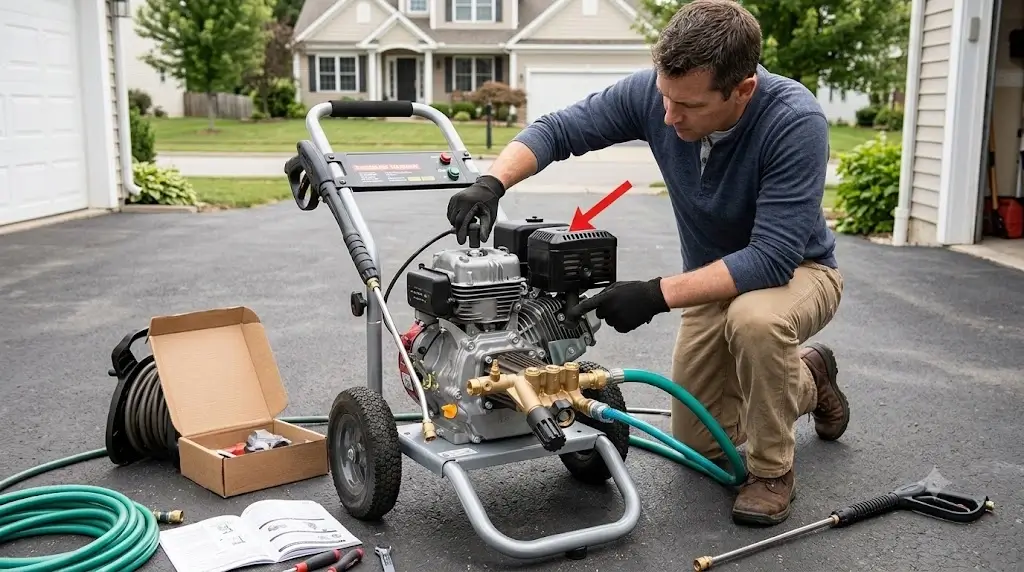
This guide separates OEM-mandated specifications from variable field inspections. Always review your manufacturer manual for exact engine oil grades, pump crankcase fluids (SAE 30 Non-Detergent vs. ISO 68), spark plug gap dimensions, and winterization chemicals.
Quick Answer: How Often Should You Maintain a Pressure Washer?
Inspect before every trigger pull; service mechanically by run hours.
- Every Use: Inspect high-pressure hose jacket, clear water inlet filter screen, relieve line backpressure upon shutdown, and purge chemical detergents.
- Gas Models: Check engine oil before each run. Execute the initial break-in engine oil change at 5 operating hours, with subsequent changes every 50 operating hours. Service air filters every 25–50 hours and inspect the spark plug annually or every 100 hours.
- Electric Models: Inspect the power cord and GFCI trip mechanism prior to every use; inspect unloader valves and pump seals every 25–50 hours.
- End of Season: Apply fuel stabilizer, isolate the carburetor circuit, and inject pressurized pump saver before storage drops below 32°F (0°C).
Pressure Washer Maintenance Schedule at a Glance
| Operational Interval | Gasoline Pressure Washer Protocol | Electric Pressure Washer Protocol | Failure Risk Level |
|---|---|---|---|
| Before Every Use | Check engine oil, verify fresh fuel, check inlet screen, inspect hose jacket and spray wand | Test GFCI plug, inspect power cable insulation, check inlet screen and hose fittings | Critical (Safety / Pump Cavitation) |
| After Every Use | Flush detergent line, shut off water, discharge trapped trigger pressure, drain hoses | Flush chemical pickup tube, discharge residual pressure, disconnect cord, drain lance | High (Unloader & Seal Stress) |
| Initial 5 Hours (Break-In) | Drain and replace factory break-in engine crankcase oil | Not Applicable (Factory-lubricated induction motor) | High (Internal Engine Scuffing) |
| Every 25–50 Hours | Clean foam air-filter element, inspect pump seals, check triplex pump oil sight glass | Inspect pump manifold bolts, clean nozzle orifices, check quick-connect O-rings | Moderate (Performance Loss) |
| Every 50–100 Hours | Change engine oil, replace paper air filter, service pump oil (triplex), check spark plug | Detailed manifold leakage inspection, lubricate brass quick-connect couplings | High (Mechanical Wear) |
| Prior to Winter Storage | Stabilize fuel or run carburetor dry, inject aerosol pump saver, lubricate O-rings | Inject pump saver / non-toxic propylene glycol, store inside heated envelope | Critical (Freeze Cracking) |
| Annually / Spring Re-Commission | Install fresh spark plug, fuel filter, and engine oil; run full system leak check | Inspect wiring, flush water lines without nozzles to clear scaling, test GFCI | High (Operational Reliability) |
Operational intervals listed above represent standardized engineering benchmarks. When individual manufacturer operator manuals specify tighter thresholds, the OEM guideline takes priority.
Why Pressure Washer Maintenance Is Different for Gas and Electric Models
Although both designs use positive-displacement pumps to pressurize water, the prime movers impose completely different maintenance requirements. For a full breakdown of motor torque vs. combustion drive systems, consult our detailed pressure washer buying guide.
- Gasoline Pressure Washers: Combine high-RPM mechanical pumps with four-stroke internal combustion engines. They require ongoing combustion maintenance: motor oil changes, foam/paper air filter degreasing, spark plug gap calibration, carburetor bowl cleaning, and fuel stabilization against ethanol phase separation.
- Electric Pressure Washers: Rely on induction or universal electric motors with sealed bearings. Units from our top-tested best electric pressure washers eliminate spark plugs, engine lubricants, and fuel systems. However, electrical safety monitoring (GFCI interrupters, cord insulation integrity) and thermal management of enclosed wobble-plate pumps require equal diligence.
Before Every Use: The 3-Minute Pre-Operation Inspection
Pre-operation checks prevent catastrophic pump cavitation and high-pressure hose bursts under load. Before pressurizing the system, always observe the fundamental operating protocols in our pressure washing safety guide to protect yourself and your equipment.
Pre-Use Operational Checklist
- High-Pressure Hose: Check the entire length for cuts, external wire reinforcement exposure, heat blisters from mufflers, and crimped couplings.
- Water Supply Capacity: Confirm incoming garden hose flow rate (GPM) exceeds pump output requirements by at least 20% to prevent pump cavitation.
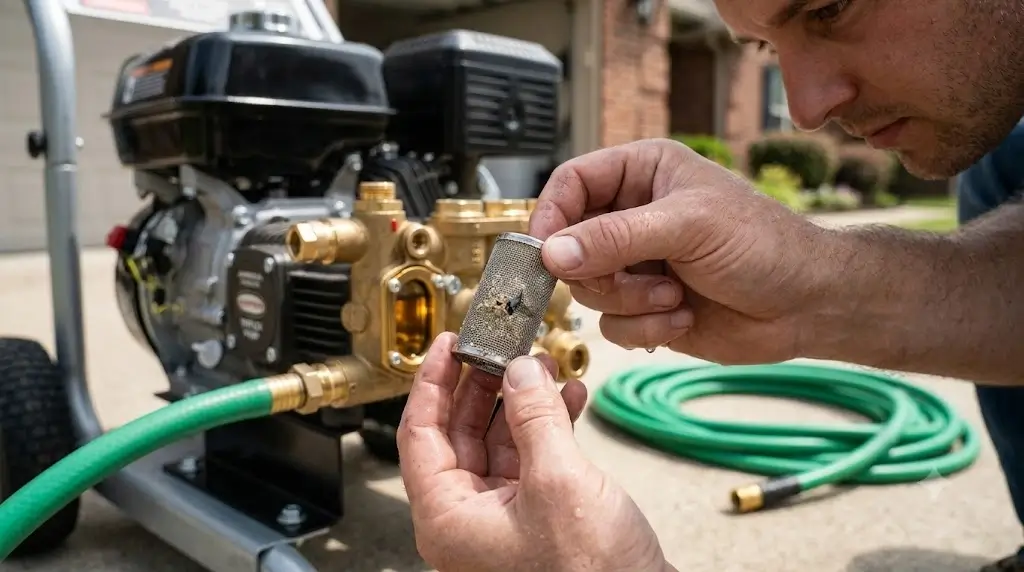
- Water Inlet Screen: Remove and clear sediment, silt, and algae from the brass inlet filter screen.
- Nozzle Check: Ensure the quick-connect spray tip orifice is clean and clear of sand or mineral obstruction.
- Fluid Verification (Gas): Check engine oil on a level plane; verify gasoline is fresh and ethanol-free (E0) or stabilized.
- Electrical Inspection (Electric): Inspect the power lead and depress the GFCI “Test” and “Reset” buttons to ensure functional ground-fault interruption.
Never operate a damaged high-pressure hose.Pressure washer lines hold dynamic hydraulic forces between 1,500 and 4,000 PSI. Taping, clamping, or splicing a damaged high-pressure line creates severe hazard risks. Discard damaged lines immediately.
After Every Use: Pressure Washer Shutdown Procedure
Leaving hydraulic pressure or caustic chemicals trapped in the manifold accelerates seal dry rot and unloader valve seizure.
- Flush Chemical System: Remove the detergent pickup siphon from detergent and place it in clear water for 60 seconds to purge chemical salts from the brass injector body.
- Engine / Motor Shutdown: Toggle the ignition switch to OFF or switch the electric power button OFF.
- Water Cutoff: Close the garden hose spigot completely.
- Line Depressurization: Direct the wand into an open area and squeeze the spray gun trigger until water stops flowing. This releases hydraulic tension trapped within the pump and hose.
- Disconnection & Drain: Detach hoses, elevate both ends to let gravity empty internal liquid, and coil in large loops to prevent memory crimping.
Weekly Pressure Washer Maintenance
For commercial operators or property owners with regular weekly usage, run these preventative checks:
Weekly Inspection Protocol
- Extract, wash, and reseat the stainless steel inlet strainer.
- Inspect high-pressure hose jackets along operational friction and dragging points.
- Check triplex pump crankcase sight glass (if equipped) for milky water contamination.
- Examine the unloader valve stem and bypass tubing for weeping water droplets.
- Clean engine cooling fins and clear the recoil starter shroud of grass clippings and debris.
Monthly Pressure Washer Maintenance
Adjust monthly checklists to match actual accumulated engine/pump runtime hours:
Gasoline Equipment Priorities
- Inspect engine oil color; check for fuel dilution or burning.
- Remove air cleaner cover; tap out loose dust or wash foam pre-cleaners in warm water and detergent.
- Examine fuel lines and primer bulbs for drying, ozone cracks, or weeping clamps.
- Inspect structural engine and pump mounting bolts for loosening caused by operational vibration.
Electric Equipment Priorities
- Inspect power cable along its entire length for pinching, flattening, or outer jacket cuts.
- Verify GFCI housing screws are tight and free of internal water ingress.
- Condition quick-connect rubber O-rings with 100% pure silicone paste.
- Examine external pump housing seals for traces of emulsified white grease leaks.
Pressure Washer Maintenance by Operating Hours
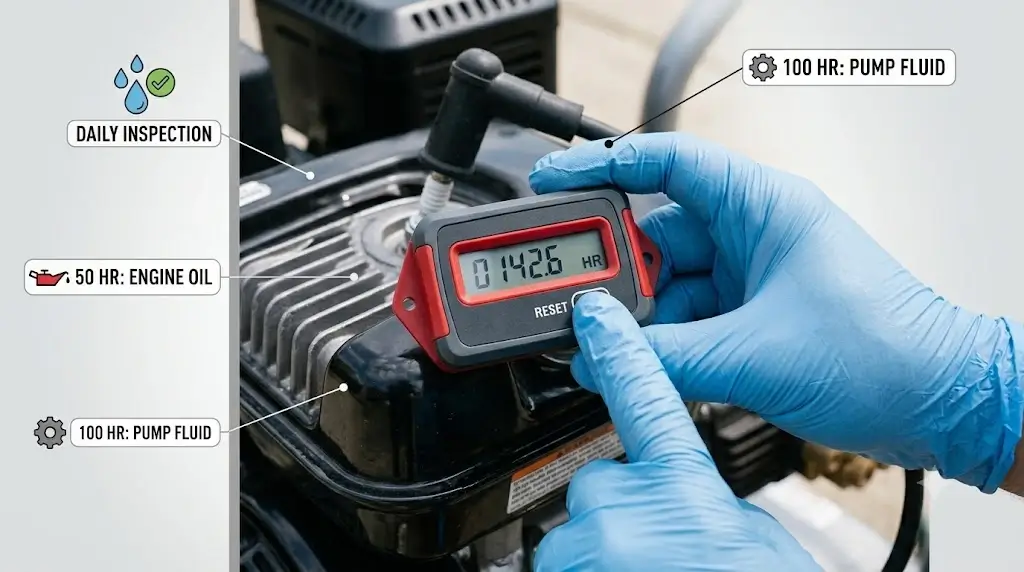
For dependable service planning, track maintenance by hour-meter metrics instead of calendar weeks:
| Operating Metric | Component System | Required Service Operation |
|---|---|---|
| Initial 5 Hours | Gas Engine Crankcase | Drain initial break-in oil to remove factory manufacturing metals and seat piston rings. |
| Every 25 Hours | Combustion Air System | Wash foam pre-filters; clean cooling shrouds under dusty operational conditions. |
| Every 50 Hours | Engine & Triplex Pump | Change 4-stroke engine oil. Drain and refill serviceable triplex pump crankcases with designated non-detergent fluid. |
| Every 100 Hours | Ignition & Fuel Lines | Clean and gap spark plug; replace in-line fuel filters; replace paper air filter cartridges. |
| Every 250+ Hours | Water Manifold Assembly | Replace high-pressure water packings, inspect ceramic piston plungers, and reseat brass unloader valves. |
Pressure Washer Pump Maintenance
The positive displacement pump is the mechanical core of the machine. Pump care focuses on preventing dry running, internal cavitation, and thermal degradation.
1. Prevent Pump Cavitation
Pumps convert incoming water into high-pressure flow. When inlet supply is restricted (by kinked garden hoses, undersized spigots, or clogged strainers), vacuum pressure vaporizes water inside the manifold. These microscopic vapor pockets implode violently against the plungers, pitting brass castings and fracturing ceramic sleeves within hours.
2. Avoid Thermal Relief Meltdown
Leaving a running pressure washer idling with the trigger gun closed forces water to circulate continuously through the unloader bypass loop. Friction heats this isolated water charge quickly. Always squeeze the trigger every 60 seconds during idling or equip the machine with an operational thermal relief valve.
3. Service Pump Crankcase Lubricants Correctly
Serviceable pumps require dedicated lubricants. Review our complete guide to pressure washer pump oil types, capacities, and intervals to ensure you match non-detergent SAE 30, 15W-40, or ISO 68 to your specific pump model without using automotive detergents.
Gas Pressure Washer Engine Maintenance
Small combustion engines operating under continuous hydraulic loads require consistent fluid and ignition checks:
Engine Crankcase Oil
Run standard SAE 10W-30 or SAE 30 four-stroke engine oil rated API-SJ or higher. Check oil levels prior to every startup by inserting the dipstick into the neck without screwing it in (standard for Honda GX and Briggs engines).
Combustion Air Filtration
A restricted filter starves the engine of combustion air, causing cylinder bore carbon fouling, rough hunting idling, and unburned fuel entering the exhaust. Clean foam elements regularly; replace pleated paper cartridges when discolored.
Ignition & Spark Plug Maintenance
Pull the spark plug every 100 hours. Clean carbon buildup using a wire brush, measure the electrode gap with a wire feeler gauge (standard 0.028–0.030 in / 0.70–0.76 mm), and replace fouled or eroded plugs.
Electric Pressure Washer Maintenance
Electric pressure washers rely on regular checks of electrical insulation and motor cooling efficiency:
- Cord Care: Never drag machines by their electrical cords. Avoid running extension cords unless they meet OEM gauge requirements (typically 12 AWG up to 50 ft). Undersized cords drop line voltage, causing universal motors to overheat.
- GFCI Breakers: Test the built-in ground fault circuit interrupter before every wash session. If it trips repeatedly during normal operation, discontinue use and inspect the motor brushes and switch housing for water intrusion.
- Ventilation Ports: Use compressed air to blow accumulated spider webs, dry dirt, and debris out of the electric motor housing vents to maintain air cooling.
Pressure Washer Hose Maintenance & Damage Triage
| Visible Hose Condition | Mechanical Meaning | Action Mandate |
|---|---|---|
| Superficial Mud & Grit | Normal exterior dirt accumulation | Wipe down with clean microfiber rag; allow to dry |
| Sharp Kinks or Twists | Steel wire braid bent beyond bend radius | Uncoil fully; replace if structural crimp remains permanent |
| Outer Jacket Scuffs | Thermoplastic/rubber skin worn down | Monitor carefully; verify inner steel braiding is not exposed |
| Localized Swelling / Blistering | Inner tube punctured; pressure trapped in outer jacket | Immediate replacement; discard immediately |
| Exposed Steel Braid | Outer defensive protective jacket severed | Immediate replacement; failure under pressure is imminent |
| Coupling Collars Deformed | Fitting dropped or crushed under vehicular load | Replace entire high-pressure quick-connect assembly |
Pressure Washer Nozzle Maintenance
Spray tips meter water discharge to generate system pressure. When mineral scale, grit, or debris obstructs an orifice, backpressure spikes through the unloader assembly, causing engine bogging and pump damage.
Nozzle Cleaning Procedure
- Turn off the machine and squeeze the trigger to relieve line pressure.
- Detach the quick-connect spray tip from the lance barrel.
- Insert a fine wire nozzle cleaning pick through the orifice opening from the front to dislodge obstruction.
- Flush water backward through the tip under a standard sink tap to evacuate dislodged debris.
- Inspect orifice roundness; replace spray tips showing uneven spray fan patterns.
Water-Inlet Filter Maintenance
The garden hose inlet screen serves as the primary barrier against pump debris. Check it before attaching the supply hose. Mineral scale and fine sand will pass into the manifold if the mesh is torn or missing, which can score stainless check-valve balls and cause pressure drops.
Hard Water and Descaling Protocols
Hard water supplies contain dissolved calcium and magnesium carbonates that precipitate onto hot brass surfaces under working pressure. In hard water areas, flush water circuits with an approved pump descaling solution or non-toxic pump conditioner every 25 hours of operation.
Pressure Washer Maintenance After Detergent Use
Detergent soaps dry into sticky, alkaline solids that seize brass ball-checks within siphon barbs. Always submerge the detergent suction line into a bucket of clear, warm freshwater and run the machine on low pressure for 60 to 90 seconds to clean out injection lines.
Seasonal Pressure Washer Maintenance
Spring Commissioning
Before the first spring wash, inspect the machine to catch leaks and connection issues early:
- Inspect the brass pump block for frost splits or hairline winter casting fractures.
- Check engine and pump crankcase oil levels for moisture or discoloration.
- Hook up garden hose water without starting the motor, depress the wand trigger, and flush out winterizing storage fluid until water runs clear.
- Verify fuel line elasticity; fill with fresh non-ethanol fuel and verify stable idle speed.
Fall Winterization
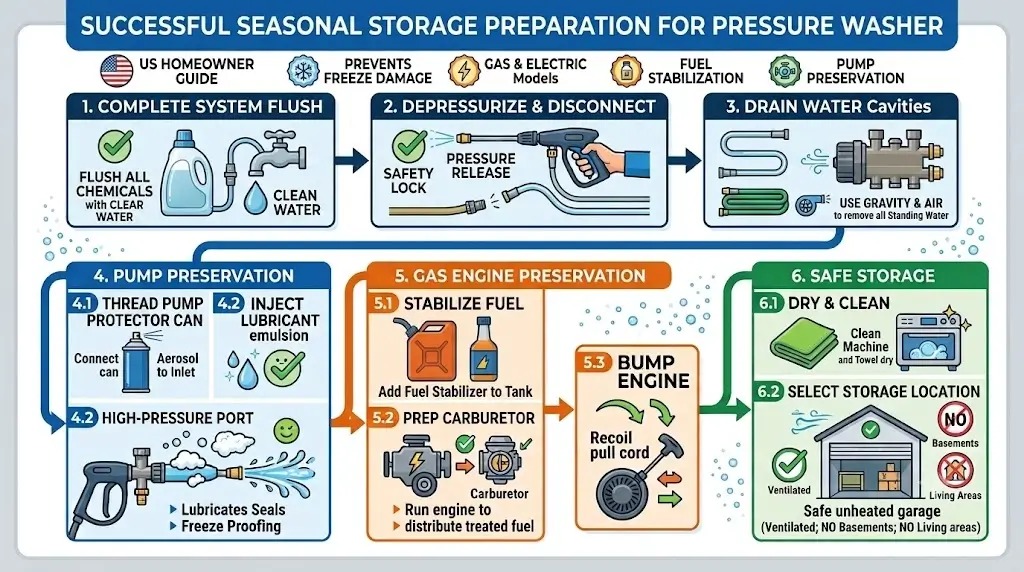
Winterizing is essential maintenance for anyone storing equipment in sub-freezing climates. Follow our complete step-by-step instructions in how to winterize a pressure washer to safeguard check-valves and protect unloader bodies using non-toxic aerosol pump savers.
Pressure Washer Maintenance Schedule for Occasional Homeowners
| Operational Stage | Homeowner Preventative Maintenance Tasks |
|---|---|
| Prior to Every Cleaning Session | Inspect supply water flow; check inlet screen for grit; visually scan high-pressure hose. |
| Following Completion of Job | Flush detergent lines; depressurize spray gun; drain high-pressure line and wand. |
| Pre-Winter Seasonal Storage | Inject pump protector fluid; stabilize gasoline or drain carburetor; store above freezing. |
| Annual Spring Wake-Up | Inspect engine oil level; install clean fuel; flush pump lines before firing ignition. |
Pressure Washer Maintenance Schedule for Frequent Users & Pros
| Frequency Target | Commercial Maintenance Routine |
|---|---|
| Daily (Every Job Session) | Inspect high-pressure lines for friction wear; examine quick-connect O-rings; check engine oil. |
| Weekly (Every 15–20 Hours) | Extract and clear inlet filter screens; clean engine cooling fins; check triplex pump sight glass. |
| Monthly (Every 50 Hours) | Change 4-stroke engine oil; inspect spark plug electrodes; clean foam air pre-cleaners. |
| Bi-Annually (Every 100 Hours) | Drain/replace triplex pump crankcase lubricant; install new spark plug and fuel filter. |
| Annually (Off-Season) | Replace high-pressure pump water packings; reseat unloader valve internal O-rings. |
Troubleshooting Operational Symptoms
| Observed Operational Symptom | Most Common Root Cause | First Corrective Action |
|---|---|---|
| Severe System Pressure Drop | Obstructed nozzle orifice or clogged inlet screen | Clear spray nozzle with wire tool; clean water inlet strainer. |
| Surging Water Delivery | Air drawn into inlet; insufficient supply GPM | Tighten garden hose fittings; confirm water source exceeds pump output. |
| Engine Stalls Under Pressure | Unloader valve seized or carburetor jet partially clogged | Lubricate/adjust unloader valve; clean carburetor main jet. |
| Water Leaking From Pump Head | Manifold freeze crack or ruptured plunger packings | Inspect manifold casting for cracks; replace high-pressure packings. |
| Milky Pump Oil in Sight Glass | Worn low-pressure water seals allowing water into crankcase | Drain oil immediately; replace low-pressure water seals and oil seals. |
DIY Maintenance vs. Professional Service Boundaries
Tasks Suitable for Homeowners
- Cleaning water inlet strainers and unclogging spray tips.
- Changing small-engine motor oil and inspecting spark plugs.
- Replacing air filters and conditioning quick-connect O-rings.
- Injecting pump protector fluids and draining water lines.
Tasks Requiring Professional Service
- Machining or replacing scored ceramic pump plungers.
- Diagnosing and setting internal unloader valve bypass pressures.
- Electric motor capacitor replacement and internal switch wiring.
- Engine cylinder head decarbonization and valve lash adjustment.
Maintenance Mistakes That Shorten Pressure Washer Life
- Running the Pump Dry: Operating without an active water supply destroys Teflon packings and scores ceramic pistons within 30 seconds.
- Idling in Bypass Mode: Leaving the machine running with the spray gun trigger closed overheats water inside the pump head.
- Neglecting Winterization: Skipping pump saver fluid allows trapped water to freeze, expand, and crack brass pump manifolds.
- Filling Pumps with Motor Oil: Using automotive detergent oil in non-detergent pump crankcases leads to oil foaming and bearing failure.
- Using Damaged Hoses: Neglecting hose blisters or kinks risks explosive line failure under dynamic working pressure.
Pressure Washer Maintenance Log
| Service Date | Hour Meter | Maintenance Protocol Executed | Fluid / Replacement Parts Used | Technician Signature |
|---|---|---|---|---|
| ___ / ___ / 2026 | ________ | Break-in Engine Oil Change | SAE 10W-30 (API-SJ) | ________________ |
| ___ / ___ / 2026 | ________ | Triplex Pump Fluid Service | SAE 30 Non-Detergent Pump Oil | ________________ |
| ___ / ___ / 2026 | ________ | Seasonal Winterization Purge | Aerosol Pump Saver & Fuel Stabilizer | ________________ |
FAQ: Pressure Washer Maintenance Schedule
How often should I service a pressure washer?
Perform basic pre-use inspections and post-use depressurization with every cleaning session. Gas models require engine oil changes every 50 hours and air filter servicing every 25–50 hours. Electric models require pump seal inspections and electrical checks every 50 operating hours.
How often should I change pressure washer oil?
Change gasoline engine oil after the initial 5-hour break-in period, then every 50 operating hours or annually. For serviceable triplex pumps, perform the first pump oil change at 50 hours, followed by changes every 100 operating hours.
Do electric pressure washers need oil changes?
Electric pressure washer motors use sealed bearings and require no engine oil. Most consumer electric washers use sealed, maintenance-free axial wobble pumps that do not require oil changes. Commercial electric units with triplex pumps require routine pump oil changes.
Does a pressure washer pump need oil?
Professional triplex plunger pumps require dedicated non-detergent crankcase oil. In contrast, residential axial-cam pumps are factory-sealed with permanent synthetic grease and cannot be refilled by the user.
How often should I clean the pressure washer inlet filter?
Inspect and rinse the stainless steel water inlet strainer before every wash session. Silt or debris in the supply line can starve the pump, leading to cavitation damage.
Can I leave water in my pressure washer?
Avoid leaving water in the pump between cleaning sessions. Trapped water causes mineral scaling, oxidizes internal check valves, and can freeze and crack the brass manifold during cold weather.
How do I maintain a pressure washer in winter?
Flush all detergents, drain residual line water, and inject pressurized aerosol pump saver through the garden hose inlet until foam exits the high-pressure port. For gas units, treat fuel with stabilizer and run the carburetor dry.
How long can a pressure washer sit unused?
Without fuel stabilizer, modern ethanol gasoline can degrade in 30 days, gumming up carburetor jets. An untreated pump left with standing water can suffer seal dry rot and mineral corrosion within 60 to 90 days.
Why does my pressure washer lose pressure over time?
Common causes include a partially clogged spray nozzle orifice, a dirty water inlet screen, insufficient water supply (GPM), worn high-pressure pump packings, or an unloader valve stuck in bypass mode.
Should I use an hour meter on a pressure washer?
Yes. Small vibration-activated digital hour meters help track maintenance intervals accurately, ensuring you change engine and pump fluids based on actual runtime rather than guesswork.
Final Takeaway: Follow Operating Hours, Not Calendar Guesswork
Dependable pressure washer maintenance comes down to four core habits: check incoming water volume to protect against cavitation, change small-engine oil every 50 hours, bleed line backpressure upon shutdown, and inject pump protector before winter downtime.
Verify water supply before every trigger pull, track engine service by run hours, and inject pump protector before freezing temperatures arrive.
