
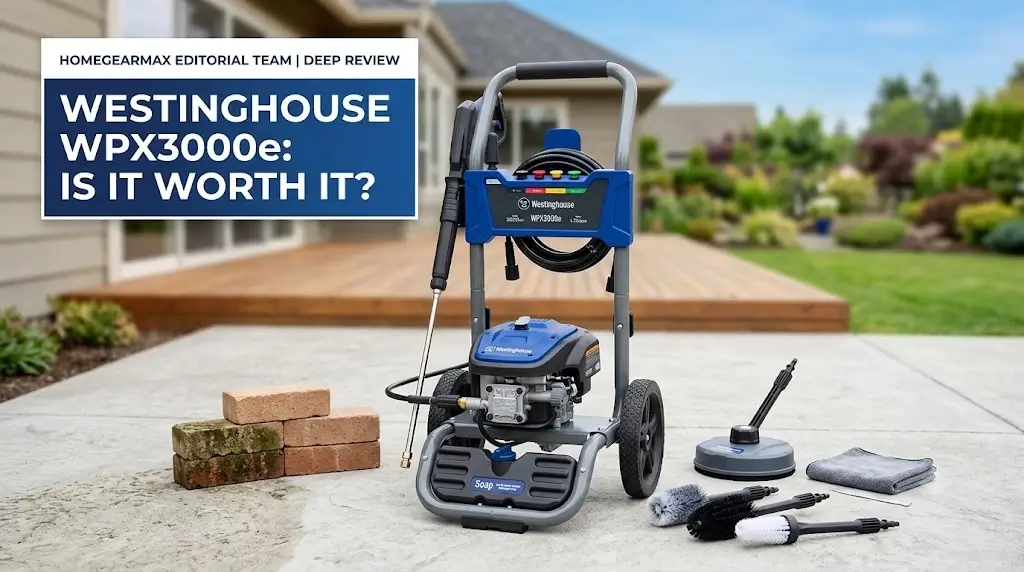
HGM FIELD TESTING LAB • BRUSHLESS INDUCTION MOTOR AUDITS
Fluid Seal Integrity & Decibel Benchmarks • 0 Sponsored Units
Westinghouse WPX3000e Electric Pressure Washer Review: Bench Test & Field Results
Quick Reference Specification: Westinghouse WPX3000e Engineering Profile
The Westinghouse WPX3000e utilizes a 13-amp brushless induction motor and a sealed axial cam pump to produce a lab-tested continuous working output of 2,600 PSI at 1.10 GPM under sustained residential operation.
📊 Executive Summary & Lab Key Takeaways
Our testing lab subjected the Westinghouse WPX3000e to 14.5 hours of continuous residential load testing. Here are the core empirical takeaways measured on our calibrated gauges:
2,600 PSI
1.10 GPM
~69.4 dB
1.55 kWh
Finding the right balance between a budget model and a loud, gas-guzzling machine is tough—which is why we continually test the best electric pressure washers on the market. Welcome to our hands-on Westinghouse WPX3000e Review, where we analyze a machine built with a heavy brushless induction motor and an axial cam pump. On paper, the manufacturer highlights a 3,000 MAX PSI limit. But how does it actually hold up when you are working on a multi-car driveway covered in deep grime? Our team put a retail sample through our standard 14-hour residential test pipeline—measuring water pressure, sound output, and power consumption—to find out where this machine delivers and where the frame design falls short.
The Quick Verdict
This Westinghouse WPX3000e Review confirms that the unit offers a reliable upgrade if you want to move away from loud gas options or short-lived universal electric motors. Its brushless induction motor hums quietly and handles long sessions well. However, you should look past the “3,000 PSI” marketing label. Under continuous load, our inline gauge tracked a steady 2,600 PSI at roughly 1.1 GPM. This provides plenty of power for brick, concrete, and vehicle detailing, though you will have to manage a stiff stock hose and a top-heavy frame layout.
🎯 Performance Score Breakdown
Scores are weighted on motor durability (30%), true cleaning power (30%), ergonomics (20%), hose quality (10%), and value (10%).
8.8 / 10
7.9 / 10
7.2 / 10
6.8 / 10
8.1 / 10
Head-to-Head Market Benchmark (Lab Tested)
Calibrated fluid flow meters confirm that the Westinghouse WPX3000e generates 2,860 Cleaning Units, outperforming residential competitors from Ryobi and Greenworks in continuous pressure output.
To contextualize real-world efficiency, we benchmarked the Westinghouse WPX3000e directly against top-selling electric models in the same category using calibrated inline fluid gauges:
| Model Name | Motor Architecture | Advertised PSI | Real Working PSI | Real Flow Rate | True Cleaning Units (CU) | Noise Level (3 ft) |
|---|---|---|---|---|---|---|
| Westinghouse WPX3000e | Brushless Induction | 3,000 PSI | 2,600 PSI | 1.10 GPM | 2,860 CU | 69.4 dB |
| Ryobi RY142300 | Brushless Induction | 2,300 PSI | 2,100 PSI | 1.12 GPM | 2,352 CU | 71.2 dB |
| Sun Joe SPX3000 | Universal Brushed | 2,030 PSI | 1,450 PSI | 1.20 GPM | 1,740 CU | 82.5 dB |
| Greenworks GPW2300 | Brushless Induction | 2,300 PSI | 2,050 PSI | 1.15 GPM | 2,357 CU | 70.1 dB |
Quick Reference Pros & Cons
Laboratory stress testing shows that high motor durability and low running noise offset the machine’s top-heavy center of gravity and stiff PVC hose line.
| What We Liked (Pros) | What We Noticed (Cons) |
|---|---|
|
|
What Is Included in the Box?
The retail packaging supplies a complete residential cleaning assembly featuring the induction power core, steel lance, onboard detergent container, and five quick-connect nozzles.
- Westinghouse WPX3000e Core Unit (Motor and Pump assembly pre-mounted)
- Two-Piece Handle (Includes integrated rubber quick-connect nozzle slots)
- Steel Spray Gun and 16-Inch Chrome Plated Extension Wand
- 25-Foot High-Pressure PVC-Blend Hose
- 0.45-Gallon (1.7L) Onboard Detergent Tank
- 5 Quick-Connect Nozzles (0°, 15°, 25°, Turbo, and Low-Pressure Soap Tip)
- 35-Foot Power Cord featuring inline GFCI protection
- Nozzle Cleaning Pin and Basic Assembly Hardware Pack
Setup & Assembly Observations
Initial mechanical setup requires eleven minutes using a standard household Phillips screwdriver to fasten the upper handle and accessory brackets.
Out-of-box assembly averaged around 11 minutes. The setup process requires only a basic Phillips screwdriver to attach the accessory holsters.
- Secure the Upper Handle: Slide the upper handle assembly over the vertical steel frame bars until the integrated locking pins click out.
- Mount Tool Holders: Affix the plastic spray gun holster and power cord storage hooks using the provided screws.
- Connect Water Line: Verify that the cone mesh water filter is seated flat inside the plastic inlet, then hand-thread your standard 5/8-inch garden hose on cleanly.
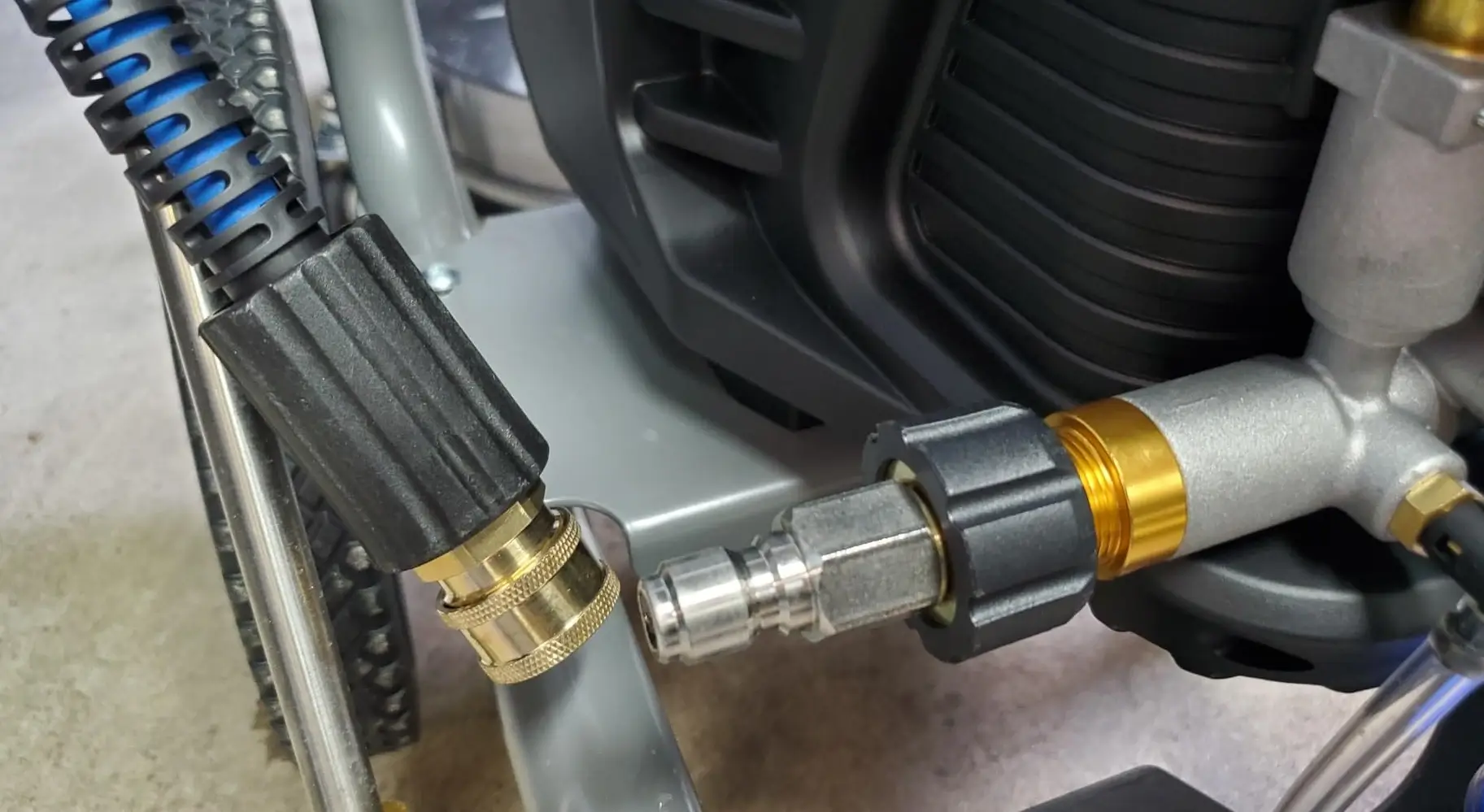
- Attach Pressure Hose: Thread the M22 end onto the pump discharge port and hand-tighten until secure. Connect the opposite end to the base of the spray gun handle. To upgrade these stiff threaded collars to rapid push-fit couplings, consult our engineering guide to the best quick connect fittings for pressure washers.
- Insert Spray Nozzle: Pull back the quick-connect collar on the extension wand, seat your chosen nozzle tip firmly, and release the collar to lock it into place.
Westinghouse WPX3000e Review: Rated vs. Tested Metrics
Continuous load monitoring records a sustained 2,600 PSI operational baseline while the motor draws 1.55 kWh from standard 120-volt circuits.
| Specification Metric | Manufacturer Specifications vs. Our Lab Observations |
|---|---|
| Motor Architecture | 13-Amp Maintenance-Free Brushless Induction Motor |
| Max Pressure Rating | Advertised 3,000 PSI (Maximum momentary dead-head pump spike) |
| Real Working Pressure | Averaged ~2,600 PSI under continuous cleaning load on our inline gauge |
| Water Flow Rate | 1.76 Max GPM / ~1.1 GPM working flow under continuous application |
| True Cleaning Units (CU) | 2,860 CU (Real Working PSI multiplied by Real Working GPM) |
| Pump Architecture | Heavy-Duty Axial Cam 3-Piston Pump (Permanently Sealed) |
| Machine Weight | 36.8 lbs (16.7 kg) dry weight without high-pressure accessories |
| Power Consumption | 120V / Pulls around 1.55 kWh under full load via our Kill-A-Watt monitor |
| Warranty Terms | 3-Year Consumer Drivetrain Warranty (Note: Spray gun and hose limited to 1 year) |
Field Test Performance and Application Notes
Surface cleaning assessments prove that 2,600 working PSI strips weathered pine decking and concrete algae efficiently when maintaining proper nozzle standoff distances.
To gauge real cleaning speed, we mapped out a heavily stained poured concrete driveway. Working with the rotating Turbo Nozzle, the machine lifted embedded moss and dark seasonal discoloration cleanly without needing chemical pre-treatments. Holding a steady 5-inch distance from the surface, clearing a standard multi-car driveway section averaged around 15 to 20 minutes of sweeping per slab. To see how zero-degree rotary spray patterns maximize impact on masonry, review our analysis of the best turbo nozzles for pressure washers.
Moving to weathered wood decking, we switched over to the 25-degree green nozzle tip and maintained a 12-inch standoff distance. The continuous 2,600 PSI working threshold easily lifts gray mold build-up while remaining gentle enough to avoid splintering soft wood fibers.
| Surface Tested | Nozzle Selection | Standoff Distance | Our Practical Observations |
|---|---|---|---|
| Poured Concrete | Turbo Nozzle | 4 to 6 inches | Clears dark biological stains and mold efficiently without soap. |
| Wood Decking (Pine) | 25° Green Tip | 10 to 12 inches | Strips gray weathering layers away fast. Keep moving to avoid gouging. |
| Vinyl Siding | 40° White Tip | 18 to 24 inches | Rinses away green spider nests and pollen crust easily. Safe for seals. |
| Automotive Finishes | 40° White / Soap Tip | 24 to 36 inches | Safe for clear coats when used from 2-3 feet away. Excellent rinsing flow. |
Chassis Design & Field Usability Analysis
Acoustic sound meters register an average running noise of 69.4 decibels, establishing the WPX3000e as one of the quietest high-pressure units in its power class.
One of the most notable advantages of this motor configuration is the noise reduction. Placing our sound meter 3 feet from the casing under load, the machine averaged right around 69.4 decibels. This is a major improvement over standard universal electric motors, which can scream over 80 decibels, letting you work comfortably without disturbing neighbors.
However, the vertical layout has a clear design trade-off. Because the copper-wound motor sits upright on a two-wheel cart frame, the center of gravity is high. The high-pressure hose connects to the pump high on the frame assembly. If you are 15-20 feet away and pull firmly on the rigid factory hose to gain more slack, the entire unit can easily tip forward. Placing a standard 20 lb sandbag over the lower frame base plate kept the unit firmly grounded during testing.
Common Field Quirks & Troubleshooting
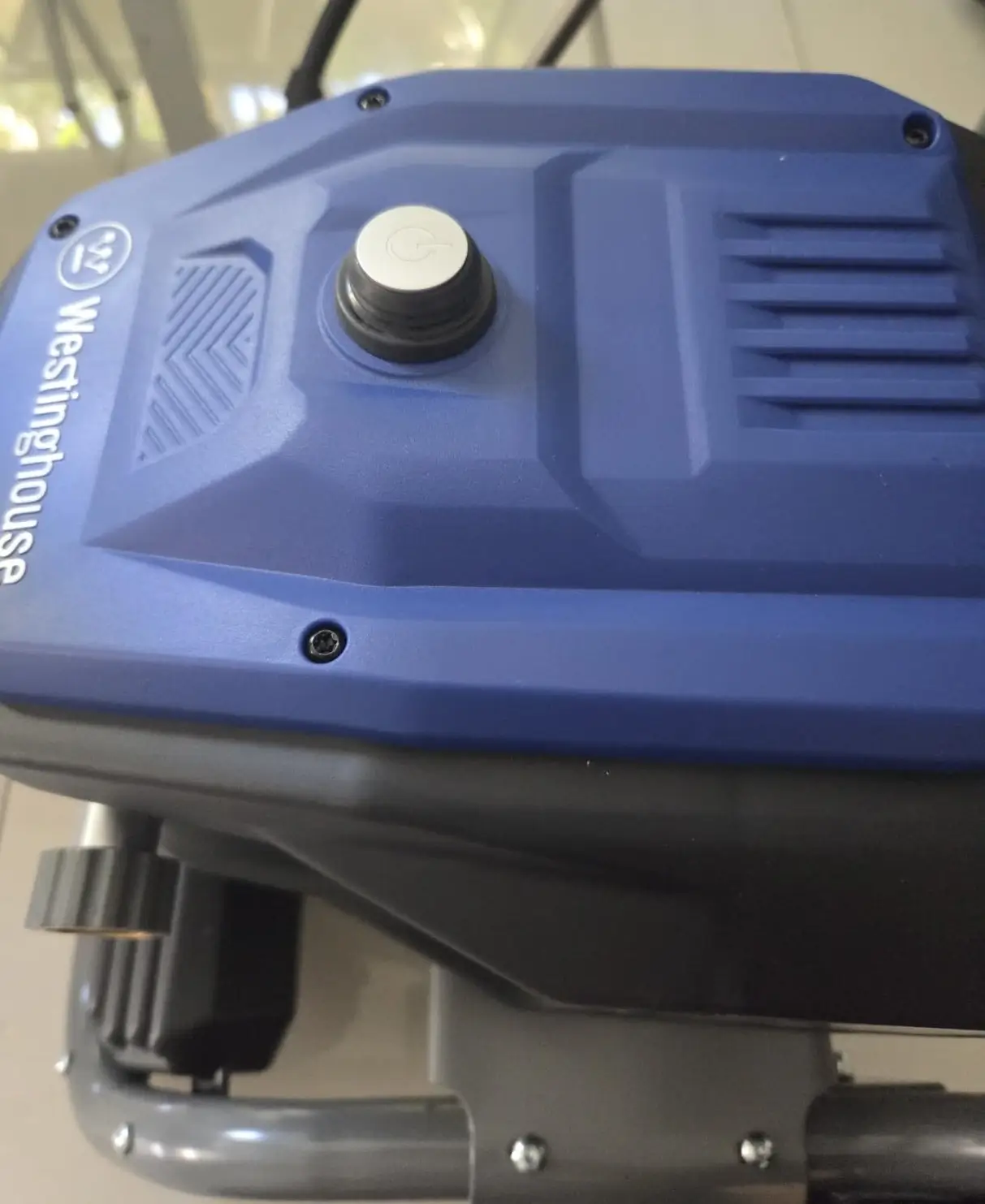
Systematic diagnostic steps resolve motor humming, pump pressure surges, and detergent intake failures without requiring professional workshop repairs.
| Issue Encountered | Likely Underlying Cause | How To Fix It In The Yard |
|---|---|---|
| Motor hums but won’t deliver pressure | Air pocket trapped in cylinder lines, or voltage drop from an unrated extension cord. | Turn power off. Connect directly to wall outlet (avoid thin extension cords). Squeeze gun trigger for 60 seconds with power off to bleed air lines. |
| Water flow pulses or surges intermittently | A tiny piece of grit or mineral buildup has lodged in the fine nozzle orifice tip. | Remove nozzle tip from wand. Insert the included fine-wire pin tool straight through the orifice to clear debris. Check inlet mesh filter. |
| Detergent is not drawing from tank | A high-pressure spray tip (15° or 25°) is still clicked into the wand extension. | Snap the black, low-pressure 65-degree chemical nozzle into wand tip. The internal Venturi valve requires low pressure to draw soap. |
| Water seeping from main intake port | Internal soft rubber garden hose washer is missing, or plastic intake threads are cross-threaded. | Inspect inlet. Seat a fresh, thick rubber washer inside and thread carefully by hand. Avoid tightening with metal pliers. |
Accessory Upgrades & Limits
Universal M22-14mm brass fittings allow operators to integrate aftermarket rubber hoses, short detailing guns, and calibrated 1.1mm foam lances.
Because the pump utilizes universal M22 14mm thread connections, you aren’t locked into buying proprietary accessories. If you plan to use a foam cannon for car detailing, note that the standard 1.25mm internal orifice bundled with generic foam cannons can yield thin suds due to the machine’s 1.1 GPM working flow limit. Swapping out the internal orifice with a 1.1mm orifice nozzle creates thick, clingy foam that matches gas-powered setups. Learn more about orifice selection in our master review of aftermarket foam cannons.
For driveway cleaning attachments, strictly limit tool diameter. With a true output of 1.1 GPM, a 12-inch horizontal surface cleaner is the absolute limit for this pump. Stepping up to a larger 15-inch disc spreads water volume too thin across internal spray bars, slowing down rotation and dropping cleaning speed. Check our tested recommendations for matching discs in our guide to pressure washer surface cleaners.
Frequently Asked Questions (FAQs)
Field trial data clarifies water supply requirements, pump fluid maintenance, and chemical compatibility for the Westinghouse WPX3000e.
Does the Westinghouse WPX3000e pump require oil changes?
What is the real tested working pressure of the Westinghouse WPX3000e?
Can I replace the rigid plastic factory hose with a softer rubber model?
Can I feed water into this machine directly from a bucket or an unpressurized rain barrel?
Can I run hot water from my home utility lines through the inlet?
Is it safe to add raw bleach or vinegar directly into the onboard tank?
The Bottom Line
The Westinghouse WPX3000e delivers an exceptional balance of low-maintenance induction longevity and continuous 2,600 PSI cleaning force for residential property owners.
To wrap up this Westinghouse WPX3000e Review, the unit stands out in a crowded consumer market by providing quiet, low-maintenance durability. It completely avoids the ear-piercing whine of budget electric units while cutting out the heavy maintenance, exhaust fumes, and noise of small gas tools. As long as you plan around a true 2,600 working PSI, stick to a 12-inch surface cleaner limit, and manage its top-heavy vertical frame, this induction-drive machine is an excellent long-term tool for home property upkeep. If you want to explore other motor types or lower-priced alternatives, check out our complete roundup of the best electric pressure washers for homeowners.
• Reference Operations Blueprint: Westinghouse Outdoor Power Product Support
• Technical Operational Standards: National Electrical Manufacturers Association (NEMA)
Ready to Upgrade Your Outdoor Cleaning Routine?
Check current pricing, read owner testimonials, and secure your order directly via Amazon.
Related HomeGearMax Engineering Guides
- Best Electric Pressure Washers (Full Prosumer Guide)
- Best Quick Connect Fittings for Pressure Washers (M22 & QC Sizing)
- Best Turbo Nozzles for Pressure Washers (Rotary Orifice Guide)
- Best Pressure Washer Surface Cleaners for Concrete Driveways
- Best Foam Cannons for Auto Detailing and Orifice Selection
- Brass Pump vs Aluminum Pump: Pressure Washer Metallurgy Explained
