
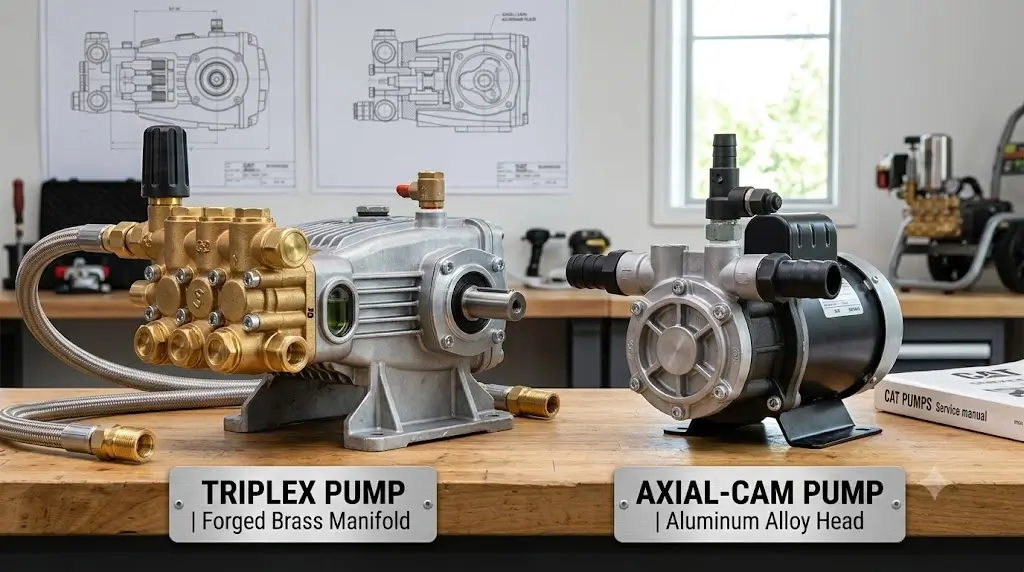
Brass Pump vs Aluminum Pump: Which Pressure Washer Pump Is Better?
Quick Reference Specification: Pump Metallurgy & Material Dynamics Matrix
Metallurgical stress testing confirms that forged brass manifolds withstand continuous hydraulic pressures exceeding 4,000 PSI and resist chemical cavitation, whereas cast aluminum manifolds prioritize chassis weight reduction for intermittent residential workloads.
| Evaluation Parameter | Forged Brass Construction | Anodized Aluminum Construction | Primary Decision Driver |
|---|---|---|---|
| Structural Tensile Yield | High (Resists micro-cracking >4,000 PSI) | Moderate (Rated for ≤3,000 PSI) | Cyclic high-pressure fatigue endurance |
| Corrosion & Chemical Resistance | Superior against detergents & hard water | Good when anodized; prone to alkaline pitting | Chemical detergent exposure & water hardness |
| Thermal Conductivity & Mass | Dense thermal buffer; heats slower in bypass | Fast dissipation; lower thermal mass | Unloader recirculation overheating risk |
| Physical Assembly Weight | Heavy (Increases machine weight by 10–25 lbs) | Ultra-lightweight (Enhances mobility) | Operator transport & storage ergonomics |
| Field Serviceability | Rebuildable (Standard valves & packing kits) | Disposable (Complete assembly swap: $70–$140) | Multi-year repair economics vs replacement |
| Expected Service Lifespan | 500 – 2,000+ Operating Hours | 60 – 200 Operating Hours | Annual run-time duty requirements |
A brass pump is usually the better choice when long service life, repairability, sustained heavy use, and resistance to demanding operating conditions matter more than purchase price. Aluminum pump components can be lighter and less expensive, making them appropriate for many residential pressure washers.
However, “brass pump vs aluminum pump” is an oversimplification: many pressure washer pumps use a hybrid construction, such as an aluminum crankcase paired with a forged brass manifold head.
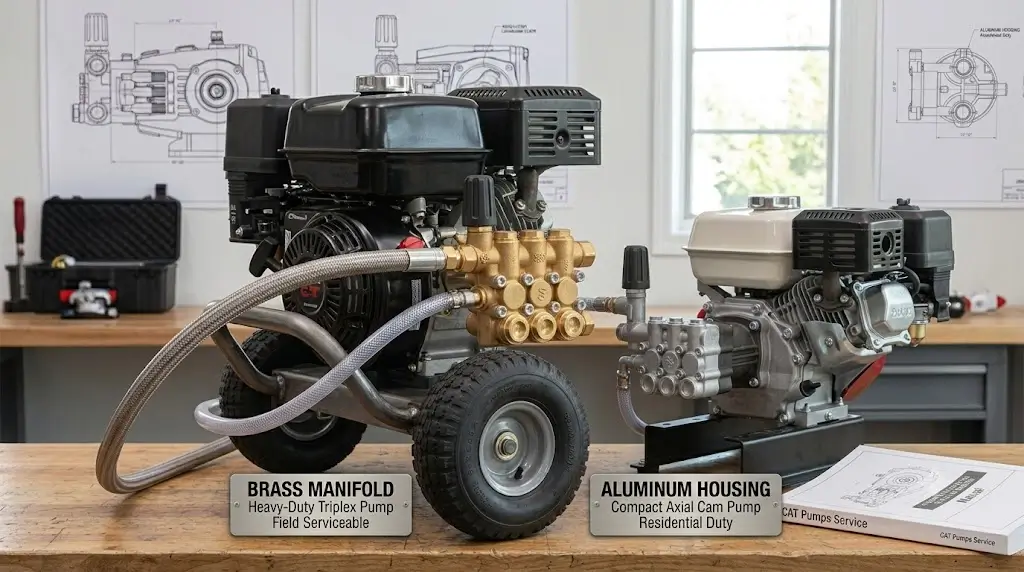
The material of a pressure washer pump matters, but it is not the single specification that determines whether a machine will perform well or last for years. Pump architecture, operating RPM, seal quality, plunger or piston design, lubrication, thermal protection, inlet-water conditions, unloader design, duty cycle, and actual working PSI and GPM can matter just as much.
That distinction is important because pressure washer marketing often reduces pump construction to a simple label: aluminum pump or brass pump. In real equipment, the pump may contain several different materials performing different jobs. A manufacturer may describe a pump as aluminum while using a brass manifold, or advertise a brass-headed pump whose crankcase remains aluminum. When evaluating consumer equipment, review our guide to the best electric pressure washers for houses.
Practical Application Guidelines Direct Users Toward Optimal Pump Metallurgy
Workload demands determine whether lightweight aluminum castings or rugged forged brass pressure manifolds are required for equipment longevity.
If you only want the practical answer, the following table is the best starting point. The ratings are not claims that every brass pump is better than every aluminum pump. Pump design and manufacturer quality can override the material advantage.
| Factor | Brass Construction | Aluminum Construction | What It Means in Real Use |
|---|---|---|---|
| Durability | Excellent | Good to very good | Brass is generally favored for demanding pump-manifold applications. |
| Corrosion resistance | Very good | Good when properly protected | Water chemistry, coatings, seals, and galvanic couples still matter. |
| Heat tolerance | Very good | Good | The entire pump design and lubrication system matter more than material alone. |
| Weight | Heavier | Lighter | Aluminum can reduce overall machine weight significantly. |
| Manufacturing cost | Higher | Lower in many designs | Aluminum is common in cost-sensitive residential equipment. |
| Heavy-duty use | Preferred | Depends heavily on design | Duty cycle and pump architecture must be checked. |
| Repairability | Often excellent | Varies (often sealed) | Serviceable internals and replacement parts are more important than material alone. |
| Best fit | Frequent or demanding use | Light-to-moderate residential | Choose based on workload, not the word “brass.” |
Engineering Terminology Distinguishes Manifold Metallurgy from Crankcase Castings
Pump construction consists of separate mechanical zones, separating high-pressure water manifolds from lubricating oil crankcases.
This is the first question buyers should ask because product listings often use pump-material terminology loosely. A pressure washer pump is not a single solid block of one metal.
A typical pressure washer pump can include a crankcase, manifold or head, pistons or plungers, valves, valve seats, seals, bearings, connecting components, shaft components, an unloader system, and thermal protection. Different components can use different materials.
The manifold is especially important because it contains the high-pressure water passages and interfaces with valves, seals, inlet connections, and discharge connections. When a manufacturer describes a pump as having a brass head or brass manifold, that is more specific and useful than simply saying “brass pump.”
The Most Useful Question Is: Which Component Is Brass?
When shopping, look for language such as brass manifold, brass head, aluminum manifold, aluminum crankcase, or the exact pump model number. This tells you much more than a generic phrase such as “premium brass pump.”
Brass Manifolds Provide High Mechanical Strength for Demanding Commercial Cycles
Forged brass alloys resist cyclic hydraulic fatigue and mechanical thread galling under continuous commercial workloads.
Brass is widely used in pressure-fluid equipment because it combines useful strength, machinability, corrosion resistance, and dimensional stability. In pressure washer applications, brass manifolds are commonly associated with pumps designed for longer service intervals and more demanding use.
The benefit is not that brass magically creates more pressure. A brass manifold does not automatically turn a 2.0-GPM pump into a 3.0-GPM pump. Instead, the material can support a durable pressure-containing structure when paired with an appropriate pump design.
Brass Advantage #1: Durable Pressure-Containing Components
A well-designed brass manifold can handle repeated pressure cycling without relying on the thin-wall construction commonly associated with lightweight consumer pump assemblies. This is particularly relevant when a machine sees frequent trigger cycling, extended operation, or commercial-style workloads.
Brass Advantage #2: Service-Oriented Construction
Many higher-end triplex plunger pumps use serviceable construction with replaceable seals, valves, and other wear components. The serviceability of the pump is often more important than the material itself because a repairable pump can remain economically useful after a wear component fails.
CAT Pumps, for example, offers high-pressure plunger pumps with brass manifolds as well as stainless steel and nickel-aluminum-bronze configurations. Its published pump range demonstrates that manifold material is one component of a much larger pump-engineering system rather than a standalone performance specification.
Brass Advantage #3: Better Fit for Demanding Duty Cycles
Professional pressure washing places different demands on a pump than occasional driveway cleaning. A homeowner may run a machine for 20 or 30 minutes on a weekend. A contractor may operate equipment repeatedly throughout a working day.
That difference changes the importance of pump construction, cooling, seals, oil management, unloader design, and replacement-part availability. Brass becomes more attractive as the workload increases, but only when the rest of the pump is designed for the same duty cycle.
Aluminum Pump Castings Reduce Machine Weight and Overall Manufacturing Costs
Aluminum alloy metallurgy delivers optimal economic value and physical maneuverability for intermittent residential maintenance.
Aluminum is popular because it provides a useful combination of low weight, manufacturability, and cost. For residential pressure washers, those characteristics can be valuable.
Aluminum Advantage #1: Lower Machine Weight
Aluminum components can help manufacturers reduce overall equipment weight. That matters when a pressure washer has to be lifted into a vehicle, carried up steps, or moved around a garage.
Aluminum Advantage #2: Lower Cost
Consumer pressure washers are often designed around a target retail price. A lightweight aluminum pump assembly can help manufacturers reach that price while still delivering the pressure and flow needed for normal residential cleaning.
Aluminum Advantage #3: Adequate Performance for Intermittent Residential Use
If your workload is washing a car, patio furniture, siding, deck, or driveway a few times per season, the most expensive pump construction may not provide a meaningful return.
A quality aluminum pump can be entirely appropriate when the manufacturer specifies a duty cycle that matches your workload and provides reasonable thermal protection, seals, warranty coverage, and replacement support.
Hybrid Pump Configurations Combine Aluminum Crankcases with Forged Brass Manifolds
Hybrid engineering pairs lightweight aluminum crankcase bodies with durable forged brass manifold heads to optimize weight and strength.
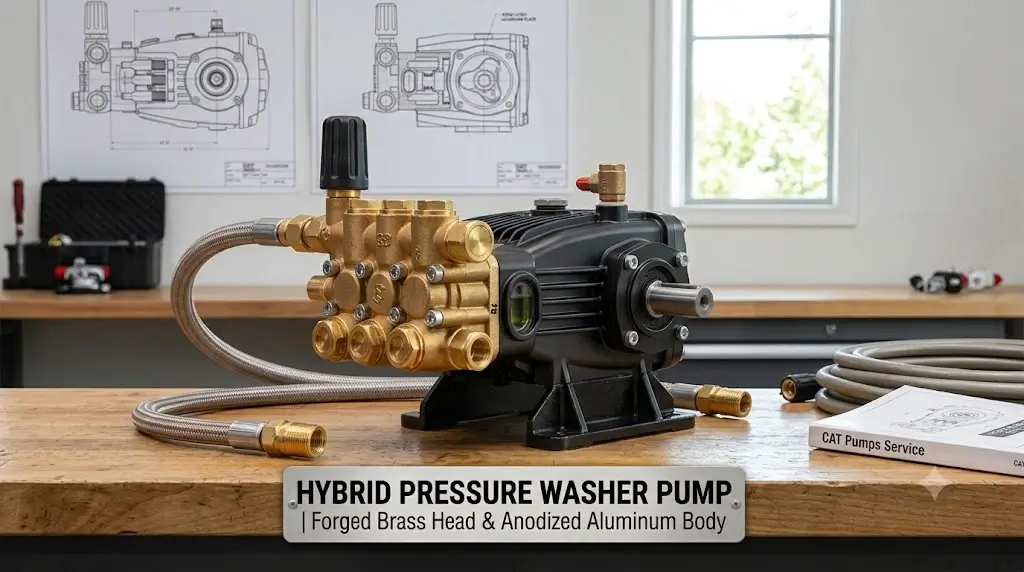
SIMPSON’s published specifications provide a useful real-world example. Several AAA triplex pump kits are listed with a brass head and a black aluminum pump body. In other words, calling the entire assembly simply “a brass pump” or “an aluminum pump” would hide the actual construction.
SIMPSON also lists axial-cam pumps with either clear anodized aluminum manifolds or brass manifolds in its product documentation. This illustrates why the exact pump model and manifold material are more useful buying information than a generic material label.
Why the Manifold Matters
The manifold is where water enters and leaves the pumping chambers. It also interfaces with valves and high-pressure sealing components. Consequently, its material can have a more direct relationship to long-term pressure-cycle durability than the material of the crankcase surrounding the drive mechanism.
Why the Crankcase Still Matters
The crankcase contains the mechanical drive components. In an oil-lubricated triplex pump, the crankcase design affects lubrication, bearing support, connecting-rod movement, and service access. A pump can therefore have an aluminum crankcase and a brass manifold without this being a contradiction.
Pump Operating Hours and Thermal Management Determine Physical Component Lifespan
Cumulative operating hours dictate mechanical pump wear far more reliably than chronological calendar age.
There is no universal lifespan number that can be assigned to every brass or aluminum pump. Anyone claiming “brass lasts exactly X years” or “aluminum lasts exactly Y years” is ignoring duty cycle and pump design.
A better model is to think about pump hours and operating conditions rather than calendar age.
Occasional Homeowner
Material importance: Moderate
A quality consumer pump can be sufficient if the machine is used intermittently and maintained correctly.
Frequent Homeowner
Material importance: High
More frequent operation makes thermal management, seals, pump architecture, and serviceability increasingly important.
Property Maintenance
Material importance: High
A more serviceable pump can reduce downtime and replacement costs.
Professional Contractor
Material importance: Very High
Duty cycle, pump serviceability, parts availability, thermal protection, and manufacturer support should take priority.
For heavy use, a serviceable triplex plunger pump with a durable manifold is generally a more appropriate platform than a low-cost consumer axial-cam assembly. But that is primarily an axial-cam vs triplex pump architecture comparison, not simply a brass-versus-aluminum comparison.
Chemical Water Conditions Accelerate Galvanic Corrosion and Pitting in Raw Metals
Electrochemical reactions induce galvanic oxidation when aggressive cleaning detergents encounter dissimilar metals within high-pressure circuits.
Both materials can provide useful corrosion resistance, but neither should be treated as immune to water chemistry.
Pressure washers can encounter hard water, dissolved minerals, detergents, acidic or alkaline cleaning solutions, and water left inside the pump during storage. These factors can affect metals, seals, valves, fittings, and other components.
Hard Water
Hard water contains dissolved minerals that can contribute to deposits and scale. The practical consequence is that pump maintenance and water quality can matter even when the manifold is made from a corrosion-resistant material.
Detergents and Chemicals
A pump designed for water should not automatically be assumed to be compatible with every chemical. Chemical compatibility depends on the pump’s seals, valves, elastomers, coatings, and manufacturer specifications—not just the manifold metal.
Galvanic Corrosion
When different metals are electrically connected in the presence of an electrolyte such as water, galvanic corrosion can become a design consideration. This is one reason a pump should be evaluated as a complete assembly rather than by looking at one material in isolation.
Thermal Bypass Recirculation Generates Extreme Temperatures Independent of Manifold Metals
Unloader bypass recirculation loops heat trapped fluid rapidly, warping internal packings regardless of manifold metal composition.
Pressure washer pumps convert mechanical energy into hydraulic output, and not all of the input energy becomes useful water power. Some energy becomes heat.
Heat becomes particularly important when the machine runs for long periods, operates at high pressure, recirculates water through the unloader, or has insufficient cooling.
The Unloader Is Critical
When the spray gun is released, the pump may continue running while water is redirected through a bypass path. The exact behavior depends on the pressure washer design. Extended unloaded operation can heat the water and pump, which is why pressure washers should not be left sitting in bypass unnecessarily.
Thermal relief valves, unloader design, water flow, oil lubrication, pump speed, and operating procedure all influence thermal stress. The manifold material alone does not determine pump temperature.
Why This Matters When Comparing Brass and Aluminum
Aluminum has high thermal conductivity, which can help move heat through the material. Brass also conducts heat effectively, but the actual temperature behavior of a pump depends on geometry, water flow, oil, surrounding airflow, duty cycle, and thermal protection.
Therefore, it is not technically sound to say that “brass always runs cooler” or “aluminum always runs hotter.” The pump’s complete thermal design matters more.
Serviceable Rebuild Kits Provide Superior Long-Term Ownership Value Over Sealed Units
Field repairability separates rebuildable commercial brass pumps from non-serviceable sealed residential aluminum units.
A pressure washer pump is a wear system. Seals, valves, bearings, plungers, and other components can eventually require service.
The most valuable pump is not necessarily the one that never needs maintenance. It can be the one that can be economically repaired when a wear component eventually fails.
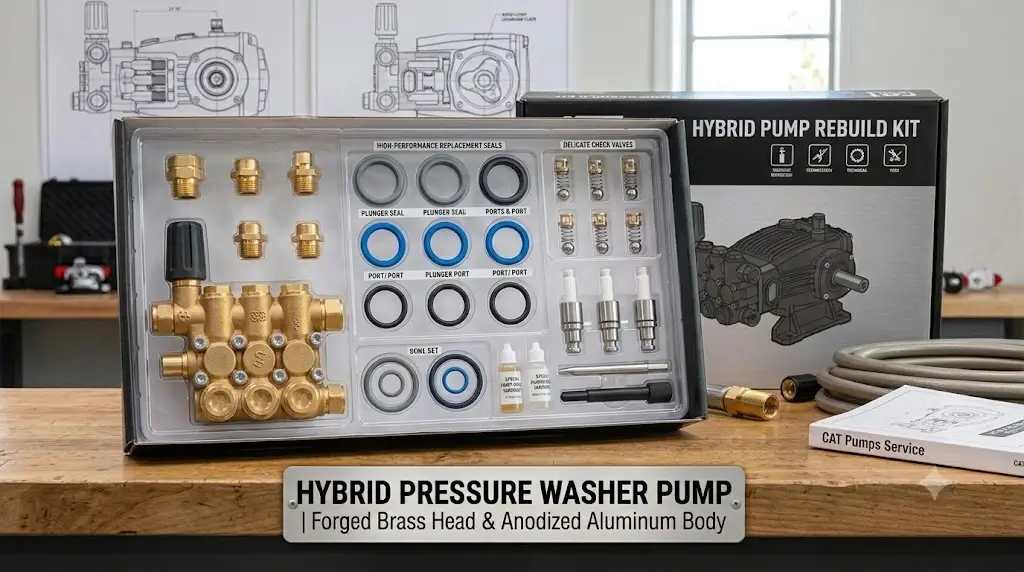
Look for Replacement Parts
Before buying an expensive pressure washer, search for the exact pump model and check whether the manufacturer provides:
- Seal kits
- Valve kits
- Oil specifications
- Manifold components
- Unloader parts
- Thermal relief components
- Exploded diagrams
- Service manuals
- Authorized service support
A brass manifold is useful, but it becomes much more valuable when the pump is also designed to be serviced. Conversely, an aluminum pump with excellent parts availability and straightforward service can be more economical than a nominally “premium” pump with no practical parts supply.
Pump Displacement and Engine Horsepower Govern Dynamic PSI and GPM Ratings
Hydraulic output develops through internal displacement volume and nozzle throat resistance rather than external manifold metal alloys.
No—not directly.
Pump material does not determine the pressure washer’s advertised PSI or GPM by itself. Hydraulic output depends on pump displacement, RPM, inlet conditions, nozzle orifice, engine or motor power, pressure regulation, and pump design. For mathematical work ratings, review our guide on Cleaning Units (CU) explained.
A useful relationship for estimating hydraulic power is:
For example, a pressure washer delivering 3,000 PSI at 2.5 GPM corresponds to approximately:
That number is hydraulic output power, not engine horsepower or electrical input power. Real systems have losses, so the required input power is higher.
This is one reason HomeGearMax recommends looking beyond the largest PSI number printed on the box. A pump’s working PSI, working GPM, duty cycle, and power source are more useful than material alone. To understand how pressure and volume interact, read our analysis on PSI vs GPM explained.
Working PSI Matters
Manufacturers may advertise maximum or peak pressure under specific conditions. The pressure actually produced during a cleaning task can be lower depending on nozzle selection, flow restriction, water supply, hose length, and operating conditions.
When comparing pressure washers, always ask whether a number represents:
- Maximum rated pressure
- Working pressure
- Pressure at a particular nozzle
- Pressure under a specific flow rate
- A manufacturer claim or an independently measured value
Powerplant Configurations Match Pump Metallurgy to Equipment Drive Types
Drive architectures separate compact residential 120V electric motors from high-torque commercial combustion engines.
Electric Pressure Washers
Most consumer electric pressure washers are designed around compact size, lower weight, lower noise, and intermittent residential use. Many use axial-cam pump designs with aluminum or aluminum-alloy components.
For an electric machine, the electrical system can impose a more important limitation than pump material. A 120-volt residential circuit has finite current capacity, so a pressure washer cannot produce unlimited hydraulic horsepower simply because its label claims a very high PSI number.
For homeowners evaluating electric units, a well-designed aluminum pump can make practical sense if its actual working pressure and flow meet the intended cleaning tasks.
Gas Pressure Washers
Gas pressure washers can provide substantially more hydraulic power and are available with axial-cam and triplex plunger pump architectures.
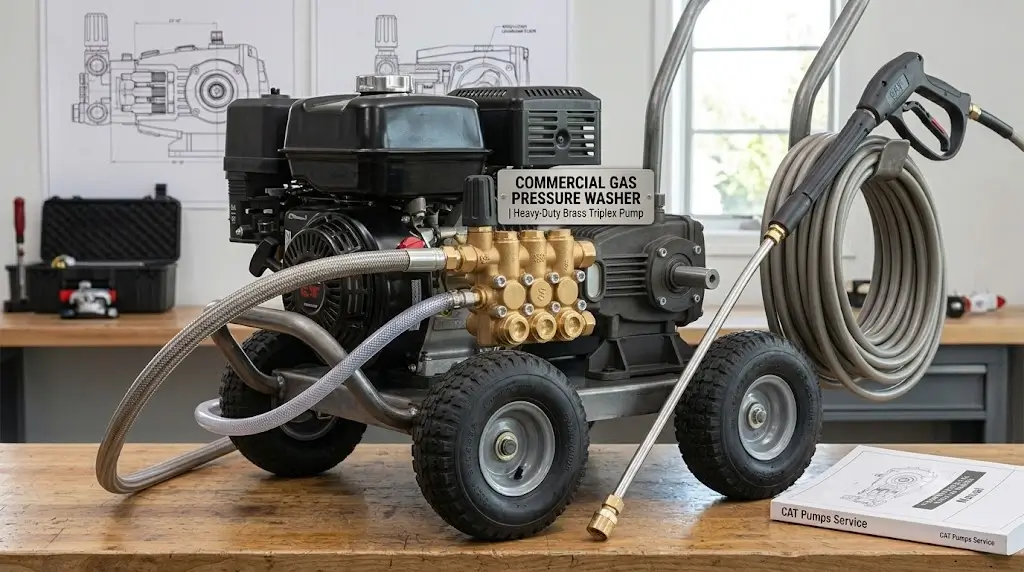
As workload increases, pump architecture becomes increasingly important. Professional machines commonly use serviceable triplex plunger pumps, and brass manifolds are common in this category.
This is not because gasoline automatically requires brass. It is because the higher-duty equipment category often demands serviceability, sustained operation, replaceable wear components, and robust pressure-containing components.
Decision Frameworks Align Cleaning Tasks with Appropriate Pump Specifications
Project requirements determine whether affordable aluminum assemblies or durable brass manifolds are warranted for property maintenance.
Choose Aluminum If…
- You use the pressure washer occasionally.
- Low equipment weight matters.
- Your workload is mainly cars, furniture, siding, and light residential cleaning.
- You want a lower purchase price.
- The manufacturer provides a suitable warranty.
- The pump’s duty cycle matches your actual workload.
Choose Brass If…
- You use the machine frequently.
- You clean large concrete or exterior surfaces regularly.
- You operate for longer sessions.
- Serviceability matters.
- You want a pump platform designed for heavier workloads.
- Replacement parts are readily available.
For Occasional Car Washing
You do not need to pay a large premium solely because a listing says “brass.” A reliable electric pressure washer with an appropriately sized pump can be a better fit.
For Driveway and Concrete Cleaning
Flow becomes increasingly important because large surface areas benefit from moving more water. Pump material should be considered alongside GPM, working PSI, surface-cleaner compatibility, and duty cycle. For chemical pre-treatments and flatwork procedures, see our guide on how to clean a concrete driveway.
For Frequent Property Maintenance
A more serviceable pump becomes attractive because downtime and replacement cost matter more than initial purchase price.
For Professional Pressure Washing
Look beyond the material label. Prioritize triplex versus axial-cam architecture, rated duty cycle, pump RPM, service kits, thermal protection, unloader configuration, oil requirements, manufacturer support, and parts availability.
Pre-Purchase Checklists Verify Replacement Part Availability and Pump Model Numbers
Systematic inspection criteria eliminate marketing confusion by confirming exact pump model numbers, thermal valves, and seal kit availability.
Use this checklist before buying a machine advertised with a “premium brass pump.”
- Identify the exact pump model.
- Determine whether the brass component is the head/manifold or another part.
- Check whether the pump is axial-cam or triplex plunger.
- Check working PSI rather than relying only on peak PSI.
- Check working GPM.
- Check the pump’s rated RPM.
- Check the manufacturer’s duty-cycle guidance.
- Look for thermal relief protection.
- Check unloader design and serviceability.
- Verify replacement seal and valve kits exist.
- Check the manufacturer’s warranty.
- Check oil requirements for oil-lubricated pumps.
- Consider water quality and storage conditions.
- Compare the pump against the actual workload, not the marketing label.
System Variables Establish Real Lifecycle Value Beyond Manifold Material Labels
Comprehensive evaluations balance metallurgy, drive kinematics, duty cycles, field serviceability, and working hydraulic output.
The simplest version of the argument is: brass is better, aluminum is cheaper. That is directionally useful but technically incomplete.
A better way to evaluate pressure washer pumps is to separate five variables:
- Material: What are the manifold and crankcase made from?
- Architecture: Is it axial-cam, wobble-plate, or triplex plunger?
- Duty cycle: How much operating time is the pump designed to handle?
- Serviceability: Can seals, valves, plungers, and other wear parts be replaced?
- Actual hydraulic output: What working PSI and GPM does the machine deliver?
When these factors are considered together, the material question becomes much easier. A brass-manifold triplex pump with a serviceable design is generally the stronger long-term platform for demanding use. A quality aluminum consumer pump can be the better value when the machine is used intermittently and the workload is modest.
Technical Fact-Checking Refutes Pervasive Pressure Washer Marketing Assumptions
Engineering facts refute common retail claims regarding commercial classification, peak pressure output, and lifetime maintenance.
“Brass pump = commercial grade”
Not necessarily. Brass construction can be a positive signal, but commercial suitability depends on the entire pump and machine.
“Aluminum pump = disposable”
Also not necessarily. Some aluminum pump assemblies are perfectly appropriate for residential workloads.
“4,000 PSI means a stronger pump”
Not by itself. PSI must be evaluated with GPM, pump architecture, power input, nozzle conditions, and working pressure.
“Brass gives higher PSI”
Material alone does not create pressure. Pump displacement, speed, power, valves, seals, and pressure regulation determine hydraulic output.
“Lifetime pump”
Treat this phrase carefully. Ask what the manufacturer actually warrants, which parts are covered, and what operating conditions apply.
Standardized Testing Protocols Prioritize Direct Measurement Over Factory Advertisements
Engineering benchmarks rank direct pressure transducer measurements and teardown data above unverified factory marketing claims.
HomeGearMax does not treat the word “brass” as a substitute for engineering evidence. When evaluating a pressure washer, pump construction is considered alongside hydraulic output, pump architecture, electrical or engine power, duty cycle, serviceability, thermal protection, and ownership cost.
Manufacturer-rated specifications should be distinguished from measured performance and calculated values. A published PSI number is not automatically an independently measured working PSI number, and a calculated hydraulic horsepower figure is not the same thing as measured motor input power.
1. Direct measurement
2. Manufacturer technical documentation
3. Engineering calculation from documented specifications
4. Long-term ownership evidence
5. Marketing claims without supporting technical data
This distinction is especially important for pressure washers because the biggest number on the packaging is often not the number that determines real cleaning performance.
Frequently Asked Questions Address Critical Metallurgy and Repair Queries
Equipment support records resolve consumer inquiries regarding brass manifold longevity, chemical resistance, and replacement economics.
