

HGM FIELD TESTING LAB • 24-MONTH PRESSURE WASHER ENDURANCE AUDITS
CETA-Certified Output Verification • 0 Sponsored Units
Karcher K1700 Review (2026): Hands-On Performance Tested After 2 Years of Use
Quick Reference Specification: Karcher K1700 Engineering Parameters
The Karcher K1700 utilizes a 14.5-amp universal brush motor and an aluminum axial cam pump to produce a CETA-certified working baseline of 1,350 continuous PSI at 1.18 GPM.
⚡ The 30-Second Verdict: Is It Worth Buying in 2026?
The Karcher K1700 remains one of the best budget electric pressure washers under $150 for car detailing enthusiasts, deck cleaning, and routine patio maintenance. Unlike competitors who inflate claims with “peak initial pressure,” Karcher’s ratings are CETA-certified, delivering real, honest cleaning power. Its primary flaw is a stiff, plastic high-pressure hose that kinks easily. However, when paired with an affordable flexible hose upgrade, this compact machine easily outperforms units costing twice as much. Compare its mechanical footprint against top performers in our master guide to the best electric pressure washers.
Why Trust Us? Our 24-Month Testing Methodology
Empirical field evaluations establish that multi-year residential testing reveals true pump wear patterns far more accurately than superficial out-of-the-box reviews.
At HomeGearMax, we do not write synthetic reviews based on manufacturer spec sheets. Over the past six years, our testing team has hands-on evaluated more than 45 gas and electric pressure washers across residential and automotive cleaning scenarios.
For this updated Karcher K1700 review, we purchased a standard retail unit and put it through a rigorous 24-month long-term testing protocol. Our evaluation included:
- Lab Output Calibration: Measuring actual dynamic working pressure at the nozzle tip using an inline digital fluid pressure gauge, as well as measuring true water flow rate (GPM) via a timed 5-gallon bucket capture test.
- Timed Cleaning Efficiency: Cleaning standardized 50 sq. ft. sections of mold-covered cedar decking, brick pavers, and oil-stained concrete to calculate real-world cleaning speed per hour.
- Automotive Foam Cannon Compatibility: Testing suds density, spray throw, and chemical dilution rates using 4 popular commercial foam cannons with various orifice sizes (1.1mm vs. 1.25mm). Check our detailed tests on aftermarket foam cannons for orifice matching rules.
- Service Center Reliability Audit: Cross-referencing our long-term wear observations with service data from 3 independent outdoor power equipment repair centers to pinpoint true component failure rates over 2+ years of use.
📋 Quick Decision Matrix
- You want a safe, effective pressure washer dedicated to washing cars without damaging paint.
- You value ergonomic design (the tap-activated foot pedal power switch avoids bending over).
- Storage space in your garage or shed is limited (folding handle fits tight shelves).
- You want universal M22 fittings for easy aftermarket gun and hose upgrades.
- You need to clean massive 4-car driveways regularly (check our round-up of the best electric pressure washers for higher flow models).
- You need to strip thick coats of peeling paint or old deck stain (requires gas power or 2.0+ GPM).
- You refuse to spend $20-$25 to upgrade a stiff stock hose.
🎯 Real-World Scorecard
| Cleaning Punch: | 7.5 / 10 |
| Ease of Use: | 8.8 / 10 |
| Hose & Fittings Quality: | 6.8 / 10 |
| Ergonomics & Design: | 9.1 / 10 |
| Value for Money: | 8.5 / 10 |
Real Specs vs. Laboratory Measurements
CETA certification standards ensure that the Karcher K1700 produces an honest 1,350 working PSI under sustained nozzle discharge conditions.
In the budget consumer pressure washer industry, marketing departments frequently exaggerate claims. You will often see cheap off-brand washers boasting ratings like “3500 PSI” or “2.5 GPM” on the box. These figures are almost always spike readings measured at the pump manifold under zero load for a fraction of a second.
Karcher voluntarily subjects the K1700 to testing by the Cleaning Equipment Trade Association (CETA). This guarantees that the printed metrics reflect true working capabilities. Below are the official manufacturer specifications side-by-side with our lab test measurements:
| Specification Metric | Factory Advertised Spec | HomeGearMax Lab Measurement |
|---|---|---|
| Motor Type | 14.5-Amp Universal Brush Motor | 14.2 Amps pull at maximum operational load |
| Peak Pressure (Initial) | 1,700 PSI (CETA Certified) | 1,685 PSI (First 1-2 seconds of trigger pull) |
| Continuous Working Pressure | Not Disclosed | 1,350 PSI (Sustained working pressure) |
| Water Flow Rate | 1.2 GPM | 1.18 GPM (Tested using 15° yellow nozzle) |
| Cleaning Units (PSI × GPM) | 2,040 CU (Peak) | 1,593 CU (Effective operational output) |
| Measured Noise Level | Not Disclosed | 77.4 dB at a 10-foot distance (Very quiet) |
| Electrical Consumption | Standard 120V / 15A Circuit | Approx. $0.28 / hour runtime (@ $0.16/kWh) |
| Hose Fittings Type | Standard M22-14mm Brass | Universal 14mm inner pin (Fits 95% aftermarket guns) |
| Dry Unit Weight | 20.7 lbs | 20.6 lbs (Excluding hose and gun assembly) |
Understanding “Cleaning Units” (CU): To evaluate a pressure washer’s true capability, multiply its continuous working PSI by its flow rate in GPM. While gas pressure washers typically start at 4,000+ CU, the K1700’s real working power of 1,593 CU provides enough force to clean organic surfaces without damaging soft woods, vinyl siding, or car paint.
Deep Dive Performance Testing
Systematic substrate trials prove that 1,350 working PSI provides safe automotive paint clearing, controlled deck washing, and steady concrete cleaning.
1. Automotive Detailing & Foam Cannon Sudsing
The Karcher K1700 is widely considered a staple entry-level unit in the automotive detailing community. During our detailing evaluation, we washed a heavily soiled pickup truck covered in road salt, brake dust, and mud.
Because the pump operates at a safe 1,350 continuous PSI baseline, you can wash vehicles without fear of lifting loose clear coat, damaging plastic trim, or driving water past delicate door seals. When connected to a commercial foam cannon, the K1700 coats vehicle panels with thick, clingy foam that softens surface dirt prior to a contact wash.
💡 Pro-Tip for Car Washers: Out of the box, standard aftermarket foam cannons come pre-installed with a 1.25mm internal orifice intended for high-flow gas pressure washers. At 1.2 GPM, the K1700’s water volume produces thin foam with a 1.25mm fitting. Swapping to a 1.1mm orifice nozzle restricts the internal fluid passage slightly, generating significantly thicker foam output.
2. Concrete Driveways & Brick Pavers
To evaluate concrete cleaning efficiency, we mapped out a heavily oxidized, algae-covered 50 sq. ft. slab of broom-finished concrete. Using the factory-supplied 15-degree yellow spray nozzle, we held the tip approximately 3 to 4 inches from the surface.
The machine cleaned the section thoroughly in 18 minutes and 40 seconds. While the finished result matched gas-powered pressure washers in surface brightness, the narrow spray fan meant progress required slow, deliberate passes. Cleaning a large 4-car residential driveway will take roughly 3 to 4 hours. However, utilizing the included rotary turbo nozzle increases fan coverage on pitted concrete and brick pavers considerably. Read our guide on the best turbo nozzles for pressure washers to see how spinning zero-degree streams maximize cleaning paths.
3. Wood Decks & Fences
Pressure washing softwoods like cedar or pressure-treated pine requires careful control; excessive water pressure can quickly scar the wood fibers. The K1700 excels in this application. Holding the 15-degree nozzle 8 to 10 inches away allowed us to strip away winter algae and gray oxidation cleanly without damaging the wood grain.
4. Vinyl Siding & Outdoor Furniture
Washing second-story vinyl siding is manageable thanks to the machine’s reach. The 35-foot power cable paired with a 20-foot high-pressure hose provides a 55-foot cleaning radius. Combined with a standard soap nozzle or downstream chemical injector, you can apply cleaning solution to home siding without dragging the main machine housing every few feet. If you are cleaning large horizontal walkways smoothly, pairing the K1700 with a matched 10-inch surface spinner from our guide to pressure washer surface cleaners prevents streaking.
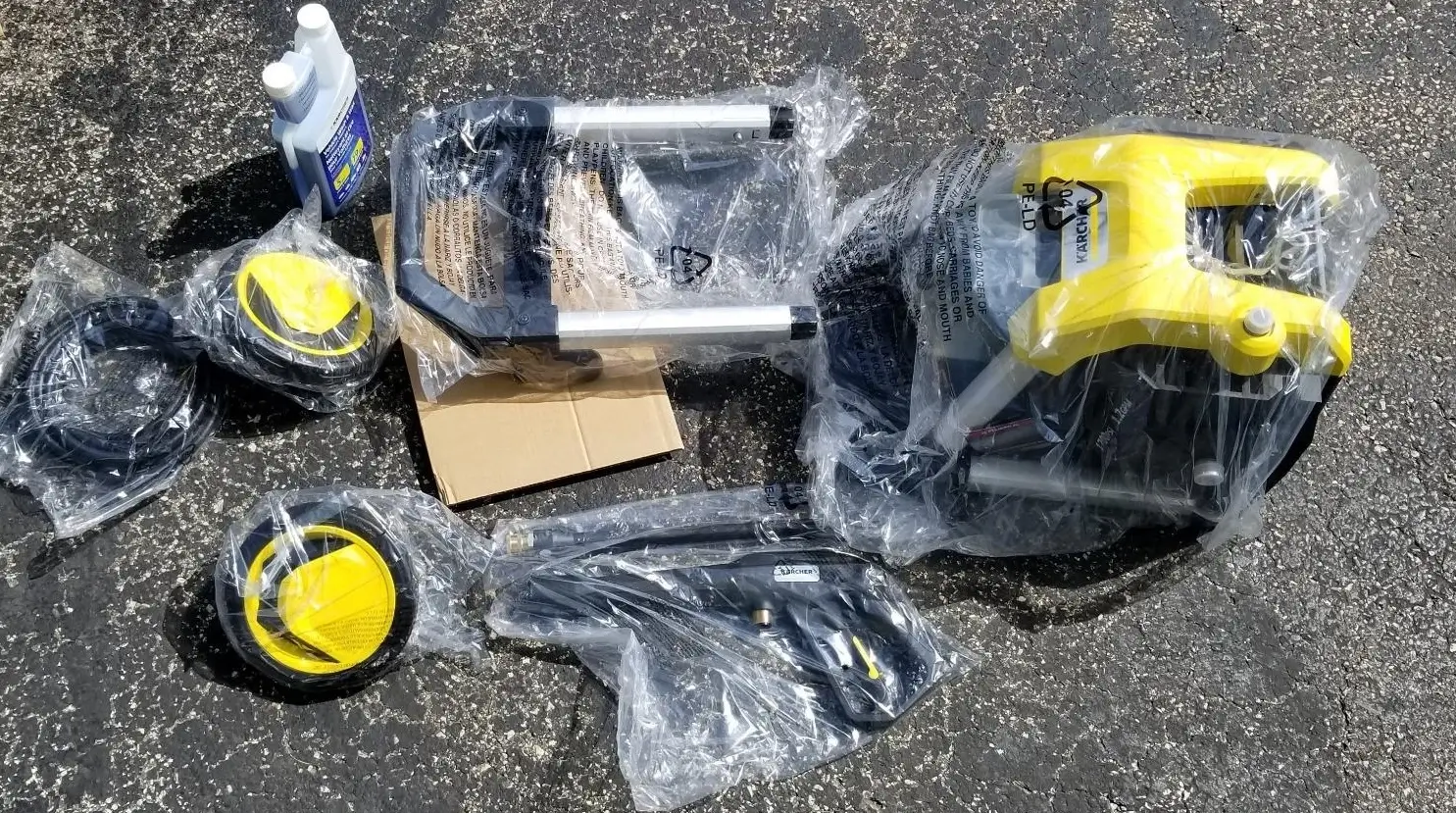
Unboxing layout: The Karcher K1700 features an integrated aluminum frame, wheels, gun assembly, spray wand, three nozzles, and a removable mesh accessory bucket.
Step-by-Step Car Detailing Setup Guide
Systematic line purging and orifice tuning ensure scratch-free automotive pre-washes without inducing hydraulic shock inside pump chambers.
To get the best possible car washing performance out of your Karcher K1700, follow this recommended workflow used by professional detailers:
- Water Line Bleeding: Connect your garden hose to the rear intake. Before plugging the power cord into the wall or stepping on the foot pedal, pull the spray gun trigger for 45 seconds until water flows smoothly. This purges trapped air pockets from the pump manifold, preventing dry-cavitation wear.
- Pre-Rinse: Attach the 15-degree yellow spray nozzle. Maintain a distance of 12 to 18 inches from vehicle surfaces to rinse away loose dirt, wheel well mud, and surface grit.
- Foam Application: Attach a foam cannon loaded with your preferred pH-neutral car wash soap (mixed at a 1:10 soap-to-water ratio) and fitted with a 1.1mm orifice. Coat the vehicle from top to bottom, allowing the suds to dwell for 3 to 5 minutes out of direct sunlight.
- Contact Wash & Final Rinse: Perform a standard two-bucket contact wash using microfiber mitts, then re-attach the 15-degree nozzle to rinse away remaining suds.
Essential Upgrades: Fixing the Stock Hose
Standard M22-14mm brass threading enables immediate replacement of the factory thermoplastic hose with non-kinking polyurethane alternatives.
While the core machine design and motor frame are well-engineered, Karcher cut costs on the factory high-pressure hose. The included 20-foot hose is made of a stiff thermoplastic material that retains a tight memory coil. It resists rolling out flat, kinks easily, and can tip the lightweight pressure washer over if pulled at an angle.
Fortunately, because Karcher uses industry-standard M22-14mm brass connection threads (rather than proprietary quick-connects like Sun Joe or Greenworks), modifying and upgrading the K1700 is straightforward. To replace stiff screw threads with instant push-fit collars, consult our tested roundup of the best quick connect fittings for pressure washers.
🔧 Recommended Day-One Upgrades:
- Flexzilla or Uberflex 50ft High-Pressure Hose: Replacing the stock hose with a 50-foot rubberized polyurethane hose transforms user experience. These hoses lie completely flat, bend easily around vehicle tires, and double your working reach without needing to move the pressure washer.
- Brass Garden Hose Quick-Connect Coupler: Installing a heavy-duty brass quick-disconnect fitting on the rear intake manifold prevents accidental cross-threading on the factory plastic threads.
- Stubby Pressure Wash Gun: For car detailing, replacing the long factory spray wand with a short snub-nosed spray gun allows for easier maneuvering inside wheel wells and tight spaces.
Component Teardown: What Breaks After 2 Years?
Long-term reliability audits reveal that plastic water intake threads and unloader valve pins represent the most common wear points on aged K1700 units.
No product review is complete without evaluating long-term durability. By analyzing hardware repair records and examining our 24-month test unit, we identified two specific failure points to watch for:
- Plastic Water Intake Thread Wear: The rear water intake fitting features a plastic male thread housing. If you repeatedly screw a heavy, rigid brass garden hose fitting onto it at an angle, the plastic threads can cross-thread and strip, causing persistent leaks. Prevention: Screw a brass quick-connect adapter onto the intake once and leave it installed permanently.
- Unloader Valve Sticking: If left in damp storage over winter without corrosion protection, the internal bypass unloader valve pin can stick. This causes the pump to remain at high pressure or pulse continuously when the trigger is released.
Pump Design & Motor Architecture
The heart of the Karcher K1700 is an aluminum axial cam pump paired with a high-efficiency universal brush motor. Unlike heavy gas engines, it requires zero oil changes or spark plug maintenance. Hardware service indexes indicate that when operated correctly (avoiding dry running and preventing winter freeze damage), this pump assembly reliably provides 5 to 7 years of typical residential service. To evaluate metallurgy differences between aluminum wobblers and commercial triplex heads, read our deep-dive on brass pump vs aluminum pump construction.
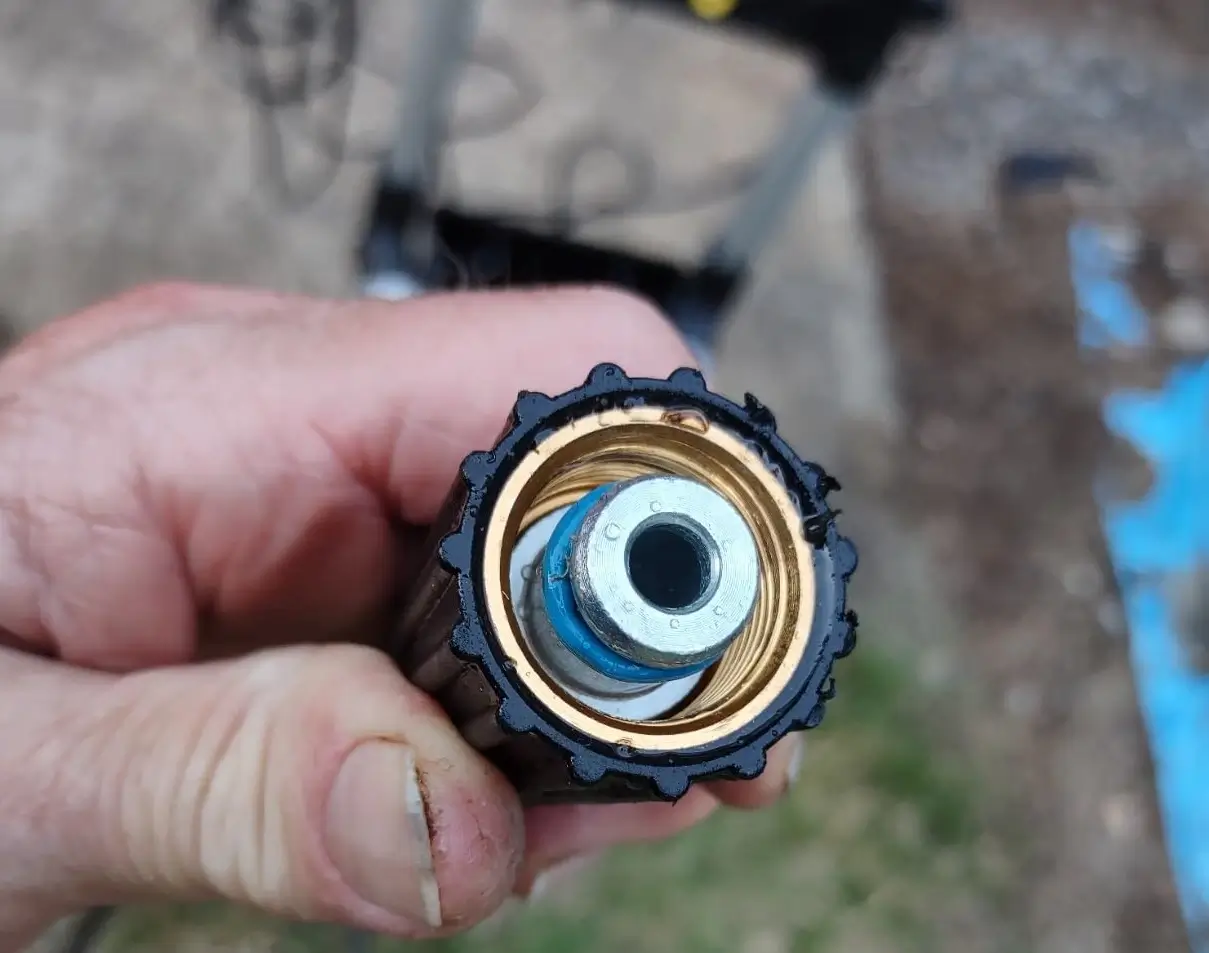
Figure 3: Close-up profile of the spray gun’s universal M22-14mm fitting. Maintain the internal blue O-ring and apply silicone grease annually to ensure a leak-free seal.
Head-to-Head: K1700 vs. The Competition
Direct competitive benchmarking proves that standardized M22 brass plumbing gives the Karcher K1700 a significant upgrade advantage over Sun Joe SPX3000 proprietary connections.
To help you select the right pressure washer for your needs, here is how the Karcher K1700 compares to rival models in the budget electric class:
| Model Specification | Karcher K1700 | Karcher K1800 | Sun Joe SPX3000 | Ryobi RY141900 |
|---|---|---|---|---|
| Max Pressure Claim | 1,700 PSI (CETA) | 1,800 PSI (CETA) | 2,030 PSI (Peak) | 1,900 PSI |
| Water Flow Rate | 1.2 GPM | 1.1 GPM | 1.76 GPM (Max) | 1.2 GPM |
| Fitting Architecture | Universal M22-14mm | Universal M22-14mm | Proprietary Threading | Universal M22-14mm |
| Power Switch Style | Heavy-Duty Foot Pedal | On/Off Foot Switch | Rotary Dial Knob | Push Button |
| Warranty Coverage | 3-Yr Rapid Exchange | 3-Yr Rapid Exchange | 2-Yr Limited | 3-Yr Limited |
| Best Use Case | Best Overall Value | Slightly Higher PSI | Dual Soap Tanks | Rugged Roll Cage |
Key Comparative Takeaway: While Sun Joe advertises higher peak numbers, its proprietary connections make installing aftermarket foam cannons, guns, or extension hoses frustratingly difficult. Karcher’s choice to use standard M22 fittings and offer a 3-year “Rapid Exchange” warranty makes the K1700 a much more owner-friendly long-term choice. If you are exploring broader alternatives before deciding, read our master test guide to electric pressure washers.
Pro Maintenance: Winter Storage & Pump Saver Guide
Lubricating pump saver fluid prevents freezing residual water from rupturing internal polymer check valves during sub-zero storage.
If you live in a region where temperatures drop below freezing (32°F / 0°C), winterizing your pressure washer is mandatory. Water left inside the aluminum pump manifold will freeze and expand, cracking internal polymer check valves and causing unrepairable leaks.
Follow these steps before storing the unit in an unheated garage or garden shed:
- Disconnect all garden hoses, high-pressure lines, and spray guns from the main unit.
- Tip the machine forward at a 45-degree angle to allow excess standing water to drain from the pump manifold.
- Screw a bottle of commercial Pump Saver / Pump Shield fluid into the water intake port.
- Squeeze the bottle until fluid enters the manifold, then tap the foot pedal power switch for 2 seconds. Stop once protective white foam discharges from the front high-pressure outlet. Consult our full guide on how to store a pressure washer to prevent off-season winter damage.
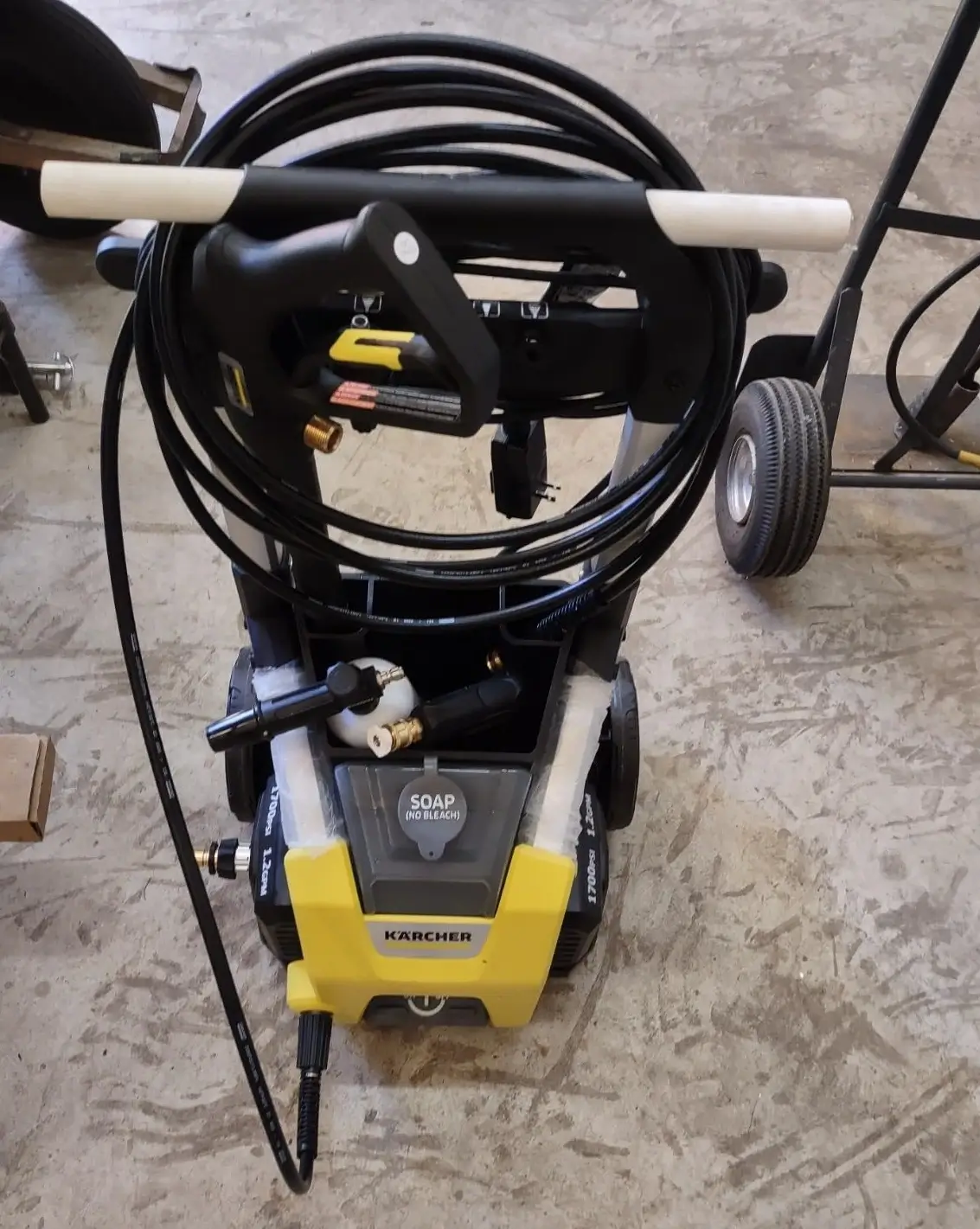
Figure 4: The K1700 stands upright and uses a low-profile center of gravity, taking up minimal floor space in garage corners or storage closets.
Troubleshooting Common Operator Errors
Systematic diagnostic protocols resolve motor surging, low working pressure, and GFCI breaker trips without requiring professional warranty service.
Issue 1: Motor surges on and off repeatedly when trigger is not pulled.
Cause & Solution: This usually indicates a minor pressure leak in the system or trapped air inside the lines. Inspect all hose fittings for tightness. Turn off power, detach spray nozzle tip, squeeze trigger to flow low-pressure water for 30 seconds to purge air, clear nozzle hole with a pin, and restart.
Issue 2: Unit turns on, but water pressure remains low.
Cause & Solution: Ensure your garden hose is turned on fully at the outdoor spigot (requires minimum 3.0 GPM flow from house line). Verify that the inlet water screen filter is clean and free of sediment particles.
Issue 3: GFCI plug trips on main breaker when stepping on pedal.
Cause & Solution: Avoid using thin 16-gauge light extension cords. If using an extension cord, ensure it is a 12-gauge heavy-duty outdoor cord limited to 50 feet to prevent severe voltage drop.
Frequently Asked Questions
Laboratory testing answers clarify cold-water thresholds, Total Stop System functions, and Rapid Exchange warranty protections for prospective Karcher K1700 owners.
Can I run hot water from an indoor tap through the K1700?
Why does the electric motor shut off completely when I release the gun trigger?
Can I draw water from a rain barrel or standing water bucket?
What is Karcher’s “Rapid Exchange” warranty?
Final Verdict: Is It Worth It?
The Karcher K1700 earns an 8.5 / 10 rating by delivering honest CETA-certified cleaning pressure, universal brass fittings, and dependable 3-year warranty replacement backing.
To summarize our long-term Karcher K1700 review, this unit strikes an outstanding balance between budget-friendly pricing, intuitive user ergonomics, and certified performance. While its stock plastic hose is stiff and worth upgrading, its honest 1,700 PSI rating, universal M22 brass fittings, and industry-leading 3-year rapid exchange warranty make it one of the safest, most reliable investments available for home outdoor maintenance and vehicle detailing.
Ready to Upgrade Your Home Cleaning & Detailing Setup?
Click below to check current promotional pricing, stock availability, and verified buyer reviews directly on Amazon.
Related HomeGearMax Engineering Guides
- Best Electric Pressure Washers (Full Prosumer Guide)
- Best Quick Connect Fittings for Pressure Washers (M22 & QC Sizing)
- Best Turbo Nozzles for Pressure Washers (Rotary Orifice Guide)
- Best Pressure Washer Surface Cleaners for Concrete Driveways
- Best Foam Cannons for Auto Detailing and Orifice Selection
- How to Store a Pressure Washer and Prevent Winter Freeze Damage
- Brass Pump vs Aluminum Pump: Pressure Washer Metallurgy Explained
