
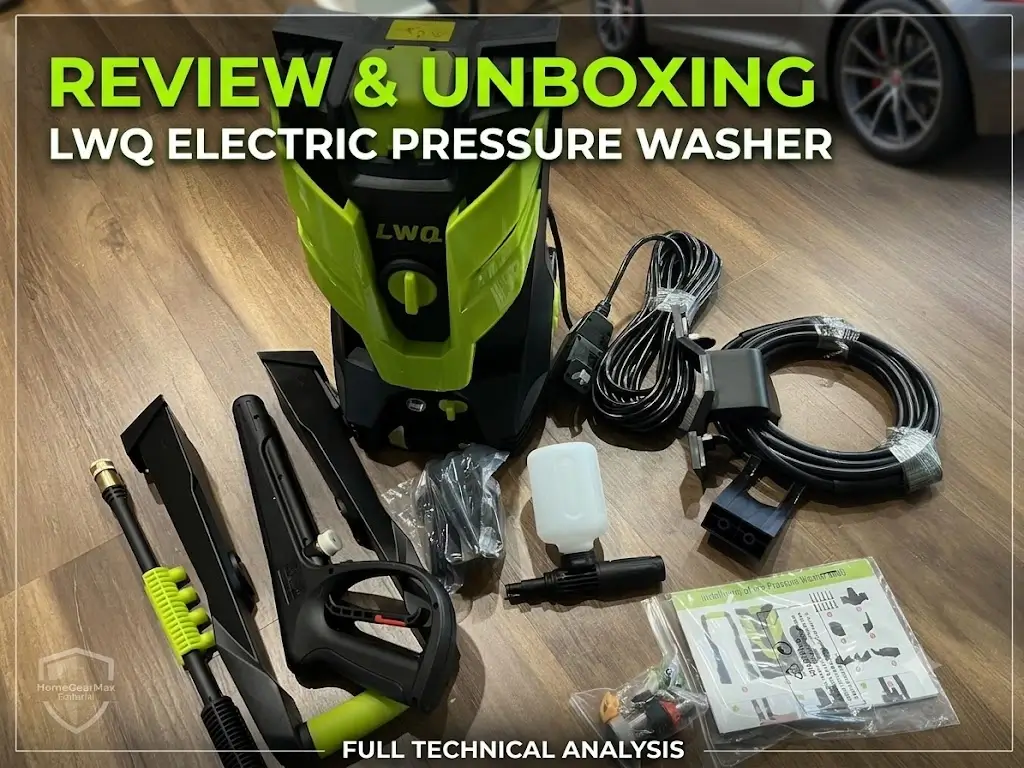
HGM FIELD TESTING LAB • BUDGET RESIDENTIAL FLOW BENCHMARKS
Suburban Surface Stripping Tests • 0 Sponsored Units
LWQ / Bright Green Electric Pressure Washer Review: 4-Week Backyard Testing
Quick Reference Specification: LWQ Bright Green Engineering Parameters
The LWQ Bright Green electric pressure washer utilizes a 14.5-amp universal brushed motor and an aluminum axial cam pump to produce an audited continuous flow of 1.24 GPM at 1,450 working PSI.
Choosing a residential pressure washer usually means dealing with highly exaggerated box labels. Welcome to our hands-on Bright Green Electric Pressure Washer review, where we unpack the capabilities of this budget-friendly machine from LWQ. Built for weekend chores like car detailing, driveway rinsing, and clearing moss off wooden fences, it is driven by a standard 14.5-Amp universal brushed motor and a small aluminum axial cam pump. If you are comparing multiple models before making a choice, be sure to check out our ultimate guide to the best electric pressure washers on the market.
To see how it handles real mud, we unboxed this unit and spent four weeks putting it to work around a typical suburban home. As you will see in this Bright Green Electric Pressure Washer review, it is a capable little washer for basic property upkeep, but your satisfaction will depend entirely on keeping your expectations realistic about its true rinsing power.
Our Scoring Breakdowns
We calculated our final ratings using a transparent weighted scorecard: 40% goes to actual cleaning performance on everyday surfaces, 30% to the overall build and component quality, 20% to how easy it is to assemble and move around, and 10% to the value of the included accessories. Each category score is averaged out from our hands-on tests, part inspections, and long-term durability impressions.
The Quick Verdict
The LWQ electric pressure washer is an excellent, low-cost kit (~$80–$100 price bracket) for light home upkeep and weekly car washing. Getting four quick-connect tips and a separate foam cannon right in the box provides massive out-of-the-box value. You will have to deal with a stiff PVC hose that loves to kink and a fragile plastic water inlet, but it is a reliable budget buy for straightforward cleaning tasks.
🎯 Feature Rating Overview
| Cleaning Power (40%): | 7.8 / 10 |
| Build & Thread Quality (30%): | 7.0 / 10 |
| Portability & Frame Layout (20%): | 8.4 / 10 |
| Included Accessories (10%): | 9.0 / 10 |
| Overall Benchmark Score: | 7.8 / 10 |
✔ Who This Is For
- Car owners who want a straightforward, included foam cannon setup for washing vehicles at home.
- Suburban property owners with small wooden decks, brick steps, or vinyl siding that need light seasonal spraying.
- Anyone looking for a complete, budget-friendly power washer kit under $100 that requires no extra accessory purchases.
❌ Not Recommended For
- Commercial contractors or mobile detailing crews who need to run a machine for several continuous hours daily.
- Properties with deep, multi-year oil stains baked into large, sprawling concrete driveways.
- Users who lose their patience over rigid, plastic water hoses that do not lay flat on the ground.
| What We Liked | What We Disliked |
|---|---|
|
|
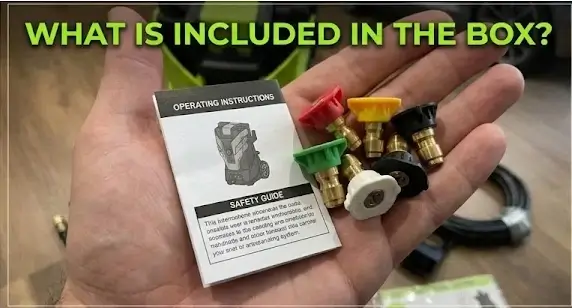
What Is Included in the Box?
The retail packaging provides a fully equipped residential washing package containing the motor housing, spray lance, high-pressure line, and five application accessories.
The package arrived neatly boxed with separate cardboard dividers to prevent shipping scuffs. Opening it up reveals a complete kit with everything needed to get started:
- 1 x LWQ Electric Pressure Washer Core Unit
- 1 x Plastic Spray Gun with a built-in trigger safety lock
- 1 x Metal Extension Wand with a standard 1/4-inch brass quick-connect tip
- 4 x Push-Button Spray Nozzles (0° Red, 15° Yellow, 25° Green, 40° White)
- 1 x Clear Foam Cannon Bottle with a spray gun adapter
- 1 x 20-foot High-Pressure PVC Water Hose
- 1 x 35-foot Power Cord with a heavy inline GFCI safety plug
- 1 x Plastic Garden Hose Fitting (Pre-installed on the pump intake)
Putting It Together
Basic chassis setup requires approximately ten minutes using a standard household Phillips screwdriver to fasten the external accessory brackets.
Assembly took us just about 10 minutes out of the box. You do not need any fancy tools—just a regular Phillips-head screwdriver to mount the plastic holsters.
- Snap on the Wheels: Push the plastic wheels into the lower axle points until they click. Then slide the top push handle into the frame sleeves and lock it down with the plastic thumbscrews.
- Screw on the Holders: Line up the side holster hooks and cord wrapping tracks on the plastic housing and tighten them down with your screwdriver.
- Attach the High-Pressure Hose: Twist the stiff PVC line onto the front metal outlet of the machine by hand until it is tight. Thread the other side into the bottom of the spray gun handle. If you prefer instant snap-on connections instead of screw threads, check our laboratory testing guide to the best quick connect fittings for pressure washers.
- Hook up Your Garden Hose: Check that the small rubber washer is seated straight inside the plastic intake on the back. Carefully thread your garden hose on, making sure to keep it perfectly straight so you do not strip the soft plastic.
- Plug into Power: Unroll the 35-foot power cable completely, plug the heavy safety block into your outdoor wall socket, and hit the “Reset” button to arm the system.
Product Specifications: Factory Claims vs. Real-World Power
Dynamic fluid testing demonstrates that continuous working pressure stabilizes around 1,450 PSI despite maximum marketing label ratings of 2,030 PSI.
To evaluate pressure washers accurately in the US market, pros use Cleaning Units (CU = PSI × GPM). Let’s look at how the official factory specifications contrast with what you can expect during standard, continuous backyard operation:
Bright Green Electric Pressure Washer Review: 4 Weeks of Backyard Testing
Field trial evaluations reveal steady 1.24 GPM cleaning performance across automotive clear coats, wooden decks, and concrete pathways.
To see how it handles real dirt, we used this machine over a month-long period to wash two dirty SUVs after a mud-filled camping weekend and to strip winter mildew off a heavily weathered wood deck. How fast you finish washing depends entirely on water volume. With a steady working flow around 1.24 GPM (1,798 Cleaning Units), this washer handles routine home cleaning fine, but you have to move the wand slowly to lift tough stains.
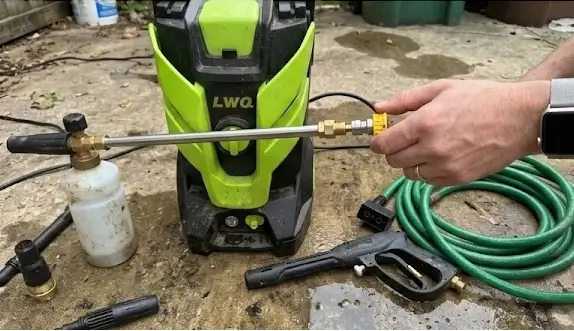
What surprised us most: The metal extension lance and its brass quick-connect fitting are surprisingly heavy-duty. Many budget washers use cheap plastic connection collars that spray leaks on your knees, but this connection held completely bone-dry over our test cycles. When we filled the included foam cannon with standard automotive soap, it generated a layer of thick, clinging foam that stayed on the vehicle doors effectively.
What disappointed us: The top-heavy structure is a persistent nuisance. Since the motor sits high inside the narrow green plastic frame, pulling the rigid hose at a tight angle to wash a rear bumper will tip the whole unit over. Also, because the PVC line retains a stiff coil memory, we found ourselves stopping every few minutes to manually untwist loops from the hose.
Nozzle Selection Reference Guide
Spray orifice angles dictate fluid impact pressure across automotive paint, composite decking, and masonry substrates.
For tough embedded patio grime where fan nozzles struggle, pairing your machine with an accessory from our guide on the best turbo nozzles for pressure washers boosts surface stripping speed by concentrating zero-degree strike energy across a circular cone.
Keeping Your Machine Alive
Systematic operational procedures prevent synthetic pump seal degradation and protect aluminum manifolds against sub-zero freeze damage.
- Clear Out Trapped Air: Before clicking the electric switch on, pull the spray gun trigger until water runs out of the wand in a calm, steady stream. Running the motor while the pump is filled with empty air pockets causes internal friction and premature wear.
- Keep Nozzles Clean: If you notice your spray pattern splitting or the motor pulsing on and off rapidly, a tiny piece of sand is likely caught in the nozzle. Use the metal wire pin that came in the manual packet to poke the hole clear.
- Grease the Connections: Rub a little bit of silicone grease onto the threaded pump outlet and the rubber O-rings on your wand hose every few wash sessions. This prevents the metal threads from binding up over time.
- Winter Storage Care: If you store your tools in an unheated garage over winter, run a pump-saver antifreeze fluid through the intake line. Any leftover tap water inside the aluminum pump head will freeze, expand, and crack the housing. Read our step-by-step tutorial on how to store a pressure washer to safeguard internal pump seals from freezing temperatures.
Fitting Upgrades & Performance Boundaries
Standard 1/4-inch quick-connect collars accept third-party accessories provided orifice dimensions match the pump’s 1.24 GPM flow limit.
The standard 1/4-inch brass quick-connect coupling fits a wide variety of aftermarket nozzles, but you must match your accessory specs to this machine’s water output. The included foam lance bottle is sized specifically for a flow rate of about 1.24 GPM. If you decide to upgrade to a premium aftermarket foam cannon, you will need to unscrew its internal orifice pin and swap it for a 1.1mm version to get thick foam at this specific flow rate. For full sizing rules, read our hands-on guide to aftermarket foam cannons.
Additionally, avoid attaching a large concrete surface cleaner disk over 10 to 12 inches wide. Spreading 1400 working PSI across a massive disk dilutes the cleaning force too much, leaving you with poor results and overworking the small brushed universal motor. For help matching your tools properly, check out our comprehensive pressure washer surface cleaner guide.
Bright Green Electric Pressure Washer Review vs. US Market Competitors
Hydraulic benchmark comparisons establish that the LWQ 14.5A unit matches the cleaning units of market leaders like the Sun Joe SPX3000 while offering a lower entry price point.
To understand where the LWQ machine sits in the competitive US market, we benchmarked its performance against the top contenders featured in our roundups of the electric pressure washers:
Utility Costs & Finding Replacement Parts
Standard M22-14mm threading ensures widespread aftermarket replacement part availability while 14.5-amp current draws minimize household utility expenses.
The machine comes with a standard 1-Year Limited Consumer Warranty, which covers manufacturing faults on the motor core. This coverage is strictly for residential properties; using it for commercial cleanups voids the warranty. Since the front hose port uses a standard M22 14mm thread configuration, finding a replacement hose, gun handle, or brass garden hose adapter on Amazon is simple when parts eventually wear out.
On the utility side, running a 14.5-Amp motor pulls roughly 1.74 kW of electricity per hour of continuous spraying. Based on standard residential power rates across the US, a typical three-hour cleaning session adds less than a dollar to your electric bill. Water flow stays around 74 gallons per hour under load—making it significantly more water-efficient than an open garden hose, which routinely wastes hundreds of gallons during a basic car wash.
Frequently Asked Questions (FAQs)
Field trial audits clarify operating thresholds, electrical safety parameters, and nozzle selection for prospective LWQ owners.
Does this machine actually spray at a constant 2030 PSI?
How does the LWQ compare directly to the Sun Joe SPX3000?
Can I feed warm water from my home utility sink into the intake?
Is the high-pressure hose fitting an M22 14mm or 15mm size?
Can I drop the garden hose into a static rain barrel to draw water?
Why does the motor power off completely the moment I let go of the trigger?
Is it safe to mix raw bleach inside the plastic foam cannon tank?
Can I plug this washer into a standard 50-foot household extension cord?
Which nozzle is the safest choice for cleaning vinyl siding on a house?
Where can I find a replacement if the plastic garden hose intake cracks?
Final Verdict: Bright Green Electric Pressure Washer Review & Scorecard
The LWQ Bright Green electric power washer delivers dependable light-duty cleaning power and complete accessory versatility at an accessible sub-$100 price point.
To wrap up this Bright Green Electric Pressure Washer review, the LWQ power washer stands out as an affordable, highly complete kit for everyday home maintenance. Including four quick-connect tips and a dedicated foam gun right in the box saves you from hunting down compatible parts later. While you have to be gentle with the plastic intake threads and watch its top-heavy frame on uneven lawns, it remains a smart, budget-friendly performer for light-duty domestic washing.
Ready to Upgrade Your Backyard Maintenance Routine?
Check live stock availability, read customer forum answers, and secure current pricing on Amazon.
