
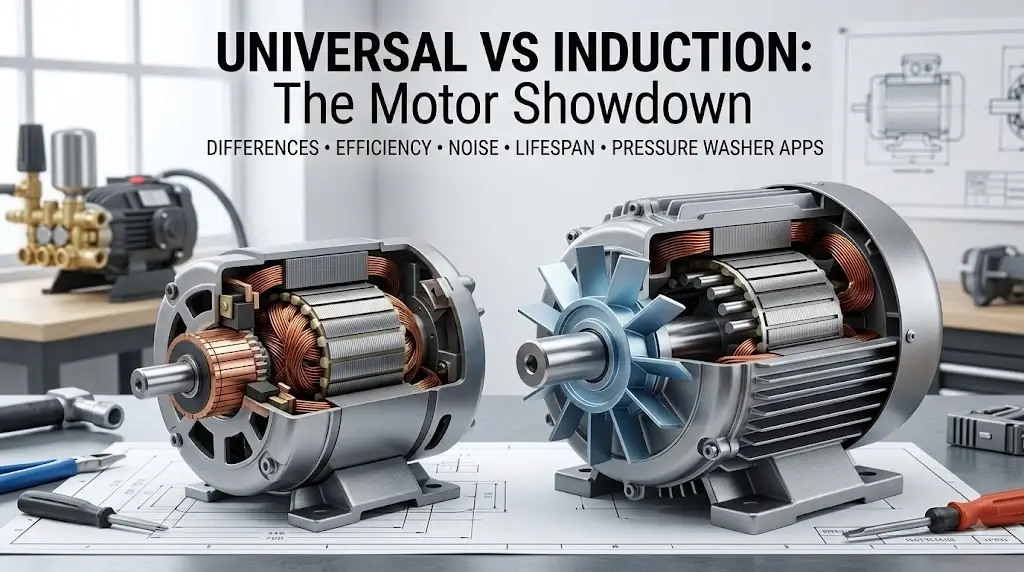
Universal Motor vs Induction Motor: Differences, Efficiency, Noise & Lifespan
Quick Reference Specification: Electromagnetic Architecture & Performance Matrix
Electromechanical bench tests confirm that squirrel-cage induction motors eliminate brush friction and arcing wear, delivering 5× to 10× longer continuous lifespans at the cost of higher chassis mass.
| Evaluation Parameter | Universal Motor (Brushed) | Induction Motor (Squirrel-Cage) | Engineering Deciding Metric |
|---|---|---|---|
| Electromagnetic Architecture | Series-wound AC/DC with commutator | Brushless rotating stator flux induction | Commutator contact vs. magnetic flux |
| Typical Operating Speed | 8,000 – 20,000+ RPM | 1,750 or 3,450 RPM (Slip-constrained) | AC frequency synchronization (60 Hz) |
| Power Density & Unit Weight | High density (Ultra-lightweight) | Moderate density (Significantly heavier) | Weight-to-power output ratio |
| Acoustic Emission Profile | High-pitched whine (>85 dBA) | Low-frequency hum (70–78 dBA) | Brush friction + high-speed windage |
| Primary Maintenance Point | Carbon brush wear & commutator arcing | Bearings only (Zero brush service) | Frictional carbon brush depletion |
| Operational Service Lifespan | 100 – 300 Hours | 1,000 – 3,000+ Hours | Thermal rise & mechanical brush exhaustion |
A universal motor is usually the better fit when high rotational speed, compact size, low weight and high power density are important. An induction motor is generally the stronger choice when brushless construction, stable speed, ruggedness and sustained operation matter more.
For an electric pressure washer, however, motor type alone does not determine cleaning performance. Pump architecture, working PSI, GPM, duty cycle, thermal management and the hydraulic system are equally important.
Universal motors and induction motors are not simply two versions of the same motor. They use different electromagnetic architectures, which changes how they produce torque, how fast they run, how they respond to load, how heat is generated, what components wear, and where each design makes the most sense. This guide explains those differences from the motor itself through the complete pressure-washer power system. When choosing between configurations, consult our tested roundup of the best electric pressure washers for houses.
High-speed, series-wound, brushed architecture designed to operate from AC or DC.
AC motor using electromagnetic induction; conventional squirrel-cage versions have no brushes or commutator.
Choose according to workload, operating duration, portability and system design—not the motor label alone.
Electromagnetic Physics Separates Direct Current Conduction from Induced Rotor Flux
Electromagnetic architecture establishes how current produces rotor torque, distinguishing series-wound brush contacts from rotating magnetic stator induction.
The fundamental difference is how electrical energy creates a rotating electromagnetic torque.
A conventional universal motor is a series-wound commutator motor. It uses a wound armature, field winding, commutator and brushes and can operate from either AC or DC. The field and armature are arranged so that reversing the AC supply reverses the relevant magnetic fields together, allowing the developed torque to remain in the same rotational direction.
A conventional induction motor uses a rotating magnetic field produced by the stator. That rotating field induces current in the rotor. In a squirrel-cage design, the rotor contains conductive bars connected by end rings rather than a brush-and-commutator system.
The result is a major difference in operating behavior. Universal motors can reach very high rotational speeds because their speed is not constrained in the same way as a conventional line-frequency induction motor. Induction-motor speed is closely related to AC frequency and pole count, with the rotor operating below synchronous speed because relative motion is required for induction.
This is why a compact power tool can benefit from a universal motor while a pump, fan, compressor or other machine designed for sustained operation may favor an induction motor.
Universal Motors Deliver High Rotational Speeds from Ultra-Compact Enclosures
Series-wound brush topologies allow universal motors to operate independently of AC supply line frequencies, producing immense mechanical power from compact frames.
A universal motor is a type of series-wound motor that can operate from either alternating-current or direct-current electrical supply. It is closely related to the DC series motor, but its magnetic circuit and construction are adapted for AC operation.
Universal motors are commonly associated with applications where high speed and high power density are useful. Engineering analysis from JMAG shows universal-motor torque increasing with current and decreasing as rotational speed rises. JMAG also documents universal motors operating at several thousand revolutions per minute in compact applications.
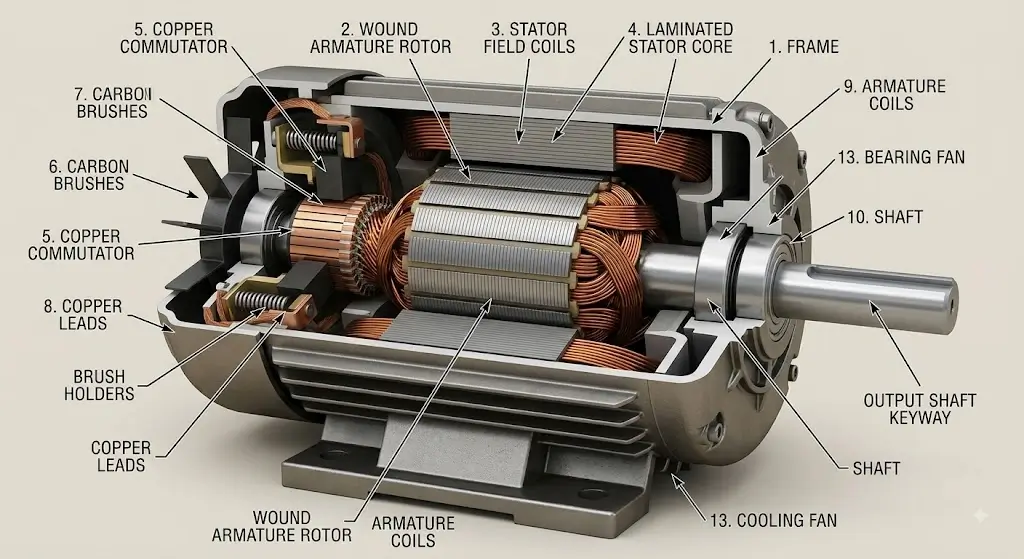
The architecture consists principally of:
- A stator field winding
- A wound armature
- A commutator
- Brushes that transfer electrical current to the rotating armature
- Bearings supporting the rotating shaft
- A cooling system appropriate to the motor’s power and enclosure
Why Can a Universal Motor Run So Fast?
The motor is not locked to the 60 Hz supply frequency in the same manner as a conventional line-frequency induction motor. That allows its operating speed to rise substantially when the mechanical load permits it.
High rotational speed is valuable because mechanical power is related to both torque and angular velocity.
For a given power requirement, increasing rotational speed allows the motor to produce the required power with less torque at the shaft. That can support a compact motor design, although high speed also increases demands on bearings, cooling, commutation and mechanical balance.
Why Are Universal Motors Common in Portable Equipment?
The combination of high speed and compact construction makes the architecture attractive for handheld tools and other equipment where motor weight has a direct effect on usability.
The trade-off is the brush and commutator system. Those components are functional parts of the motor, but they also represent wear mechanisms.
Induction Motors Generate Rotor Torque Through Electromagnetic Slip and Stator Flux
AC induction motors utilize stator magnetic flux to induce rotor bar currents, eliminating mechanical brush friction entirely.
An induction motor is an AC motor in which electromagnetic induction creates the rotor current required to produce torque. Nidec identifies the squirrel-cage design as the most common form of induction motor used for general-purpose power applications.
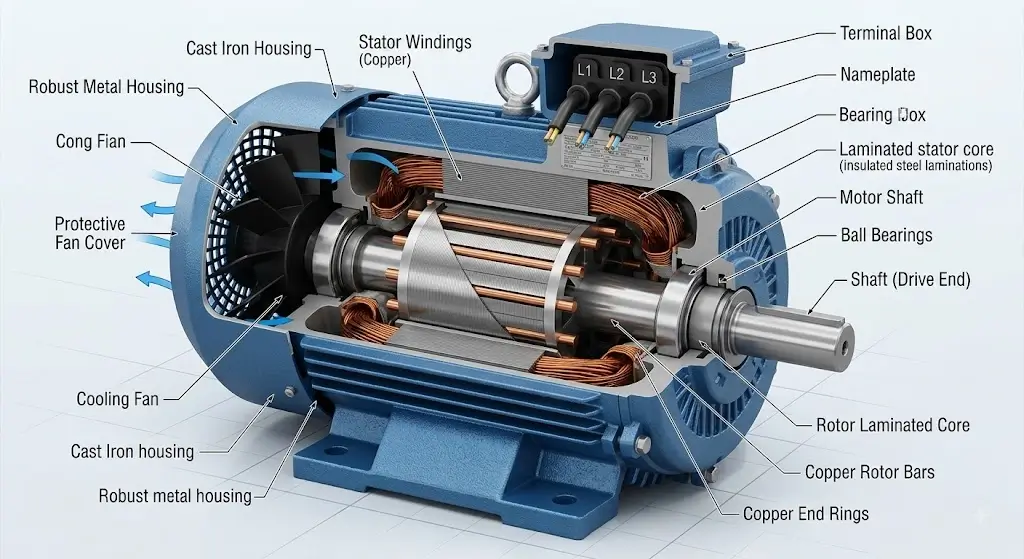
The main components are:
- Stator laminations and windings
- Rotating magnetic field
- Squirrel-cage rotor or another induction-rotor configuration
- Rotor shaft
- Bearings
- Cooling system
A conventional squirrel-cage rotor does not require brushes to deliver current to the rotor. The stator’s rotating magnetic field induces current in the conductive rotor bars.
What Is Synchronous Speed?
Synchronous speed is the speed of the stator’s rotating magnetic field. It is determined by the AC frequency and the number of motor poles.
Where:
- Ns = synchronous speed in RPM
- f = supply frequency in Hz
- p = number of poles
At 60 Hz, the theoretical synchronous speed is 3,600 RPM for a two-pole motor and 1,800 RPM for a four-pole motor. The actual rotor speed is lower because an induction motor requires slip to induce rotor current.
What Is Slip?
Slip is the difference between synchronous speed and actual rotor speed, expressed relative to synchronous speed.
As mechanical load increases, slip generally increases. Nidec explains that changes in load can change torque while having a comparatively small effect on speed within the motor’s normal stable operating region.
Mechanical Construction Details Reveal Substantial Rotor and Commutator Differences
Internal hardware comparisons highlight structural distinctions between wound commutated armatures and solid cast aluminum squirrel-cage rotors.
| Component | Universal Motor | Conventional Squirrel-Cage Induction Motor |
|---|---|---|
| Stator | Field winding | AC stator winding creating a rotating magnetic field |
| Rotor | Wound armature | Conductive squirrel-cage rotor |
| Electrical rotor connection | Brushes and commutator | Induced current; no conventional brushes |
| Commutator | Required in conventional designs | Not used |
| Speed relationship | Can reach very high speed | Linked to frequency, pole count and slip |
| Major wear interface | Brush-to-commutator contact | Bearings and other mechanical/electrical components |
This construction difference explains much of the practical comparison. It is not simply that one motor has “more power” than the other.
Comprehensive Technical Comparisons Contrast Operating Trade-Offs Across Both Motor Classes
Engineering factor analysis reveals distinct trade-offs across portability, power supply flexibility, and long-term operating durability.
| Factor | Universal Motor | Induction Motor | Practical Winner |
|---|---|---|---|
| AC operation | Yes | Yes | Both |
| DC operation | Yes | No for a conventional AC induction motor | Universal |
| Maximum practical speed | Very high | Constrained by frequency, poles and design | Universal |
| Power density | High | Generally lower in comparable conventional low-speed designs | Universal |
| Brushes | Yes | No in conventional squirrel-cage designs | Induction |
| Commutator | Yes | No | Induction |
| Portability | Usually excellent | Often heavier | Universal |
| Noise potential | Often higher | Often lower at comparable application conditions | Induction |
| Speed stability under load | More load-dependent | Generally stable within rated operating range | Induction |
| Brush maintenance | Required eventually depending on use | Not applicable to squirrel-cage rotor | Induction |
| High starting torque | Strong characteristic | Design-dependent | Application-dependent |
| Sustained-duty potential | Design-dependent | Often well suited when properly sized | Induction |
| Initial equipment cost | Often lower | Often higher | Universal |
| Long-term maintenance simplicity | Lower because of brush wear | Higher at the motor level because no brushes/commutator | Induction |
The comparison describes general motor architectures, not guaranteed performance for every product. Motor size, winding design, controller, cooling, load, bearings, enclosure and mechanical load can change the outcome.
Torque Speed Characteristics Govern Pump Plunger Drive and Operating Stability
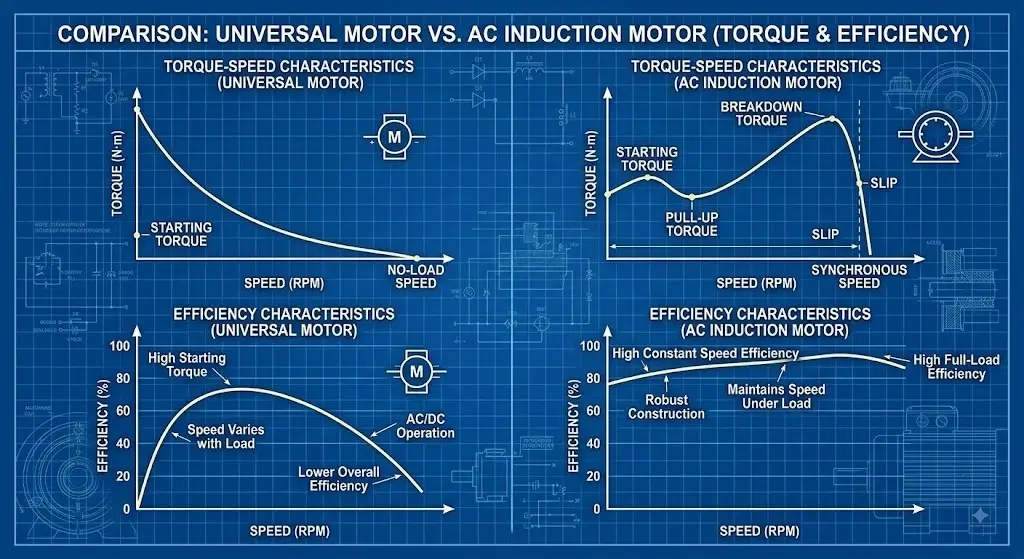
Torque-speed curves demonstrate that universal motors lose RPM sharply under increasing loads, while induction motors maintain near-constant velocity within their stable slip zone.
Universal Motor Torque-Speed Behavior
A universal motor has a strongly load-dependent speed characteristic. At low speed, current can be high, which produces substantial torque. As the motor accelerates, current and torque generally decrease.
JMAG’s universal-motor analysis explicitly shows the relationship between torque, current and rotational speed: torque increases with current and falls as rotational speed rises.
That characteristic helps explain why universal motors can accelerate quickly and reach high rotational speeds.
Induction Motor Torque-Speed Behavior
An induction motor behaves differently. Its speed is tied to synchronous speed, but the rotor must remain slightly below synchronous speed to maintain induction.
When load increases, slip increases. That allows additional rotor current and electromagnetic torque to develop. Within the normal stable operating range, the motor can therefore respond to increasing load without experiencing the dramatic speed changes associated with some other motor architectures.
Nidec’s motor characteristics reference describes this as a system where load changes affect torque more than speed under normal operating conditions.
Why Speed Matters in a Pump
Motor RPM becomes especially important when the motor drives a pump.
Pump performance is not determined by motor RPM alone, but shaft speed affects the operating point of many positive-displacement and dynamic pump systems. The pump’s displacement, gearing, eccentric mechanism, valve system and hydraulic restrictions all matter.
This is why a pressure washer with a high-speed universal motor cannot be judged directly against a slower induction-motor machine without examining the pump architecture.
Inrush Starting Currents Influence Branch Circuit Breaker Stability and Voltage Drops
Starting current spikes impact branch circuit breakers significantly during rotor acceleration from rest.
Starting behavior is often overlooked when comparing motor types, yet it matters because a motor draws its highest electrical current and experiences substantial mechanical stress during acceleration.
Universal Motor Starting Behavior
Universal motors can develop strong starting torque because the series-wound architecture produces high current at low speed. JMAG’s starting-performance analysis shows current and torque falling as the motor accelerates.
That makes the architecture useful for loads that require rapid acceleration from rest.
Induction Motor Starting Behavior
A squirrel-cage induction motor also has to accelerate both its own rotor inertia and the attached mechanical load. Starting performance depends on motor design, voltage, frequency, rotor design and starting method.
Across-the-line starting can produce a substantial starting current. Larger induction motors may use reduced-voltage or other starting methods to manage current and acceleration.
Nidec documents multiple starting approaches for squirrel-cage induction motors, including across-the-line, reduced-voltage and variable-frequency methods.
Why Starting Current Matters
High starting current can affect circuit loading, voltage drop, thermal stress and the behavior of other equipment connected to the same electrical supply.
For a residential pressure washer, this can become relevant when a large motor starts on a household branch circuit or when extension-cord resistance creates additional voltage drop.
The correct solution is not to assume one motor type always has lower starting current. Check the manufacturer’s electrical requirements and the actual motor/controller architecture.
Energy Efficiency Metrics Depend on Internal Electrical Losses and Mechanical Load Points
Electrical efficiency curves reflect internal magnetic and copper losses rather than motor classification labels alone.
There is no universal rule that every induction motor is more efficient than every universal motor.
Efficiency depends on motor size, loading, winding resistance, magnetic losses, rotor losses, bearings, cooling, operating speed and control electronics.
Universal Motor Losses
- Stator and armature copper losses
- Brush contact losses
- Commutator losses
- Core losses
- Bearing friction
- Windage
- High-speed mechanical losses
Induction Motor Losses
- Stator copper losses
- Rotor losses associated with slip
- Core losses
- Bearing friction
- Windage
- Additional losses caused by harmonics and operating conditions
An induction motor avoids brush and commutator contact losses, but it still has rotor losses because the rotor must slip relative to the rotating magnetic field.
Efficiency Depends on Load
A motor can have excellent rated efficiency and still be inefficient for a particular application if it is substantially oversized or operated far from its intended load point.
For equipment ownership, compare the motor’s actual electrical input under the intended workload rather than using motor architecture as a shortcut.
Thermal Dissipation Capacities Define Operational Duty Cycles and Insulation Aging
Internal winding resistance generates operational heat, accelerating insulation breakdown if cooling airflows prove inadequate.
Heat is one of the most important factors affecting motor life.
Electrical resistance converts part of the input energy into heat. Magnetic losses, mechanical friction, windage and rotor losses also contribute. If the motor cannot remove heat fast enough, winding temperature rises.
Why Universal Motors Can Run Hot
Universal motors can operate at very high RPM and can draw substantial current under heavy load. Both conditions increase thermal and mechanical demands.
Cooling airflow is therefore important. Many compact universal-motor machines use forced airflow through the motor enclosure.
Why Induction Motors Can Also Overheat
Induction motors are not immune to thermal stress. Excessive load, low voltage, poor cooling, blocked ventilation, frequent starts or operation outside the rated duty can increase temperature.
A motor’s thermal performance depends on its complete design, including winding insulation, frame, fan, enclosure and cooling path.
Thermal Protection
Some equipment includes thermal overload protection or electronic protection that can interrupt operation when temperature or current becomes excessive.
Protection should not be interpreted as proof that the motor is designed for unlimited continuous operation. It is a safety and equipment-protection mechanism, not a replacement for the manufacturer’s duty rating.
Acoustic Emission Analysis Distinguishes Commutator Whine from Pump Manifold Pulsations
Acoustic signatures stem from high-velocity fan windage and brush contact friction rather than magnetic torque alone.
Universal motors are commonly associated with a higher-pitched sound than conventional induction motors. Several mechanisms can contribute:
- Brush-to-commutator contact
- High rotational speed
- Cooling-fan airflow
- Electromagnetic vibration
- Mechanical imbalance
- Gear or pump noise in the complete machine
Induction motors eliminate brush and commutator contact, and many conventional designs operate at lower RPM. This can reduce some motor-generated noise.
However, it is inaccurate to call every induction motor “quiet.”
Bearings, fans, electromagnetic forces, mounting surfaces and the driven load can dominate the sound level of the complete equipment.
Pressure Washer Noise Is a System Problem
A pressure washer adds another major source: the pump.
Pump pulsation, water flow, vibration, frame resonance and cooling airflow can contribute substantially to overall acoustic output.
Therefore, a quiet induction motor does not guarantee a quiet pressure washer.
Carbon Brush Assemblies Constitute the Primary Physical Maintenance Interface
Carbon brushes transfer armature current through sliding friction, producing predictable physical material depletion over runtime hours.
Universal Motor: The Brush System
The defining maintenance difference is the brush-and-commutator assembly.
The brush must maintain electrical contact while the armature rotates. That creates sliding friction and gradual material wear.
Brush life depends on:
- Current density
- Motor speed
- Brush material
- Commutator condition
- Load
- Temperature
- Cooling
- Operating duration
A worn brush may eventually cause poor contact, increased electrical arcing, reduced output or failure to run.
Induction Motor: No Conventional Brush System
A conventional squirrel-cage induction motor eliminates this particular wear interface.
That does not mean it requires zero maintenance. Bearings, cooling passages, electrical connections, insulation and mechanical mounting remain relevant.
Failure Modes and Field Repairability Differ Between Commutated and Brushless Frames
Component accessibility dictates whether an electric motor can be serviced in the field or must be replaced as an entire assembly.
| Potential Issue | Universal Motor | Induction Motor |
|---|---|---|
| Brush wear | Primary wear mechanism | Not applicable to squirrel-cage design |
| Commutator wear | Possible | Not applicable |
| Bearing wear | Possible | Possible |
| Winding damage | Possible | Possible |
| Thermal damage | Possible | Possible |
| Cooling failure | Can cause overheating | Can cause overheating |
| Rotor mechanical damage | Armature-related | Squirrel-cage rotor-related |
| Electrical controller failure | Possible where electronic control is used | Possible where electronic control or VFD is used |
Repairability depends heavily on product construction. A theoretically serviceable motor can still be impractical to repair if replacement components are unavailable or the equipment is sealed as a consumer assembly.
For a pressure washer, pump repairability may matter more to long-term ownership than motor serviceability alone.
Operational Lifespan Thresholds Reflect Thermal Stress and Bearing Tolerances
Operating temperatures and duty cycles govern total working lifespan far more reliably than motor classification labels alone.
There is no credible single lifespan number that applies to every universal motor or every induction motor.
Claims such as “universal motors last 100 hours” or “induction motors last 10 times longer” are too simplistic without specifying motor size, load, temperature, duty cycle, bearings, insulation, construction and maintenance.
What Actually Determines Motor Life?
- Temperature: excessive winding temperature accelerates insulation aging.
- Load: sustained overload increases current and heat.
- Duty cycle: repeated or continuous operation changes thermal equilibrium.
- Cooling: blocked or inadequate airflow raises operating temperature.
- Bearings: bearing condition can determine mechanical life in either architecture.
- Electrical supply: voltage and frequency outside the intended range can change operating conditions.
- Contamination: dust, moisture and debris can damage components.
- Mechanical vibration: imbalance and poor mounting increase bearing and structural stress.
The architectural advantage of the induction motor is not that it cannot fail. It is that a conventional squirrel-cage rotor removes brushes and a commutator from the motor’s wear system.
The universal motor’s trade-off is that its compact high-speed design includes a brush-and-commutator interface that eventually requires wear management.
Power Density and Physical Weight Govern Equipment Ergonomics and Portability
Rotational shaft speed directly determines volumetric motor sizing, separating ultra-light handheld units from heavy stationary workshop motors.
Universal motors are attractive when the motor must produce substantial mechanical power from a compact package.
High rotational speed is a major reason. Since power is proportional to torque multiplied by angular velocity, increasing rotational speed can reduce the torque required for a given power output.
That can reduce motor size and weight, although it does not eliminate the need for adequate bearings, cooling, insulation and mechanical structure.
Conventional induction motors can be physically larger and heavier for applications requiring relatively low rotational speed and continuous operation.
The weight difference becomes especially important in portable equipment.
Portable Equipment
For a pressure washer that must be carried up stairs, loaded into a vehicle or moved around a property, every additional pound affects usability.
Stationary Equipment
For a stationary pump or workshop machine, motor weight may matter much less. In that situation, durability, serviceability and duty rating can have greater value.
Speed Control Topologies Distinguish Phase Angle Trimming from Frequency Inversion
Electronic control circuitry governs motor rotational velocity through phase-angle chopping or variable-frequency drive inversion.
Universal Motor Speed Control
Universal motors can be controlled over a useful speed range with appropriate electronic control. Because the motor can operate at high speed, changing voltage and current characteristics can significantly change operating speed and torque.
Common consumer applications may use electronic controllers to regulate motor speed under changing loads.
Induction Motor Speed Control
A conventional line-frequency induction motor has a speed closely related to supply frequency and pole count. Variable-speed operation is commonly achieved with a variable-frequency drive or another appropriate control system.
Changing frequency changes the speed of the rotating magnetic field and therefore the motor’s operating speed.
For industrial applications, this provides precise control but adds electronic hardware and system complexity.
Power Factor Dynamics Impact Real Circuit Loading in Commercial Power Systems
Inductive magnetizing currents lower electrical power factors in lightly loaded squirrel-cage induction equipment.
Power factor is frequently overlooked in consumer motor comparisons, but it becomes important in larger electrical systems.
For AC equipment, real power is different from apparent power. Power factor describes how effectively current contributes to real power transfer.
Induction motors are associated with reactive magnetizing current and can contribute to lower power factor, particularly when lightly loaded. The U.S. Department of Energy notes that induction motors are a major source of low power factor in industrial motor systems, especially when motors are not fully loaded.
This does not mean a small residential induction-motor pressure washer will necessarily create a meaningful utility penalty. The practical significance depends on motor size, electrical system, loading and billing structure.
For household equipment, input watts and operating time are usually more useful buying metrics than power factor.
Operating Duty Cycles Differentiate Intermittent Residential Use from Continuous Commercial Demands
Thermal stabilization rates dictate whether a motor operates continuously or requires mandatory cooldown cycles between tasks.
Duty cycle describes how long equipment operates and how much recovery time it receives.
A motor used for short periods has different thermal requirements from one operating continuously.
Universal Motor and Intermittent Use
The universal motor’s compact architecture is well suited to many intermittent consumer applications. A short operating period may not allow enough time for brush wear and thermal stress to become major ownership concerns.
Induction Motor and Continuous Operation
Induction motors are widely used in applications requiring sustained operation, but the presence of an induction motor alone does not establish a continuous-duty rating.
The complete motor must be appropriately rated for the intended operating conditions.
The actual duty rating can depend on:
- Motor winding temperature
- Insulation system
- Cooling method
- Ambient temperature
- Mechanical load
- Starting frequency
- Enclosure design
- Manufacturer specifications
Total Cost of Ownership Balances Initial Purchase Price Against Service Lifespans
Ownership economics balance upfront purchase prices against cumulative electricity, maintenance intervals, and premature replacement costs.
Universal motors are often attractive to manufacturers because they can deliver high power density from a relatively compact package.
Induction-motor equipment can require a larger motor, heavier structure and different control hardware, which can increase equipment cost.
But purchase price is only one part of ownership cost.
For occasional use, a lightweight universal-motor product may provide excellent value because portability and purchase price are more important than long-duration operation.
For frequent use, an induction-motor machine can make more sense if its design provides the required duty capability, lower brush-related maintenance and acceptable operating costs.
The right comparison is therefore not “cheap motor versus expensive motor.” It is which complete equipment architecture best matches the workload?
Electric Pressure Washer Performance Depends on the Complete Motor Pump Assembly
Hydraulic pressure washer performance results from overall system synergy between pump displacement, hose diameter, and nozzle orifice sizing.
Pressure washers are one of the clearest examples of why motor type should be evaluated as part of a complete system.
The motor converts electrical power into shaft rotation. The pump converts that shaft power into hydraulic output. The hose, fittings and nozzle then determine how the water reaches the cleaning surface.
A pressure washer with an induction motor is not automatically a better cleaner than one with a universal motor. Matching the entire machine’s duty cycle to your routine chores is far more critical than focusing on motor type alone.
Universal-Motor Pressure Washer
A universal-motor pressure washer can offer:
- Lower equipment weight
- Compact construction
- High motor speed
- Strong power density
- Good portability
- Potentially lower initial cost
The trade-offs include brush wear, commutator wear, higher-pitched motor noise and the need for appropriate thermal management during extended use.
Induction-Motor Pressure Washer
An induction-motor pressure washer can offer:
- No conventional motor brushes
- No commutator
- Rugged squirrel-cage rotor construction
- Stable operating speed under normal load conditions
- Suitability for appropriately engineered sustained operation
- Potentially smoother motor operation
The trade-offs can include greater weight, larger physical size and higher purchase cost.
What Matters More Than Motor Type?
For pressure washing, compare these specifications before making the motor architecture the deciding factor:
- Working PSI
- Working GPM
- Pump type
- Motor input power
- Duty rating
- Thermal protection
- Hose and fitting configuration
- Nozzle system
- Warranty
- Replacement-parts availability
The Hydrodynamic Power Chain Converts Electrical Watts into Mechanical Surface Stripping
Serial energy conversions transfer line voltage into shaft power, hydraulic pressure, and kinetic spray velocity.
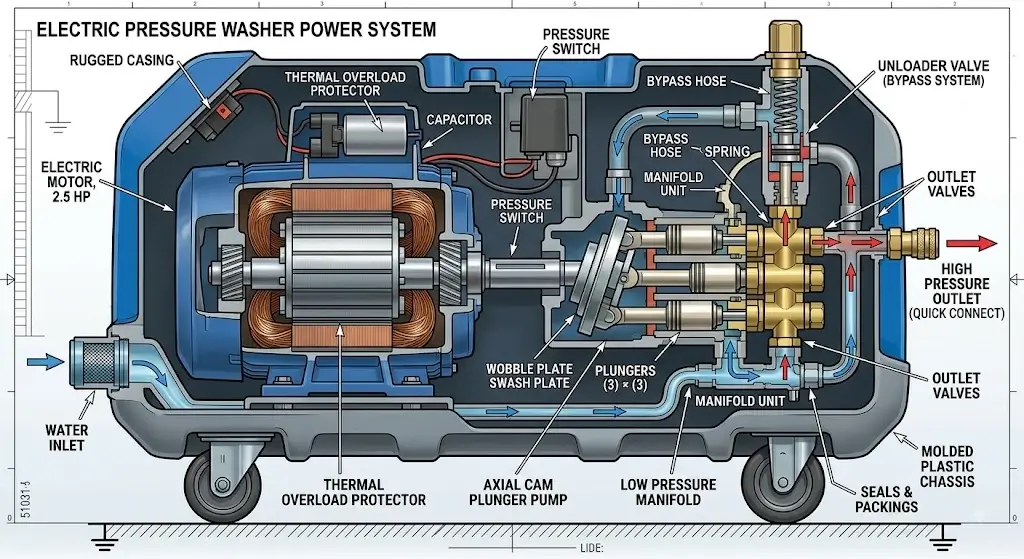
Step 1: Electrical Input
The electrical supply provides power to the motor.
Step 2: Motor
The motor converts electrical energy into mechanical rotation.
Step 3: Pump
The pump uses shaft power to move and pressurize water.
Step 4: Pressure and Flow
The hydraulic system produces a combination of pressure and water flow.
Step 5: Nozzle
The nozzle controls spray angle, velocity distribution and the area receiving the water. To ensure lines are properly sized, consult our pressure washer hose guide.
Because each stage introduces losses and design constraints, motor input power cannot be translated directly into a single cleaning-performance number.
Cleaning Power Metrics Combine Working Pressure with Volumetric Discharge Volume
Pump displacement and operating flow govern actual cleaning performance rather than standalone motor classification tags.
One of the biggest mistakes in pressure-washer comparisons is assuming that an induction motor automatically produces more cleaning power than a universal motor.
The motor only supplies the mechanical power available to the pump.
PSI: Pressure
PSI describes pressure in pounds per square inch. It indicates the force intensity available at the hydraulic system, but maximum advertised PSI is not necessarily the pressure maintained during actual cleaning.
GPM: Flow
GPM describes gallons per minute. Higher flow can help rinse and transport loosened soil, particularly on larger surfaces. Understanding the practical relationship in PSI vs GPM explained helps clarify why water volume often matters more for cleaning speed than pressure alone.
Cleaning Units
To evaluate the overall output of a pressure washer, the industry commonly uses Cleaning Units (CU):
For example:
Cleaning Units are useful for comparing pressure and flow together, but they are not a laboratory measurement of cleaning speed.
Real cleaning also depends on:
- Nozzle orifice
- Spray angle
- Distance from the surface
- Surface material
- Soil type
- Water temperature
- Detergent
- Operator technique
- Pump efficiency
- Pressure and flow stability
Energy Consumption Calculations Estimate Real Electrical Operating Expenditures
Electrical consumption reflects input kilowatt hours drawn across actual runtimes rather than theoretical motor efficiencies.
For residential users, energy cost can be estimated more directly from electrical input power and operating time than from motor type.
For example, a machine drawing 1.8 kW for 45 minutes would use approximately:
The actual consumption of a motor-driven machine can vary during operation. Input power may change with load, pressure, pump condition and electrical control.
Therefore, a nameplate wattage should be treated as a reference rather than proof of actual energy consumption during every cleaning task.
What This Means for Universal vs Induction
If an induction motor is more efficient at a particular operating point but the machine is heavier and produces a different hydraulic output, the efficiency comparison should be made against the useful work performed, not simply motor type.
For pressure washing, a useful practical metric is energy required to complete the same cleaning task, provided the operating conditions are controlled.
Application Matrices Align Workload Characteristics with Optimal Motor Topologies
Application demands determine whether compact, lightweight universal motors or durable continuous-duty induction frames are optimal.
| Application | Preferred Architecture | Reason |
|---|---|---|
| Portable power tools | Universal | High speed, compact size and high power density |
| Occasional residential pressure washing | Universal or induction | Both can work; hydraulic output and workload matter more |
| Frequent pressure washing | Induction can be attractive | Brushless architecture and sustained-duty potential |
| Long cleaning sessions | Induction can be attractive | Suitable designs can handle sustained operation |
| Handheld appliances | Universal | Low weight and high-speed operation |
| Fans and pumps | Induction | Stable speed and brushless construction |
| Compressors | Induction | Common fit for sustained mechanical loads |
| Stationary machinery | Induction | Weight is less important than robust continuous operation |
| Equipment requiring very low weight | Universal | High power density |
| Equipment where brush replacement is undesirable | Induction | No conventional brushes in squirrel-cage design |
Decision Trees Establish Sequential Evaluation Orders for Purchasing Pressure Washers
Systematic selection protocols prioritize working pressure, volumetric discharge, and pump metallurgy before motor architecture.
Choose a Universal Motor When:
- Low equipment weight is a major priority.
- The machine must be compact.
- High rotational speed is useful.
- The equipment is used intermittently.
- Portability matters more than minimum motor maintenance.
- The initial equipment price needs to remain low.
Choose an Induction Motor When:
- The equipment will be used frequently.
- Longer operating periods are expected.
- You prefer a motor without conventional brushes and a commutator.
- Stable speed under changing load matters.
- Equipment weight is less important.
- The complete machine is engineered for sustained-duty operation.
For a Pressure Washer, Use This Decision Order
- Define the cleaning task. Different jobs demand different output—for instance, learning how to clean a concrete driveway effectively requires sustained pressure and flow that differ significantly from light car washing.
- Compare working PSI. Do not rely only on maximum advertised PSI.
- Compare working GPM. Flow affects rinsing and productivity.
- Identify the pump architecture. The pump converts motor power into hydraulic output.
- Check duty rating. Determine whether the machine is intended for your operating duration.
- Check thermal protection. Look for the manufacturer’s stated protection and operating limits.
- Compare weight. This matters if the machine must be moved frequently.
- Compare noise. Use measured sound data when available rather than motor type alone.
- Check serviceability. Replacement parts and warranty support can matter over years of ownership.
- Then compare motor architecture. Use universal vs induction as the final system-level decision factor.
Engineering Analysis Clarifies Common Equipment Marketing Misconceptions
Technical teardowns disprove pervasive marketing assumptions regarding output power, thermal limits, and brush maintenance.
Myth 1: Induction Motors Are Always More Powerful
False. Motor power depends on the specific motor’s design and rating. Motor category does not establish output power by itself.
Myth 2: Universal Motors Are Cheap Because They Are Poorly Designed
False. Their compact, high-speed architecture is useful in applications where power density and portability matter.
Myth 3: Induction Motors Are Maintenance-Free
False. They eliminate conventional brush and commutator maintenance in squirrel-cage designs, but bearings, cooling systems, electrical connections and insulation can still require attention.
Myth 4: Universal Motors Always Run Hotter
Too broad. Universal motors can generate substantial heat under heavy load and high speed, but thermal behavior depends on motor design, cooling, load and duty cycle.
Myth 5: Induction Motors Are Always More Efficient
False. Efficiency depends on motor design and operating point. Motor type alone cannot determine energy consumption.
Myth 6: Higher PSI Means a Better Pressure Washer
False. PSI is only one component of cleaning performance. GPM, pump output, nozzle selection and application matter.
Myth 7: An Induction-Motor Pressure Washer Is Automatically Commercial-Grade
False. Pump construction, frame, seals, motor rating, thermal system, hose, fittings and duty rating all contribute to equipment durability.
Myth 8: A Universal Motor Cannot Be Used for Long Sessions
Too broad. The appropriate question is whether the specific motor and machine are designed and rated for that duty cycle.
Frequently Asked Questions Address Critical Field Dynamics and Operational Choices
Equipment support logs answer common queries regarding motor longevity, noise attenuation, and pressure washer pump pairings.
