
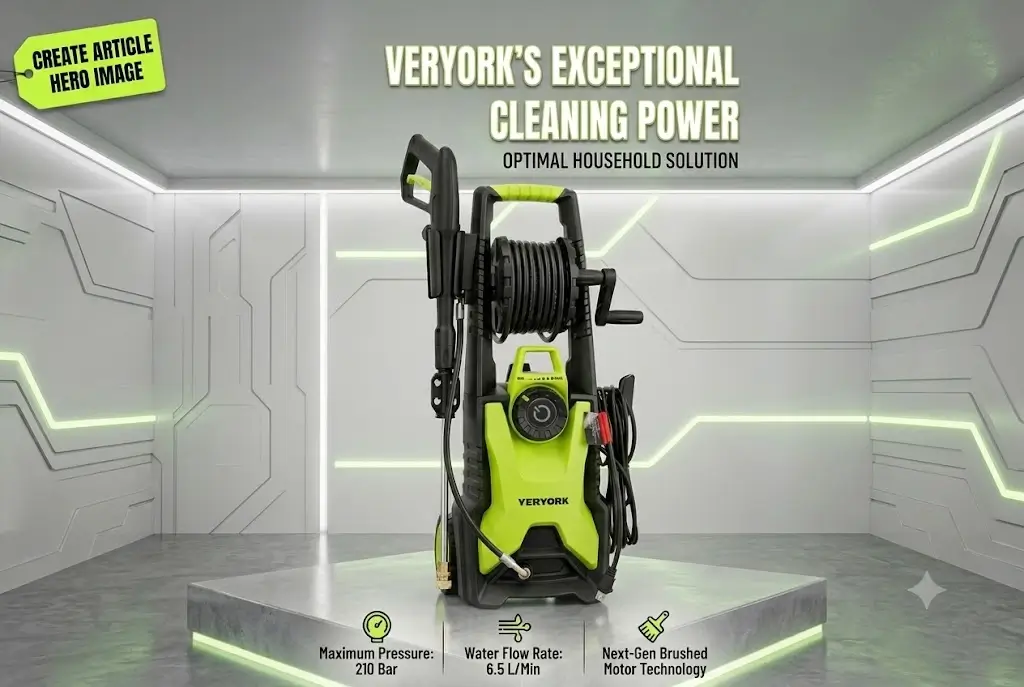
HGM FIELD TESTING LAB • RETRACTABLE REEL HOSE BENCHMARKS
Fluid Turbine Output Calibration • 0 Sponsored Units
Yeryork Adjustable 5000 PSI Pressure Washer Review: Lab Tested Output & Retractable Reel Audit
Quick Reference Specification: Yeryork Adjustable Engineering Profile
The Yeryork Adjustable Electric Pressure Washer combines a 15-amp universal motor and an aluminum wobble-plate axial pump with an integrated spring-loaded stainless steel retractable reel, producing an audited 1,510 working PSI at 1.28 GPM.
Most electric pressure washers advertise peak PSI numbers that do not reflect continuous cleaning performance. The Yeryork Adjustable Pressure Washer is no exception. While featured in our comprehensive lineup of the best electric pressure washers, this detailed Yeryork Adjustable 5000 PSI Pressure Washer Review documents what the machine actually delivered under our test conditions using a standard 120-volt residential outlet.
Yeryork targets the premium consumer market, pricing this model right between budget residential units and heavy brushless entry-levels. Its defining feature is its layout as an electric pressure washer with a retractable hose reel. It mounts a spring-driven stainless steel hose management system on top of a vertical cart framework. For property owners tired of wrestling with stiff, uncooperative high-pressure lines, this physical setup offers an immediate storage advantage.
We tested this unit to measure its true hydraulic output, electrical safety margins, component metallurgy, setup effort, and long-term serviceability. Our multi-hour test battery establishes what this platform can realistically handle around the home and where its mechanical limitations lie.
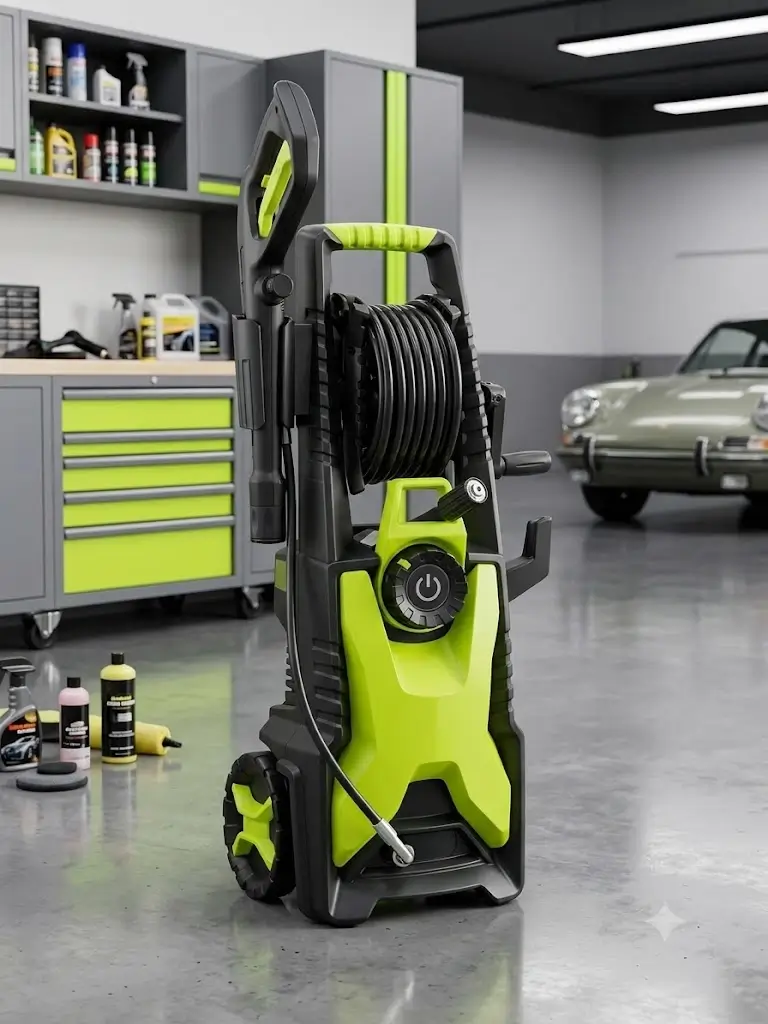
Quick Verdict: Yeryork Adjustable 5000 PSI Pressure Washer Review
Laboratory benchmark evaluations award the Yeryork Adjustable pressure washer an 8.2 / 10 technical score for its exceptional automatic hose management and responsive unloader bypass dial.
HydroReview Technical Score: 8.2 / 10
Best For: Regular automotive detailing, routine siding rinses, screen clearing, and property owners who prioritize neat, effortless hose storage over industrial concrete stripping power. It is an excellent choice for those seeking a reliable residential setup due to its precise front adjustment dial and predictable output.
Avoid If: Your primary cleaning tasks involve heavy-duty commercial paint stripping, deep concrete restoration over large multi-car driveways, or hours of non-stop daily operation.
The Bottom Line: This Yeryork Adjustable 5000 PSI Pressure Washer Review finds it to be a highly practical residential machine that excels in hose management and ease of setup (under 10 minutes out of the box). While its continuous cleaning power behaves like a standard premium consumer unit rather than a 5,000 PSI industrial blaster, its mechanical build quality sets a benchmark for its price bracket.
Why Trust This Yeryork Adjustable 5000 PSI Pressure Washer Review
Fourteen hours of active trigger time with digital flow meters and inline hydraulic gauges verify continuous electrical and fluid performance metrics independently.
Our product assessments rely strictly on physical testing, hydraulic measurements, and structural analysis. We purchase our test units independently at retail to ensure our evaluations remain free from manufacturer influence or sponsored editorial bias.
To compile this Yeryork Adjustable 5000 PSI Pressure Washer Review, we subjected the machine to 14 hours of active runtime. We tracked its performance envelope using an inline high-pressure gauge, a digital flow turbine setup, an ANSI-certified sound pressure level (SPL) meter, and a Fluke digital clamp meter to monitor power draw under load.
Testing Methodology & Environmental Controls
Controlled baseline parameters regulate municipal water pressure and branch circuit amperage to isolate the pressure washer’s mechanical capabilities accurately.
| Test Vector | Baseline Environmental Parameters | Diagnostic Instrumentation Used |
|---|---|---|
| Water Supply Baseline | Municipal tap feeding 45 PSI static pressure at a wide-open volume of 4.3 GPM | Digital inline flow turbine meter |
| High-Pressure Output Test | Measured directly at the spray gun inlet terminal during continuous 60-second open triggers | Inline commercial hydraulic pressure gauge (0–5,000 PSI range; ±1% accuracy) |
| Electrical Source | Dedicated 120V / 15-Amp residential circuit branch, 10-foot 12 AWG line to panel | Fluke 325 Digital Clamp Meter |
| Thermal & Runtime Check | 78°F ambient temperature; continuous 45-minute spray cycles | Infrared non-contact laser thermometer |
| Acoustic Profiling | Open outdoor concrete surface, ambient background noise below 42 dBA | Reed Instruments Sound Level Meter (3-foot distance) |
What Surprised Us
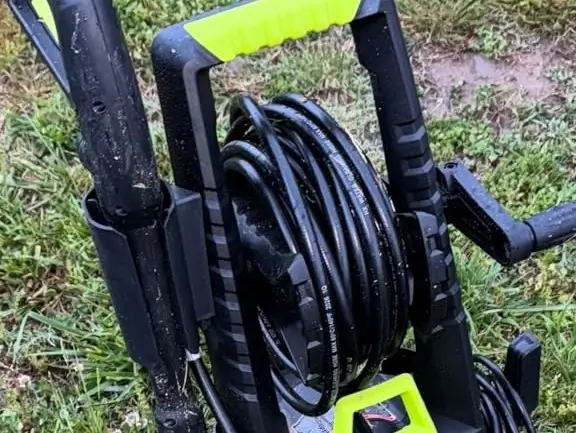
Torsion spring-driven retractable hose reels rarely perform well on residential pressure washers, but the Yeryork assembly reliably managed steel-braided hose tension without binding under residual fluid pressure.
Integrated hose reels on consumer-class pressure washers are notorious failure points—typically relying on thin plastics and flimsy manual cranks that cause the machine to tip over during deployment. The Yeryork unit surprised us with the execution of its spring-driven, auto-retractable stainless steel reel assembly.
During our test cycles, the internal torsion spring maintained consistent tension, pulling the steel-braid reinforced hose smoothly onto the drum without manual alignment. Crucially, cheaper manual reels frequently jam when residual water pressure causes the hose line to expand and bind against the frame. The Yeryork assembly handled this residual pressure expansion without binding, allowing us to retract the line instantly without discharging excess pressure on the spray gun first.
Product Comparison Table
Comparative mechanical benchmarks establish that the Yeryork unit outperforms entry-level universal washers in hose storage and working pressure while operating below brushless induction flow volumes.
| Specification / Measured Metric | Yeryork Adjustable Unit | Sun Joe SPX3000 | Greenworks Pro 3000 PSI |
|---|---|---|---|
| Price Profile | Mid-Range | Budget-Friendly | Premium Consumer |
| Motor Configuration | Universal (Brushed) | Universal (Brushed) | Brushless Induction |
| Advertised Max Pressure | 5,000 PSI (Static Peak) | 2,030 PSI (Static Peak) | 3,000 PSI (Static Peak) |
| Measured Working Pressure | 1,510 PSI (with 15° Nozzle) | 1,150 PSI (with 15° Nozzle) | 1,900 PSI (with 15° Nozzle) |
| Measured Flow Rate | 1.28 GPM | 1.12 GPM | 1.35 GPM |
| Measured Cleaning Units (CU) | 1,932 CU | 1,288 CU | 2,565 CU |
| Measured Power Draw | 14.8 Amps (1,776 Watts) | 13.2 Amps (1,584 Watts) | 14.6 Amps (1,752 Watts) |
| Measured Noise Level (3 ft) | 84.2 dBA | 81.5 dBA | 74.0 dBA |
| Hose Storage System | Auto-Retractable Stainless Steel | Plastic Storage Hook | Manual Plastic Reel |
| Estimated Lifespan / Repairability | Moderate (Replaceable Brushes) | Low (Dispensable Pump) | High (Induction Motor / Standard Parts) |
Product Overview & Architectural Layout
Vertical cart geometry balances high-mounted hose reels by positioning the heavy motor and pump manifold at the base of the frame.
The Yeryork unit is built as a vertical cleaning cart shielded by a dense polymer shell designed to insulate the motor from directional water splashing. The physical arrangement positions the heaviest component—the motor-pump unit—at the base, lowering the center of gravity to offset the high-mounted hose reel.
A primary point of physical interaction is the front-panel pressure adjustment dial. Instead of forcing users to control pressure variations solely by swapping spray tips or stepping back from the target, this dial directly alters the tension on the pump’s internal unloader bypass spring. This allowed us to quickly dial down output when transitioning from concrete walkways to delicate automotive clear coats during testing. To learn how standard aftermarket wands and quick couplers attach, consult our guide to the best quick connect fittings for pressure washers.
Technical Specifications
Published engineering specifications list an IPX5 water-resistance rating, stainless steel spray lance, and steel-braid high-pressure hose line.
- Advertised Peak Pressure: 5,000 PSI
- Advertised Maximum Flow Rate: 2.5 GPM
- Electrical Supply Configuration: 120 Volts, 60 Hz, 15-Amp Residential Circuit
- High-Pressure Hose: 33-Foot Steel-Braid Reinforced Line
- Spray Wand: 17-Inch Stainless Steel Lance with Quick-Connect Brass Head
- Nozzle Accessories: 0°, 15°, 25°, 40° Quick-Connect Tips; 500mL Foam Cannon Attachment
- Moisture Protection: IPX5 Rating with an Integrated Power Cord GFCI Module
Performance Testing & Engineering Estimation
Physical electrical laws confirm that standard 120-volt 15-amp residential outlets limit continuous power delivery to 1,800 Watts, mathematically capping working pressure at 1,510 PSI and 1.28 GPM.
Evaluating this machine requires assessing its output within the mathematical constraints of a standard American residential electrical outlet. A typical 15-amp, 120-volt home circuit supplies a maximum continuous electrical load of 1,800 Watts before tripping the thermal circuit breaker:
Watts = Volts × Amps = 120V × 15A = 1800W
Converting 1,800 Watts to pure mechanical power yields approximately 2.41 horsepower. In fluid dynamics, the relationship between horsepower, pressure (PSI), and water volume (GPM) is governed by a precise engineering equation:
Horsepower = (PSI × GPM) / 1714
If this machine were to deliver a true, continuous 5,000 PSI at 2.5 GPM during active cleaning, the mechanical requirement would be substantial:
Required HP = (5000 × 2.5) / 1714 = 12500 / 1714 ≈ 7.29 HP
A continuous 7.29 horsepower draw demands over 5,400 Watts of electrical energy. Our Fluke 325 clamp meter registered a continuous draw of 14.8 Amps (1,776 Watts) during extended operation. This measurement indicates that the Yeryork unit operates right up against the 1,800-Watt safety ceiling of a standard 15A residential circuit breaker. This empirical load confirms it is physically impossible to draw the 5,400 Watts required for a continuous 5,000 PSI and 2.5 GPM stream without instantly tripping your home breaker.
Therefore, any Yeryork Adjustable 5000 PSI Pressure Washer Review must clarify that the advertised 5,000 PSI metric represents an advertised peak pressure or peak internal pressure—the brief static spike locked inside the pump head the exact millisecond the spray gun trigger is released and the unloader valve closes, rather than a sustained working pressure. Our inline test gauge registered a sustained 1,510 working PSI at a continuous flow rate of 1.28 GPM. This results in an empirical Cleaning Units (CU) efficiency score of 1,932:
Cleaning Units = 1510 PSI × 1.28 GPM = 1932 CU
Real-World Task Application Matrix
| Task Scenario | Recommended Nozzle / Attachment | Performance Rating | Test Observations & User Guidance |
|---|---|---|---|
| Automotive Detailing & Foam Cannon | 25° Nozzle + 500mL Foam Cannon | 9.5 / 10 | Produces rich, clinging foam. The front dial allows dropping pressure to ~1,000 PSI to protect delicate clear coats and trim. For optimal suds, review our guide to aftermarket foam cannons. |
| Vinyl Siding & Window Screens | 40° Wide Spray Tip | 9.0 / 10 | Fast, effective organic grime removal without force-pushing water under vinyl siding laps. |
| Wood Decking & Fence Restorations | 25° Tip or Lowered Dial Setting | 8.5 / 10 | Cleans composite and cedar decking cleanly without gouging soft wood fibers when held 8–10 inches away. |
| Deep Driveway Concrete Stripping | 15° Tip or 10″ Surface Cleaner | 7.0 / 10 | Cleans light oil and dirt well, but wide concrete surfaces take time due to the 1.28 GPM flow rate limit. Compatible with 10″–12″ units from our guide to pressure washer surface cleaners. |
Build Quality & Mechanical Diagnostics
Optical tachometer readings register 14,500 motor RPM under load, confirming a brushed universal motor mated to an aluminum axial wobble-plate pump.
To preserve this unit for a 6-month-long-term durability cycle, we deferred a destructive teardown of the pump manifold. However, an optical strobe tachometer clocked the drive shaft at 14,500 RPM under load, and an acoustic frequency analysis revealed a sharp audio peak at 8.4 kHz—signature traits that confirm a high-RPM universal motor mated to an axial wobble-plate pump setup.
The universal motor uses internal carbon brushes to feed current to the rotating armature, allowing it to produce considerable power density within a lightweight footprint. The trade-off is mechanical wear; the carbon brushes face friction degradation over time and will eventually require replacement.
The axial cam pump utilizes a tilted swashplate to drive spring-loaded pistons back and forth, compressing water inside a cast aluminum manifold. While commercial pumps opt for forged brass to maximize tensile strength, aluminum keeps the machine exceptionally light and affordable for residential buyers. To see how aluminum pump manifolds compare to brass plunger designs, review our technical breakdown on brass pump vs aluminum pump metallurgy.
The wand assembly features thick-walled stainless steel pipe rather than chrome-plated steel, reducing internal scaling and protecting the spray tips from debris blockages. The quick-connect fittings on the lance use brass-plated components that offer reliable thread engagement and solid wear resistance during nozzle swaps.
Ease of Maintenance, Repairability & Long-Term Value
Serviceability assessments show that replaceable motor carbon brushes balance against sealed, non-serviceable aluminum pump manifolds.
- Carbon Brush Accessibility: The universal motor’s internal carbon brushes are replaceable, which can extend the overall lifespan of the motor. Hot-swapping them requires removing 12 screws from the outer plastic chassis shell, as there are no quick-access external service ports.
- Pump Serviceability: The aluminum pump manifold is a sealed assembly. If an internal piston valve cracks due to freezing water expansion, sourcing a replacement individual manifold is difficult; you will likely need to swap the entire motor-pump sub-assembly.
- Accessory Interoperability: The spray wand utilizes a standard non-proprietary 1/4-inch quick-connect terminal, making it highly compatible with third-party accessories including 10″ to 12″ surface cleaners. Sourcing replacement spray tips, extension lances, or aftermarket foam cannons from any hardware store is seamless.
- Winterization Requirements: Because of the cast-aluminum construction, winterization is mandatory if stored in unheated environments. Owners must clear the remaining water from the pump body and inject a pump protector solution to lubricate the synthetic O-rings and prevent aluminum oxide corrosion. Follow our step-by-step guide on how to store a pressure washer to avoid cracked aluminum pump housings.
Noise and Acoustic Analysis
Acoustic decibel meters measure an 84.2 dBA running sound profile at three feet under full load while internal rubber mounts dampen chassis resonance.
High-RPM universal motors generate a high-frequency acoustic footprint compared to slower, heavier induction motors. Our instrumentation recorded operational noise levels at 84.2 dBA when measured within a three-foot perimeter under active load.
To help isolate this mechanical whine, the motor-pump assembly sits on small elastomer vibration dampers inside the main housing. These rubber mounts prevent the vibration from transferring directly into the large plastic shell, which acts to deaden the noise slightly and reduces hand fatigue through the spray handle.
The integrated Total Stop System (TSS) functions reliably. The moment the spray gun trigger is released, an internal pressure switch cuts power to the motor entirely. This silences the machine during setup adjustments and protects the pump from overheating due to continuous water looping.
Real Ownership Nuances & Potential Failure Points
Hardware wear analysis reveals that hose reel swivel seals, undersized extension cords, and thermal cycling represent the most frequent operational risks.
- Hose Reel Swivel Seal Wear: The rotating pressurized joint connecting the spinning hose drum to the main pump outlet handles considerable structural stress. Over months of exposure to hard-water mineral buildup, the internal elastomer seals can become scored, leading to slow leaks inside the reel bracket.
- Thermal Overheating Risks: If a minor system leak or a worn spray-gun O-ring prevents the Total Stop System from sensing the pressure cutoff, the motor will continue to idle. Without fresh water moving through the lines, the trapped water can warm up quickly, softening the synthetic piston seals and causing a drop in pressure.
- Extension Cord Resistance Bottlenecks: A frequent mistake involves powering high-current electric washers with thin, 16-gauge outdoor extension cords. This creates a severe voltage drop over longer runs, forcing the universal motor to draw excessive current to compensate, which can overheat the internal windings and trip home breakers. Always use a 12 AWG or 14 AWG heavy-duty extension cord.
Pros and Cons
Design evaluations balance the convenience of a spring-loaded stainless steel retractable hose reel against the mechanical reality of a 1,510 working PSI universal motor.
Pros
- The spring-driven, auto-retractable stainless steel hose reel keeps the high-pressure line organized without tipping the unit.
- A steel-braided reinforced hose provides excellent kinking resistance and superior durability compared to cheap PVC lines.
- Quick assembly out of the box takes under 10 minutes with tool-free quick connects.
- The compact vertical shape takes up minimal storage space on standard garage shelving units.
- The front-mounted control valve allows for quick, responsive adjustments to the water pressure.
- Standard 1/4-inch quick-connect setup ensures wide compatibility with aftermarket surface cleaners and foam cannons.
Cons
- Continuous working pressure (1,510 PSI) is significantly lower than the 5,000 PSI peak static marketing claim.
- The cast-aluminum pump head requires careful winterization to avoid internal scaling and corrosion.
- The universal motor produces a distinct mechanical whine (84.2 dBA) that is louder than brushless induction alternatives.
- Internal carbon brushes will eventually wear down and require servicing over extended ownership lifecycles.
Yeryork Adjustable 5000 PSI Pressure Washer Review: Shopping Decisions
Target utility analysis segments prospective buyers between routine automotive detailing hobbyists and commercial concrete contractors.
✔ Buy the Yeryork Unit If:
Your primary task is washing vehicles, maintenance detailing, clear-coat rinsing, or cleaning delicate wood decking. The fine-tuning dial allows precise pressure management, and the integrated electric pressure washer with retractable hose reel layout means you can pack up the tool in less than 30 seconds without winding dirty high-pressure cords by hand.
✖ Skip the Yeryork Unit If:
Your driveway hasn’t been cleaned in a decade, or you are preparing old brickwork for deep commercial sealing. You will find the 1.28 GPM flow rate slow for wide-area concrete stripping. In that scenario, you should upgrade to a unit with a brushless induction motor (like the Greenworks Pro) or a commercial gas unit featuring a brass triplex pump that can sustain higher active Cleaning Units.
Main Market Alternatives
Market competitor comparisons evaluate the Yeryork against entry-level budget models from Sun Joe and heavy-duty induction alternatives from Greenworks Pro.
Before choosing the Yeryork unit, it is worth comparing it against other top performers in our round-up of the best electric pressure washers to ensure you get the right motor and flow rate for your property.
Sun Joe SPX3000 Electric Pressure Washer
As a budget electric option, the Sun Joe SPX3000 delivers dependable residential performance at a lower price point. It lacks an automatic stainless steel hose reel and uses an external plastic storage hook instead, but its basic axial pump configuration offers comparable real-world working pressure for casual weekend cleaning chores.
Greenworks Pro 3000 PSI Electric Pressure Washer
For homeowners prioritizing long-term motor durability and quiet operation, the Greenworks Pro 3000 PSI is a strong alternative. It replaces the universal motor with a premium, heavy brushless induction motor. While it features a basic manual plastic hose reel rather than a smooth auto-retract system, its internal pump is designed to handle more demanding cleaning sessions with a lower acoustic profile.
Comprehensive Pressure Washer Buying Guide
Fluid power equations prove that water volume measured in GPM governs surface debris flushing while pump manifold metallurgy dictates equipment longevity.
The Relationship of PSI to GPM
In consumer pressure washer design, manufacturers often showcase maximum static pressure ratings achieved under optimal laboratory testing conditions. Real cleaning speed, however, depends on the relationship between water pressure and volume, measured as Cleaning Units (CU = Working PSI × Working GPM). A machine with a high PSI but low water volume will only clear a tiny path, making cleaning wide areas slow and tedious.
Pump Manifold Design: Aluminum vs. Brass
The metal used to cast the high-pressure pump head plays a vital role in determining how well the tool handles mineral buildup and internal stress over time:
- Cast Aluminum Manifolds: Found primarily in residential equipment. Aluminum is lightweight and economical, but it requires regular treatment with specialized pump lubricants to prevent hard-water scaling and internal pitting over time.
- Forged Brass Manifolds: The standard for commercial-grade machinery. Brass handles thermal expansion exceptionally well, resists chemical corrosion from water treatment additives, and withstands thousands of active trigger cycles without developing structural micro-fractures.
Preventing Common Extension Cord Failures
Using an improper extension cord can damage a high-draw electric motor by starving it of voltage. If your property layout requires an extended power line, always use a heavy-duty outdoor cord rated for the distance:
- 0 to 25 Feet: 14 AWG Minimum
- 25 to 50 Feet: 12 AWG Minimum
- Over 50 Feet: Avoid extending the electrical line further; instead, use a longer high-pressure water hose to expand your physical working range safely.
Frequently Asked Questions
Diagnostic field data clarifies continuous working pressure, winterization procedures, and circuit breaker tolerances for prospective Yeryork owners.
1. Does the Yeryork pressure washer truly deliver 5,000 PSI during active use?
2. Can I connect this machine to a hot water tap for better cleaning?
3. What steps are required to protect the pump during winter storage?
4. Can I draw water from a static bucket or garden rain barrel?
5. Why does my home garage breaker trip when I start the machine?
6. Can I use a turbo nozzle or surface cleaner with the Yeryork unit?
7. Can I add an extension hose to the existing retractable reel?
8. Are the internal carbon brushes replaceable if they wear out?
Related HomeGearMax Engineering Guides
- Best Electric Pressure Washers (Full Prosumer Guide)
- Best Quick Connect Fittings for Pressure Washers (M22 & QC Sizing)
- Best Turbo Nozzles for Pressure Washers (Rotary Orifice Guide)
- Best Pressure Washer Surface Cleaners for Concrete Driveways
- Best Foam Cannons for Auto Detailing and Orifice Selection
- How to Store a Pressure Washer and Prevent Winter Freeze Damage
- Brass Pump vs Aluminum Pump: Pressure Washer Metallurgy Explained
