
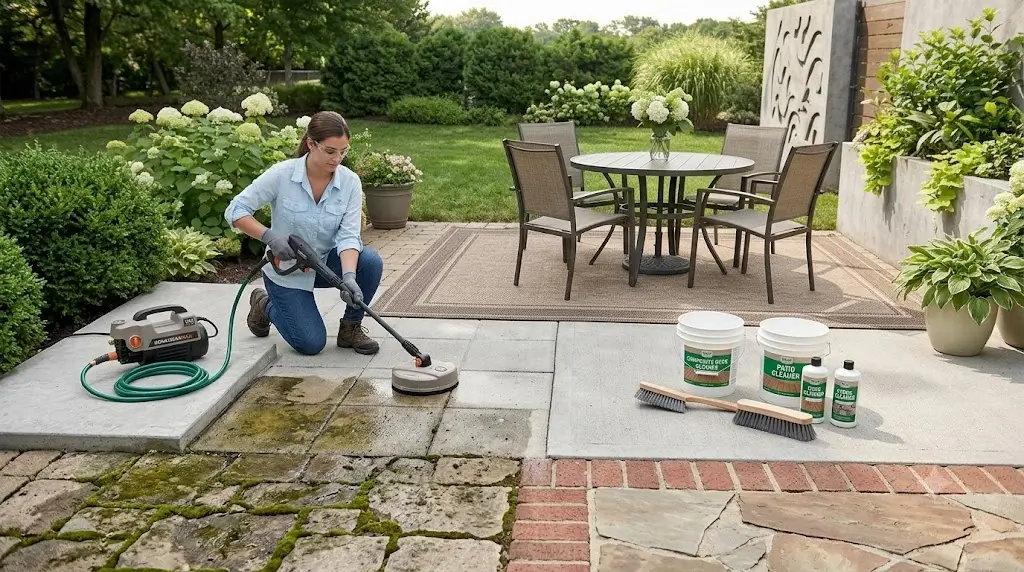
How to Clean a Patio: Concrete, Pavers, Brick & Stone
A patio collects a different mix of dirt than an indoor floor. Pollen, leaves, soil, algae, moss, food, grease, rust, tire or furniture marks, and atmospheric grime can settle into pores, joints, texture and surface coatings.
Understanding how to clean a patio safely depends first on what the patio is made of. Concrete, concrete pavers, brick, natural stone, stamped concrete, and sealed surfaces do not all tolerate the same cleaner, brush, or pressure-washer technique.
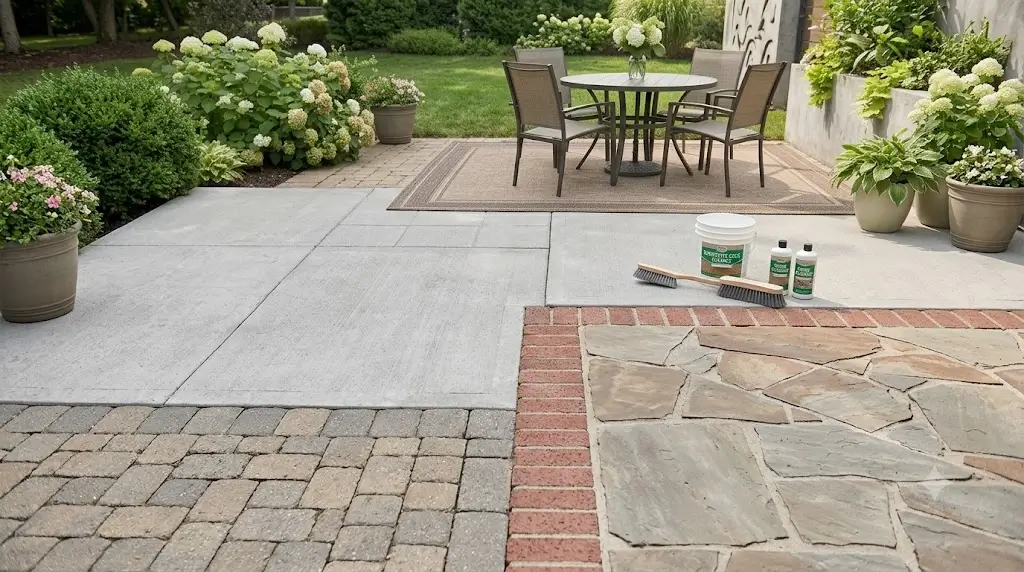
Before You Clean: Identify the Patio Surface
The surface material determines how aggressive you can be with water pressure, chemicals, and mechanical scrubbing when learning how to clean a patio. Just as engineered caps require specific methods when learning how to clean composite decking, outdoor masonry and stone surfaces each have distinct durability thresholds.
| Patio Surface | Typical Cleaning Approach | Main Risk |
|---|---|---|
| Unsealed concrete | Cleaner + brush + hose or controlled pressure washing | Etching or surface damage from excessive pressure |
| Stamped concrete | Gentle cleaning appropriate for the finish | Damaging decorative texture or sealer |
| Sealed concrete | Compatible cleaner + controlled rinsing | Dulling or stripping the coating |
| Concrete pavers | Cleaner + brushing + controlled rinsing | Removing joint sand or damaging joints |
| Brick | Low-to-moderate pressure and brick-compatible cleaner | Damaging mortar or brick surface |
| Natural stone | Stone-compatible cleaner and conservative rinsing | Etching or discoloration |
Do not clean an unknown patio with maximum pressure.If you do not know whether the surface is sealed, painted, coated, fragile, repaired, or made from natural stone, start with a small test area and the mildest practical method to clean a patio safely.
Tools and Supplies You Need to Clean a Patio
- Outdoor broom
- Garden hose
- Adjustable hose nozzle
- Stiff nylon deck or patio brush
- Bucket
- Surface-compatible patio cleaner
- Cleaning gloves
- Safety goggles
- Closed-toe shoes
- Pressure washer, if appropriate for the surface (options among the best electric pressure washers provide excellent control for residential spaces)
- Pressure washer surface cleaner, when appropriate
- Plastic sheeting or covers for nearby plants when using chemicals
A pressure washer is not mandatory. Lowe’s current concrete-patio guide lists an outdoor broom, garden hose, spray nozzle, and stiff-bristle deck brush among the basic tools needed to clean a patio thoroughly.
The Best Patio Cleaning Method
The most reliable method for how to clean a patio is a systematic progression rather than relying on a single high-pressure tool:
- Remove loose debris.
- Identify the surface.
- Pre-rinse.
- Pre-treat stains.
- Apply a compatible cleaner.
- Scrub where necessary.
- Rinse completely.
- Inspect after drying.
- Repeat spot treatment if needed.
This sequence matters because high-pressure water is not a replacement for cleaning chemistry when you clean a patio slab or paver layout. Oil, algae, organic staining, and mineral deposits require targeted chemical treatments.
How to Clean a Patio Step by Step
1 Clear the Patio Area
Move patio furniture, grills, planters, toys, rugs, and other objects away before you clean a patio.
Cleaning around objects leaves hidden dirty areas and can also expose furniture or decorative items to detergent or pressure-washer overspray.
2 Sweep Away Loose Dirt
Use an outdoor broom or leaf blower to remove leaves, soil, grass clippings, pollen, and loose debris.
This is one of the easiest ways to reduce the amount of material that must be removed with water when preparing to clean a patio.
3 Protect Nearby Plants
If you are using a chemical cleaner, identify nearby grass, flowers, shrubs, and garden beds.
Cover or wet vulnerable vegetation as appropriate for the cleaner being used, and follow the product label.
4 Pre-Rinse the Patio
Use a garden hose to wet the surface and remove loose contamination.
A pre-rinse also helps reveal where the more difficult stains are located before you apply cleaning solutions.
5 Apply the Correct Cleaner
Choose a cleaner formulated specifically for your patio material.
Read the product label for dilution, dwell time, and compatibility. Always test an inconspicuous section before applying an unfamiliar chemical across the entire patio.
6 Scrub the Surface
Use a stiff nylon brush for compatible concrete surfaces and focus on stained or textured areas.
Avoid metal-wire brushes unless the material manufacturer specifically permits them. QUIKRETE warns that wire or metallic bristles can scratch or damage concrete.
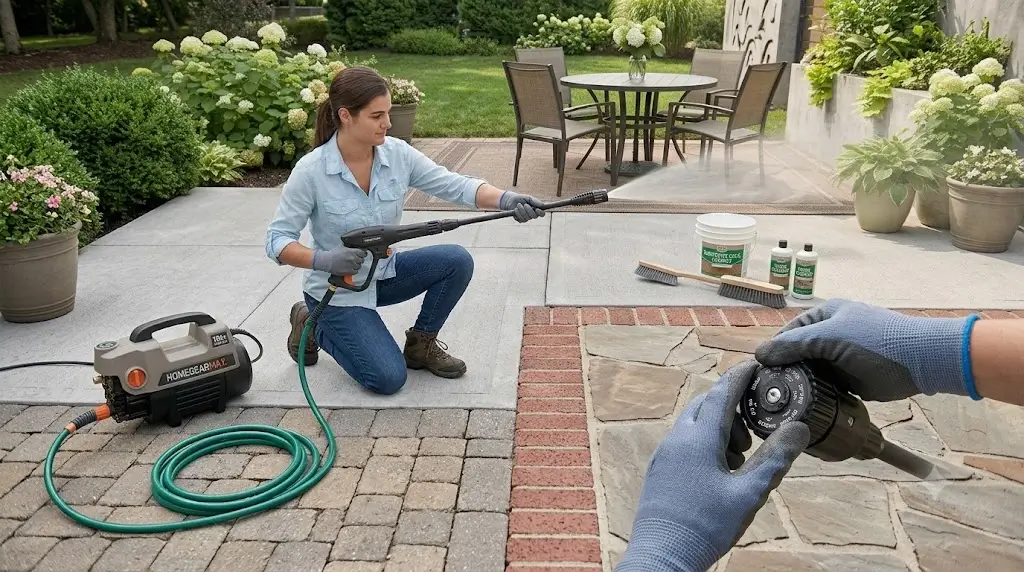
7 Rinse Thoroughly
Rinse until the cleaning solution and loosened dirt are completely washed away.
Cleaner residue can leave streaks or create a slippery film if left to dry.
8 Inspect the Patio
Allow the surface to dry enough to see remaining stains clearly.
Do not immediately escalate to stronger chemicals or higher pressure simply because a wet patio still looks uneven. Water can temporarily darken concrete and stone.
9 Spot-Clean Remaining Stains
Treat oil, rust, algae, paint, and mineral deposits according to the specific stain rather than repeatedly pressure washing the entire patio.
10 Let the Patio Dry Completely
Allow the patio to dry before replacing furniture, applying sealer, or evaluating the final appearance.
How to Clean a Concrete Patio
Knowing how to clean a concrete patio is relatively straightforward because concrete can generally tolerate more mechanical agitation than many decorative surfaces. That does not mean every concrete slab should be pressure washed aggressively.
Routine Concrete Cleaning
- Sweep the surface.
- Wet the concrete.
- Apply a concrete-compatible cleaner.
- Scrub heavily soiled areas.
- Rinse with a hose or suitable pressure-washer setting.
- Allow the surface to dry.
Lowe’s current concrete patio guide recommends sweeping, wetting the surface, applying a commercial outdoor/concrete cleaner, scrubbing stained areas, and rinsing thoroughly.
For Heavily Soiled Concrete
Pressure washing can reduce labor on large concrete surfaces. Start conservatively and increase cleaning power only when necessary.
QUIKRETE describes 2,500 PSI pressure washing as an option for extremely stubborn dirt and stains on sound concrete patios, while recommending milder detergent-and-brush methods for lighter contamination.
How to Clean Patio Pavers
When figuring out how to clean patio pavers, keep in mind they have an additional consideration that a monolithic concrete slab does not: the joints.
Aggressive pressure washing can disturb joint material and expose or remove sand between individual pavers.
Best Method
- Sweep the pavers and joints.
- Remove weeds and loose organic debris.
- Pre-rinse.
- Apply a paver-compatible cleaner.
- Scrub stained areas.
- Rinse with controlled pressure.
- Inspect the joints after drying.
Pressure-washing pavers requires more control than cleaning a solid slab.Avoid concentrating the spray directly into joints. If joint sand has been displaced, the patio may require joint restoration after cleaning.
How to Clean a Brick Patio
Understanding how to clean a brick patio involves protecting both the brick surface and surrounding mortar. Brick can accumulate dirt, algae, moss, efflorescence, and organic staining in its pores and mortar joints.
Start with a broom, water, and a brick-compatible cleaner. Use conservative pressure and test a small area first.
What to Avoid
- Highly concentrated pressure from very close range
- Unverified acid cleaners
- Wire brushes that can damage the surface
- Spraying mortar joints aggressively
- Cleaning damaged or crumbling brick with high pressure
How to Clean a Natural Stone Patio
Learning how to clean a natural stone patio requires knowing your specific rock type. Natural stone is not one single material: granite, slate, limestone, sandstone, and flagstone have different levels of porosity and chemical sensitivity.
For this reason, do not assume that a cleaner suitable for concrete is automatically suitable for stone.
Natural stone requires extra caution with acids.Acidic cleaners can damage acid-sensitive stones such as limestone and some other calcareous materials. Identify the stone and verify cleaner compatibility before using an acidic product.
Conservative Stone-Cleaning Sequence
- Remove loose debris.
- Wet the stone.
- Use a stone-compatible cleaner.
- Scrub gently with an appropriate brush.
- Rinse thoroughly.
- Inspect after drying.
How to Clean Stamped Concrete Patios
Stamped concrete combines concrete with a decorative surface pattern and often a sealer or protective coating.
The surface should therefore be treated more carefully than ordinary unfinished concrete when you clean a patio with decorative textures.
Before pressure washing, determine whether the surface is sealed and check the sealer manufacturer’s recommendations.
Avoid holding a concentrated spray in one location. Excessive mechanical force can damage the surface or alter the appearance of a decorative finish.
How to Clean Sealed Concrete Patios
Sealed concrete has a surface barrier that alters your cleaning approach.
A cleaner that is harmless to bare concrete can potentially dull, soften, or otherwise degrade a coating when you clean a patio with a top seal.
Best Practice
- Identify the sealer if possible.
- Use a cleaner compatible with that sealer.
- Avoid aggressive pressure until the coating’s limits are known.
- Test a hidden area first.
- Rinse completely.
Can You Pressure Wash a Patio?
Yes, many patios can be pressure washed, but the correct technique depends on the surface.
Concrete generally provides more tolerance than decorative coatings, fragile stone, deteriorated brick, or paver joints.
Lowe’s recommends using the lowest pressure and widest-angle nozzle that effectively cleans the surface. Its general pressure-washer guidance also recommends testing the nozzle on an inconspicuous area before proceeding.
Think in terms of cleaning power, not PSI alone.Actual cleaning force at the surface depends on PSI, GPM, nozzle orifice, spray angle, distance, and movement speed. A high-rated machine does not need to be operated at maximum output for every patio.
What PSI Do You Need to Clean a Patio?
There is no universal patio PSI.
For ordinary concrete patio maintenance, a practical starting point is usually a lower-pressure setting rather than maximum machine output.
Home Depot’s current patio-maintenance guidance gives a general range of approximately 1,900–2,700 PSI with a nozzle setting of no less than 15 degrees, while also recommending a low setting to reduce the risk of damaging concrete.
QUIKRETE provides a more aggressive 2,500 PSI example for extremely stubborn contamination on concrete, illustrating why PSI should be matched to the cleaning task rather than treated as a fixed requirement.
| Patio Condition | Starting Approach | Reason |
|---|---|---|
| Light dust | Garden hose | No high pressure necessary |
| General dirt | Low/moderate pressure or brush | Enough force without unnecessary surface stress |
| Ground-in concrete grime | Moderate pressure + cleaner | Chemistry reduces mechanical work |
| Heavy organic contamination | Pre-treatment + controlled pressure | Organic growth may need chemical treatment |
| Fragile stone or coating | Manual cleaning first | Surface may be pressure-sensitive |
What Pressure Washer Nozzle Should You Use on a Patio?
For broad patio cleaning, wider fan patterns generally distribute impact across a larger area than narrow jets.
| Nozzle | General Character | Patio Use |
|---|---|---|
| 0° | Extremely concentrated | Avoid for general patio cleaning |
| 15° | High-impact fan | Heavy-duty concrete only when appropriate |
| 25° | Moderate fan | Common general-purpose option |
| 40° | Wide fan | Lower-impact cleaning and rinsing |
| Soap nozzle | Low pressure | Applying detergent |
Home Depot’s patio guidance recommends a nozzle setting of no less than 15 degrees, while Lowe’s advises using the lowest-pressure, widest-angle nozzle that effectively cleans the surface.
Should You Use a Pressure Washer Surface Cleaner?
For a large, relatively flat concrete patio, a surface cleaner can provide a more uniform cleaning pattern than a handheld wand.
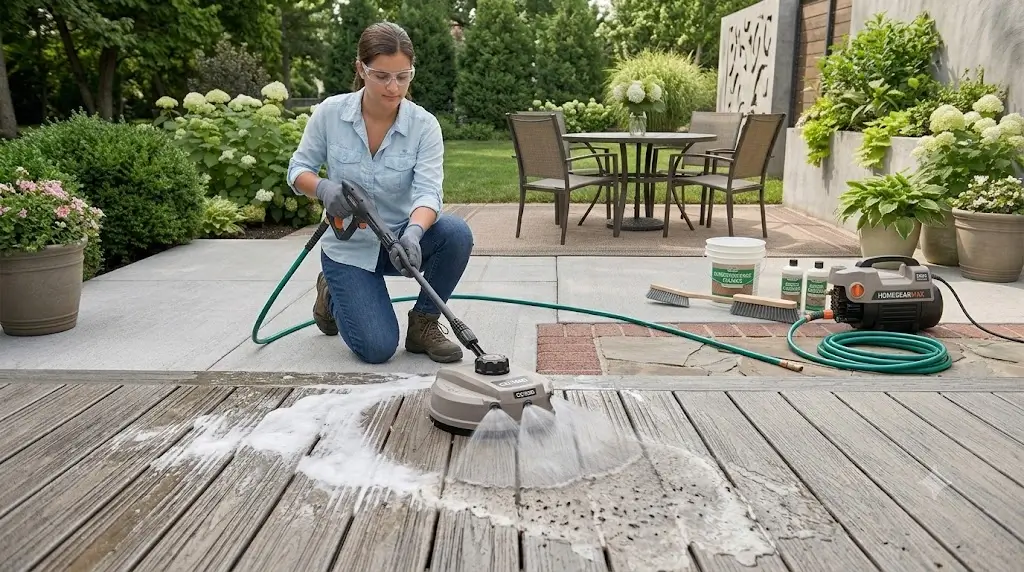
The rotating spray bars distribute the cleaning action over a defined circular area, which can reduce visible wand striping when used correctly.
When a Surface Cleaner Makes Sense
- Large concrete patios
- Flat slabs
- Heavy general dirt
- Projects where consistent cleaning appearance matters
When to Be Careful
- Damaged concrete
- Loose pavers
- Fragile brick
- Natural stone with uncertain compatibility
- Decorative or deteriorated coatings
Match the surface-cleaner diameter and nozzle configuration to the pressure washer’s actual flow rate rather than PSI alone.
How to Remove Algae and Green Slime From a Patio
Green discoloration is often associated with algae, moss, or other biological growth, especially where moisture, shade, and organic debris persist.
Step-by-Step
- Remove leaves and organic debris.
- Rinse the surface.
- Apply a compatible outdoor cleaner or biological-growth treatment.
- Allow the product to work according to its label.
- Scrub the affected area.
- Rinse thoroughly.
- Improve drainage or sunlight exposure where practical.
Do not rely exclusively on pressure when you clean a patio with algae. Mechanical removal can make the patio look cleaner while leaving favorable conditions for regrowth.
How to Remove Moss From a Patio
Moss commonly grows where patio surfaces remain damp and shaded.
Remove the bulk of the growth mechanically, then clean the remaining staining using a surface-compatible treatment.
Also address the root cause: blocked drainage, excessive shade, leaf accumulation, or persistent moisture.
Do not aggressively pressure wash fragile mortar or paver joints simply to remove moss.The resulting joint damage can create a larger maintenance problem than the original moss.
How to Remove Oil and Grease From a Patio
Oil is easier to manage when treated quickly.
Fresh Oil
Blot or absorb excess oil before adding water. An absorbent material can help reduce the amount that penetrates deeper into porous concrete.
Older Grease
Use a concrete- or patio-compatible degreaser according to the manufacturer’s instructions, scrub the affected area, and rinse thoroughly.
Lowe’s recommends baking soda as an option for absorbing oil that has not already soaked into concrete, followed by scrubbing and rinsing.
How to Remove Rust From a Patio
Rust stains can originate from metal furniture, fertilizer, tools, planters, or other iron-containing material.
Start with a rust remover specifically compatible with the patio material.
Do not use an acid-based rust remover blindly.Acid compatibility varies significantly between concrete, stone, brick, and decorative finishes. Natural stone is especially important to identify before using acidic chemistry.
How to Remove Leaf and Tannin Stains From a Patio
Leaves can leave brown or dark organic staining, especially when they remain wet on porous concrete or pavers.
- Remove the leaves.
- Sweep away remaining organic debris.
- Apply a compatible patio cleaner.
- Scrub the stained area.
- Rinse thoroughly.
- Repeat if the product instructions permit.
Preventing long-term leaf accumulation is easier than repeatedly restoring deep organic stains on your patio.
How to Remove White Efflorescence From Patio Pavers
White powdery deposits on masonry and pavers can be efflorescence, a mineral deposit associated with moisture movement through masonry.
Efflorescence is different from ordinary dirt, so increasing water pressure may not solve the underlying problem.
Use a cleaner specifically designed for the material and stain, and follow the manufacturer’s instructions.
Avoid using acid simply because it appears to dissolve the deposit. The paver, joint material, and surrounding surfaces must all be compatible with the treatment.
How to Clean Weeds From Patio Joints
Weeds growing between pavers are usually a joint-maintenance problem rather than simply a surface-cleaning problem.
- Remove the visible weeds.
- Clear loose organic material from the joints.
- Clean the patio surface thoroughly.
- Inspect joint depth and condition.
- Replace or restore joint material if required.
Pressure washing directly into joints can remove polymeric or bedding sand. If that happens, the patio will need joint restoration after cleaning.
How to Remove Paint From a Patio
Paint removal depends on whether the paint is latex, acrylic, oil-based, or another coating, and whether it is fresh or cured.
Fresh water-based paint may be easier to remove than old cured paint.
For stubborn paint on concrete, pressure washing can sometimes help, but Lowe’s recommends selecting the nozzle and pressure carefully, testing an inconspicuous area, and keeping the spray moving.
How to Clean a Patio Without a Pressure Washer
If you don’t own power equipment, you can still easily learn how to clean a patio without a pressure washer.
Manual Cleaning Method
- Sweep the patio thoroughly.
- Wet the surface with a hose.
- Apply a compatible patio cleaner.
- Allow it to work according to the label.
- Scrub with a stiff nylon brush.
- Rinse thoroughly.
- Spot-clean remaining stains.
- Allow the patio to dry.
For ordinary residential spaces, this manual routine is often sufficient for routine maintenance. Lowe’s explicitly lists cleaning a concrete patio without a power washer as a viable and safe method.
How to Clean a Patio After a BBQ
Barbecue areas commonly develop grease, food residue, smoke residue, and dark spots.
Clean spills as soon as practical rather than allowing oils to penetrate porous concrete.
- Remove food particles.
- Absorb fresh oil.
- Apply a compatible degreaser.
- Scrub the affected area.
- Rinse completely.
- Repeat spot treatment if necessary.
How to Clean a Patio After Winter
Spring is one of the best times to perform a full cleaning because winter leaves behind leaves, dirt, organic material, and moisture-related staining.
QUIKRETE specifically recommends spring cleaning for concrete patios and notes that the correct method depends on how dirty the patio is and what type of stain is present.
Spring Checklist
- Sweep leaves and debris.
- Clear drainage paths.
- Inspect cracks and joints.
- Check for moss and algae.
- Clean grease and rust stains.
- Rinse the surface.
- Inspect after drying.
12 Common Patio Cleaning Mistakes
1. Starting With Maximum PSI
More pressure is not automatically better. Start with the least aggressive method that can accomplish the job.
2. Using a 0-Degree Nozzle
A concentrated jet can create localized surface damage.
3. Holding the Wand Too Close
Reducing distance increases the intensity of the water’s impact on the surface.
4. Staying in One Spot
A stationary spray can etch or discolor concrete.
5. Using Acid Without Identifying the Material
Some masonry and natural stones are sensitive to acidic chemistry.
6. Using Wire Brushes on Concrete
Metal bristles can scratch or damage the surface. QUIKRETE specifically warns against them for concrete cleaning.
7. Ignoring Paver Joints
Aggressive cleaning can remove joint material.
8. Cleaning Without Testing
Always test an unfamiliar cleaner or aggressive cleaning method in a discreet area first.
9. Letting Cleaner Dry
Dried detergent can leave residue and make the final result uneven.
10. Cleaning Only the Visible Stain
Organic growth and grease may extend beyond the area that is visibly discolored.
11. Ignoring Drainage
Persistent moisture can cause algae and moss to return.
12. Applying Sealer Immediately
Concrete and masonry must be appropriately clean and dry before sealing, and the sealer must be compatible with the surface.
How Often Should You Clean a Patio?
There is no universal schedule because patios in shaded, wooded, or humid environments accumulate organic material faster than exposed patios. Similar to seasonal maintenance routines when considering how to clean a wood deck, outdoor living spaces thrive on regular inspections and scheduled washing.
| Cleaning Task | Typical Timing | Why |
|---|---|---|
| Sweep | Weekly or as needed | Prevents debris accumulation |
| Spot-clean spills | Immediately | Reduces staining |
| Rinse | Every few weeks or as needed | Removes loose dirt and pollen |
| Full cleaning | Spring and/or fall | Removes seasonal buildup |
| Mildew inspection | Seasonally | Finds biological growth early |
For a concrete patio, Lowe’s recommends cleaning every few months as general maintenance and specifically highlights spring, post-party cleanup, and prompt treatment of oil, rust, and grease.
Should You Seal a Patio After Cleaning?
A concrete patio may benefit from sealing, but sealing is not automatically necessary every time you clean a patio.
The decision depends on whether the concrete is already sealed, the type of sealer, the condition of the surface, and the intended performance.
Potential Benefits
- Reduced absorption of some stains
- Improved resistance to weather exposure
- Easier future cleaning
- Potentially improved appearance
Important Considerations
The patio must be properly prepared and sufficiently dry before sealing. A sealer can also change surface appearance and traction characteristics.
QUIKRETE notes that sealing can help protect concrete and make future maintenance easier, while also warning that sealed concrete can be slippery when wet.
Patio Cleaning Decision Tree
Is the patio only dusty?
→ Sweep + hose.
Is there ordinary dirt?
→ Compatible cleaner + brush + rinse.
Is the patio concrete and heavily soiled?
→ Consider controlled pressure washing after testing the surface.
Is it paver?
→ Protect joints and avoid concentrated spray.
Is it natural stone?
→ Identify the stone before selecting chemicals.
Is there algae or moss?
→ Treat the biological growth and correct persistent moisture conditions.
Is there oil?
→ Use an appropriate degreaser or absorbent treatment.
Is there rust?
→ Use a material-compatible rust treatment.
Is there a decorative coating or sealer?
→ Follow the coating manufacturer’s cleaning instructions.
Patio Cleaning: Pressure Washer vs. Garden Hose
| Factor | Garden Hose | Pressure Washer |
|---|---|---|
| Light dust | Excellent | Usually unnecessary |
| Loose dirt | Good | Fast |
| Heavy concrete grime | Limited | Very useful |
| Large patio | Slow | Efficient |
| Fragile surface | Lower risk | Requires caution |
| Paver joints | Lower mechanical impact | Potential joint disturbance |
| Decorative coating | Safer starting point | Requires compatibility check |
How PSI and GPM Affect Patio Cleaning
Pressure washer performance is not determined by PSI alone when you clean a patio.
PSI describes pressure. GPM describes water flow. Understanding what GPM you need is critical because a machine with higher flow can move more water and rinse heavy sludge faster, while pressure affects the mechanical stripping force available at the surface.
For large patios, flow rate becomes particularly important because it influences how quickly you can rinse away loosened dirt.
Cleaning-power concept:A useful engineering approximation is: Cleaning Units (CU) = PSI × GPM
CU is useful for comparing pressure-washer output, but it does not replace surface-specific technique. Nozzle angle, orifice size, distance, and movement still determine how the energy reaches the patio.
How to Avoid Pressure-Washer Striping on Concrete
Visible stripes occur when the spray cleans one path more aggressively than adjacent paths.
To Reduce Striping
- Keep your walking speed consistent.
- Maintain a consistent nozzle distance.
- Overlap adjacent passes.
- Keep the wand moving.
- Use a surface cleaner for large flat slabs when appropriate.
- Avoid stopping over one spot.
Lowe’s recommends overlapping passes and working in manageable sections during pressure-washer cleaning.
When You Should Not Pressure Wash a Patio
- The concrete is severely cracked or spalled.
- The surface coating is loose or failing.
- Stone type and chemical compatibility are unknown.
- Brick is deteriorated.
- Paver joints are already unstable.
- The surface has recently been repaired and has not fully cured.
- You cannot control spray direction around doors, windows, or delicate landscaping.
- The pressure washer cannot be adjusted to a suitable cleaning level.
Patio Cleaning Safety
Pressure washers and chemical cleaners can cause injuries or property damage if used incorrectly.
- Wear splash-resistant safety goggles.
- Wear closed-toe footwear.
- Use gloves appropriate for the cleaner.
- Keep children and pets away from the work area.
- Never point the spray wand at people or animals.
- Keep electrical connections protected from water.
- Follow the pressure-washer manual.
- Follow the chemical label.
- Protect nearby plants from chemical overspray.
- Never mix cleaning chemicals unless the product instructions specifically permit the combination.
Lowe’s and Home Depot both emphasize appropriate protective equipment and surface testing when using pressure washers to clean a patio.
Frequently Asked Questions
What is the best way to clean a patio?
The best way to clean a patio is to sweep loose debris, identify the surface, pre-rinse, apply a compatible cleaner, scrub stained areas, rinse thoroughly, and allow the patio to dry. Use a pressure washer only when the surface and cleaning task are appropriate.
Can you pressure wash a patio?
Yes, many concrete patios can be pressure washed. However, pressure should be matched to the surface and condition. Pavers, brick, natural stone, and coated surfaces require additional caution.
What PSI should I use to pressure wash a concrete patio?
There is no single correct PSI. A practical approach is to start conservatively and increase cleaning power only when needed. Home Depot gives a general patio-maintenance range of approximately 1,900–2,700 PSI, while QUIKRETE describes 2,500 PSI for extremely stubborn contamination on sound concrete.
What nozzle is best for cleaning a patio?
For broad patio cleaning, a wider fan nozzle is generally safer than a concentrated 0-degree jet. A 25-degree nozzle is commonly useful for concrete, while a 40-degree pattern provides lower-impact coverage. Always follow the pressure-washer and surface manufacturer’s instructions.
Can I clean a patio without a pressure washer?
Yes. Sweep the surface, rinse it, apply a compatible cleaner, scrub with a suitable brush, and rinse thoroughly. This manual method is sufficient for many routine concrete patio cleaning jobs.
How do I clean green algae from a patio?
Remove organic debris, apply a compatible outdoor cleaner or algae treatment, scrub the surface, and rinse thoroughly. Also address shade, drainage, and persistent moisture that can encourage regrowth.
How do I remove oil from a concrete patio?
Treat fresh oil as soon as possible with an absorbent material, then use a concrete-compatible degreaser or cleaner. Scrub and rinse thoroughly. Older oil stains may require repeated treatment.
How do I remove rust from a patio?
Use a rust remover compatible with the patio material. Do not assume an acid-based product is safe for every patio, particularly natural stone.
Can I use bleach to clean a concrete patio?
Do not use bleach automatically. Verify compatibility with the concrete finish, nearby plants, and the specific cleaning product instructions. QUIKRETE warns that bleach and acidic cleaners can discolor or otherwise harm concrete and surrounding materials.
What is the easiest way to clean a large concrete patio?
For a large, sound concrete patio, a pressure washer paired with an appropriately sized surface cleaner can reduce cleaning time and help create a more uniform result. Use the lowest effective pressure and correct nozzle configuration.
Can pressure washing damage concrete?
Yes. Excessive pressure, a concentrated nozzle, excessive dwell time, or holding the spray too close can damage the surface or create visible etching. Test a small area and keep the spray moving.
Can you pressure wash patio pavers?
Pavers can often be cleaned with controlled pressure, but the joints require special care. Excessive pressure can displace joint sand or damage deteriorated joints.
Can you pressure wash natural stone?
Some natural stone can be cleaned with controlled pressure, but stone type matters. Identify the stone and follow the stone manufacturer’s or installer’s cleaning guidance before using high pressure or chemical cleaners.
How often should a patio be cleaned?
Sweep as needed, clean spills promptly, and perform a deeper cleaning at least seasonally or whenever dirt, algae, moss, or staining becomes noticeable. Patios surrounded by trees or exposed to persistent moisture may need more frequent cleaning.
Should I seal my concrete patio after cleaning?
Sealing can help protect suitable concrete surfaces and may make future cleaning easier, but the surface must be properly prepared and dry and the sealer must be compatible with the concrete. Sealed concrete can also become slippery when wet.
How do I prevent patio stains from coming back?
Sweep regularly, remove leaves, clean spills promptly, keep drainage paths clear, and reduce persistent moisture where possible. For suitable concrete, a compatible sealer may also reduce absorption and simplify future maintenance.
Bottom Line: The Best Way to Clean a Patio
The best patio-cleaning method is not simply the most powerful one. It is the method that removes contamination while preserving the surface integrity.
For ordinary maintenance, sweep, rinse, apply the right cleaner, scrub, and rinse. For large or heavily soiled concrete patios, pressure washing can dramatically reduce labor when the pressure, nozzle, and technique are appropriate.
The most important decision when planning how to clean a patio comes before you turn on the pressure washer: identify the patio material. Concrete, pavers, brick, natural stone, stamped concrete, and sealed surfaces each require a specific cleaning approach.
