
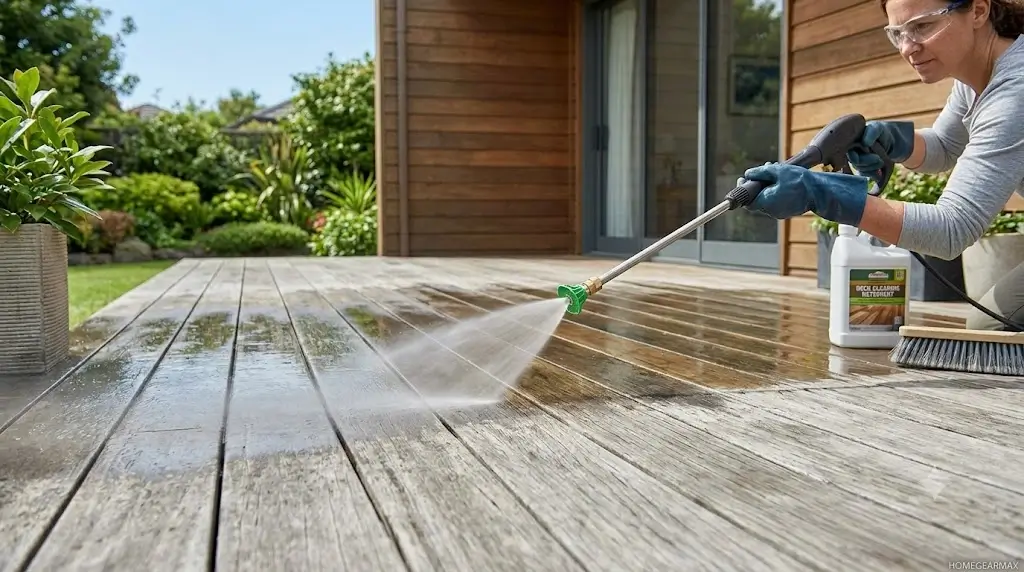
How to Clean a Wood Deck Without Damaging It
Cleaning a wood deck is less about using maximum pressure and more about controlling
water pressure, flow rate, nozzle angle, spray distance, cleaning chemistry, and drying time.
A pressure washer can remove dirt, algae, mildew, gray weathered fibers, and surface grime quickly, but the same machine can also scar soft wood, expose fresh fibers, create lap marks, and drive water into damaged boards if it is used incorrectly.
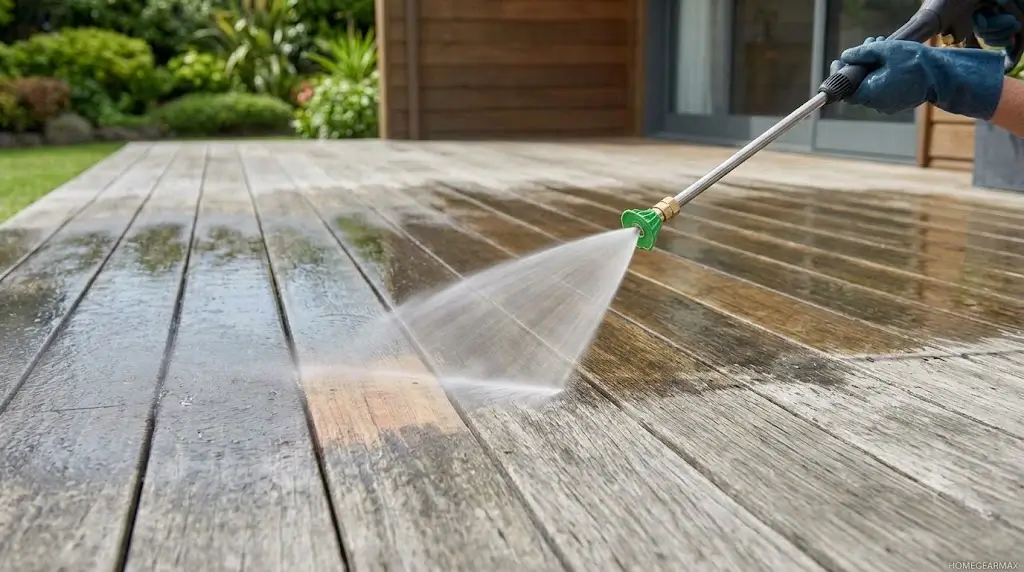
The safest approach is to identify the wood first, remove loose debris, apply an appropriate deck cleaner, allow the cleaner to work, rinse with controlled pressure, and let the deck dry thoroughly before sanding or applying a new finish.
500–800 PSI for softer wood and 800–1,200 PSI for harder or pressure-treated wood,
provided the surface tolerates the test area. Use a wide fan nozzle, keep the wand moving, maintain a consistent distance, and avoid concentrating the spray directly into cracks, end grain, damaged boards, or fastener holes.The exact pressure matters less than the combination of pressure + nozzle orifice + distance + angle + operator movement. Never assume that a pressure washer advertised as 2,000, 3,000, or 4,000 PSI should be used at that pressure on a wood deck.
Before You Clean: Identify the Deck
Not all wood decks should be cleaned the same way. Wood species, age, surface condition, previous coatings, board orientation, and existing damage determine how aggressively you can clean the surface.
| Deck Type | Relative Cleaning Risk | Starting Approach | Important Consideration |
|---|---|---|---|
| Cedar | High | Low pressure + wide spray | Soft fibers can be easily raised |
| Redwood | High | Low pressure + controlled rinse | Aggressive spray can create visible texture differences |
| Pressure-treated pine | Moderate | Moderate pressure after testing | Older boards can become soft and splintered |
| Hardwood | Moderate | Controlled pressure | Dense wood can still be scarred by a concentrated jet |
| Composite | Different cleaning method | Follow manufacturer guidance | Do not treat composite like unfinished wood |
Before bringing out the pressure washer, inspect the deck for loose boards, protruding fasteners, rotten sections, cracked boards, damaged railings, and areas where previous paint or stain is already failing.
Do not pressure-wash structurally damaged wood.If a board is soft, severely cracked, rotten, or unstable, cleaning it does not solve the underlying problem. High-pressure water can make existing damage worse. Repair or replace compromised boards before deep cleaning.
What You Need to Clean a Wood Deck
You do not need an extremely powerful pressure washer to clean a residential wood deck; in fact, many of the best electric pressure washers provide ideal, manageable output for residential surfaces where control is more valuable than maximum advertised PSI.
- Pressure washer with adjustable pressure or a suitable nozzle
- Wide-angle fan nozzle
- Garden hose with adequate water supply
- Wood-safe deck cleaner
- Stiff synthetic-bristle deck brush
- Bucket or pump sprayer if the cleaner requires one
- Safety glasses
- Water-resistant gloves
- Protective footwear
- Plastic sheeting or covers for sensitive nearby items when appropriate
The pressure washer’s maximum PSI is not your target cleaning pressure.A machine rated for 3,000 PSI can still be useful for wood if its pressure can be controlled or a larger-orifice nozzle is used. The objective is to remove contamination without removing sound wood.
How Much PSI Should You Use on a Wood Deck?
PSI means pounds per square inch. It describes pressure, but it does not tell you the complete cleaning force delivered to the deck.
For wood, a useful starting framework is:
| Wood / Condition | Suggested Starting Range | Technique |
|---|---|---|
| Soft cedar or redwood | 500–800 PSI | Wide fan, longer distance, constant movement |
| Older weathered wood | 500–1,000 PSI | Start low because weakened fibers may be easily removed |
| Pressure-treated pine | 800–1,200 PSI | Test first and increase only when necessary |
| Harder wood | 800–1,200+ PSI | Use controlled passes and avoid concentrated spray |
These are starting ranges, not universal operating specifications. The condition of the actual boards matters more than the species name alone.
Why Maximum PSI Is Usually a Bad Target
A concentrated spray produces a very small impact area. That can create a dramatic cleaning effect because the water is removing not only dirt but also loose wood fibers.
If you can see a sharply defined stripe where the spray passed, the cleaning process may be too aggressive. A properly cleaned deck should not have obvious carved lines caused by individual wand passes.
Does GPM Matter When Cleaning a Wood Deck?
Yes. GPM means gallons per minute and represents the volume of water delivered by the pressure washer. Pressure affects impact force, but knowing what GPM you need is equally critical because flow rate determines how efficiently loosened dirt and detergents are carried away.
Cleaning Units = PSI × GPM
For example, a washer producing 1,500 PSI at 1.5 GPM has a theoretical cleaning-unit figure of 2,250. That does not mean it is automatically twice as suitable for wood as another washer with a lower number. Wood cleaning depends heavily on technique and the condition of the surface.
For decks, excessive flow can also create unnecessary pressure washer water consumption. You want enough flow to rinse away loosened contamination without turning the cleaning process into uncontrolled flooding.
Best Pressure Washer Nozzle for Wood Decks
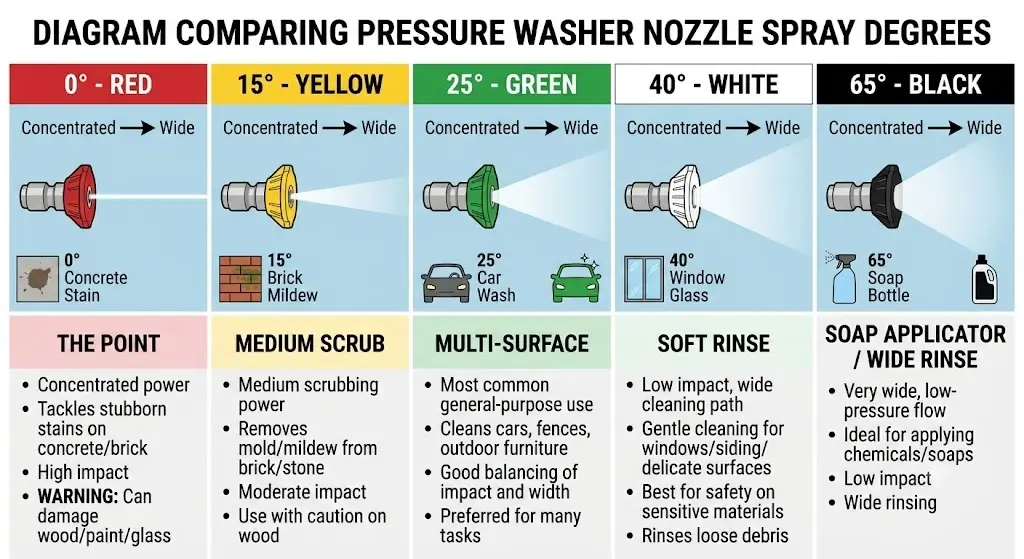
For most wood decks, a wide fan nozzle is safer than a narrow-angle nozzle.
| Nozzle Type | Wood Deck Recommendation | Why |
|---|---|---|
| 0° | Do not use | Extremely concentrated stream can gouge wood |
| 15° | Generally avoid for routine wood cleaning | Can create visible cutting or striping |
| 25° | Possible with caution | Requires controlled distance and movement |
| 40° | Preferred starting option | Wider spray distributes impact |
| 65° / soap nozzle | Useful for detergent application | Low-impact coverage |
Why a Wide Fan Is Safer
A wide fan spreads the available pressure across a larger area. The result is less aggressive impact at any single point on the wood.
This is especially important on cedar, redwood, old pressure-treated pine, and boards that have already been exposed to years of weather.
Keep the Wand Moving
Never hold the nozzle in one location while the machine is running.
Move the wand in controlled, overlapping passes. Maintain approximately the same distance from the deck throughout each pass. Uneven distance creates uneven cleaning intensity and can produce visible stripes.
Choosing the Right Wood Deck Cleaner
A chemical cleaner can reduce the amount of mechanical force required from the pressure washer. This is one of the most important ways to clean wood without damaging it.
Instead of trying to blast organic contamination from the surface, allow the cleaner to loosen it first.
For General Dirt
A wood-compatible detergent can help loosen soil, pollen, grime, and everyday outdoor contamination.
For Algae and Mildew
Use a product specifically labeled for exterior wood and organic growth. Follow the product’s dilution, dwell-time, rinsing, and plant-protection instructions.
For Oxidized Gray Wood
Weathered wood can develop a gray appearance as the surface oxidizes. Cleaning may remove some loose oxidation, but heavily weathered boards may require brightening, sanding, or refinishing after the deck has dried.
Never mix cleaning chemicals unless the manufacturer explicitly states that they are compatible.Some chemical combinations can create hazardous fumes or unwanted reactions. Use one cleaning system according to its label rather than improvising chemical mixtures.
How to Clean a Wood Deck Step by Step
1 Clear the Deck
Remove furniture, rugs, planters, decorations, grills, toys, and other movable objects. Dirt trapped underneath furniture can produce obvious differences in color after cleaning.
2 Sweep Away Loose Debris
Sweep leaves, pine needles, soil, and other dry debris from the boards. Clean the gaps between boards when practical because trapped organic material can hold moisture against the wood.
3 Inspect the Boards
Look for rot, cracks, raised fasteners, loose boards, splinters, damaged railings, and areas with deteriorated finish. Mark damaged areas mentally or with a removable reference so you do not accidentally treat them like healthy wood.
4 Protect Nearby Areas
Consider nearby plants, exterior electrical equipment, delicate finishes, outdoor furniture, and painted surfaces. Move objects that can be moved. Wet vegetation before and after cleaning when appropriate for the cleaning product being used.
5 Wet the Deck if Required
Some cleaning products work best when the wood is damp before application. Others specify a different procedure. Follow the cleaner’s label rather than assuming every product behaves the same way.
6 Apply the Deck Cleaner
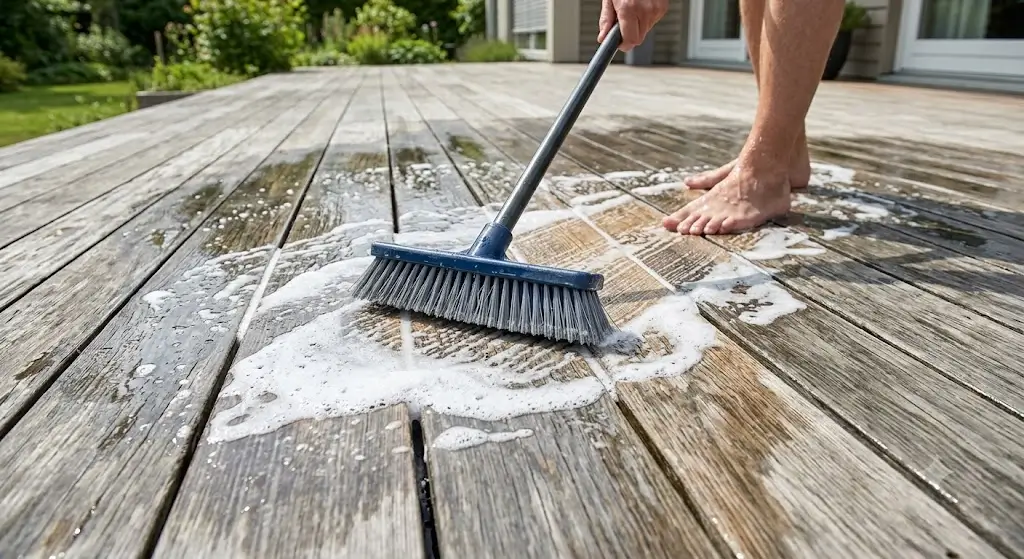
Apply enough cleaner to keep the surface wet during the required dwell period. Do not allow the solution to dry prematurely unless the product specifically permits it. The objective is to give the chemical time to loosen contamination so the pressure washer does less physical work.
7 Scrub Difficult Areas
Use a synthetic deck brush on heavily soiled sections. Scrubbing is often more controllable than increasing pressure.
8 Rinse with Low Controlled Pressure
Start with the widest suitable spray pattern and maintain a consistent distance from the boards. Keep the wand moving parallel to the board direction rather than repeatedly attacking the same point from multiple angles.
9 Inspect While Cleaning
Stop periodically and look at the surface from different angles. You are checking for raised fibers, gouging, uneven color, and areas that are being cleaned more aggressively than surrounding boards.
10 Allow the Deck to Dry
Do not immediately apply stain or sealer simply because the surface looks dry. Wood can retain moisture below the surface. Use the coating manufacturer’s moisture requirements when preparing for staining or sealing.
How to Clean Cedar and Redwood Decks
Cedar and redwood are attractive outdoor decking materials, but both can be relatively vulnerable to aggressive pressure washing because their surface fibers are easier to remove than dense hardwood.
Use a wide spray pattern, conservative pressure, and a longer working distance. Chemical cleaning and gentle brushing should perform much of the cleaning work.
Watch for These Warning Signs
- Raised fuzzy fibers
- Long grooves following wand passes
- Sharp color transitions
- Splintering
- Soft or degraded board sections
- Wood grain appearing unusually rough after rinsing
If any of these appear, stop increasing pressure. More pressure is not the solution.
How to Clean Pressure-Treated Wood
Pressure-treated pine is common in North American decks because preservatives are introduced into the wood to improve resistance to decay and insects. It is still wood, however, and the surface can be damaged by excessive mechanical force.
Older pressure-treated decks deserve particular caution because years of UV exposure, moisture cycling, and freeze-thaw conditions can weaken the surface fibers.
A moderate pressure setting can be effective after testing, but do not rely solely on the pressure washer’s maximum rating.
How to Clean Hardwood Decks
Hardwood decking can tolerate more mechanical stress than many softwoods, but a concentrated pressure stream can still damage it.
Dense wood may show fewer obvious fibers initially, which can encourage operators to increase pressure too quickly. That is unnecessary when a cleaner and appropriate nozzle are doing most of the work.
Use a controlled spray pattern and inspect the finish after cleaning. If the deck has an oil-based or film-forming coating, determine whether the goal is routine cleaning or complete coating removal before choosing a pressure-washing strategy.
How to Clean a Wood Deck Without a Pressure Washer
A pressure washer is not required for routine deck cleaning. For a lightly or moderately dirty deck, manual cleaning can provide excellent control.
- Sweep the deck thoroughly.
- Wet the boards according to the cleaner’s instructions.
- Apply a wood-compatible deck cleaner.
- Allow the recommended dwell time.
- Scrub with a stiff synthetic deck brush.
- Rinse using a garden hose with a suitable spray pattern.
- Inspect for remaining contamination.
- Repeat localized cleaning instead of using excessive force.
- Allow the wood to dry before refinishing.
When manual cleaning is better:Choose a brush-and-hose method when the deck is relatively small, the wood is fragile or heavily weathered, or you are concerned about accidentally removing sound fibers.
How to Remove Mold, Mildew and Algae From a Wood Deck
Green, black, or slippery growth on a deck often indicates persistent moisture and insufficient drying rather than simply “dirty wood.”
A proper cleaning process should address both the visible contamination and the conditions that allow it to return.
Common Moisture Sources
- Persistent shade
- Leaves accumulating on the surface
- Blocked deck gaps
- Water draining toward the deck
- Nearby irrigation systems
- Dense vegetation restricting airflow
- Furniture or outdoor rugs trapping moisture
Use a wood-safe product intended for the specific contamination and follow its label instructions. After cleaning, improve drainage and airflow where practical.
How to Remove Gray Weathered Wood
Gray decking is often the result of ultraviolet exposure and oxidation of the outer wood fibers.
Cleaning alone may not restore the original color because the gray material can be partially integrated into the weathered surface.
A deck restoration process may therefore involve:
- Cleaning
- Rinsing
- Drying
- Optional wood brightening
- Light sanding when required
- Final dust removal
- Application of an appropriate stain or sealer
Do not sand aggressively simply because the deck looks gray immediately after washing. Let the wood dry first and evaluate its actual condition.
How to Handle Common Wood Deck Stains
| Problem | Best First Approach | Pressure-Washing Note |
|---|---|---|
| Loose dirt | Cleaner + brushing | Low pressure is usually sufficient |
| Algae | Wood-safe organic-growth cleaner | Do not rely on pressure alone |
| Mildew | Appropriate mildew treatment | Rinse thoroughly according to product instructions |
| Gray oxidation | Deck cleaner / brightener system | Aggressive pressure can worsen appearance |
| Leaf stains | Deck cleaner + localized scrubbing | Increase dwell time before pressure |
| Old stain | Identify coating type and use a wood stripper | Removal may require a separate chemical stripping process |
| Grease | Suitable degreasing product | Do not simply blast the stain into surrounding boards |
How Long Should a Wood Deck Dry After Cleaning?
Drying time depends on temperature, humidity, sunlight, airflow, board thickness, wood condition, and recent rainfall.
A warm, sunny, breezy deck may dry substantially faster than a shaded deck during humid weather. There is no single drying time that applies to every installation.
If you plan to stain or seal the deck, follow the coating manufacturer’s moisture specification rather than relying on a calendar estimate.
Common Pressure-Washing Mistakes That Damage Wood Decks
1. Using the Maximum PSI
A pressure washer’s maximum rating describes machine capability, not the correct pressure for every surface.
2. Using a 0-Degree Nozzle
The narrow jet concentrates force into a tiny area and can cut grooves into wood.
3. Holding the Wand Too Close
Moving the nozzle only a few inches closer can dramatically increase impact intensity.
4. Holding the Wand Stationary
Stationary spraying creates localized damage and visible marks.
5. Cleaning Against the Grain
A concentrated stream directed across the grain can emphasize texture differences and lift loose fibers.
6. Ignoring End Grain
The ends of deck boards can absorb water more readily than the broad face of the board. Avoid forcing high-pressure water directly into end grain and cracks.
7. Trying to Remove Every Mark with Pressure
Some stains require chemistry, brushing, sanding, or coating removal. Increasing PSI is not a universal stain-removal strategy.
8. Applying Stain Too Soon
Wood can appear dry while retaining moisture. Follow the coating manufacturer’s moisture requirements.
9. Using the Wrong Cleaner
A product designed for masonry, concrete, or another substrate may not be appropriate for wood.
10. Ignoring Nearby Plants and Surfaces
Cleaning solutions and dirty rinse water can affect vegetation and adjacent surfaces. Protect and rinse surrounding areas according to the product instructions.
How Often Should You Clean a Wood Deck?
The ideal cleaning frequency depends on climate, shade, tree coverage, traffic, moisture, and the type of finish on the deck.
Many homeowners benefit from inspecting the deck at least twice a year, particularly before and after the wetter season.
Routine maintenance does not always mean pressure washing. Sweeping, removing leaves, keeping gaps open, and preventing standing moisture can reduce the amount of aggressive cleaning required later.
| Maintenance Task | Typical Timing | Purpose |
|---|---|---|
| Sweep debris | Regularly | Reduces trapped moisture and organic buildup |
| Inspect boards | Spring / fall | Finds damage before it becomes structural |
| Deep clean | As needed | Removes accumulated contamination |
| Check finish | Annually | Determines whether refinishing is needed |
| Clean drainage areas | Regularly | Improves drying and reduces organic growth |
Pressure Washer Settings: A Practical Starting Blueprint
If you are using a pressure washer for the first time on a wood deck, use this sequence rather than starting at maximum power.
- Install a wide-angle nozzle.
- Start at the lowest practical pressure.
- Begin several feet away from the wood.
- Test a small inconspicuous section.
- Move closer only if cleaning performance is insufficient.
- Keep the wand moving continuously.
- Maintain a consistent distance.
- Work in manageable sections.
- Use cleaning chemistry instead of pressure when possible.
- Stop immediately if the surface begins to fuzz, groove, or splinter.
Wood Deck Cleaning Decision Rule
Dirty but structurally sound: Clean with detergent and controlled pressure.
Soft, cracked, or rotten: Repair before pressure washing.
Heavily weathered: Use conservative pressure and expect possible sanding or refinishing.
Organic growth: Use an appropriate treatment instead of relying solely on PSI.
Old coating: Determine whether you need cleaning or coating removal.
How to Avoid Pressure-Washer Stripes on a Wood Deck
Striping occurs when one section of wood is cleaned more aggressively than another. It is particularly noticeable when weathered wood is being cleaned because the difference between treated and untreated fibers becomes visible.
To reduce striping:
- Use a wider spray pattern.
- Maintain the same wand distance.
- Keep the nozzle perpendicular to the board surface.
- Move at a consistent speed.
- Overlap adjacent passes slightly.
- Avoid stopping at the end of each pass while spraying.
- Clean entire board sections rather than randomly spot-cleaning the middle.
If a pressure washer creates obvious lines even at a conservative setting, switch to more chemical dwell time and manual brushing instead of increasing pressure.
Should You Pressure Wash Before or After Sanding?
For most deck restoration projects, cleaning generally comes before final sanding.
Pressure washing can raise loose fibers and expose rough areas that become easier to evaluate after the deck dries. Sanding before washing can also be inefficient because the cleaning process may alter the surface again.
A common restoration sequence is:
- Repair damaged boards and fasteners.
- Clean the deck.
- Allow the wood to dry.
- Evaluate raised fibers and rough areas.
- Sand where necessary.
- Remove sanding dust.
- Apply stain or sealer according to manufacturer requirements.
When You Should Not Pressure Wash a Wood Deck
Pressure washing is not always the best option if:
- The wood is severely deteriorated.
- Boards are structurally unstable.
- Large areas are rotten.
- The deck has fragile decorative details.
- You cannot control the pressure adequately.
- The surface contains a coating that requires a specialized removal process.
- You are unable to protect nearby sensitive surfaces.
In these situations, manual cleaning or professional restoration may produce a safer result.
Frequently Asked Questions
Can you pressure wash a wood deck?
Yes. Pressure washing can be an effective way to clean a wood deck when the pressure, nozzle, spray distance, and technique are appropriate for the wood’s condition. The goal is to remove contamination without removing sound wood fibers.
What PSI is safe for a wood deck?
A conservative starting range is approximately 500–800 PSI for softer woods and 800–1,200 PSI for many pressure-treated or harder wood surfaces. These are starting points rather than universal limits. Always test an inconspicuous area first.
What pressure washer nozzle should I use on a wood deck?
A wide-angle fan nozzle is generally the safest starting point. A 40-degree nozzle is commonly useful because it distributes the spray over a larger area. Avoid concentrated 0-degree jets on wood.
Can a pressure washer damage a wood deck?
Yes. Excessive pressure, a narrow nozzle, short spray distance, stationary spraying, or aggressive technique can gouge wood, raise fibers, create stripes, and remove more material than intended.
Should I use soap when pressure washing a wood deck?
A suitable wood-deck cleaner can reduce the mechanical force needed to remove dirt and organic contamination. Follow the cleaner’s dilution, dwell-time, application, and rinsing instructions.
How close should a pressure washer nozzle be to a wood deck?
There is no single distance that is safe for every machine and nozzle. Start farther away, test the surface, and gradually reduce the distance only if necessary. The correct distance is the one that cleans effectively without altering the wood.
Can you use a 2,000 PSI pressure washer on a wood deck?
Yes, but the machine’s maximum rating does not mean the deck should be exposed to 2,000 PSI. Use an appropriate nozzle, pressure setting, and spray distance to reduce the effective impact on the wood.
Can you use a 3,000 PSI pressure washer on wood?
A 3,000-PSI machine can potentially be used for wood when its output is controlled appropriately. Do not use the machine’s maximum pressure simply because it is available.
How long should I wait to stain my deck after pressure washing?
Wait until the wood meets the moisture requirement specified by the stain or sealer manufacturer. Drying time varies with weather, wood condition, airflow, sunlight, and humidity.
Can I clean a wood deck without a pressure washer?
Yes. A deck cleaner, synthetic-bristle brush, and garden hose can clean many residential decks effectively. Manual cleaning provides especially good control on soft, old, or fragile wood.
Why does my deck look fuzzy after pressure washing?
The spray may have lifted loose surface fibers. This usually indicates that the cleaning process was too aggressive for the wood’s condition. Allow the deck to dry before deciding whether light sanding is necessary.
Should I pressure wash with the grain?
Generally, working in the direction of the boards and maintaining a consistent spray angle helps produce a more uniform result. Avoid concentrating the spray across the grain or directly into cracks and end grain.
Bottom Line: The Safest Way to Clean a Wood Deck
The best wood-deck cleaning method is not the one that removes dirt fastest. It is the one that removes contamination while preserving the wood fibers you actually want to keep.
Start by identifying the wood and inspecting its condition. Sweep away debris, apply a compatible deck cleaner, give it enough dwell time, and use a wide spray pattern with conservative pressure. Keep the wand moving and maintain a consistent distance.
For soft cedar, redwood, and heavily weathered boards, prioritize chemistry and brushing over pressure. For pressure-treated and harder wood, controlled pressure can make the process faster, but maximum PSI is still unnecessary.
After cleaning, allow the deck to dry thoroughly and use the coating manufacturer’s moisture requirements before staining or sealing.
The key principle:Use the least mechanical force that gets the surface clean. The pressure washer should assist the cleaning process, not become the primary tool for removing wood.
