
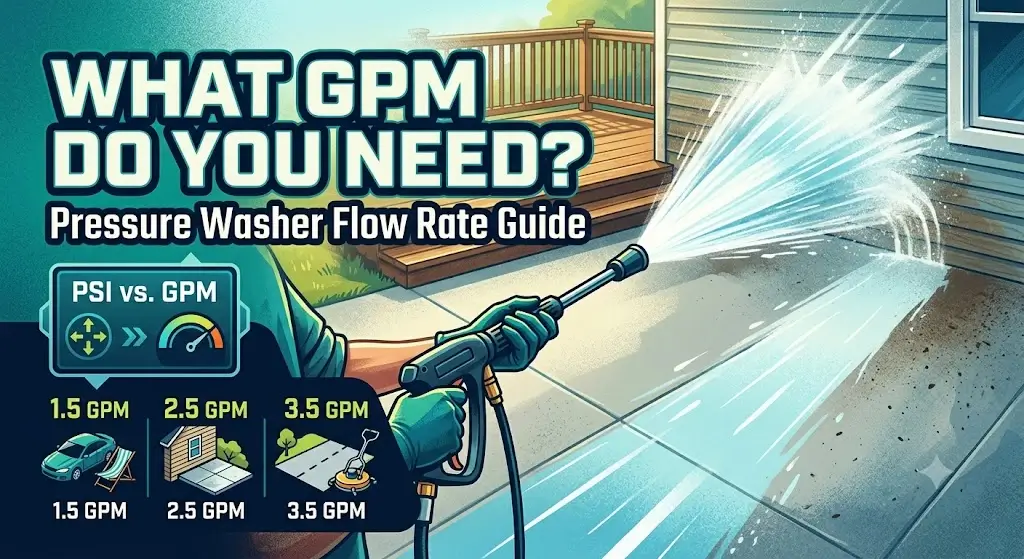
What GPM Do You Need? Pressure Washer Flow Rate Guide
GPM means gallons per minute. On a pressure washer, it tells you how much water the machine moves through the system over time.
PSI gets most of the attention on pressure-washer packaging, but GPM often determines how quickly you can rinse and clean a large surface. A pressure washer with higher GPM can move substantially more water across a driveway, patio or other large area even when its PSI rating is similar to another machine.
The correct question is therefore not simply “What is the highest GPM I can buy?” It is:
What Does GPM Mean on a Pressure Washer?
GPM stands for gallons per minute. It is a flow-rate measurement showing the volume of water moving through the pressure washer each minute.
For example, a pressure washer rated at 2.0 GPM is designed to move approximately two gallons of water per minute under the manufacturer’s specified operating conditions.
GPM is different from PSI. PSI describes pressure, while GPM describes flow.
Pressure
Indicates the pressure condition of the water system and contributes to the force available at the nozzle.
Flow
Indicates how much water moves through the system and strongly influences rinsing and large-area productivity.
Neither measurement should be used alone when comparing pressure washers.
Why Does GPM Matter So Much?
GPM matters because pressure washing is not only about striking dirt with a high-pressure stream. The loosened contamination must also be rinsed away.
More water flow can increase the amount of surface that can be rinsed in a given period. This becomes increasingly important as the cleaning area gets larger.
GPM matters most when:
- You clean large driveways.
- You clean patios or concrete slabs.
- You use a surface cleaner.
- You perform frequent property maintenance.
- You need faster rinsing after detergent application.
- You clean commercial or large residential areas.
For a small car, the productivity difference between 1.5 and 2.5 GPM may not matter much to a homeowner. For hundreds or thousands of square feet of concrete, it can matter considerably.
GPM vs. PSI: Which Is More Important?
PSI and GPM perform different jobs, so calling one universally “more important” is misleading (for a closer look at pressure ratings, refer to our pressure washer PSI guide).
PSI influences pressure and spray force.
GPM influences water volume and rinsing capacity.
A useful way to compare the two is to look at the hydraulic output together.
For example:
| Machine | PSI | GPM | Simple CU |
|---|---|---|---|
| A | 2,000 | 1.5 | 3,000 |
| B | 2,000 | 2.5 | 5,000 |
| C | 3,000 | 2.5 | 7,500 |
Machine C has the highest simple CU value, but this does not mean CU is a laboratory measurement of real cleaning performance. Nozzle design, pump efficiency, detergent, surface condition, operator technique and other variables also matter.
What GPM Do You Need? Quick GPM Chart
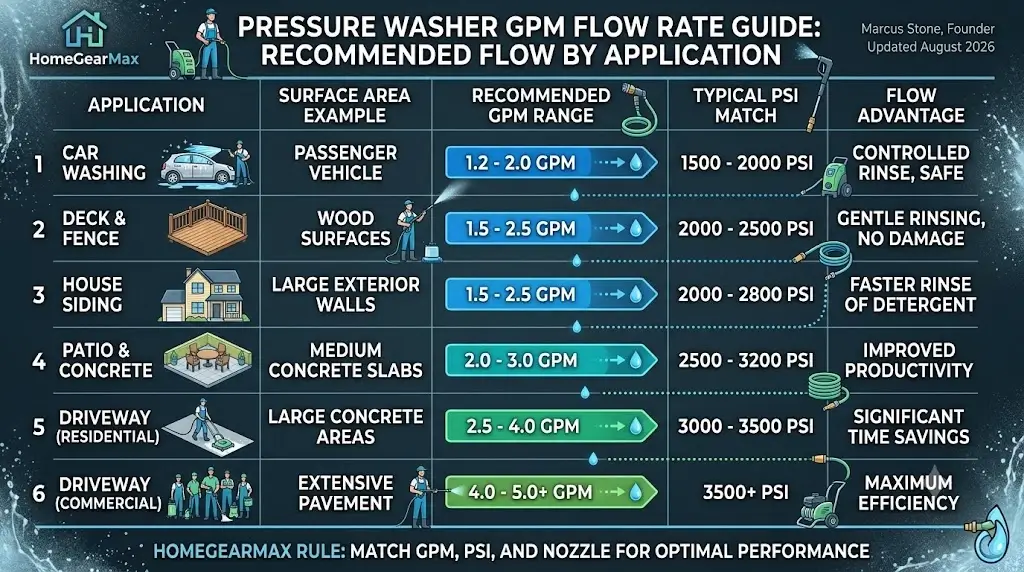
These ranges are practical starting points for common residential pressure-washing jobs. They are not universal requirements.
| Cleaning Job | Useful GPM Range | Practical Starting Point | Why Flow Matters |
|---|---|---|---|
| Car washing | 1.2–2.0 GPM | 1.5 GPM | Enough flow for rinsing without excessive water consumption. |
| Outdoor furniture | 1.2–2.0 GPM | 1.5 GPM | Small surface area limits the benefit of very high flow. |
| Decks | 1.5–2.5 GPM | 1.8–2.0 GPM | Moderate flow provides useful rinsing while maintaining control. |
| Fence | 1.5–2.5 GPM | 2.0 GPM | Useful for rinsing long linear surfaces. |
| House siding | 1.5–2.5 GPM | 2.0 GPM | Helps rinse detergent from large exterior areas. |
| Patio | 2.0–3.0 GPM | 2.5 GPM | Higher flow improves productivity over larger surfaces. |
| Concrete driveway | 2.5–4.0 GPM | 3.0 GPM | Large-area rinsing benefits from additional water volume. |
| Commercial concrete | 3.0–5.0+ GPM | 4.0 GPM+ | Higher flow can substantially improve productivity. |
What GPM Do You Need to Wash a Car?
For most passenger vehicles, approximately 1.2–2.0 GPM is sufficient. Around 1.5 GPM is a practical target for a homeowner who primarily wants to wash cars.
Very high GPM is usually unnecessary because a vehicle has a relatively small cleaning area compared with a driveway.
Why lower GPM can make sense for vehicles:
- Lower water consumption.
- Easy compatibility with compact electric pressure washers.
- Good rinsing capability when paired with suitable pressure.
- Less demand on the household water supply.
For automotive cleaning, spray pattern, nozzle selection, detergent and safe washing technique generally matter more than maximizing GPM.
What GPM Do You Need to Wash a House?
House washing generally benefits from more flow than car washing because the exterior surface area is much larger.
Approximately 1.5–2.5 GPM is a useful homeowner range for many siding-cleaning applications.
Higher GPM can make rinsing large walls faster, especially after detergent has been applied.
GPM is particularly useful during rinsing
House washing often relies on detergent to loosen organic contamination and road dust. Once the detergent has done its job, adequate flow allows the operator to rinse the loosened material efficiently.
What GPM Do You Need for a Deck or Fence?
Approximately 1.5–2.5 GPM is a practical range for many residential deck and fence-cleaning applications.
Flow is useful for rinsing wood, but pressure control remains more important than maximum water volume because wood fibers can be damaged by concentrated spray.
For wood, prioritize:
- Correct pressure.
- Appropriate nozzle angle.
- Safe spray distance.
- Controlled operator movement.
- Adequate but not excessive flow.
Increasing GPM does not make it safe to increase pressure on a fragile wooden surface.
What GPM Do You Need to Clean a Driveway?
For residential driveway cleaning, approximately 2.5–4.0 GPM is a useful range to consider. Around 3.0 GPM is a strong starting point for many homeowners who regularly clean concrete.
The reason is simple: driveways are large. Once dirt and organic contamination have been loosened, the operator needs enough water to rinse the surface efficiently.
Example
Consider two machines operating at similar pressure:
| Specification | Machine A | Machine B |
|---|---|---|
| Working PSI | 2,800 | 2,800 |
| Working GPM | 1.8 | 3.0 |
| Simple CU | 5,040 | 8,400 |
| Expected productivity direction | Lower | Higher |
The second machine moves approximately 67% more water per minute at the same pressure. That does not mean it cleans exactly 67% faster, but it illustrates why flow becomes important on large surfaces.
What GPM Do You Need for Concrete Cleaning?
Concrete is where GPM becomes particularly important.
For typical residential concrete, 2.5–4.0 GPM is a useful range. For larger commercial work, 4 GPM or more can become attractive when the water supply and equipment are designed for it.
Concrete cleaning combines mechanical pressure with water volume. Pressure helps break the bond between contamination and the surface, while flow helps remove and rinse the loosened material.
What GPM Do You Need for a Pressure Washer Surface Cleaner?
Surface cleaners are one of the strongest reasons to pay attention to GPM.
A surface cleaner uses rotating spray bars underneath a housing to clean a wider path than a standard wand. The attachment’s performance depends on both the pressure washer’s PSI and available flow.
A large surface cleaner paired with a low-flow pressure washer can perform poorly because the spray bars may not receive enough water to operate at their intended performance.
Practical surface-cleaner matching
| Pressure Washer GPM | Typical Surface-Cleaner Direction | Use Case |
|---|---|---|
| 1.5–2.0 GPM | Smaller residential cleaner | Small patios and compact concrete areas |
| 2.0–3.0 GPM | Medium residential cleaner | Driveways and patios |
| 3.0–4.0 GPM | Larger residential/prosumer cleaner | Large driveways and property maintenance |
| 4.0+ GPM | Large/high-productivity cleaner | Professional or extensive concrete work |
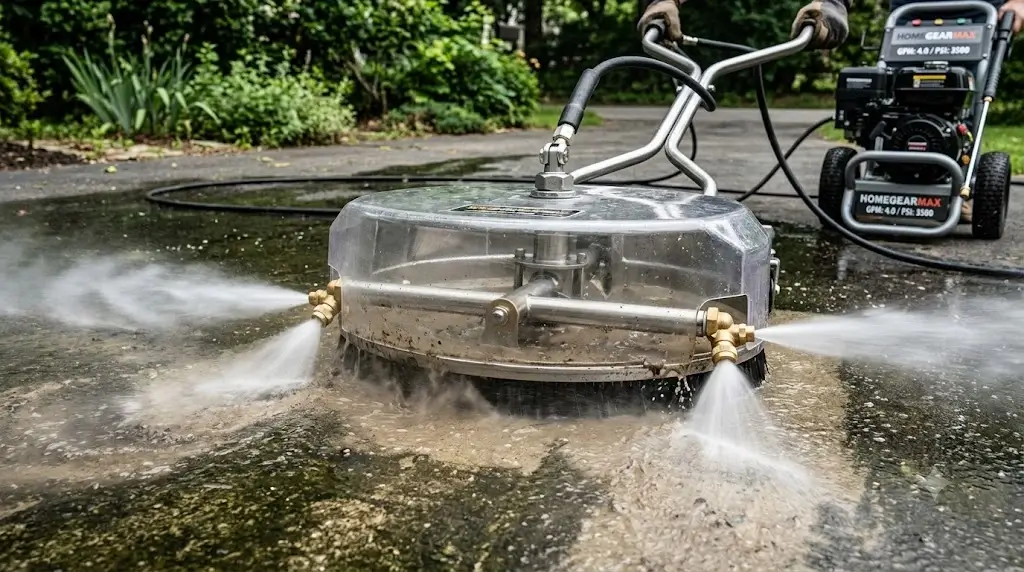
Always check the actual accessory manufacturer’s minimum and maximum PSI/GPM requirements before selecting a surface cleaner.
How Does Hose Length Affect GPM?
A pressure washer hose creates flow resistance. Longer hose runs and smaller internal diameters can increase friction losses.
This does not mean every extra foot of hose will cause a dramatic performance reduction. The actual effect depends on hose diameter, length, flow rate, fittings, elevation and other system variables.
The important engineering point is that the pump’s advertised GPM is not necessarily the same as the flow experienced at the nozzle under every hose configuration.
When hose losses matter most:
- High-flow pressure washers.
- Long hose runs.
- Small-diameter hoses.
- Multiple restrictive fittings.
- Applications where maximum GPM is critical.
How Much Water Supply Do You Need for a Pressure Washer?
Your pressure washer cannot deliver its rated flow if the incoming water supply cannot keep up.
Before buying a high-flow machine, verify that your outdoor faucet and plumbing system can provide sufficient flow under operating conditions.
Why this matters
A pressure washer rated at 3.5 GPM needs a water source capable of supplying that volume reliably. If the supply falls short, the pump can become starved for water and the machine may not perform as intended.
A simple bucket test
A basic flow test can provide a rough estimate of available water supply:
- Use a container with a known volume.
- Open the faucet fully.
- Measure how long it takes to fill.
- Convert the result to gallons per minute.
This is a basic field estimate rather than a complete hydraulic analysis because pressure can change while the system is flowing.
GPM and Electric Pressure Washers
Electric pressure washers face practical power constraints because the pump ultimately requires mechanical power from an electric motor.
As both PSI and GPM increase, hydraulic power requirements increase.
This is one reason compact 120-volt models among the best electric pressure washers commonly operate at lower flow rates than heavy-duty gas machines.
Why this matters when shopping
A manufacturer claiming an unusually high PSI and GPM combination from a standard household electrical circuit deserves careful technical evaluation.
The hydraulic horsepower relationship provides a useful reality check.
GPM and Gas Pressure Washers
Gas engines can provide substantially more continuous mechanical power than many compact residential electric systems, making higher-flow pressure washers practical.
This is one reason gas pressure washers commonly dominate applications where large concrete areas need to be cleaned quickly.
The tradeoff is greater noise, fuel consumption, maintenance and emissions compared with electric equipment.
For a homeowner who cleans a driveway a few times per year, the extra GPM of a gas machine may not justify the additional ownership complexity.
GPM, PSI and Cleaning Units
A commonly used comparison metric is Cleaning Units:
For example:
| PSI | GPM | CU |
|---|---|---|
| 1,500 | 1.5 | 2,250 |
| 2,000 | 2.0 | 4,000 |
| 2,500 | 2.5 | 6,250 |
| 3,000 | 3.0 | 9,000 |
| 3,500 | 3.5 | 12,250 |
CU is useful because it prevents shoppers from looking at PSI without considering flow.
However, CU is a simplified calculation. It does not account for nozzle efficiency, spray angle, water temperature, detergent, pump efficiency, operator technique or the physical characteristics of the surface.
Editorial distinction: CU should be treated as a comparison metric, not as proof that one machine will clean exactly proportionally faster than another.
How GPM Affects Hydraulic Horsepower
GPM and PSI are directly connected to hydraulic power.
Example: 2,000 PSI at 2 GPM
2,000 × 2 ÷ 1714 ≈ 2.33 hydraulic horsepower.
Example: 3,000 PSI at 3 GPM
3,000 × 3 ÷ 1714 ≈ 5.25 hydraulic horsepower.
Example: 4,000 PSI at 4 GPM
4,000 × 4 ÷ 1714 ≈ 9.33 hydraulic horsepower.
These calculations explain why very high PSI and very high GPM combinations require substantial power.
Why GPM Determines Pressure Washer Nozzle Size
The nozzle orifice must be matched to the pressure washer’s operating pressure and flow.
A nozzle that is too restrictive can raise pressure and reduce flow through the system. A nozzle that is too large can reduce pressure and produce a weaker spray.
This is why pressure-washer nozzle sizing is an engineering problem rather than simply choosing a nozzle based on color.
Common nozzle angles
| Angle | Spray Pattern | General Direction |
|---|---|---|
| 0° | Extremely concentrated | Specialized heavy-duty applications; high damage potential |
| 15° | Narrow fan | Hard surfaces and stubborn contamination |
| 25° | Medium fan | General cleaning |
| 40° | Wide fan | Vehicles and more delicate surfaces |
| 65° | Very wide | Detergent application |
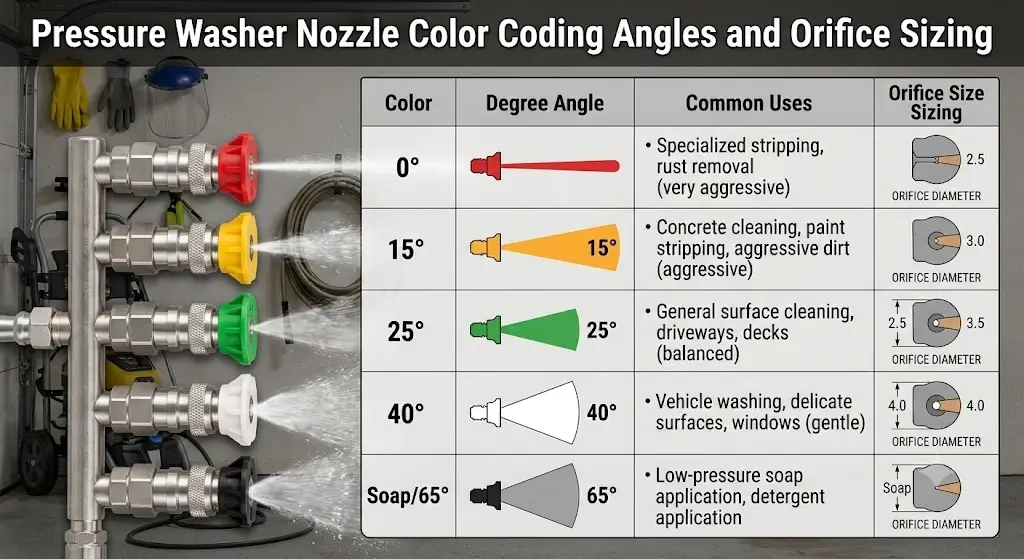
The color convention can vary by manufacturer, so verify the actual nozzle specification rather than relying only on color.
Does Higher GPM Mean More Water Usage?
Yes, assuming the machine is actually operating at that flow rate for the period being measured.
A 3.0-GPM pressure washer theoretically moves twice as much water per minute as a 1.5-GPM machine.
| Flow Rate | 10 Minutes | 30 Minutes | 60 Minutes |
|---|---|---|---|
| 1.5 GPM | 15 gal | 45 gal | 90 gal |
| 2.0 GPM | 20 gal | 60 gal | 120 gal |
| 2.5 GPM | 25 gal | 75 gal | 150 gal |
| 3.0 GPM | 30 gal | 90 gal | 180 gal |
| 4.0 GPM | 40 gal | 120 gal | 240 gal |
Actual water consumption can differ from the theoretical value because the trigger may not remain engaged continuously and operating flow may differ from the headline specification.
Does Higher GPM Always Clean Faster?
No.
Higher GPM provides more water, but cleaning speed depends on the entire system:
- Working PSI
- GPM
- Nozzle design
- Surface contamination
- Detergent
- Water temperature
- Surface-cleaner design
- Operator movement
- Water supply
A 4-GPM machine is not automatically four times faster than a 1-GPM machine. It simply has substantially greater flow capacity.
GPM for Foam Cannons
Foam cannons require adequate flow and pressure to generate their intended spray pattern and foam characteristics.
The correct orifice depends on the pressure washer’s actual operating characteristics and the foam cannon configuration.
A machine with low flow can still work with a compatible foam cannon, but the resulting spray and foam behavior can differ from that of a higher-flow system.
Do not assume that a larger nozzle orifice is automatically better. Match the foam cannon insert to the pressure washer according to the accessory manufacturer’s recommendations.
GPM for Rinsing vs. Cleaning
One of the most useful ways to understand GPM is to separate the cleaning stage from the rinsing stage.
During cleaning
Pressure, nozzle concentration, chemistry and agitation contribute heavily to breaking the contamination bond.
During rinsing
Flow becomes increasingly valuable because the goal is to move loosened dirt, detergent and debris away from the surface.
GPM and Water Temperature
Water temperature can also influence cleaning performance.
Hot-water pressure washers are commonly used for grease, oil and industrial contamination because heat can improve the removal of certain soils.
In these applications, the operator may not need to rely exclusively on extremely high pressure.
Pressure, flow, temperature and chemistry can work together.
9 Common Pressure Washer GPM Mistakes
1. Choosing the highest GPM
More flow means more water consumption and greater demand on the water supply.
2. Ignoring PSI
GPM without pressure does not describe the complete cleaning system.
3. Ignoring the water supply
A pump cannot reliably deliver its rated flow if the inlet supply is inadequate.
4. Buying a surface cleaner that is too large
Larger cleaners can require substantially more flow.
5. Using the wrong nozzle orifice
Incorrect nozzle sizing changes pressure and flow.
6. Assuming manufacturer GPM equals measured nozzle flow
Specifications can be measured under different conditions, so equivalent measurements should be compared.
7. Ignoring hose friction
Long or restrictive hose configurations can reduce system performance.
8. Thinking more GPM always means less cleaning time
Productivity depends on the entire cleaning process.
9. Ignoring water consumption
Higher flow can consume significantly more water during long cleaning sessions.
Manufacturer-Rated GPM vs. Measured GPM
Pressure-washer specifications should be classified carefully.
| Data Type | Meaning | How to Use It |
|---|---|---|
| Manufacturer-rated | Published by the manufacturer | Useful for initial product comparison |
| Calculated | Derived from published or measured inputs | Useful for engineering analysis |
| Measured | Obtained using a measurement procedure | Strongest basis when methodology is disclosed |
A trustworthy comparison should never present a calculated value as though it were independently measured.
How to Measure Pressure Washer GPM
A simple field measurement can estimate actual flow at the outlet.
Basic timed-volume method
- Prepare a container with a known volume.
- Run the pressure washer under the intended operating condition.
- Collect the discharge for a measured period.
- Record the volume collected.
- Convert the result to gallons per minute.
For example, if a system collects 10 gallons in five minutes, the measured average flow is 2.0 GPM.
For more rigorous testing, a calibrated flow meter can provide continuous measurements and reduce the limitations of manual collection.
What GPM Do You Need for a 15-Inch Surface Cleaner?
A 15-inch surface cleaner is commonly considered a practical size for many residential pressure washers, but diameter alone does not determine compatibility.
Check the manufacturer’s minimum GPM and PSI requirements before use.
A lower-flow electric machine may be better matched with a smaller cleaner, while a 3–4 GPM machine can support larger cleaning equipment.
Pressure washer working PSI → surface cleaner rated PSI
Pressure washer working GPM → surface cleaner required GPM
Nozzle orifice → machine flow and pressure
Cleaner diameter → available hydraulic output
What GPM Do You Need for a 20-Inch Surface Cleaner?
A 20-inch surface cleaner generally makes more sense with a higher-flow pressure washer than a compact 1.5-GPM electric unit.
The larger cleaning path can improve productivity, but only if the pressure washer provides enough flow to operate the spray bars correctly.
For this reason, a 20-inch cleaner should be evaluated using the manufacturer’s exact GPM and PSI requirements rather than a generic rule based only on diameter.
GPM and Pressure Washer Pump Architecture
Pump design affects how a pressure washer generates and maintains flow.
Wobble-plate pumps
Common on lighter-duty consumer machines. They are compact and suitable for intermittent homeowner use.
Axial-cam pumps
Common on residential and prosumer machines. They can provide higher pressure and flow than many compact consumer designs.
Triplex plunger pumps
Common in professional equipment. They are designed for higher duty cycles and can support substantial flow and pressure.
Pump architecture does not determine GPM by itself. Motor or engine power, pump displacement, operating pressure, RPM and system efficiency all matter.
What GPM Should You Buy for General Home Use?
If you want one pressure washer for a broad range of homeowner tasks, approximately 2.0–3.0 GPM is a strong range to evaluate.
Around 2 GPM is suitable for many lighter residential jobs. Around 2.5–3 GPM provides more useful flow for patios, concrete and larger exterior surfaces.
Light-duty
Best suited to vehicles, furniture and smaller cleaning jobs.
General homeowner
A versatile range for cars, siding, decks, fences and moderate household work.
Heavy homeowner
Better suited to concrete, patios, driveways and frequent property maintenance.
Professional productivity
Useful when large surfaces and fast cleaning throughput justify higher water volume.
How to Choose the Right GPM: HomeGearMax Decision Process
Step 1: Identify your largest regular cleaning job
GPM becomes increasingly valuable as the cleaning area increases.
Step 2: Determine the surface
Concrete, siding, wood and vehicles have different pressure requirements even when the desired flow rate is similar.
Step 3: Choose working PSI and GPM together
Never select GPM independently from PSI.
Step 4: Check your water supply
Your inlet supply must be capable of supporting the machine.
Step 5: Check hose configuration
Long or restrictive hoses can increase friction losses.
Step 6: Check accessories
Surface cleaners, foam cannons and other accessories have their own flow requirements.
Step 7: Consider water consumption
Higher GPM means greater theoretical water use during continuous operation.
Step 8: Consider duty cycle
A high-flow machine intended for professional use may be unnecessary for occasional residential cleaning.
Pressure Washer GPM Buying Matrix
| Buyer | GPM Direction | Typical Jobs | Main Priority |
|---|---|---|---|
| Car-focused homeowner | 1.2–2.0 | Cars and light cleaning | Control and water efficiency |
| General homeowner | 1.5–2.5 | Cars, siding, decks, patios | Balanced system |
| Concrete-focused homeowner | 2.5–4.0 | Driveways and patios | Flow + surface cleaner compatibility |
| Frequent property maintenance | 3.0–4.0+ | Large exterior surfaces | Productivity |
| Professional operator | 4.0–5.0+ | Commercial concrete | High throughput and duty cycle |
Is 1.5 GPM Enough?
Yes, for many homeowners.
A 1.5-GPM machine can be very useful for cars, outdoor furniture, siding, small patios and other relatively compact surfaces.
The limitation becomes more obvious on large concrete areas where the lower flow rate increases the time required to rinse and cover the surface.
Is 2.0 GPM Enough?
For many homeowners, 2.0 GPM is a useful middle ground.
It provides more rinsing capacity than many compact machines while remaining compatible with a wide range of residential applications.
Whether it is enough for your needs depends primarily on how much concrete or other large-area cleaning you perform.
Is 2.5 GPM Enough?
2.5 GPM is a strong homeowner flow rate for mixed-use cleaning.
It can support vehicles, siding, decks, patios and many residential concrete applications when paired with appropriate pressure.
For frequent driveway cleaning, moving toward 3 GPM or higher can provide additional productivity.
Is 3 GPM Enough?
For many residential users, 3 GPM is more than enough.
A 3-GPM machine can provide strong rinsing performance and is well suited to many driveway and surface-cleaner applications when the PSI and attachment specifications are matched correctly.
At this flow rate, the quality of the water supply becomes increasingly important.
Is 4 GPM Too Much for a Homeowner?
Not necessarily, but it may be unnecessary.
Four GPM can be highly useful for large concrete areas and frequent property maintenance, but it may be unnecessary for occasional light-duty cleaning.
For someone who only washes a car and occasionally cleans a small patio, the additional water consumption, equipment size and water-supply requirements may not provide enough benefit to justify it.
What GPM Is Best for a Pressure Washer Surface Cleaner?
There is no universal GPM requirement because surface cleaners vary by diameter and nozzle configuration.
A practical residential approach is:
- 1.5–2.0 GPM: compact surface-cleaning equipment.
- 2.0–3.0 GPM: medium residential cleaners.
- 3.0–4.0 GPM: larger residential/prosumer cleaners.
- 4.0+ GPM: high-productivity equipment when the attachment is rated accordingly.
Always verify the accessory’s specifications before use.
What GPM Do Professionals Use?
Professional pressure washers commonly use higher-flow equipment because productivity is directly tied to the amount of surface that can be cleaned and rinsed per unit of time.
Machines around 3–4 GPM can be useful for many professional applications, while larger commercial systems can exceed 5 GPM.
The correct professional flow rate depends on the surface, equipment, water supply, transport requirements, duty cycle and required cleaning speed.
GPM vs. Water Pressure at the Nozzle
It is important to distinguish pump output from nozzle behavior.
The pump moves water. The nozzle restricts and shapes that water. The resulting hydraulic conditions determine the pressure and flow available through the system.
This is why changing a nozzle can dramatically alter the pressure washer’s behavior even though the pump and motor remain unchanged.
GPM and Electrical Reality
High flow at high pressure requires substantial hydraulic power.
This creates a useful reality check when evaluating electric pressure washers.
For example, 3,000 PSI at 3 GPM requires approximately 5.25 hydraulic horsepower before accounting for losses.
A standard household electrical circuit has practical power limits, which is why claims of very high PSI and GPM from compact electric machines should be evaluated carefully.
How GPM Changes Cleaning Productivity
Suppose two machines have identical working PSI but different GPM:
| Specification | Machine A | Machine B |
|---|---|---|
| Working PSI | 2,500 | 2,500 |
| Working GPM | 2.0 | 3.0 |
| Water per 10 minutes | 20 gallons | 30 gallons |
| Simple CU | 5,000 | 7,500 |
Machine B moves 50% more water at the same stated pressure. That can be valuable when rinsing large surfaces, although real cleaning-time savings depend on the entire workflow.
GPM for Residential vs. Commercial Pressure Washing
| Application | Typical GPM Direction | Primary Reason |
|---|---|---|
| Vehicle detailing | 1.2–2.0 | Controlled water use |
| House washing | 1.5–2.5 | Rinsing exterior surfaces |
| Residential concrete | 2.5–4.0 | Large-area productivity |
| Commercial concrete | 3.0–5.0+ | High throughput |
How GPM Affects Total Cleaning Cost
Higher GPM can shorten cleaning time, but it also increases theoretical water consumption.
The economic question is therefore not simply whether higher GPM is better. It is whether the productivity gain is worth the additional water use and equipment cost.
For professional operators, labor time can be more expensive than water consumption, making higher flow attractive.
For occasional homeowners, water consumption and equipment cost may matter more than maximum productivity.
GPM and Cleaning Large Areas
The larger the surface, the more important flow becomes.
This is particularly obvious with driveways, sidewalks, commercial concrete and large patios.
A low-flow machine can still produce high pressure, but the operator may need more passes and more time to rinse the same area.
What GPM Do You Need? Simple Decision Tree
Mostly washing cars?
→ Consider approximately 1.2–2.0 GPM.
Cars + siding + decks + general household cleaning?
→ Consider approximately 1.5–2.5 GPM.
Driveways and patios?
→ Consider approximately 2.5–3.5 GPM.
Frequent large concrete cleaning?
→ Consider approximately 3–4+ GPM.
Professional high-productivity work?
→ Evaluate 4–5+ GPM systems based on the exact equipment and water supply.
What GPM Do You Need? FAQ
What GPM is good for a pressure washer?
For many homeowners, 1.5–2.5 GPM is a useful range. Around 2.5–3.5 GPM becomes more attractive for driveways, patios and larger residential surfaces.
Is 1.5 GPM enough for a pressure washer?
Yes. 1.5 GPM is sufficient for many cars, siding, outdoor furniture and smaller residential cleaning jobs.
Is 2 GPM enough for a driveway?
It can clean a driveway, but higher flow around 2.5–4.0 GPM can improve rinsing and productivity on larger concrete areas.
Is 2.5 GPM good for a pressure washer?
Yes. 2.5 GPM is a versatile flow rate for many homeowner applications, including vehicles, siding, patios and moderate concrete cleaning.
Is 3 GPM enough for a driveway?
Yes. Around 3 GPM is a strong flow rate for many residential driveway-cleaning applications, especially when paired with appropriate working PSI and a properly sized surface cleaner.
Is 4 GPM too much for a homeowner?
Not necessarily. Four GPM can be useful for large concrete areas and frequent property maintenance, but it may be unnecessary for occasional light-duty cleaning.
Is GPM more important than PSI?
Neither is universally more important. PSI and GPM measure different aspects of pressure-washer performance and should be evaluated together.
Does higher GPM clean faster?
Higher GPM can improve rinsing and productivity, especially on large surfaces, but actual cleaning speed depends on PSI, nozzle design, detergent, surface condition and operator technique.
What GPM do I need for a surface cleaner?
The correct GPM depends on the surface cleaner’s specifications. Smaller residential cleaners can work with lower-flow machines, while larger cleaners generally require more GPM.
How much water does a 3 GPM pressure washer use?
At continuous 3 GPM flow, it theoretically uses 30 gallons in 10 minutes, 90 gallons in 30 minutes and 180 gallons in one hour.
Can a pressure washer get its rated GPM from any faucet?
No. The incoming water supply must be capable of supplying the pump’s required flow under operating conditions.
Does hose length reduce GPM?
Longer or smaller-diameter hoses increase friction losses, which can affect the flow and pressure available at the working end of the system.
What GPM do professional pressure washers use?
Professional machines can use approximately 3–5 GPM or more depending on the application. Large concrete-cleaning operations often benefit from higher flow because of the productivity advantage.
What is Cleaning Units in a pressure washer?
Cleaning Units are commonly calculated as PSI multiplied by GPM. CU is useful for comparing pressure and flow together but should not be treated as a complete laboratory measurement of cleaning performance.
Final Verdict: What GPM Do You Really Need?
For most homeowners, 1.5–2.5 GPM is enough for general pressure-washing work.
If you frequently clean patios, driveways or larger concrete areas, moving toward 2.5–3.5 GPM provides more useful water volume and can improve productivity.
For professional or high-productivity concrete cleaning, 3–5+ GPM can be appropriate when the pump, engine or motor, nozzle system, surface cleaner and water supply are all designed around that flow rate.
For cars, excessive flow usually adds little practical benefit.
For siding and general home maintenance, moderate GPM provides a useful balance.
For concrete and large surfaces, GPM becomes increasingly important because water volume directly affects rinsing and cleaning productivity.
The best pressure washer is therefore not the one with the biggest GPM number. It is the machine that delivers the right flow at the right pressure, through the right nozzle, with enough water supply for the job.
