
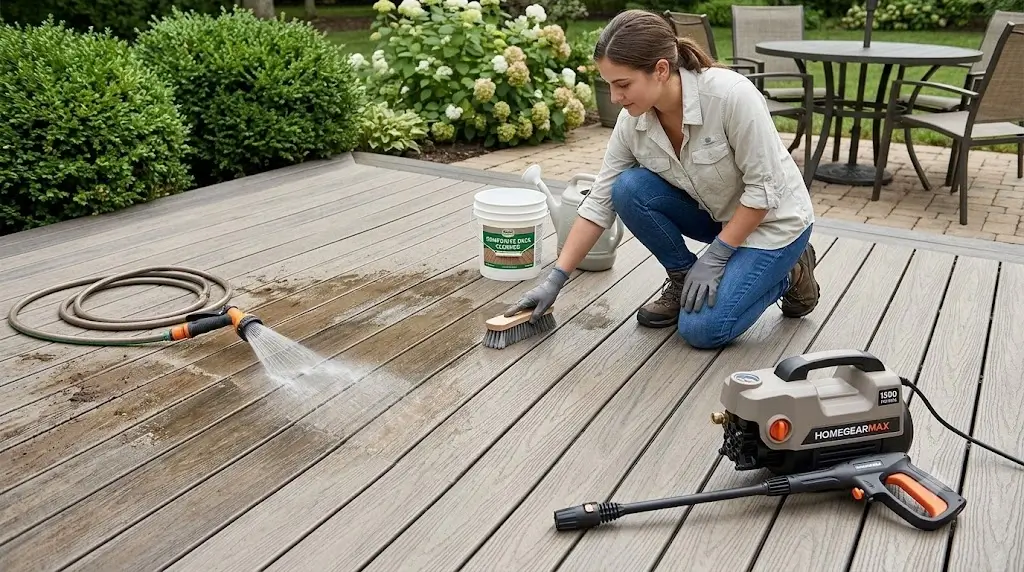
How to Clean Composite Decking Without Damaging It
Composite decking is designed to require less maintenance than traditional wood, but it is not maintenance-free. Dirt, pollen, leaves, grease, food, algae, mildew, and other organic debris can accumulate in the textured surface and between boards.
The safest way to clean composite decking is to start with the manufacturer’s care instructions for the exact product, then use the least aggressive method that removes the contamination. For many decks, that means water, a compatible cleaner, and the correct brush. A pressure washer may be appropriate for some products, but the allowable pressure and technique differ substantially by manufacturer and product generation.
What Is Composite Decking?
Composite decking is manufactured from engineered materials rather than a conventional solid wood board. Depending on the product, the construction may include a wood-plastic composite core and a protective outer cap, or another engineered formulation.
That distinction matters when cleaning because the visible surface is not necessarily the same material as the interior of the board.
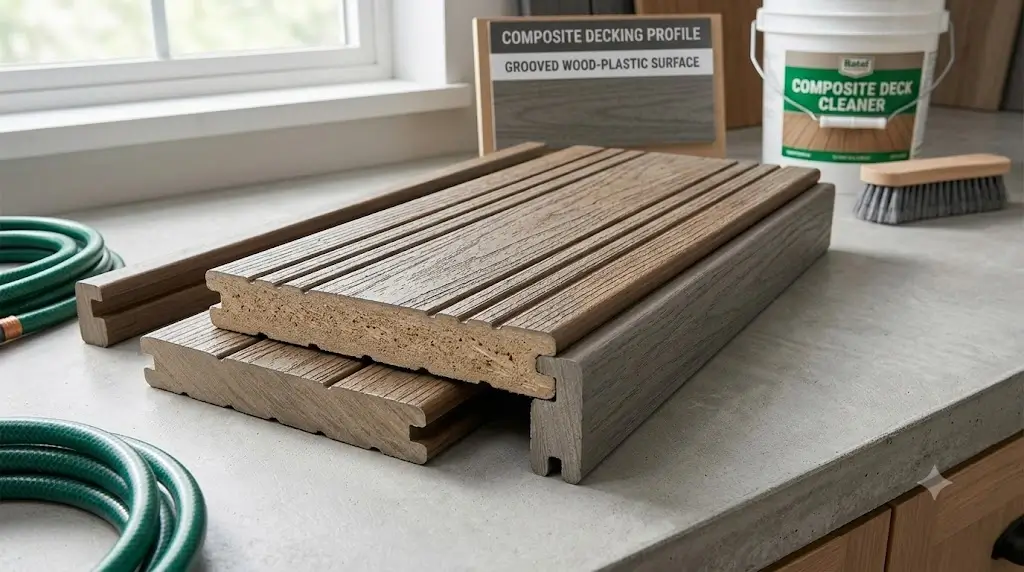
Some newer capped composite products have a protective surface layer designed to resist moisture, staining, and fading. Older generations can have different care requirements.
The most important rule:Do not use a generic “composite decking” cleaning rule if your manufacturer publishes product-specific instructions. Product generation matters.
Before Cleaning: Identify Your Deck
Find the manufacturer’s name and, if possible, the product line or collection. This information can usually be found in the original paperwork, installation documents, purchase records, or product identification information.
This step prevents one of the most common composite-deck cleaning mistakes: applying a method approved for one product to a different product with different surface characteristics.
| Situation | Best Starting Method | Why |
|---|---|---|
| Light dirt and pollen | Hose + mild cleaner + appropriate brush | Low mechanical stress |
| Ground-in grime | Approved cleaner + brushing | Chemistry reduces required force |
| Mildew or algae | Manufacturer-approved treatment | Organic growth often requires more than water pressure |
| Grease or food | Prompt cleaning + approved spot treatment | Oil-based contamination can bond to the surface |
| Heavy restoration | Manufacturer-specific procedure | Older products may have different limitations |
| Unknown decking | Manual cleaning first | Reduces risk until the product is identified |
What You Need to Clean Composite Decking
- Garden hose with adjustable spray nozzle
- Manufacturer-approved composite deck cleaner
- Bucket if the cleaner requires dilution
- Manufacturer-recommended deck brush
- Soft or medium nylon brush where appropriate
- Measuring container for concentrated cleaners
- Sponge mop, towel, or leaf blower for removing standing water
- Protective gloves
- Safety glasses
A pressure washer is optional (units among the best electric pressure washers typically offer the lower, controllable output ideal for delicate composite caps). For many composite decks, a garden hose is sufficient for rinsing.
TimberTech specifically states that a garden hose is all that is required for rinsing its current products and allows a power washer for rinsing only under specified conditions.
The Best Routine Cleaning Method for Composite Decking
For ordinary dirt, the safest cleaning sequence is simple:
- Remove furniture and objects.
- Sweep loose debris from the boards.
- Identify the decking manufacturer and product line.
- Prepare the approved cleaner according to its label.
- Work in a small section.
- Keep the surface wet with cleaner during the cleaning process.
- Scrub the board texture with the appropriate brush.
- Rinse thoroughly.
- Move to the next section.
- Allow the deck to dry completely.
The key is to clean in manageable sections rather than covering the entire deck with cleaner at once. This makes it easier to scrub and rinse before the solution dries.
How to Clean Composite Decking Step by Step
1 Remove Furniture and Loose Objects
Move chairs, tables, planters, rugs, toys, grills, and other objects away from the cleaning area.
Pay particular attention to areas under planters and furniture because trapped pollen, leaves, dirt, and moisture can create localized staining or biological growth.
2 Sweep the Deck
Sweep leaves, dirt, pollen, grass, and other loose debris from the boards.
Clean debris from the gaps between boards when practical. Organic material trapped between boards can retain moisture and contribute to staining and mildew conditions.
3 Rinse Loose Dirt
Use a garden hose to remove loose surface contamination before applying cleaner.
This reduces the amount of material the brush must move across the surface.
4 Prepare the Correct Cleaner
Use the cleaner recommended for the specific decking product whenever the manufacturer provides one.
Follow the label for dilution and application. Do not guess at concentration because stronger is not automatically better.
5 Work in Small Sections
Choose an area small enough to scrub and rinse before the cleaner dries.
This is particularly important during hot, sunny weather.
6 Apply the Cleaner
Saturate the selected section according to the manufacturer’s instructions.
Some manufacturer systems specify a short dwell period before scrubbing. TimberTech, for example, currently recommends working in small areas and allowing its diluted cleaner to stand for approximately 30–60 seconds before scrubbing, without allowing it to dry.
7 Scrub the Textured Surface
Use the brush specified for your decking material.
The purpose of brushing is to mechanically loosen dirt trapped in the embossed texture rather than relying on high-pressure water to blast it away.
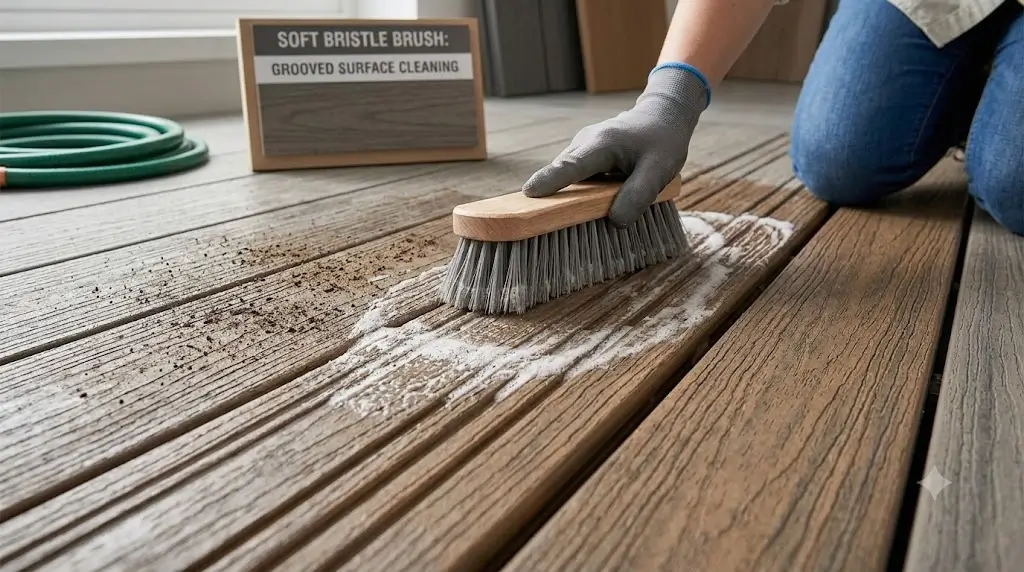
8 Rinse Thoroughly
Rinse the cleaned section completely before moving to the next section.
Residual cleaner can dry inside the surface texture and leave a visible film. TimberTech specifically warns that allowing its cleaner to dry can create a white surface film.
9 Remove Standing Water
Use a sponge mop, towel, or leaf blower where appropriate to remove excess water.
This can reduce water spotting and allows you to inspect the surface sooner.
10 Let the Deck Dry
Allow the composite surface to air dry completely before replacing furniture, rugs, or other objects.
Can You Use Soap on Composite Decking?
Often yes, but the safest answer is: follow the decking manufacturer’s cleaning instructions first.
Trex recommends warm soapy water and a soft-bristle brush for certain high-performance composite products. TimberTech also describes mild liquid soap and water as a general cleaning approach for some products, while recommending its dedicated cleaner for current collections.
If you use dish soap, dilute it appropriately and rinse thoroughly. Avoid leaving soap residue inside the board’s texture.
Do not assume that any household cleaner is safe for every composite deck.The surface chemistry varies by manufacturer and product generation. Check the care guide before using bleach, acids, solvents, abrasive powders, degreasers, or specialty stain removers.
What Brush Is Best for Composite Decking?
Brush selection depends on the decking material. A brush that is suitable for one product can be too aggressive for another.
| Brush Type | General Use | Caution |
|---|---|---|
| Soft nylon | Routine cleaning | Low surface aggression |
| Medium nylon | Textured composite surfaces | Follow manufacturer guidance |
| Natural fiber | Some PVC products | Not appropriate for every composite surface |
| Metal wire brush | Not recommended for routine composite cleaning | Can damage the surface |
| Very stiff abrasive brush | Generally avoid | May dull or mark the surface |
TimberTech specifically recommends a medium-to-stiff nylon brush for its composite decking and warns against stiff natural-fiber brushes on its composite collections because they can dull the surface.
Can You Pressure Wash Composite Decking?
Sometimes. The correct answer depends on the manufacturer and product line. This is one of the most important distinctions in composite-deck cleaning.
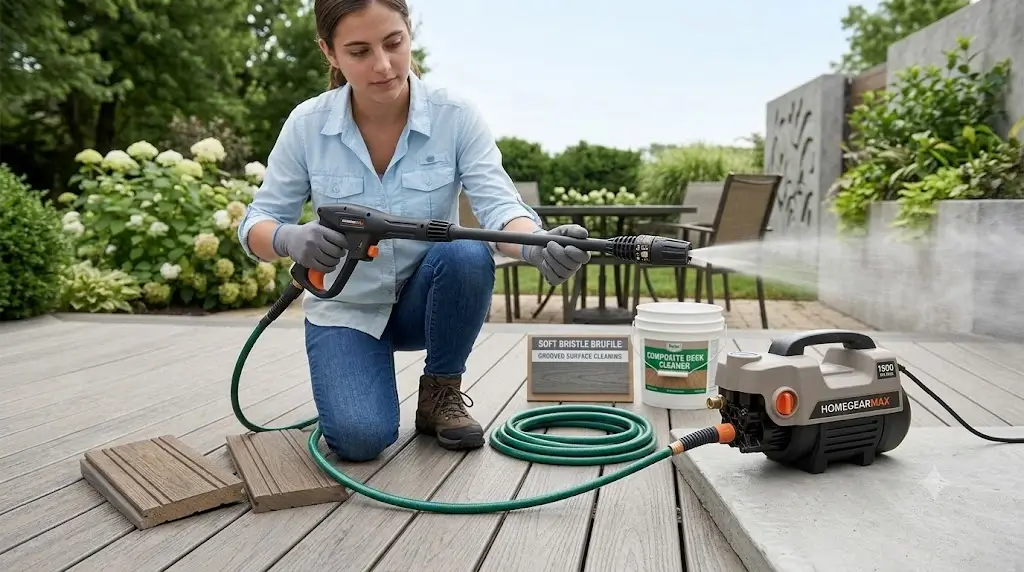
| Manufacturer / Product Guidance | Pressure Washer Position | Important Detail |
|---|---|---|
| Trex Transcend / Enhance / Select | Permitted under specified conditions | Trex states no greater than 3,100 PSI, fan attachment, and at least 8-inch distance for general cleaning |
| Older Trex generations | Different restrictions | Trex does not recommend pressure washing certain early-generation products |
| Current TimberTech products | Rinsing only | Fan tip, maximum 1,500 PSI |
| Fiberon | Use extreme caution | Fiberon warns improper pressure washing can damage the surface and recommends keeping the tip at least 12 inches away |
These differences are why a generic statement such as “use 2,000 PSI on composite decking” is poor advice. Manufacturer guidance can vary by product, generation, and surface construction.
What PSI Should You Use on Composite Decking?
There is no universal PSI number for all composite decking.
The correct pressure is the lower of the manufacturer’s maximum allowable pressure and the pressure necessary to rinse or clean the surface safely.
For example, TimberTech currently specifies a maximum of 1,500 PSI for power-washer rinsing. Trex’s current care guidance for certain high-performance lines allows a pressure washer up to 3,100 PSI under specified conditions.
Do not treat a pressure washer’s nameplate PSI as the required deck-cleaning pressure.A machine rated for 3,000 PSI does not mean the deck should be exposed to 3,000 PSI. Pressure, nozzle, distance, spray angle, and what GPM you need for effective cleaning without gouging all factor into surface safety.
What Pressure Washer Nozzle Should You Use?
When a manufacturer permits pressure washing, a fan-tip nozzle is generally preferable to a narrow concentrated stream.
| Nozzle Pattern | Composite Deck Guidance | Reason |
|---|---|---|
| 0° | Avoid | Highly concentrated stream |
| 15° | Generally avoid unless specifically approved | Higher impact concentration |
| 25° | Use only if manufacturer guidance allows | More concentrated than a wide fan |
| 40° | Preferred general fan pattern when compatible with manufacturer guidance | Distributes water across a wider area |
| Soap / low-pressure tip | Useful for applying compatible detergent | Low impact |
The exact nozzle is less important than following the decking manufacturer’s instructions. Trex and TimberTech both specify fan-tip use in their pressure-washing guidance.
How to Clean Trex Composite Decking
Trex has different care requirements for different product generations.
Trex Transcend, Enhance and Select
Trex states that warm soapy water and a soft-bristle brush can be used for routine dirt and debris. For general cleaning, Trex also allows a pressure washer with no greater than 3,100 PSI, a fan attachment or adjustment, and a soap dispenser. Trex instructs users to keep the fan tip at least 8 inches from the decking surface and rinse thoroughly.
Older Trex Generations
Early-generation Trex products have different guidance. Trex states that pressure washing is not recommended for certain early-generation decking and that pressure washing can damage the surface.
Trex lesson:Do not identify a deck simply as “Trex” and assume every cleaning instruction applies to it. Product generation matters.
How to Clean TimberTech Composite Decking
TimberTech’s current care guidance emphasizes cleaning with its recommended cleaner and brush, followed by thorough rinsing.
TimberTech states that a garden hose is sufficient for rinsing. If a power washer is used, its current guidance specifies rinsing only, a fan-tip nozzle, and a maximum pressure of 1,500 PSI. It also instructs users to spray in the direction of the grain pattern rather than across the width of the board.
TimberTech Cleaner Technique
TimberTech recommends working in small sections, avoiding direct sunlight where possible, and not allowing cleaner to dry on the surface. Its current cleaner instructions specify a 1:3 cleaner-to-water dilution for general cleaning and a short dwell period before scrubbing.
The important takeaway is that TimberTech’s approach relies on cleaner + brush + controlled rinse, rather than high-pressure mechanical cleaning.
How to Clean Fiberon Composite Decking
Fiberon recommends periodic cleaning with soap and water for its products and cautions that improper pressure washing can damage the deck surface.
Fiberon’s published guidance states that when a pressure washer has been used, extra cleaning may be necessary for mold treatment and recommends keeping the pressure-washer tip at least 12 inches from the deck surface to reduce the risk of damage.
The safest interpretation is to prioritize Fiberon’s product-specific cleaning instructions and avoid using pressure as a substitute for proper cleaning chemistry and brushing.
How to Remove Mold, Mildew and Algae From Composite Decking
Mold, mildew, and algae are usually associated with a combination of moisture, organic debris, shade, and limited airflow. Pressure alone is not necessarily the best treatment because the visible growth can be removed while contamination remains in textured areas.
Step-by-Step
- Remove leaves and debris.
- Rinse loose contamination.
- Apply a manufacturer-approved cleaner or treatment.
- Allow the product to work for the specified time.
- Scrub the textured surface.
- Rinse thoroughly.
- Inspect after drying.
- Repeat localized treatment if required by the product instructions.
Trex recommends periodic spring and fall cleaning because accumulated pollen and debris can support mold and mildew conditions.
Prevention matters:Keep leaves and pollen from accumulating, clean beneath planters, maintain open drainage paths, and avoid leaving moisture-trapping debris on the deck for long periods.
How to Remove Grease and Food Stains From Composite Decking
Grease and food should be addressed quickly because oily contamination can become more difficult to remove after it sits on the surface.
- Remove solid food residue.
- Rinse with water.
- Apply the manufacturer’s recommended cleaner.
- Scrub with the appropriate brush.
- Rinse thoroughly.
- Repeat only if the product instructions permit.
Trex recommends rinsing oil, grease, and food stains with hot water as soon as possible and provides product-specific guidance for remaining stains.
How to Remove Rust and Metal Stains
Rust stains require more care than ordinary dirt.
Some manufacturers recommend specific acid-based cleaning systems for mineral or rust staining. Trex, for example, references oxalic- or phosphoric-acid-based deck brighteners for certain rust, ground-in dirt, and pigment stains.
Do not automatically apply an acid cleaner to composite decking.Chemical compatibility is product-specific. Verify the manufacturer’s instructions before using an acid-based stain remover.
How to Remove Leaf and Tannin Stains
Leaves, branches, and other organic debris can leave dark or brown discoloration on composite decking.
Start with routine cleaning:
- Remove the organic debris.
- Rinse the surface.
- Apply an approved cleaner.
- Scrub the texture.
- Rinse thoroughly.
Persistent discoloration may require a product-specific stain treatment. Do not jump directly to aggressive pressure washing because the stain may require chemistry rather than mechanical force.
How to Remove Chalk Marks From Composite Decking
Colored construction chalk can be difficult to remove because some pigments can become persistent stains.
Trex specifically warns that many colored chalk lines can be permanent and provides product-specific recommendations for marking chalk.
For an existing chalk mark, test the manufacturer’s recommended cleaning approach in an inconspicuous area first.
Why Does Composite Decking Get a White Film After Cleaning?
A white or cloudy film can appear when cleaning solution dries on the textured surface before it is thoroughly rinsed. This is a common reason to clean composite decking in small sections.
TimberTech explicitly warns that allowing its cleaner to dry can leave a white surface film that may require additional cleaning.
How to Prevent It
- Do not clean the entire deck at once.
- Work in manageable sections.
- Avoid direct sunlight when possible.
- Keep the cleaner wet during scrubbing.
- Rinse immediately after cleaning each section.
How to Deal With Scratches on Composite Decking
Cleaning cannot remove every surface defect. A scratch, gouge, burn mark, or damaged cap is different from dirt. Increasing pressure or using an abrasive brush can make the defect more visible.
Some composite manufacturers have specific repair procedures, while others warn against sanding or abrasive restoration. Trex, for example, does not recommend sanding its decking because it can change the surface appearance and affect warranty coverage.
Identify the decking product before attempting a repair.
10 Common Composite Deck Cleaning Mistakes
1. Assuming All Composite Decking Is the Same
Product generations and surface constructions differ. Always check the manufacturer.
2. Starting With Maximum Pressure
Pressure is a mechanical tool, not a universal cleaning solution.
3. Using a Narrow Nozzle
A concentrated spray can mark or damage the surface.
4. Holding the Nozzle Too Close
Even a permitted pressure washer can become aggressive when the nozzle is moved too close.
5. Letting Cleaner Dry
Dried cleaner can leave residue and require another cleaning cycle.
6. Cleaning the Whole Deck at Once
Large sections are harder to keep wet and rinse thoroughly.
7. Using the Wrong Brush
A brush that is suitable for one material may dull another.
8. Using Unapproved Chemicals
Bleach, acids, solvents, and abrasive cleaners should not be used simply because they remove stains from another surface.
9. Ignoring the Deck’s Texture
Dirt often remains in embossed grain patterns even when the board looks clean from a distance.
10. Cleaning Only When the Deck Looks Dirty
Regular removal of pollen and organic debris can reduce the conditions that support mildew.
How Often Should You Clean Composite Decking?
Cleaning frequency depends on climate, shade, trees, pollen, rainfall, deck orientation, traffic, and the amount of debris accumulating on the surface.
A practical maintenance schedule is:
| Maintenance | Suggested Timing | Purpose |
|---|---|---|
| Sweep loose debris | Regularly | Prevents organic buildup |
| Rinse surface | As needed | Removes loose pollen and dirt |
| Full cleaning | Often twice yearly | Removes accumulated contamination |
| Spot cleaning | Immediately after spills | Reduces permanent staining risk |
| Mildew inspection | Spring and fall | Finds growth before it spreads |
TimberTech recommends full-scale cleaning at least twice per year for its current decking guidance, while Trex also recommends semi-annual cleaning for relevant products.
Spring and Fall Composite Deck Cleaning
Spring Cleaning
Spring is a useful time to remove winter debris, pollen, leaves, and accumulated organic material before warm weather encourages biological growth.
Fall Cleaning
Fall cleaning helps prevent leaves and organic debris from remaining wet against the decking through the winter.
High-Pollen Areas
If your property is surrounded by trees, seasonal cleaning may need to be more frequent than a twice-yearly baseline.
Composite Deck Cleaning Decision Tree
Is the deck only dusty or lightly dirty?
→ Use a garden hose and mild cleaning method.
Is dirt embedded in the texture?
→ Use an approved cleaner and the correct brush.
Is there mildew or algae?
→ Use a manufacturer-approved treatment and scrub/rinse thoroughly.
Is there grease or food?
→ Treat promptly with the manufacturer’s recommended spot-cleaning method.
Are you considering a pressure washer?
→ Check the exact product’s manufacturer instructions first.
Does the manufacturer permit pressure washing?
→ Use only the specified PSI, nozzle, distance, and direction.
Does the manufacturer allow rinsing only?
→ Use the pressure washer only for the permitted rinse step.
Composite Deck vs. Wood Deck: Cleaning Differences
| Cleaning Factor | Wood Deck | Composite Deck |
|---|---|---|
| Primary concern | Removing contamination without removing wood fibers | Protecting the engineered surface/cap |
| Pressure washer | Technique-sensitive | Manufacturer-specific |
| Sanding | Often part of restoration | May damage or alter the surface |
| Sealing | May be required depending on finish | Usually product-specific and often unnecessary |
| Brush choice | Depends on wood condition | Depends strongly on product surface |
| Cleaner | Wood-specific | Composite/product-specific |
This is why a composite deck should not automatically be cleaned using the same PSI and aggressive nozzle techniques used when learning how to clean a wood deck.
How to Clean Composite Decking Without a Pressure Washer
For many homeowners, a garden hose is the better starting point. Aside from avoiding mechanical stress on composite boards and reducing overall pressure washer water consumption, this approach provides more control over the cleaning process.
- Sweep the deck.
- Rinse loose debris.
- Apply the manufacturer’s recommended cleaner.
- Work in a manageable section.
- Scrub with the correct brush.
- Rinse thoroughly.
- Remove standing water if desired.
- Repeat on the next section.
- Allow the surface to dry.
Can You Use Bleach on Composite Decking?
Do not assume bleach is safe for every composite decking product.
Some manufacturers provide specific guidance for bleach or acid-based products, while others recommend proprietary or mild cleaning systems.
Trex notes that products containing bleach or acid can lighten the surface and recommends testing in an inconspicuous area when applicable.
Best practice:If the manufacturer does not specifically approve a chemical, choose a product listed in the decking’s care instructions instead of experimenting on the entire deck.
How to Protect Composite Decking After Cleaning
Cleaning is only part of composite-deck maintenance.
- Remove leaves before they accumulate.
- Keep deck gaps reasonably clear.
- Clean beneath planters.
- Avoid prolonged moisture traps.
- Use compatible mats recommended by the manufacturer.
- Clean spills promptly.
- Inspect shaded areas for mildew.
- Follow the manufacturer’s annual maintenance recommendations.
Fiberon, for example, warns that rubber, latex, and vinyl products can react with certain PVC and PE composite decking surfaces and cause discoloration.
Frequently Asked Questions
What is the best way to clean composite decking?
The best starting method is manufacturer-approved cleaner, the correct brush, and thorough rinsing with a garden hose. Work in small sections and do not allow cleaner to dry on the surface.
Can you pressure wash composite decking?
Sometimes. It depends on the manufacturer and product line. TimberTech currently limits power-washer use to rinsing with a fan tip and maximum 1,500 PSI, while certain Trex lines permit pressure washing under specified conditions.
What PSI should I use to pressure wash composite decking?
There is no universal PSI. Follow the exact decking manufacturer’s maximum and technique requirements. For example, TimberTech specifies 1,500 PSI maximum for power-washer rinsing, while certain Trex products allow up to 3,100 PSI under specified conditions.
What nozzle should I use on composite decking?
When pressure washing is permitted, use the fan-tip nozzle specified by the manufacturer. Avoid concentrated 0-degree jets because they create a highly concentrated stream.
Can I use Dawn dish soap on composite decking?
Some composite decking manufacturers permit mild soap and water, but the exact recommendation varies by product. Follow the manufacturer’s care instructions and rinse thoroughly.
Can I use a stiff brush on composite decking?
Use the brush specified for your particular decking. TimberTech recommends medium-to-stiff nylon brushes for its composite decking and warns against stiff natural-fiber brushes on its composite collections.
How do I remove mold and mildew from composite decking?
Remove organic debris, apply a manufacturer-approved cleaner or treatment, scrub the textured surface, and rinse thoroughly. Repeat according to the product instructions if necessary.
Why is my composite deck white after cleaning?
A white film can result when cleaner dries on the surface before it is rinsed. Work in smaller sections and rinse thoroughly before the cleaner dries.
Can I use bleach on composite decking?
Only if the decking manufacturer permits it. Some manufacturers warn that bleach or acid-containing products can change the surface color.
Can I use a pressure washer to remove mold from composite decking?
Do not use pressure as a substitute for the manufacturer’s mold-treatment process. If pressure washing is permitted, use the manufacturer’s specified pressure, nozzle, distance, and cleaning procedure.
How often should composite decking be cleaned?
A common maintenance baseline is twice per year, with additional spot cleaning after spills or periods of heavy pollen and debris. Local climate and shade can require more frequent cleaning.
Can I sand composite decking?
Do not sand composite decking unless the manufacturer specifically provides a sanding procedure. Sanding can permanently change the appearance or surface characteristics of the board. Trex specifically does not recommend sanding its decking.
Do composite decks need to be sealed?
Composite decking generally does not require the same sealing process as conventional wood, but maintenance requirements vary by manufacturer and product. Follow the specific decking manufacturer’s instructions.
Bottom Line: The Safest Way to Clean Composite Decking
Composite decking is easier to maintain than traditional wood, but the correct cleaning method depends on the product.
The safest workflow is to identify the decking, check the manufacturer’s instructions, remove loose debris, use an approved cleaner, scrub with the correct brush, and rinse thoroughly before the cleaner dries.
A pressure washer can be useful in some situations, but it should never be treated as a universal composite-deck cleaning tool. TimberTech currently limits power washers to rinsing at no more than 1,500 PSI, while certain Trex lines allow pressure washing at higher pressures under specific conditions. Fiberon also warns that improper pressure washing can damage the surface.
The key rule:Use the least aggressive cleaning method that gets the composite surface clean, and let the manufacturer’s care guide determine the limits.
