
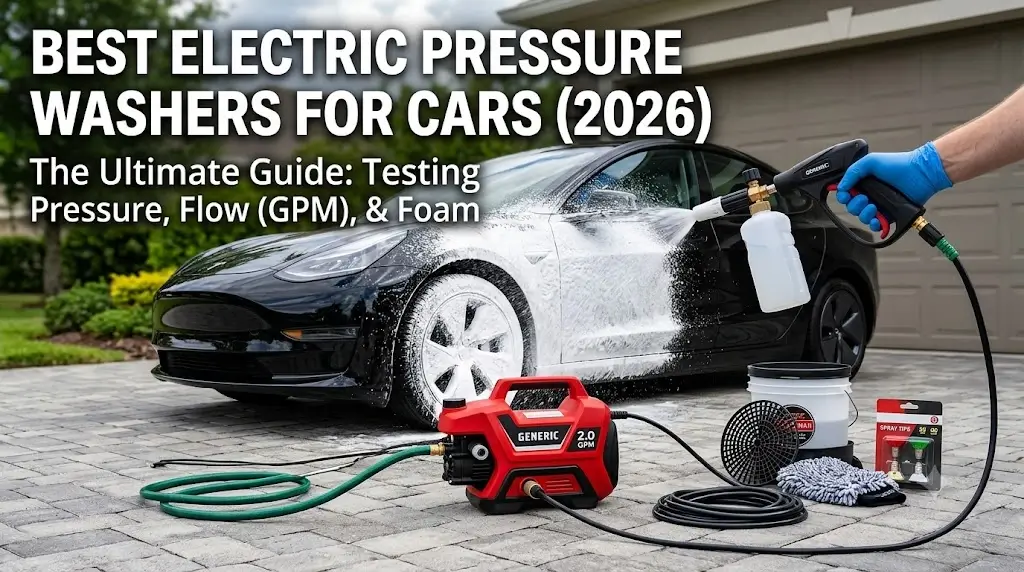
Find the best electric pressure washers for cars in 2026. Compare working PSI, GPM flow, foam cannon performance, noise levels, and detailing value.
5 Best Electric Pressure Washers for Cars in 2026: Working PSI, GPM & Detailing Guide
Last Updated: July 2026 | Review Method: Benchmarked Output + Third-Party Load Data + Editorial Detailing Testing
When evaluating the best electric pressure washers for cars, higher advertised PSI isn’t always better. A great vehicle-washing setup requires a balance of working pressure, usable water flow (GPM), flexible hose behavior, and foam cannon compatibility. Extreme pressure might strip concrete driveways, but it isn’t the right tool for delicate clear coats.
For most home vehicle owners, finding the best electric pressure washers for cars comes down to choosing a machine that provides enough force (around 1,000–1,500 PSI under load) to safely lift road grime without risking paint damage. Higher usable water flow can also make soap rinsing faster, especially on larger trucks and SUVs.
Independent pressure-washer testing published by external publications such as Car and Driver’s Pressure Washer Tests illustrates an important distinction between advertised maximum PSI and measured operating performance under load. When testing the best electric pressure washers for cars, that difference matters because headline box ratings rarely reflect the pressure delivered at the nozzle during real-world use under load.
This guide evaluates our top choices for the best electric pressure washers for cars, separating published manufacturer specifications from independent third-party measurements where available.
Quick Verdict: Ranking the Best Electric Pressure Washers for Cars
Here is a quick overview of our top recommendations when selecting the best electric pressure washers for cars based on your specific detailing goals and budget:
- Best Overall Value: Craftsman CMEPW2100 — Best for homeowners who want a compact, accessible machine with documented third-party performance data.
- Best Dedicated Detailing Choice: Active 2.0 Electric — Best for users who prioritize high published water flow and a detailing-oriented accessory ecosystem.
- Best Compact / Lower-Noise Design: Ryobi 1800 PSI Whisper Series (RY141802VNM) — Best for buyers prioritizing compact storage and Ryobi’s quieter-operation positioning, with no standardized independent dBA comparison identified.
- Best Budget Entry Point: Sun Joe SPX3000 — Best for occasional car washing and general light-duty outdoor cleaning.
- Best Car + Concrete Dual-Purpose Machine: Greenworks Pro 3000 PSI — Best for homeowners who need substantial electric cleaning power for masonry and also want to wash vehicles with careful technique.
Important: The overall order is car-first and value-adjusted. The Greenworks is #5 overall among the best electric pressure washers for cars, but it is our top pick for dual-purpose concrete + vehicle cleaning. The Active 2.0 is #2 overall but our preferred choice for dedicated detailing workflows.
Why We Rank Craftsman CMEPW2100 #1 Among the Best Electric Pressure Washers for Cars
The Craftsman is not necessarily the highest-performing machine here. Its advantage is that we can evaluate its real-world output with more confidence while it remains accessible to mainstream buyers. For the average homeowner seeking the best electric pressure washers for cars for routine maintenance, it offers a reported 1,500 PSI / 1.2 GPM output under load, a light 20-lb frame, and lower entry cost out of the box.
When to Choose the Active 2.0 Instead: If your primary focus is maximizing rinse volume and foam cannon throughput for frequent detailing, the Active 2.0’s published 2.0 GPM flow rating makes it a top contender among the best electric pressure washers for cars for high-volume workflows.
Comparison: 5 Best Electric Pressure Washers for Cars in 2026
Below is our head-to-head breakdown comparing the best electric pressure washers for cars, matching published specs against independent third-party test results:
Data verification note: Published and reported test figures should not be treated as directly equivalent measurements because manufacturer and third-party testing conditions may differ. Test configurations vary by model and should not be interpreted as a standardized head-to-head benchmark. Always verify the exact model SKU before purchasing.
| Model & SKU | Performance Evidence Level | Published Max Specs | Selected Third-Party Test Result | Hose Type & Fitting Standard | Best Workflow / Category | Main Trade-Off |
|---|---|---|---|---|---|---|
| Craftsman CMEPW2100 | Third-party tested | 1,900 PSI / 1.2 GPM | 1,500 PSI / 1.2 GPM (15° nozzle) [C&D Test] | 25 ft PVC Plastic / M22-14mm | Most Home Car Owners | Lower water flow rate (1.2 GPM) |
| Active 2.0 Electric | Manufacturer specs only | 1,800 PSI / 2.0 GPM | No comparable test data identified | 30 ft Rubber Hose / M22-14mm | Dedicated Car Detailing | Higher price / unverified sustained flow |
| Ryobi RY141802VNM | Manufacturer specs only | 1,800 PSI / 1.2 GPM | No comparable test data identified | 20 ft PVC Plastic / M22-14mm | Noise-Sensitive Suburban Use | No standardized dBA comparison data |
| Sun Joe SPX3000 | Manufacturer specs only | 2,030 PSI / 1.76 GPM | No comparable test data identified | 20 ft Rigid PVC / M22-15mm (Requires Adapter) | Budget Pick & Occasional Use | Consumer-grade plastic accessories |
| Greenworks Pro 3000 | Third-party data (config-dependent) | 3,000 PSI / 2.0 GPM | ~2,600 PSI Tested [C&D Test] | 25 ft Steel-Braided / M22-14mm | Cars & Heavy Concrete Cleaning | Higher output requires extra car safety care |
*Performance Evidence Level indicates whether independent third-party lab testing was identified for the specific SKU in our research pass.
⚠️ Critical Paint Safety Rules for Vehicle Detailing
- NEVER Use a 0° (Red) Nozzle: Even when using the best electric pressure washers for cars, a pinpoint 0-degree nozzle delivers concentrated hydraulic force that can tear rubber seals, strip clear coat, or puncture tires.
- Stick to 25° (Green) or 40° (White) Nozzles: These fan spray patterns distribute impact pressure safely across paint panels.
- Maintain a Safe Working Distance: Always start spraying at least 12 to 18 inches away from the surface and move closer only as needed.
- Check Circuit Limits (15A Electrical Draw): Most standard residential outdoor outlets in the US operate on a 15-Amp circuit breaker. Ensure your unit does not exceed 13–15A under full load to avoid tripping breakers during operation.
How We Ranked the Best Electric Pressure Washers for Cars
How Our Editorial Ranking Works
To keep our product analysis transparent, we separate technical information into three distinct data types rather than claiming proprietary laboratory testing:
- Manufacturer Specifications: Published maximum PSI, peak GPM, motor type, and accessory specifications provided by the brand.
- Reported Third-Party Measurements: Performance data reported by external testing publications (specifically citing Car and Driver load-testing measurements).
- Editorial Synthesis: MenReviewHub’s evaluation of how each machine aligns with specific automotive buyer personas, garage storage constraints, and detailing workflows.
If We Were Buying Today: Quick Recommendations
- First-time home car owner wanting an easy out-of-the-box setup: Craftsman CMEPW2100
- Dedicated detailing enthusiast using foam cannons frequently: Active 2.0 Electric
- Suburban homeowner needing compact garage storage & lower noise: Ryobi RY141802VNM
- Budget buyer washing a car once or twice a month: Sun Joe SPX3000
- One machine for heavy driveway cleaning + careful car rinsing: Greenworks Pro 3000 PSI
Buyer Decision Tree: Which Washer Should You Buy?
Do you primarily need a pressure washer for vehicles?
  ├── NO
  │    └── Do you need serious concrete or patio restoration power?
  │         ├── YES ──> Greenworks Pro 3000 PSI (Car + Concrete Dual-Purpose)
  │         └── NO  ──> Consider our guide to the Best Electric Pressure Washers for General Home Use
  │
  └── YES
       ├── Is low operating noise and compact storage your main priority? ────> Ryobi Whisper Series (RY141802VNM)
       ├── Are you on a strict budget (<$150) for occasional washes? ────────> Sun Joe SPX3000
       └── Do you regularly use foam cannons, have adequate water supply, and want high rinse volume?
            ├── YES ──────────────────────────────────────────────────────────> Active 2.0 (High Flow Focus)
            └── NO (Want a balanced, accessible out-of-the-box car washer) ───> Craftsman CMEPW2100 (#1 Overall)
Why We Did Not Rank These Models Higher
Transparency requires explaining the specific trade-offs that kept individual models from taking the top spot in our review of the best electric pressure washers for cars:
- Why the Active 2.0 Isn’t #1: Published 2.0 GPM flow is highly attractive for detailing workflows, but independent sustained-flow lab measurements were not identified, and its higher price makes it less practical for general homeowners seeking a budget-friendly out-of-the-box solution.
- Why the Ryobi Whisper Isn’t #1: Its quiet-design positioning is compelling for suburban driveways, but standardized independent dBA test data was not available to objectively verify sound levels against competitors.
- Why the Sun Joe SPX3000 Isn’t #1: Its low entry price is attractive for budget buyers, but its consumer-grade fittings and stiffer factory hose offer a less refined detailing workflow compared to higher-ranked units.
- Why the Greenworks Pro 3000 Isn’t #1: Car and Driver reported approximately 2,600 PSI in its test configuration. That high output is exceptionally useful for concrete restoration, making it over-spec for car-only workflows where lower working pressures are preferred.
- Why the Craftsman Wins: The Craftsman is not necessarily technically superior in every spec, but it is easier to evaluate with greater confidence while remaining accessible to mainstream buyers.
What Actually Matters for Car Washing vs. Marketing Hype
| Feature / Metric | Why It Matters for Cars | What Not to Overweight |
|---|---|---|
| Working Pressure (PSI) | Determines surface cleaning force to break contamination bonds. | Headline “Max Burst PSI” printed on the retail box. |
| Usable Water Flow (GPM) | Determines rinsing speed and carries dirt away efficiently. For car washing, hose behavior and flow can matter more than an extra few hundred PSI because the operator repeatedly moves around the vehicle. | Peak open-flow GPM ratings measured without nozzle resistance. |
| Hose Flexibility | Prevents hose coiling, dragging, and whipping against body panels. | Hose length alone if the material is rigid PVC plastic. |
| Water Inlet Flow | Prevents pump starvation and pressure surging under dynamic load. | Static open-spigot faucet flow without backpressure testing. |
| Foam Cannon Compatibility | Enhances pre-wash dwell time and soap encapsulation coverage. | Built-in low-pressure detergent siphon tanks. |
Detailed Reviews: The Best Electric Pressure Washers for Cars
1. Craftsman CMEPW2100 — Best Overall Value
Overview & Data Analysis
The Craftsman CMEPW2100 earns our top recommendation as the best electric pressure washer for cars for general vehicle owners based on its reported third-party test output, compact footprint, widespread availability, and practical performance for routine automotive maintenance.
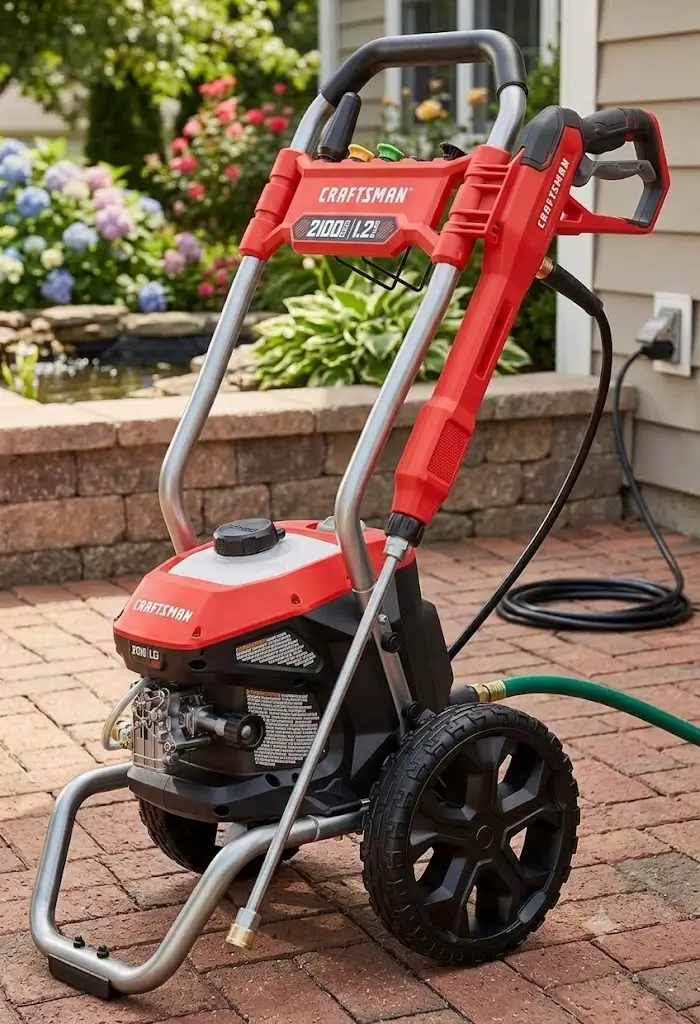
Independent load-testing published by Car and Driver recorded 1,500 PSI at 1.2 GPM using the standard 15-degree nozzle (against its published 1,900 Max PSI rating). The tester also recorded 1,400 PSI / 1.4 GPM with the turbo nozzle and an 85 dBA sound reading under their specific test environment conditions. These measurements reflect the exact configuration tested by Car and Driver and should not be interpreted as universal performance specifications for every operating setup.
[Published Box Spec: 1,900 Max PSI] ---> [Reported C&D Test Output: 1,500 PSI @ 1.2 GPM under load]
Specifications & Source Attribution
- Published Specs: 1,900 Max PSI / 1.2 Max GPM
- Reported Third-Party Output: 1,500 PSI @ 1.2 GPM (15° nozzle); 1,400 PSI @ 1.4 GPM (turbo) [Source: Car and Driver]
- Weight & Sound: 20 lbs | 85 dBA (Recorded under Car and Driver’s specific testing environment and distance, which may vary under different operating conditions)
Editorial Decision Engine
- Why It Ranks #1: It delivers the most practical out-of-the-box balance for non-professional car owners—offering reported third-party working pressure that falls within a practical range for routine vehicle washing, light weight, and accessible pricing.
- Why It Beats #2 (Active 2.0): Higher published maximum flow (2.0 GPM vs. 1.2 GPM) makes the Active 2.0 attractive on paper, although independent sustained-flow measurements were not identified in the sources reviewed. The Craftsman holds the top spot for general users due to lower entry cost, widespread retail accessibility, and reported test output.
- Who Should Buy: Homeowners wanting a simple, balanced pressure washer dedicated primarily to routine vehicle maintenance.
- Who Should Avoid: Detailing enthusiasts who demand high water volume (1.8–2.0 GPM) for dense foam cannons or homeowners needing heavy masonry stripping power.
- Better Alternative: Choose the Active 2.0 for high-flow foam cannon performance or the Greenworks Pro 3000 for driveway restoration.
Pros & Cons
- Pros: Reported third-party working pressure fits routine car washing; compact 20 lb footprint; accessible retail pricing.
- Cons: The included hose is less flexible than premium rubber or hybrid hoses and may be more prone to retaining coil memory; stock accessories require verification per SKU revision.
2. Active 2.0 Electric — Best Dedicated Detailing Choice
Overview & Data Analysis
The Active 2.0 is widely recognized as one of the best electric pressure washers for cars among auto detailing enthusiasts. According to manufacturer statements, the Active 2.0 uses a five-piston pump design, while its published 2.0 GPM flow rating places greater emphasis on water throughput than many compact consumer models.
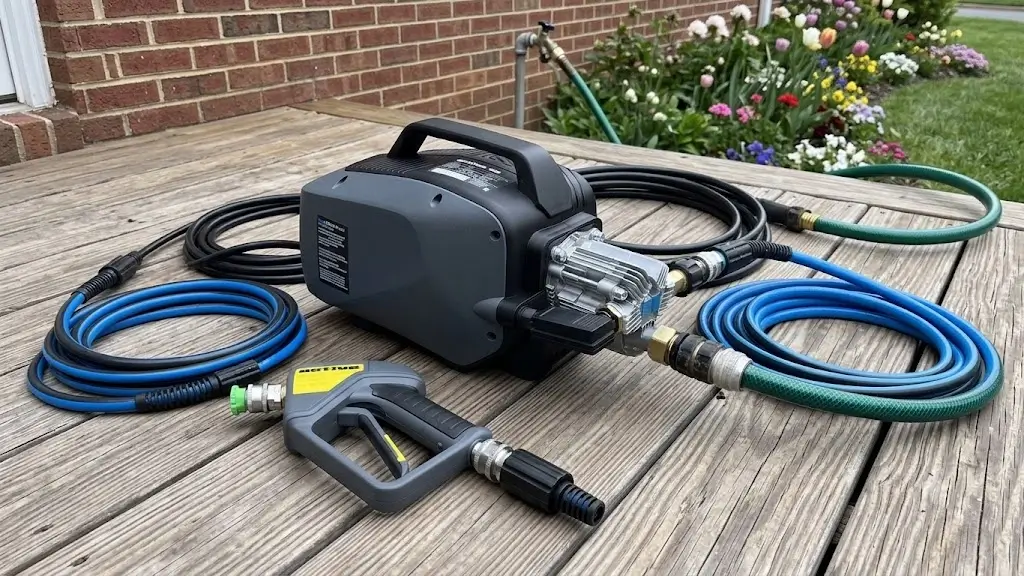
The Active 2.0’s published 2.0 GPM rating makes it the more attractive choice for high-volume rinsing and foam-cannon workflows, although actual foam performance depends on the cannon, orifice, detergent dilution, and operating conditions. Because we did not identify independent load testing for this model in the sources reviewed, we do not treat the published 2.0 GPM figure as verified sustained output.
Specifications & Source Attribution
- Published Specs: 1,800 Max PSI / 2.0 Max GPM
- Reported Third-Party Output: No independent third-party lab measurements identified in the sources reviewed.
- Pump & Fitting Architecture: 5-Piston Pump (Manufacturer claim); uses standard-style 1/4-inch quick-connect hardware at the spray-accessory end, while buyers should verify the exact hose and inlet fittings for their configuration.
Editorial Decision Engine
- Why It Ranks #2: It is marketed specifically for detailing workflows, offering high published flow (2.0 GPM) and direct compatibility with aftermarket short trigger guns and foam cannons.
- Why It Beats #3 (Ryobi Whisper): Significantly higher published water flow (2.0 GPM vs 1.2 GPM) tailored specifically for foam cannons and rapid soap rinsing.
- Who Should Buy: Car detailing enthusiasts who prioritize water volume and frequent foam cannon use.
- Who Should Avoid: Casual car washers on a tight budget or those with weak household water spigot flow.
- Better Alternative: Choose the Craftsman CMEPW2100 for general home washing at a lower price point.
Pros & Cons
- Pros: High 2.0 GPM published flow rate; detailing-oriented marketing and design; non-proprietary quick-connect fittings.
- Cons: Higher purchase price; requires adequate home water supply; lacks independent third-party lab verification in sources reviewed.
3. Ryobi 1800 PSI Whisper Series (RY141802VNM) — Best Compact / Lower-Noise Design
Overview & Data Analysis
Operating sound is a major factor for suburban homeowners searching for the best electric pressure washers for cars in tight residential areas. Ryobi positions the model as part of its Whisper Series, with an emphasis on quieter operation.
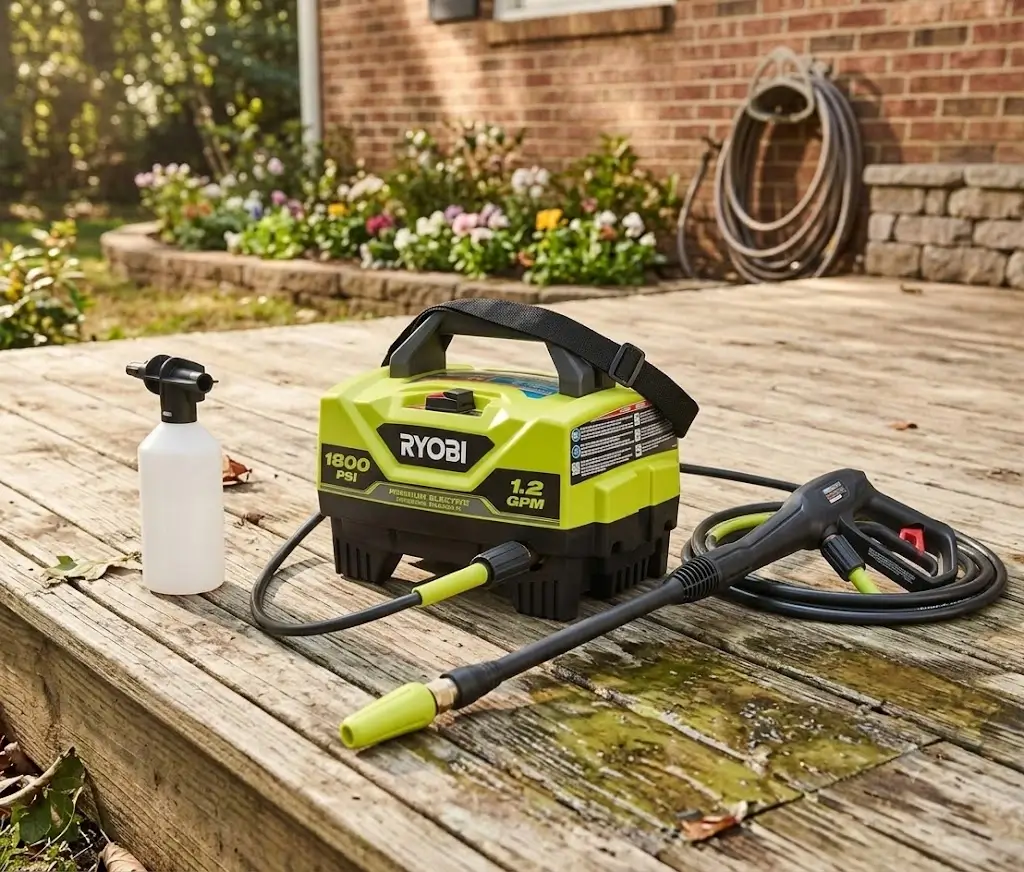
Ryobi markets this model with a reduced-noise design emphasis; however, we did not find standardized third-party dBA testing that allows a direct comparison with the other models in this list. We therefore rank it for buyers who value the design emphasis, not because we can verify that it is objectively quieter than every competing model. Its compact frame and Whisper Series positioning make it appealing to buyers who prioritize storage and operating noise.
Specifications & Source Attribution
- Published Specs: 1,800 Max PSI / 1.2 Max GPM (Model RY141802VNM)
- Motor Architecture: Brushless Motor System
- Reported Third-Party Output: No independent third-party lab measurements identified in the sources reviewed.
Editorial Decision Engine
- Why It Ranks #3: Ideal for noise-sensitive suburban environments where a compact, low-noise design emphasis and stable unit are preferred.
- Why It Beats #4 (Sun Joe SPX3000): Modern brushless motor design and protective roll-cage frame architecture.
- Who Should Buy: Suburban homeowners in noise-sensitive neighborhoods prioritizing compact garage storage.
- Who Should Avoid: Users seeking maximum water volume (2.0 GPM) for rapid truck rinsing.
- Better Alternative: Choose the Active 2.0 for higher flow or the Craftsman CMEPW2100 for reported test data.
Pros & Cons
- Pros: Sound-dampened housing design emphasis; stable roll-cage frame; brushless motor design.
- Cons: Modest 1.2 GPM flow rate; published specs await independent third-party lab verification.
4. Sun Joe SPX3000 — Best Budget Entry Point
Overview & Data Analysis
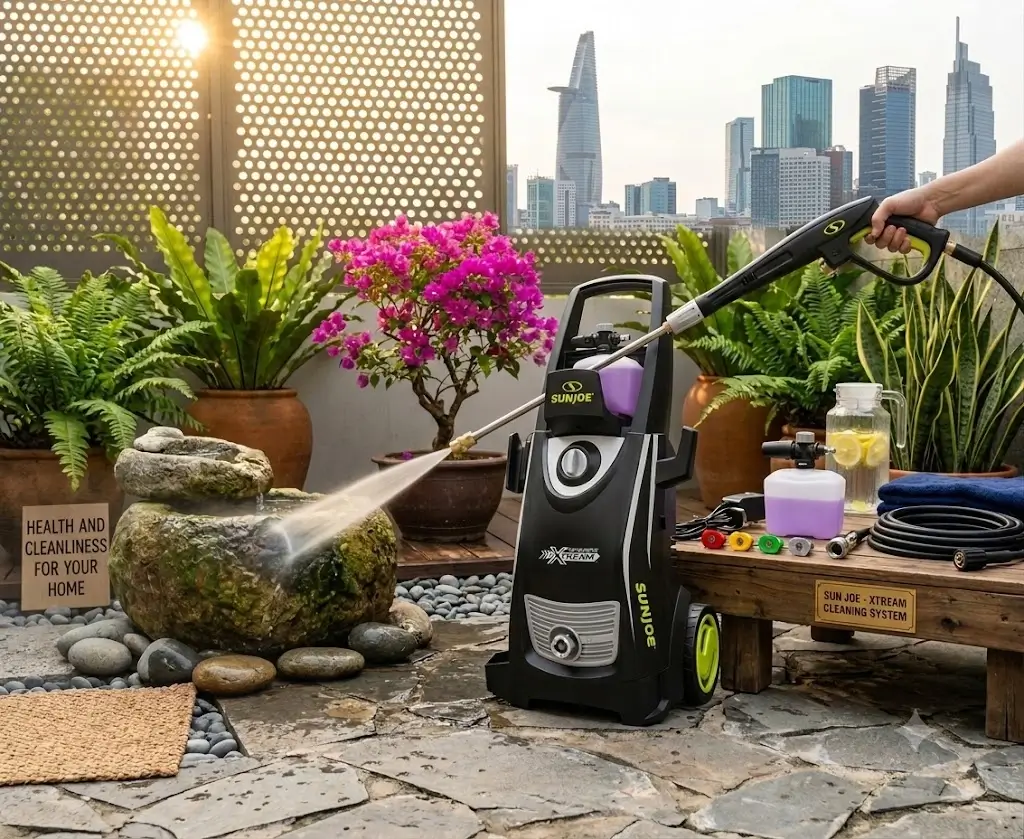
The Sun Joe SPX3000 remains a popular entry-level pick among the best electric pressure washers for cars on a tight budget, featuring dual onboard soap tanks and an accessible purchase price. Published maximum PSI and GPM figures are often peak ratings rather than measurements of sustained output under a specific real-world load.
Specifications & Source Attribution
- Published Specs: 2,030 Max PSI / 1.76 Max GPM (14.5-Amp Motor)
- Reported Third-Party Output: No independent third-party lab measurements identified in the sources reviewed.
- Build Features: Dual onboard detergent tanks, 5 included quick-connect spray tips.
Editorial Decision Engine
- Why It Ranks #4: Offers an inexpensive entry point for casual car washing (1–2 times per month) and general outdoor chores.
- Why It Beats #5 (Greenworks Pro 3000): Significantly lower entry price for casual users who do not need heavy concrete cleaning power.
- Who Should Buy: Budget-conscious car owners washing vehicles infrequently.
- Who Should Avoid: Serious car care enthusiasts seeking high repairability, heavy-duty brass fittings, or flexible non-kinking hoses.
- Better Alternative: Choose the Craftsman CMEPW2100 for superior tested working performance and ergonomics.
Pros & Cons
- Pros: Low entry price; includes 5 spray tips; dual soap tanks.
- Cons: The included hose is less flexible than premium rubber or hybrid hoses and may be more prone to retaining coil memory; budget-oriented fitting construction; published specs represent peak limits.
5. Greenworks Pro 3000 PSI — Best Car + Concrete Dual-Purpose Machine
Overview & Data Analysis
For homeowners seeking one machine to clean concrete driveways, brick patios, and siding while also washing vehicles, the Greenworks Pro 3000 PSI offers substantial electric power. The overall ranking is car-first. The Greenworks ranks fifth overall because its strengths are more valuable for masonry and multi-surface cleaning than for dedicated vehicle washing; within the dual-purpose category, however, it stands out as one of the best electric pressure washers for cars and general home maintenance.
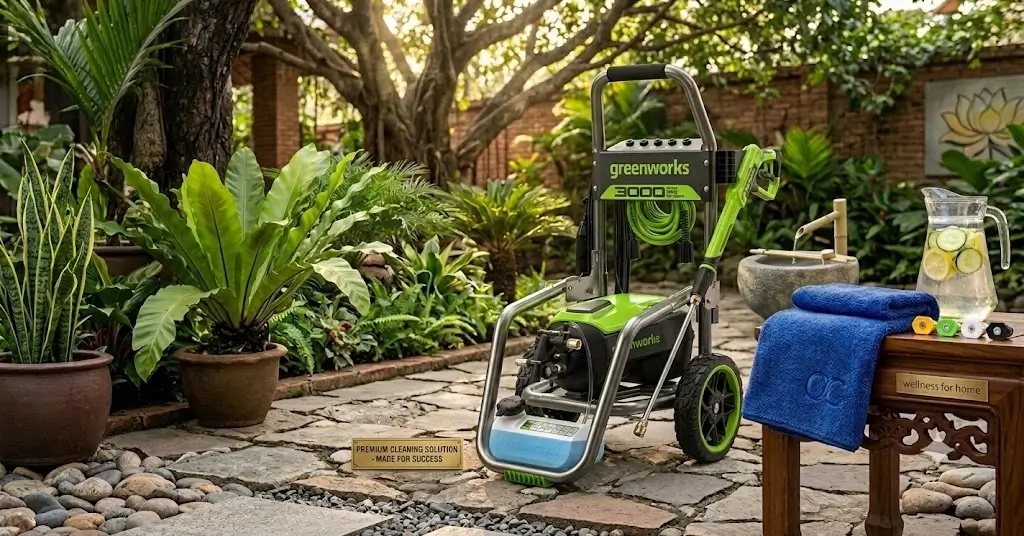
Car and Driver reported approximately 2,600 PSI in its test configuration. This figure should not be interpreted as a universal sustained operating specification. Because the measured output is substantially higher than what is typically needed for routine car washing, we rank this model primarily as a dual-purpose machine rather than a car-first recommendation.
Specifications & Source Attribution
- Published Specs: 3,000 Max PSI / 2.0 Max GPM (Brushless Motor)
- Reported Third-Party Output: Car and Driver reported approximately 2,600 PSI in its test configuration
- Warranty: 3-Year Limited Tool Warranty; verify current Greenworks Warranty terms before purchase.
Editorial Decision Engine
- Why It Ranks #5: Exceptional electric power for heavy masonry restoration combined with a high 2.0 GPM flow rate; positioned as a dual-purpose heavy-duty pick rather than a car-first washer.
- Who Should Buy: Homeowners needing maximum electric power for driveways and patios who also wash cars carefully.
- Who Should Avoid: Car-only buyers who do not need heavy concrete cleaning capability.
- Better Alternative: Choose the Craftsman CMEPW2100 for a more balanced car-washing setup, or the Active 2.0 if higher published flow is your priority.
Pros & Cons
- Pros: Heavy-duty electric cleaning power; 2.0 GPM flow rate; brushless motor design.
- Cons: Higher working pressure increases the consequence of poor technique on cars; heavy frame requires significant storage space.
Practical Buying Targets for Different Car-Washing Workflows
Selecting among the best electric pressure washers for cars requires matching machine output to your specific vehicle care routine:
These are editorial buying targets rather than universal industry standards. Actual results depend on nozzle selection, machine output under load, water supply, foam cannon orifice, and the specific workflow.
| Type of Use | Editorial Target Range | Primary Feature Focus |
|---|---|---|
| Occasional Car Washing | Moderate Working PSI (~1,000–1,400) + 1.2 GPM | Portability & Low Cost |
| Foam Cannon Enthusiast | Prioritize sufficient working pressure + compatible flow/orifice setup | Workflow Preference & Quick-Connects |
| Large SUV / Truck Rinsing | Higher Usable Flow (1.5–2.0 GPM) | Water Volume & Hose Length |
| Car + Driveway Restoration | 2,000+ PSI Capability | Pressure Adjustability / Wide Nozzles |
Water Supply: Open-Flow Static Rate vs. Dynamic Load
A pressure washer’s available inlet supply can limit its ability to maintain stable pump performance. If the water source cannot keep up with the pump’s demand, even the best electric pressure washers for cars may experience pressure fluctuation, reduced performance, or pump starvation.
A pressure washer rated at 2.0 GPM does not necessarily require a household supply that delivers exactly 2.0 GPM under all conditions, but inadequate supply can cause pressure fluctuation, pump starvation, or reduced performance depending on the machine.
Screening Test Note: As a practical screening test, a 5-gallon bucket that fills in roughly 2.5 minutes corresponds to about 2.0 GPM of open-flow supply. This is a screening test, not a specification test, because the bucket test measures unrestricted faucet output, not the pressure washer’s actual operating flow under dynamic load. To maintain proper flow:
- Use a sufficiently large-diameter garden hose (5/8-inch is generally adequate for many residential pressure washers, while 3/4-inch can reduce restriction on longer runs or higher-demand setups). Avoid unnecessarily long or restrictive supply runs. The exact hose length that works depends on the home’s water pressure, hose diameter, fittings, and the pressure washer’s inlet requirements.
- Avoid restrictive plastic shut-off valves or quick-connects at the spigot.
Best Pressure Washer Setup for Car Detailing
To build a high-efficiency detailing setup, structure your equipment chain to optimize workflow speed and surface protection. If you are setting up one of the best electric pressure washers for cars, our guide to the best foam cannons for electric pressure washers covers orifice sizing, inlet compatibility, and soap draw in depth.
[Electric Pressure Washer Unit]
         │
         ▼ (M22 Outlet Connection)
[Flexible Hose] ─────────> (Easier to control, less likely to snag or whip against paint)
         │
         ▼ (1/4" Quick-Connect Outlet)
[Short Trigger Gun ("Snubby")] ──> (Can improve maneuverability around wheel wells & grilles)
         │
         ├───> [Foam Cannon + Matched Orifice Jet] ──> (Pre-wash foam dwell stage)
         └───> [25° or 40° Spray Nozzle] ───────────> (Controlled pressure rinse stage)
Foam Cannon Orifice Selection & Flow Matching
Foam cannon performance depends on matching the cannon’s orifice to the pressure washer’s actual operating pressure and flow, not simply its advertised maximum ratings. When using the best electric pressure washers for cars, foam cannon performance is often easier to optimize when the machine provides enough flow for the cannon’s specified operating range.
Lower-flow electric pressure washers may perform better with a smaller orifice, but the correct size depends on the specific foam cannon and the machine’s measured output. Some manufacturers and detailing suppliers recommend testing different orifices to achieve the desired combination of draw, coverage, and foam thickness. For this reason, we do not recommend treating 1.1 mm or 1.25 mm as universal specifications. Check the foam cannon manufacturer’s compatibility guidance before changing the orifice.
| Washer Usable Flow (GPM) | Recommended Foam Cannon Orifice | Expected Foam Dwell & Performance |
|---|---|---|
| 1.1 – 1.3 GPM (e.g., Craftsman, Ryobi) | 1.1 mm Orifice | Creates rich, thick shaving-cream foam on lower-flow units. |
| 1.4 – 1.8 GPM (e.g., Sun Joe) | 1.1 mm or 1.25 mm Orifice | Balanced flow and foam density; minimal pump strain. |
| 1.9 – 2.0+ GPM (e.g., Active 2.0) | 1.25 mm Orifice | Maximum fluid flow; rich foam coverage with reduced backpressure. |
What PSI Is Appropriate for Car Washing?
For many home vehicle-washing workflows, an operating range around 1,000–1,500 PSI can provide enough cleaning force without requiring the higher output of heavy-duty surface-cleaning machines. This is an editorial buying target—not a manufacturer or industry-wide safety standard.
Safety Factors Beyond PSI: Nozzle force alone does not dictate surface safety when operating the best electric pressure washers for cars. Always manage these variables:
- Actual Delivered Pressure: The pressure measured at the nozzle during operation, rather than the peak rating on the box.
- Spray Nozzle Angle: Use 25-degree (green) or 40-degree (white) nozzles. Avoid 0-degree pinpoint nozzles on painted automotive surfaces and other vulnerable exterior components.
- Recommended Starting Distance: Start at a conservative distance—often around 12–18 inches—and adjust based on the nozzle pattern, machine output, and condition of the surface.
- Surface Pre-Inspection: Exercise extra caution around pre-existing paint chips, flaking clear coat, vinyl wraps, decals, and rubber window seals.
- Operator Motion: Keep the spray wand moving continuously across the panel rather than holding it on a single spot.
Technical Analysis: PSI vs. GPM in Automotive Care
Understanding how water pressure and flow interact is essential for vehicle care. For a deeper breakdown of flow calculations and nozzle dynamics across the best electric pressure washers for cars, read our detailed guide on PSI vs. GPM for Pressure Washing.
- PSI (Pressure): Provides the mechanical impact force required to break loose bonded road film and mud.
- GPM (Water Volume): Once sufficient pressure is available to loosen dirt, water volume plays a major role during rinsing by flushing debris away and supporting foam cannons.
[Adequate Working PSI]  --> Loosens surface contamination
[Higher Usable GPM]     --> Flushes loosened debris rapidly & powers foam cannons
Quick-Connect System Compatibility Breakdown
Understanding pressure washer connection standards prevents purchasing incompatible accessories. For upgrading stiff factory lines on the best electric pressure washers for cars
- Nozzle-End (1/4″ Quick-Connect): The standard female socket at the end of spray wands and short trigger guns, accepting spray tips and foam cannon male plugs. Most consumer electric washers accept standard 1/4-inch quick-connect spray tips at the nozzle end.
- Gun & Hose Threading (M22-14mm vs M22-15mm): M22 fittings are commonly described as M22-14 or M22-15 based on the insert configuration. The naming convention can be confusing because M22 compatibility depends on the insert/stem configuration, so verify the exact fitting before ordering. M22-14 and M22-15 fittings are not interchangeable without the correct adapter or insert.
- Proprietary Connections: Brands like Kärcher often use proprietary quick-click wands, requiring specialized adapters to attach standard 1/4″ quick-connect accessories.
Pressure Washer Features to Avoid for Car Detailing
- Peak Advertised PSI Alone: High box ratings do not reflect sustained working pressure under load.
- Built-In Soap Tanks for Detailing: Built-in detergent tanks are convenient for general cleaning, but they typically do not provide the same level of foam control and cling as a dedicated pressure-washer foam cannon.
- Pinpoint 0-Degree Spray Tips: Can damage paint, trim, weatherstripping, or other delicate surfaces.
Motor Type: What It Means for Ownership
Understanding internal motor architecture helps manage lifespan expectations when buying the best electric pressure washers for cars:
- Universal Motors: Universal motors are common in many compact consumer electric pressure washers. They are relatively lightweight and inexpensive but tend to produce more operating noise than induction motors.
- Brushless Motors: Brushless motor systems eliminate mechanical carbon brushes, which can reduce one source of wear. What this tells you: No carbon-brush wear. What it does not tell you: Pump lifespan, seal durability, or electronics board reliability.
- Induction Motors: Induction motors are generally associated with heavier-duty pressure washers and quieter operation, but they add weight and cost.
- Pump Maintenance & Water Flow: Running a pressure washer without adequate water flow can overheat the pump and accelerate wear or damage internal components. Always establish a full water supply before turning the unit on.
Vehicle Protection & Wheel Care Guidelines
Preventing swirl marks and clear-coat etching requires disciplined technique. Read our complete guide on how to pressure wash a car safely for step-by-step pre-wash protocols.
- Maintain Safe Working Distance: Start at a conservative distance—often around 12 to 18 inches—and adjust based on the nozzle pattern, machine output, and surface condition.
- Cool Hot Wheels & Follow Chemical Labels: Allow extremely hot wheels and brake components to cool before applying wheel cleaners, especially if the product label instructs against use on hot surfaces.
- Hose Management: Route the hose behind you and keep it away from the vehicle’s lower panels. A flexible hose also reduces dragging and snagging compared with a stiff factory hose.
Frequently Asked Questions (FAQ)
1. Is 2,000 PSI too much for washing a car?
A 2,000-PSI-rated pressure washer is not automatically unsuitable for vehicle washing. The relevant factors are the pressure actually delivered through the selected nozzle, spray angle, distance, and the condition of the surface being cleaned.
2. What PSI is appropriate for car detailing?
For many home vehicle-washing workflows, an operating range around 1,000 to 1,500 PSI under working conditions can provide enough cleaning force without requiring the higher output of heavy-duty surface-cleaning machines. This is an editorial buying target—not a manufacturer or industry-wide safety standard.
3. Is GPM more important than PSI for car washing?
Once sufficient working pressure is available to loosen contamination, usable water flow plays a major role in rinsing efficiency by carrying debris away and supporting foam cannon operation.
4. Does higher GPM automatically guarantee thicker foam?
Higher-flow pressure washers can make some foam cannon setups easier to tune, but foam thickness is not determined by GPM alone. The cannon’s orifice, pressure, detergent concentration, and the machine’s actual operating output all matter.
5. Do I need a short pressure washer trigger gun?
A short trigger gun is not mandatory, but it can improve maneuverability around wheel wells, grilles, and tight body contours compared with many long stock wands.
6. Can I use standard 1/4-inch quick-connect accessories on any washer?
Most electric washers accept 1/4-inch quick-connect fittings at the nozzle end. However, machine or gun inlet threads (such as M22-14 vs M22-15) may require specific adapters.
7. Is a 3,000 PSI pressure washer safe if I stay farther back?
A 3,000-PSI machine can be used for vehicle washing, but distance alone does not guarantee safety. Use a wide spray pattern (40°), keep the nozzle moving, maintain a conservative distance, and avoid damaged paint, loose trim, and delicate seals.
8. What is the difference between a car wash and a car detailing workflow?
A standard car wash focuses on quick surface dirt removal. A detailing workflow involves methodical steps: wheel cleaning, pre-rinsing, foam cannon dwell time, contact washing with lubricated shampoo, detail rinsing, and surface drying.
9. How do I prevent my pressure washer hose from scratching my car?
Route the hose behind you and keep it away from the vehicle’s lower panels. Upgrading to a flexible rubber or hybrid polymer hose that stays flat on the driveway reduces dragging and snagging compared with a stiff factory hose.
10. How often should I maintain my electric pressure washer?
Inspect and clean the water inlet filter screen before every use. Flush all detergent out of the system with clean water after spraying soap, and drain all internal water before winter storage.
