
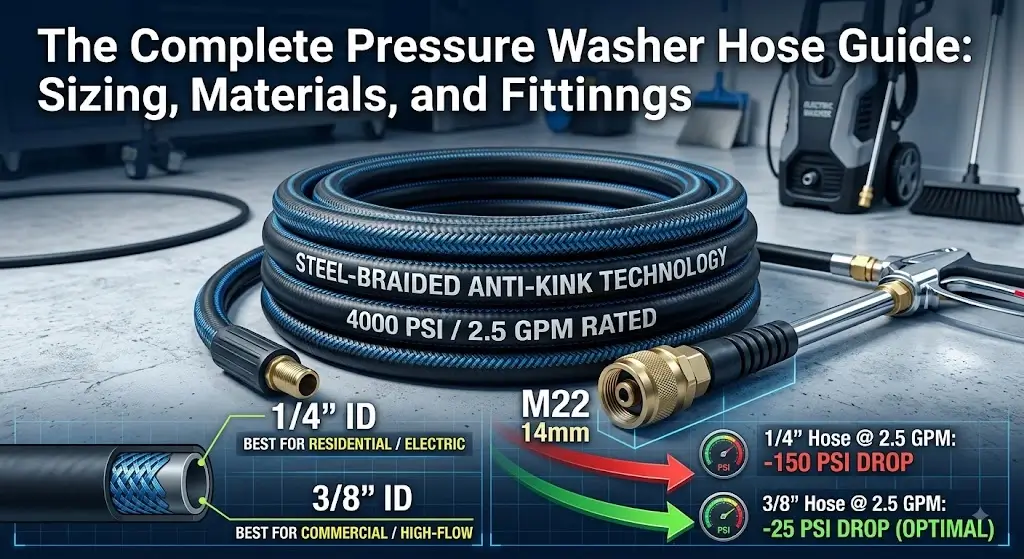
Pressure Washer Hose Guide: Size 1/4 vs 3/8, PSI, GPM & M22 Fittings
- 1/4-inch ID: Practical starting point for lower-flow residential pressure washers (1.0 to 2.0 GPM). Provides minimal physical weight, high flexibility, and easy storage.
- 5/16-inch ID: Useful intermediate size for 2.1 to 3.0 GPM residential gas pressure washers on longer hose extensions (50–100 ft).
- 3/8-inch ID: Preferred for high-flow commercial pressure washers (3.5+ GPM) or extended hose runs where minimizing fluid friction loss is critical.
The correct choice depends on your pump’s flow output (GPM), total hose length, maximum working PSI, and exact fitting specifications.
Welcome to our technical pressure washer hose guide. Pressure washer hoses are among the most frequently replaced components of high-pressure cleaning systems, yet they receive minimal technical scrutiny during initial equipment purchases. Stock hoses supplied with consumer-grade pressure washers are often short, stiff, prone to permanent kinking, and susceptible to thermal degradation when routed near engine exhaust components. Upgrading to an appropriate aftermarket hose significantly improves maneuverability, working radius, kink resistance, and operational safety.
This pressure washer hose guide uses hydraulic principles, manufacturer specifications, and pressure-washer hose construction standards to explain hose sizing. Where a specific pressure-loss value is presented as hydraulic reference data, it is derived from published fluid mechanics data for smooth-wall high-pressure lines rather than generic marketing claims.
Decision Framework: Pressure Washer Hose Guide Selection
Light Electric / Easy Handling: 1/4-inch TPU or Thermoplastic Hose
- Best For: Compact, low-flow electric pressure washers (1.0 to 1.8 GPM). Review our guide to the best electric pressure washers to verify system flow and fitting specifications.
- Bottom Line: Offers minimal weight, smooth dragging, and easy storage for light residential washing.
Residential Utility / Durability: 1/4-inch or 5/16-inch Steel-Braided Rubber Hose
- Best For: High-output electric and residential gas pressure washers (1.9 to 2.5+ GPM).
- Bottom Line: Single wire-braided synthetic rubber hoses provide an excellent balance of anti-kink flexibility, durability, and handling ease. They lie flat during deployment without retaining coiling loops.
Commercial High-Flow: 3/8-inch Double Wire-Braided Rubber Hose
- Best For: Professional detailing, commercial job sites, surface cleaners, and high-flow pressure washers pumping 3.5 GPM or higher over long runs (100+ ft).
- Bottom Line: Engineered for maximum volumetric throughput and daily abrasion tolerance, double wire-braided hoses minimize dynamic pressure drop over extended distances.
1/4 vs 5/16 vs 3/8 Pressure Washer Hose Comparison
The table below summarizes typical application characteristics across the three primary hose inner diameters. Use this as a starting guide rather than a universal specification limit:
| Feature / Attribute | 1/4-inch ID | 5/16-inch ID | 3/8-inch ID |
|---|---|---|---|
| Primary Application | Residential / Light Gas | Higher-Output Residential | Commercial / High-Flow |
| Flow Capacity | Lower | Medium | High |
| Friction Loss (At Same GPM) | Higher | Medium | Lower |
| Physical Weight | Lowest | Medium | Highest |
| Handling Flexibility | Usually Highest | Medium | Usually Lower |
| 1.0 – 2.0 GPM Compatibility | Well-Suited | Often Unnecessary | Usually Unnecessary |
| 2.1 – 3.0 GPM Compatibility | Good for Short Runs | Excellent Balance | Good for Long Runs |
| 3.1+ GPM Compatibility | Increasing Restriction | Acceptable | Preferred |
Hose Size by Pressure Washer Type
| Machine Classification | Typical Flow Output | Recommended Starting Hose ID | Key Handling Consideration |
|---|---|---|---|
| Compact Handheld Electric | 1.0 – 1.5 GPM | 1/4-inch ID | Lightweight thermoplastic; easy maneuverability. |
| Full-Size Residential Electric | 1.5 – 2.0 GPM | 1/4-inch ID | Flexible TPU or light rubber; matches low GPM flow. |
| Residential / Prosumer Gas | 2.0 – 3.0 GPM | 1/4-inch or 5/16-inch ID | Single wire-braided rubber; handles muffler heat. |
| Commercial Gas / Belt Drive | 3.0 – 4.0 GPM | 3/8-inch ID | Minimizes line loss across 100+ ft runs. |
| Industrial High-Flow / Trailer Rig | 4.0+ GPM | 3/8-inch ID (or larger) | Double wire-braided; engineered for heavy daily drag. |
Practical Hose ID Starting Points (GPM x Length)
Selecting the correct hose inner diameter (ID) involves balancing dynamic friction loss against physical hose weight and maneuverability. The matrix below offers practical starting points for common setups:
| Pump Flow Output (GPM) | 25-Foot Hose Run | 50-Foot Hose Run | 100-Foot Hose Run |
|---|---|---|---|
| 1.0 – 1.8 GPM | 1/4-inch ID | 1/4-inch ID | 1/4-inch ID |
| 1.9 – 2.5 GPM | 1/4-inch ID | 1/4-inch ID | 5/16-inch or 3/8-inch ID |
| 2.6 – 3.5 GPM | 1/4-inch or 5/16-inch ID | 5/16-inch ID | 3/8-inch ID |
| 3.6 – 5.0+ GPM | 3/8-inch ID | 3/8-inch ID | 3/8-inch ID (or larger) |
How to Measure Your Existing Pressure Washer Hose
If you are replacing an existing hose and lack the original manual, follow this 5-step measurement procedure:
- Measure the Internal Passageway (Nominal ID): Do not measure the outside diameter. Inspect the printed text along the hose jacket (e.g., “1/4 in. ID” or “3/8 in. ID”). If unprinted, measure the internal diameter of the bare hose tube end before fitting crimps.
- Identify the Fitting Architecture: Check if your machine utilizes threaded M22 connections, 3/8-inch Quick Connect couplers, or a proprietary quick-latch system.
- Measure the M22 Internal Stem Diameter: If your hose uses M22 twist-connect ends, measure the diameter of the solid inner brass pin/stem on the male outlet port using calipers:
- ~14.0 mm diameter = M22-14mm configuration
- ~15.0 mm diameter = M22-15mm configuration
- Verify Machine Continuous Working PSI: Locate the pump specification plate or manual. Check the operating pressure (e.g., 2,500 PSI) rather than peak marketing figures. Ensure the replacement hose working pressure rating meets or exceeds this number.
- Verify Actual Machine Flow Output (GPM): Match the hose ID to your machine’s true GPM output to prevent excessive pressure drop across your target hose length.
How Hose Diameter Affects Pressure and Flow
The internal diameter (ID) of a hose directly influences fluid velocity, dynamic friction loss, and delivered working pressure at the spray gun nozzle.
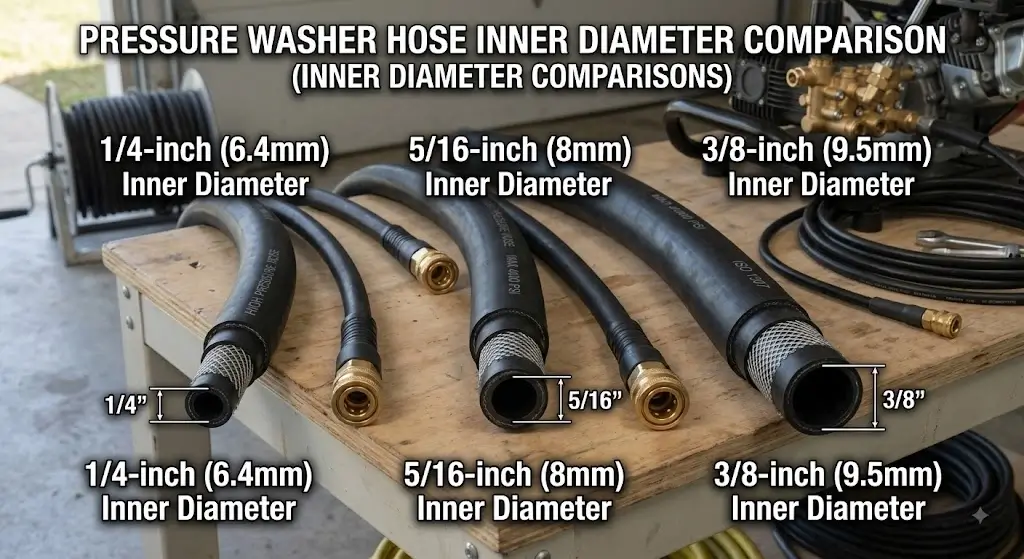
Friction Loss Mechanics
Fluid cross-sectional area increases with the square of the internal radius (Area = π × r2). Comparing a nominal 3/8-inch ID line to a 1/4-inch ID line reveals a cross-sectional area increase of approximately 2.25 times:
At a fixed volumetric flow rate, the larger cross-sectional area lowers average fluid velocity. Lower velocity substantially reduces frictional pressure loss along a given hose length.
Published Hydraulic Reference Data (Friction Loss per 100 Feet)
To demonstrate how inner diameter impacts dynamic line pressure, consider published hydraulic reference figures for water flow through smooth high-pressure lines (Source: General Pump Hydraulic Reference Chart):
| System Flow Output (GPM) | 1/4-inch ID Loss (PSI / 100 ft) | 5/16-inch ID Loss (PSI / 100 ft) | 3/8-inch ID Loss (PSI / 100 ft) |
|---|---|---|---|
| 1.0 GPM | ~54 PSI | ~20 PSI | ~7 PSI |
| 2.0 GPM | ~180 PSI | ~60 PSI | ~25 PSI |
| 3.0 GPM | ~380 PSI | ~120 PSI | ~50 PSI |
| 4.0 GPM | Excessive Restriction | ~220 PSI | ~90 PSI |
| 5.0 GPM | Excessive Restriction | ~320 PSI | ~130 PSI |
Note: Reference values represent smooth-bore line losses. At 2.0 GPM, moving from 1/4-inch to 3/8-inch reduces reference friction loss over 100 feet from approximately 180 PSI down to 25 PSI. The friction benefit is therefore substantially more significant on 100-foot runs than on a 25-foot residential hose.
- 1/4-inch ID: Common on lower-flow residential pressure washers. It is generally well suited to roughly 1.0–2.0 GPM systems, while higher flow rates and longer runs make friction loss increasingly important. At flow rates around 2.5 GPM or higher, check manufacturer pressure-loss recommendations before running long 1/4-inch lines.
- 5/16-inch ID: A useful intermediate size for some higher-flow residential systems, sitting between 1/4 and 3/8 in both hydraulic restriction and physical bulk. It reduces friction loss compared with 1/4-inch hose while remaining lighter than many 3/8-inch configurations.
- 3/8-inch ID: Commonly preferred for higher-flow commercial pressure washers, particularly when long hose runs make friction loss significant. The wider passage ensures unrestricted flow to surface cleaners and downstream accessories.
Technical Deep-Dive: Flow, Pressure, and Hose Performance
How Long Can a Pressure Washer Hose Be?
There is no single maximum hose length that applies to every pressure washer. Maximum practical length depends primarily on pump flow (GPM), hose ID, acceptable pressure loss, fittings, and manufacturer specifications. For residential units operating at 2.0 GPM or less, 50 to 100 feet is typically practical. Commercial units running 3.5+ GPM on 3/8-inch lines frequently operate 100 to 200+ feet without significant cleaning impairment.
How Much PSI Does a 50-Foot Pressure Washer Hose Lose?
There is no universal PSI-loss number for a 50-foot hose. Friction loss depends on actual GPM, measured hose ID, liner wall smoothness, fitting bore restriction, and fluid temperature. On a typical 2.0 GPM setup, a 50-foot 1/4-inch hose incurs approximately 90 PSI of friction loss, whereas a 3/8-inch line incurs under 15 PSI over the same distance.
Does a Longer Pressure Washer Hose Reduce PSI?
A longer hose does not decrease the pump’s internal mechanical pressure capacity, but it increases hydraulic friction along the hose walls. This friction drops the dynamic working pressure available at the nozzle tip. While short runs (25–50 ft) show minimal pressure drop, extending runs to 100 feet or more without increasing hose ID can result in noticeable performance drops.
Can You Use a 3/8-inch Hose on a 2 GPM Pressure Washer?
Yes, provided the fittings and pressure ratings match. A larger 3/8-inch ID hose will reduce line friction loss. However, on a low-flow 2.0 GPM unit, the pressure-loss reduction may be small enough that many residential users will not notice a meaningful cleaning-performance difference on a short 25–50 ft run, while adding extra weight and stiffness.
Does Hose Size Affect GPM Output?
A hose cannot increase a pump’s maximum GPM capability. However, an undersized or highly restrictive hose increases pressure loss between the pump and spray gun. Depending on pump and unloader valve design, excessive restriction can affect system operating behavior and delivered flow.
High-Pressure Discharge Hose vs. Garden Inlet Hose
Do not confuse high-pressure discharge lines with low-pressure water supply hoses:
| Attribute | Low-Pressure Supply Hose (Garden Hose) | High-Pressure Discharge Hose |
|---|---|---|
| Location in System | Water Source → Pump Inlet | Pump Outlet → Spray Gun |
| Operating Pressure | Low (Water Supply Pressure) | High (1,500 – 4,000+ PSI) |
| Primary Specification | Sufficient supply flow (GPM) to prevent pump cavitation | Continuous working pressure rating (PSI) & low friction loss |
| Standard Fitting | 3/4-inch Garden Hose Thread (GHT) | M22 Threaded Stem or 3/8-inch Quick Connect |
Working PSI vs. Burst Pressure Ratings
When reviewing pressure washer hose specifications, distinguish between operational limits and structural failure thresholds:
- Continuous Working Pressure: The maximum allowable operating limit designated by the manufacturer for continuous, safe operation. The hose working pressure rating should meet or exceed your pressure washer’s maximum pump pressure output. Do not size the hose to the pressure shown on the washer’s marketing label if the manufacturer separately specifies a lower operating working pressure.
- Burst Pressure: Burst pressure is a separate design test parameter indicating the point of structural failure. Never use burst pressure as an operating limit or safety rating.
A hose assembly is only as strong as its lowest-rated component. The complete pressure path should be evaluated as an assembly: hose tube, reinforcement, crimp ends, couplers, adapters, swivels, and mating equipment. Additionally, installing a 4,000-PSI hose on a 2,000-PSI washer does not increase system pressure; it merely indicates the hose’s allowable capacity.
Hose Materials vs. Reinforcement Construction
It is important to evaluate hose cover material and internal reinforcement as separate specifications:
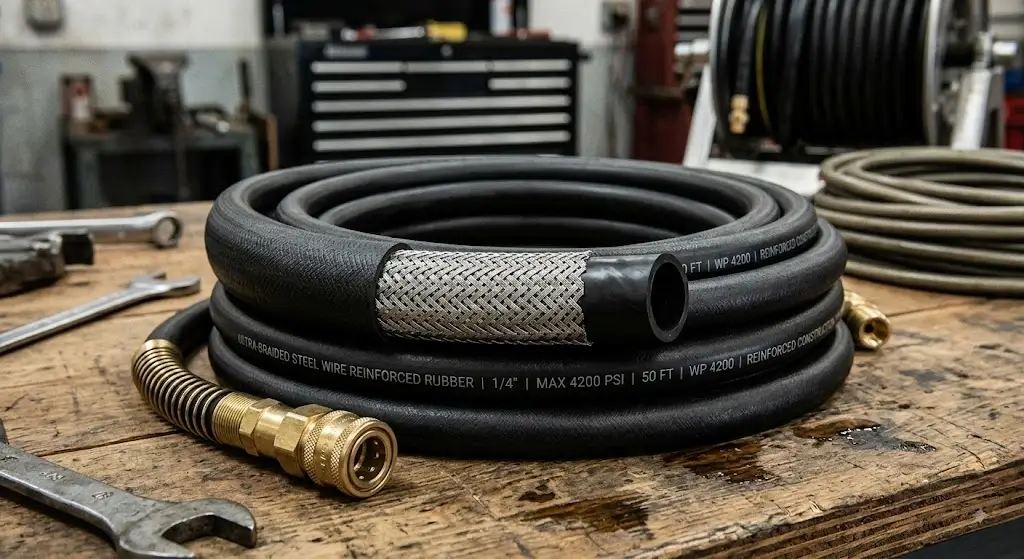
Outer Cover Materials
- Polyvinyl Chloride (PVC): Cold-water thermoplastic hoses often have substantially lower temperature ratings than dedicated hot-water hoses; always use the manufacturer’s stated maximum fluid temperature. PVC is economical but prone to coiling memory and kinking.
- Thermoplastic Polyurethane (TPU): TPU formulations can offer good flexibility, light weight, and a non-marring finish that resists leaving dark marks on concrete or wood decks. Chemical and temperature tolerances depend on the specific formulation.
- Synthetic Rubber: A common choice for professional and heavy-duty pressure-washing applications where flexibility, abrasion resistance, and high pressure ratings are important.
Internal Reinforcement Types
- Textile Braid: Lightweight woven synthetic fiber braid used primarily on lighter-duty, lower-PSI thermoplastic hoses.
- Single Wire Braid (1-Wire): High-tensile steel wire mesh wrapped around the inner tube. Offers high kink resistance and working pressure limits up to 4,000 PSI.
- Double Wire Braid (2-Wire): Two layers of steel-wire reinforcement used in hose constructions designed for higher pressure and/or demanding service. Temperature capability depends on the hose tube, cover, fittings, and manufacturer’s specification.
M22-14 vs. M22-15 Fitting Stem Decision Tree
Incorrect fitting selection is a common cause of leaks and connection problems at the pump or spray gun interface.
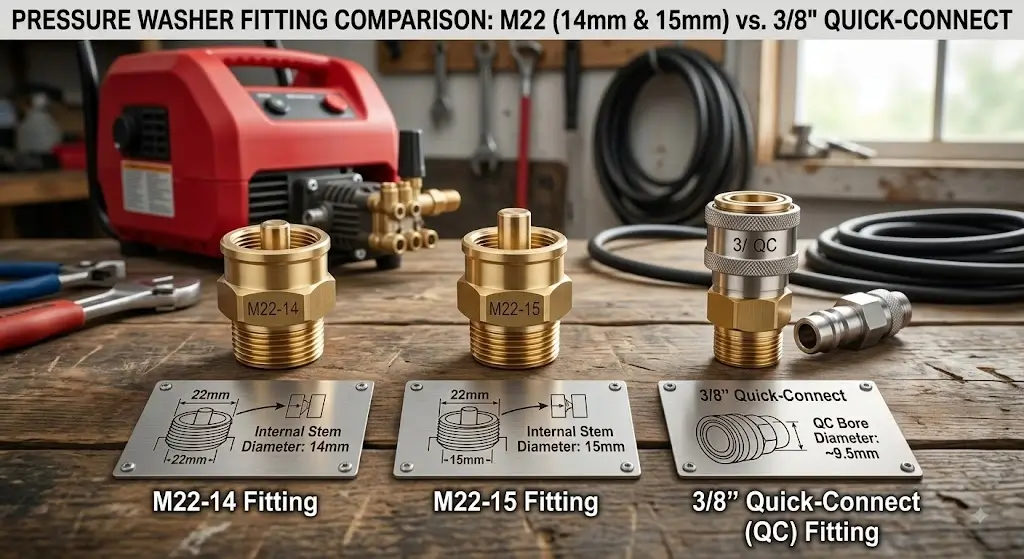
Follow this logic sequence before ordering a replacement M22 threaded hose:
• If stem measures 15.0 mm → Requires M22-15mm female hose end.
- Pump GPM: Determines the appropriate hose inner diameter (ID) to minimize pressure drop.
- Maximum Working PSI: Ensures the hose meets or exceeds your pump’s continuous operating output.
- Total Hose Length: Determines friction accumulation and impacts handling requirements.
Quick Connect (QC) Fittings
Quick-connect couplers allow fast attachment without thread tape. Note that 1/4-inch QC couplers are commonly used for nozzle-tip connections at the lance outlet, whereas 3/8-inch QC fittings are frequently used for higher-flow hose, pump, and spray gun connections. Always match the actual connection on the equipment rather than selecting by diameter alone.
Maintenance, Handling, and Storage Best Practices
Preventing Kinks and Reinforcement Strain
Repeated bending below the manufacturer’s minimum bend radius can damage internal wire reinforcement and the inner tube over time, increasing the risk of premature leakage or hose failure.
- Coiling Technique: Avoid wrapping the hose tightly around narrow machine brackets. Store the line in large loops or use a figure-8 coil pattern to neutralize torsional twisting.
- Live Swivel Adapters: Installing a properly rated live swivel at the spray gun inlet allows the gun to rotate while reducing torsional loading on the hose during operation.
Thermal & Environmental Protection
- Exhaust Clearance: Route rubber and thermoplastic hoses clear of hot engine mufflers and exhaust components. Always adhere to the manufacturer’s stated maximum fluid temperature limits.
- Chemical Rinsing: Flush the hose interior with clean water after drawing heavy detergents through downstream chemical injectors. For detailing applications, consult our tested guide to the best pressure washer soap options.
- Winterization: Purge all residual water from the hose before winter storage. Freezing water expands, placing mechanical stress on the inner tube, crimped ends, and fittings.
Frequently Asked Questions
What size pressure washer hose do I need?
For most residential pressure washers under 2.0 GPM, a 1/4-inch ID hose offers the best balance of flow and easy handling. Mid-range units (2.1-3.0 GPM) benefit from 1/4-inch on short runs or 5/16-inch on longer runs. Commercial systems pumping over 3.5 GPM typically require a 3/8-inch ID hose to minimize fluid friction loss.
How long can a pressure washer hose be?
There is no single maximum hose length limit. Practical length depends on pump GPM output, hose inner diameter, and acceptable pressure loss. Residential units can typically run 50 to 100 feet using an appropriate hose ID, while commercial units can operate 100 to 200+ feet on 3/8-inch or larger hoses.
Can you use a garden hose as a pressure washer hose?
No. Standard garden hoses are low-pressure water supply lines designed only for the inlet side of the pump (typically under 100 PSI). High-pressure discharge lines between the pump and spray gun operate at 1,500 to 4,000+ PSI and require reinforced steel or textile-braided pressure washer hoses.
Does a longer pressure washer hose reduce nozzle PSI?
A longer hose does not decrease the pump’s mechanical pressure capacity, but it increases dynamic friction loss along the hose run. This results in slightly reduced working pressure available at the spray nozzle.
Can I use a 3/8-inch hose on a 2.0 GPM pressure washer?
Yes, provided the fittings and pressure ratings match. A 3/8-inch hose reduces friction loss further, though the practical cleaning improvement on a short run is small while adding extra weight and stiffness.
Why is my replacement pressure washer hose leaking at the pump connection?
Leaks at the pump outlet interface are often caused by a missing or damaged O-ring, thread binding due to dirt or debris, or an M22 fitting stem mismatch (such as attempting to pair an M22-14mm female fitting with an M22-15mm pump stem).
How do I determine if a pressure washer hose is rated for hot water?
Always check the maximum fluid temperature rating printed directly on the hose cover or specified by the manufacturer. Cold-water hoses have lower thermal thresholds, whereas dedicated hot-water pressure washer hoses are engineered for substantially higher temperatures.
Final Pressure Washer Hose Guide Decision Matrix
Select your replacement hose starting point using your machine’s primary attributes:
| Your Machine Setup | Typical Hose Starting Point | Main Consideration |
|---|---|---|
| 1.0 – 1.5 GPM, ≤50 ft | 1/4-inch ID | Low flow + short run; low physical weight. |
| 1.5 – 2.0 GPM, ≤50 ft | 1/4-inch ID | Usually adequate; verify pressure-loss requirements. |
| 2.0 – 3.0 GPM, 50–100 ft | 5/16-inch ID | Lower friction loss than 1/4-inch without full 3/8-inch bulk. |
| 3.0+ GPM, Long Runs | 3/8-inch ID | Lower pressure loss at higher flow rates. |
| 4.0+ GPM Commercial | 3/8-inch ID (or larger) | High-flow systems require exact hydraulic sizing. |
Always verify the hose’s continuous working pressure rating and exact fitting configuration (matching M22 stem size or 3/8-inch QC) independently before purchasing.
Technical References & Engineering Standards
- General Pump – Hydraulic Reference Data & Water Friction Loss Charts
- SAE International – SAE J517 Hydraulic Hose Standards & Pressure Safety Tolerances
- Water Jet Technology Association (WJTA) – High-Pressure Hose Safety Guidelines
