

What Are Cleaning Units (CU)? The Definitive Engineering Guide
Quick Reference Specification: Cleaning Units & Hydraulic Duty Tier Matrix
Fluid momentum calculations confirm that volumetric water displacement (GPM) dominates macroscopic surface cleaning speed, while operating pressure (PSI) determines mechanical bond fracture thresholds.
| Duty Tier | CU Range (PSI × GPM) | Typical Pressure & Flow | Pump Architecture | Max Surface Tool Size | Primary Application Target |
|---|---|---|---|---|---|
| Residential Light | 1,500 – 3,500 CU | 1,500–2,000 PSI | 1.1–1.7 GPM | Wobble Plate / Axial Cam | Not recommended (<10″) | Automotive clear coats, patio chairs, bikes |
| Prosumer Suburban | 4,000 – 8,000 CU | 2,300–3,200 PSI | 1.8–2.5 GPM | Axial Cam / Light Triplex | 10″ – 12″ Deck Diameter | Driveways, wood decks, home vinyl siding |
| Commercial Contractor | 8,000 – 16,000 CU | 3,500–4,000 PSI | 3.5–4.0 GPM | Crankshaft Triplex Plunger | 14″ – 18″ Deck Diameter | Commercial flatwork, parking lots, masonry |
| Industrial High-Flow | 16,000 – 40,000+ CU | 3,000–4,000 PSI | 5.0–10.0 GPM | Belt-Drive / Gear-Reducer Triplex | 20″ – 28″ Dual-Bar Decks | Heavy equipment fleets, industrial grease, soft wash |
Cleaning Units (CU = PSI × GPM) represent the true mathematical measurement of pressure washer work capacity. PSI (Pounds per Square Inch) measures the stripping force required to shear adhesion bonds, while GPM (Gallons per Minute) measures the mass flow volume required to flush dislodged grit off the surface. Higher GPM cleans flatwork up to 400% faster than higher PSI because it supports wider rotary surface cleaner accessories and carries away heavier sediment loads.
Pressure washer marketing relies on a predictable retail tactic: displaying inflated Pounds per Square Inch (PSI) numbers on product packaging. Big-box home improvement retailers across the United States—from Home Depot and Lowe’s to Tractor Supply Co.—stock shelves with machines highlighting 3,000, 4,000, or 4,400 PSI.
For the average consumer, higher pressure sounds like superior stripping power. In actual fluid dynamics and field cleaning operations, evaluating a machine strictly by its static pressure rating causes surface etching, ruined wood fibers, premature pump failure, and sluggish cleaning cycles.
The single metric that dictates how fast, deep, and effectively a pressure washer works is Cleaning Units (CU). Industry professionals and mechanical engineers also refer to this as Cleaning Power Units (CPU) or Effective Cleaning Units (ECU). To compare machines built for residential properties, explore our complete guide on the best electric pressure washers for houses.
PSI supplies the concentrated mechanical shear stress needed to break the chemical adhesion and mechanical bond between a contaminant (such as dried mud, road film, biological algae, or oxidized paint) and a substrate.
Gallons per Minute (GPM) supplies the kinetic fluid mass required to suspend, lift, and flush that broken debris off the work area. If a machine generates high PSI without sufficient GPM, it acts like a liquid needle: cutting narrow furrows into dirt without washing it away. If a machine outputs high GPM with low PSI, it behaves like an open garden hose: plenty of rinse volume, but incapable of fracturing stubborn bonds.
Cleaning Unit Formulas Quantify Effective Work Capacity Across Outdoor Equipment Tiers
Mathematical products of working pressure and volumetric discharge establish empirical cleaning velocity benchmarks across residential and commercial categories.
- Mathematical Formula: PSI × GPM = Cleaning Units (CU).
- Residential & Automotive Tier (1,500 – 3,500 CU): Safe for automotive clear coats, patio furniture, mountain bikes, composite decking, and light vinyl siding.
- Prosumer & Heavy Suburban Tier (4,000 – 8,000 CU): Required for sweeping concrete driveways, brick walkways, stain preparation, and running compact 10-inch to 12-inch surface cleaners.
- Commercial Contractor Tier (8,000 – 16,000+ CU): Essential for daily fleet washing, multi-story commercial wash-downs, gum removal, and powering 16-inch to 20-inch rotary surface cleaners at a brisk walking pace.
- The Contractor Rule: Given two pressure washers with identical CU ratings, the machine with the higher GPM will complete flatwork projects faster every single time.
Technical Evaluation Methodology Anchors Recommendations in Physical Pressure and Flow Metrology
Laboratory test procedures record dynamic working pressures, electrical inrush amperages, and pump manifold thermal tolerances across continuous duty runs.
Our technical editorial team evaluates outdoor power equipment through mechanical engineering principles, fluid dynamics, and long-term ownership economics. We do not accept free promotional units from manufacturers, nor do we run paid placement rankings.
Every evaluation and benchmark is anchored by:
- Physical pressure and volumetric flow measurements using inline fluid gauges and calibrated flow meters.
- Internal teardown analysis of pump manifolds, unloader valves, ceramic plungers, and swash plates.
- Real-world electrical testing measuring running amperage and starting inductive inrush currents on standard North American 120V/240V circuits.
- Long-term teardown data analyzing thermal degradation within bypass loops, seal extrusion, and valve cavitation.
Hydrodynamic Physics Distinguishes Mechanical Bond Cleavage from Downstream Mass Transport
Fluid momentum transfers mass and compressive stress simultaneously to disrupt dirt matrixes without exceeding substrate yield points.
To understand Cleaning Units, you must separate the two distinct physical processes that occur during pressure washing: mechanical bond fracture and mass transport.
⚠️ High PSI / Low GPM
- Extreme pinpoint cutting force
- Narrow effective spray angle (0°–15°)
- Sluggish slurry evacuation
- High risk of gouging wood & concrete
✓ Balanced High CU
- Rapid bond fracture
- Wide spray fan coverage (25°–40°)
- Immediate mass debris transport
- Maximum cleaned square-footage per hour
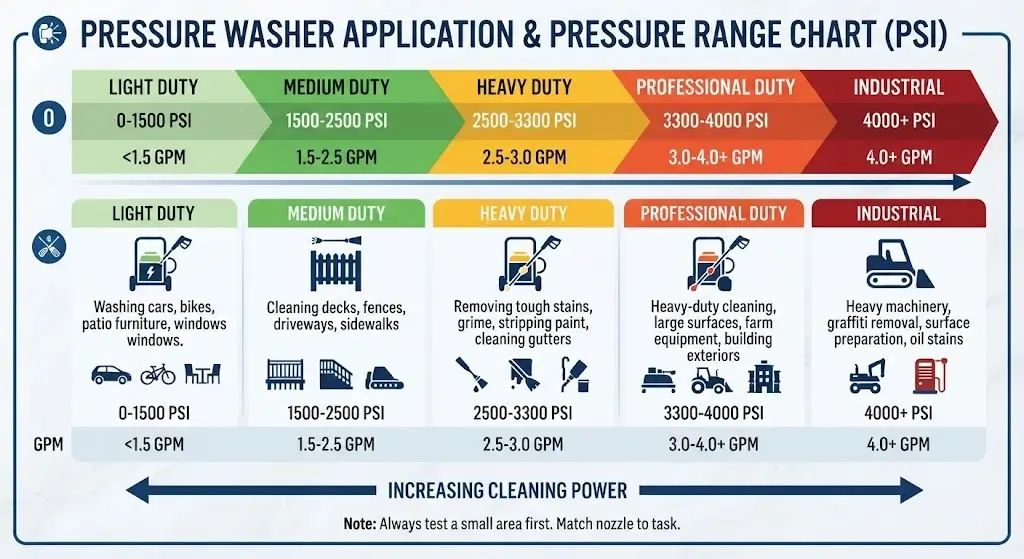
PSI: Mechanical Bond Fracture
Pounds per Square Inch (PSI) measures the static hydraulic force exerted upon one square inch of surface area. PSI provides the localized shear stress necessary to overcome the adhesive and tensile forces holding dirt, mildew, paint, or grease to a substrate.
Every material has a critical yield threshold. Standard concrete cream coats etch at pressures exceeding 3,000 to 3,500 PSI when using tight nozzles. Softwoods (such as cedar, redwood, and southern yellow pine) gouge at pressures over 1,200 to 1,500 PSI. Automotive clear coats risk delamination above 1,900 to 2,000 PSI.
GPM: Kinetic Mass Transport
Gallons per Minute (GPM) measures the volumetric flow rate passing through the pump and exiting the nozzle orifice. Water has mass (8.34 lbs per gallon). GPM represents the total physical mass hitting the surface per unit of time.
Higher flow rates allow operators to step up from narrow 15-degree nozzles to wide 25-degree or 40-degree nozzles without losing the minimum impact force needed to dislodge dirt. This widens the effective cleaning path per pass, cutting job times significantly.
Pump Mechanical Design Determines Total Sustainable Cleaning Units and Operating Duty Cycles
Drive mechanisms govern heat dissipation inside the fluid manifold, separating disposable consumer pumps from industrial crankshaft systems.
A motor or engine only provides rotational shaft torque. The high-pressure pump converts that mechanical energy into fluid flow and pressure. The structural design of that pump directly determines how many Cleaning Units a machine can sustain, its thermal tolerance, and its total service life. For internal component comparisons, review our technical breakdown on axial cam vs triplex pumps.
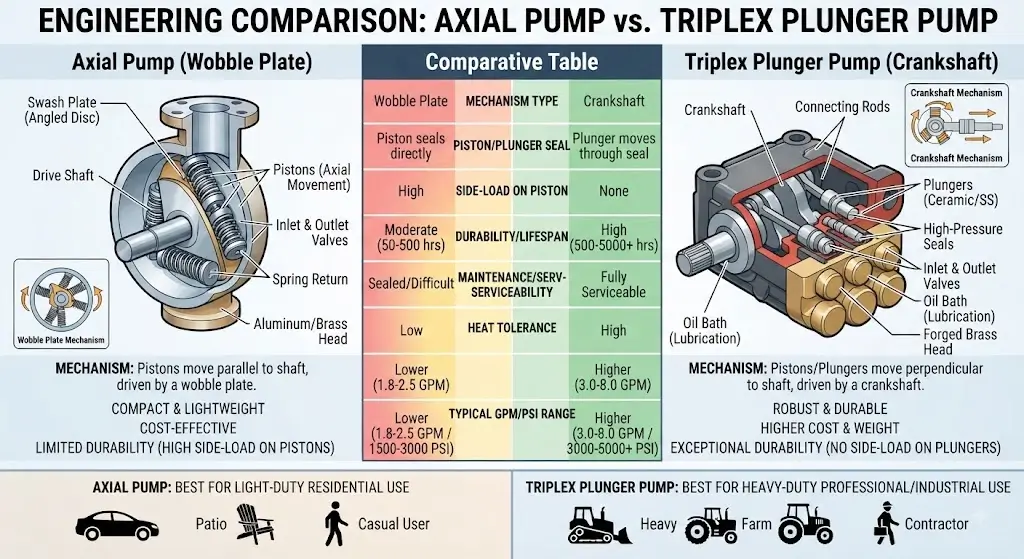
Wobble Plate Pump
Entry Residential
Lifespan: 50 – 100 Hours
Head Material: Aluminum / Plastic
Driven by a swash plate against spring-loaded pistons. Sealed throwaway units that cannot be rebuilt.
Axial Cam Pump
Mid-Tier Consumer
Lifespan: 150 – 300 Hours
Head Material: Cast Brass / Aluminum
Pistons run horizontally at direct engine speed (3,400 RPM). Sensitive to thermal bypass buildup.
Triplex Plunger Pump
Commercial Contractor
Lifespan: 1,000 – 5,000+ Hours
Head Material: Forged Brass (Ceramic Plungers)
Crankshaft-driven design. Fully modular, rebuildable, and engineered for continuous daily duty cycles.
Field Cleaning Benchmarks Prove That Higher GPM Drastically Reduces Project Completion Time
Higher volumetric flow rates support wider rotary surface cleaners, reducing total flatwork project durations by up to 75%.
To illustrate why Cleaning Units and volumetric flow dictate job speed, review this field test benchmark comparing two machines on an identical 1,000 sq ft concrete driveway slab (see our comprehensive guide on how to clean a concrete driveway for proper chemical-mechanical sequencing):
~3.0 Hours
Narrow 8-inch cleaner, sluggish debris flushing, constant back-rinsing required.
~45 Minutes
Wide 14-inch surface cleaner at brisk walking pace; slurry sweeps off slab instantly. Pair with matched attachments from our surface cleaner guide.
Specification Comparison Matrices Contrast Consumer Electric and Industrial Gas Equipment
Performance benchmarks reveal significant work index variances between lightweight consumer universal units and commercial belt-drive machines.
| Model | PSI | GPM | Cleaning Units | Pump Type | Powerplant | Weight |
|---|---|---|---|---|---|---|
| Kärcher K1700 | 1,700 | 1.2 | 2,040 CU | Wobble Plate | 14A Universal 120V | 20.7 lbs |
| AR Blue Clean AR630 | 1,900 | 2.1 | 3,990 CU | Triplex Plunger | 20A Induction 120V | 64.0 lbs |
| Simpson MS60763-S | 3,100 | 2.4 | 7,440 CU | Axial Cam | Kohler RH265 (196cc) | 59.0 lbs |
| Simpson PS4240 | 4,200 | 4.0 | 16,800 CU | Triplex Plunger | Honda GX390 (389cc) | 138.0 lbs |
| BE Power PE-4013 | 4,000 | 4.0 | 16,000 CU | Triplex (Belt Drive) | Honda GX390 (389cc) | 175.0 lbs |
Nozzle Orifice Sizing Regulates System Backpressure and Discharge Velocity
Calibrated nozzle throat diameters convert fixed pump flow displacement into target dynamic operating pressures.
A pressure washer does not output a fixed, unchangeable PSI. The pressure rating stamped on the pump is simply the back-pressure generated when a specific volume of water is forced through a precise nozzle orifice diameter. Refer to our detailed pressure washer nozzle guide for complete degree fan charts and orifice sizing formulas.
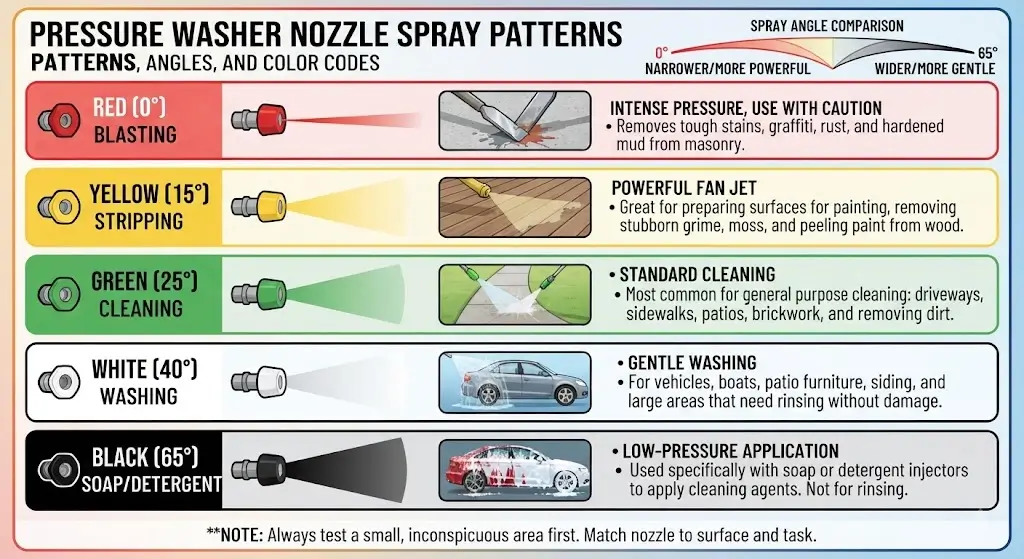
- If the nozzle orifice is too small: The restriction creates excessive back-pressure. The pump exceeds its operating limits, and the unloader valve opens, dumping water into the bypass loop. You lose working GPM at the wand tip, and the pump heats up rapidly.
- If the nozzle orifice is too large: The pump cannot build sufficient back-pressure against the oversized opening. The machine delivers its full GPM, but system PSI drops, lowering total Cleaning Units and weakening the stream’s stripping power.
Critical Infrastructure Factors Limit Real-World Pressure Washer Duty Cycles
Electrical circuit amperage ceilings, spigot supply deficits, and bypass heating constrain actual machine runtimes.
1. Electrical Supply and Extension Cords
Electric pressure washers rated above 2,500 CU pull significant current. A 14-amp motor operating on a 15-amp breaker will trip the circuit if used with an undersized, light-gauge extension cord. Long, thin cords create a voltage drop that starves the motor, causing higher amp draw and thermal tripping.
For induction machines rated above 1.8 GPM (like the AR630), run exclusively on a dedicated 20-amp circuit with a 12-gauge or 10-gauge cord (maximum 50 feet).
2. Water Supply Verification (The Garden Hose Bottleneck)
A pressure washer cannot output more water than your garden spigot supplies. Operating a high-flow pump with an inadequate supply causes cavitation—the formation and sudden implosive collapse of vapor bubbles inside the pump manifold. Cavitation erodes brass heads, micro-pits ceramic plungers, and ruins check valves within minutes. To minimize friction loss across long supply runs, see our pressure washer hose guide for recommended inner diameters.
3. Bypass Thermal Management
When you release the spray gun trigger, the unloader valve diverts high-pressure water into a continuous internal bypass loop within the pump manifold. Direct-drive axial pumps contain less than two cups of water; in bypass mode, friction heats this trapped water by 20°F to 40°F every 30 seconds.
When water temperatures exceed 140°F, internal Buna-N rubber packings melt and check-valve cages distort. Rule of thumb: Never leave a gas-powered machine idling off-trigger for more than 60 seconds.
4. Winterization and Storage
Allowing residual water to freeze inside a pump manifold is the leading cause of pressure washer failure across the United States. Water expands by 9% upon freezing, generating over 20,000 PSI of hydrostatic force—easily cracking forged brass pump heads.
Before winter storage, pull Pump Guard / RV Antifreeze into the garden hose intake until it discharges out the high-pressure outlet.
Frequently Asked Questions Address Common Cleaning Unit Conflicts and Sizing Rules
Technical support records resolve user inquiries regarding surface cleaner sizing, paint stripping risks, and direct-drive limitations.
