
Pressure Washer Flow Rate Explained: What GPM Means, How Much You Need & Why It Matters
Quick Reference Specification: Volumetric Flow Rate & Hydraulic Duty Matrix
Fluid momentum calculations confirm that doubling volumetric flow rate (GPM) halves flatwork cleaning cycle times, whereas elevating pressure (PSI) beyond substrate tolerance yields diminishing returns and accelerates surface pitting.
| Flow Tier | Operating GPM Range | Common Operating PSI | Hydraulic Power (HP) | Optimal Substrate Task | Inlet Supply Demand |
|---|---|---|---|---|---|
| Compact Electric | 1.0 – 1.5 GPM | 1,500 – 2,000 PSI | 0.87 – 1.75 HP | Cars, outdoor furniture, hand tools | ≥2.0 GPM minimum |
| Residential Standard | 1.6 – 2.4 GPM | 2,000 – 3,000 PSI | 1.86 – 4.19 HP | Decks, siding, patio walkways | ≥3.0 GPM minimum |
| Prosumer / High Flow | 2.5 – 3.5 GPM | 2,500 – 3,500 PSI | 3.64 – 7.14 HP | Concrete driveways, 12″–14″ surface cleaners | ≥4.2 GPM minimum |
| Commercial Contractor | 4.0 – 8.0+ GPM | 3,000 – 4,000 PSI | 6.99 – 18.66+ HP | Commercial flatwork, fleet washing, soft wash | Buffer tank required |
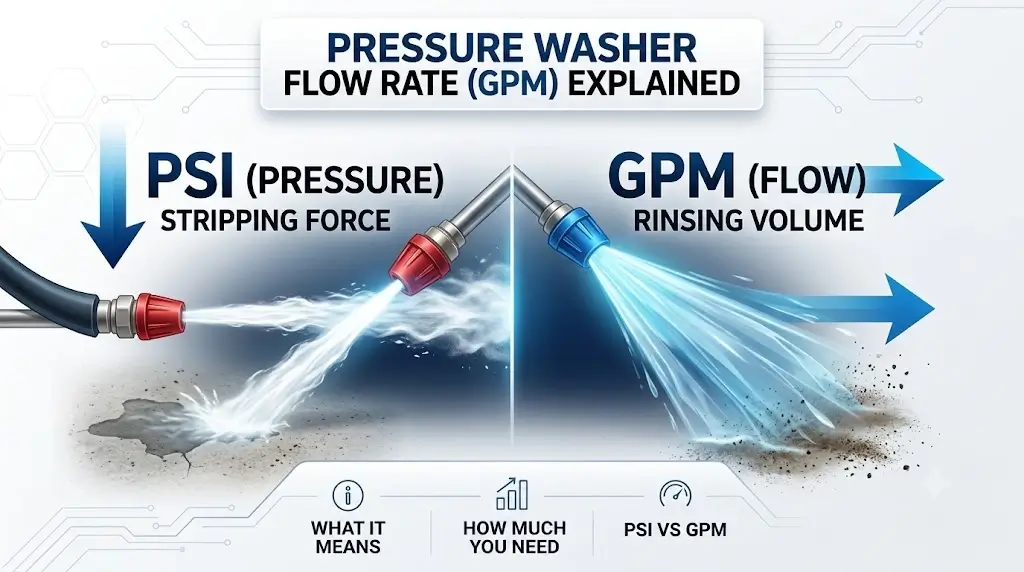
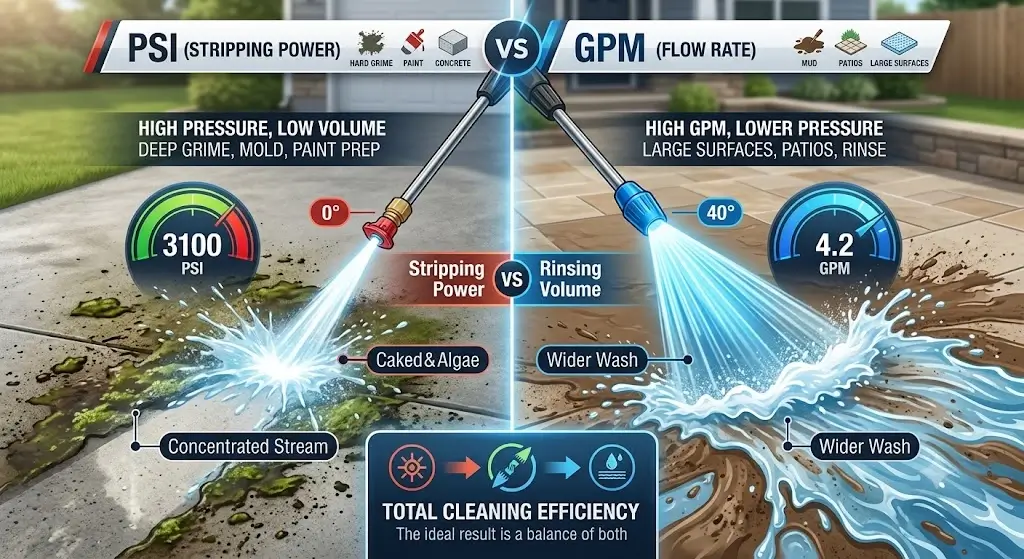
Pressure washer flow rate is measured in GPM (gallons per minute) and tells you how much water the machine moves during operation. PSI describes pressure; GPM describes water volume. PSI helps loosen and strip contamination, while GPM provides the water volume needed to carry loosened dirt away.
For real-world cleaning speed, PSI and GPM must be considered together. A higher GPM is especially valuable when rinsing large surfaces, operating a surface cleaner, or doing frequent professional work.
Pressure washer specifications often make PSI the headline number, but GPM is one of the most important specifications for understanding what a machine can actually accomplish. A pressure washer rated at 3,000 PSI and 2.0 GPM is a very different machine from one rated at 3,000 PSI and 4.0 GPM even though both display the same pressure number.
The reason is simple: pressure and flow perform different jobs. Pressure concentrates the available water force at the nozzle and cleaning surface. Flow determines how much water is continuously available to rinse, transport, and remove the material that has been loosened. To evaluate units configured for home upkeep, consult our tested guide on the best electric pressure washers for houses.
This guide explains pressure washer GPM from the pump outward: what the number means, why advertised GPM can differ from real-world flow, how nozzle orifice size changes pressure, why inadequate garden-hose supply can reduce performance, how GPM affects surface cleaners and foam cannons, and how to choose a pressure washer based on the work you actually do.
Volumetric Flow Rate Metrics Measure Total Water Mass Discharged per Operating Minute
Gallons per minute quantify total fluid volume moving through the pump manifold during active spray trigger cycles.
GPM means gallons per minute. It is the volumetric flow rate of water moving through the pressure washer system.
If a pressure washer delivers 2.5 GPM under a specified operating condition, it is moving approximately 2.5 U.S. gallons of water every minute. In one hour of continuous operation, that theoretical rate would equal 150 gallons of water.
The actual water volume used during a cleaning job depends on trigger time, nozzle selection, operating pressure, pump behavior, and whether the machine is flowing continuously. A pressure washer rated at 2.5 GPM does not necessarily consume 2.5 gallons every minute that the engine is running if the gun is released or the system enters bypass.
For example, a 2.5-GPM machine that sprays continuously for 20 minutes would theoretically move about 50 gallons of water during that trigger time. If the operator spends only half the time actually spraying, the water consumption is substantially lower.
GPM Is Volume, Not Pressure
This distinction is fundamental. GPM tells you how much water is moving. PSI tells you how much pressure the system produces under the specified condition.
Two pressure washers can have the same GPM and completely different PSI ratings. They can also have the same PSI rating and very different GPM.
Volumetric Displacement Determines Macroscopic Debris Rinsing Speed and Project Duration
Water mass flow carries dislodged dirt off substrates to eliminate re-washing passes across expansive flat surfaces.
GPM becomes increasingly important as the cleaning job gets larger. Once contamination has been loosened, the machine needs sufficient water volume to carry that material away.
This is why a higher-flow machine can often clean a large driveway faster even when another machine has a similar or higher PSI rating.
Pressure
Concentrates water force and helps loosen, strip, and break apart contamination.
Flow
Determines how much water is continuously available for rinsing and transporting loosened material.
The practical result is that GPM tends to become more valuable as surface area and cleaning time increase. Washing one car is different from cleaning 2,000 square feet of concrete.
Physical Mechanics Confirm That Pressure Strips Contamination While Volume Clears Slurry
Hydraulic pressure shears physical surface bonds, whereas fluid flow provides the kinetic carry required to evacuate suspended sludge.
GPM helps move the loosened contamination away.
This is not a literal division of labor where PSI does all the cleaning and GPM only rinses. Increasing flow can also change nozzle behavior, impact the effective cleaning pattern, and increase productivity. But the model is useful when comparing machines. For a complete mathematical evaluation of both metrics, read our guide on PSI vs GPM explained.
Example: Same PSI, Different GPM
| Pressure Washer | PSI | GPM | Simple CU | Practical Difference |
|---|---|---|---|---|
| Machine A | 3,000 | 2.0 | 6,000 | Lower water volume for rinsing |
| Machine B | 3,000 | 3.0 | 9,000 | 50% more nominal flow |
| Machine C | 3,000 | 4.0 | 12,000 | Twice the nominal flow of Machine A |
The simple CU calculation makes the difference visible, but it should not be treated as a laboratory measurement of cleaning speed. Real cleaning performance depends on nozzle orifice, spray angle, standoff distance, surface type, detergent, operator technique, and the actual pressure and flow delivered at the point of use.
Cleaning Units Form a Screening Index by Multiplying Working Pressure and Flow
Cleaning Units establish a baseline performance index by multiplying continuous working PSI by rated water volume GPM.
A common comparison method is:
For example:
CU is useful because it combines pressure and flow into a single number. It can help expose why a machine with a lower PSI rating can still have a strong overall hydraulic specification if it provides substantially more water. For in-depth mathematical derivations, read our engineering guide on what are Cleaning Units (CU).
Why HomeGearMax Does Not Rank Machines by CU Alone
Suppose Machine A produces 3,500 PSI at 2.0 GPM and Machine B produces 2,800 PSI at 3.0 GPM. Their simple CU values are 7,000 and 8,400 respectively.
That does not prove Machine B will clean every surface faster. The nozzle, surface, cleaning pattern, and operating conditions can change the result.
CU is best used as a screening metric, not as the final answer.
Laboratory Standards Distinguish Factory Advertised Ratings from Dynamic Operating Flow
Manufacturing tolerances cause actual operating discharge volumes to diverge from static retail marketing claims.
One of the most important distinctions in pressure washer shopping is the difference between a manufacturer’s rated flow and the flow actually delivered under a particular operating condition.
Manufacturers may specify maximum or rated PSI and GPM within defined conditions and tolerances. Some manuals explicitly state that rated pressure and rated water flow are subject to manufacturing tolerances.
The exact meaning of the specification depends on the manufacturer and pump system. Therefore, HomeGearMax recommends recording the measurement condition whenever a flow number is reported.
1. Manufacturer-Rated GPM
The published specification supplied by the manufacturer under ideal factory conditions.
2. Calculated GPM
A value derived from documented pump displacement, RPM, nozzle orifice, or other engineering information.
3. Measured GPM
Flow physically measured under a defined test condition using appropriate inline instrumentation.
These numbers should never be silently mixed together. A calculated or manufacturer-rated GPM should not be presented as if it were independently measured.
Pump Displacement Dimensions and Shaft Speeds Determine Inherent Flow Capacity
Internal cylinder bore volume and drive shaft RPM dictate maximum volumetric water output before nozzle restrictions occur.
GPM ultimately comes from the pump’s ability to move a certain volume of water at a given operating speed and pressure.
Pump flow is influenced by several variables:
- Pump displacement
- Pump RPM
- Number and geometry of pumping chambers
- Inlet water availability
- Pressure regulation
- Nozzle orifice
- Pump efficiency and leakage
- System restrictions
Pump Displacement
A pump with greater displacement can move more water per revolution when operated under comparable conditions.
RPM
Pump speed is another major variable. If the pump turns faster, its theoretical flow generally increases, assuming the pump is designed for that speed and operating conditions remain appropriate.
Pump manufacturers publish flow and pressure combinations at specific RPM values. For example, professional pump catalogs can show substantially different GPM ratings for different pump models and operating speeds.
Pressure Changes the System
Pump flow cannot be considered independently of pressure. A pump may have a published maximum flow at one condition and a maximum pressure at another. The two maximum values should not automatically be interpreted as simultaneously achievable.
Nozzle Orifice Dimensions Regulate Backpressure Without Altering Pump Displacement
Precision nozzle orifices establish hydraulic backpressure but cannot create water volume beyond mechanical pump displacement limits.
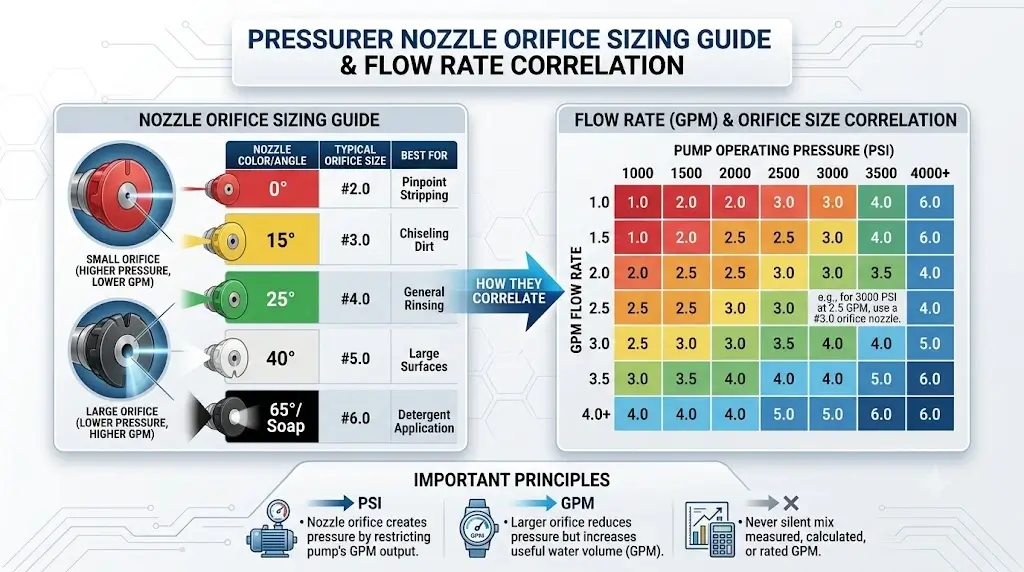
The spray nozzle is one of the most important flow restrictions in the entire system. Its orifice determines how much water can pass through at a given pressure.
A pressure washer pump may be capable of moving a certain flow, but installing a nozzle with an inappropriate orifice can change the operating pressure and system behavior.
Too-Small Nozzle Orifice
A nozzle that is too small can create excessive restriction. The pump attempts to maintain its operating characteristics against the increased restriction, potentially driving pressure higher than intended.
Too-Large Nozzle Orifice
A nozzle that is too large allows more water through but may reduce operating pressure because the pump is no longer operating against the same restriction.
This is why nozzle selection must match the pressure washer’s intended PSI and GPM.
Why Nozzle Orifice Charts Matter
Professional nozzle sizing uses pressure and flow together. The same nozzle orifice is not appropriate for every pressure washer. A 4-GPM machine operating at high pressure needs a different orifice than a 1.5-GPM electric machine.
Always use a nozzle sizing chart from the nozzle manufacturer or pressure washer manufacturer when selecting an orifice for a specific operating point. Consult our complete pressure washer nozzle guide for orifice cross-reference charts.
Inlet Water Supply Constraints Prevent Pump Starvation and Destructive Cavitation
Supply spigot volume must exceed pump rated discharge by at least 20 percent to avoid vapor bubble implosions.
The pressure washer cannot deliver more useful flow than the water supply can reliably provide.
This is one of the most overlooked reasons a machine can appear to produce less pressure than expected.
If the pump requires more incoming water than the garden hose or plumbing system can provide, the pump can become water-starved. The result can be unstable pressure, poor performance, pump noise, or potentially damaging operating conditions.
SIMPSON advises checking for adequate water supply when troubleshooting low pressure and gives a minimum supply guideline of 5 GPM and 20 PSI for its equipment. That should not be treated as a universal requirement for every pressure washer model; the manufacturer’s own inlet-water specification should take priority.
Why Your Home’s Water Supply Matters
Municipal water systems often have enough capacity for many residential pressure washers, but well systems, long hoses, restrictive fittings, clogged inlet screens, and partially closed valves can change the available flow.
- Open the water spigot fully.
- Use a suitable garden hose diameter.
- Avoid unnecessary restrictions at fittings.
- Inspect the inlet filter screen.
- Check for kinks or crushed hose sections.
- Measure supply flow if the washer repeatedly starves for water.
- Follow the pressure washer manufacturer’s inlet requirements.
Garden Hose Internal Diameters Restrict Water Supply Flow Over Extended Distance Runs
Undersized garden hose diameters generate severe internal friction losses that starve positive displacement pressure washer pumps.
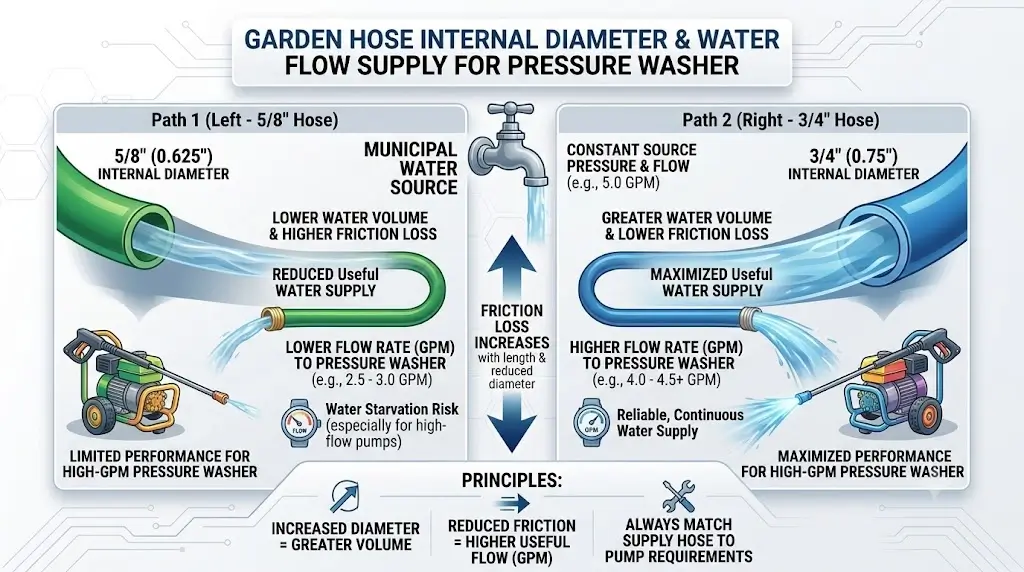
A garden hose is not just a passive pipe. Its internal diameter, length, condition, elevation changes, fittings, and restrictions affect water flow.
A long, narrow hose creates more friction loss than a shorter hose with a larger internal diameter. The pressure washer may therefore receive less water than the house supply can provide directly at the spigot.
Why Hose Diameter Matters
Flow resistance rises significantly as the available internal passage becomes smaller. This is why a pressure washer designed to consume several gallons per minute should not be paired with a severely undersized or damaged supply hose.
High-Pressure Hose vs. Supply Hose
Do not confuse the garden hose feeding the machine with the high-pressure hose between the pump and spray gun. They perform different jobs and are designed for different pressure and flow conditions. Review internal conduit friction charts in our pressure washer hose guide.
Rotary Surface Cleaner Sizing Rules Require Matched Volumetric Flow Across Dual Spray Arms
Surface cleaner deck diameters require approximately one gallon per minute for every four inches of shroud width to maintain rotation.
Surface cleaners are one of the clearest examples of why flow matters. A surface cleaner uses rotating spray bars under a housing to clean a relatively large area while keeping the spray contained.
If the pressure washer does not provide enough flow for the surface cleaner, the rotating jets may not operate as intended and cleaning productivity can fall.
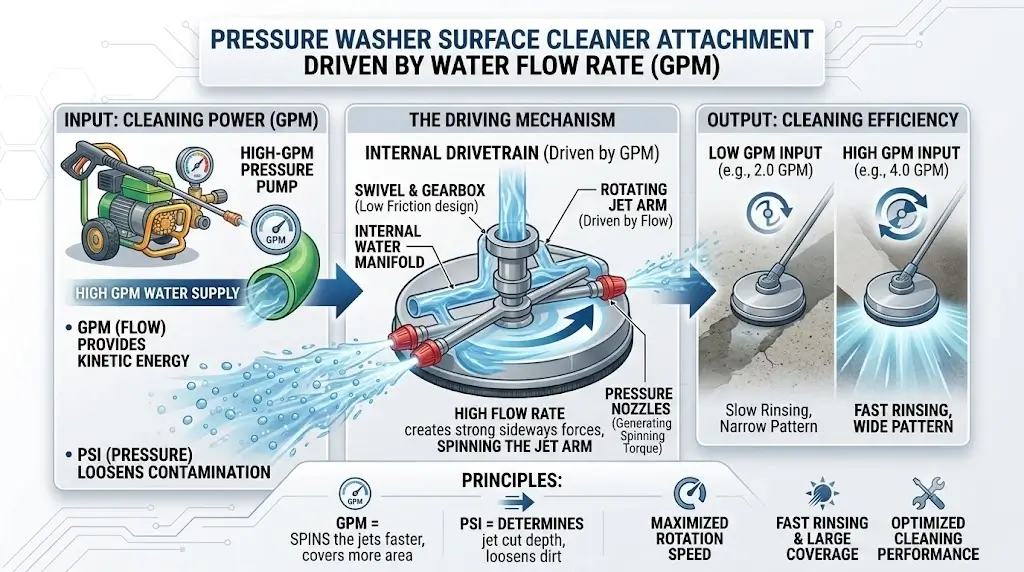
Do Not Size a Surface Cleaner by PSI Alone
A common mistake is buying a large surface cleaner because the pressure washer has a high PSI rating. The cleaner also needs enough GPM to drive its jets and maintain useful cleaning performance. See tested flatwork gear in our surface cleaner guide.
| Pressure Washer Flow | Typical Use Direction | Surface Cleaner Consideration |
|---|---|---|
| 1.2–1.8 GPM | Small residential cleaning | Favor smaller cleaners and verify manufacturer minimum GPM. |
| 2.0–2.5 GPM | Typical homeowner work | Small to medium surface cleaners are generally more appropriate. |
| 3.0–4.0 GPM | Frequent residential / property maintenance | More flexibility with larger surface-cleaning attachments. |
| 4.0+ GPM | Professional / large-area cleaning | Higher-flow surface cleaners become practical when matched correctly. |
These ranges are decision guidelines, not universal compatibility ratings. Always check the surface cleaner manufacturer’s minimum and maximum PSI/GPM specifications.
Venturi Chemical Injectors Depend on Water Flow Velocity to Induce Detergent Siphon Suction
Venturi vacuum suction curves require precise water flow thresholds to siphon cleaning chemicals and expand dense foam.
Foam cannons are another accessory where GPM matters. The cannon uses the pressure washer’s water flow to create the spray pattern and draw detergent into the mixing system.
A foam cannon designed around a particular flow range may perform poorly when connected to a machine outside that range.
Too Little Flow
The cannon may produce weak output, poor coverage, or insufficient draw depending on the injector and orifice configuration.
Too Much Flow
Excessive flow can change the spray pattern and may exceed the accessory’s intended operating range.
Foam quality is also affected by detergent concentration, water chemistry, orifice size, air entrainment, and adjustment settings. Therefore, GPM is important but not the only variable. Review orifice tuning in our foam cannon guide.
Automotive Detailing Guidelines Specify Moderate Water Flow to Protect Vehicle Paint Clearcoats
Vehicle washing demands moderate water volume to flush abrasive grit safely without risking paint delamination.
A 2.0-GPM machine can provide plenty of rinsing capacity for a normal passenger vehicle while using less water than a high-flow professional machine.
For detailing operations, the choice can change depending on whether the machine is being used primarily for pre-rinse, foam application, wheel cleaning, paint-safe washing, or rapid final rinsing.
For Vehicle Paint
More GPM does not automatically mean safer or better. Technique, nozzle selection, spray distance, detergent, and surface condition matter.
Driveway and Flatwork Restoration Requires Higher Water Volume to Prevent Streak Lines
Concrete surface cleaning requires elevated flow rates to sweep dense sediment slurry downhill across porous slabs.
A 4-GPM machine can move twice as much water as a 2-GPM machine during the same trigger time. That does not guarantee twice the cleaning speed, but it can substantially improve rinsing capacity and compatibility with larger surface-cleaning accessories.
Why Low-Flow Machines Feel Slow on Large Concrete
When a machine has limited GPM, the operator often has to move more slowly and make additional passes. The pressure may be sufficient to loosen contamination, but the limited water volume makes rinsing less productive. For chemical pre-treatments, see our guide on how to clean a concrete driveway.
House Washing Protocols Prioritize Water Volume to Flush High Siding Peaks Safely
Low-pressure soft washing uses high-volume rinsing to clean high siding peaks without forcing water into wall cavities.
House washing requires a different balance than concrete cleaning. The ideal flow depends on the washing method, detergent system, siding material, water access, and whether the operator is using a dedicated soft-wash approach or a conventional pressure-washer setup.
For general residential exterior cleaning, approximately 2.0–3.5 GPM can be a practical starting range for many applications. Larger professional systems can use substantially more flow when rapid rinsing and productivity are priorities.
Commercial Contractors Prioritize High Water Flow to Maximize Hourly Labor Productivity
Commercial pressure washing operations maximize volumetric flow to reduce labor hours on expansive job sites.
Professional pressure washing changes the equation because labor is one of the largest operating costs.
If a contractor can complete the same surface area faster without compromising the cleaning result, higher flow can increase productivity.
CAT Pumps, for example, lists pressure-washing pumps ranging from relatively low-flow configurations to pumps capable of several gallons per minute at substantial pressure.
Why Professional Operators Often Prioritize GPM
- Faster rinsing
- Higher surface-cleaning productivity
- Better compatibility with larger surface cleaners
- More effective removal of loosened contamination
- Faster chemical rinse-off
- Higher production rate per labor hour
This does not mean professional machines should simply maximize GPM. Higher flow requires more hydraulic power, adequate water supply, correctly sized hoses, appropriate nozzles, and accessories capable of handling the flow.
Household Electrical Circuit Capacities Limit Sustained Flow in Residential Electric Washers
Residential 120V electrical circuits enforce strict physical boundaries on sustained electric motor output.
Residential electric pressure washers are constrained by available electrical power. A typical U.S. household circuit cannot provide unlimited motor power, so manufacturers must balance motor input, pump efficiency, pressure, flow, weight, noise, and cost.
This is why many consumer electric pressure washers operate in a relatively modest GPM range compared with professional gas machines.
What Matters When Comparing Electric Pressure Washers
- Working PSI
- Working GPM
- Motor input power
- Pump architecture
- Electrical current
- Thermal protection
- Duty cycle
- Hose and nozzle configuration
A large PSI number printed on an electric pressure washer does not automatically mean the machine has high hydraulic output. The electrical power available to the motor places a real engineering constraint on sustained hydraulic performance.
Combustion Engine Horsepower Enables High-Displacement Pumps in Gas Equipment
Combustion engines supply the mechanical torque needed to drive large triplex pump plungers at high volumetric rates.
Gas engines can provide substantially more mechanical power than typical residential electric pressure washer motors. That allows manufacturers to build systems with higher flow, higher pressure, or both.
Professional gas machines often pair higher-flow pumps with axial cam vs. triplex pump architectures, depending on the intended duty cycle.
But higher GPM also increases the requirements on:
- Water supply
- Garden hose capacity
- High-pressure hose sizing
- Nozzle orifice
- Surface-cleaner compatibility
- Pump cooling
- Engine power
- Fuel consumption
Volumetric Comparison Tables Contrast Flow Ratings Across Market Segments
Flow rate classifications define operational capabilities across compact consumer units and commercial rigs.
The following ranges are useful for choosing a machine by workload rather than by marketing PSI. They are not universal performance standards.
| GPM | Typical Position | Good For | Limitations |
|---|---|---|---|
| 1.0–1.5 | Compact electric | Small vehicles, furniture, light cleaning | Slow on large surfaces |
| 1.5–2.0 | Light residential | Cars, siding, patios, general household work | Limited rinsing speed |
| 2.0–2.5 | General homeowner | Cars, decks, siding, patios, moderate concrete | Large areas take longer |
| 2.5–3.0 | Strong homeowner | Concrete, driveways, property maintenance | Needs adequate water supply |
| 3.0–4.0 | High-productivity residential | Large concrete, surface cleaners, frequent use | Higher power and water requirements |
| 4.0+ | Professional/high-flow | Large-area cleaning and commercial work | Requires properly matched system and water supply |
Systematic Diagnostic Sequences Identify Upstream and Downstream Hydraulic Flow Losses
Step-by-step diagnostic sequences isolate water supply restrictions from internal pump seal blowouts.
If a pressure washer feels weak, do not immediately assume the pump has failed. Flow problems can originate upstream or downstream from the pump.
1. Blocked Inlet Screen
The inlet screen prevents debris from entering the pump. A clogged screen can restrict water entering the pump.
2. Inadequate Water Supply
A restricted faucet, undersized supply hose, weak well system, or long restrictive plumbing run can reduce available inlet flow.
3. Kinked Supply Hose
A kink can sharply reduce the effective cross-sectional area available to water.
4. Blocked Nozzle
A partially blocked nozzle can alter spray behavior and increase restriction. Clean or replace the nozzle according to the manufacturer’s instructions.
5. Incorrect Nozzle Size
A nozzle that is too small or too large for the machine can change operating pressure and flow behavior.
6. Air Entering the Inlet
Air in the supply line can cause unstable pump behavior. Purging trapped air from the system before starting the machine can help.
7. Pump Wear
Worn seals, valves, plungers, or internal manifold wear (a key factor when evaluating brass vs. aluminum pressure washer pumps) can reduce hydraulic performance. Professional pump systems should be diagnosed according to the manufacturer’s service procedure.
Target Workload Profiles Guide Practical Pressure Washer Sizing Decisions
Sequential selection frameworks prioritize recurring property maintenance tasks over peak advertised marketing metrics.
Instead of asking “What is the highest GPM I can afford?”, ask:
Step 1: Identify Your Largest Recurring Job
If you mainly wash cars, you do not need the same GPM as someone cleaning large concrete surfaces every week.
Step 2: Choose the Surface Cleaner First for Concrete Work
If driveway cleaning is your priority, determine the surface cleaner size and minimum GPM requirement first. Then choose the pressure washer.
Step 3: Check Working PSI and GPM Together
Do not select based on PSI alone.
Step 4: Verify Water Supply
Your house or well system needs to provide enough water for the machine.
Step 5: Match Nozzles
The nozzle orifice must be compatible with the pressure washer’s operating PSI and GPM.
Step 6: Consider Duty Cycle
A machine used for 20 minutes twice per year has very different requirements from one used several hours per week.
Step 7: Consider Lifecycle Cost
Higher GPM often requires more hydraulic power and can increase equipment cost. Buy the flow that improves productivity for your workload rather than paying for unused capacity.
Trigger Run Times Govern Total Water Consumption More than Instantaneous Flow Rates
Total gallons consumed reflect instantaneous discharge flow multiplied by actual spray trigger run time.
A higher-GPM pressure washer can use more water per minute, but that does not automatically mean it uses more water for the entire job.
The relevant variable is:
A 4-GPM machine that completes a job in 20 minutes can use less total water than a 2-GPM machine that requires 50 minutes of continuous trigger time.
This is one reason professional operators may choose higher-flow equipment despite the higher instantaneous water demand.
Hydraulic Horsepower Equations Connect Operating Pressure and Volumetric Water Output
Hydraulic horsepower equations establish the theoretical mechanical work required to move pressurized fluid through spray nozzles.
Pressure and flow are connected through hydraulic power. A useful engineering relationship for water horsepower is:
For example, 3,000 PSI at 2.0 GPM represents:
At 3,000 PSI and 4.0 GPM:
Doubling GPM at the same PSI therefore doubles the theoretical hydraulic power requirement.
This relationship is also useful for detecting unrealistic marketing specifications. If a claimed PSI/GPM combination would require far more input power than the machine’s motor or engine can plausibly provide, the specification deserves closer examination.
System Infrastructure Constraints Impose Real Practical Limits on Higher Water Flow
High-flow pumps introduce larger water supply demands, heavier engine blocks, and larger diameter hose requirements.
More flow is useful only when the rest of the system can use it.
A homeowner washing a compact vehicle may gain little from moving from 2.5 GPM to 4.0 GPM. The additional water may increase supply requirements without producing a proportional improvement in the actual task.
Higher flow also means:
- Greater water demand
- Greater hydraulic power requirements
- Potentially larger equipment
- Higher accessory flow requirements
- Higher hose and fitting requirements
- Greater consequences if the household supply is inadequate
The best pressure washer is therefore not the machine with the largest GPM number. It is the machine whose PSI, GPM, pump architecture, accessories, water supply, and duty cycle match the job.
Engineering Decision Frameworks Direct Operators Toward Ideal GPM Configurations
Structured decision rubrics align operator cleaning requirements with pump displacement and available water infrastructure.
| Buyer | Recommended Direction | Why |
|---|---|---|
| Occasional car washer | 1.5–2.0 GPM | Enough flow for controlled vehicle cleaning without unnecessary water demand. |
| General homeowner | 2.0–2.5 GPM | Good balance of cleaning speed, portability, and water consumption. |
| Driveway-focused homeowner | 2.5–3.5 GPM | Higher flow improves rinsing and surface-cleaner productivity. |
| Frequent property maintenance | 3.0–4.0 GPM | Better productivity across larger surfaces. |
| Professional operator | 4.0+ GPM when appropriate | Higher production potential, provided pump, engine, water supply, hose, and accessories are correctly matched. |
These are not hard cutoffs. A well-designed 2.5-GPM machine can outperform a poorly configured 3.5-GPM machine on a specific task. Use them as starting points, then check the complete system.
Frequently Asked Questions Address Critical Water Supply and Flow Metrics
Equipment engineering records resolve common operator inquiries regarding nozzle sizing, cavitation risks, and surface cleaner compatibility.
