
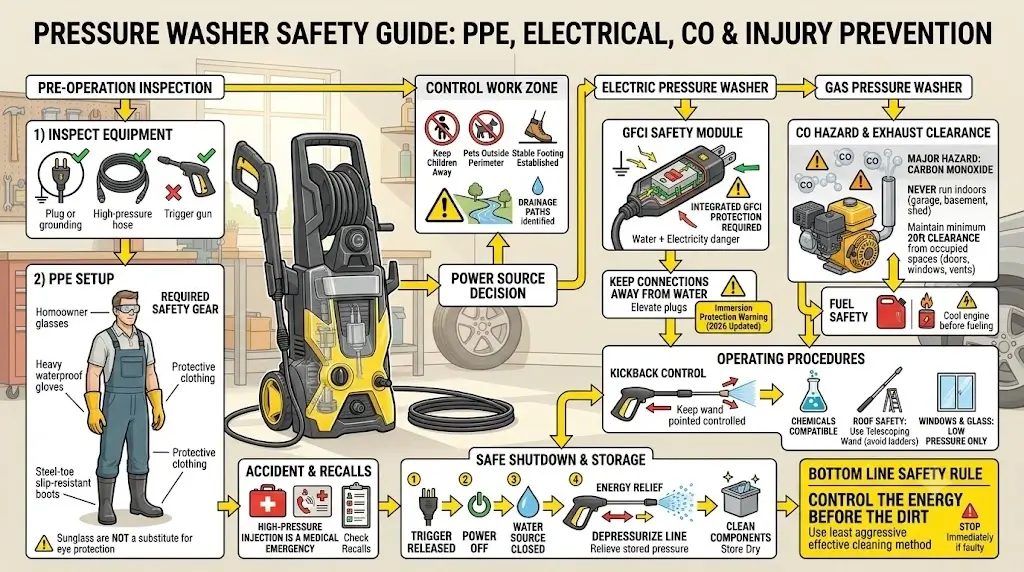
Pressure Washing Safety Guide: PPE, Electrical, CO & Injury Prevention
Pressure washers combine water, mechanical energy, electrical or gasoline power, cleaning chemicals, hoses and high-pressure spray in one work area. That combination creates hazards that are easy to underestimate because the equipment looks like a normal outdoor cleaning tool.
The most important pressure-washing safety rule is simple: treat the machine as high-energy equipment, not as an ordinary garden hose. High-pressure spray can cause serious injuries, uncontrolled hoses can create hazards, electricity and water can create shock risks, and gasoline-powered machines can produce dangerous carbon monoxide.
PPE
Electrical Safety
GFCI
Carbon Monoxide
Chemical Safety
Hose Safety
2026 Updated
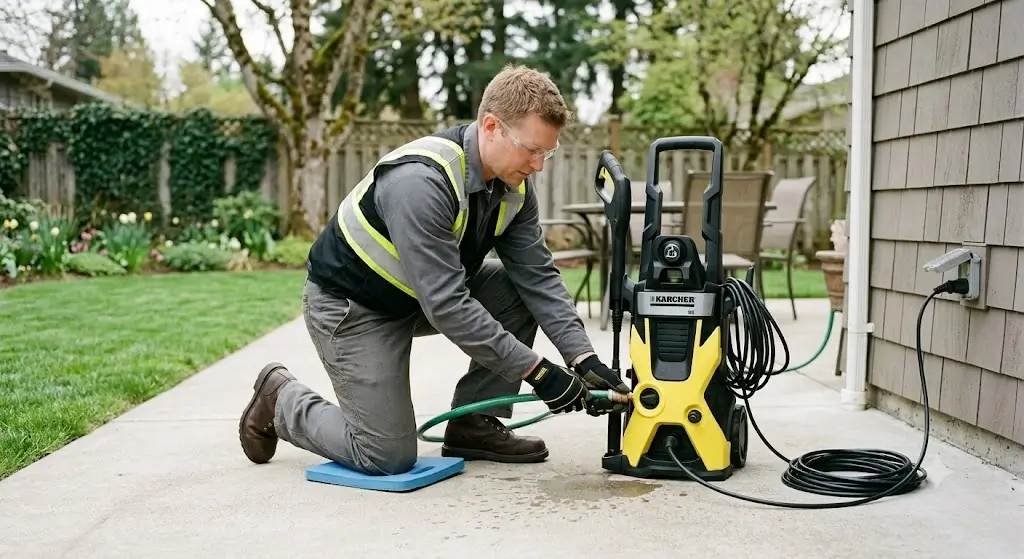
Safety first:If a pressure washer, hose, power cord, plug, gun, wand or fitting is damaged, leaking, electrically unsafe or behaving unexpectedly, stop using it. Do not improvise a repair that the manufacturer does not authorize.
In 2026, the U.S. Consumer Product Safety Commission issued warnings involving specific pressure washers that lacked required immersion protection/GFCI-related protection, demonstrating why electrical safety features and product recalls should be taken seriously.
- Read the pressure washer’s owner manual before operation.
- Inspect the machine, hose, gun, wand, fittings and electrical cord before use.
- Wear appropriate eye, foot and hand protection.
- Never point the spray at yourself or another person.
- Keep children and bystanders away from the work area.
- Keep electrical connections away from water and standing water.
- Use GFCI protection where required or recommended.
- Never operate a gasoline-powered pressure washer indoors or in an enclosed space.
- Never use gasoline-powered equipment near doors, windows or vents where exhaust can enter.
- Do not climb a ladder while operating a pressure-washer wand.
- Use only cleaning chemicals compatible with the equipment and surface.
- Stop immediately if equipment develops a leak, electrical fault or abnormal behavior.
Why Pressure Washing Safety Matters
A pressure washer can produce substantially more mechanical force at the spray point than a standard garden hose. The risk is not limited to the water itself. The complete system includes the pump, hose, trigger gun, nozzle, electrical supply or engine, fuel, cleaning chemicals and the surface being cleaned.
Before buying or running unfamiliar hardware, reviewing an engineering-based pressure washer buying guide ensures you match the machine’s pressure output and motor rating to your property’s physical safety limitations.
CDC/NIOSH safety guidance recommends identifying mechanical, energy-source, chemical and task-related hazards before pressure-washing work begins. It also recommends appropriate PPE and equipment inspection.
OSHA similarly identifies high-pressure water or air streams, uncontrolled hoses and leaks as hazards capable of causing serious injuries.
Information Gain:Pressure-washing safety is not just “wear safety glasses.” A safe job requires controlling energy, water, electricity, exhaust, chemicals, people, surfaces and movement at the same time.
The 10 Major Pressure Washing Hazards
| Hazard | What Can Go Wrong | Primary Prevention |
|---|---|---|
| High-pressure spray | Serious cuts or tissue injury | Never aim spray at people; use appropriate PPE |
| Hose failure | Uncontrolled movement or high-pressure leak | Inspect hose and fittings before use |
| Electrical shock | Serious injury or electrocution | GFCI protection and dry electrical connections |
| Carbon monoxide | Poisoning from gasoline-engine exhaust | Operate gasoline engines outdoors in open air |
| Chemicals | Eye, skin or respiratory exposure | Follow product label and use compatible PPE |
| Kickback | Loss of balance or control | Stable stance and controlled operation |
| Slippery surfaces | Falls | Control runoff and maintain stable footing |
| Ladders | Falls while handling the wand | Avoid operating from ladders |
| Flying debris | Eye and skin injury | Eye protection and controlled work zone |
| Noise | Hearing damage | Hearing protection where exposure warrants it |
Pressure Washing PPE: What Should You Wear?
PPE should match the hazards present on the job. CDC/NIOSH pressure-washing guidance specifically emphasizes protection for the eyes, hands, feet, ears and torso.
- Safety glasses or appropriate eye protection
- Face protection when splash or chemical exposure warrants it
- Protective gloves suitable for the task
- Closed-toe, slip-resistant footwear
- Hearing protection when noise exposure warrants it
- Clothing that protects skin from spray and debris
PPE does not make unsafe equipment safe. It is the final layer of protection after equipment condition, electrical safety, chemical controls and work-area controls.
Eye and Face Protection
High-pressure spray can propel dirt, paint chips, concrete particles, vegetation and other debris toward the operator.
Safety glasses should be appropriate for the hazards present. If chemical splash or significant face exposure is possible, additional face protection may be appropriate.
OSHA’s pressure-washing guidance identifies eye and face exposure from high-pressure cleaning and chemical splash as hazards requiring appropriate protection.
Do not rely on ordinary sunglasses.Sunglasses are not a substitute for appropriate protective eyewear.
Hand Protection
Gloves can help protect hands from spray, debris, chemicals and wet surfaces, but glove selection should match the task.
A waterproof glove may be appropriate for water exposure, while chemical-resistant gloves may be required for certain cleaning products. Always follow the chemical manufacturer’s PPE recommendations.
Gloves should never be used as a reason to handle a damaged hose, leaking fitting or malfunctioning pressure washer.
Foot Protection
Pressure-washing areas can become slippery because water mixes with dirt, algae, oil and cleaning chemicals.
- Use stable, closed-toe footwear.
- Choose slip-resistant footwear appropriate for wet surfaces.
- Keep feet away from the spray path.
- Do not work while standing on unstable objects.
CDC/NIOSH recommends PPE that protects the feet and warns operators to avoid stepping on oil, grease and other slippery substances.
Hearing Protection
Pressure washers can be noisy, particularly gasoline-powered machines and equipment operated in reflective areas such as garages, walls or enclosed structures.
If the work environment produces significant noise exposure, appropriate hearing protection can reduce risk.
Noise is easy to overlook because it does not produce an immediate visible injury, but repeated exposure can still be harmful.
Clothing and Skin Protection
Wear clothing appropriate for the combination of water, debris and cleaning products present at the work site.
Avoid loose clothing that could interfere with equipment or movement.
When chemicals are involved, the product label should determine additional skin and respiratory protection requirements.
Pre-Use Pressure Washer Inspection
A short inspection can identify problems before pressurized water or electrical power is introduced.
Inspect the Pressure Washer
- Look for visible damage.
- Check the power cord on electric models.
- Inspect plugs and electrical connections.
- Inspect the high-pressure hose.
- Check trigger-gun and wand connections.
- Check quick-connect fittings.
- Look for leaks.
- Confirm guards and safety features are intact.
- Check the owner’s manual for required pre-use inspections.
Do Not Use Equipment With
- Damaged electrical insulation
- Missing grounding components
- Cracked or damaged high-pressure hose
- Leaking fittings
- Damaged trigger gun
- Unexpected starting behavior
- Missing safety components
- Unknown modifications
OSHA recommends inspecting hoses and connections because high-pressure leaks and uncontrolled hoses can create serious hazards.
High-Pressure Spray Safety
The spray stream is the most obvious hazard, but it is also one of the easiest to underestimate.
Never treat the wand as harmless simply because the trigger is released. Follow the manufacturer’s procedures for depressurizing and handling the equipment.
- Never aim the wand at yourself.
- Never aim the wand at another person.
- Keep the spray away from animals.
- Do not use the spray to clean clothing or footwear while wearing them.
- Do not place hands near the spray path.
- Do not attempt to locate a leak with your hand.
- Keep the nozzle pointed in a controlled direction when not actively cleaning.
OSHA identifies direct contact with high-pressure water or air streams as a serious workplace hazard.
Pressure Washer Kickback and Loss of Control
The force generated by a pressure washer can create noticeable reaction forces at the gun and wand.
Loss of control becomes more likely when the operator is standing on a slippery surface, reaching excessively, working from an unstable position or suddenly changing direction.
Safer Work Position
- Keep both feet on a stable surface.
- Maintain a balanced stance.
- Avoid overreaching.
- Keep the hose routed away from your feet where practical.
- Pause work if footing becomes unstable.
High-Pressure Hose Safety
The hose is a pressurized component, not an ordinary garden hose.
Inspect it before every use for cuts, abrasions, bulges, exposed reinforcement, damaged connectors or other signs of failure.
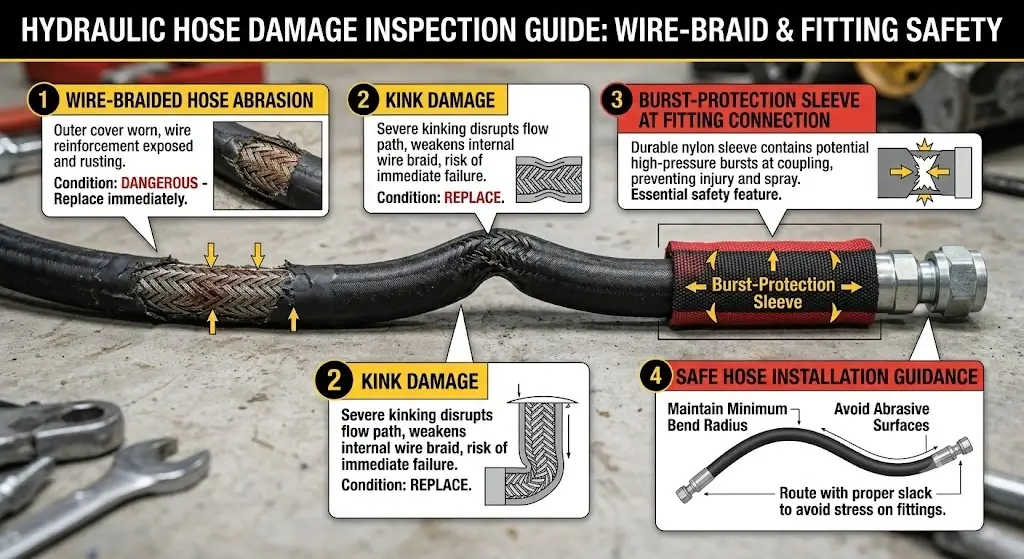
Never attempt to stop a high-pressure leak with your hand.A small-looking leak can represent a concentrated high-energy stream. Shut down the equipment according to the manufacturer’s instructions and have damaged components replaced appropriately.
OSHA specifically identifies uncontrolled hoses and high-pressure leaks as hazards during pressure-washing operations.
Electrical Pressure Washer Safety
Electric pressure washers combine water and electricity, so electrical protection is a central safety issue. If you use corded models from our roundup of the best electric pressure washers, always verify that the manufacturer includes an integrated inline ground-fault interrupter right on the power plug.
The CPSC has issued pressure-washer warnings in 2026 involving products lacking integrated immersion protection/GFCI-related protection, with the agency describing the hazard as a risk of serious injury or death from electric shock or electrocution.
Electrical Safety Rules
- Use equipment with the required electrical safety features.
- Use properly grounded electrical connections as specified by the manufacturer.
- Keep plugs and electrical connections away from water and runoff.
- Do not use damaged cords.
- Do not remove grounding components.
- Do not improvise electrical repairs.
- Follow the pressure washer manufacturer’s electrical requirements.
CPSC has long warned that water, electrical equipment and improper grounding can create serious shock hazards.
GFCI Safety: Why It Matters
A ground-fault circuit interrupter, or GFCI, is designed to interrupt electrical power when it detects a ground-fault condition.
For pressure washers, GFCI protection is particularly important because the equipment operates around water.
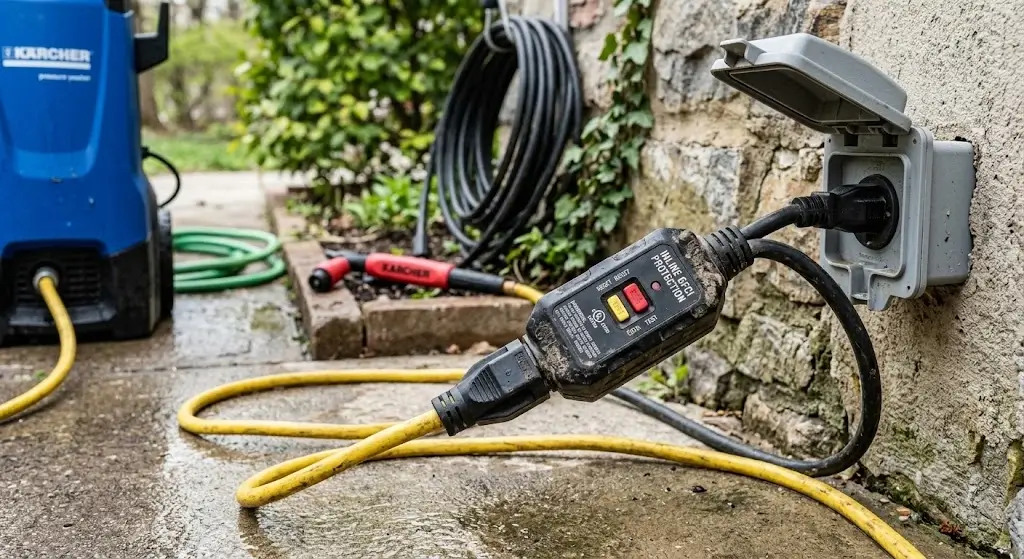
Use GFCI protection as required by the equipment instructions and applicable electrical requirements, and test the device according to the manufacturer’s instructions.
Important distinction:A GFCI is a safety device, not permission to operate electrical equipment in standing water or with damaged wiring. The entire electrical setup still needs to be appropriate and maintained.
Extension Cord Safety
Extension cords can introduce additional electrical and trip hazards.
If an extension cord is permitted by the pressure washer manufacturer, use the correct type and rating specified by the manufacturer.
- Keep connections away from water.
- Do not use damaged cords.
- Do not cut or splice cords as an improvised repair.
- Do not remove grounding prongs.
- Route cords to reduce trip hazards.
CPSC guidance warns against cutting or splicing cords and removing grounding prongs, and recommends keeping electrical connections away from standing water.
Gas Pressure Washer Safety
Gasoline-powered pressure washers introduce hazards that electric models do not have, including exhaust gases, fuel and hot engine components.
The most important difference is carbon monoxide.
Homeowners seeking to eliminate fuel storage risks and hazardous emissions often turn to high-output cordless battery systems. In our detailed EGO pressure washer review, we tested how battery-powered platforms eliminate carbon monoxide risks while providing mobility without extension cords.
Never operate a gasoline-powered pressure washer inside a house, garage, basement, shed, enclosed workshop or other enclosed space.Opening a door or window does not make an enclosed location automatically safe.
CDC/NIOSH warns that gasoline-powered pressure washers should not be used indoors because engine exhaust can cause carbon monoxide poisoning.
Carbon Monoxide Safety: The Hazard Many Homeowners Miss
Carbon monoxide, or CO, is a poisonous gas produced by gasoline-powered engines. It is especially dangerous because it cannot be reliably detected by sight or smell.
CDC guidance states that gasoline-powered pressure washer engines should never be placed indoors, in garages or carports, or near open windows, doors or vents where exhaust can enter.
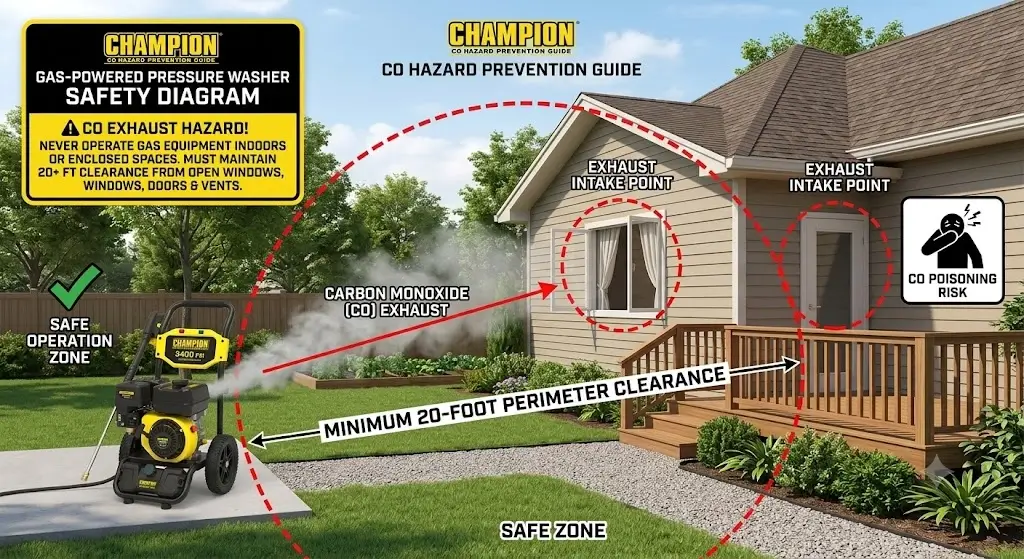
Never Use a Gas Pressure Washer
- Inside a home
- Inside a garage
- Inside a basement
- Inside a shed
- Inside an enclosed workshop
- Inside an enclosed parking structure
- Near openings where exhaust can enter occupied spaces
This is not merely a ventilation issue. CO can accumulate rapidly in enclosed areas.
Recent OSHA accident records also document fatal incidents involving gasoline-powered pressure washers used in enclosed or poorly ventilated areas.
Fuel and Fire Safety
Gas-powered pressure washers contain gasoline and operate with hot engine components.
- Keep fuel away from ignition sources.
- Do not smoke around fuel.
- Follow the manufacturer’s fueling instructions.
- Allow hot components to cool according to the owner’s manual before performing maintenance or handling fuel.
- Store fuel only as permitted by local requirements and the equipment manufacturer’s instructions.
- Clean up fuel spills promptly and appropriately.
Fuel safety should be treated separately from pressure-washing technique because gasoline introduces a fire hazard even when the spray system is operating correctly.
Pressure Washer Chemical Safety
Cleaning chemicals can create hazards independent of the pressure washer.
Before using any detergent, degreaser, mold treatment or other chemical, read the product label and determine whether it is compatible with the pressure washer, surface and surrounding environment.
Check Three Things
| Question | Why It Matters |
|---|---|
| Is it safe for the surface? | Some chemicals can discolor, etch or damage materials. |
| Is it compatible with the equipment? | Chemicals can affect components or seals. |
| Is it safe for people and surroundings? | Splash, mist and runoff can expose people, pets and plants. |
OSHA identifies chemical absorption, burns and eye/face exposure as potential hazards when pressure washing with chemical cleaners.
Why You Should Not Mix Cleaning Chemicals
Do not mix cleaning products unless the manufacturer explicitly instructs you to do so.
Combining incompatible chemicals can produce dangerous reactions or hazardous vapors.
Keep chemicals in their original labeled containers and follow the product’s storage and disposal instructions.
Pressure Washing and Ladder Safety
A pressure-washer wand requires both hands and produces reaction force. Combining that equipment with a ladder creates a difficult balance problem.
CDC/NIOSH pressure-washing guidance specifically recommends using a telescoping wand to avoid working from ladders or elevated platforms.
Do not operate a pressure washer from a ladder.Use a safer access method or have an appropriately equipped professional handle elevated work.
Roof and Elevated-Surface Safety
Roof cleaning is substantially different from cleaning a patio or driveway.
Water, algae and cleaning chemicals can make surfaces slippery, while pressure-washer reaction forces can affect balance.
Do not improvise roof-access systems or attempt elevated work without appropriate fall protection, training and equipment.
For homeowners, roof cleaning is often a task where professional service is safer than attempting to operate pressure equipment from an elevated surface.
Windows and Glass Safety
Glass, window seals, screens and surrounding trim can be damaged by inappropriate pressure or concentrated spray.
Avoid treating windows as if they were concrete. Surface material, seal condition, frame construction and manufacturer’s recommendations matter.
If the manufacturer of the window or building system provides specific cleaning instructions, those instructions take priority.
Vehicle and Automotive Pressure Washing Safety
Vehicles contain paint, trim, sensors, seals, electronics and delicate components that should not be treated like concrete.
- Keep concentrated spray away from delicate components.
- Do not spray damaged seals aggressively.
- Do not use pressure to clean electrical connectors.
- Keep the spray away from openings where water could enter sensitive components.
- Follow the vehicle manufacturer’s cleaning recommendations.
For automotive detailing, the objective is controlled cleaning rather than maximum pressure.
Concrete and Surface Safety
Pressure washing can remove dirt, but excessive mechanical force can also damage surfaces.
Potential problems include surface etching, removal of weak surface material, damaged coatings, disturbed joint material and visible cleaning patterns.
Higher Risk Surfaces
- Cracked concrete
- Spalled concrete
- Old or deteriorated brick
- Loose pavers
- Natural stone with unknown properties
- Painted or coated surfaces
- Damaged mortar joints
- Fragile wood surfaces
A safe cleaning strategy starts by identifying the surface and choosing the least aggressive effective method.
Children, Pets and Bystander Safety
Pressure washing creates a work zone that should be treated as restricted while the equipment is operating.
- Keep children away from the work area.
- Keep pets away from hoses, chemicals and spray.
- Keep visitors outside the active work zone.
- Pause work when pedestrians approach.
- Do not assume people can see the spray stream.
- Secure loose hoses and equipment when the machine is not being used.
CDC/NIOSH recommends maintaining awareness of surroundings and pausing work until pedestrians are safely away.
Weather and Environmental Conditions
Weather can change the safety profile of pressure washing.
Wet Surfaces
Wet surfaces can become slippery, especially when mixed with algae, oil or detergent.
Lightning and Severe Weather
Do not continue outdoor work during lightning or dangerous weather. Electrical equipment and wet conditions create an especially poor combination during storms.
Heat
Long pressure-washing jobs can create heat exposure, particularly when wearing protective clothing.
Take appropriate breaks, stay hydrated and stop work if conditions become unsafe.
How to Set Up a Safer Pressure-Washing Work Area
A well-organized work area reduces hazards before the machine is turned on.
Before Starting
- Identify the cleaning area.
- Remove unnecessary objects.
- Move children and pets away.
- Identify electrical connections.
- Identify drainage paths.
- Check where chemical runoff will go.
- Inspect hoses and cords.
- Establish a stable operator position.
- Identify nearby windows, doors and vehicles.
- Confirm adequate outdoor air circulation for gasoline equipment.
Safe Pressure Washer Shutdown
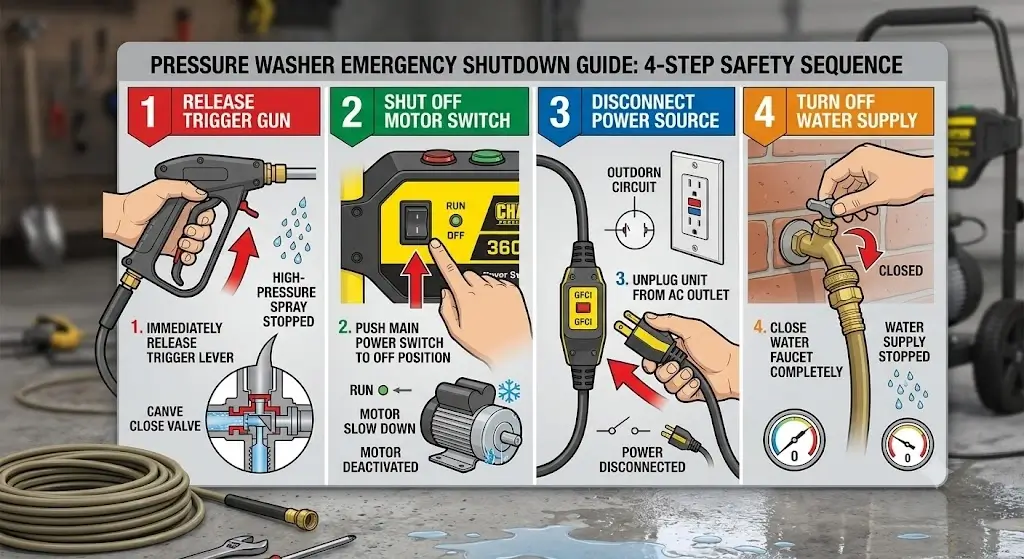
When the job is finished, do not simply walk away from a pressurized machine.
Follow the manufacturer’s shutdown and depressurization procedure exactly.
General Shutdown Principles
- Stop the cleaning operation.
- Turn the machine off according to the owner’s manual.
- Disconnect electrical power when required by the manufacturer’s procedure.
- Shut down the water supply as directed.
- Relieve stored pressure according to the manufacturer’s instructions.
- Allow hot components to cool as appropriate.
- Inspect the equipment for damage.
- Store hoses and accessories safely.
Do not improvise a depressurization procedure.Different pressure washers have different operating and shutdown requirements. The owner’s manual should control the procedure for the specific machine.
Pressure Washer Storage and Maintenance Safety
Safe storage prevents damage that could become a hazard during the next use.
Storage Checklist
- Store the machine in a suitable dry location.
- Protect electrical components from moisture.
- Inspect hoses before storing them.
- Prevent sharp bends and crushing of high-pressure hoses.
- Store chemicals according to their labels.
- Keep gasoline and fuel-related materials appropriately stored.
- Follow the manufacturer’s winterization instructions when necessary.
- Replace damaged components before the next job.
Pressure Washer Recalls and Product Safety
Checking for recalls is part of equipment safety, especially when purchasing an unfamiliar pressure washer or using an older machine.
The U.S. Consumer Product Safety Commission maintains a pressure-washer recall and warning database. In 2026, CPSC issued warnings involving specific pressure washers with electrical shock hazards and also listed a 2026 recall expansion involving certain electric-start pressure washers because of a carbon-monoxide hazard if the unit could self-start in a confined space.
Before using an unfamiliar pressure washer:
- Identify the exact brand and model.
- Check the manufacturer’s safety information.
- Check current CPSC recalls and warnings.
- Confirm that required safety components are present.
- Do not use a product subject to a safety warning until the manufacturer’s or CPSC’s remedy has been followed.
When to Stop Pressure Washing Immediately
The safest pressure washer operator knows when not to continue.
- The high-pressure hose develops a leak.
- The machine behaves unexpectedly.
- An electrical breaker or GFCI trips repeatedly.
- The electrical cord becomes damaged.
- You smell fuel or see a fuel leak.
- A gasoline-powered machine is being used in an enclosed area.
- You lose stable footing.
- A person or animal enters the work zone.
- A chemical splashes into your eyes or onto skin.
- The surface begins to deteriorate under cleaning.
- Weather creates an unsafe condition.
- You are unsure whether a component is safe.
When in doubt, stop.A cleaning job can wait. A damaged hose, electrical fault, unstable position or unknown chemical exposure should not be treated as a minor inconvenience.
If an Accident Happens
If a pressure-washing accident occurs, prioritize personal safety and obtain appropriate medical assistance.
Electrical Incident
Do not touch a person who may still be in contact with an energized electrical source. Shut off power only when it can be done safely, and obtain emergency assistance.
Chemical Exposure
Follow the chemical product’s first-aid instructions and seek appropriate medical or poison-control assistance when required.
High-Pressure Injection-Type Injury
A high-pressure injection injury can appear less serious externally than the underlying tissue damage. It requires prompt medical evaluation.
Carbon Monoxide Exposure
If carbon monoxide exposure is suspected, move to fresh air if it is safe to do so and seek emergency medical assistance. Do not re-enter a potentially contaminated enclosed area.
Pressure Washing Safety Checklist
Before the Job
- Read the owner’s manual.
- Check recalls and safety notices.
- Inspect the pressure washer.
- Inspect the hose.
- Inspect the wand and trigger gun.
- Inspect electrical components.
- Confirm appropriate GFCI protection.
- Identify chemicals and read labels.
- Put on appropriate PPE.
- Remove children, pets and bystanders from the work zone.
- Check weather and footing.
- Confirm that gasoline equipment will remain outdoors in open air.
During the Job
- Keep the spray pointed in a controlled direction.
- Never aim the spray at people or animals.
- Maintain stable footing.
- Keep cords and electrical connections away from water.
- Monitor hoses and fittings.
- Keep chemical exposure controlled.
- Watch for pedestrians.
- Stop if equipment behaves abnormally.
After the Job
- Follow the manufacturer’s shutdown procedure.
- Depressurize according to the manual.
- Disconnect power as required.
- Inspect for damage.
- Clean and store accessories appropriately.
- Store chemicals safely.
- Store fuel according to applicable requirements.
- Record defects that must be repaired before the next use.
Pressure Washing Safety: Electric vs. Gas Models
| Safety Factor | Electric Pressure Washer | Gas Pressure Washer |
|---|---|---|
| Electrical shock | Primary concern | Less central, but electrical components may still exist |
| GFCI considerations | Important | Depends on model/electrical components |
| Carbon monoxide | No gasoline engine exhaust | Major hazard |
| Fuel/fire | No gasoline fuel | Gasoline and hot engine components require control |
| Noise | Often lower, model dependent | Often higher, model dependent |
| Enclosed-space use | Still requires electrical/water precautions | Never use gasoline engine indoors or in enclosed spaces |
Pressure Washing Safety by Cleaning Surface
Using improper pressure or nozzle angles on exterior walls can force gallons of water behind vinyl siding and soffits, ruining insulation and creating mold. Our guide on the best electric pressure washers for houses explains how to use low-pressure soft-washing techniques safely to protect your building envelope from water intrusion.
| Surface | Primary Safety Concern |
|---|---|
| Concrete driveway | Surface damage, flying debris and slippery runoff |
| Wood deck | Surface damage, splinters and excessive water impact |
| Composite decking | Surface damage and manufacturer-specific cleaning limits |
| Brick | Mortar and brick deterioration |
| Pavers | Joint material displacement |
| Natural stone | Material-specific chemical and mechanical sensitivity |
| Vehicle | Paint, trim, seals and sensitive components |
| Windows | Glass, seals, screens and trim |
| Siding | Water intrusion and surface damage |
| Roof | Fall risk and surface damage |
5 Pressure Washing Safety Rules Worth Memorizing
1. Never Aim the Spray at a Person
The spray is a high-energy stream. Treat the wand as dangerous equipment whenever it is connected to a pressurized system.
2. Never Run a Gas Pressure Washer Indoors
Carbon monoxide can accumulate without an obvious warning. CDC/NIOSH specifically warns against indoor use.
3. Never Ignore Electrical Protection
Water and electricity require careful control. GFCI protection, proper grounding and intact electrical equipment are essential considerations.
4. Never Use Damaged Pressurized Components
A damaged hose or fitting can become a high-pressure hazard. Inspect equipment before every job.
5. Never Trade Safety for Speed
The fastest cleaning job is not the one that uses maximum pressure. It is the one that avoids injury, equipment damage and unnecessary rework.
Pressure Washing Safety for Homeowners vs. Professionals
Homeowners and professional operators face many of the same physical hazards, but professional work can involve additional exposure because of longer operating periods, unfamiliar properties, commercial chemicals, elevated work and other workers or members of the public nearby.
Professional operations should use a formal hazard assessment, training, PPE program and applicable workplace safety requirements rather than relying solely on household cleaning habits.
CDC/NIOSH recommends job hazard analysis and worker training for pressure-washing operations.
Why Maximum PSI Is Not a Safety Strategy
A common pressure-washing mistake is treating the maximum PSI printed on a machine as the correct setting for every job.
Higher pressure can increase the potential consequences of incorrect technique, particularly on delicate surfaces or when the spray is accidentally directed toward a person, animal or body part.
A better safety principle is:
This principle applies to pressure, spray pattern, distance, chemical strength and cleaning duration.
Pressure Washing Safety and Information Gain: What Most Guides Miss
Many generic safety articles stop at “wear goggles and gloves.” A more useful safety framework asks what can actually fail during the job.
| Question | Safety Decision |
|---|---|
| What powers the machine? | Electricity introduces shock hazards; gasoline introduces CO and fuel hazards. |
| What is under pressure? | Inspect hose, gun, fittings and connections. |
| What chemicals are present? | Check compatibility, PPE and runoff. |
| Who is nearby? | Control the work zone. |
| What surface are you cleaning? | Prevent damage and unexpected reactions. |
| Where is the operator standing? | Control slips, trips and balance hazards. |
| What happens if something fails? | Know when to stop and how to shut down safely. |
Frequently Asked Questions
Are pressure washers dangerous?
Yes. Pressure washers combine high-pressure spray with mechanical, electrical or engine-related energy, chemicals and wet working conditions. Proper equipment inspection, PPE, work-zone control and manufacturer instructions reduce risk.
What PPE should I wear when pressure washing?
Appropriate PPE can include eye protection, gloves, closed-toe slip-resistant footwear, hearing protection and clothing that protects against spray and debris. Chemical-specific PPE should follow the cleaner’s label.
Can a pressure washer cause serious injury?
Yes. High-pressure water streams can cause serious injuries. OSHA identifies direct contact with high-pressure water or air streams, uncontrolled hoses and leaks as significant hazards.
Can you get electrocuted using an electric pressure washer?
Yes. Water and electricity can create serious shock and electrocution hazards. Proper grounding, GFCI protection, intact electrical equipment and keeping electrical connections away from water are important safety measures.
Do pressure washers need GFCI protection?
GFCI protection is an important electrical safety measure for equipment operating around water. Follow the pressure washer manufacturer’s instructions and applicable electrical requirements. CPSC has issued 2026 warnings involving specific pressure washers lacking appropriate immersion/GFCI-related protection.
Can you use a gas pressure washer in a garage?
No. Gasoline-powered pressure washers should not be operated inside garages or other enclosed spaces because their engines produce carbon monoxide. CDC specifically warns against using gasoline-powered pressure washer engines indoors or near openings where exhaust can enter.
Can you pressure wash indoors?
Gasoline-powered pressure washers should never be used indoors because of carbon monoxide. Electric equipment also presents electrical and water hazards, so indoor use should only occur when specifically permitted by the equipment and site requirements.
Can pressure washing cause carbon monoxide poisoning?
Yes, when a gasoline-powered pressure washer is operated in an enclosed or poorly ventilated area. Carbon monoxide is colorless and odorless and can accumulate rapidly.
Can I use a pressure washer on a ladder?
Operating a pressure washer from a ladder creates a balance and control hazard. CDC/NIOSH recommends using a telescoping wand to avoid working from ladders or elevated platforms.
How do I safely handle a leaking pressure washer hose?
Stop the equipment according to the manufacturer’s shutdown procedure and do not attempt to locate or block a high-pressure leak with your hand. Replace damaged components using appropriate manufacturer-approved parts or obtain qualified service.
Can I point a pressure washer at my hand to test it?
No. Never use your hand or any part of your body to locate or test a high-pressure spray or leak.
Can children use a pressure washer?
Pressure washers are high-energy equipment and should not be treated as children’s cleaning tools. Children and other bystanders should remain outside the active work area. CPSC has historically warned against allowing children to operate pressure washers.
Should pets be kept away while pressure washing?
Yes. Keep pets outside the active work area because of high-pressure spray, noise, hoses, chemicals and flying debris.
Can I mix pressure washer detergents?
Do not mix cleaning chemicals unless the product manufacturer specifically instructs you to do so. Incompatible chemicals can create dangerous reactions or vapors.
What should I do if a GFCI keeps tripping?
Stop using the equipment and investigate the cause according to the manufacturer’s instructions. Do not repeatedly reset a GFCI and continue operating equipment that may have an electrical fault.
What should I do if a pressure washer behaves strangely?
Stop operation and follow the manufacturer’s troubleshooting and shutdown instructions. Do not bypass safety features or continue using equipment with an unknown fault.
How often should I inspect a pressure washer?
Inspect the machine before each use, including the hose, fittings, trigger gun, wand and electrical components. OSHA specifically recommends inspecting hoses and connections for pressure-washing operations.
Should I check pressure washer recalls?
Yes. Check the exact model against current manufacturer safety notices and CPSC recalls or warnings, particularly when using an older or unfamiliar machine.
What is the most important pressure washing safety rule?
Treat the pressure washer as high-energy equipment: inspect it before use, control the work area, use appropriate PPE, never direct the spray at people, protect electrical connections, keep gasoline engines outdoors and stop immediately when equipment or conditions become unsafe.
Bottom Line: Pressure Washing Safety Comes Before Cleaning Speed
A pressure washer is useful because it concentrates water and mechanical energy into a small area. That same concentration is why safe operation requires more than a pair of gloves.
The highest-priority controls are straightforward: inspect the equipment, protect your eyes and body, control the spray, protect electrical connections, keep gasoline engines outdoors, manage chemicals, maintain stable footing and keep other people away from the work zone.
The safest operator also knows when to stop. A damaged hose, electrical fault, unexpected machine behavior, unstable footing, chemical exposure or unsafe weather conditions are reasons to pause rather than push through the job.
HomeGearMax Safety Rule:Control the energy before you control the dirt.
If you cannot confidently control the pressure washer, its power source, the work area or the surface being cleaned, stop and use a safer method or qualified professional service.
Safety Sources & Editorial Basis
This guide is based on U.S. government safety information and should be used together with the owner’s manual for the specific pressure washer and the labels/SDS for cleaning chemicals.
- U.S. Consumer Product Safety Commission — pressure washer safety warnings and recalls.
- CDC/NIOSH — pressure washing injury prevention and carbon monoxide guidance.
- OSHA — high-pressure cleaning hazards, PPE and equipment inspection guidance.
The recommendations above do not replace the manufacturer’s instructions, applicable electrical requirements, workplace safety requirements or professional medical advice.
