
Pressure Washer Power Consumption: Watts, Amps, kWh & Electricity Cost
The number printed on an electric pressure washer’s box—such as 1,500 W, 1,650 W or 2,000 W—does not by itself tell you how much electricity the machine will use during an entire cleaning job.
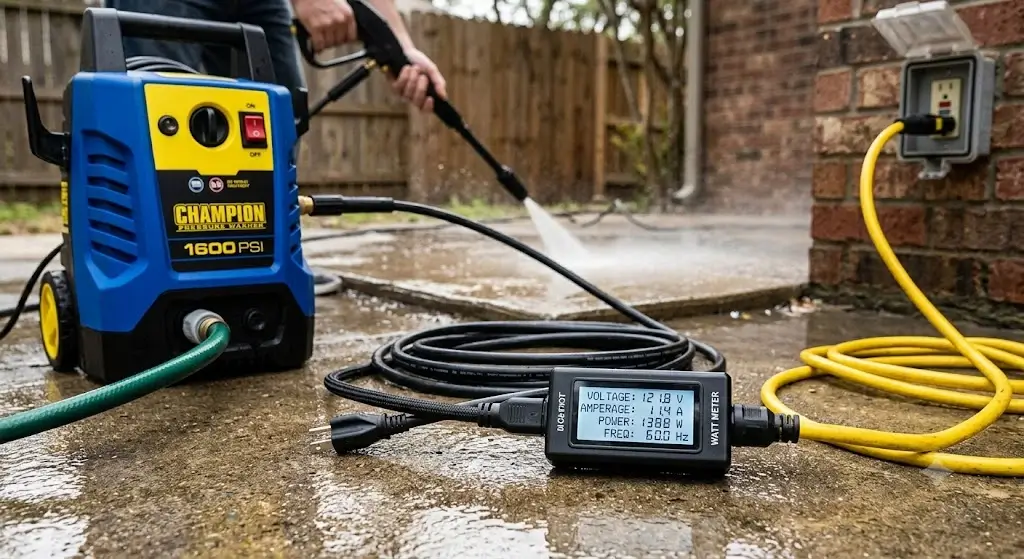
Actual consumption depends on electrical load, motor operating conditions, trigger-on time, pump load and duty cycle.
This distinction is especially important in the United States because many consumer electric pressure washers operate from a standard 120V household circuit. The available circuit capacity can become a practical limitation long before the pressure washer’s headline PSI specification does.
How Much Electricity Does a Pressure Washer Use?
A typical residential electric pressure washer can consume roughly 1,200 to 2,000+ watts while operating, although the actual range varies considerably by model and operating load. When testing the best electric pressure washers on standard branch circuits, efficiency largely depends on whether the unit utilizes an energy-dense universal motor or a sustained-duty induction motor.
A machine rated at 1,500 watts running for one hour at its stated electrical load would theoretically consume:
If electricity costs $0.20 per kWh, that theoretical hour would cost:
But a real cleaning session rarely consists of one continuous hour of full electrical load.
The motor may cycle on and off, the trigger may be released between passes, and electrical demand can change depending on hydraulic load.
What Are Watts on a Pressure Washer?
Watts (W) measure electrical power.
For a simplified single-phase electrical calculation:
For example, a 120V pressure washer drawing 12.5 amps would correspond to:
This is a useful engineering approximation, but real AC motor systems can involve power factor, so a simple volts-times-amps calculation does not always equal the exact real power measured by a watt meter.
For household electricity-cost calculations, actual wattage measured by a suitable power meter is preferable when precision matters.
How Many Amps Does a Pressure Washer Use?
Amperage tells you how much electrical current the machine draws from the supply under a particular operating condition.
For a nominal 120V system, the simplified relationship is:
| Approx. Power | At 120V | Approx. Current |
|---|---|---|
| 1,200 W | 120 V | 10.0 A |
| 1,400 W | 120 V | 11.7 A |
| 1,500 W | 120 V | 12.5 A |
| 1,650 W | 120 V | 13.75 A |
| 1,800 W | 120 V | 15.0 A |
| 2,000 W | 120 V | 16.7 A |
What Voltage Does a Pressure Washer Use?
Most consumer electric pressure washers sold in the United States use 120V AC.
Larger commercial equipment may use different electrical configurations, including higher-voltage circuits, depending on the model and intended application.
Always follow the electrical requirements printed on the pressure washer and in its owner’s manual.
| System | Typical Application | Electrical Consideration |
|---|---|---|
| 120V | Residential electric pressure washers | Standard U.S. household power |
| 240V | Some higher-power equipment | Requires appropriate circuit |
| Gas engine | Many high-output pressure washers | Primary energy source is fuel |
Pressure Washer Power Consumption Formulas
Electrical power
Current
Energy consumption
Electricity cost
These formulas are useful for estimating operating cost. For precise AC motor measurements, use actual measured real power rather than assuming that voltage multiplied by current equals real watts in every operating condition.
Pressure Washer Watts and Amps Chart
| Power Rating | Approx. Amps at 120V | 1-Hour Energy |
|---|---|---|
| 1,200 W | 10.0 A | 1.2 kWh |
| 1,300 W | 10.8 A | 1.3 kWh |
| 1,400 W | 11.7 A | 1.4 kWh |
| 1,500 W | 12.5 A | 1.5 kWh |
| 1,600 W | 13.3 A | 1.6 kWh |
| 1,650 W | 13.75 A | 1.65 kWh |
| 1,800 W | 15.0 A | 1.8 kWh |
| 2,000 W | 16.7 A | 2.0 kWh |
The current figures are simplified calculations using 120V. Actual measured current can differ because of voltage variation, motor characteristics and power factor.
How to Calculate Pressure Washer kWh Consumption
Electric utilities bill energy, not watts.
Watts describe the rate of power use. Kilowatt-hours (kWh) describe the amount of energy consumed over time.
Example: 1,500W pressure washer
Suppose the machine draws an average of 1,500W while the motor is operating and runs for 30 minutes:
At a hypothetical electricity price of $0.20/kWh:
The same machine operating for 20 minutes would consume approximately:
How Much Does It Cost to Run an Electric Pressure Washer?
The electricity cost of pressure washing is often relatively small compared with labor, equipment, detergent and other operating costs, but the exact figure depends on your local electricity rate.
Use:
| Average Load | 30 Minutes | 1 Hour | At $0.20/kWh |
|---|---|---|---|
| 1.2 kW | 0.60 kWh | 1.20 kWh | $0.12 / $0.24 |
| 1.5 kW | 0.75 kWh | 1.50 kWh | $0.15 / $0.30 |
| 1.65 kW | 0.825 kWh | 1.65 kWh | $0.17 / $0.33 |
| 1.8 kW | 0.90 kWh | 1.80 kWh | $0.18 / $0.36 |
The last column is illustrative. Replace $0.20/kWh with your actual utility rate.
How Much Electricity Does a Pressure Washer Use Per Job?
The most useful calculation for homeowners is often energy per cleaning job rather than energy per hour.
Suppose a pressure washer averages 1,500W while its motor is actively running and the total motor runtime is 18 minutes:
At $0.20/kWh:
The exact result depends on the actual measured power draw and runtime.
120V Pressure Washer Circuit Requirements
A major reason electrical power consumption matters is that consumer pressure washers can operate near the practical limits of common U.S. household circuits.
A standard 120V, 15A circuit has a nominal mathematical capacity of:
That does not mean an 1,800W pressure washer should automatically be treated as a suitable continuous load for every 15A circuit.
Circuit loading, motor startup characteristics, other connected loads, wiring conditions, receptacle condition and applicable electrical-code requirements all matter.
Can a Pressure Washer Run on a 15-Amp Circuit?
Many consumer electric pressure washers are designed to operate from ordinary household circuits, but the exact answer depends on the machine’s electrical specifications.
For example, a nominal 1,500W load at 120V corresponds to approximately 12.5A by simple arithmetic.
An 1,800W load corresponds to approximately 15A.
The motor’s starting current can temporarily exceed its running current.
Other appliances connected to the same branch circuit can also contribute to the total load.
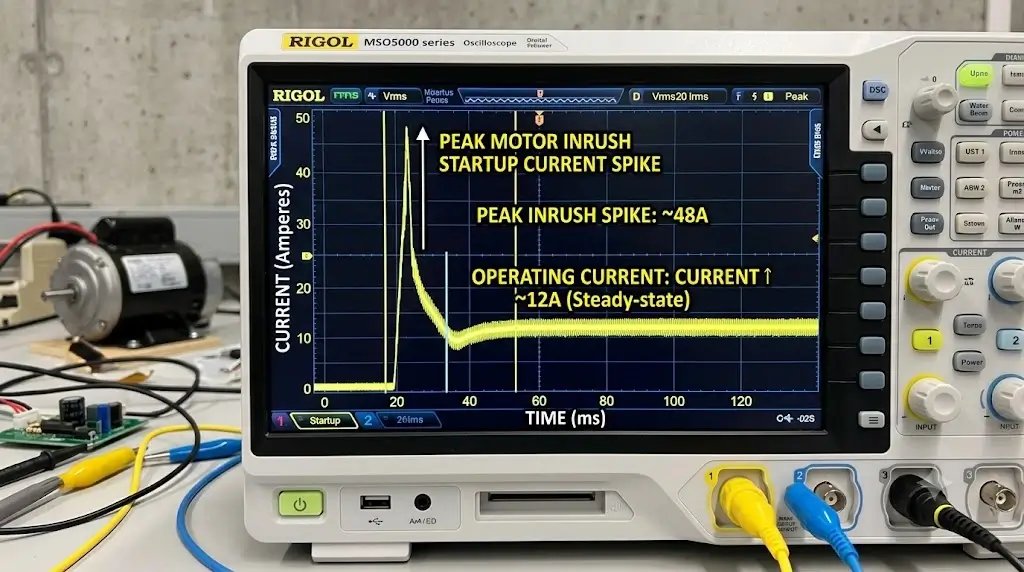
Pressure Washer Startup Current and Motor Inrush
Electric motors can draw more current during startup than during steady-state operation.
This temporary increase is commonly called inrush current or starting current.
It matters because a pressure washer may appear to operate comfortably once running but still trip a circuit breaker when the motor starts.
Why startup is different
When an electric motor accelerates from zero speed, the motor’s electrical characteristics are different from those during normal operation.
The exact startup current depends on motor design, control electronics, supply voltage and load.
Why Pressure Washer Power Draw Changes Under Load
A pressure washer motor does not necessarily draw exactly the same electrical power during every second of operation.
Hydraulic load changes as the pump operates under different conditions.
Factors affecting electrical demand can include:
- Operating pressure.
- Flow rate.
- Nozzle orifice.
- Water supply.
- Pump condition.
- Motor efficiency.
- Supply voltage.
- Mechanical friction.
- Temperature.
A pressure washer operating at a different nozzle or pressure condition may therefore show a different current draw than the number printed on the nameplate suggests.
PSI, GPM and Electrical Power: How Are They Connected?
Pressure washer hydraulic output is related to both pressure and flow.
A commonly used hydraulic horsepower approximation is:
For example, 2,000 PSI at 1.5 GPM:
That does not mean the machine requires exactly 1.75 mechanical horsepower or exactly 1.75 HP worth of electrical input.
Real systems have losses in the motor, pump, couplings, bearings, seals and other components.
Therefore, electrical input power must be higher than ideal hydraulic output power.
Why PSI Alone Cannot Tell You Power Consumption
A pressure washer advertised as 3,000 PSI does not necessarily require the same electrical power as another machine advertised at 3,000 PSI.
You also need to know the flow rate.
The hydraulic power requirement is driven by the product of pressure and flow.
That is why a machine claiming extremely high PSI with a very small GPM can have a dramatically different hydraulic requirement from a machine producing similar PSI at substantially higher flow.
Pressure Washer Horsepower vs. Watts
Horsepower and watts both describe power, but they are not interchangeable without conversion.
However, an electric motor rated at 2 HP does not necessarily consume exactly 1,492W from a 120V outlet.
Motor ratings and electrical input are different concepts.
Motor efficiency determines how much electrical input is converted into mechanical output.
For pressure washers, additional losses occur between the motor and the hydraulic output.
| Measurement | What It Describes |
|---|---|
| Electrical watts | Electrical power entering the system |
| Motor horsepower | Mechanical motor output/rating |
| Hydraulic horsepower | Idealized hydraulic power associated with PSI and GPM |
| PSI | Pressure |
| GPM | Flow |
Electric vs. Gas Pressure Washer Power Consumption
| Characteristic | Electric Pressure Washer | Gas Pressure Washer |
|---|---|---|
| Primary energy source | Electricity | Gasoline |
| Typical consumer application | Cars, patios, homes | Large concrete and commercial work |
| Electrical circuit requirement | Yes | Usually no external power required |
| Common GPM range | Often lower | Often higher |
| Typical portability limitation | Power cord | Fuel and engine |
| Energy-cost calculation | kWh × utility rate | Fuel consumption × fuel price |
Electric and gas pressure washers should not be compared solely by advertised PSI.
A gas machine may produce significantly greater hydraulic output, while an electric model may be more practical for residential jobs where lower noise, simpler startup and household electrical access are priorities.
Does a Gas Pressure Washer Use Electricity?
A conventional gas pressure washer does not normally use household electricity to power its engine and pump.
It may contain electrical components depending on its design, but the primary energy source is gasoline.
Therefore, its operating energy cost is usually evaluated through fuel consumption rather than household kWh consumption.
Electricity Used by Pressure Washer Jobs
| Average Electrical Load | Runtime | Energy |
|---|---|---|
| 1,200 W | 15 min | 0.30 kWh |
| 1,500 W | 15 min | 0.375 kWh |
| 1,500 W | 30 min | 0.75 kWh |
| 1,650 W | 30 min | 0.825 kWh |
| 1,800 W | 30 min | 0.90 kWh |
| 1,500 W | 60 min | 1.50 kWh |
These are mathematical examples using constant average load. Real machines can draw different power during startup, unloaded operation and loaded pumping.
How Much Electricity Does Pressure Washing a Car Use?
Suppose an electric pressure washer averages 1,400W while operating and the motor runs for 15 minutes during a vehicle wash.
At a hypothetical $0.20/kWh electricity rate:
This illustrates why electricity cost is usually a relatively small component of a single electric-pressure-washing job.
How Much Electricity Does Pressure Washing a Driveway Use?
Driveways generally require longer operating time than vehicles.
Suppose a 1,650W pressure washer operates for 45 minutes:
At $0.20/kWh:
Again, this is a theoretical example. Actual electricity consumption depends on the pressure washer’s measured average load and the time the motor actually operates.
Pressure Washer Power Consumption for House Washing
House washing can involve significant elapsed time, but the motor may not operate continuously.
Suppose an electric pressure washer averages 1.5kW and accumulates 35 minutes of motor runtime:
The calculation is based on motor runtime, not simply the number of hours the operator spends at the property. If you are tackling multi-story vinyl siding or large exterior walls, selecting one of the best electric pressure washers for houses ensures you get the necessary GPM throughput to wash exterior walls efficiently without continuously maxing out circuit duty limits.
Pressure Washer Duty Cycle and Electricity Consumption
Duty cycle describes how equipment is intended to operate over time.
A pressure washer that runs for short periods and rests between cycles has a different thermal operating profile from a machine subjected to continuous full-load operation.
Duty cycle affects:
- Motor temperature.
- Pump temperature.
- Thermal protection.
- Mechanical wear.
- Average energy consumption.
- Total cleaning-job runtime.
A lower-duty residential pressure washer should not be treated like a commercial continuous-duty machine simply because both display similar PSI figures.
Does Releasing the Trigger Save Electricity?
It can.
Many pressure washers use automatic pump-control systems that reduce or stop motor operation when the spray-gun trigger is released.
The exact control strategy varies by equipment.
If the motor stops rather than continuing to run under load, the machine can consume substantially less electricity during periods when no water is being sprayed.
This is another reason why total elapsed job time is not necessarily equal to motor runtime.
Pressure Washer Idle Power vs. Loaded Power
An electric pressure washer can have different electrical demands under different operating states.
| Operating State | Potential Electrical Behavior |
|---|---|
| Motor off | Little or no motor energy consumption |
| Startup | Temporary higher current may occur |
| Running unloaded/lightly loaded | Lower than maximum loaded demand in some systems |
| Pressure washing under load | Higher hydraulic and motor load |
| Thermal protection | Motor may stop until temperature falls |
Exact behavior depends on the pressure washer’s motor, pump and control architecture.
Extension Cords and Pressure Washer Power Consumption
Extension cords introduce additional electrical resistance into the circuit.
Long, undersized or poor-quality extension cords can produce voltage drop.
Voltage drop can affect motor performance and may increase electrical stress.
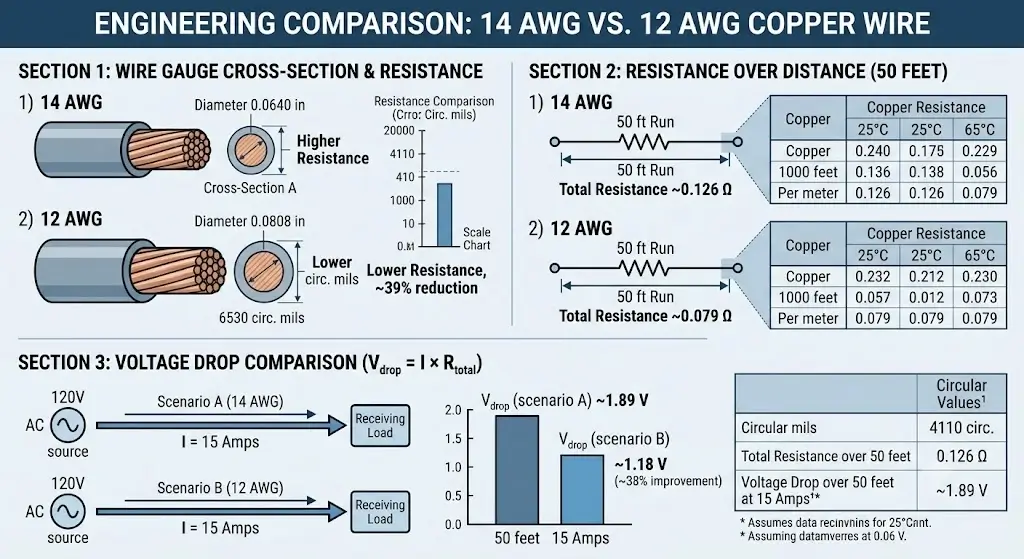
For this reason, many manufacturers recommend avoiding extension cords or specify particular cord lengths and wire gauges when one is permitted.
Why longer cords matter
Electrical resistance increases with conductor length. Higher current loads make voltage-drop effects more important.
This becomes especially relevant for pressure washers operating near the capacity of a residential circuit.
Does a Longer Hose Increase Power Consumption?
A longer water hose can introduce additional hydraulic resistance.
Whether this causes a meaningful increase in electrical consumption depends on the system and operating conditions.
A restrictive hose, undersized fittings or inadequate water supply can change the pump’s operating condition.
The more important rule is to use hose diameter and fittings appropriate for the machine’s flow requirements.
How to Reduce Pressure Washer Electricity Consumption
1. Match the machine to the job
Do not choose an oversized machine simply because its PSI headline is higher.
2. Reduce unnecessary runtime
Release the trigger during repositioning and preparation whenever appropriate.
3. Use the correct nozzle
An appropriate nozzle helps the pump operate within its intended hydraulic range.
4. Use suitable detergent
Chemistry can reduce the amount of mechanical cleaning required for certain contaminants.
5. Use the correct surface cleaner
On large flat surfaces, a properly matched surface cleaner can increase productivity and reduce total operating time.
6. Maintain the pump
A poorly maintained system may operate inefficiently or produce inconsistent performance.
7. Avoid unnecessary extension-cord losses
Use the power configuration specified by the manufacturer.
8. Measure rather than guess
A suitable power meter can reveal actual energy consumption under your specific operating conditions.
Does Higher PSI Mean Higher Electricity Consumption?
Not necessarily.
Higher pressure can require more hydraulic power if flow is held constant, but the actual electrical demand depends on the entire motor-pump system.
The basic hydraulic relationship is:
If both PSI and GPM increase, hydraulic power demand increases significantly.
If PSI increases while GPM decreases, the relationship can be very different.
Therefore, PSI alone is not an adequate indicator of electrical power consumption.
Does Higher GPM Mean More Electricity?
Often, but not automatically.
Moving more water at the same pressure requires more hydraulic power.
However, pressure washers can be engineered with different pump efficiencies, motor efficiencies and operating points.
Two machines with similar GPM ratings can therefore have different electrical input requirements.
Why Advertised Peak PSI Is Not an Electrical Specification
Peak PSI describes a pressure condition and is not equivalent to electrical input power.
A pressure washer’s electrical requirements should be evaluated using its voltage, amperage, wattage and manufacturer electrical specifications.
This is especially important when evaluating machines that advertise very high peak PSI numbers but use relatively modest electrical input.
If the advertised PSI/GPM combination implies more hydraulic power than the available electrical input could plausibly provide, the headline specification should be treated carefully.
Pressure Washer Electrical Efficiency
Electrical efficiency can be viewed as how effectively electrical input is converted into useful mechanical and hydraulic output.
Losses occur at several stages:
- Electrical resistance.
- Motor losses.
- Bearing friction.
- Pump friction.
- Seal losses.
- Hydraulic turbulence.
- Heat generation.
This means two machines with identical PSI and GPM ratings can theoretically require different electrical input power.
How to Measure a Pressure Washer’s Actual Power Consumption
If you want a real-world number rather than a nameplate estimate, measurement is the best approach.
Method 1: Plug-in power meter
For compatible consumer equipment, a properly rated plug-in energy monitor can measure voltage, current, watts and cumulative kWh.
Method 2: Professional electrical instrumentation
For engineering-level testing, a true-power analyzer or suitable electrical measurement system can capture real power, current, voltage and power factor.
What to record
- Voltage.
- Current.
- Real watts.
- Power factor when available.
- Startup behavior.
- Loaded operating watts.
- Average watts over a complete cleaning cycle.
- Total kWh.
Why a Watt Meter Is Better Than a Simple Amps Calculation
A simple calculation such as 120V × 13A = 1,560W is useful for estimating apparent electrical load, but it may not equal real power consumed by an AC motor because of power factor.
A true-power meter measures real watts more directly.
That makes it more useful when calculating actual electricity cost.
Pressure Washer Power Factor Explained
Power factor describes the relationship between real power and apparent power in an AC electrical system.
For a simplified single-phase system:
This is why volts multiplied by amps can be greater than measured real watts for some AC motor loads.
The exact power factor varies by motor and operating condition.
For most homeowner cost estimates, using the manufacturer’s wattage or a measured wattage is simpler and more useful than trying to derive real power solely from current.
Pressure Washer Power Consumption and Circuit Breaker Trips
Repeated breaker trips can have several causes:
- Pressure washer electrical load is too high for the circuit.
- Other appliances are sharing the branch circuit.
- Motor startup current is causing a trip.
- Extension cord resistance is contributing to voltage drop.
- The receptacle or wiring has an issue.
- The pressure washer itself has an electrical or mechanical fault.
Pressure Washer Power Consumption on a Generator
Generator sizing requires more than matching the pressure washer’s running watts.
Motor startup can require temporarily higher power.
For a pressure washer with a 1,500W running load, a generator should not be selected solely by assuming that exactly 1,500W of generator capacity is always sufficient.
The pressure washer manufacturer’s generator guidance, startup characteristics and other connected loads should be considered.
Can a Portable Power Station Run a Pressure Washer?
This depends on the pressure washer’s continuous wattage, startup characteristics, the power station’s continuous inverter rating and surge rating, and battery capacity.
For example, a power station advertised at 1,000W continuous output would not be an appropriate assumption for a pressure washer that requires 1,500W of continuous electrical input.
Battery energy is also important.
Actual runtime will be lower than the simple theoretical result because inverter losses and battery-system limits matter. For off-grid scenarios, advanced cordless battery platforms like the one explored in our hands-on EGO pressure washer review bypass household AC cords entirely by drawing peak power directly from dedicated 56V lithium-ion battery packs.
Pressure Washer Electricity vs. Water Consumption
Electricity and water are separate operating inputs.
Water consumption is primarily determined by:
Electricity consumption is primarily determined by:
A pressure washer can therefore use more water but less electricity, or less water but more electricity, depending on its design and operating conditions.
| Metric | Main Driver |
|---|---|
| Water consumption | GPM × trigger time |
| Electricity consumption | Average watts × motor runtime |
| Cleaning productivity | Pressure + flow + accessory + technique |
| Electricity cost | kWh × utility rate |
| Water cost | Gallons × local utility rate structure |
Does a Higher-Wattage Pressure Washer Clean Faster?
Not automatically.
Electrical input is only one part of the system.
Cleaning productivity also depends on:
- Actual working PSI.
- Actual GPM.
- Nozzle design.
- Surface cleaner size.
- Pump efficiency.
- Operator technique.
- Surface contamination.
A higher-wattage machine may have greater potential hydraulic output, but the wattage number alone does not prove that it will clean a particular surface faster.
Power Consumption vs. Cleaning Units
Cleaning Units are commonly calculated as:
This can help compare hydraulic output.
It should not be interpreted as electrical efficiency.
A machine producing more Cleaning Units may require more electrical input, but the relationship is not one-to-one because motor and pump efficiency vary.
How Much Power Does a 1,500-Watt Pressure Washer Use?
A 1,500W pressure washer operating continuously at a 1,500W real electrical load consumes approximately:
- 0.25 kWh in 10 minutes.
- 0.50 kWh in 20 minutes.
- 0.75 kWh in 30 minutes.
- 1.50 kWh in 60 minutes.
At $0.20/kWh, those examples would cost approximately $0.05, $0.10, $0.15 and $0.30 respectively.
Actual cost depends on the measured average load and local electricity price.
How Much Power Does a 1,650-Watt Pressure Washer Use?
At a constant 1,650W real load:
- 10 minutes = approximately 0.275 kWh.
- 20 minutes = approximately 0.55 kWh.
- 30 minutes = approximately 0.825 kWh.
- 60 minutes = approximately 1.65 kWh.
At a hypothetical $0.20/kWh, one hour would cost approximately $0.33.
How Much Power Does a 2,000-Watt Pressure Washer Use?
At a constant 2,000W real load:
- 10 minutes = approximately 0.333 kWh.
- 20 minutes = approximately 0.667 kWh.
- 30 minutes = approximately 1.0 kWh.
- 60 minutes = approximately 2.0 kWh.
What Electrical Rating Should You Look for in an Electric Pressure Washer?
Do not select an electric pressure washer based on wattage alone.
Evaluate the complete specification set:
Working Pressure
Look for realistic working pressure rather than relying solely on peak marketing numbers.
Actual Flow
Flow determines water throughput and contributes directly to hydraulic power.
Electrical Input
Wattage indicates electrical power requirements under the specified operating conditions.
Current Draw
Amperage helps determine compatibility with the available electrical circuit.
For typical U.S. homeowners
A pressure washer designed for ordinary 120V household power is usually easier to integrate into residential use than equipment requiring specialized electrical service.
For large-area concrete cleaning, however, the limiting factor may be productivity rather than electrical convenience.
Electric Pressure Washer Buying Checklist
Before purchasing equipment, cross-reference our foundational pressure washer buying guide to ensure you properly balance motor size, pump mechanics, and home power limits:
- Verify rated voltage.
- Check rated amperage.
- Check electrical wattage.
- Compare working PSI rather than only peak PSI.
- Compare actual GPM.
- Check the recommended circuit.
- Check whether an extension cord is permitted.
- Consider startup-current behavior.
- Check duty-cycle instructions.
- Consider available water supply.
- Match accessories to GPM.
- Estimate electricity cost from actual runtime.
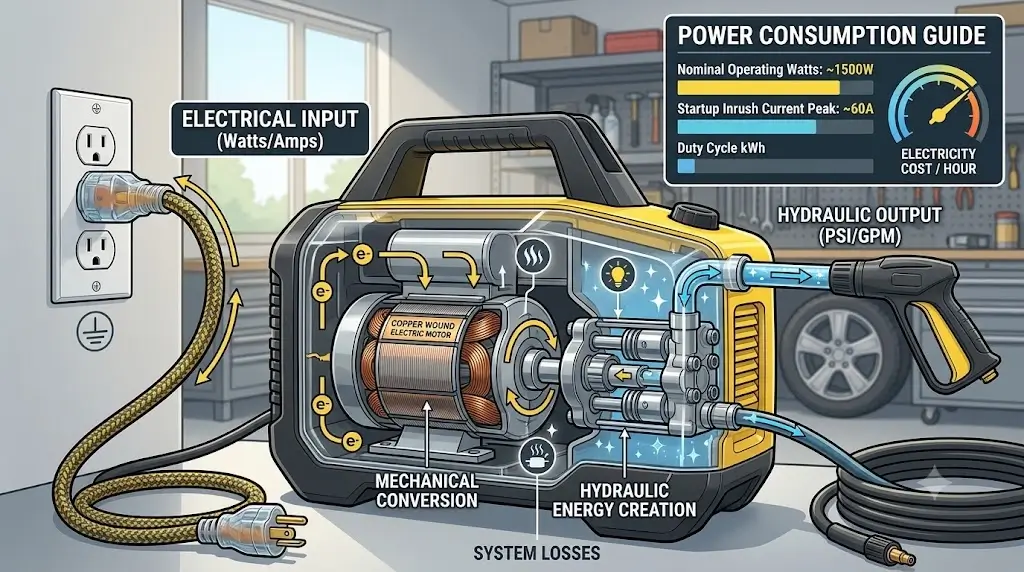
Pressure Washer Power Consumption: The Engineering Model
The complete energy chain can be represented as:
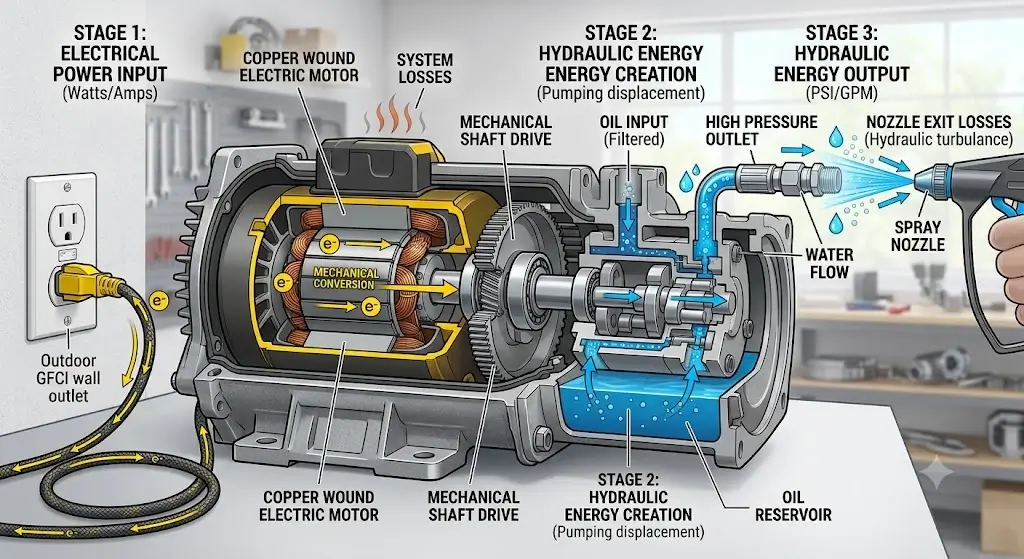
Electrical power enters the motor.
The motor converts electrical energy into mechanical energy.
The pump converts mechanical energy into hydraulic output.
The nozzle converts that hydraulic energy into a controlled high-pressure water stream.
Every conversion stage has losses.
That is why the electrical input wattage is greater than the ideal hydraulic power calculated from PSI and GPM.
What Is the Most Important Power Specification?
For electrical compatibility, amperage and voltage are particularly important.
For energy cost, real watts and runtime are more useful.
For cleaning capability, working PSI and GPM matter more than electrical wattage alone.
| Your Question | Specification to Examine |
|---|---|
| Will it work on my outlet? | Voltage + amperage + circuit requirements |
| How much electricity will it use? | Real watts + runtime |
| How much water will it use? | GPM + trigger time |
| How fast will it clean? | Working PSI + GPM + accessories |
| Can it run for a long job? | Duty cycle + manufacturer instructions |
Pressure Washer Power Consumption: Common Mistakes
Mistake 1: Treating PSI as watts
PSI measures pressure. It is not an electrical power rating.
Mistake 2: Treating peak PSI as working performance
Peak pressure does not necessarily represent sustained cleaning pressure.
Mistake 3: Assuming rated wattage equals average consumption
Actual electrical demand changes with operating conditions.
Mistake 4: Ignoring startup current
Motor startup can create temporary current demand above normal running current.
Mistake 5: Ignoring other circuit loads
A pressure washer is not necessarily the only appliance connected to a household circuit.
Mistake 6: Choosing a generator based only on running watts
Startup characteristics and other loads also matter.
Mistake 7: Using an unsuitable extension cord
Voltage drop can become significant with high-current equipment.
Mistake 8: Assuming more watts automatically means better cleaning
Hydraulic output, efficiency and accessories all affect cleaning performance.
Pressure Washer Power Consumption vs. Water Consumption
A useful comparison is to evaluate both resources together.
| Machine | Example Power | Example Flow | 20-Minute Electricity | 20-Minute Water |
|---|---|---|---|---|
| A | 1,300 W | 1.5 GPM | 0.43 kWh | 30 gal |
| B | 1,500 W | 2.0 GPM | 0.50 kWh | 40 gal |
| C | 1,650 W | 2.5 GPM | 0.55 kWh | 50 gal |
These examples show why a pressure washer cannot be judged by one number.
Higher electrical input may accompany greater hydraulic output, but the value of that additional power depends on the cleaning task.
How to Compare Pressure Washers by Power Efficiency
If you want to compare machines objectively, record:
- Measured real watts.
- Measured working PSI.
- Measured GPM.
- Cleaning time for the same surface.
- Total kWh used.
- Total water used.
Then compare the energy required to complete the same cleaning task.
There is no universal unit for “cleaning task,” so this metric is most useful when comparing the same surface under controlled conditions.
HomeGearMax Bottom Line
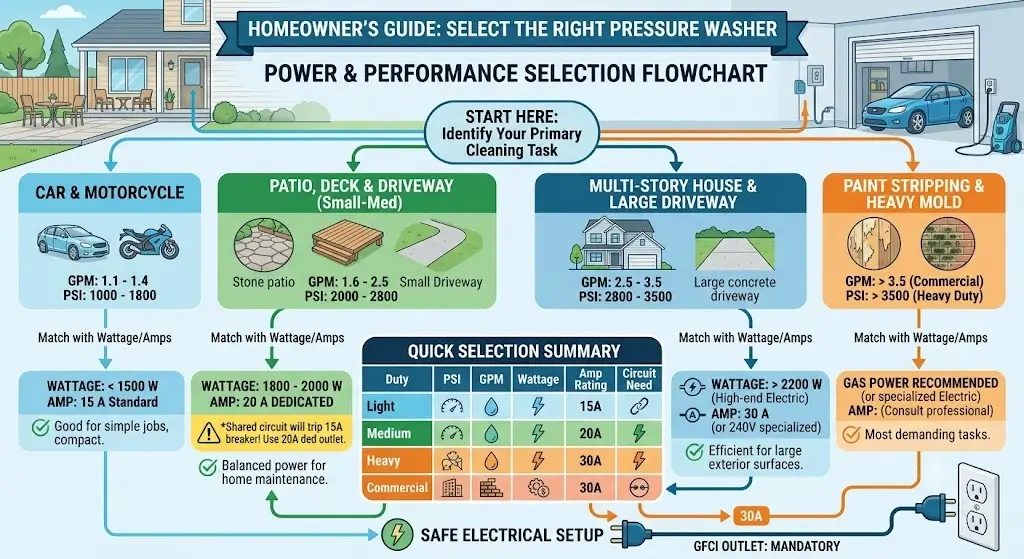
Pressure washer power consumption is best understood through watts, amps, volts, kWh and runtime, not through PSI alone.
For a simplified 120V system:
For electricity consumption:
And for electricity cost:
A 1,500W electric pressure washer operating continuously for 30 minutes would theoretically consume about 0.75 kWh. A 1,650W machine would consume about 0.825 kWh over the same 30-minute period.
But actual consumption depends on the machine’s real operating load, motor cycling, hydraulic load and total runtime.
Pressure Washer Power Consumption FAQ
How much electricity does a pressure washer use?
Electric pressure washer consumption depends on operating watts and runtime. A 1,500W machine running continuously for 30 minutes would theoretically consume 0.75 kWh.
How many watts does a pressure washer use?
Many residential electric pressure washers operate roughly in the 1,200–2,000W range, although actual requirements vary by model. Check the manufacturer’s electrical specifications.
How many amps does a 1,500W pressure washer draw?
At a nominal 120V, a simplified calculation gives 12.5A. Actual AC current can differ because of voltage, motor characteristics and power factor.
How many amps does a 1,650W pressure washer draw?
At 120V, a simple watts-divided-by-volts calculation gives approximately 13.75A. Actual operating current can vary.
How many amps does a 2,000W pressure washer draw?
At 120V, the simplified calculation is approximately 16.7A. A pressure washer at this electrical level requires careful attention to the manufacturer’s specified circuit requirements.
Can a pressure washer run on a 15-amp circuit?
Many consumer models are designed for household circuits, but compatibility depends on the specific pressure washer’s electrical requirements, startup current and the loads already connected to the circuit.
How much does it cost to run an electric pressure washer?
Calculate average real power in kW, multiply by operating hours, then multiply by your electricity rate. For example, 1.5kW for 30 minutes equals 0.75kWh.
Does a pressure washer use electricity when the trigger is released?
Some pressure washers automatically stop or reduce pump operation when the trigger is released. The exact behavior depends on the machine’s control system.
Does a pressure washer use more electricity at higher PSI?
Higher PSI can increase hydraulic power requirements when other variables remain constant, but actual electrical consumption depends on both PSI and GPM as well as motor and pump efficiency.
Does higher GPM require more electricity?
Higher GPM generally increases hydraulic power requirements when pressure is held constant, but actual electrical input varies with pump and motor efficiency.
What is the relationship between PSI, GPM and horsepower?
A commonly used hydraulic approximation is hydraulic horsepower equal to PSI multiplied by GPM divided by 1714. This is hydraulic output, not electrical input.
Is motor horsepower the same as electrical watts?
No. Motor horsepower describes mechanical output or rating, while electrical watts describe electrical input. Motor efficiency and system losses separate the two.
Does a gas pressure washer use electricity?
A conventional gas pressure washer uses gasoline as its primary energy source rather than household electricity, although specific models can contain electrical components.
Can an extension cord affect a pressure washer?
Yes. An unsuitable or excessively long extension cord can create voltage drop and affect motor performance. Follow the manufacturer’s requirements.
Can a portable power station run a pressure washer?
Only if its continuous inverter output, surge capability and battery capacity are sufficient for the pressure washer’s actual electrical requirements. Startup current must also be considered.
How do I measure a pressure washer’s actual power consumption?
A suitable power meter can measure real watts and cumulative kWh for compatible consumer equipment. Professional electrical instrumentation can provide more detailed measurements.
What is more important, watts or PSI?
For electrical compatibility and energy use, watts and amps matter. For cleaning capability, working PSI and GPM are more informative. No single specification describes the entire pressure washer.
Does a higher-wattage pressure washer clean better?
Not automatically. Cleaning performance depends on working PSI, GPM, nozzle design, pump efficiency, accessories and operator technique.
How much electricity does a 1,500W pressure washer use in one hour?
At a constant 1,500W real load, it would consume approximately 1.5kWh in one hour.
How much electricity does a 1,650W pressure washer use in one hour?
At a constant 1,650W real load, it would consume approximately 1.65kWh in one hour.
How much electricity does a 2,000W pressure washer use in one hour?
At a constant 2,000W real load, it would consume approximately 2kWh in one hour. Actual circuit compatibility must be evaluated separately.
