
Pressure Washer Water Consumption: How Many Gallons Does a Pressure Washer Use?
Pressure washers are often described by PSI and GPM, but those numbers answer different questions. PSI describes pressure, while GPM describes water flow.
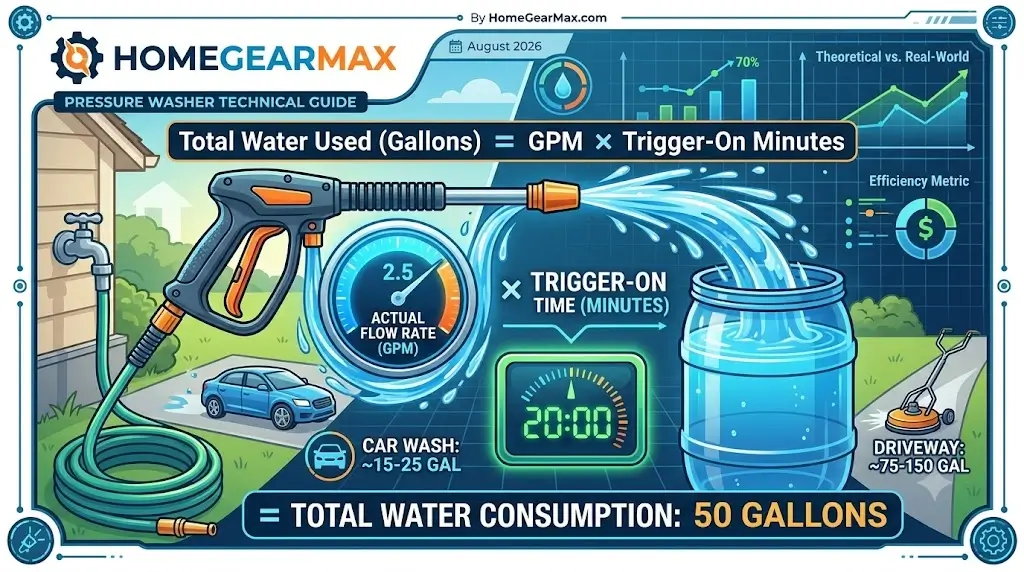
When the question is “How much water does a pressure washer use?”, GPM is the starting point. The second variable is operating time.
This distinction matters because a pressure washer rated at 3 GPM does not necessarily consume 180 gallons every time it is used for one hour. If the operator runs the trigger for only 20 minutes during that hour, water consumption is based primarily on those 20 minutes of actual flow.
How Much Water Does a Pressure Washer Use?
A pressure washer can use anywhere from roughly 1–5+ gallons per minute, depending on the machine, pump, nozzle configuration, and operating conditions.
Compact electric pressure washers commonly operate at lower flow rates, while larger gas-powered and professional machines move substantially more water.
The simplest way to estimate consumption is to multiply actual GPM by actual trigger-on time.
| Pressure Washer Flow | 5 Minutes | 10 Minutes | 20 Minutes | 30 Minutes | 60 Minutes |
|---|---|---|---|---|---|
| 1.0 GPM | 5 gal | 10 gal | 20 gal | 30 gal | 60 gal |
| 1.5 GPM | 7.5 gal | 15 gal | 30 gal | 45 gal | 90 gal |
| 2.0 GPM | 10 gal | 20 gal | 40 gal | 60 gal | 120 gal |
| 2.5 GPM | 12.5 gal | 25 gal | 50 gal | 75 gal | 150 gal |
| 3.0 GPM | 15 gal | 30 gal | 60 gal | 90 gal | 180 gal |
| 4.0 GPM | 20 gal | 40 gal | 80 gal | 120 gal | 240 gal |
| 5.0 GPM | 25 gal | 50 gal | 100 gal | 150 gal | 300 gal |
These numbers assume continuous trigger operation at the stated flow rate. Actual consumption during a cleaning job can be considerably lower.
Why GPM Determines Pressure Washer Water Consumption
GPM is the most important specification when estimating water consumption because it directly describes flow volume.
A 2-GPM machine theoretically moves twice as much water per minute as a 1-GPM machine. A 4-GPM machine moves twice as much water as a 2-GPM machine under equivalent flow conditions.
Pressure
PSI describes pressure. It helps determine spray force and surface impact, but it does not directly tell you how many gallons of water the machine consumes.
Flow
GPM describes water volume. It is the primary pressure-washer specification used to calculate water consumption.
This is why two machines with similar PSI ratings can have very different water consumption if their GPM ratings differ.
Pressure Washer Water Consumption Chart
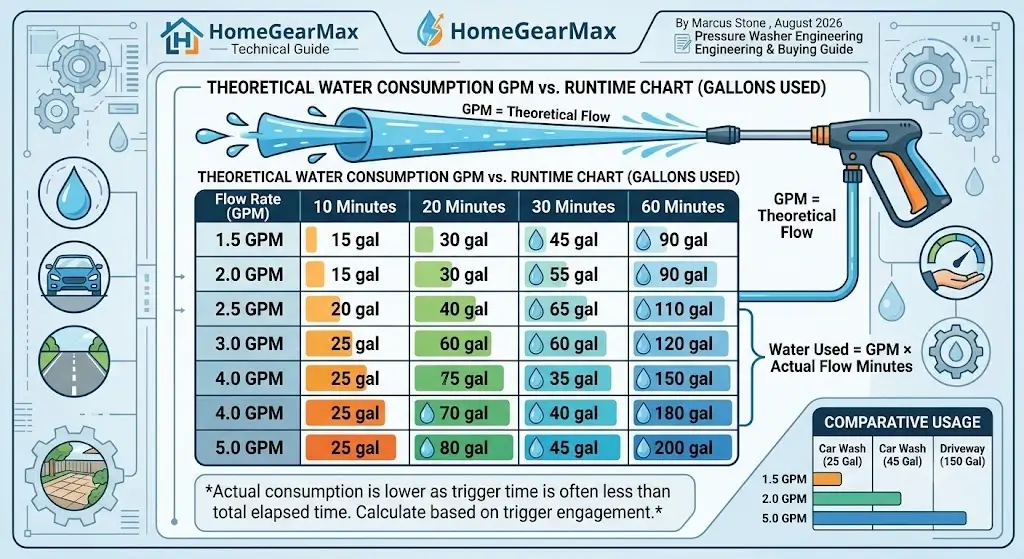
The following chart shows theoretical water consumption during continuous trigger operation.
| GPM | Gallons / 5 min | Gallons / 10 min | Gallons / 15 min | Gallons / 30 min | Gallons / hour |
|---|---|---|---|---|---|
| 1.0 | 5 | 10 | 15 | 30 | 60 |
| 1.5 | 7.5 | 15 | 22.5 | 45 | 90 |
| 2.0 | 10 | 20 | 30 | 60 | 120 |
| 2.5 | 12.5 | 25 | 37.5 | 75 | 150 |
| 3.0 | 15 | 30 | 45 | 90 | 180 |
| 3.5 | 17.5 | 35 | 52.5 | 105 | 210 |
| 4.0 | 20 | 40 | 60 | 120 | 240 |
| 5.0 | 25 | 50 | 75 | 150 | 300 |
How to Calculate Pressure Washer Water Consumption
The calculation is straightforward.
Example 1: 2 GPM machine
If a 2-GPM pressure washer runs continuously for 15 minutes:
Example 2: 3 GPM machine
A 3-GPM pressure washer running for 25 minutes:
Example 3: 4 GPM machine
A 4-GPM machine running for 18 minutes:
The same formula works regardless of machine size.
How Much Water Does a Pressure Washer Use Per Hour?
If the trigger remains engaged continuously, multiply GPM by 60.
| GPM | Theoretical Gallons per Hour |
|---|---|
| 1.5 GPM | 90 gallons/hour |
| 2.0 GPM | 120 gallons/hour |
| 2.5 GPM | 150 gallons/hour |
| 3.0 GPM | 180 gallons/hour |
| 4.0 GPM | 240 gallons/hour |
| 5.0 GPM | 300 gallons/hour |
These figures should not be interpreted as typical water consumption for a complete homeowner cleaning session. They represent continuous flow for a full hour.
How Much Water Does a Pressure Washer Use to Wash a Car?
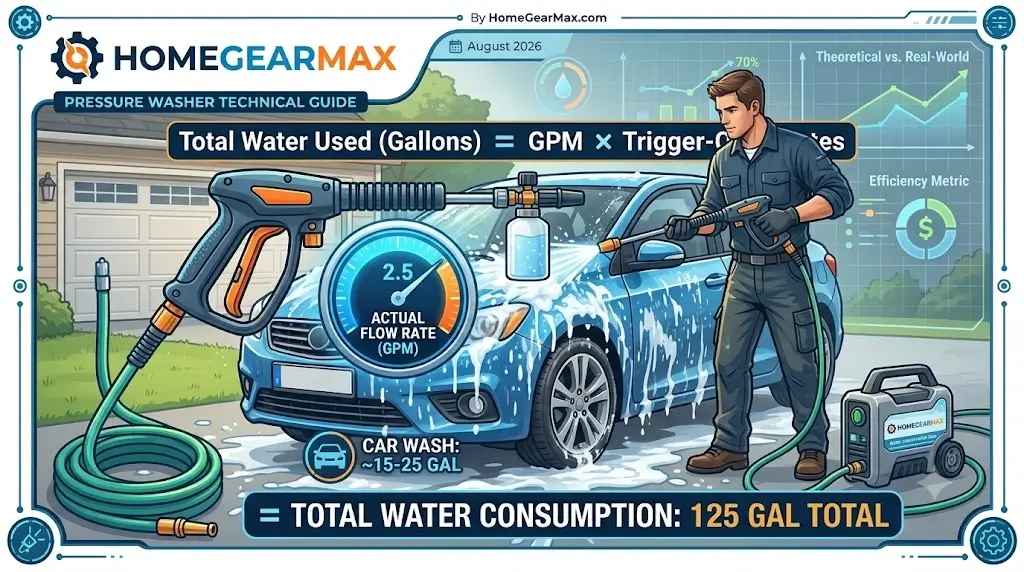
Vehicle washing usually requires substantially less water than large concrete cleaning because the total surface area is relatively small.
A useful way to estimate consumption is to calculate trigger-on time rather than the entire time spent washing.
| Machine | 10 Min Trigger Time | 15 Min Trigger Time | 20 Min Trigger Time |
|---|---|---|---|
| 1.5 GPM | 15 gal | 22.5 gal | 30 gal |
| 2.0 GPM | 20 gal | 30 gal | 40 gal |
| 2.5 GPM | 25 gal | 37.5 gal | 50 gal |
| 3.0 GPM | 30 gal | 45 gal | 60 gal |
Actual water use varies with washing technique, foam-cannon use, trigger time, and how much rinsing is performed.
How Much Water Does a Pressure Washer Use to Clean a Driveway?
Driveway cleaning can consume considerably more water because concrete areas are large and often require repeated passes.
Suppose a 3-GPM pressure washer has a trigger-on time of 30 minutes:
If the same machine is operated for 45 minutes of actual trigger time:
A larger 4-GPM machine would use more water during equivalent trigger-on time:
The higher-flow machine may nevertheless finish the job faster. This creates an important distinction between water consumed per minute and water consumed per completed job.
How Much Water Does a Pressure Washer Use to Wash a House?
House washing can involve a large amount of exterior surface, but actual water consumption depends heavily on technique.
Many house-washing processes use detergent followed by a rinse. The pressure washer may therefore spend significant time flowing water during the rinse stage.
A 2-GPM machine running for 30 minutes of trigger time theoretically uses:
A 3-GPM machine running for the same 30 minutes uses:
However, if the 3-GPM machine reduces the required trigger time to 20 minutes:
These examples illustrate why comparing GPM alone does not tell you how much water a completed job will consume.
How Much Water Does a Pressure Washer Use on a Patio?
Patio water consumption depends on size, contamination, pressure, flow rate, and whether a surface cleaner is used.
For example, a 2.5-GPM machine with 20 minutes of trigger time uses approximately:
A 3.5-GPM machine with 15 minutes of trigger time uses:
In this example, the higher-flow machine consumes nearly the same total water because it completes the cleaning process in less trigger time.
How Much Water Does a Pressure Washer Use on a Deck?
Deck cleaning usually requires careful pressure management. Water consumption is often less important than preventing surface damage.
Wood can be damaged by excessive pressure or an overly concentrated spray, so increasing GPM should not be treated as permission to increase pressure indiscriminately.
For many residential deck-cleaning jobs, moderate flow combined with appropriate pressure and nozzle technique is more useful than maximum GPM.
Do Surface Cleaners Use More Water?
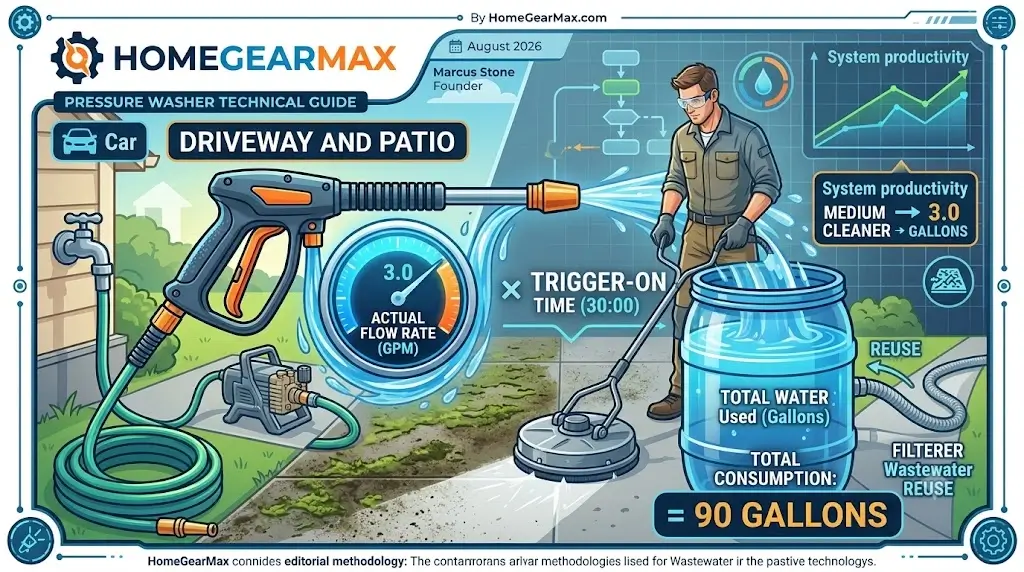
A surface cleaner does not inherently consume more water simply because it is a surface cleaner. Water consumption is primarily determined by the flow rate of the pressure washer and how long the attachment is operating.
However, larger surface cleaners are commonly paired with higher-flow machines, which can increase total gallons used per minute.
Example
| System | GPM | 30-Minute Trigger Use |
|---|---|---|
| Small residential cleaner | 2.0 | 60 gallons |
| Medium cleaner | 3.0 | 90 gallons |
| High-flow cleaner | 4.0 | 120 gallons |
A higher-flow system can still use fewer gallons per completed job if its greater productivity significantly reduces cleaning time.
Do Electric Pressure Washers Use Less Water?
Not automatically.
Electric pressure washers often use less water because many consumer electric models have lower GPM ratings than larger gas-powered machines. The motor being electric does not inherently make water consumption lower.
A 3-GPM electric pressure washer and a 3-GPM gas pressure washer would theoretically consume the same amount of water at the same actual flow rate and trigger-on time.
Do Gas Pressure Washers Use More Water?
Many gas pressure washers do use more water because they are commonly designed for higher GPM.
Professional gas machines may operate around 3–5 GPM or more, while compact electric machines frequently operate at lower flow rates.
This is not a universal rule. Water consumption should always be calculated from the machine’s actual flow rate.
Can Your Outdoor Faucet Supply Enough Water?
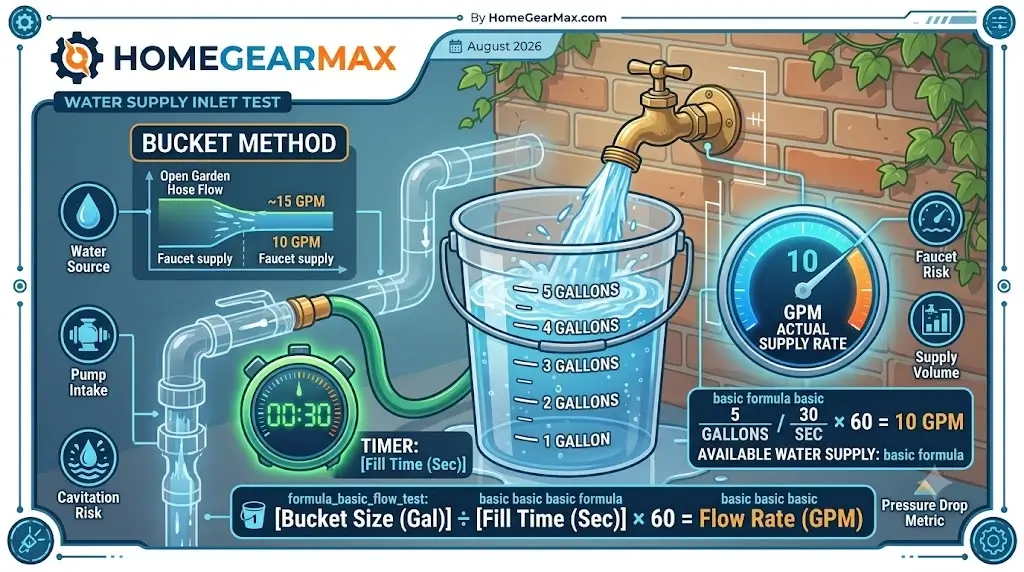
One of the most overlooked aspects of pressure washer operation is the inlet supply.
A pressure washer cannot reliably deliver its rated flow if the incoming water source cannot supply enough water.
For example, a pressure washer designed around 4 GPM needs an inlet supply capable of keeping up with that demand under operating conditions.
Why water starvation matters
Pressure washer pumps are designed to receive a continuous supply of water. An inadequate inlet supply can cause unstable operation and may contribute to pump damage.
Basic water-supply test
- Use a container with a known capacity.
- Open the faucet fully.
- Measure the time required to fill the container.
- Calculate gallons per minute.
This provides a rough field estimate. Water pressure and flow can change under load, so it should not be treated as a laboratory measurement.
How Much Does Pressure-Washer Water Cost?
Water cost depends on local utility rates. The calculation is simple once you know the price per gallon or the applicable water and sewer rate structure.
If a hypothetical utility rate were $0.01 per gallon and a cleaning job consumed 100 gallons:
Real U.S. utility billing is often more complicated than a single flat gallon price because water and wastewater charges may use tiers, minimum charges, or other billing structures.
Does Pressure Washing Use More Water Than a Garden Hose?
It depends on the flow rate of the hose and pressure washer.
A conventional garden hose can have a surprisingly high flow rate when connected to a strong water supply. A pressure washer may use less water per minute while delivering much higher pressure at the nozzle.
This is one reason pressure washers can be effective without necessarily using huge quantities of water.
The relevant comparison is actual gallons used during the job, not simply the visual intensity of the spray.
Why Pressure Washers Can Be Water-Efficient
Pressure washing concentrates hydraulic energy through a small nozzle or controlled spray system.
Instead of moving a large volume of low-pressure water over a surface, the pressure washer converts available pump power into a high-pressure spray.
This can make the cleaning process more productive than using an unrestricted hose for some applications. Water efficiency, however, depends on operator technique and equipment selection.
How to Reduce Pressure Washer Water Consumption
1. Use the lowest practical GPM
If you only wash vehicles, there is little reason to choose a 4-GPM machine.
2. Use detergent intelligently
Proper chemistry reduces the mechanical work required to loosen contamination.
3. Reduce idle trigger time
Release the trigger while repositioning or changing working areas.
4. Use the correct nozzle
A nozzle with an appropriate orifice and spray pattern uses hydraulic output effectively.
5. Use a properly sized surface cleaner
The right surface cleaner increases cleaning productivity and eliminates unnecessary passes.
6. Keep the spray moving
Dwelling unnecessarily in one location wastes water without improving cleaning.
7. Maintain the equipment
A properly maintained pump and nozzle system preserves predictable operating performance.
8. Measure actual trigger time
If water consumption matters, a timer provides more useful information than recording total elapsed time on the property.
Does Hose Length Affect Water Consumption?
Hose length can affect pressure and flow through friction losses.
A longer hose does not automatically mean that a machine will consume dramatically less water. The actual effect depends on hose diameter, length, flow rate, fittings, and system configuration.
At a given pump operating condition, restrictions can alter the flow delivered to the working end.
Higher-flow systems are more sensitive to restrictions
As flow increases, hydraulic friction losses become more significant. This is one reason high-GPM professional systems commonly use appropriately sized hoses and fittings.
Rated GPM vs. Real-World Water Consumption
Manufacturer-rated GPM should not automatically be treated as an independently measured value across every operating condition.
Pressure washers can be specified using different testing conditions, nozzle configurations, and measurement points.
| Specification Type | Meaning | Use for Water Estimates |
|---|---|---|
| Manufacturer-rated GPM | Published specification | Good starting point |
| Measured GPM | Flow measured under stated conditions | Better for precise comparisons |
| Estimated GPM | Derived from available information | Useful when clearly labeled |
| Trigger-on GPM | Flow during actual operation | Most useful for job consumption |
For accurate water-use analysis, the most important number is the actual flow occurring while the trigger is engaged.
Why Pressure Washer Trigger Time Matters
A pressure washer may be running for an hour without flowing water continuously.
Modern pressure washers utilize trigger-controlled systems or automatic pump-control technologies that unload or stop the pump when the trigger is released.
Machine electrical or engine runtime should not automatically be interpreted as equivalent to water-flow runtime.
Total Stop Systems and Water Consumption
Many pressure washers use a form of automatic pump control (Total Stop System) that stops or unloads the pump when the spray-gun trigger is released.
When the pump is not actively moving water through the spray system, the machine does not consume water at its rated GPM.
This makes the difference between theoretical continuous-flow consumption and actual job consumption substantial.
Pressure Washer Water Consumption vs. Cleaning Speed
The lowest GPM machine is not always the most water-efficient choice for a completed job.
Consider two hypothetical machines:
| Specification | Machine A | Machine B |
|---|---|---|
| Flow | 2 GPM | 3 GPM |
| Trigger time | 40 minutes | 25 minutes |
| Total water | 80 gallons | 75 gallons |
The higher-flow machine uses more water every minute, but it completes the hypothetical job using fewer total gallons because it requires substantially less trigger time.
Water Consumption and Cleaning Units
Cleaning Units are commonly calculated:
CU helps explain why higher-flow pressure washers produce greater cleaning productivity when pressure is also sufficient.
However, CU is not a water-efficiency measurement. A machine with greater CU may clean faster, but whether it consumes more or less water for the entire job depends on total required trigger time.
Does Higher PSI Reduce Water Consumption?
Not directly.
PSI and GPM are separate variables. A higher-pressure machine can have lower, similar, or higher GPM depending on its design.
Higher PSI may improve cleaning capability for certain applications, but it does not automatically mean the machine uses less water. If water consumption is the question, start with actual flow and trigger time.
Does a Foam Cannon Save Water?
A foam cannon improves detergent application, but it does not automatically reduce total water consumption.
The water used by the pressure washer during foam application depends on the system’s actual flow rate and trigger-on duration.
The potential water-saving benefit comes indirectly if better chemical application reduces overall mechanical cleaning time and high-pressure rinsing.
Does a Surface Cleaner Save Water?
A surface cleaner improves productivity on large flat surfaces because it cleans a wider path in each pass.
Whether it saves water depends on the difference between its flow rate and the reduction in trigger-on time. If the attachment requires more flow but cuts cleaning time by a greater proportion, total water consumption declines.
Are Pressure Washers Environmentally Friendly?
A pressure washer’s environmental impact depends on more than water consumption:
- Total water consumption.
- Electricity consumption.
- Fuel consumption for gas machines.
- Detergent and chemical runoff.
- Wastewater disposal.
- Surface contamination being removed.
- Local water availability.
A lower-GPM pressure washer reduces water consumption per minute, but a very slow machine may require much longer trigger time. Likewise, a high-GPM machine consumes more water per minute while completing a large job faster.
Can You Reuse Pressure Washer Water?
Reusing pressure-washer wastewater is not as simple as collecting it and feeding it back into the pump.
Used water contains dirt, oils, detergents, metals, and other contaminants removed from the surface. Reusing contaminated water requires appropriate filtration and treatment, and local environmental rules apply to disposal and collection.
For ordinary residential pressure washing, the safer approach is to follow local requirements for runoff and wastewater management rather than attempting reuse.
Pressure Washer Water Consumption by Job
| Job | Example GPM | Example Trigger Time | Theoretical Water |
|---|---|---|---|
| Car wash | 1.5 GPM | 15 min | 22.5 gal |
| Small patio | 2.0 GPM | 20 min | 40 gal |
| Deck | 2.0 GPM | 20 min | 40 gal |
| House rinse | 2.5 GPM | 30 min | 75 gal |
| Driveway | 3.0 GPM | 30 min | 90 gal |
| Large driveway | 4.0 GPM | 45 min | 180 gal |
These are illustrative calculations, not universal consumption figures. Actual trigger time can vary substantially between operators and surfaces.
Water Consumption by Specific GPM Ratings
How Much Water Does a 1.5 GPM Pressure Washer Use?
- 7.5 gallons in 5 minutes.
- 15 gallons in 10 minutes.
- 22.5 gallons in 15 minutes.
- 30 gallons in 20 minutes.
- 45 gallons in 30 minutes.
- 90 gallons in one hour.
How Much Water Does a 2 GPM Pressure Washer Use?
- 10 gallons in 5 minutes.
- 20 gallons in 10 minutes.
- 30 gallons in 15 minutes.
- 40 gallons in 20 minutes.
- 60 gallons in 30 minutes.
- 120 gallons in one hour.
How Much Water Does a 2.5 GPM Pressure Washer Use?
- 12.5 gallons in 5 minutes.
- 25 gallons in 10 minutes.
- 37.5 gallons in 15 minutes.
- 50 gallons in 20 minutes.
- 75 gallons in 30 minutes.
- 150 gallons in one hour.
How Much Water Does a 3 GPM Pressure Washer Use?
- 15 gallons in 5 minutes.
- 30 gallons in 10 minutes.
- 45 gallons in 15 minutes.
- 60 gallons in 20 minutes.
- 90 gallons in 30 minutes.
- 180 gallons in one hour.
How Much Water Does a 4 GPM Pressure Washer Use?
- 20 gallons in 5 minutes.
- 40 gallons in 10 minutes.
- 60 gallons in 15 minutes.
- 80 gallons in 20 minutes.
- 120 gallons in 30 minutes.
- 240 gallons in one hour.
How Much Water Does a 5 GPM Pressure Washer Use?
- 25 gallons in 5 minutes.
- 50 gallons in 10 minutes.
- 75 gallons in 15 minutes.
- 100 gallons in 20 minutes.
- 150 gallons in 30 minutes.
- 300 gallons in one hour.
Five-GPM equipment is generally intended for commercial applications where high cleaning productivity justifies the greater water flow.
Pressure Washer Water-Use Calculator
You can calculate theoretical water consumption with three pieces of information:
- Actual GPM.
- Total trigger-on minutes.
- Local water/sewer rate if you want to estimate cost.
Pressure washer = 2.5 GPM
Trigger-on time = 24 minutes
The estimated water consumption is approximately 60 gallons.
For multiple cleaning stages
If you use different flow rates during different stages, calculate each stage separately:
This is more accurate than multiplying one headline GPM by the total time spent on the property.
What GPM Should You Buy If Water Consumption Matters?
| Primary Use | GPM Range to Consider | Water-Use Priority |
|---|---|---|
| Cars and detailing | 1.2–2.0 GPM | Moderate flow and control |
| General homeowner cleaning | 1.5–2.5 GPM | Balanced productivity |
| Patios and decks | 1.5–2.5 GPM | Efficient rinsing |
| Driveways | 2.5–4.0 GPM | Productivity vs. water use |
| Large concrete areas | 3.0–5.0+ GPM | High throughput |
These are starting ranges rather than hard requirements. Always match the machine to the surface, accessory specifications, and available water supply.
Low GPM vs. High GPM: Which Uses Less Water?
| Factor | Low GPM | High GPM |
|---|---|---|
| Gallons per minute | Lower | Higher |
| Water use during continuous operation | Lower | Higher |
| Large-area rinsing | Slower | Usually faster |
| Water-supply requirement | Lower | Higher |
| Potential productivity | Lower | Higher |
| Gallons per completed job | Depends on actual trigger time | |
This is the key distinction that many simple pressure washer comparisons miss.
The Most Water-Efficient Pressure Washing Strategy
Water efficiency is not achieved simply by choosing the smallest pressure washer. A more effective strategy matches equipment to the cleaning task:
- Use adequate—not excessive—GPM.
- Use appropriate pressure for the surface.
- Use the correct nozzle orifice and pattern.
- Use suitable detergent when appropriate.
- Use a properly sized surface cleaner on large flat concrete.
- Avoid unnecessary trigger-on time.
- Maintain the pump and spray equipment.
- Verify the inlet water supply.
- Measure actual water use when consumption is important.
Pressure Washer Water Consumption: The Engineering View
Water consumption is fundamentally a flow problem.
The pressure washer pump converts mechanical energy into hydraulic energy. The nozzle then controls and shapes the water flow.
The amount of water leaving the system depends on the operating conditions of that hydraulic system. GPM is therefore the most direct specification for calculating water consumption, while PSI explains the pressure applied to the surface.
Why “Gallons Per Hour” Can Be Misleading
Pressure washer manufacturers sometimes discuss gallons per hour, but this number can be misleading if presented without explaining that it assumes continuous flow.
A 3-GPM machine theoretically consumes 180 gallons per hour. That does not mean a homeowner will use 180 gallons during a one-hour cleaning session.
If the trigger is engaged for only 20 minutes:
The remaining 40 minutes include setup, repositioning, detergent dwell time, and nozzle changes where the machine is not actively flowing water.
Pressure Washer Water Consumption and Duty Cycle
Water consumption and duty cycle are related but distinct concepts.
Water consumption describes how much water moves through the system.
Duty cycle describes how long equipment can operate under specified conditions before thermal or mechanical limits become critical.
A pressure washer can have a high GPM rating but still require operating intervals appropriate to its motor and pump design.
Pressure Washer Water Consumption Checklist
- Find the machine’s actual or rated GPM.
- Determine approximate trigger-on time.
- Multiply GPM by trigger-on minutes.
- Check whether the water source can supply the required flow.
- Account for different flow rates during different stages.
- Check hose and fitting restrictions.
- Match surface cleaners to machine output.
- Consider total gallons per completed job, not only GPM.
- Use local utility rates for cost calculations.
- Follow local requirements for wastewater and runoff.
Pressure Washer Water Consumption FAQ
How many gallons of water does a pressure washer use?
A pressure washer’s water consumption depends primarily on GPM and trigger-on time. A 2-GPM machine uses approximately 20 gallons during 10 minutes of continuous flow, while a 4-GPM machine uses approximately 40 gallons.
How much water does a 2 GPM pressure washer use?
A 2-GPM pressure washer theoretically uses 20 gallons in 10 minutes, 40 gallons in 20 minutes, 60 gallons in 30 minutes, and 120 gallons in one hour of continuous flow.
How much water does a 3 GPM pressure washer use?
A 3-GPM pressure washer theoretically uses 30 gallons in 10 minutes, 60 gallons in 20 minutes, 90 gallons in 30 minutes, and 180 gallons in one hour of continuous flow.
How much water does a 4 GPM pressure washer use?
A 4-GPM pressure washer theoretically uses 40 gallons in 10 minutes, 80 gallons in 20 minutes, 120 gallons in 30 minutes, and 240 gallons in one hour of continuous flow.
How much water does a pressure washer use to wash a car?
There is no universal number. Calculate actual GPM multiplied by trigger-on time. For example, a 1.5-GPM machine running for 15 minutes uses 22.5 gallons.
How much water does a pressure washer use to clean a driveway?
Driveway consumption varies with size, equipment, and technique. For example, a 3-GPM machine with 30 minutes of trigger-on time uses 90 gallons.
Does a pressure washer use less water than a garden hose?
It can. Pressure washers often operate at lower flow rates than an unrestricted garden hose while producing substantially higher pressure. Actual consumption depends on the flow rate of both systems.
Does higher PSI mean less water usage?
No. PSI and GPM measure different properties. Water consumption is calculated from actual GPM and trigger-on time.
Does higher GPM always use more water?
Higher GPM uses more water per minute, but not necessarily more water per completed job. A higher-flow machine can finish a job faster and use similar or fewer total gallons.
How do I calculate pressure washer water consumption?
Multiply actual flow in GPM by the number of minutes the trigger is actively flowing water (Water Used = GPM × Trigger-On Minutes).
Can my faucet supply a 4 GPM pressure washer?
It depends on available supply flow. Test the faucet or verify plumbing specifications rather than assuming an outdoor faucet can provide 4 GPM continuously.
Does a surface cleaner use more water?
Water consumption is determined by the pressure washer’s flow and trigger-on time. A larger cleaner may be paired with a higher-flow machine, but faster cleaning offsets additional gallons per minute.
Are electric pressure washers more water efficient?
Not inherently. Electric models often use less water because consumer electric units typically have lower GPM ratings, but consumption is governed by actual flow rate.
Do gas pressure washers use more water?
Many gas units use more water because they are designed for higher GPM. The actual amount depends entirely on operating flow rate.
How much water does a 5 GPM pressure washer use?
At continuous flow, a 5-GPM pressure washer uses 25 gallons in 5 minutes, 50 gallons in 10 minutes, 150 gallons in 30 minutes, and 300 gallons in one hour.
Can a pressure washer use too much water for a residential faucet?
Yes. A pressure washer can demand more inlet flow than household plumbing reliably provides. High-GPM machines must be matched to an adequate supply.
How can I reduce pressure washer water consumption?
Use appropriate GPM, minimize idle trigger time, select the correct nozzle, use suitable detergent, and maintain equipment properly.
Is gallons per hour the same as actual water consumption?
Only when water flows continuously for the entire hour. Real-world water consumption is based on actual trigger-on time.
Final Verdict: How Much Water Does a Pressure Washer Really Use?
The answer starts with one number: GPM.
Multiply the machine’s actual flow rate by the time water is actively flowing for a practical estimate:
A 1.5-GPM pressure washer uses about 15 gallons during 10 minutes of continuous flow; a 2-GPM machine uses about 20 gallons; a 3-GPM machine uses about 30 gallons; and a 4-GPM machine uses about 40 gallons.
However, higher-GPM machines complete large jobs in substantially less time, making gallons per completed job the key metric when evaluating water efficiency.
For cars and light residential work, a lower-flow pressure washer provides an efficient balance. For driveways, patios, and large concrete surfaces, higher GPM improves productivity and reduces total cleaning time.
