
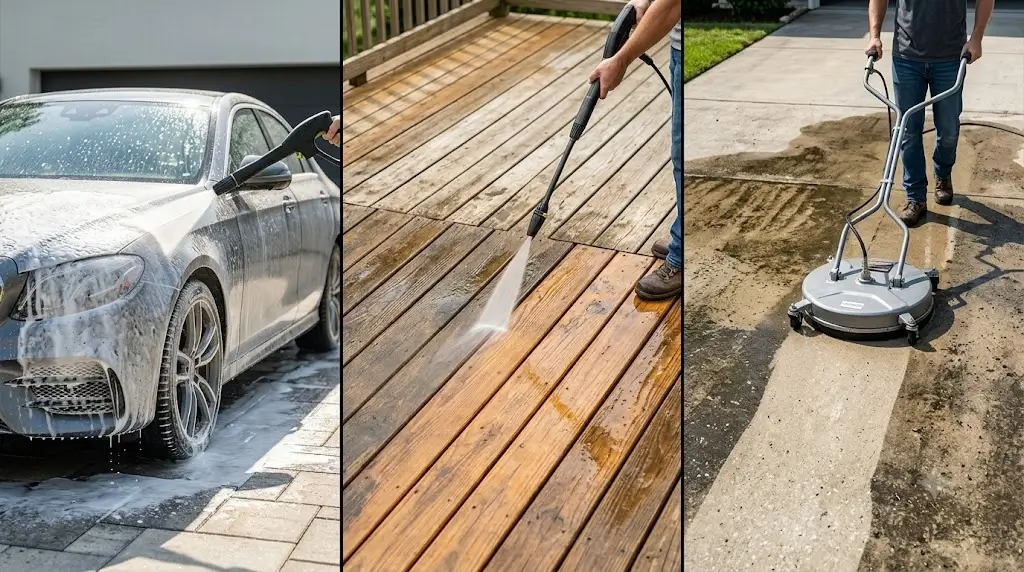
What PSI Do You Need? Pressure Washer PSI Guide by Cleaning Job
PSI means pounds per square inch. On a pressure washer, it describes the pressure generated by the water system under a specified operating condition. It is one of the most visible specifications on a pressure washer, but it is also one of the most misunderstood.
A machine advertised as “4,000 PSI” is not automatically a better choice than a 2,000-PSI machine. The correct PSI depends on what you are cleaning, what material the surface is made from, how dirty it is, what nozzle you use, how far the spray is held from the surface, and how much water the pump moves.
Using too little pressure can make a job unnecessarily slow. Using too much pressure can damage paint, wood, mortar joints, siding, coatings or other surfaces. The goal is therefore not maximum pressure. The goal is enough effective pressure to remove the contamination without damaging the substrate.
What Does PSI Mean on a Pressure Washer?
PSI stands for pounds per square inch. It is a pressure measurement describing the force exerted by water over an area.
Pressure is not the same thing as cleaning power. A pressure washer’s cleaning performance depends on both pressure and flow, along with nozzle geometry and the way the water is applied to the surface.
Think of PSI as the pressure available to drive the water through the nozzle and against the surface. GPM, meanwhile, tells you how much water is moving through the system.
Pressure
Describes the pressure available in the water system and influences the force concentrated through the spray nozzle.
Flow
Describes how much water the machine moves per minute and strongly affects rinsing and large-area productivity.
That distinction becomes critical when comparing pressure washers. A 3,000-PSI machine producing 1.5 GPM is not hydraulically equivalent to a 3,000-PSI machine producing 3.0 GPM.
PSI vs. GPM: Which One Matters More?
Neither PSI nor GPM should be evaluated in isolation.
PSI is useful for understanding pressure. GPM is useful for understanding water volume and productivity.
Pressure helps loosen contamination, while pressure washer flow rate (GPM) supplies the water needed to rinse and transport loosened material away. This is especially important when cleaning large surfaces such as driveways, patios and commercial concrete.
| Pressure Washer | PSI | GPM | Simple CU | What the Numbers Suggest |
|---|---|---|---|---|
| A | 2,000 | 2.0 | 4,000 | Moderate pressure and moderate flow |
| B | 2,500 | 2.0 | 5,000 | More pressure at the same flow |
| C | 2,500 | 3.0 | 7,500 | Higher pressure and substantially more flow |
The CU column is calculated as PSI × GPM and can be useful for comparing hydraulic specifications. It should not be treated as a complete laboratory measure of cleaning performance.
Working PSI vs. Peak PSI: The Number You Should Actually Compare
Pressure washer specifications can contain several pressure numbers. This is where shopping gets confusing.
Peak or maximum PSI
Peak PSI generally refers to the maximum pressure a machine or pump can produce under specified conditions. It is often the larger number used in marketing.
Rated or working PSI
Working pressure describes the pressure associated with the machine’s normal operating specification. Depending on the manufacturer, terminology may include rated pressure, operating pressure or working pressure.
The exact definitions vary by manufacturer, so the owner’s manual and technical specifications for the specific model should take priority.
Why the distinction matters
A pressure washer advertised at 4,000 PSI may have a lower rated operating pressure. Another machine advertised at 2,800 PSI may provide a similar or stronger real-world cleaning result if its working pressure, GPM, pump efficiency and nozzle system are better matched to the job.
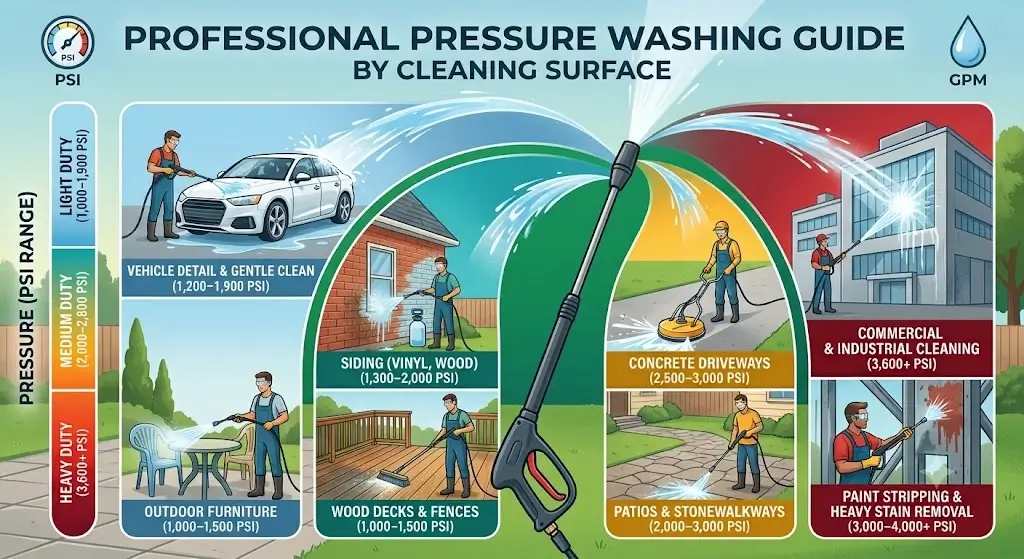
What PSI Do You Need? Quick PSI Chart by Cleaning Job
The following table is a practical starting point for common residential pressure-washing jobs. It is not a substitute for the surface manufacturer’s instructions or the pressure washer manufacturer’s specifications.
| Cleaning Job | Practical PSI Range | Typical Starting Point | Important Consideration |
|---|---|---|---|
| Car / vehicle | 1,200–2,000 PSI | 1,500 PSI | Use a wider-angle nozzle and appropriate distance. |
| Outdoor furniture | 1,000–1,500 PSI | 1,200 PSI | Material varies widely. |
| Wood deck | 1,000–1,500 PSI | 1,200 PSI | Wood species, condition and grain matter. |
| Wood fence | 1,000–1,500 PSI | 1,200 PSI | Avoid concentrated spray and surface gouging. |
| Vinyl siding | 1,300–2,000 PSI | 1,500 PSI | Use appropriate distance and avoid forcing water behind panels. |
| Brick | 1,500–2,500 PSI | 1,800 PSI | Mortar condition matters. |
| Patio | 2,000–3,000 PSI | 2,500 PSI | Surface material determines safe pressure. |
| Concrete driveway | 2,500–3,500 PSI | 3,000 PSI | Use a suitable nozzle or surface cleaner. |
| Heavy concrete | 3,000–4,000+ PSI | 3,000 PSI | High pressure can damage weak or deteriorated concrete. |
What PSI Do You Need to Wash a Car?
For most passenger vehicles, a pressure washer around 1,200–2,000 PSI is sufficient when used correctly. You generally do not need a 3,000–4,000 PSI machine simply because it is available.
Vehicle paint and clear coat are not improved by excessive pressure. The objective is to remove loose dirt, road film and detergent without concentrating excessive force on the finish, trim, seals or damaged areas.
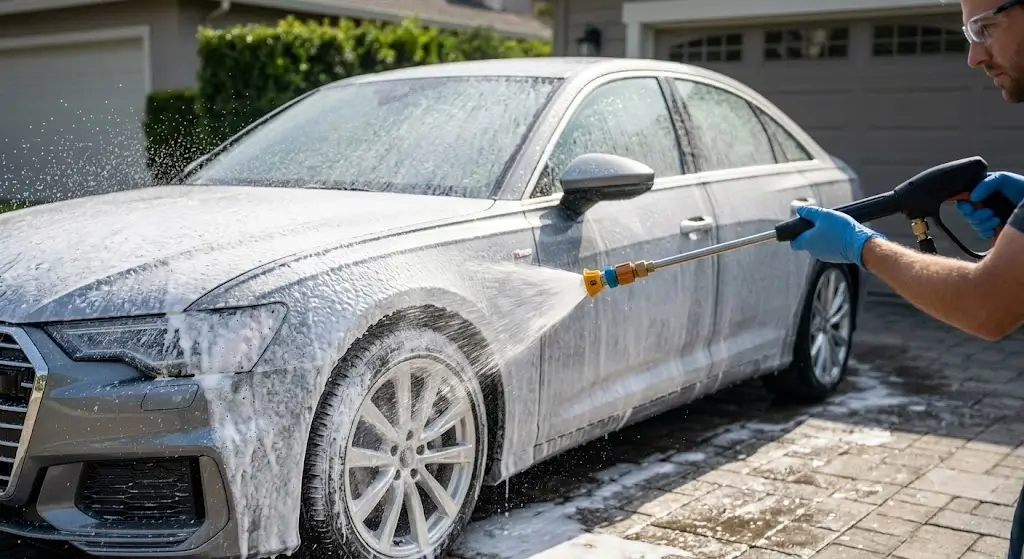
A good starting setup
- Approximately 1,200–2,000 PSI
- Wide spray pattern
- Reasonable spray distance
- Clean, undamaged nozzle
- Appropriate car-wash detergent
- Pre-rinse before making close passes
When lower pressure is better
Use extra caution around chipped paint, damaged clear coat, loose trim, decals, weatherstripping, convertible tops and previously repaired areas.
What PSI Do You Need to Clean a Driveway?
Concrete driveways generally tolerate considerably more pressure than automotive paint or soft wood. For typical residential concrete, approximately 2,500–3,500 PSI is a practical range to consider.
A machine around 3,000 PSI with useful GPM is often a strong homeowner configuration for driveway cleaning.
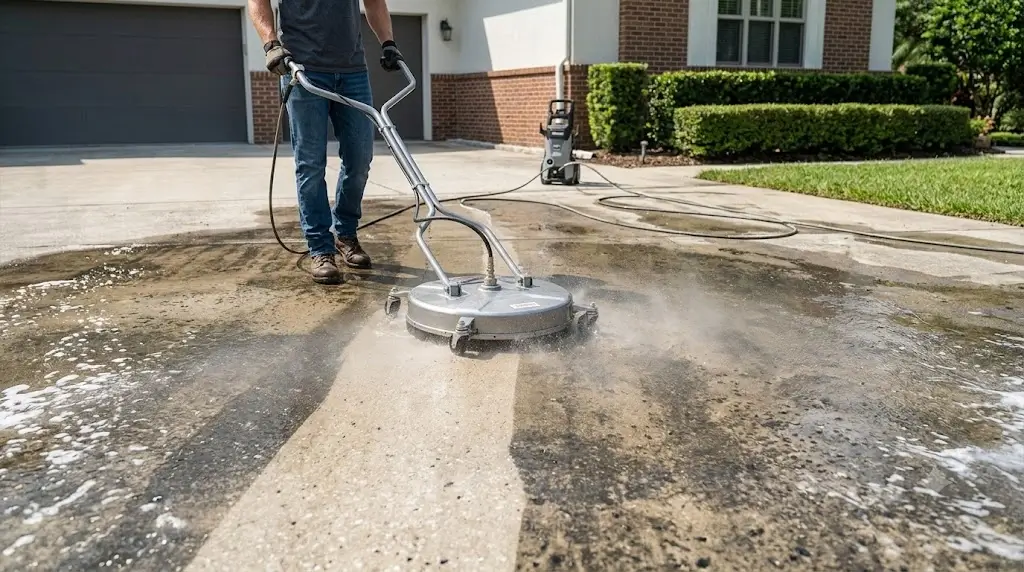
Why GPM matters on concrete
Concrete cleaning covers a large area. Once the contamination has been loosened, water volume becomes important for rinsing and maintaining cleaning speed.
This is why a 3,000-PSI machine at 3 GPM can be more useful for driveway work than a machine with a higher headline PSI but substantially lower flow.
Use a surface cleaner for large concrete
A surface cleaner can make a major difference in both cleaning pattern and productivity. The surface cleaner must be matched to the pressure washer’s PSI and GPM range.
What PSI Do You Need to Pressure Wash a House?
House washing requires more caution than driveway cleaning because exterior surfaces vary substantially. Vinyl siding, painted wood, fiber-cement siding, stucco and masonry should not automatically be treated as if they have the same pressure tolerance.
For many residential siding applications, approximately 1,300–2,000 PSI can be a practical upper working range, but the correct pressure depends heavily on the material and cleaning method.
Vinyl siding
Vinyl siding generally does not require extreme pressure. A moderate-pressure setup combined with detergent can remove much of the dirt without forcing water behind siding panels.
Painted siding
Old or deteriorated paint requires additional caution. High pressure can remove already-loose coatings rather than simply cleaning the surface.
Fiber-cement siding
Follow the siding manufacturer’s maintenance instructions. Surface condition, joints and coatings can affect the safe cleaning method.
Stucco
Stucco can contain cracks, damaged areas or vulnerable texture. Use a conservative pressure setting and test an inconspicuous area first.
What PSI Do You Need to Pressure Wash a Wood Deck?
Wood is one of the surfaces where excessive pressure causes problems quickly. For many wood decks, approximately 1,000–1,500 PSI is a sensible starting range, with pressure adjusted for the species, condition and finish.
The nozzle should generally be kept moving rather than held stationary. A narrow spray held too close can cut grooves into softer wood fibers.
Pressure is not the only variable
- Wood species
- Age of the deck
- Moisture condition
- Existing finish
- Paint or stain condition
- Nozzle angle
- Spray distance
- Operator movement speed
A lower-pressure setup used carefully can often produce a better result than a high-pressure machine used aggressively.
What PSI Do You Need to Pressure Wash a Wood Fence?
A wood fence generally needs less pressure than a concrete driveway. Approximately 1,000–1,500 PSI is a useful starting range for many residential wood fences.
Older fencing deserves particular caution because weathered wood can have weakened fibers.
What PSI Do You Need for Brick?
Brick itself can tolerate substantially more pressure than painted surfaces, but the mortar joints can be the limiting component.
Approximately 1,500–2,500 PSI can be a practical range for many brick-cleaning applications. However, deteriorated mortar requires a more conservative approach.
Why mortar matters
The brick may remain intact while the mortar has already weakened. Concentrated high-pressure water can accelerate erosion of fragile joints.
Test a small area first and inspect the result before increasing pressure.
What PSI Do You Need for a Patio?
The correct pressure depends on whether the patio is concrete, brick, pavers, natural stone, composite material or another surface.
For typical concrete patios, approximately 2,000–3,000 PSI can be a useful range. Pavers and masonry require additional care because joint sand and mortar can be displaced.
Patio cleaning is where surface type matters most
| Surface | General Pressure Direction | Main Risk |
|---|---|---|
| Concrete | Moderate to high | Etching or surface damage |
| Brick | Moderate | Mortar erosion |
| Pavers | Moderate | Joint-sand displacement |
| Natural stone | Conservative | Surface damage or discoloration |
| Wood | Low to moderate | Fiber damage |
How Much PSI Do Different Pressure Washers Need?
Pressure washer categories overlap, so the machine’s label should not be treated as a strict industry classification. If you are comparing domestic plug-in units, reviewing the best electric pressure washers can help you see which PSI ratings fit typical household workloads.
| Pressure Washer Type | Common Pressure Range | Typical Jobs |
|---|---|---|
| Compact electric | 1,000–2,000 PSI | Cars, furniture, light household cleaning |
| Residential electric | 1,500–2,500 PSI | Cars, decks, siding, patios |
| Heavy-duty electric | 2,000–3,000+ PSI | Concrete and demanding homeowner work |
| Residential gas | 2,500–3,500 PSI | Driveways, patios, property maintenance |
| Professional gas | 3,000–4,000+ PSI | Commercial and heavy-duty cleaning |
These ranges overlap intentionally. A high-quality 2,000-PSI machine can be more appropriate for a particular job than a 3,500-PSI machine.
How Pressure Washer Nozzles Change Effective Cleaning Pressure
The PSI number on the pressure washer does not tell the entire story because the nozzle controls how the water is distributed.
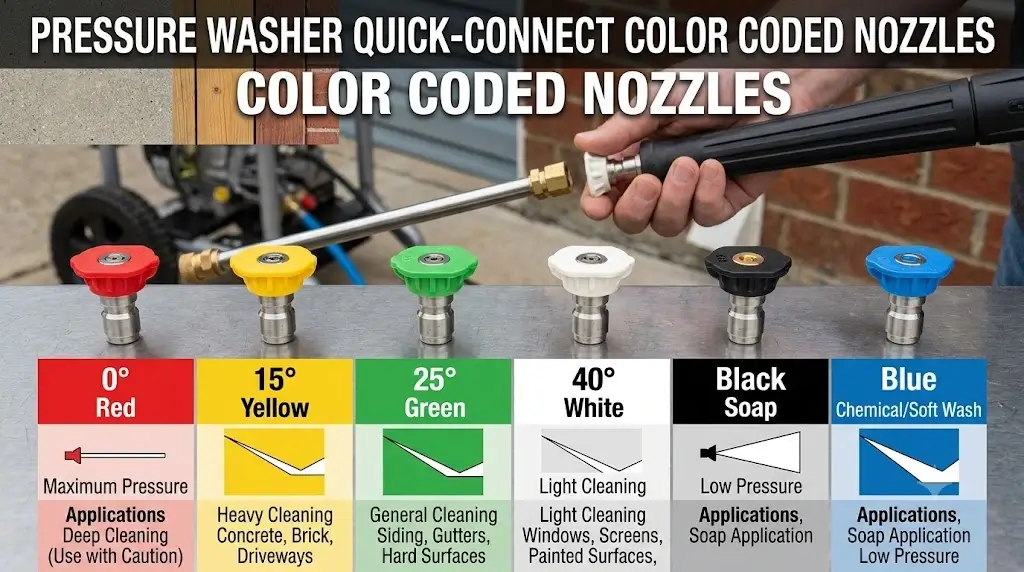
Common pressure washer nozzle angles include:
| Nozzle Angle | General Spray Behavior | Typical Application Direction |
|---|---|---|
| 0° | Extremely concentrated stream | Specialized heavy-duty spot work; high damage risk |
| 15° | Narrow fan | Hard surfaces and heavy contamination |
| 25° | Moderate fan | General-purpose cleaning |
| 40° | Wide fan | Vehicles, siding and more delicate surfaces |
| 65° / soap | Very wide, low-impact spray | Detergent application |
These angle labels describe the spray pattern, not a guarantee that the surface receives the exact PSI printed on the machine.
Why a wider nozzle is often safer
A wider fan spreads the water over a larger area. This reduces the concentration of force at any single point compared with a narrow jet.
Spray Distance Changes the Pressure Reaching the Surface
The pressure washer’s operating pressure is measured within the hydraulic system. The surface does not necessarily experience that same pressure in the same way once the spray leaves the nozzle and travels through air.
Increasing the distance between the nozzle and surface generally spreads the spray over a larger area and reduces its impact intensity.
This is one reason professional operators adjust distance before simply increasing machine pressure.
A useful technique
- Start with the recommended nozzle.
- Begin farther from the surface.
- Make a test pass.
- Move closer gradually if necessary.
- Only increase pressure when the surface can safely tolerate it.
Why Detergent Can Reduce the PSI You Need
Pressure is only one tool in the cleaning process. Detergent can loosen oils, organic contamination and other soils so that the pressure washer does not have to do all of the work mechanically.
This is particularly important for house washing, vehicle cleaning and many types of exterior maintenance.
A common mistake is trying to compensate for poor chemistry with more pressure. That approach can increase surface damage without solving the underlying cleaning problem.
What PSI Do You Need for a Pressure Washer Surface Cleaner?
Surface cleaners have their own operating specifications. The correct pressure washer must satisfy both the cleaner’s PSI requirement and its GPM requirement.
A pressure washer with sufficient PSI but insufficient GPM may not drive the surface cleaner as intended. Conversely, a very high PSI machine can be inappropriate if the attachment or surface is not rated for it.
Do not buy a surface cleaner by diameter alone
A larger surface cleaner can cover more area, but it also places greater demands on the pressure washer’s available flow and nozzle system.
7 Common Pressure Washer PSI Mistakes
1. Buying the highest PSI available
Maximum PSI is not the same as maximum usefulness.
2. Using one nozzle for everything
Cars, concrete, wood and siding have different cleaning requirements.
3. Comparing peak PSI to working PSI
This can make two machines look more different than they actually are.
4. Ignoring GPM
A machine’s flow rate has a major effect on rinsing and large-surface productivity.
5. Holding the nozzle too close
Distance changes spray concentration and therefore surface impact.
6. Using high pressure to compensate for poor detergent technique
Chemistry and dwell time can often remove contamination more efficiently than brute-force pressure.
7. Assuming concrete is indestructible
Weak, old or damaged concrete can be etched or otherwise damaged by aggressive pressure washing.
How Much PSI Do You Need for Common Household Jobs?
| Task | Recommended Starting Direction | Why |
|---|---|---|
| Car | 1,200–1,500 PSI | Reduces unnecessary surface impact. |
| SUV / truck | 1,200–2,000 PSI | Moderate pressure with good rinse flow. |
| Deck | 1,000–1,500 PSI | Protects wood fibers. |
| Fence | 1,000–1,500 PSI | Weathered wood can be vulnerable. |
| Vinyl siding | 1,300–2,000 PSI | Moderate pressure is generally sufficient. |
| Brick | 1,500–2,500 PSI | Enough cleaning force without unnecessarily attacking mortar. |
| Patio | 2,000–3,000 PSI | Depends strongly on material. |
| Concrete driveway | 2,500–3,500 PSI | Higher pressure is useful on durable concrete. |
| Heavy concrete | 3,000–4,000+ PSI | Useful only when surface and equipment are appropriate. |
What PSI Do You Need for Oil, Grease and Tough Stains?
Tough contamination does not automatically mean you should increase PSI.
Oil, grease, embedded organic contamination and old deposits may respond better to appropriate detergents or degreasers combined with mechanical cleaning.
Increasing pressure can remove surface material along with the contamination. That is particularly undesirable on painted surfaces, wood and masonry with weak joints.
Can Too Much PSI Damage Concrete?
Yes.
Concrete is durable, but it is not immune to pressure-washing damage. Aggressive cleaning can expose aggregate, create visible etching, remove weak surface material or leave uneven cleaning patterns.
The risk increases when the concrete is old, poorly cured, already deteriorated or subjected to an excessively concentrated spray.
Signs you are being too aggressive
- Visible lines from individual passes
- Surface texture changing during cleaning
- Aggregate becoming exposed
- Chipping or flaking
- Uneven bright and dark cleaning bands
- Surface material being visibly removed
Can Too Much PSI Damage Wood?
Wood is particularly sensitive to concentrated water jets.
Excessive pressure can raise or remove fibers, create grooves, damage soft areas and produce a rough texture that becomes obvious after the wood dries.
For wood, the nozzle and distance are just as important as the pressure rating on the machine.
What PSI Do You Need for a Pressure Washer to Remove Mold and Mildew?
Mold and mildew are often found on siding, decks, concrete, fences and outdoor furniture. Pressure alone is not always the best way to remove them.
Appropriate cleaning chemistry can loosen biological contamination before the pressure washer performs the rinse.
For many exterior surfaces, moderate pressure combined with suitable detergent can be more controlled than using maximum pressure.
Always follow the cleaning-product label, surface manufacturer’s instructions and local environmental requirements when using chemicals outdoors.
What PSI Do You Need for Commercial Pressure Washing?
Commercial cleaning changes the priority because productivity and equipment duty cycle become more important.
Professional operators may use machines in the 3,000–4,000+ PSI range, but pressure alone does not determine productivity. High-flow pumps can be more important when large concrete areas need to be cleaned rapidly.
The professional system should therefore be evaluated as:
A high-PSI machine with insufficient flow can be less productive on a large surface than a slightly lower-pressure machine with substantially greater GPM.
PSI and Hydraulic Horsepower
PSI and GPM are connected through hydraulic power. A commonly used approximation is:
For example, a system producing 3,000 PSI at 2.0 GPM represents approximately:
At 3,000 PSI and 4.0 GPM:
This is why PSI and GPM must be evaluated together. Increasing both substantially requires substantially more hydraulic input power.
Pump build quality also impacts sustained performance under load; understanding the trade-offs in brass pump vs. aluminum pump designs is essential when choosing equipment for frequent or demanding tasks.
What PSI Should You Buy for General Home Use?
If you want one pressure washer for a broad range of homeowner tasks, approximately 2,000–3,000 PSI is a sensible category to consider.
This range gives you enough pressure for many residential surfaces without forcing you into the aggressive operating characteristics of a very high-pressure machine.
But the final choice should depend on GPM and the tasks you actually perform.
Best for lighter residential work
Cars, siding, furniture, decks and general maintenance when paired with the right nozzle.
Balanced homeowner option
A strong middle ground for vehicles, patios, siding and moderate concrete cleaning.
Heavy homeowner work
Useful for driveways, concrete and frequent property maintenance when GPM is also adequate.
Heavy-duty territory
Useful for demanding applications but requires more attention to surface compatibility and technique.
How to Choose the Right PSI: HomeGearMax Decision Process
Use this sequence before buying a pressure washer.
Step 1: Identify your most demanding regular job
Do not choose a machine based on the easiest job you perform. If you occasionally clean concrete but mostly wash cars, however, you should still consider whether a high-pressure machine creates unnecessary complexity.
Step 2: Identify the surface material
Concrete, brick, wood, vinyl, painted metal and automotive finishes have different pressure tolerances.
Step 3: Choose a safe starting PSI
Start at the lower end of an appropriate range.
Step 4: Match the GPM
Large surfaces need enough flow to rinse efficiently.
Step 5: Match the nozzle
The nozzle determines spray concentration and must be sized for the machine.
Step 6: Test an inconspicuous area
A small test patch can reveal damage before the entire surface is cleaned.
Step 7: Increase intensity gradually
Change pressure, distance, nozzle or cleaning chemistry one variable at a time.
Step 8: Stop when the surface is clean
There is no benefit to continuing to increase pressure after the contamination has already been removed.
Pressure Washer PSI Buying Matrix
| Buyer Type | PSI Direction | GPM Direction | Best Fit |
|---|---|---|---|
| Mostly car washing | 1,200–2,000 | 1.5–2.5 | Vehicle cleaning and light household work |
| General homeowner | 2,000–2,500 | 2.0–2.5 | Mixed household cleaning |
| Concrete-focused homeowner | 2,500–3,500 | 2.5–4.0 | Driveways, patios and surface cleaners |
| Frequent property maintenance | 2,500–3,500+ | 3.0–4.0+ | Large surfaces and repeated use |
| Professional operator | 3,000–4,000+ | 3.5–5.0+ | High-productivity commercial work |
These are starting-point categories, not universal specifications. The correct machine must still be matched to the pump, nozzle, surface cleaner, water supply and manufacturer’s operating limits.
What PSI Is Too High?
There is no single PSI number that is “too high” for every task. A pressure that is appropriate for cured concrete may be excessive for automotive paint or soft wood.
The better question is:
This is the central principle behind safe pressure washing.
What PSI Is Too Low?
Pressure is too low when the machine cannot efficiently loosen or remove the contamination even after the nozzle, distance, detergent and technique are appropriate.
If a 1,500-PSI machine struggles with a heavily contaminated concrete driveway, jumping immediately to 4,000 PSI may not be the best solution.
The missing variable could be:
- GPM
- Nozzle selection
- Surface-cleaner configuration
- Detergent
- Dwell time
- Water temperature
- Operator speed
- Pump condition
PSI Troubleshooting: When a Pressure Washer Seems Weak
If a pressure washer is not producing the expected pressure, diagnose the complete water path before assuming the pump has failed.
- Confirm the water supply is fully open.
- Check the inlet hose for kinks.
- Inspect and clean the inlet screen.
- Remove trapped air from the system.
- Inspect the spray nozzle for blockage.
- Verify that the nozzle orifice is appropriate.
- Check the high-pressure hose and fittings.
- Confirm the unloader/regulator system is operating correctly.
- Check the pump according to the manufacturer’s service procedure.
Peak PSI vs. Cleaning PSI: A Simple Example
Imagine two pressure washers:
| Machine A | Machine B | |
|---|---|---|
| Advertised maximum PSI | 3,500 | 3,000 |
| Working PSI | 2,500 | 2,800 |
| Working GPM | 2.0 | 3.0 |
| Simple working CU | 5,000 | 8,400 |
Machine A has the bigger marketing PSI number. Machine B has the stronger working hydraulic combination.
This example illustrates why headline PSI should never be the sole buying criterion.
How PSI, GPM and Nozzle Size Work Together
These three variables form the core of pressure-washer operation.
PSI
The system’s pressure condition. Higher pressure can increase cleaning force but also increases surface-damage risk.
GPM
The water volume moved through the system. Higher flow generally improves rinsing and large-area productivity.
Nozzle
Controls how the available water is distributed and therefore strongly influences spray concentration.
Distance
Changes the concentration and impact of the spray at the surface.
Changing one of these variables changes how the pressure washer behaves at the surface. This is why “3,000 PSI” by itself cannot fully describe a cleaning system.
When You Should Buy a Lower-PSI Pressure Washer
A lower-pressure machine can be the better choice when most of your work involves:
- Vehicles
- Outdoor furniture
- Painted surfaces
- Vinyl siding
- Decks
- Fences
- Light household cleaning
Lower pressure can provide more operating margin for inexperienced users because accidental close passes are less aggressive.
When You Should Buy a Higher-PSI Pressure Washer
Higher-pressure equipment becomes more useful when your workload regularly includes:
- Concrete driveways
- Large patios
- Heavy masonry cleaning
- Embedded dirt
- Large-area property maintenance
- Commercial cleaning
Even here, higher PSI should be paired with sufficient GPM. A large-area cleaner benefits from water volume as much as pressure.
What PSI Do You Need? The Short Version
| If You Mainly Clean… | Start Around… |
|---|---|
| Cars | 1,200–1,500 PSI |
| Outdoor furniture | 1,000–1,500 PSI |
| Wood decks | 1,000–1,500 PSI |
| Wood fences | 1,000–1,500 PSI |
| Vinyl siding | 1,300–2,000 PSI |
| Brick | 1,500–2,500 PSI |
| Patios | 2,000–3,000 PSI |
| Concrete driveways | 2,500–3,500 PSI |
| Heavy-duty concrete | 3,000–4,000+ PSI |
What PSI Do You Need? FAQ
What PSI is good for a pressure washer?
For general homeowner use, approximately 2,000–3,000 PSI is a practical range. The correct PSI depends on the surface and cleaning task.
Is 2,000 PSI enough for a driveway?
It can clean some driveways, particularly with suitable detergent and technique, but 2,500–3,500 PSI with adequate GPM is generally more appropriate for demanding residential concrete cleaning.
Is 3,000 PSI too much for a car?
A 3,000-PSI machine can be used for vehicle cleaning if the pressure is controlled and the correct nozzle and distance are used, but there is usually no need to apply maximum pressure directly to automotive paint.
What PSI do I need to wash a house?
Many residential siding applications can be cleaned with approximately 1,300–2,000 PSI, but the safe pressure depends on siding material, condition, coatings and cleaning method.
What PSI do I need for a wood deck?
Approximately 1,000–1,500 PSI is a useful starting range for many wood decks. Start conservatively because wood fibers can be damaged by concentrated high-pressure spray.
What PSI do I need for concrete?
Approximately 2,500–3,500 PSI is a practical range for many residential concrete-cleaning jobs. Old or deteriorated concrete may require a more conservative setting.
Is higher PSI better?
No. Higher PSI is useful only when the surface and cleaning task require it. Excessive pressure can damage wood, paint, siding, mortar and concrete.
Is PSI more important than GPM?
No. PSI and GPM measure different aspects of hydraulic performance. PSI relates to pressure while GPM measures water flow. Both should be evaluated together.
What is the difference between peak PSI and working PSI?
Peak PSI generally represents a maximum pressure specification, while working or rated PSI describes an operating condition. Manufacturer terminology varies, so equivalent specifications should be compared.
What PSI do professionals use?
Professional pressure washers may operate around 3,000–4,000 PSI or higher depending on the equipment and task. Professional productivity also depends heavily on GPM, pump design, nozzles and surface-cleaning equipment.
Can too much PSI damage concrete?
Yes. Excessive or concentrated pressure can etch concrete, expose aggregate or remove weak surface material, particularly on deteriorated surfaces.
Can pressure washing damage wood?
Yes. Excessive pressure or a concentrated nozzle can remove or raise wood fibers and create visible grooves. Conservative pressure, wider spray patterns and appropriate distance reduce the risk.
What PSI do I need for a surface cleaner?
The required PSI depends on the specific surface cleaner. Check the attachment’s rated PSI and GPM range and match both specifications to the pressure washer.
Final Verdict: How Much PSI Do You Really Need?
The right pressure washer PSI is determined by the surface, contamination, cleaning method and complete hydraulic system — not by the largest number printed on the box.
For cars and delicate surfaces, moderate pressure is usually the better choice. For decks and fences, controlling pressure and spray concentration is more important than maximizing cleaning force. For siding and general household maintenance, roughly 1,300–2,500 PSI covers a broad range of applications. For concrete and demanding masonry, approximately 2,500–3,500 PSI is often more useful.
Heavy-duty commercial work can justify 3,000–4,000+ PSI, but higher pressure should be accompanied by sufficient GPM, properly sized nozzles, adequate water supply and equipment designed for the operating conditions.
The best pressure washer is not the one with the highest PSI. It is the one that delivers the right pressure at the right flow, through the right nozzle, at the right distance, for the right surface.
