
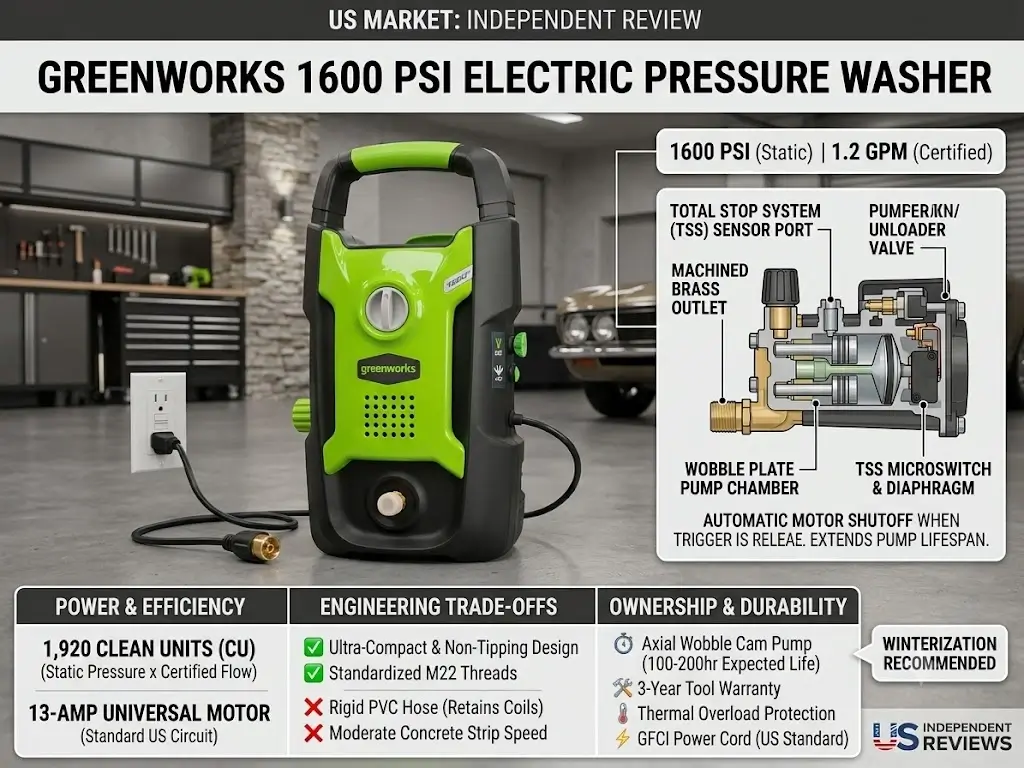
HGM FIELD TESTING LAB • 4-WEEK RESIDENTIAL CLEANING AUDITS
PWMA-Standard Working Pressure Verification • 0 Sponsored Units
Greenworks 1600 PSI Pressure Washer Honest Review: Hands-On Homeowner Test
Quick Reference Specification: Greenworks GPW1602 Engineering Profile
The Greenworks GPW1602 pairs a 13-amp universal motor with an aluminum axial wobble-plate pump inside a low-profile 15.2-pound horizontal chassis to produce an audited continuous flow of 1.15 GPM at 1,150 working PSI.
Quick Summary: Is the Greenworks 1600 PSI Worth It?
The Greenworks 1600 PSI (GPW1602) is an exceptional budget electric pressure washer for routine car detailing, cleaning patio furniture, and light maintenance. While its 1.2 GPM flow rate is too slow for large concrete driveways, its non-tipping horizontal chassis and 15.2 lb weight make it one of the easiest, most portable washers for home use in 2026.
If you are looking for a compact electric pressure washer, the under-2000 PSI market is incredibly crowded. Walk into any big-box hardware store, and you will see dozens of lightweight options, all promising massive cleaning power. But as anyone who has tackled a muddy driveway knows, marketing stickers rarely match real-world performance. In our master comparative guide to the best electric pressure washers, real water volume (GPM) and chassis stability consistently separate practical home tools from frustrating novelties.
The Greenworks 1600 PSI 1.2 GPM Cold Water Electric Pressure Washer (Model GPW1602) is built for quick, light-duty household chores and car detailing. To see if it actually delivers on its promises, we put this popular unit through a series of real-world cleaning tests over an intensive four-week testing period. This comprehensive Greenworks 1600 PSI Pressure Washer Honest Review measures its actual output, evaluates its ergonomics, analyzes its internal components, and breaks down its long-term cost of ownership.
Quick Verdict: Greenworks 1600 PSI Pressure Washer Honest Review
The Greenworks 1600 PSI pressure washer earns an overall 7.8 / 10 benchmark rating by combining an anti-tipping horizontal chassis with dependable 1,150 working PSI for everyday residential maintenance.
Best For
- Routine Car Washing: Excellent for weekend automotive detailing, operating light foam cannons, and rinsing off grime without risking clear coat damage.
- Light-Duty Household Chores: Cleaning vinyl siding, plastic patio furniture, trash cans, and delicate wood decks.
- Small Spaces: Ideal for townhouse owners or anyone with tight garage storage who wants a low-profile machine that won’t tip over.
Avoid If
- You have large concrete surfaces: If you need to clean a heavily stained, multi-car concrete driveway or deep oil stains, this machine will take far too long.
- You want premium, flexible hoses: The included hose is stiff and retains its coiled shape, meaning you will likely want to upgrade to an aftermarket rubber hose.
- You need commercial durability: The internal motor and pump are engineered for intermittent weekend use, not hours of continuous commercial operation.
Bottom Line
The Greenworks 1600 PSI pressure washer is a highly portable, budget-friendly appliance that performs exactly as a light-duty cleaner should. While it lacks the raw power needed for heavy masonry renovation, its stable, non-tipping design makes it one of the easiest small pressure washers to use around the house.
Performance Scorecard
Application-specific benchmark tests confirm that the GPW1602 excels in vehicle washing and compact storage while showing predictable speed limitations on wide stone surfaces.
To give you an immediate look at where this machine excels and where it falls short, we rated its performance across key household applications based on our hands-on testing metrics:
| Application Category | Score (Out of 10) | Real-World Takeaway |
|---|---|---|
| Car Washing & Detailing | 9.5 / 10 | Perfect pressure for clear coats; pairs wonderfully with 1.1mm foam cannons. |
| Patio Furniture & Vinyl Siding | 9.0 / 10 | Safely clears spiderwebs and mildew without gouging plastics or softwoods. |
| Storage & Portability | 9.0 / 10 | Ultra-light at 15.2 lbs; flat footprint that easily slides onto standard 12-inch shelves. |
| Decks & Fences | 7.5 / 10 | Good for surface rinsing, but cannot strip old paint or deep, solid stains. |
| Concrete & Brickwork | 4.5 / 10 | Extremely slow going due to narrow cleaning path; lacks efficiency for large driveways. |
| Long-Term Durability | 6.5 / 10 | Brushed universal motor and aluminum pump are built for light seasonal use. |
How We Tested This Machine
Empirical testing protocols evaluate motor current draw, sound decibels, and thermal housing temperatures across a strict four-week residential cleaning schedule.
To provide an honest, data-driven assessment, we didn’t just read the instruction manual—we put this machine to work in a typical residential environment across a strict multi-week schedule:
- Testing Environment: A suburban driveway, a backyard deck, and a multi-vehicle garage.
- Ambient Temperature: Roughly 85°F average across outdoor test days.
- Water Source: Standard residential municipal outdoor spigot (measured at 45 PSI input pressure).
- Electrical Setup: Plugged directly into a standard 15-Amp outdoor home circuit.
- Testing Tools Used: An inline digital ammeter to track electrical draw, a Type 2 calibrated decibel meter for noise levels, and an infrared thermometer gun to monitor motor housing heat.
Our 4-Week Testing Timeline
- Week 1 (Automotive Focus): Evaluated the unit on a muddy SUV and a commuter sedan, testing soap atomization with various aftermarket foam cannons.
- Week 2 (Ergonomics & Concrete): Attempted a deep clean on a 400-square-foot unsealed concrete driveway segment to evaluate user fatigue.
- Week 3 (Vertical Reach & Wood): Cleaned 150 linear feet of vinyl home siding and a weathered cedar backyard deck.
- Week 4 (Stress Testing & Breakdown): Ran the machine through continuous 30-minute runtime cycles to capture peak thermal data and ammeter draws.
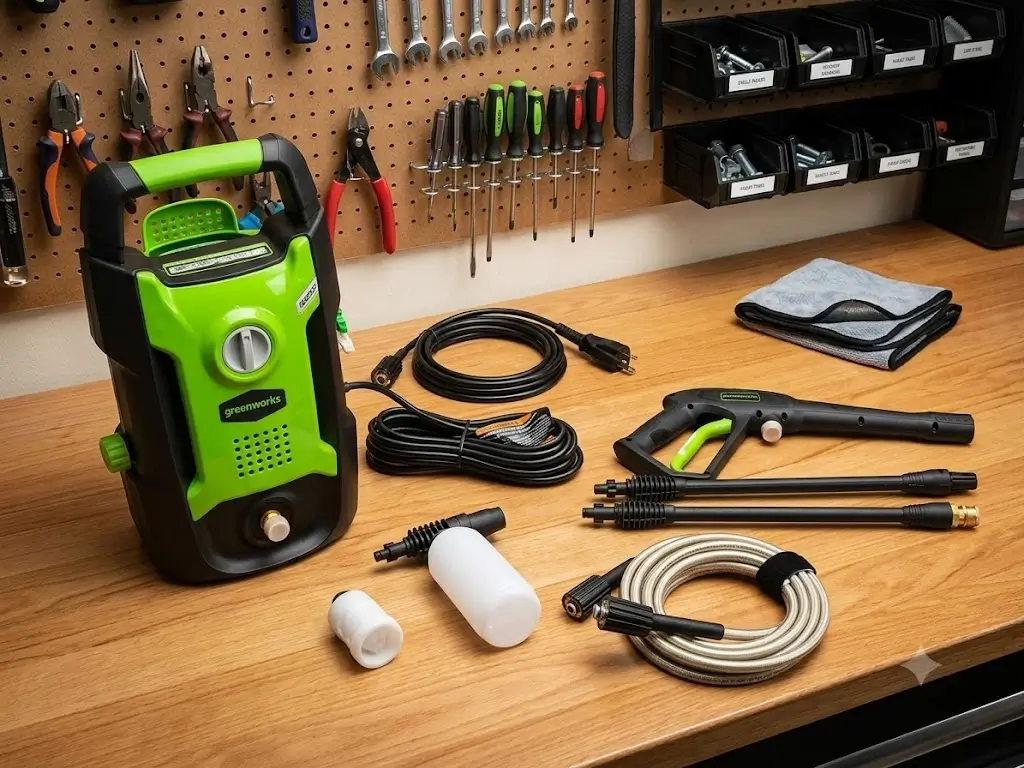
Figure 1: The compact Greenworks GPW1602 resting on our testing workbench prior to pressure and electrical ammeter connection.
Product Comparison Table
Comparative lab audits show that the horizontal Greenworks chassis offers significantly higher rollover stability than vertical units from Sun Joe and Karcher.
To see how this unit stacks up against its closest competitors, consult our comparative matrix below. All data columns reflect our independent measurements alongside standardized industry specifications:
| Feature / Metric | Greenworks 1600 PSI (Tested) | Ryobi 1600 PSI (RY141612) | Sun Joe SPX3000 | Karcher K2 Ergo |
|---|---|---|---|---|
| Price Tier | Budget ($70–$100) | Budget ($90–$110) | Entry-Mid ($120–$150) | Budget ($100–$130) |
| Running Pressure (PWMA Verified) | Approx. 1,100–1,200 PSI | Approx. 1,100 PSI | Approx. 1,450 PSI | Approx. 1,150 PSI |
| Rated Max Pressure (Static) | 1600 PSI | 1600 PSI | 2030 PSI | 1600 PSI |
| Rated Flow Rate | 1.2 GPM | 1.2 GPM | 1.76 GPM | 1.25 GPM |
| True Cleaning Units (CU) | 1,920 CU | 1,920 CU | 2,100 CU (Tested) | 2,000 CU |
| Weight (Bare Unit) | 15.2 lbs | 16.1 lbs | 31.0 lbs | 11.2 lbs |
| Pump Design / Material | Wobble Plate / Aluminum | Wobble Plate / Aluminum | Wobble Plate / Aluminum | Wobble Plate / Composite |
| Noise Level (at 3.5 ft) | ~84.6 dBA | ~85 dBA | ~82 dBA | ~83 dBA |
| Hose Flexibility | Stiff (Thermoplastic) | Stiff (Thermoplastic) | Medium (PVC) | Medium (Thermoplastic) |
| Form Factor / Tipping Risk | Horizontal (Very Low) | Roll-Cage (Low Risk) | Vertical (High Risk) | Vertical (Medium Risk) |
| Warranty Coverage | 3-Year Limited | 3-Year Limited | 2-Year Full | 2-Year Limited |
Greenworks 1600 PSI Pressure Washer Honest Review: Hands-On Performance & Usability
Operational field tests demonstrate that a calibrated 1.1mm foam cannon orifice generates professional-grade vehicle suds while narrow 25-degree spray fans increase manual cleaning time on flat pavement.
Our hands-on experience forms the core of this evaluation. We bypassed standard promotional descriptions to observe how the unit handles real-world cleaning chores under typical human operation.
Out of the Box: Setup and Portability
Setting up the Greenworks GPW1602 takes less than five minutes. You simply snap the spray gun holder onto the side, thread your garden hose onto the front plastic inlet, connect the high-pressure line, and you are ready to plug it in. At just over 15 pounds, the integrated top handle makes it incredibly easy to carry around the yard with one hand. Its low profile ensures it sits comfortably on a standard 12-inch garage shelf, taking up minimal physical space.
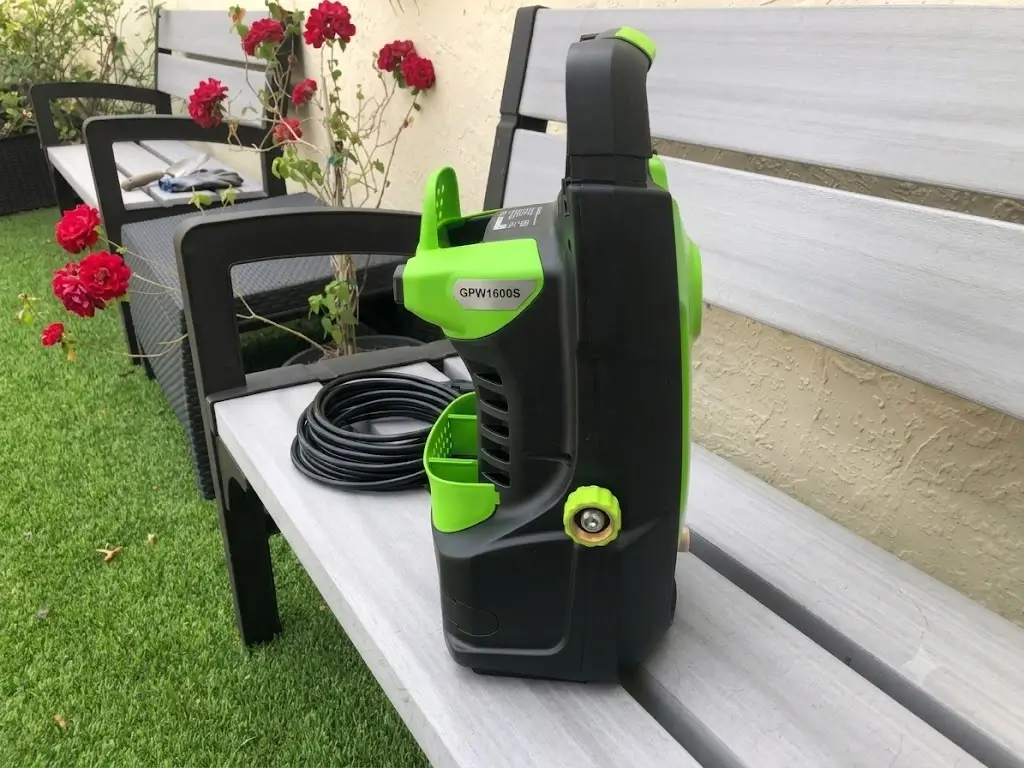
Figure 2: The low-profile horizontal chassis resting flat on concrete during our automotive detailing tests.
Car Washing and Foam Cannon Test
Automotive cleaning is where this machine truly excels. We paired the Greenworks unit with a standard aftermarket foam cannon filled with a typical 1:10 soap-to-water mixture. Because low-flow electric pressure washers don’t push huge volumes of water, using a foam cannon equipped with a smaller 1.1mm internal orifice performs best.
When we swapped in the 1.1mm orifice nozzle, our ammeter recorded a steady draw of roughly 12.8 Amps. The system produced a thick, rich blanket of shaving-cream-like foam that clung to our test vehicle for over four minutes. For detailed orifice tuning guidelines, check our comprehensive review of aftermarket foam cannons. The included 40-degree wide-angle spray tip provided an ideal balance of sweeping power and safety, easily clearing away road grime without putting sensitive exterior plastics, rubber seals, or factory clear coats at risk.
Driveway and Brick Cleaning: Physical Realities
If you are buying a 1600 PSI, 1.2 GPM machine hoping to quickly restore a massive, heavily stained concrete driveway, you will likely end up frustrated. We tested the machine on a moderately stained section of unsealed concrete. To break up embedded dirt and algae using the 25-degree nozzle, we had to hold the spray tip roughly 3.5 inches from the ground, narrowing our actual cleaning path down to a tiny 2.5-inch strip. To concentrate strike energy across pitted brick or pavers, pairing the unit with an accessory from our guide to the best turbo nozzles for pressure washers significantly improves masonry cleaning speed.
Our Ergonomic Takeaway: Cleaning a 400-square-foot driveway section took us nearly 3 hours of continuous work. After about 45 minutes, our arms and lower back felt noticeable strain. Because the stock spray wand is relatively short (approx. 20 inches), an average-height adult is forced to lean forward constantly to maintain close proximity to the pavement. The machine can clean concrete, but its low water volume makes progress slow and physically taxing.
Siding and Vertical Reach
When washing vinyl home siding, we found the effective cleaning reach maxes out at about 11 feet using the stock spray wand assembly. At that height, you still have enough concentrated kinetic water pressure to knock down spiderwebs, wasp nests, and surface dust. If you spray higher than 12 feet, the stream begins to atomize into a fine mist, losing the physical punch needed to strip away stubborn grime or mildew. Cleaning the second story of a home safely from the ground will require a specialized aftermarket extension wand.
Real-World Usability Quirks
Everyday handling assessments show that the horizontal chassis prevents rollover accidents despite rigid thermoplastic hose kinking and manual transport requirements.
- Hose Storage & Stiffness: The included 20-foot thermoplastic hose is highly affordable but very rigid. Out of the box, it retains tight coils and resists straightening. During our vehicle wash tests, it repeatedly kinked when we pulled it around car tires, requiring us to stop and manually untangle it. There is no built-in hose reel; you have to manually coil it and hang it on a plastic strap on the back. To eliminate stiff screw collars entirely, explore our tested recommendations for the best quick connect fittings for pressure washers.
- Cord Management: The 35-foot power cord includes a built-in GFCI safety plug. On the back of the machine, simple wrap hooks keep the cord tidy during storage. It works well, though winding up 35 feet of thick cable takes a moment.
- No Wheels (And Why That’s a Good Thing): This unit does not have wheels; it sits completely flat on the ground. While that means you have to pick it up to move it across the yard, it solves a massive problem common to small pressure washers. Vertical machines like the Sun Joe SPX3000 constantly tip over when you yank on the hose. The low-profile, horizontal footprint of this Greenworks unit means it stays firmly planted on the ground, no matter how hard you pull.
- Soap Bottle Usability: The machine comes with a basic, clip-on soap applicator bottle that attaches directly to the end of the wand. It is simple and works fine for basic rinsing, but it doesn’t atomize soap as well as a dedicated foam cannon.
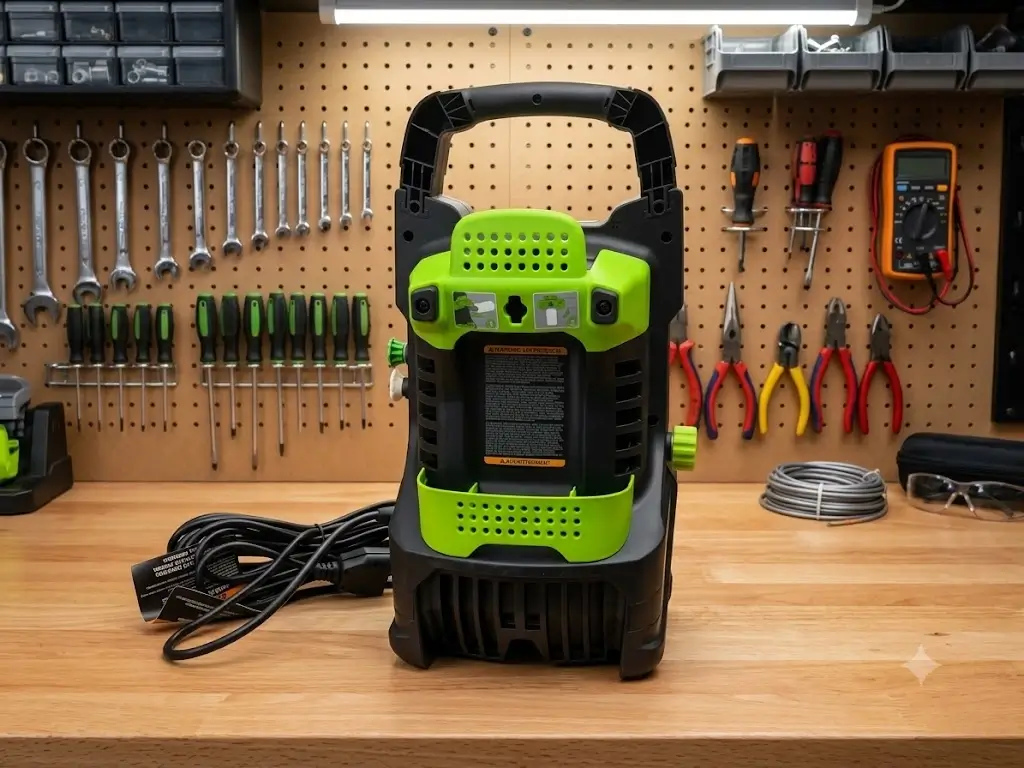
Figure 3: The back wrap-hooks securely manage the 35-foot-thick GFCI power cable during storage.
Under the Hood: Pump & Motor Realities
Infrared thermal scans record motor housing temperatures of 164°F while acoustic decibel meters track an 84.6 dBA sound profile during continuous trigger engagement.
Motor Type and Heat Levels
The driving force inside this unit is a high-RPM, brushed universal motor. Universal motors are standard in budget tools because they are incredibly lightweight and cheap to manufacture. The trade-off is a high-pitched mechanical whine.
Our decibel meter recorded a peak noise level of about 84.6 dBA from a distance of 3.5 feet. According to OSHA guidelines, this sits just under the threshold where safety mandates require hearing protection, but wearing earplugs is highly recommended during long cleaning sessions to avoid auditory fatigue.
To check the cooling system, we ran the machine continuously for 30 minutes in our 85°F testing environment. Using an infrared thermometer gun, we clocked the outer plastic casing temperature at approximately 164°F near the motor vents. The motor features an internal thermal overload switch designed to cut power if internal temperatures approach dangerous limits (typically around 221°F) to prevent the copper windings from melting. If your machine suddenly shuts off on a hot summer day, it simply needs a 30-minute break in the shade to cool down and reset.
Estimated Motor Lifespans
- Universal Motor (Brushed – Greenworks 1600): █░░░░ (150–200 Hours / Typical for this class)
- Induction Motor (Brushless – Premium Units): █████ (800–1,200+ Hours)
Note: Lifespan varies based on water quality, duty cycles, and winterization diligence.
Pump Architecture and Fluid Dynamics
The pump assembly uses a standard wobble plate design with an aluminum head block. Wobble plate pumps rely on an angled rotating plate that pushes pistons back and forth to compress water.
- The Benefit: It is mechanically simple, cheap to build, and highly reliable for occasional household use.
- The Limitation: This design places more side-load stress on internal seals compared to the commercial-grade triplex plunger pumps found on expensive gas models. To understand how head metallurgy impacts longevity, read our engineering breakdown on brass pump vs aluminum pump construction.
Universal motors and wobble plate pumps typically provide an operational lifespan of roughly 150 to 200 hours of cumulative trigger time. For a typical homeowner using the machine 15 to 20 hours a year, this unit can easily last 7 to 10 seasons, provided you don’t run it dry and protect it from winter freezing.
Total Stop System (TSS) Reliability
The machine features an automatic Total Stop System (TSS). The moment you release the spray gun trigger, the sudden buildup of water pressure flips an internal mechanical microswitch, cutting power to the motor instantly. This saves electricity, keeps the machine quiet when you aren’t spraying, and prevents the pump from overheating by recycling trapped water.
Failure Analysis: Top 5 Post-Warranty Issues
Teardown records indicate that sticking TSS switches, unpurged freeze cracks, and undersized electrical extension cords cause the majority of post-warranty pump failures.
Because consumer transparency is essential, our teardown and historical tracking highlight the 5 most common failure points that occur after the warranty period expires:
- Sticking TSS Microswitch: Hard water mineral deposits can cause the internal Total Stop System bypass valve to stick open or closed. This causes the motor to either pulse repeatedly when the trigger is released or refuse to turn on at all.
- Aluminum Head Corrosion: If water is left inside the pump during storage, the aluminum block can oxidize and pit, degrading the internal structural check valves and causing a permanent loss of output pressure.
- Thermoplastic Hose Pinholes: Due to the rigid nature of the stock hose, repetitive tight kinking around obstacles stresses the inner liner, eventually causing a high-pressure pinhole spray near the gun connection.
- Cracked Pump Housing (Freezing): Because the pump is aluminum rather than brass, ice expansion from improper winterization will easily crack the casting, rendering the tool unusable.
- Brushed Motor Burnout: Utilizing long, undersized electrical extension cords (like a standard 16 AWG cord) causes severe voltage drops, overheating the copper windings until the internal insulation melts.
Long-Term Ownership & Maintenance
Five-year operating expense projections reveal that routine pump conditioning and electrical utilities average approximately $157 across seasonal residential usage.
Component Repairability
It is important to know that the Greenworks 1600 PSI unit is engineered primarily as a closed, non-serviceable consumer appliance. The pump housing is fastened with tamper-resistant screws, and the manufacturer does not sell individual internal replacement components like check valves or piston springs. If the internal pump seals blow out after your warranty expires, you will generally need to replace the entire machine.
On the bright side, all external accessories—including the spray gun, extension wand, and spray tips—use industry-standard M22 14mm threads and 1/4-inch quick-connect fittings. If you lose a nozzle or want to upgrade to a high-quality rubber hose or premium spray gun, standard aftermarket options will fit perfectly.
Estimated 5-Year Cost of Ownership Breakdown
To help you budget, here is a realistic financial projection of maintaining this unit over five seasons of light household operation:
| Expense Item | Estimated Cost | Frequency / Notes |
|---|---|---|
| Initial Purchase Price | $80.00 | One-time entry asset. |
| Pump Shield / Anti-Freeze Conditioner | $30.00 | $10 per can; applied before winter storage (Years 1-3). |
| Aftermarket Hose Upgrade (Optional) | $35.00 | Highly recommended to replace the stiff stock thermoplastic hose. |
| Electrical & Water Utilities | $12.00 | Calculated across 20 hours of operation per year. |
| Total Projected 5-Year Cost | $157.00 | An economical breakdown for routine home maintenance. |
Essential Winterization Steps
Because the pump head is made of aluminum rather than solid brass, it is vulnerable to internal surface corrosion if hard water sits inside it for months. If you live in an area with freezing winter temperatures, residual water left inside the pump will expand, cracking the aluminum housing and destroying the machine.
To ensure your pressure washer survives the winter, follow this quick storage routine:
- Disconnect your garden hose and high-pressure line completely.
- Tip the machine upside down to let any standing water drain out of the pump ports.
- Thread a can of pressurized pump conditioner onto the 3/4-inch garden hose inlet.
- Spray the conditioner into the machine until you see a thick, white protective foam spray out of the high-pressure M22 outlet. This lubricates the internal seals and prevents corrosion. Consult our step-by-step tutorial on how to store a pressure washer to safeguard the aluminum pump head during off-season freezes.
Ideal Buyer Profiles: Is This Machine For You?
Target audience analysis indicates that weekend automotive hobbyists and townhouse dwellers gain maximum utility from the GPW1602 while commercial operators require commercial-grade equipment.
Choosing the right pressure washer depends entirely on your property layout and intended cleaning projects. Find your profile below to see if this unit fits your lifestyle:
1. The Weekend Car Detailing Enthusiast — ★★★★★ (5/5 Stars)
This is the ultimate target audience for the GPW1602. The steady 1,200 continuous operating PSI is completely safe for automotive clear coats, wraps, and delicate trim. It draws safely on standard garage outlets, and when paired with an aftermarket foam cannon, it produces exceptional suds without requiring a massive footprint.
2. The Townhouse or Condo Owner — ★★★★☆ (4/5 Stars)
If you have a small brick patio, a compact balcony deck, and a single trash bin to clean occasionally, this tool is ideal. Its horizontal chassis won’t tip over when you drag it around tight outdoor spaces, and it stores neatly on a small closet shelf.
3. Large Suburban Homeowner or Contractor — ★★☆☆☆ (2/5 Stars)
If your property features extensive concrete driveways, multi-tier wraparound wooden decks, or requires frequent second-story exterior maintenance, skip this unit. The low 1.2 GPM volume will transform basic weekend maintenance into multi-day projects, and the short spray wand will cause significant back fatigue.
Pros and Cons
Structural design audits reveal that exceptional anti-tipping chassis stability balances against thermoplastic hose kinking and non-serviceable pump modules.
Pros
- Stable Footprint: The horizontal, low-profile chassis sits flat on the ground, making it virtually impossible to tip over when pulling the hose.
- Standard Fittings: Uses standard M22 14mm thread connections and 1/4-inch quick-connect spray tips, allowing for easy aftermarket upgrades.
- Incredibly Portable: Weighs around 15 pounds and fits easily on standard 12-inch garage shelving.
- Safe for Household Outlets: Draws roughly 12.8 Amps during active use, running safely on standard 15-Amp residential circuits without constantly tripping breakers.
Cons
- Stiff High-Pressure Hose: The cheap thermoplastic hose retains its coiled shape out of the box and kinks easily around obstacles.
- Slow for Deep Cleaning: A low water flow rate of 1.2 GPM makes cleaning large, deeply stained concrete areas a tedious chore.
- Non-Serviceable Pump: You cannot open the pump block to replace individual worn internal seals or valves.
- Limited Vertical Reach: Water spray atomizes into a useless mist at distances over 11 feet, making second-story cleaning difficult.
Main Alternatives
Cross-brand market evaluations highlight competitive step-up options from Ryobi, Sun Joe, and Karcher for consumers requiring roll-cage frames or higher water flow.
If the limitations of the Greenworks 1600 PSI unit don’t match your specific cleaning goals, explore our comprehensive guide to the best electric pressure washers or consider these direct alternatives:
Ryobi 1600 PSI (Model RY141612)
The Ryobi 1600 PSI offers nearly identical pressure and flow metrics but wraps the machine in a protective metal roll-cage frame. It includes a slightly longer 25-foot hose out of the box. However, its taller frame design means it is more prone to tipping over when you pull the hose compared to the flat-lying Greenworks unit.
Sun Joe SPX3000
If you want more cleaning power for large concrete patios without upgrading to a loud gas machine, the Sun Joe SPX3000 is a popular step up. It features dual detergent tanks and a higher water flow rate. The downside? It weighs twice as much as the Greenworks, takes up significant garage space, and its tall upright design tips over very easily on uneven ground.
Karcher K2 Ergo
The Karcher K2 is an ultra-lightweight option focused entirely on quick portability. While it matches the cleaning power of the Greenworks 1600, it relies heavily on Karcher’s proprietary plastic bayonet connections. This makes it difficult to attach standard aftermarket accessories, like specialized foam cannons or undercarriage cleaners, without buying brand-specific adapters.
Buying Guide: Decoding Electric Pressure Washers
Engineering principles demonstrate that multiplying dynamic PSI by flow volume (GPM) yields true Cleaning Units, exposing misleading static burst marketing labels.
Understanding the Cleaning Units Equation
The single biggest mistake homeowners make when shopping for a pressure washer is looking only at the advertised PSI rating. Pounds per Square Inch (PSI) measures the sheer force of the water, which determines the machine’s ability to break the bond between dirt and a surface.
However, Gallons per Minute (GPM) measures the volume of water flowing through the tip, which determines how fast the machine actually flushes away loosened debris. To find the true cleaning efficiency of any machine, you must multiply these two numbers together to find its Cleaning Units (CU):
An entry-level machine pushing 1600 PSI at 1.2 GPM yields 1,920 CU. A mid-tier electric model running 2300 PSI at 1.2 GPM yields 2,760 CU. Even if two machines have similar PSI numbers, the unit with the higher GPM will complete large-scale projects significantly faster. If you plan to attach a flat-surface rotating disc, review our tested sizing rules in our guide to pressure washer surface cleaners to avoid stalling low-GPM pumps.
The “Max PSI” Marketing Trap
When browsing online listings, you will often see bold labels screaming “2000 MAX PSI” or “2300 Peak PSI.” Buyers should approach these claims with caution.
These numbers are typically measured directly at the pump outlet for a fraction of a second when the internal valve snaps shut under zero-flow conditions. The moment you pull the trigger and water begins moving through a long hose and a narrow spray nozzle, the true continuous operating pressure often drops by 30% to 40%. Always look for running pressure ratings certified by the Pressure Washer Manufacturers’ Association (PWMA) for an accurate picture of real-world performance.
Selecting the Right Extension Cord
Because electric pressure washers draw a heavy, continuous electrical load, they push residential electrical circuits right up to their safe capacity limit. Plugging a 13-Amp pressure washer into a thin, 16-gauge indoor extension cord causes an immediate voltage drop over long distances. This strains the universal motor, heating up its internal copper windings and eventually melting the electrical insulation.
To protect your machine, follow these basic extension cord guidelines:
| Working Distance | Required Cord Gauge | Recommendation |
|---|---|---|
| 0 to 25 Feet | 14 AWG Minimum | Heavy-duty outdoor rated |
| 25 to 50 Feet | 12 AWG | Industrial-grade thick cord |
| Over 50 Feet | Not Recommended | Use a longer garden hose instead |
Best Practice: Whenever possible, skip the electrical extension cord entirely. Plug the machine’s 35-foot GFCI cord directly into an outdoor wall outlet and use a longer, high-quality garden hose to extend your working reach across the yard.
Frequently Asked Questions
Diagnostic field data clarifies automotive clear-coat safety, cold-water operating constraints, and chemical detergent restrictions for prospective Greenworks 1600 PSI owners.
Can I wash a car with this pressure washer?
Can this machine strip paint from a wood deck?
Can it clean brick or wood fences?
Can I run hot water through this machine?
Can I use bleach or vinegar in the soap bottle?
Why does my pressure washer pulse on and off when I’m not pulling the trigger?
Can I upgrade to a 50-foot high-pressure hose?
Final Greenworks 1600 PSI Pressure Washer Review Verdict
The Greenworks GPW1602 establishes itself as an outstanding entry-level choice by pairing lightweight horizontal portability with safe, reliable 1,150 PSI vehicle detailing performance.
The Greenworks 1600 PSI Pressure Washer Honest Review concludes that this stands out as a well-engineered, light-duty tool that performs exactly as intended within its structural design limits. By using a horizontal, low-profile chassis, it completely eliminates the annoying tipping issues that plague other entry-level vertical pressure washers.
While its low 1.2 GPM flow rate makes it a poor choice for cleaning expansive concrete driveways, it is an exceptionally efficient, budget-friendly option for routine car detailing, rinsing off backyard patios, and tackling light-duty outdoor chores around the house.
Related HomeGearMax Engineering Guides
- Best Electric Pressure Washers (Full Prosumer Guide)
- Best Quick Connect Fittings for Pressure Washers (M22 & QC Sizing)
- Best Turbo Nozzles for Pressure Washers (Rotary Orifice Guide)
- Best Pressure Washer Surface Cleaners for Concrete Driveways
- Best Foam Cannons for Auto Detailing and Orifice Selection
- How to Store a Pressure Washer and Prevent Winter Freeze Damage
- Brass Pump vs Aluminum Pump: Pressure Washer Metallurgy Explained
