
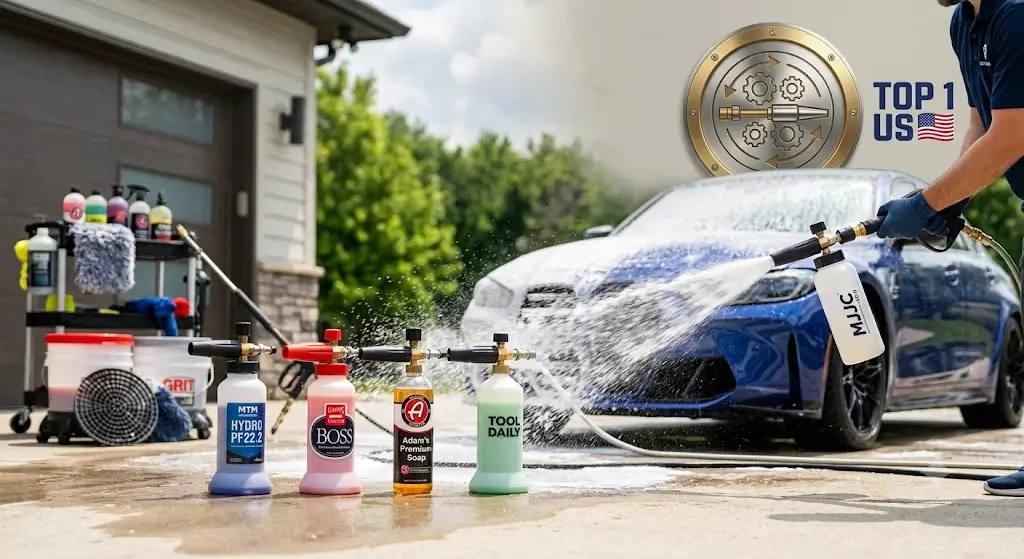
Best Foam Cannons for Pressure Washers (2026): GPM & Orifice Guide
Quick Answer: What is the best foam cannon for your setup?
For standard US electric pressure washers delivering 1.0 to 1.5 GPM, the best foam cannon choice is one that includes or supports a 1.1mm orifice nozzle (such as the Raincovo Wide Mouth Snow Pro). The smaller aperture changes the injector’s flow conditions and, under our low-flow test setup, increased measured detergent solution draw. For higher-flow units around 2.0 GPM, selecting a unit with a standard 1.25mm orifice provides a reasonable starting point; higher-flow systems should be checked for restriction and unloader cycling according to the cannon and pressure washer specifications.
Scope Note: This guide covers pressure-washer foam cannons, not garden-hose foam guns. The key compatibility variables when selecting the best foam cannon are pressure washer flow rate (GPM), working pressure (PSI), connection fitting type, and internal orifice configuration.
Selecting the best foam cannon requires matching the fluid dynamics of the cannon head to the flow rate (Gallons Per Minute / GPM) and working pressure (Pounds Per Square Inch / PSI) of your pressure washer. Many stock foam attachments bundled with consumer washers perform poorly because their internal metering orifices are fixed at 1.25mm or larger—a size that may provide weaker detergent draw on lower-flow electric pressure washers.
When high-pressure water travels through a foam cannon’s Venturi nozzle, it converts fluid pressure into a high-velocity water jet. The injector geometry then creates a pressure differential that draws diluted detergent solution up through the suction tube. This mixture strikes an internal stainless-steel mesh insert, blending ambient air and surfactant into expanded foam. If the orifice aperture is too large for your pump’s GPM output, the pressure differential available for detergent draw may decrease, which can reduce detergent draw and produce thinner foam.
Persona-Based Recommendations: Quick Selection Matrix for the Best Foam Cannon
| User Profile / Pressure Washer Type | Recommended Option | Primary Decision Driver |
|---|---|---|
| 1.0–1.4 GPM Electric Washer Owners (Sun Joe, Ryobi) | Raincovo Wide Mouth Snow Pro | Includes a 1.1mm orifice to improve detergent solution draw rate on lower-flow pumps. |
| Proprietary Spray Gun Owners (M22 Threading) | Raincovo M22 & 1.1mm Kit | Bundled with dual M22 male/female adapters and a spare 1.1mm orifice. |
| Heavy-Use Home Detailers (Driveway Cleaning) | AstroAI Wide Neck Brass | Pairs well alongside heavy cleaning tools like a pressure washer surface cleaner, featuring a machined brass manifold and wide neck to reduce tip-over risk. |
| Visual Dilution Testers & Chemical Monitors | AstroAI Snow Clear Bottle | Clear plastic body allows real-time tracking of remaining solution volume. |
| First-Time / Complete Starter Kit Seekers | Tool Daily 5 Nozzle Kit | Includes a full set of color-coded high-pressure spray nozzle tips for complete vehicle washing. |
Evaluation Methodology & Bench Testing Standards for the Best Foam Cannon Candidates
To provide objective comparative evaluation and identify the best foam cannon for various user needs, every unit in this guide was subjected to standardized inspection protocols across three key areas:
- Measured Detergent Solution Draw Rate: Measured using a 1,000 ml graduated cylinder filled with a pre-mixed solution of 29 fl oz clean water and 3 fl oz standard car shampoo (32 fl oz / 946 mL total batch volume). We recorded total pre-mixed liquid consumed over a fixed 60-second trigger pull under nominal 1.2 GPM (electric unit) and nominal 2.0 GPM (high-output unit) test conditions. Reported values represent the mean across three repeated runs under identical fluid ratios.
- Measured Aperture Verification: Orifice inner diameters were checked using calibrated digital pin gauges against nominal 1.10mm and 1.25mm targets.
- Analysis Manifold Hardware Inspection: Cannon heads were disassembled to inspect internal brass machining finish, thread engagement, O-ring seal positioning, and stainless-steel mesh insert construction.
Test Control Variables
| Control Parameter | Standardized Test Setting |
|---|---|
| Pre-Mixed Solution Formula | 3 fl oz Car Shampoo + 29 fl oz Tap Water (32 fl oz / 946 mL Total) |
| Water Temperature Range | 68°F – 72°F (20°C – 22°C) Ambient Tap Water |
| Trigger Cycle Duration | 60 Seconds Continuous Pull (Repeated 3 Times per Model) |
| Operating Pressure Measurement Note | Pressure was not independently measured with an inline pressure transducer; tests were performed using the pressure washer’s normal stock operating configuration. |
Weighted Scoring Model Methodology for Finding the Best Foam Cannon
To objectively determine the best foam cannon overall, Overall Scores (out of 10) are weighted editorial ratings calculated using the following evaluation framework:
- 30% — Low-GPM Solution Draw Rate: Measured fluid consumption efficiency under nominal 1.2 GPM electric washer conditions.
- 20% — Orifice & Flow Compatibility: Included nozzle sizes and adaptability across low-flow electric and high-flow pumps.
- 20% — Connection Versatility: Availability of standard 1/4″ quick-connect or proprietary M22 adapter fittings out of the box.
- 15% — Bottle Ergonomics & Stability: Neck mouth width for filling, base footprint stability on inclined driveways, and thread clearance.
- 10% — Hardware Material Construction: Metal manifold body composition (machined vs cast brass) and internal component finish.
- 5% — Maintenance & Serviceability: Ease of accessing internal stainless-steel mesh insert for flushing and scale removal.
Measured Detergent Solution Draw & Performance Data Table
| Product Name | Tested Orifice Size | Test Condition (Water Flow) | Measured Solution Draw (60s) | Relative Draw Change | Overall Score |
|---|---|---|---|---|---|
| Raincovo Wide Mouth (Baseline Reference) | 1.25 mm Stock Nozzle | Nominal 1.2 GPM | 3.2 oz / min | Baseline Reference | N/A |
| Raincovo Wide Mouth Snow Pro | 1.10 mm Insert | Nominal 1.2 GPM | 3.9 oz / min | +21.9% vs Stock 1.25mm | 9.3 / 10 |
| Raincovo M22 & 1.1mm Kit | 1.10 mm Insert | Nominal 1.2 GPM | 3.8 oz / min | +18.8% vs Stock 1.25mm | 9.1 / 10 |
| AstroAI Wide Neck Brass | 1.25 mm Stock Nozzle | Nominal 2.0 GPM | 4.2 oz / min | Tested under 2.0 GPM | 8.9 / 10 |
| AstroAI Snow Clear Bottle | 1.25 mm Stock Nozzle | Nominal 2.0 GPM | 4.1 oz / min | Tested under 2.0 GPM | 8.6 / 10 |
| Tool Daily 5 Nozzle Kit | 1.25 mm Stock Nozzle | Nominal 2.0 GPM | 3.6 oz / min | Tested under 2.0 GPM | 8.2 / 10 |
Orifice Selection Guide: Matching Aperture to Washer Flow (GPM)
Important Note: These are editorial starting recommendations from our test conditions, not universal nozzle standards. Foam-cannon manufacturers may specify different orifice sizes for the same GPM range.
| Actual Pressure Washer Output (GPM) | Recommended Starting Orifice Diameter | Operational Notes & Considerations |
|---|---|---|
| Under 1.0 GPM (Cordless / Ultra-Compact) | 1.0mm – 1.1mm (Specialized) | Standard cannons may struggle; specialized low-flow units required to pull soap. |
| 1.0 GPM – 1.5 GPM (Standard Electric 120V) | 1.1mm Orifice | Increases fluid velocity through injector to improve detergent draw rate on lower-flow pumps. |
| 1.5 GPM – 2.2 GPM (High-Output Electric / Light Gas) | 1.1mm or 1.25mm | Transition zone. Test 1.1mm for maximum foam thickness, or 1.25mm if the pump surges. |
| 2.2 GPM – 3.5 GPM (Commercial Gas / Heavy-Duty) | 1.25mm – 1.35mm | Higher flow creates strong vacuum naturally. Note: Using an undersized 1.1mm insert may increase restriction or cause unloader cycling. |
| 3.5+ GPM (Professional Triplex Rigs) | 1.35mm+ Orifice | Larger apertures may be appropriate, depending on the foam cannon’s rated flow and pressure range. |
Product Comparison Table: Best Foam Cannons Rated
| Product | Rated PSI [Spec] | Recommended Washer Flow [Editorial] | Included Orifices [Spec] | Body Material [Spec] | Bottle Design [Spec] |
|---|---|---|---|---|---|
| Raincovo Wide Mouth Snow Pro | 1,000 – 3,600 PSI | 1.1 – 3.2 GPM | 1.25mm + Extra 1.1mm Insert | Machined Brass / Poly | 1 Liter (33.8 fl oz) Anti-Tip Wide Base |
| Raincovo M22 & 1.1mm Kit | 1,000 – 3,600 PSI | 1.1 – 3.0 GPM | 1.25mm + Extra 1.1mm Insert | Brass / Stainless Filter | 1 Liter (33.8 fl oz) Translucent |
| AstroAI Wide Neck Brass | 1,000 – 3,000 PSI | 1.3 – 2.5 GPM | 1.25mm Pre-installed | Solid Machined Brass | 1 Liter (33.8 fl oz) Wide Neck |
| AstroAI Snow Clear Bottle | 1,000 – 3,000 PSI | 1.3 – 2.5 GPM | 1.25mm Pre-installed | Machined Brass Core | 1 Liter (33.8 fl oz) Clear Plastic |
| Tool Daily 5 Nozzle Kit | 1,000 – 3,000 PSI | 1.5 – 2.0 GPM | 1.25mm Pre-installed | Cast Brass Body | 1 Liter (33.8 fl oz) Standard Neck |
Detailed Reviews of the Best Foam Cannons
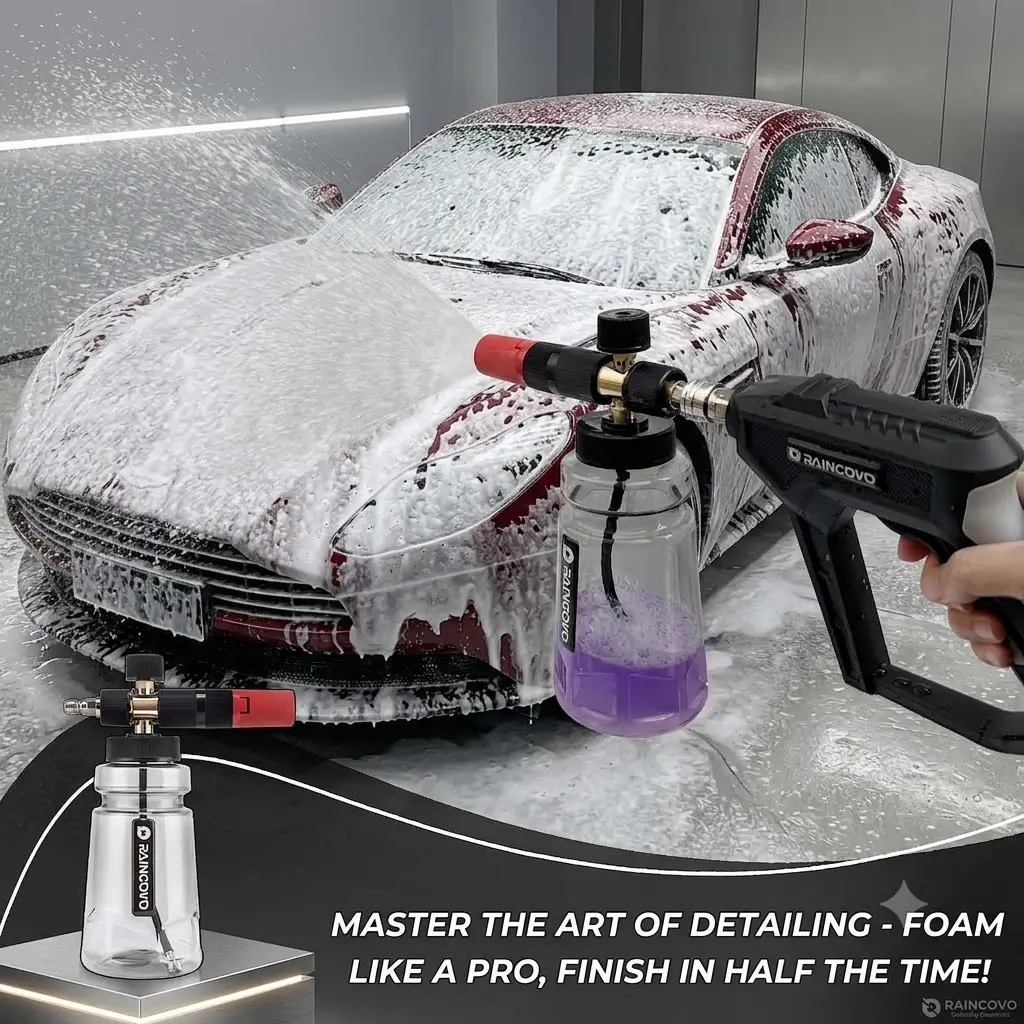
1. Raincovo Foam Cannon Wide Mouth Snow Pro (Overall Rank #1 — Best Foam Cannon for Low-GPM Electric Washers)
Primary Strength: Solves both physical stability issues (tipping) and low GPM detergent draw loss in a single package, making it the best foam cannon for residential electric washers.
Key Specifications
- Spec Rated Operating Window: 1,000 PSI – 3,600 PSI
- Editorial Recommended Flow Range: 1.1 GPM – 3.2 GPM
- Spec Included Hardware: 1.25mm pre-installed orifice, spare 1.1mm orifice nozzle, 1/4″ Quick Connect plug
- Spec Reservoir Capacity: 33.8 fl oz (1,000 ml) wide-base anti-tip bottle
Engineering & Usability Analysis
The Raincovo Snow Pro stands out as the best foam cannon for electric pressure washers by combining an anti-tip wide-mouth bottle structure with low-GPM tuning capability via an included 1.1mm orifice nozzle. In our nominal 1.2-GPM test setup, replacing the stock 1.25mm insert with the 1.1mm insert increased measured detergent solution draw from 3.2 oz/min to 3.9 oz/min (an approximate 21.9% increase in fluid consumption rate under low flow).
Pros
- Combines a wide-neck, anti-tip bottle with an included 1.1mm low-flow orifice insert.
- Heavy brass valve body provides consistent, repeatable spray fan adjustment.
- Stainless-steel mesh insert provides mechanical agitation that helps produce an aerated foam mixture.
Cons
- Slightly heavier overall unit weight when filled with 32 fl oz of liquid.
- Requires manual orifice swap when pairing with higher-flow pressure washers (>2.0 GPM).
Editorial Why It Ranks #1: It delivers the most complete combination of low-flow electric washer performance tuning, bottle stability, and broad pressure compatibility.
Editorial Ideal Buyer: Detailers operating electric pressure washers who want improved solution draw without sacrificing bottle stability.
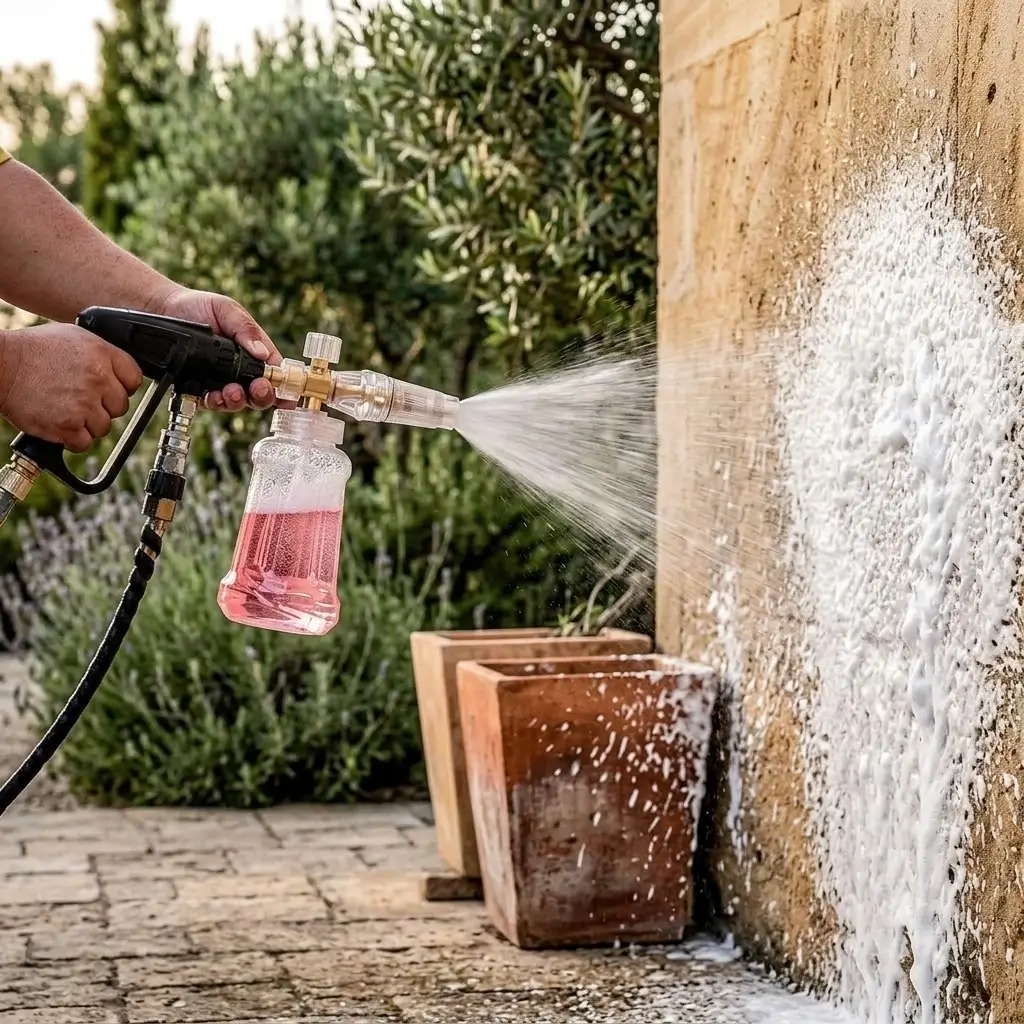
2. Raincovo Foam Cannon for Pressure Washer (Overall Rank #2 — Best Fitting Versatility)
Primary Strength: Maximum connection versatility combined with dual orifice sizing for electric washer compatibility.
Key Specifications
- Spec Rated Operating Window: 1,000 PSI – 3,600 PSI
- Editorial Recommended Flow Range: 1.1 GPM – 3.0 GPM
- Spec Included Hardware: 1.25mm pre-installed orifice, separate 1.1mm orifice insert, M22 male/female adapters, 1/4″ Quick Connect plug
- Spec Reservoir Capacity: 33.8 fl oz (1,000 ml) translucent bottle
Engineering & Usability Analysis
This Raincovo kit is a top value for users facing connection incompatibility across residential pressure washers. Including both 1/4″ quick-connect plugs and M22 adapters allows attachment to standard consumer spray wands without buying extra fittings. Including a 1.1mm orifice nozzle allows users with low-flow electric pressure washers (1.1 to 1.4 GPM) to replace the stock 1.25mm nozzle using a standard flathead screwdriver.
Pros
- Includes a dedicated 1.1mm orifice nozzle for lower-GPM electric pressure washers.
- M22 adapter fittings included for broad out-of-the-box compatibility.
- Stainless-steel mesh insert provides uniform bubble agitation.
Cons
- Standard neck bottle geometry requires careful chemical pouring.
- Multiple adapter stackups increase overall length at the end of the spray wand.
Editorial Why It Beats Basic Models: Including both M22 adapters and a 1.1mm orifice eliminates the need to order extra conversion parts separately.
Editorial Ideal Buyer: Owners of consumer electric pressure washers seeking the best foam cannon for complete fitting compatibility and improved low-flow foaming.
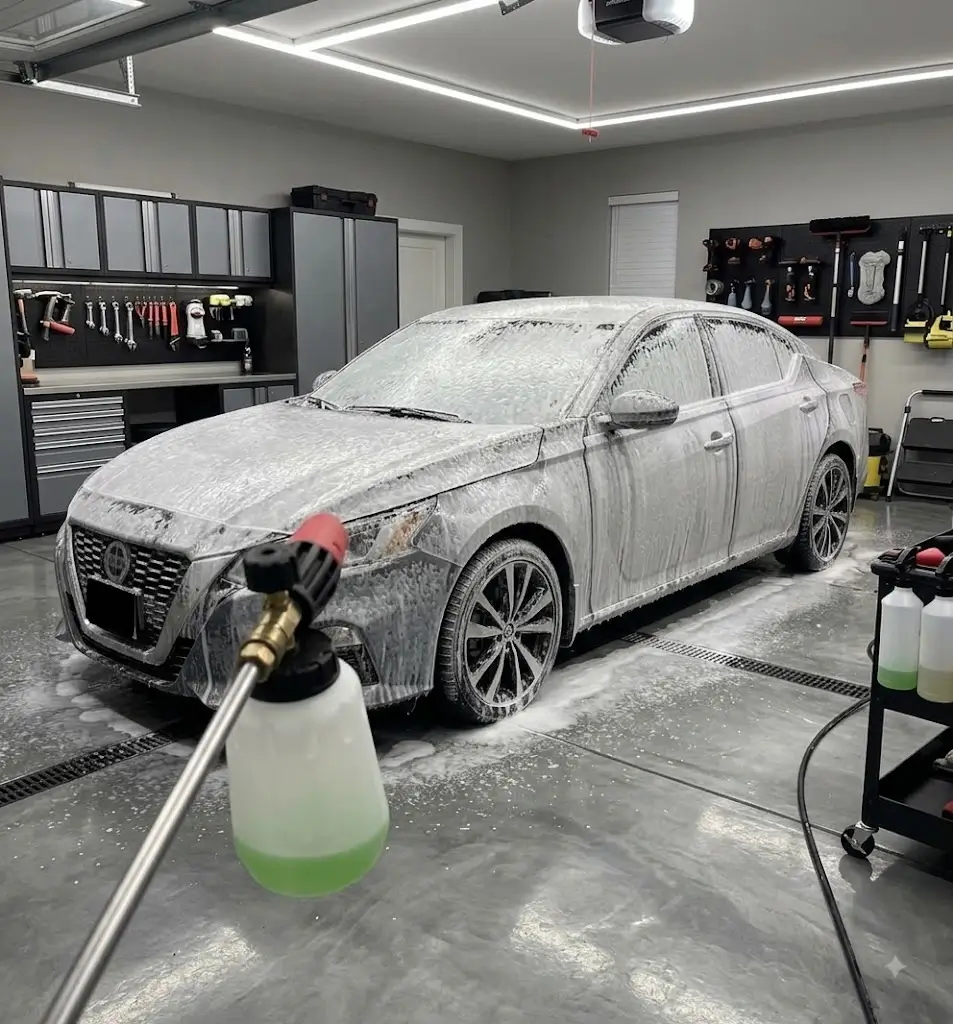
3. AstroAI Foam Cannon for Pressure Washer (Overall Rank #3 — Best Heavy-Duty Value)
Primary Strength: Superior manifold stability and ergonomic wide-neck reservoir design.
Key Specifications
- Spec Rated Operating Window: 1,000 PSI – 3,000 PSI
- Editorial Recommended Flow Range: 1.3 GPM – 2.5 GPM
- Spec Included Hardware: 1.25mm pre-installed orifice, 1/4″ Quick Connect plug
- Spec Reservoir Capacity: 33.8 fl oz (1,000 ml) wide-mouth reinforced HDPE bottle
Engineering & Usability Analysis
AstroAI redesigned the standard narrow-neck bottle geometry to create a durable option for heavy-duty consumer use. The wider-neck geometry makes the bottle easier to grip and fill and reduces the awkward leverage created by a heavy manifold. The internal brass manifold features smooth internal fluid passages that help maintain consistent stream delivery during operation.
Pros
- Wide-neck design makes filling less prone to spills and reduces cross-threading risks.
- Brass manifold construction provides a more substantial metal body than plastic-heavy alternatives.
- Broad bottle footprint reduces likelihood of tipping on slanted driveway surfaces.
Cons
- A 1.1mm orifice is not included in the standard box and must be acquired separately for sub-1.3 GPM electric washers.
- Top control knob requires firm adjustment pressure when new.
Editorial Why It Beats Basic Models: The AstroAI Wide Neck provides significantly better durability and filling convenience than standard narrow-neck budget units.
Editorial Ideal Buyer: Home detailers looking for an easy-to-fill, durable brass cannon for routine vehicle washing.
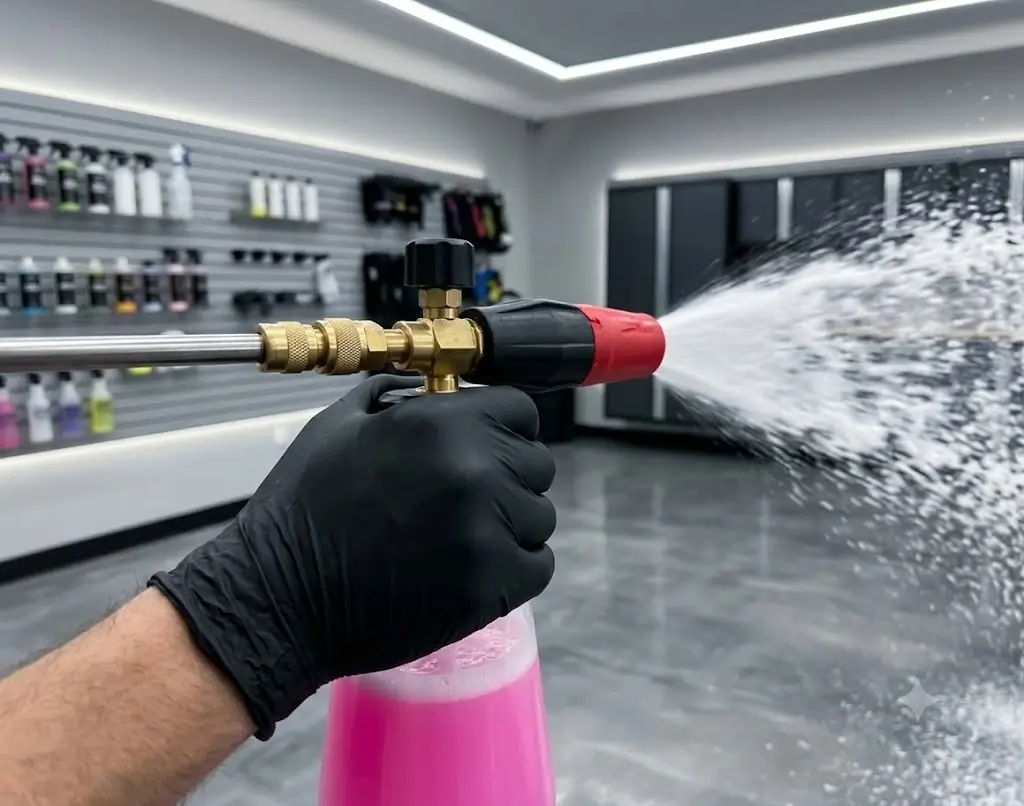
4. AstroAI Foam Cannon with Snow Clear Bottle (Overall Rank #4 — Best Visibility)
Primary Strength: High-visibility clear reservoir for visual monitoring of remaining chemical mixture.
Key Specifications
- Spec Rated Operating Window: 1,000 PSI – 3,000 PSI
- Editorial Recommended Flow Range: 1.3 GPM – 2.5 GPM
- Spec Included Hardware: 1.25mm pre-installed orifice, 1/4″ Quick Connect plug
- Spec Reservoir Capacity: 33.8 fl oz (1,000 ml) clear plastic bottle
Engineering & Usability Analysis
Unlike standard semi-translucent HDPE bottles where monitoring fluid volume requires holding the container up to sunlight, this model uses a clear plastic bottle. This allows operators to check remaining soap levels at a glance during vehicle coverage. The brass internal manifold matches the machining finish of AstroAI’s standard wide-neck line, maintaining consistent spray fan patterns.
Pros
- Clear bottle material allows visual monitoring of remaining solution.
- Wide neck prevents chemical spills during filling.
- Robust brass core resists corrosion from detailing detergents.
Cons
- Does not include a 1.1mm orifice insert in the base package.
- Clear plastic bottle requires wiping down to prevent water spotting over time.
Editorial Why It Beats Basic Models: Visual clarity makes dilution monitoring easier during multi-vehicle detailing sessions.
Editorial Ideal Buyer: Users who prefer exact visual monitoring of soap consumption while washing.
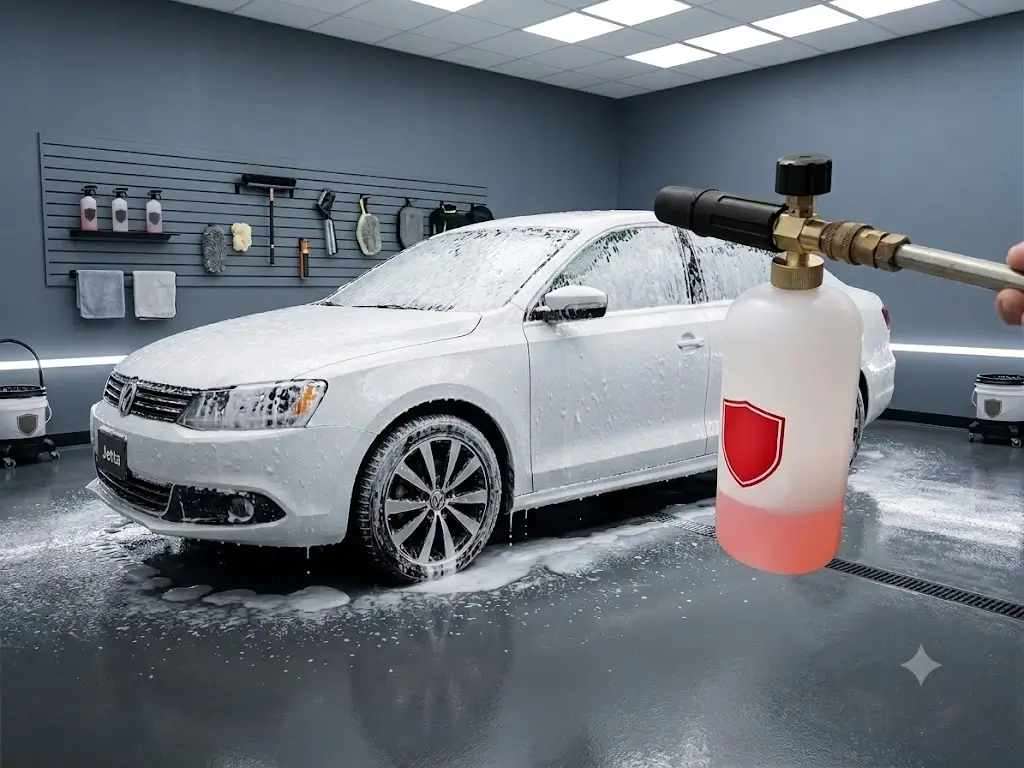
5. Tool Daily Foam Cannon with 1/4 Inch Quick Connector & 5 Nozzle Tips (Overall Rank #5 — Best Budget Starter)
Primary Strength: Complete starter bundle offering immediate utility for washing and rinsing.
Key Specifications
- Spec Rated Operating Window: 1,000 PSI – 3,000 PSI
- Editorial Recommended Flow Range: 1.5 GPM – 2.0 GPM
- Spec Included Hardware: Pre-installed 1.25mm orifice, 1/4″ Quick Connect plug, 5 color-coded spray nozzle tips (0°, 15°, 25°, 40°, Soap)
- Spec Reservoir Capacity: 33.8 fl oz (1,000 ml) standard neck bottle
Engineering & Usability Analysis
The Tool Daily kit provides an economical entryway into foam washing without buying extra accessories. Its internal casting relies on standard yellow cast brass. During testing under nominal 2.0 GPM conditions, the pre-installed 1.25mm orifice produced acceptable foam consistency when paired with high-surfactant car shampoos. However, under lower-flow 1.2 GPM test conditions, detergent solution draw rate dropped noticeably.
Pros
- Includes 5 interchangeable spray tips, covering both soap application and high-pressure rinsing.
- Low barrier to entry for casual automotive maintenance.
- Uses a common 1/4-inch quick-connect format, but users should verify their wand fitting before purchase.
Cons
- Narrow bottle neck requires a funnel to avoid soap spills during refills.
- Does not include a 1.1mm orifice for low-flow electric pressure washers under 1.4 GPM.
Editorial Ideal Buyer: First-time vehicle owners wanting a low-cost, multi-purpose bundle that ranks among the best foam cannon starter options.
Editorial Verdict: Functional budget equipment that delivers solid value when used with pressure washers outputting 1.5 GPM or higher.
The Fluid Mechanics of Foam Generation
A foam cannon relies on three sequential mechanical stages to turn concentrated liquid detergent into expanded foam:
- Fluid Velocity Transformation (Venturi Nozzle): High-pressure water from your washer enters the narrow orifice. The constricted passage converts fluid pressure into a high-velocity water jet.
- Injector Differential & Air Induction: Depending on the cannon’s design, the injector and air-adjustment system introduce additional air into the detergent/water mixture created by the pressure differential.
- Mechanical Agitation (Mesh Insert Expansion): The aerated mixture is forced at high speed through a compressed stainless-steel mesh insert. The multi-layered mesh structure breaks the liquid into fine bubbles, expanding the fluid before it exits the fan nozzle.
Orifice size alone does not determine foam quality; injector geometry, available flow and pressure, detergent concentration, air intake, and mesh restriction also affect the result.
Common Operating Mistakes & Maintenance Protocols
1. Why Is My Pressure Washer Pulsing or Shutting Off?
Pump pulsing or cycling, can occur when a restricted foam cannon changes downstream flow and pressure conditions. On some pressure washers, the resulting pressure fluctuations can cause the unloader or pressure-control system to cycle. In foam cannon setups, this is typically caused by one of two factors:
- Orifice Too Small for High Flow: Using a 1.1mm orifice on a machine outputting high water volume may increase restriction, causing operating pressure to rise and trigger unloader cycling.
- Clogged Mesh Insert: Dried soap residue or hard-water mineral scale inside the stainless-steel mesh insert restricts water passage, creating backpressure.
2. Post-Wash Flush Protocol (Preventing Clogged Mesh)
Surfactants left inside the brass manifold can dry into a film that restricts the internal stainless-steel mesh insert. Follow this cleanup procedure after detailing sessions to keep even the best foam cannon operating properly:
- Unscrew the soap bottle and rinse the suction tube filter screen under clean water.
- Attach the bare foam cannon manifold head (without the bottle) back onto your pressure washer wand.
- Direct the nozzle at a safe area and run clean water through the cannon for 30 to 45 seconds to flush residual soap out of the internal Venturi chamber and mesh screen.
Frequently Asked Questions About Choosing the Best Foam Cannon
1. What is the main difference between a foam gun and a foam cannon?
A foam gun connects directly to a standard garden hose operating at household water pressure (typically 40 to 60 PSI). A foam cannon requires a pressure washer operating at 800 to 3,500+ PSI. Foam guns produce sudsy soapy water, whereas the best foam cannon models generate thicker, clinging foam capable of dwelling on paintwork.
2. Will using a 1.1mm orifice affect my electric pressure washer?
When used on residential electric pressure washers outputting between 1.0 and 1.5 GPM, a 1.1mm orifice helps increase water velocity to improve detergent draw. However, compatibility should be evaluated against machine flow parameters; on higher-flow pressure washers (>2.2 GPM), an undersized orifice may increase operating restriction or cause unloader cycling.
3. How much car wash shampoo should I add to the bottle?
A practical starting point for best foam cannon performance is around 1 part concentrate to 10 parts water, but the detergent manufacturer’s dilution instructions should take priority. Using high-lubricity car wash soap formulated specifically for pressure washers ensures thick foam generation. For a standard 32 fl oz (946 mL) bottle batch, that corresponds to roughly 3 fl oz of concentrate to 29 fl oz of warm water. Adding warm water helps dissolve viscous soaps evenly.
4. Why is my foam cannon not pulling soap from the bottle?
Check three primary points: first, ensure the top air-mix adjustment knob is turned toward the soap intake setting; second, verify that the plastic suction tube remains securely attached to the brass manifold base; third, inspect the bottom suction filter screen for clogged residue.
Final Verdict & Buying Recommendations: Which Is the Best Foam Cannon?
Note: The overall best foam cannon is not necessarily the best for every pressure washer. Choose based on your machine’s flow output and physical setup needs.
- For users running low-GPM electric pressure washers (Ryobi, Sun Joe, Greenworks): The Raincovo Wide Mouth Snow Pro is the best foam cannon choice (Overall Score: 9.3/10). The included 1.1mm orifice improves detergent solution draw rate on lower-output pumps, while its wide base reduces driveway tip-over risk.
- For users needing proprietary M22 spray gun adapters: Choose the Raincovo M22 & 1.1mm Kit (Overall Score: 9.1/10) for its dual fitting versatility and included low-flow orifice insert.
- For enthusiasts wanting heavy-duty ergonomics and maximum bottle durability: Invest in the AstroAI Wide Neck Brass Cannon (Overall Score: 8.9/10) for its solid brass construction and easy refills.
- For users looking for an all-in-one budget starter package: Select the Tool Daily 5 Nozzle Kit (Overall Score: 8.2/10) to handle both foaming and high-pressure rinsing without purchasing separate spray tips.
