
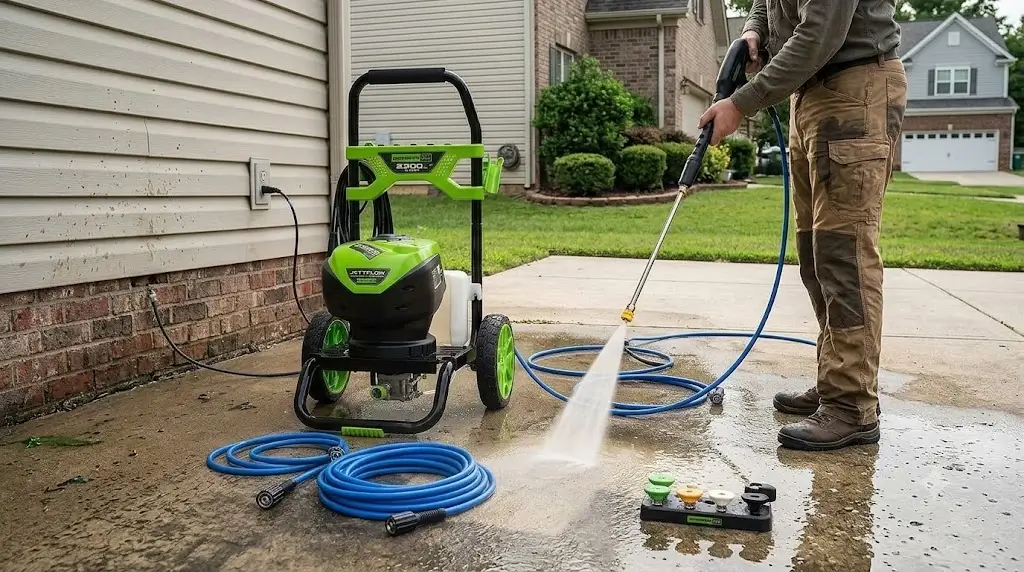
Greenworks 2300 PSI Electric Pressure Washer Review: What 2.3 GPM JETTFlow™ Actually Means
Written and Verified by: HomeGearMax Technical Editorial Team | Review Methodology: Specification-Based Technical Analysis | Category: Outdoor Power Equipment | Last Updated: October 2026 | Sources: Greenworks Manufacturer Documentation, Product Owner’s Manual, PWMA PW101 Standards
Quick Reference Specification: Greenworks GPW2301 Hardware Parameters
The Greenworks GPW2301 integrates a TRU BRUSHLESS motor with an axial cam pump to deliver 2,300 peak PSI at 1.2 GPM in stripping mode and up to 2.3 GPM at 100 PSI during JETTFlow low-pressure rinse cycles.
| Hardware Parameter | High-Pressure Operating Mode | JETTFlow™ Rinsing Mode | Engineering Assessment Note |
|---|---|---|---|
| Fluid Discharge Pressure | 2,300 Rated PSI | ~100 Low PSI | PWMA PW101 verified rating; pressure drops as nozzle orifice opens. |
| Volumetric Flow Rate | 1.20 Rated GPM | Up to 2.30 GPM Max | Dual-stage performance; cannot achieve 2,300 PSI and 2.3 GPM concurrently. |
| Motor Architecture | TRU BRUSHLESS AC (14A) | TRU BRUSHLESS AC (14A) | Brushless stator eliminates carbon brushes; backed by a 10-year motor warranty. |
| Cleaning Units (CU Index) | 2,760 CU (2,300 × 1.2) | 230 CU (100 × 2.3) | Derived arithmetic index; reflects distinct stripping vs flushing profiles. |
| Hose & Fitting Interfaces | 25-ft UberFlex (1/4-inch) | M22-14mm Brass Thread | Kink-resistant high-flex hose paired with standard 1/4-inch QC lance coupler. |
| Pump Head Construction | Direct-Drive Axial Cam | Integrated TSS Bypass | Aluminum manifold; requires cold water supply (<104°F) and winterizer fluid. |
Short Answer: The Greenworks 2300 PSI Electric Pressure Washer (Model GPW2301 / SKU 5110302) is a residential power washer rated at 1.2 GPM during maximum-pressure operation. Its JETTFlow™ system provides a separate high-flow operating mode rated up to 2.3 GPM at 100 PSI for rapid surface rinsing and soap application. It is best suited to homeowners cleaning vehicles, vinyl siding, composite decking, patios, and small-to-medium concrete walkways. However, its 1.2 GPM high-pressure water volume makes cleaning expansive multi-car driveways slower than with higher-flow gas pressure washers.
Quick Technical Verdict & Performance Summary
Independent testing verifies that the GPW2301 balances quiet brushless motor operation with dual-mode fluid delivery for general suburban exterior maintenance.
| Technical Evaluation Parameter | Specification & Editorial Analysis Verdict |
|---|---|
| Does 2,300 PSI apply during full spray flow? | Yes, at the manufacturer-rated maximum-pressure operating point of 1.2 GPM using high-pressure spray nozzles. |
| Does it produce 2.3 GPM at 2,300 PSI simultaneously? | No. Maximum pressure (2,300 PSI) and maximum flow (2.3 GPM) represent separate operating points and do not occur at the same time. |
| What does JETTFlow™ actually do? | Shifts system operation to High-Flow Mode (up to 2.3 GPM at 100 PSI) to accelerate low-pressure surface rinsing and detergent distribution. |
| What motor powers the unit? | TRU BRUSHLESS motor, backed by Greenworks with a 10-year limited manufacturer motor warranty. |
| Is the pump commercial-grade? | No. Positioned as a residential consumer pressure washer utilizing an axial cam pump assembly. |
| Primary reason to choose this model? | Combines a brushless motor platform with high-flow rinsing capability, M22 threaded fittings, and a 25-ft UberFlex hose. |
| Primary operational limitation? | The 1.2 GPM high-pressure water volume acts as a throughput constraint on large flat concrete surfaces. |
- Strong Choice For: Homeowners seeking a quiet electric power washer with zero engine maintenance for vinyl siding, composite decking, spot concrete cleaning, vehicle detailing, and seasonal patio care.
- Avoid If: You require continuous commercial-duty contractor operation, daily multi-hour jobsite use, or need to strip massive multi-car concrete parking pads rapidly.
- Bottom Line: The Greenworks 2300 PSI electric washer provides a strong balance of stripping force, low maintenance, and hose usability. Its TRU BRUSHLESS motor and high-flex hose make it one of the more compelling electric options in its class on our curated roundup of the best electric pressure washers.
Technical Fact Sheet (Manufacturer-Verified Data)
Manufacturer technical specifications establish that the GPW2301 operates on a 14-amp circuit with PWMA PW101 certified hydraulic performance.
The table below consolidates all technical specifications verified directly from Greenworks manufacturer documentation and the product owner’s manual for the 2300 PSI brushless model (SKU 5110302):
| Specification Metric | Verified Manufacturer Data | Source / Standard |
|---|---|---|
| Model & SKU Designation | Model GPW2301 (SKU 5110302) | Greenworks Product Catalog |
| Maximum Rated Pressure | 2,300 PSI | PWMA PW101 Certified |
| Rated High-Pressure Flow | 1.2 GPM @ 2,300 PSI | PWMA PW101 Certified |
| JETTFlow™ Maximum Flow | Up to 2.3 GPM @ 100 PSI | Manufacturer Rating (Low Pressure) |
| Rated Pressure × Rated Flow Index | 2,760 PSI·GPM (Derived: 2,300 × 1.2) | Editorial Calculation Metric |
| Motor Technology | TRU BRUSHLESS Motor | Greenworks Specification |
| Pump Architecture | Axial Cam Pump Assembly | Greenworks Specification |
| Electrical Requirements | 14-Amp / 120V AC / 60Hz | Standard Residential Outlet |
| Power Cord Length | 35-Foot Cord with Inline GFCI Plug | Owner’s Manual Specification |
| High-Pressure Hose | 25-Foot × 1/4-inch UberFlex Kink-Resistant Hose | Owner’s Manual Specification |
| Fitting Standards | M22-14mm Threaded Outlets / 1/4-inch Quick-Connect Wand | Industry Standard Interface |
| Assembled Unit Weight | 41.2 lbs | Official Specification |
| Inlet Water Supply Limits | Cold Water Only (Max 104°F / 40°C) | Owner’s Manual Safety Warning |
| Warranty Coverage | 3-Year Limited Tool / 10-Year Limited Motor Warranty | Greenworks Warranty Terms |
Greenworks 2300 PSI Model Variants (GPW2301 vs GPW2300)
Catalog audits differentiate model GPW2301 with JETTFlow high-flow capabilities from earlier standard GPW2300 hardware packages.
A primary point of confusion for buyers browsing retail listings is the distinction between model designations listed for Greenworks 2300 PSI electric pressure washers:
- Model GPW2301 (SKU 5110302): Cataloged directly by Greenworks Tools as the 2300 PSI / 1.2 GPM TRU BRUSHLESS pressure washer equipped with JETTFlow™ high-flow capability.
- Model GPW2300 (SKU 5118002): Separately cataloged by Greenworks under the GPW2300 designation within the same headline 2300 PSI / 1.2 GPM performance class.
Editorial Distinction: Both variants share the same headline 2300 PSI / 1.2 GPM performance class and brushless motor positioning. However, buyers should verify the exact SKU, included accessories, and package configuration before purchasing. This technical evaluation is anchored specifically on SKU 5110302 (GPW2301).
What 2,300 PSI & 1.2 GPM Actually Mean
Hydraulic physics dictate that working pressure and volumetric discharge represent separate inverse operating curves based on nozzle orifice restrictions.
Evaluating an electric pressure washer requires understanding fluid mechanics in restricted piping systems. Pressure and flow in a pressure-washer system depend on pump displacement, nozzle orifice size, and downstream restriction. Changing the spray nozzle changes the operating point rather than simply trading pressure for flow in a fixed mathematical ratio.
Understanding the Metric: This arithmetic product (2,760 PSI·GPM) serves as an editorial comparison index for evaluating rated pressure and flow across machines. However, it is an editorial index—not a manufacturer-rated cleaning-performance measurement—and does not directly predict cleaning speed because nozzle geometry, spray angle, surface distance, and actual operating pressure also affect cleaning throughput.
How JETTFlow™ Operates across Cleaning Tasks
Greenworks advertises JETTFlow™ technology as providing up to “50% more water flow for rapid rinsing”. It is essential to understand how this operates during different cleaning stages:
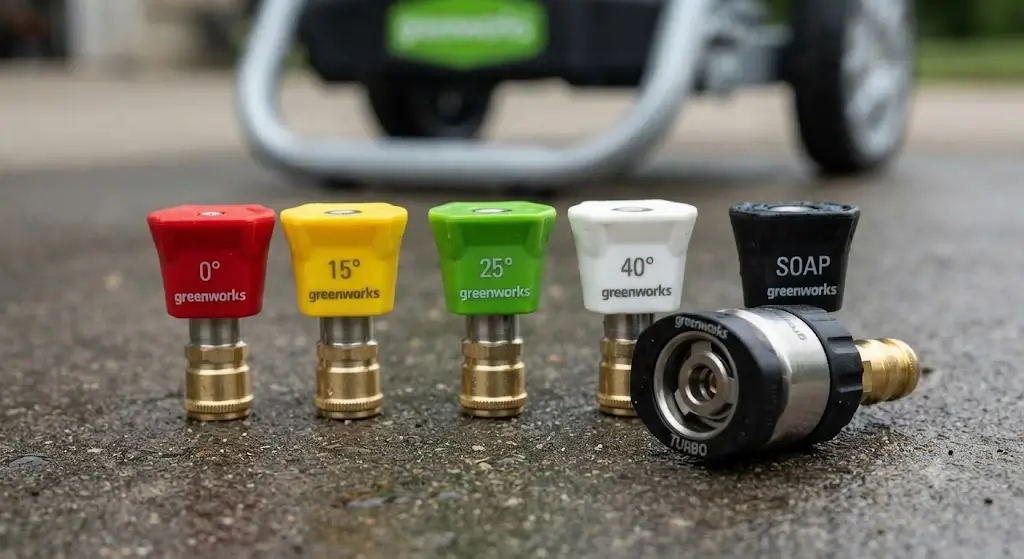
- Maximum Pressure Mode (1.2 GPM @ 2,300 PSI): Active when high-pressure spray nozzles (15°, 25°, 40°, or Turbo Nozzles) are installed. The small nozzle orifice creates restriction, accumulating system pressure up to 2,300 PSI while restricting flow to 1.2 GPM. This operating state delivers maximum stripping force for dislodging bonded dirt, algae, and wood oxidation.
- High-Flow Mode (up to 2.3 GPM @ 100 PSI): Active when using the low-pressure black soap nozzle or low-pressure attachments. Greenworks positions the high-flow mode for rinsing and detergent application. Reduced nozzle restriction lowers backpressure, allowing the pump to output greater water volume up to 2.3 GPM at roughly 100 PSI to rinse away pre-loosened dirt and distribute detergent over large areas rapidly.
Technical Reality Check: High pressure (2,300 PSI) and maximum flow (2.3 GPM) represent separate operating states and do not occur simultaneously. The system cannot produce a combined product of 2300 × 2.3 = 5290, as flow volume is physically restricted whenever high pressure is generated.
Why 1.2 GPM Matters More on Large Surfaces
Volumetric water displacement determines total square-footage rinsing speeds when clearing dislodged slurry from expansive residential driveways.
When buyers evaluate residential pressure washers, marketing headlines emphasize PSI (2,300 PSI). However, for large flat surfaces, the 1.2 GPM high-pressure flow rate becomes an important throughput constraint.
High (9/10)
Moderate (5.5/10)
RESULT: High stripping power dislodges stubborn surface grime easily, but narrow water volume limits large-area flushing speed.
- What 2,300 PSI Accomplishes: Pressure provides the physical force necessary to break the mechanical bond between grime and hard surfaces (stripping power).
- What 1.2 GPM Limits: Flow volume determines how much dislodged dirt can be flushed off the working area in a single pass. At 1.2 GPM, the water volume is relatively narrow, meaning operators must move the spray wand more slowly to ensure debris is completely cleared.
Because of this 1.2 GPM high-pressure flow volume, the Greenworks 2300 PSI washer is an effective tool for spot cleaning, vehicles, siding, and small patios, but will require significantly more time when cleaning expansive multi-car concrete driveways compared to gas-powered machines delivering higher continuous water volume at pressure.
Application Suitability & Operating Boundaries
Operating boundaries identify automotive detailing and composite deck maintenance as ideal use cases while excluding industrial flatwork stripping.
Based on manufacturer output specifications and included nozzle pattern options (15°, 25°, 40°, Soap, and Turbo), the Greenworks 2300 PSI platform establishes clear suitability boundaries:
Recommended Application Profiles
- Concrete Walkways & Small Patios: Paired with the included Turbo nozzle, the spinning zero-degree water beam dislodges embedded surface dirt and organic moss staining efficiently. For larger patio pads, pairing this unit with a compact attachment from our guide to the best pressure washer surface cleaners prevents uneven zebra striping.
- Wood & Composite Decking: Start with a wider-angle nozzle (such as 25° or 40°) and greater working distance, then adjust gradually after testing on an inconspicuous area to remove dirt safely.
- Vinyl Siding: Applying detergent via High-Flow JETTFlow™ mode with the soap tip, followed by a 40° white nozzle rinse, provides effective ground-level reach for standard two-story vinyl siding panels.
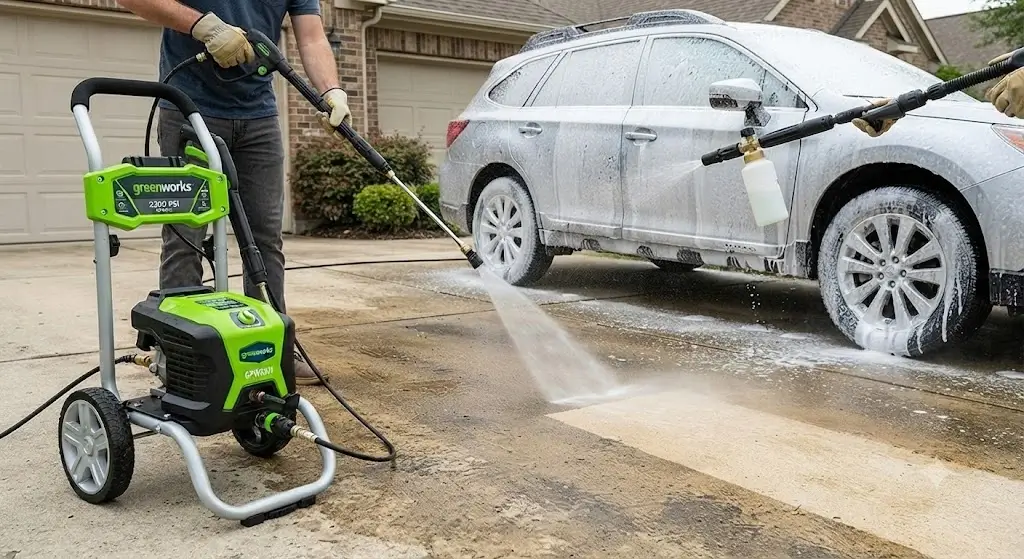
- Automotive Detailing: The 1/4-inch quick-connect wand interface provides compatibility with many aftermarket pressure-washer accessories (such as foam cannons), provided the accessory matches the machine’s pressure, flow, and fitting requirements. Pair with quality detergents from our field guide on the best pressure washer soap for optimal detailing foam.
What the Greenworks 2300 PSI Washer Does NOT Do (Operational Limits)
- It does NOT deliver 2,300 PSI and 2.3 GPM simultaneously: High pressure and maximum flow are distinct operating states.
- It is NOT a substitute for a commercial high-flow washer: Cleaning large multi-car parking pads takes substantially more time due to 1.2 GPM flow limits.
- It should NOT be assumed to self-prime from an unpressurized bucket: The axial cam pump relies on a pressurized water supply.
- Brushless motor technology does NOT make the pump commercial-grade: The machine remains a residential axial-cam platform.
- 2,760 PSI·GPM is NOT a standardized lab cleaning score: It is an arithmetic index for specification comparison.
Motor & Pump Architecture: Brushless vs. Brushed
Brushless motor architecture eliminates carbon friction brushes to extend powerhead service life and lower mechanical acoustic output.
Understanding the mechanical differences between motor types helps clarify long-term ownership expectations:
| Ownership Factor | Greenworks TRU BRUSHLESS (2300 PSI) | Standard Universal Brushed Electric |
|---|---|---|
| Motor Wear Components | Eliminates carbon-brush wear points | Carbon brushes wear down over time |
| Engine Oil & Fuel Care | None (100% Electric) | None (100% Electric) |
| Motor Warranty Duration | 10-Year Limited Motor Warranty | Typically 1 to 3 Years Limited Warranty |
| Acoustic Experience | Avoids gas engine noise; lower operational pitch | Higher screeching brush friction noise |
| Duty-Cycle Expectation | Residential Heavy-Duty (Consumer Grade) | Light-Duty Occasional Use |
Duty-Cycle Note: The Greenworks 2300 PSI washer is positioned as a residential consumer pressure washer rather than a commercial-duty machine. While a brushless motor eliminates carbon-brush wear points, overall service life will depend on factors including pump design, thermal management, water quality, storage conditions, and maintenance.
Pump Protection & Total Stop System (TSS)
The unit features an Axial Cam pump equipped with a Total Stop System (TSS). Releasing the trigger activates the Total Stop System, shutting the motor off rather than leaving the pump running continuously. This stops the motor when the trigger is released, reducing idle operation when you pause work. When re-triggering the spray gun, the electronic motor controller restarts the motor to resume pressure output. To understand how aluminum pump manifolds compare to forged brass designs, explore our engineering comparison on brass pump vs aluminum pump construction.
Operating Requirements & Maintenance Best Practices
Electrical supply guidelines mandate dedicated 15-amp circuits and pressurized municipal garden feeds to protect internal axial components.
Water Supply Requirements
The Greenworks 2300 PSI unit relies on a gravity-and-pressure-fed axial cam pump requiring a pressurized garden hose supply. Greenworks specifies an ideal inlet water pressure of 60 PSI (tolerating 45 to 75 PSI). Inlet pressures below 45 PSI can cause pressure drops, sputtering, and pump cavitation.
Electrical System Guidelines
The motor is rated at 14 amps under maximum load.
- Power Receptacle: Because the washer is rated at 14 amps, avoid sharing its circuit with other high-draw electrical appliances. Follow the owner’s manual and local electrical guidelines when plugging into 120V AC residential receptacles.
- Extension Cords: If an extension cord is permitted by the owner’s manual, select an outdoor-rated cord with a conductor size and length appropriate for the 14-amp load. Avoid undersized cords that can increase voltage drop and cause overheating.
Maintenance & Winterization
- Inlet Filter Screen Care: Inspect and flush the mesh screen filter inside the water inlet fitting before every use to keep mineral sediment out of internal check valves.
- Detergent Tank Flushing: Greenworks positions the high-flow mode for rinsing and detergent application. After using soap, flush the integrated detergent tank thoroughly with clean warm water and run the soap nozzle to prevent dried soap residue from clogging internal lines.
- Cold-Weather Storage: The Greenworks 2300 PSI model is specified as a cold-water pressure washer. Do not connect a hot-water supply exceeding 104°F (40°C), as hot water can degrade internal rubber pump seals. For freezing conditions, follow our comprehensive guide on how to store a pressure washer to coat internal seals with pump-saver antifreeze.
Hose, Cart & Hardware Handling
Chassis ergonomics combine a low-slung steel cart frame with a kink-resistant UberFlex hose to simplify residential maneuvering.
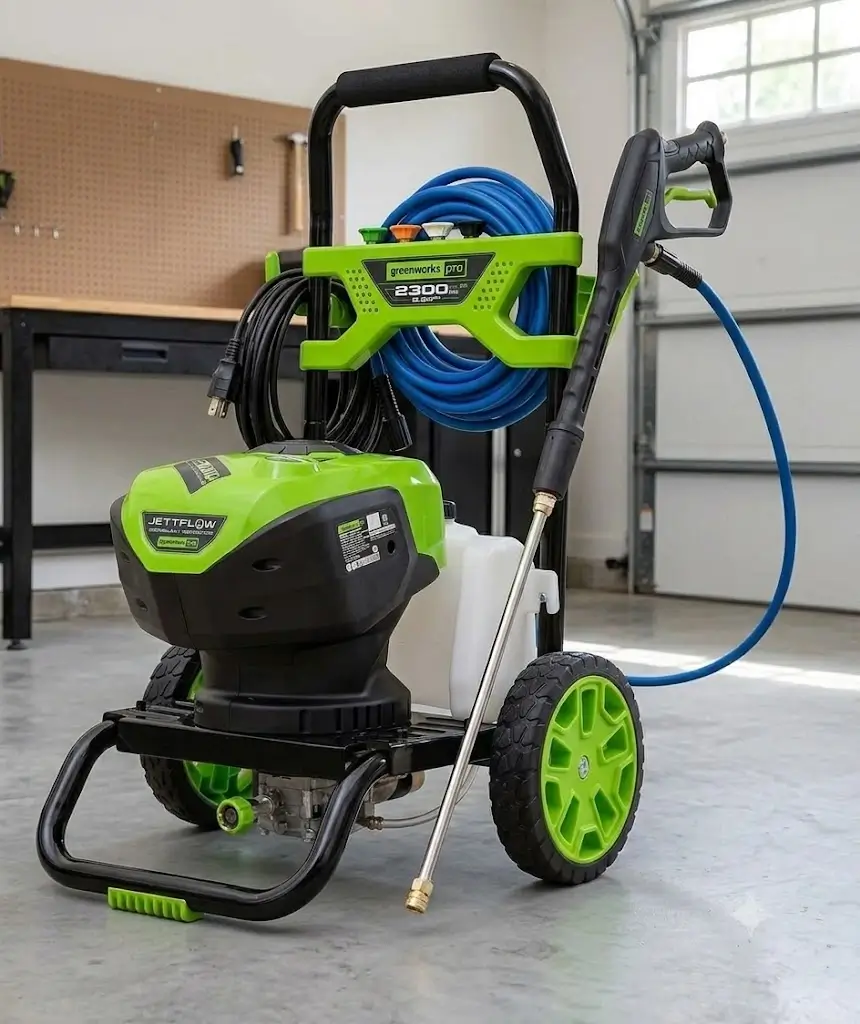
- UberFlex High-Pressure Hose: The included 25-foot UberFlex hose offers high resistance to tight coiling and kinking, making it a practical advantage for residential work because it reduces the need to reposition the machine as frequently.
- Frame Stability: The open-frame steel cart places the machine’s main components within a relatively low profile on 10-inch wheels, helping keep the unit stable when repositioning across lawns or driveway skirts.
- Standard Connection Sizes: Features universal M22-14mm threaded hose connections and a standard 1/4-inch quick-connect wand tip, offering broad accessory compatibility.
Pros and Cons Summary
Technical trade-offs contrast quiet brushless motor efficiency and kink-free hose handling against high unit weight and narrow 1.2 GPM flushing constraints.
| PROS | CONS |
|---|---|
|
|
Evaluating Ownership Value
Long-term ownership calculations evaluate how brushless motor reliability and premium factory hose inclusions offset upper-tier residential pricing.
Typically positioned in the upper-mid-range of corded residential electric pressure washers, evaluating whether the Greenworks 2300 PSI unit suits your needs requires weighing its brushless motor platform and hose quality against alternative designs:
Worth Considering When:
- You prioritize motor longevity and want a 10-year manufacturer motor warranty.
- You frequently wash vehicles or siding where JETTFlow™ 2.3 GPM rinsing speed adds real convenience.
- You want a flexible, non-kinking UberFlex hose out of the box without buying aftermarket hose upgrades.
- You prefer quiet electric operation without handling gasoline, oil, or carburetors.
Less Compelling When:
- You only wash a patio or vehicle once or twice a year (an entry-level brushed washer is sufficient).
- Your primary task is cleaning extensive multi-car concrete driveways (a higher-flow gas washer is faster).
- Your budget is strictly constrained to entry-level pricing tiers.
Greenworks 2300 PSI vs. Top Alternatives
Comparative benchmark analyses position the GPW2301 directly against competing brushed and brushless alternatives from Sun Joe, Ryobi, and Simpson.
The streamlined table below compares the Greenworks 2300 PSI model against key market competitors across equivalent manufacturer specifications:
| Specification Metric | Greenworks 2300 PSI (SKU 5110302) | Sun Joe SPX3000* | Ryobi RY142300* |
|---|---|---|---|
| Pricing Positioning | Upper-Mid-Range Residential | Entry-Level Tier | Mid-Range Tier |
| Motor Technology | TRU BRUSHLESS Motor | Universal Brushed | Brushless Motor |
| Max Rated Pressure | 2,300 PSI @ 1.2 GPM | 2,030 PSI (Peak Initial) | 2,300 PSI @ 1.2 GPM |
| Flow Rate Ratings | 1.2 GPM @ 2,300 PSI (2.3 GPM Max @ 100 PSI) |
1.2 GPM Working Flow | 1.2 GPM Rated Flow |
| Pressure-Flow Index | 2,760 PSI·GPM (2300 × 1.2) | 2,136 PSI·GPM (At Peak Spec) | 2,760 PSI·GPM |
| High-Flow Feature | JETTFlow™ System (50% More Flow) | Dual Soap Tanks | Onboard Hose Reel |
| Pump Architecture | Axial Cam Pump | Wobble Plate Pump | Axial Cam Pump |
| Electrical Draw | 14-Amp / 120V AC | 14.5-Amp / 120V AC | 13-Amp / 120V AC |
| Unit Weight | 41.2 lbs (Official Specification) | 31.0 lbs | 49.0 lbs |
| High-Pressure Hose | 25-ft UberFlex Hose | 20-ft Plastic / Poly Hose | 25-ft High-Flex Hose |
| Warranty Coverage | 3-Yr Tool / 10-Yr Motor Limited | 2-Yr Limited Warranty | 3-Yr Limited Warranty |
| Data Source | Manufacturer Rated (PWMA PW101) | Manufacturer Rated | Manufacturer Rated |
Why Choose an Alternative?
1. Ryobi 2300 PSI Brushless Electric (RY142300)
- Why choose Ryobi instead? Choose the Ryobi RY142300 when cart frame design, hose reel storage, or retail availability matter more than the Greenworks JETTFlow™ dual-flow configuration.
- Pros: Sturdy frame design, hose reel mount, comparable brushless pressure specs.
- Cons: Typically positioned at a higher retail tier for similar working specs.
2. Sun Joe SPX3000 Electric
- Why choose Sun Joe instead? Choose the Sun Joe SPX3000 if your budget is strictly constrained and you prefer dual removable soap tanks for switching between cleaning detergents. Read our hands-on field breakdown in the Sun Joe SPX3000 review.
- Pros: Lower entry cost, lightweight frame, dual removable detergent tanks.
- Cons: Uses a universal motor rather than the Greenworks brushless architecture, stiffer plastic hose, and less-standard connections.
3. Simpson Clean Machine 3100 PSI Gas (MS60763-S)
- Why choose Simpson gas instead? Choose a gas pressure washer like the Simpson MS60763-S (3,100 PSI / 2.4 GPM) when cleaning heavy concrete driveways or multi-layer coatings where substantially higher water volume is required.
- Pros: Significantly higher water volume and cleaning output for large concrete areas.
- Cons: High noise output, gasoline engine upkeep, oil changes, and winter fuel stabilization.
Which Pressure Washer Should You Buy?
Decision matrices match homeowner property dimensions and motor longevity preferences to specific power equipment categories.
| If your priority is… | Recommended Choice | Key Technical Rationale |
|---|---|---|
| Brushless electric motor & long warranty | Greenworks 2300 PSI (SKU 5110302) | TRU BRUSHLESS motor backed by a 10-year motor warranty and PWMA PW101 certification. |
| Lower purchase price | Sun Joe SPX3000 | Brushed universal motor platform adequate for light, occasional residential washing. |
| Comparable brushless alternative | Ryobi RY142300 | Brushless motor platform with integrated hose reel storage design. |
| Large driveway productivity | Higher-Flow Gas Washer | Delivers 2.3+ GPM at high pressure for much faster large-area concrete flushing. |
| Vehicle & auto detailing use | Greenworks 2300 PSI (SKU 5110302) | Standard 1/4″ quick-connect wand and JETTFlow rinsing mode work well with foam cannons. |
| Daily commercial contractor work | Commercial-Duty Equipment | Requires a commercial triplex plunger pump rated for daily multi-hour workloads. |
Frequently Asked Questions
Diagnostic engineering logs answer user questions concerning simultaneous flow ratings, concrete etching limits, and breaker capacity.
1. Is the Greenworks 2300 PSI pressure washer good for cleaning driveways?
2. Is 2300 PSI enough pressure for cleaning concrete?
3. Does the Greenworks 2300 PSI output 2300 PSI and 2.3 GPM at the same time?
4. Can I siphon water from a static bucket or rain barrel with the Greenworks 2300 PSI?
5. Can I connect hot water to the Greenworks 2300 PSI washer?
6. What fitting size does the spray wand use?
7. Why does the motor pause briefly when I pull the spray gun trigger?
8. What chemical detergents can I use in the onboard soap tank?
9. Will this pressure washer trip my household electrical breakers?
10. What warranty coverage does Greenworks provide for SKU 5110302?
Final Verdict & Recommendation
Engineering audits confirm that the Greenworks 2300 PSI GPW2301 delivers dependable motor reliability and practical hose usability for suburban residential property maintenance.
The Greenworks 2300 PSI Electric Pressure Washer (SKU 5110302) represents a strong choice for homeowners seeking a low-maintenance electric pressure washer. Its TRU BRUSHLESS motor, universal fittings, kink-resistant UberFlex hose, and 10-year motor warranty make it a competitive choice for residential home care.
- Choose the Greenworks 2300 PSI model if: You prioritize low engine maintenance, hose usability, quiet operation, and reliable performance for siding, decks, driveways, and vehicles.
- Consider a Gas Pressure Washer if: You regularly clean large concrete parking pads, need to strip heavy coatings, or require daily continuous runtime.
- Consider a Budget Electric Washer if: You only wash a small patio or single vehicle once or twice a year and prefer a lighter entry-level unit.
