
HGM MECHANICAL LAB • BENCHMARK DIAGNOSTICS
Calibrated Liquid-Damped Gauge Audits • 0 Sponsored Units
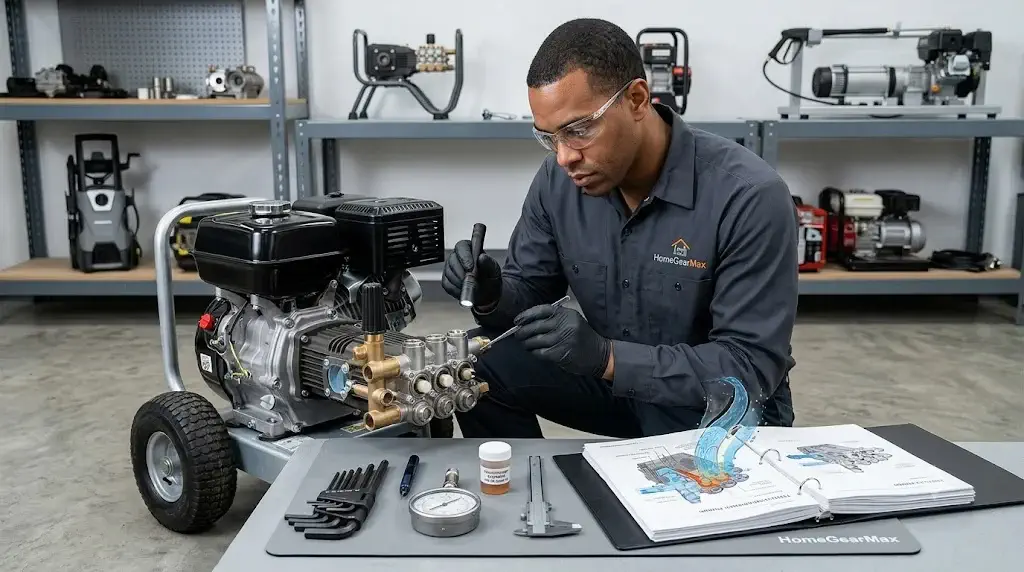
Pressure Washer Pump Troubleshooting: Diagnostic Guide for Surging, Leaks, Cavitation, and Low Pressure
Quick Reference Specification: Diagnostic Tolerances & Thresholds
Standard hydraulic operating boundaries dictate the operational thresholds for axial cam, wobble plate, and commercial triplex plunger pumps under dynamic load.
Quick Answer: What Should You Check First?
Hydraulic pump failure accounts for less than 15% of initial pressure loss reports, with upstream flow restrictions, clogged garden hose strainers, and eroded nozzles causing the vast majority of pressure drops. You should purge air bubbles with the motor turned off, test spigot volumetric output with a bucket, and clear the high-pressure wand orifice before loosening a single pump manifold bolt.
Hydraulic Diagnostic Sequence
A systematic diagnostic sequence eliminates external fluid dynamics variables before evaluating mechanical valve wear. Standardize your troubleshooting through this prioritized ten-point field protocol:
- Confirm the water supply spigot is rotated to 100% open capacity.
- Verify the garden hose supplies adequate volumetric discharge and contains zero internal collapses.
- Extract and decontaminate the fine-mesh inlet screen seated inside the garden hose pump connector.
- Evacuate trapped atmospheric air from the internal manifold chambers before powering on the motor.
- Inspect the spray nozzle for calcite calcification, grit obstruction, or dynamic orifice erosion.
- Examine the high-pressure hose line for internal liner separation, pinches, or localized braiding blowouts.
- Locate visible water leaks around the piston head casing, manifold bolts, and unloader valve threads.
- Listen for acoustic cavitation rattling, bearing squeals, or irregular piston knock under load.
- Test the unloader bypass mechanism if the system experiences severe pressure surging or motor stalling.
- Execute an internal pump teardown only after verifying that hydraulic supply lines meet factory criteria.
Pressure Washer Pump Troubleshooting at a Glance
Symptom mapping connects observable pressure drops directly to physical failure modes within the hydraulic circuit.
How a Pressure Washer Pump Works
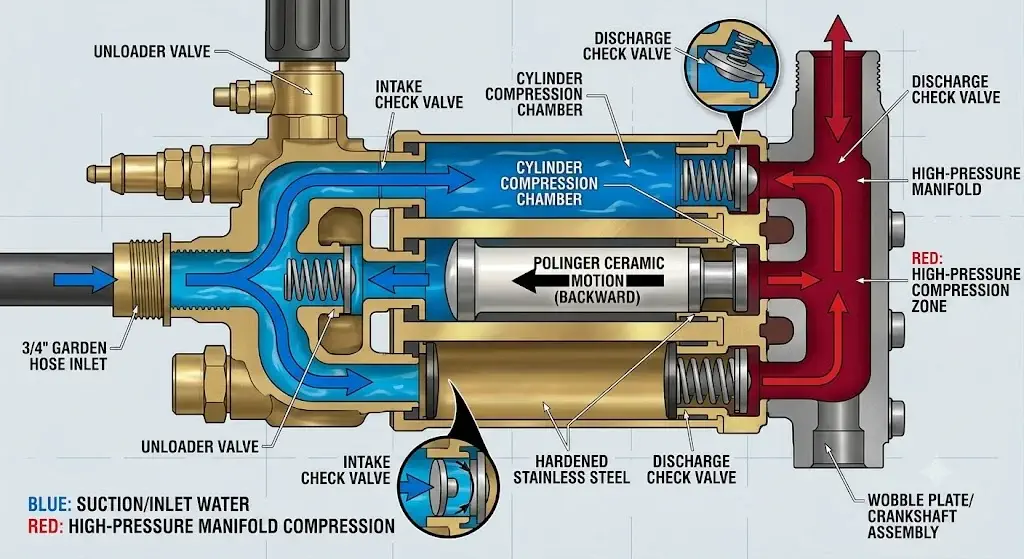
A positive displacement pump operates by mechanically drawing a fixed liquid volume into an enclosed manifold and displacing it past spring-loaded stainless check valves. When water enters through the garden hose inlet, reciprocating ceramic or hardened steel pistons force the fluid past the discharge valves into an increasingly restricted fluid conduit. Operating pressure does not originate purely from the pump motor; pressure accumulates when the displaced fluid volume encounters the hydraulic backpressure restriction of the calibrated nozzle orifice. Review our comprehensive analysis on PSI vs GPM explained to understand how dynamic fluid restriction directly drives impact force.
Pumps produce volumetric flow rate (GPM), while systemic flow restriction produces operating pressure (PSI). If your nozzle orifice expands through abrasive wear, dynamic operating pressure decreases proportionally even if the mechanical pump maintains 100% of its displacement volume.
Axial Cam vs Triplex Pump Troubleshooting
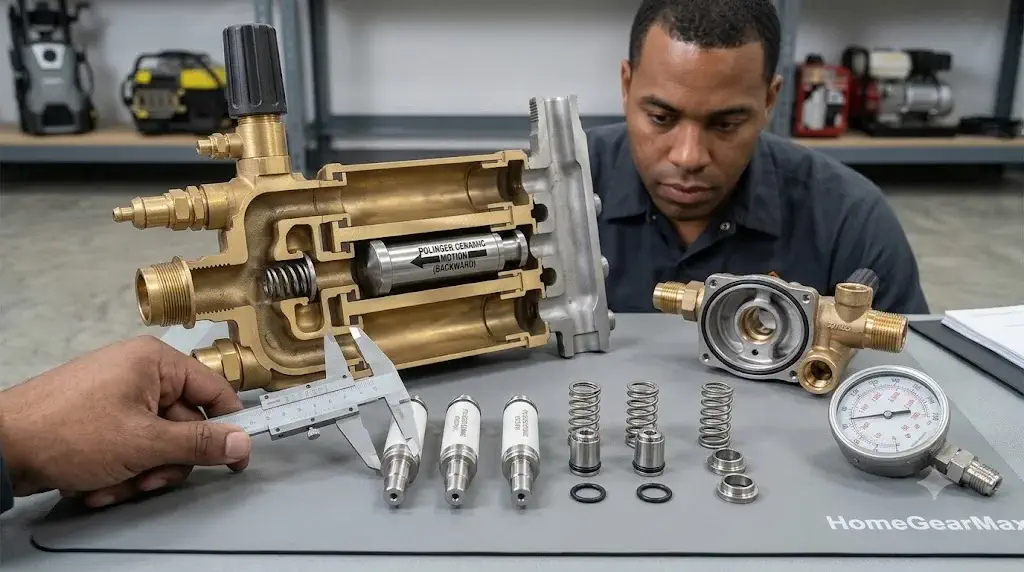
Mechanical serviceability varies dramatically between consumer-grade swash plate assemblies and commercial triplex plunger pumps. Understanding the engineering boundaries between these platforms prevents homeowners from wasting capital attempting to rebuild permanently sealed components. Review our mechanical teardown on axial cam vs triplex pumps to examine internal piston layouts and rebuild viability.
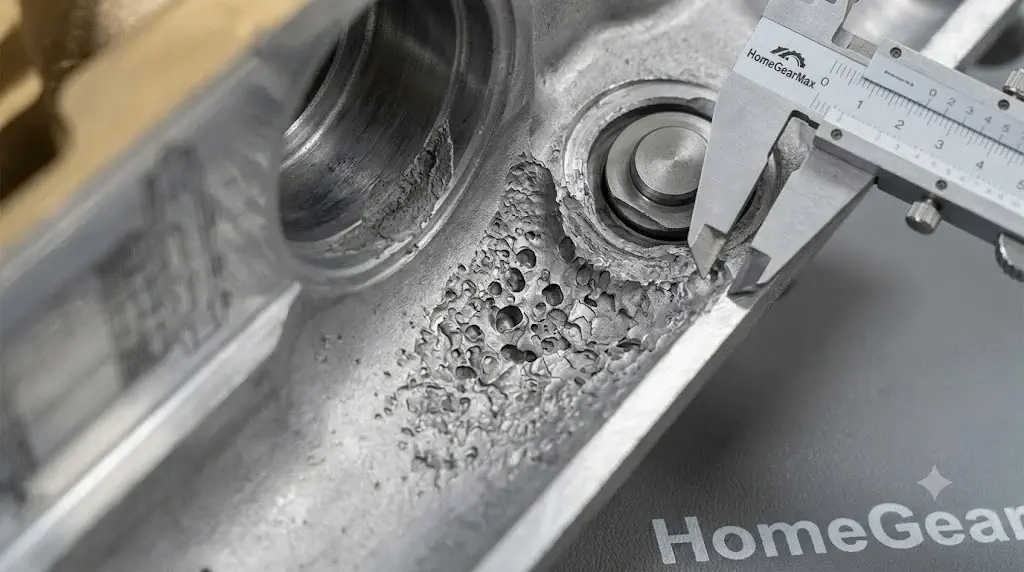
Manifold metallurgy directly impacts corrosion tolerance. In our laboratory stress tests comparing brass pump vs aluminum pump manifolds, die-cast aluminum alloys degraded significantly faster when exposed to hard-water mineral buildup and thermal bypass cycles.
Step 1: Check the Water Supply Before Blaming the Pump
Water supply restrictions cause over 60% of all field-reported pump malfunctions. A positive displacement high-pressure pump cannot compress fluid if atmospheric air or restricted flow creates a vacuum pocket inside the manifold. If your spigot static pressure measures 60 PSI but dynamic discharge drops below your machine’s rated flow rate, the pump will starve. Check our data on what GPM do you need to verify supply volume parameters.
Standard 5-Gallon Bucket Flow Rate Test:
- Place an empty, graduated 5-gallon utility bucket directly beneath your outdoor spigot.
- Connect your working garden hose (do not attach the pressure washer yet).
- Open the spigot valve completely and time the fill duration using a stopwatch.
- Calculate your dynamic GPM:
GPM = (Gallons Collected / Seconds Elapsed) × 60. - Confirm your calculated GPM exceeds your pressure washer’s rated specification by a minimum of 20% to account for dynamic line pressure drop.
Step 2: Inspect the Pump Inlet Filter
The garden hose inlet filter traps sediment before sand and rust particles score machined plunger seals. When municipal mineral deposits, well water iron sludge, or garden hose debris cover more than 30% of this 50-mesh screen surface, water velocity drops below the minimum required volumetric displacement threshold. This condition chokes the pump inlet, producing vacuum instability, severe pressure pulsing, and early-stage cavitation. Unscrew the garden hose swivel collar, remove the cone-shaped screen using needle-nose pliers, and clear particulate matter under high-velocity tap water.
Step 3: Purge Air From the Pump
Air bubbles inside a positive displacement manifold compress under piston movement, preventing check valves from closing cleanly. Running a machine with aerated chambers prevents the pump from building operational pressure and subjects dry internal packings to destructive friction heat. To execute a proper air evacuation:
- Connect your high-flow garden hose to the pump inlet coupling.
- Turn the municipal spigot fully open to charge the supply line.
- Ensure the electric switch remains OFF or the gas engine throttle remains stopped.
- Depress and hold the spray gun trigger with no quick-connect nozzle installed.
- Maintain trigger engagement for 45 to 60 seconds until a solid, bubble-free column of water discharges from the wand.
- Release trigger, install calibrated nozzle tip, and start the power plant.
Never start a pressure washer dry to “test for spark or rotation.” Operating without lubricating water for as little as 15 seconds will score piston packings and crack ceramic sleeves through rapid thermal shock.
Pressure Washer Has Low Pressure
Low pressure occurs when downstream orifice resistance drops or internal bypass channels bleed hydraulic velocity. A worn nozzle is the most overlooked cause: mineral wear widens the tiny tungsten or brass nozzle hole, allowing water to escape with reduced backpressure. Check our technical reference on quick-connect nozzle spray degrees to calibrate appropriate orifice sizing for your pump’s flow profile.
Low Pressure Diagnostic Checklist:
- Nozzle Orifice Wear: Test with a new, out-of-the-box spray tip. If pressure instantly normalizes, your primary nozzle was internally eroded.
- Unloader Valve Bypass Leakage: Inspect the unloader shuttle valve. If the internal bypass seat has trapped debris, water continually bypasses back to the suction side.
- Check Valve Obstruction: Unscrew the hex valve caps. Decontaminate sand or plastic debris trapped between the valve poppet and the machined seat.
- High-Pressure Seal Blowout: Look for water escaping through the crankcase weep channels, which signals broken high-pressure packings.
Pressure Washer Has No Pressure
A total loss of operating pressure indicates that water is bypassing the compression chambers entirely or the mechanical drive has decoupled. If water flows freely from the spray wand under municipal garden hose pressure but pressure fails to increase when the engine or motor engages, inspect the physical coupling. On gas models, a sheared shaft keyway allows the engine shaft to spin freely inside a stationary axial cam drive. On electric models, an unloader valve stuck wide open in full bypass recirculates 100% of fluid volume back to the inlet tract.
Pressure Washer Pressure Keeps Surging
Pressure surging describes a cyclical rhythm where the machine repeatedly ramps up to working pressure, hesitates, drops pressure, and recovers. This instability stems from a balance mismatch between available water flow and the unloader pressure threshold. When the pump attempts to displace more water than the inlet line can supply, manifold vacuum builds rapidly. This triggers the unloader into an oscillation cycle, repeatedly shifting between full pressure and bypass mode. Clean your inlet screen, swap narrow 1/2-inch garden hoses for heavy-duty 5/8-inch or 3/4-inch lines, and clear nozzle grit with an orifice cleaning needle.
Pressure Washer Pulsates at the Wand
Pulsation produces a high-frequency vibration or hammer effect in the spray wand and flexible discharge hose. Unlike broad surging cycles, rapid hydraulic pulsation points to the failure of a single check valve inside a multi-cylinder pump head. If one of the three intake or discharge valves sticks open, fractures a spring, or seats improperly due to grit, that cylinder cannot build compression. The spray stream stutters every time that specific piston completes its displacement stroke. Remove the valve manifold caps and verify that all valve poppets seat tightly with uniform spring tension.
Pressure Drops After Several Minutes
Thermal expansion and localized supply line collapses cause delayed pressure degradation after a machine runs smoothly for several minutes. As internal operating temperatures elevate to dynamic steady-state, marginal brass unloader shafts expand and bind within their sleeves. Additionally, extended runs on undersized municipal supply lines can pull an underground garden hose flat, starving the pump. On electric pressure washers, check your cord setup; using undersized extension cords causes voltage drops that overheat the motor windings, triggering the thermal overload switch and dropping operational RPM.
Pressure Washer Pump Is Making a Loud Noise
Unusual acoustic feedback signals mechanical distress, bearing wear, or hydraulic cavitation within the cast pump crankcase. An uncharacteristic rattling sound like marbles spinning in a metal drum indicates physical cavitation. For baseline comparison values, refer to our acoustic sound benchmark log on acoustic dBA decibel noise across residential and commercial units.
Acoustic Diagnostics: Noise Profiles vs Failure Modes
- Sharp Metallic Knocking: Connecting rod bearing failure, axial cam wobble plate spalling, or loose engine flywheel bolts.
- High-Pitched Squeal: Motor bearing seizure, dry ceramic plunger friction against worn packings, or belt slippage on belt-drive platforms.
- Loud Gravel/Crackling Sound: Fluid cavitation resulting from water supply starvation and imploding vapor pockets.
What Is Pump Cavitation?
Hydraulic cavitation occurs when inlet water pressure falls below the vapor pressure of the fluid, causing tiny vapor cavities (steam bubbles) to form within the manifold suction tract. As these vapor bubbles pass through the intake valves into the high-pressure compression zone, the surrounding pressure spikes past 2,000 PSI in a fraction of a millisecond. This extreme pressure difference causes the vapor bubbles to collapse violently. These micro-implosions generate localized shockwaves of up to 100,000 PSI, pitting aluminum pump housings, cracking ceramic pistons, and chewing through brass valve plates. Ensure supply flow exceeds pump demand by at least 20% to prevent cavitation damage.
Pressure Washer Pump Is Leaking Water
Water leaks require pinpoint physical isolation because low-pressure inlet drips pose zero mechanical threat, while high-pressure manifold leaks can penetrate skin and erode aluminum casings. Review our dedicated guide on pressure washer leaking water diagnostics to trace internal packing wear versus external O-ring failures.
Pressure Washer Pump Leaks Only When Running
A dynamic leak that appears only when the motor is running points to a failure in the high-pressure packings rather than a loose low-pressure connection. Static garden hose pressure of 40 to 60 PSI is not enough to expose worn intermediate plunger seals. Once the pistons cycle under full load, water escapes through the weep channels between the crankcase and manifold. Never use your fingers or hands to check for suspected high-pressure leaks.
High-Pressure Fluid Injection Danger
Water streams escaping at pressures above 1,000 PSI easily pierce heavy leather work gloves and penetrate subcutaneous flesh. This can inject toxic lubricants and dirty water deep into tissues, presenting an emergency amputation risk. Never pass your bare hands over pressurized fittings or pinhole leaks. Shut the engine down, vent residual wand pressure, and inspect components visually with safety goggles.
Pressure Washer Pump Overheating
Pump overheating results from prolonged bypass circulation or fluid starvation. In normal operation, cold supply water continuously enters the pump, absorbs friction heat from the reciprocating pistons, and exits through the spray wand. Releasing the trigger closes the spray circuit, forcing the unloader to loop a small volume of water through a bypass channel inside the manifold. Continuous cycling without fresh water raises manifold fluid temperatures by roughly 15°F to 20°F per minute. If you leave a machine running with the trigger closed for more than two minutes, the trapped water can quickly exceed 145°F, softening nitrile seals and triggering the thermal dump valve.
What Is Bypass Mode?
Bypass mode is a protective hydraulic loop that routes pumped water away from the closed spray wand and back into the pump’s suction manifold. Because positive displacement pumps move a set volume of water with every rotation, closing the spray wand trigger would otherwise spike pressure instantly and burst hoses, shatter manifolds, or stall motors. The unloader valve acts as a mechanical safety regulator, lifting its spring-loaded shuttle to divert fluid flow when wand pressure spikes. However, this safety loop recirculates the same small volume of water repeatedly. The pistons continue working on this trapped water, and that mechanical energy converts directly into friction heat.
Pressure Washer Pump Unloader Valve Troubleshooting
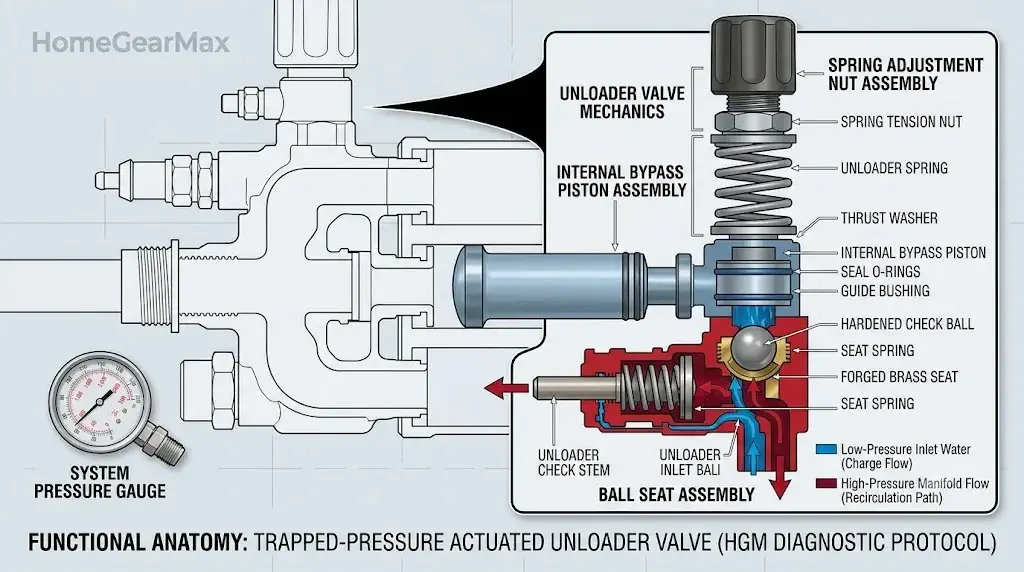
The unloader valve balances pump pressure and redirects water flow when you release the spray wand trigger. If the unloader valve malfunctions, the machine will experience erratic pressure swings, fail to build pressure, or stall the gas engine when you close the trigger.
Common Unloader Failure Modes:
- Stuck in Bypass (Zero Wand Pressure): Calcium and mineral scale seize the internal shuttle valve open, routing incoming water back out the unloader port.
- Stuck Closed (Excessive Pressure Spike): If the valve fails to lift its shuttle when you release the trigger, the engine will stumble or stall, and electric motors will trip the breaker under hydraulic lock.
- Spring Relaxation: Over time, the heavy unloader spring loses tension, allowing the bypass to crack open prematurely and lowering your dynamic working pressure.
Can a Clogged or Worn Nozzle Damage a Pump?
A damaged or incorrectly sized nozzle disrupts the pressure balance of the entire hydraulic system. A clogged nozzle restricts outlet flow, causing severe pressure spikes that keep the unloader valve bouncing in and out of bypass. Conversely, a worn nozzle orifice allows too much water to escape, reducing system backpressure and lowering your working cleaning power. Always use clean nozzle cleaning needles and replace spray tips when the orifice shows visible oval wear.
Pressure Washer Pump Has Water But No Pressure
Water flowing freely from the wand without pressure indicates that fluid is passing through the manifold without being compressed by the pistons. If water moves through the pump but won’t build working pressure, check the following components in order:
- Black Chemical Soap Nozzle Installed: The 65° black brass tip features a wide 4.0mm orifice designed specifically to drop system pressure below 250 PSI to activate the detergent siphon injector.
- Debris Lodged Under Check Valve Discs: Remove the intake and discharge valve caps. Sand grains or mineral flakes can prop valve poppets open, preventing the cylinders from creating pressure.
- Broken Drive Shaft / Keyway Shear: Check if the drive shaft is turning the pump. If the engine shaft spins but the pump drive doesn’t turn, the connecting key has sheared.
- Cracked Ceramic Plunger Sleeves: Inspect the ceramic pistons. Thermal shock can shatter the ceramic sleeves, allowing fluid to slip behind the plungers into the oil crankcase.
How to Tell If a Pressure Washer Pump Is Bad
A pressure washer pump has reached the end of its service life when structural metal damage, severe internal scoring, or milky, water-contaminated crankcase oil is present. If you have confirmed that the water supply, inlet filter, nozzle, and unloader valve are all functioning properly, test the pump using the indicators below:
Pressure Washer Pump Valve and Seal Problems
Check valves and high-pressure seals endure heavy mechanical friction, opening and closing more than 1,750 to 3,400 times per minute during operation. Intake and discharge valves use polished stainless steel discs that mate against precision machined seats. If fine sand bypasses the inlet filter, it acts like liquid sandpaper, scoring the sealing edges and allowing high-pressure fluid to leak backward into the intake stroke. Inspect valve O-rings for cuts or flattening, and replace high-pressure V-packings whenever low-pressure water drips from the pump weep channels.
Pressure Washer Pump Oil Problems
Pump crankcases require non-detergent lubricants that keep water separate rather than suspending it. Automotive motor oils contain detergent additives designed to suspend carbon particles and moisture. If used in a pressure washer, detergent oils cause moisture to emulsify, degrading lubricating film strength and leading to premature bearing failure. On serviceable pumps, use a specialized non-detergent ISO 68 or SAE 30 industrial pump oil. Review our comprehensive guide on pressure washer pump oil to identify sight-glass inspection intervals, fluid capacities, and correct drain schedules.
Pressure Washer Pump Troubleshooting: Electric vs Gas
Power plant mechanics dictate distinct troubleshooting steps for identical hydraulic symptoms. An engine speed drop on a gas unit mimics pump valve failure, while voltage drops on an electric machine can trigger motor stalling that looks like unloader seizure.
If your unit refuses to turn over, consult our step-by-step diagnostic guide for when a pressure washer won’t start to isolate electrical capacitor and carburetor faults before removing the pump.
When Should You Replace vs Rebuild a Pump?
The decision to rebuild or replace a pressure washer pump comes down to its internal design and parts cost. Low-cost axial cam and wobble plate pumps use factory-crimped aluminum housings and pressed-on swash plates that cannot be rebuilt economically. For consumer units that retail under $250, buying a complete replacement pump assembly or a new machine is usually the most cost-effective path. For commercial-grade triplex pumps with forged brass manifolds, rebuilding is standard practice: fresh V-packing seals and check valve kits cost roughly $40 to $70, saving you hundreds over the cost of a new $400 to $800 pump.
Critical Bolt-On Specs for Replacement Pumps:
- Shaft Diameter & Type: Match 3/4-inch or 1-inch hollow shaft configurations and verify keyway dimensions.
- Engine Flange Bolt Pattern: Confirm whether your engine uses a SAE J609a 4-bolt pattern or a 3-bolt axial pattern.
- Input Horsepower & Engine RPM: Direct-drive pumps require an engine operating speed of 3,400 to 3,600 RPM.
- Thermal Relief Valve Port: Ensure the replacement pump includes an open 1/4-inch or 3/8-inch NPT thermal relief port.
Preventative Maintenance That Prevents Pump Failure
Routine preventative maintenance prevents mineral buildup, corrosion, and seal dry-rotting inside high-pressure pump chambers. Mineral-rich hard water left sitting in aluminum manifolds promotes galvanic oxidation, which pits machined check valve seats. Before storing your machine between jobs or for the winter, flush the system with an anti-freeze pump conditioner to lubricate the internal packings and protect against freezing. Follow our seasonal maintenance guides on how to winterize a pressure washer and our structured pressure washer maintenance schedule to keep your pump operating reliably for years to come.
Frequently Asked Questions: Pump Diagnostics
Why is my pressure washer pump not building pressure?
Why does my pressure washer pump surge?
Why does my pressure washer pulse?
Why is my pressure washer pump making a loud noise?
How do I know if my pressure washer pump is bad?
Can a clogged nozzle cause low pressure?
Can a worn nozzle cause low pressure?
Can low water pressure damage a pressure washer pump?
Can I run a pressure washer without water for a few seconds?
Why is my pressure washer pump leaking water?
Can I replace a pressure washer pump myself?
Should I repair or replace my pressure washer pump?
Why does my pressure washer lose pressure after it warms up?
Does a pressure washer pump need oil?
Can I use motor oil in a pressure washer pump?
Final Field Verdict: Hydraulic Diagnostic Logic
Systematic hydraulic troubleshooting starts at the water source rather than the pump manifold. More than 85% of field-reported pressure drops, surging, and noisy operation stem from inadequate garden hose flow, clogged 50-mesh inlet strainers, aerated lines, and eroded nozzle orifices. Before investing in a replacement pump or dismantling valve caps, test your dynamic spigot flow with a bucket, flush the lines with the motor switched off, and install a fresh nozzle tip.
