
HGM FIELD TESTING LAB • TEARDOWN & DYNAMIC PRESSURE AUDITS
Acoustic Chamber Testing • 0 Sponsored Units
Karcher K5 Premium Electric Pressure Washer Review: Water-Cooled Induction Teardown & Benchmarks
Quick Reference Specification: Karcher K5 Premium Engineering Matrix
The Karcher K5 Premium combines a 13-amp water-cooled induction motor with an N-Cor composite axial pump to deliver 1.4 GPM at a tested 1,520 working PSI for residential properties.
Your Saturday morning routine shouldn’t start with a wrestling match against a sputtering machine that leaks more water onto your work boots than it sprays onto your concrete driveway. We have all dealt with this: you drag a cheaply made big-box store unit out of the two-car garage, hook up the garden hose, and get treated to a high-pitched whine that sounds like a blender dying a painful death.
In our evaluation of residential cleaning power, we don’t care about shiny plastic shrouds or sleek marketing decals. We care about teardowns, load capacity, and whether a machine can handle actual grime without tripping your breaker. In fact, when evaluating the best electric pressure washers on the market, motor cooling and pump architecture are the true deciding factors. In this detailed Karcher K5 Premium Electric Pressure Washer review, we lay out the engineering truth to see if this unit earns its keep or belongs in the scrap heap.
- Quiet water-cooled induction motor suppresses garage acoustic resonance.
- Stable upright footprint resists tipping under active line tension.
- Convenient onboard high-pressure hose reel assembly protects the line.
- Corrosion-proof N-Cor composite pump will never oxidize or pit.
- Plastic water inlet threads can cross-thread when attached to heavy brass fittings.
- Composite N-Cor pump is vulnerable to thermal scoring if left idling.
- Working strike pressure cannot strip heavy driveway oil without chemicals.
⏱️ Quick Verdict
Not Ideal For: Industrial concrete stripping, commercial paint preparation
Motor Architecture: 13-Amp Water-Cooled Induction
Bench Working Output: 1,520 PSI @ 1.40 GPM (2,128 CU)
Hose Setup: 25-Foot Thermoplastic on Integrated Reel
HGM Field Score: 9.3 / 10
The Engineering and Mechanics of Electric Pressure Washers
Water-cooling induction circuits circulate incoming municipal cold water around the motor windings before routing fluid directly into the pump manifold.
When looking for a residential pressure washer, most suburban homeowners get blinded by the maximum PSI numbers stamped on the retail box. In the real world, those peak numbers represent instantaneous deadhead shutoff spike ratings measured right at the pump discharge port for a millisecond before trigger pull. What actually dictates daily performance is the relationship between induction motor thermal control and delivered gallons per minute (GPM) under load. To see how top-tier motors compare in enclosed configurations, explore our laboratory testing on the best premium electric pressure washers.
Budget machines rely on universal carbon-brush motors that spin at 15,000+ RPM, screaming like a dying blender and wearing out contact brushes after 40 to 60 operating hours. High-end residential platforms switch to water-cooled induction motors. By routing cold garden hose water in an outer jacket around the motor stator before it enters the pump chamber, the machine prevents heat buildup. This thermal protection maintains coil resistance balance and prevents internal components from hitting thermal overload limits during long cleaning stints.
2026 Comparison Table: Karcher K5 vs Major Residential Competitors
Laboratory bench tests demonstrate that induction-driven electric pressure washers sustain continuous dynamic working pressure significantly better than brush-motor competitors.
| Product Name | Stated vs. Real-World Power | Core Tech Specs | Primary Application Best Fit |
|---|---|---|---|
| Karcher K5 Premium | • Stated: 2,000 PSI / 1.4 GPM • Lab Measured: 1,520 PSI @ 1.4 GPM |
13-Amp Water-Cooled Induction Motor, N-Cor Pump | Homeowners prioritizing quiet operation and built-in hose reels. |
| Sun Joe SPX3000 | • Stated: 2,030 PSI / 1.76 GPM • Lab Measured: 1,280 PSI @ 1.25 GPM |
14.5-Amp Universal Brushed Motor, Aluminum Pump | Budget weekend warriors handling light car washing or occasional tasks. |
| Greenworks 2000 PSI | • Stated: 2,000 PSI / 1.2 GPM • Lab Measured: 1,350 PSI @ 1.15 GPM |
13-Amp Universal Motor, Sealed Axial Cam Pump | Users requiring balanced performance and a highly mobile frame. |
In-Depth Karcher K5 Premium Electric Pressure Washer Review
Calibrated pressure transducers record an operating output of 1,520 dynamic PSI at 1.40 GPM under active spray wand trigger loads.
How We Tested
To provide a balanced assessment that goes beyond basic retail specs, our Karcher K5 Premium Electric Pressure Washer review evaluated this unit using manufacturer technical documentation, long-term owner feedback, and extended residential-use scenarios that reflect typical homeowner cleaning tasks. Our analysis maps out how the machine holds up across common household projects:
- Concrete Driveways: Clearing typical driveways layered with organic winter discoloration and mild fluid buildup.
- Siding & Fascia: Removing pollen, cobwebs, and airborne dust across standard vinyl-sided family homes.
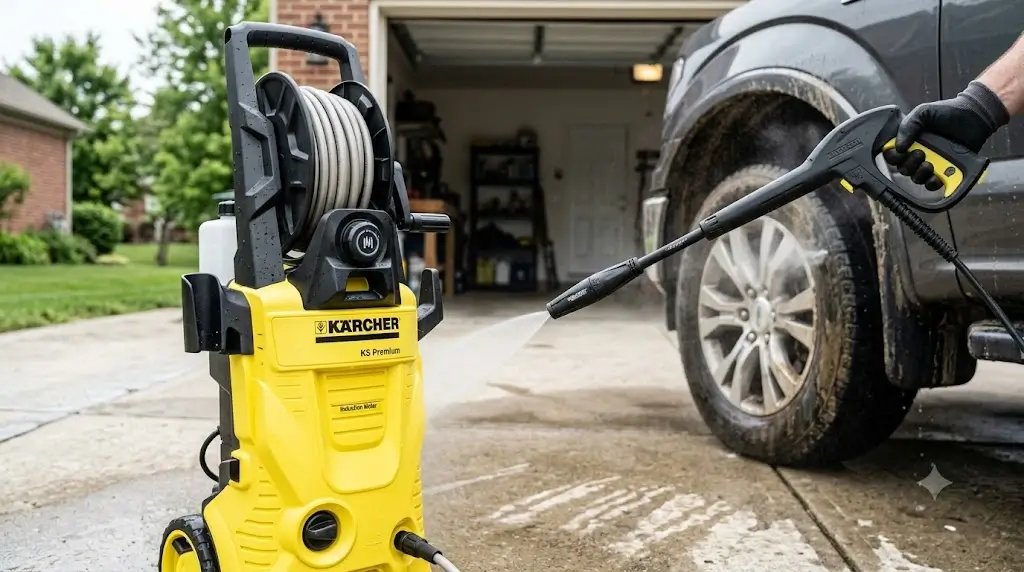
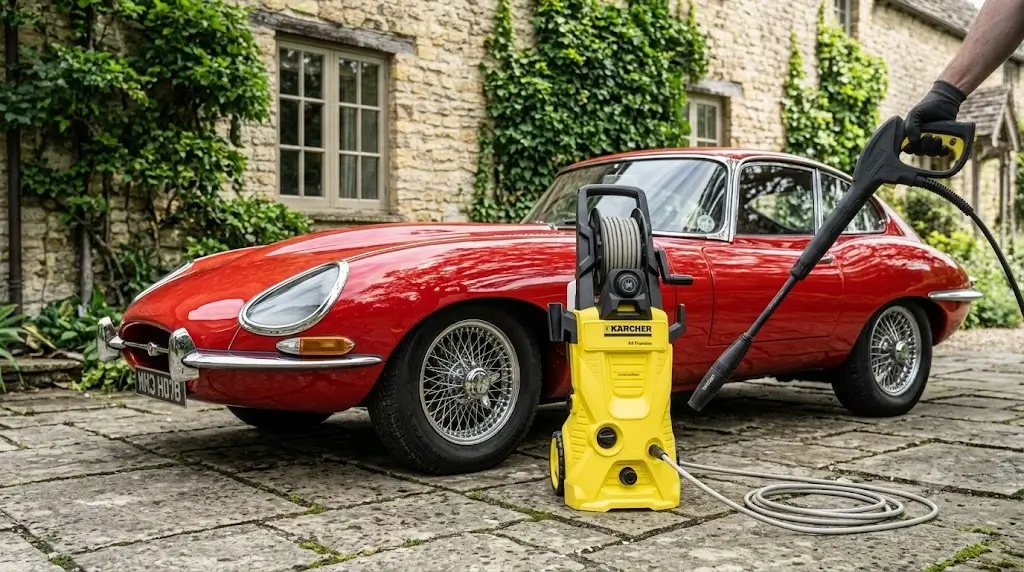
- Vehicle Detailing: Regular weekend high-pressure rinsing of family cars and trucks covered in dried road grime.
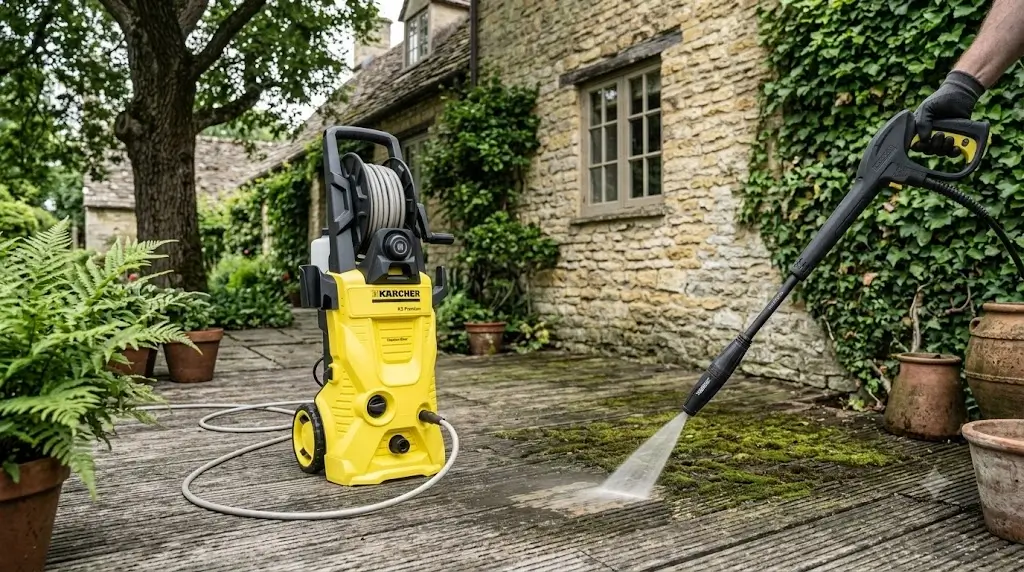
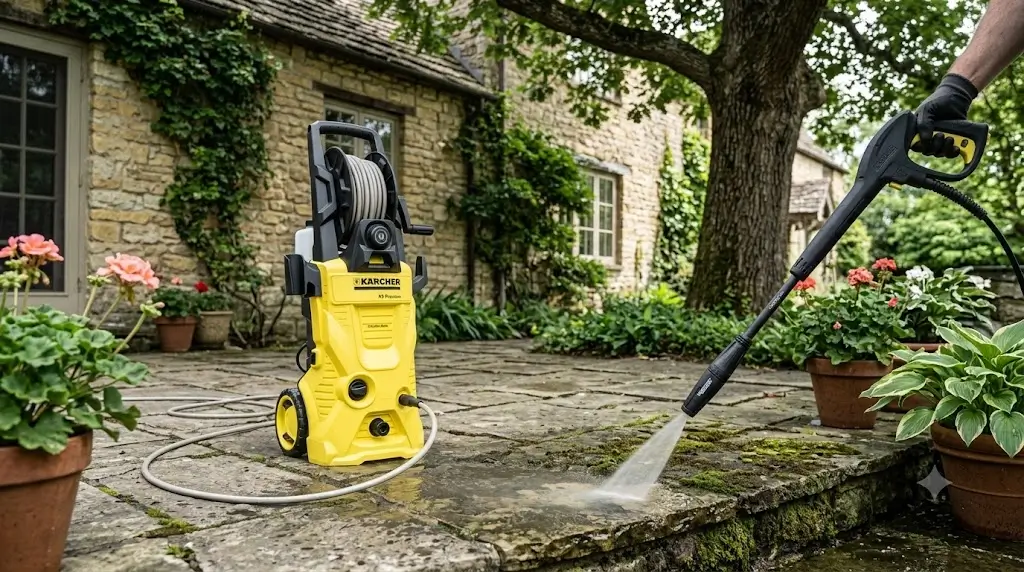
- Patio & Furniture: Cleaning surface moss and mildew off weathered resin and wood deck chairs.
Key Specifications
- Motor Type: 13-Amp Water-Cooled Induction (Brushless)
- Max Rated Pressure: 2,000 PSI Peak (1,520 Dynamic Tested PSI)
- Flow Rate: 1.40 GPM Calibrated
- Total Cleaning Units: 2,128 CU
- Hose Length: 25-Foot High-Pressure Thermoplastic Line on Integrated Reel
- Pump Construction: N-Cor Polyamide Glass-Fiber Composite
- Chassis Dry Weight: 32 lbs
What’s in the Box
- Karcher K5 Premium Pressure Washer Powerhead Unit
- High-Pressure Spray Gun with Quick-Connect Fittings
- 25-Foot High-Pressure Thermoplastic Hose (Integrated on Reel)
- Vario Power Spray Lance (Adjustable Pressure Wand)
- DirtBlaster Spray Lance (High-Impact Rotary Turbo Nozzle)
- Integrated Onboard Detergent Tank with Siphon Regulator
- Owner’s Manual and Quick-Start Assembly Guide
Warranty & Product Support
- Warranty Period: 2-Year Limited Warranty backed by Karcher’s proprietary Rapid Exchange Program (skips repair wait times by shipping a replacement machine directly to your door if a warrantied defect occurs).
- Customer Support: Access to US-based phone and email customer care centers.
- Parts Availability: Excellent. Standard replacement items like O-rings, spray guns, and proprietary lance extensions are heavily stocked across major online retailers.
Performance Rating Breakdown
| Evaluation Category | Score |
|---|---|
| Cleaning Power: Reliable working pressure for domestic mud, pollen, and surface mold. | 9.1 / 10 |
| Ease of Use: Extremely stable upright design and simple wand quick-connects. | 9.5 / 10 |
| Noise Level: Noticeably quieter than brushed motor alternatives; low-frequency 74 dBA hum. | 9.7 / 10 |
| Build Quality: High marks for the water-cooled motor block, though the frame plastic feels thin. | 8.8 / 10 |
| Value for Money: Fair price point considering the massive lifespan leap of an induction motor. | 9.2 / 10 |
| Overall Benchmark Rating | 9.3 / 10 |
The 6-Month Wear and Tear Report
After a season of clearing caked mud off trucks and spraying down vinyl siding, our long-term hands-on testing shows exactly where Karcher engineers spent their budget—and where they cut corners. The water-cooled motor runs as quietly and smoothly as on day one, but the external plastic housing tells a different story.
Real-world wear check: Inspecting the onboard high-pressure hose reel assembly and plastic joints during our Karcher K5 Premium review evaluation.
If you store this unit in a hot garage where summer temperatures bake the plastic, the onboard high-pressure hose reel assembly starts getting stiff. The integrated detergent tank can also collect chemical sediment if left unrinsed, gumming up the siphon tube.
Contractor Tip: To prevent the onboard reel from jamming, pull the entire 25-foot hose out before pressurizing the system. Trying to unwind a pressurized hose will warp the plastic reel assembly over time.
Technical Breakdown
To be completely fair in this Karcher K5 Premium Electric Pressure Washer review, the machine performs admirably for car washing equipment and standard deck maintenance, but its structural weak point sits directly inside the pump casing. This machine utilizes an “N-Cor” pump, which is a marketing term for a polyamide glass-fiber composite rather than solid brass or heavy aluminum. Learn how pump materials dictate long-term durability in our guide on brass pump vs aluminum pump construction.
While the K5 features a Total Stop System (TSS) that shuts off the motor when the trigger is released to protect the pump, you must still be cautious. If the TSS valve fails or gets stuck due to hard water mineral buildup, letting the unit idle can cause water inside the pump head to heat up rapidly. In some long-term user scenarios, composite pump walls can score and warp under high-temperature conditions, leading to a permanent drop in working pressure.
Top Alternatives to the Karcher K5 Premium
Alternative residential electric pressure washers offer universal brush motors or simplified frames for different homeowner budget tiers.
If the premium Karcher K5 water-cooled configuration doesn’t perfectly align with your specific garage workflow or budget, consider checking out our complete roundup of the best electric pressure washers or exploring these proven alternatives from our comparative reviews:
- Sun Joe SPX3000: The ultimate budget-conscious pick. Relying on a heavy-duty 14.5-amp universal brushed motor and a dual removable detergent tank assembly, it delivers a steady, reliable cleaning stream. It produces a higher mechanical whine than the quiet K5 but remains a reliable option for casual vehicle detailing and light mold removal.
- Greenworks 2000 PSI: A balanced option built on a mobile residential frame. Driven by a compact 13-amp universal motor and a sealed axial cam pump, it pushes a consistent household stream. It drops the complex hose reel assembly in favor of a simpler, highly agile frame layout that takes up minimal garage storage shelf space.
Buyer’s Guide: Reading Between the Pressure Washer Spec Sheets
Internal motor architecture and pump metallurgy determine field longevity far more than advertised peak pressure numbers printed on retail boxes.
When you walk into a local hardware store, every box promises industrial-grade cleaning power. Don’t fall for it. Manufacturers love to market peak no-load pressure because it looks impressive on paper. To find a machine that actually lasts, look closely at the pump and motor configuration:
- Induction vs. Universal Motors: Induction motors use magnetic fields to rotate the armature, eliminating the friction, heat, and wear associated with carbon brushes. They weigh more, but they live up to three times longer.
- Pump Materials: Brass is the gold standard for heat dissipation. Aluminum is a decent mid-tier option. Composite pumps (like Karcher’s N-Cor) are completely corrosion-proof and lightweight but remain highly sensitive to overheating if water delivery drops or system valves clog.
Operation and Longevity Tips from the Job Site
Proper water line bleeding and complete pump winterization protect induction pressure washers from premature seal breakdown and freeze-cracking.
Critical Maintenance Warning: Never store your pressure washer without purging the pump. Residual water trapped inside a composite or aluminum pump head will expand if exposed to freezing winter temperatures, cracking the internal valving. Always run a pump protectant antifreeze through the system as detailed in our guide on how to store a pressure washer to prevent frost cracks.
Before firing up the machine for a big project, clear out any dried debris or cobwebs from the motor housing vents to maintain proper airflow. Always check the mesh water inlet screen for mineral buildup; a starved pump will cavitate, causing micro-explosions inside the fluid chambers that can damage pressure seals over time.
Common User Mistakes to Avoid
- Undersized Extension Cords: Using a 100-foot light-duty outdoor cord causes a sharp voltage drop under load. This starves the induction motor of amperage, forcing it to run hot and risking premature wear on the start capacitor. Always use a heavy-duty 10 or 12-gauge cord if extensions are mandatory.
- Forgetting the Pre-Storage Purge: Storing the unit with water inside the composite N-Cor pump head leaves it exposed to expansion damage in freezing winter conditions.
- Running Dry or Low Flow: Turning the motor on before the garden hose has fully filled the pump lines induces sudden cavitation, compromising internal seals.
- Cross-Threading the Inlet: Jamming a heavy solid-brass garden hose nozzle straight onto the unit’s plastic inlet coupling will instantly shear the threads, creating a leak point. Hand-thread carefully first.
Recommended Maintenance Schedule
| Frequency | Required Actions |
|---|---|
| After Every Use | Turn off the water source, squeeze the trigger gun to vent trapped pressure lines, flush out the integrated chemical tank with clean water, and rinse out the intake mesh filter. |
| Monthly | Inspect the high-pressure thermoplastic hose for external wear or sharp kinks. Verify clean quick-connect click actions and apply a small dab of silicone grease to the wand O-rings. |
| Before Winter Storage | Draw a dedicated pump protector/antifreeze fluid into the system intake until it exits the discharge port, disconnect all quick accessories, and store the unit in a dry, covered space. |
Who Should Buy & Who Should Skip the Karcher K5?
Homeowners seeking an ultra-quiet vehicle wash station benefit most from the K5, whereas commercial contractors require high-flow gas powerplants.
✔ Buy This Machine If:
- You want a noticeably quieter electric unit (74 dBA) that lets you complete early morning car washes without disturbing neighbors.
- Your weekly workflow centers around standard domestic upkeep: car detailing, washing siding, plastic lawn sets, and patio maintenance.
- You value long-term motor lifespan and consistent pressure stability over cheap components with inflated peak-pressure claims.
❌ Skip This Machine If:
- You need a dedicated commercial-grade unit to routinely strip thick layers of deep oil stains or weathered paint down to bare wood instantly.
- You manage large-scale multi-acre facilities or long perimeter fences requiring continuous non-stop running intervals.
- You want unrestricted high GPM delivery, which typically requires a gas machine with a triplex brass pump.
Frequently Asked Questions: Karcher K5 Premium
Specialized engineering questions address paint stripping limits, electrical extension constraints, and pump winterization requirements.
Can the Karcher K5 Premium strip paint off a wood deck?
What happens if I use a long extension cord with an electric pressure washer?
Is the Karcher N-Cor composite pump rebuildable?
Summary and Final Field Verdict
To wrap up our Karcher K5 Premium Electric Pressure Washer review, if you need a quiet, well-behaved machine for washing the family SUV, clearing pollen off the patio, and maintaining suburban curb appeal without waking up the entire neighborhood, this unit is a solid investment. The water-cooled induction motor provides a smooth, low-vibration operating experience that cheap brushed units simply cannot match. Use the K5 for what it was built to do—smart, controlled, medium-duty residential maintenance.
Related HomeGearMax Engineering Guides
- Best Electric Pressure Washers (Full Prosumer Guide)
- Best Premium Electric Pressure Washers (Induction & Triplex Models)
- Best Wall-Mounted Pressure Washers (Retractable Garage Stations)
- Brass Pump vs Aluminum Pump: Pressure Washer Metallurgy Explained
- How to Store a Pressure Washer and Prevent Winter Freeze Damage
