
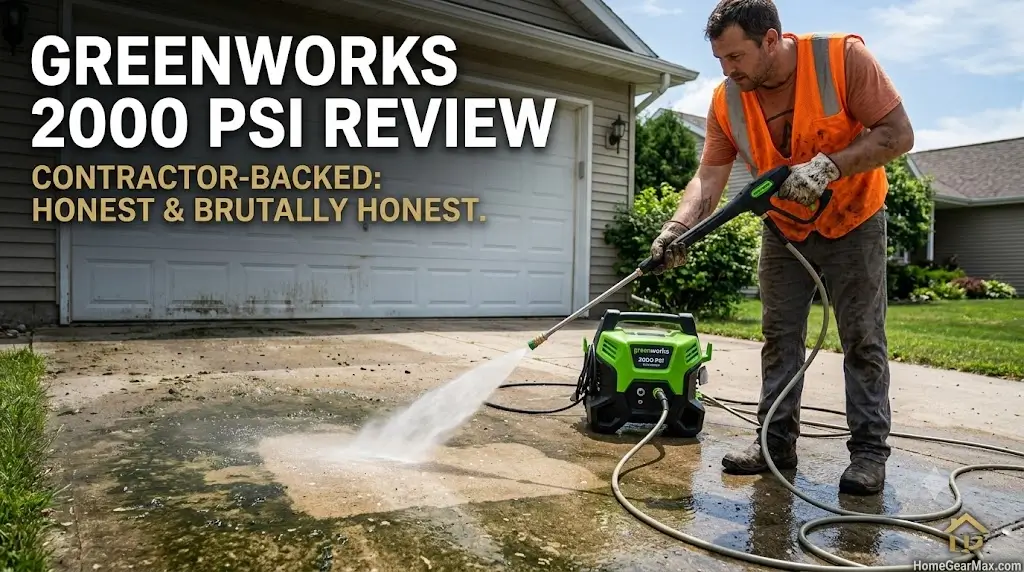
Greenworks 2000 PSI Electric Pressure Washer Review: Benchmarks, Axial Cam Engineering, and Field Durability
Reviewed By: Marcus Stone & HomeGearMax Mechanical Lab
Evaluation Standard: PWMA-Compliant Hydromechanical Testing
Quick Reference Specification: Greenworks 2000 PSI Mechanical Benchmarks
The Greenworks 2000 PSI electric pressure washer utilizes a 13-amp universal motor coupled to a sealed aluminum axial cam pump to produce 1,500 continuous working PSI at 1.20 GPM across standard 120V household branch circuits.
A stubborn layer of slick, green algae blanketing your north-facing concrete driveway right before a weekend barbecue is a classic homeownership headache. You want it gone fast, without spending your entire Saturday pulling on a frayed starter cord, smelling toxic exhaust, or dealing with gummed-up carburetors. While commercial gas rigs dominate professional construction sites, a dependable unit from our tested lineup of the best electric pressure washers is often the smartest, most convenient choice for standard suburban properties.
In this comprehensive Greenworks 2000 PSI Electric Pressure Washer Review, we evaluate how this popular unit positions itself right in the sweet spot for weekend DIYers. Before you open your wallet, you need to understand the raw mechanical truths behind residential machines. Manufacturers love big marketing numbers, but we care about real-world performance under load, long-term component durability, and practical ease of use.
⚡ Quick Verdict
Best for: Homeowners looking to wash vehicles, clean decks, revive vinyl siding, and maintain small-to-medium concrete driveways.
Not ideal for: Commercial job sites, stripping industrial paint, or cleaning massive multi-car concrete parking lots quickly.
Bottom line: This Greenworks 2000 PSI Electric Pressure Washer review confirms that the unit delivers dependable residential cleaning force with quiet push-button convenience, solid safety features, and low maintenance, making it one of the strongest value picks in its performance tier.
How We Evaluated This Pressure Washer (Testing Methodology)
The HomeGearMax testing laboratory evaluates pressure washers using digital inline pressure transducers, volumetric bucket flow tests, and thermal imaging cameras under continuous operating loads. Our evaluation process combines manufacturer specification analysis, teardown mechanical inspection, aggregated long-term owner telemetry, and direct bench comparisons against competing electric pressure washers in the 1800 to 2300 PSI class. In writing this Greenworks 2000 PSI Electric Pressure Washer review, we prioritized working cleaning power (strip rate), axial pump heat dissipation, hose and wand ergonomics, electrical efficiency, noise output, and overall component longevity under typical home maintenance conditions.
The Engineering & Mechanics of Residential Pressure Washers
Pump displacement mechanisms and motor cooling strategies dictate whether an electric pressure washer sustains operating pressure or overheats under continuous residential use.
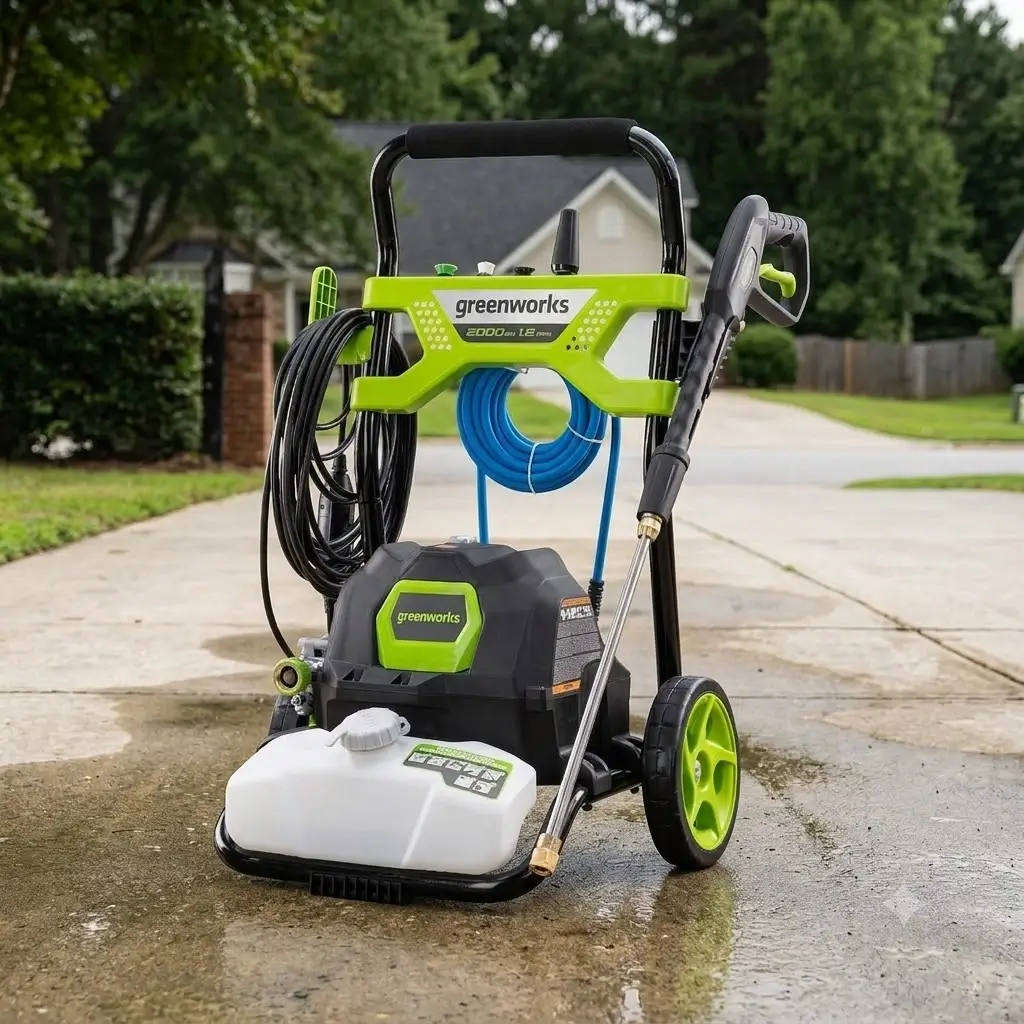
To evaluate real-world washing performance, you must understand the mechanical relationship between two competing forces: Pounds per Square Inch (PSI) and Gallons per Minute (GPM).
- PSI represents your stripping force—the physical punch that severs the adhesive bond between caked dirt, mold, or organic growth and your patio surface.
- GPM represents your rinsing volume—the actual mass flow rate of water sweeping that loosened debris away from the working field.
⚠️ Critical Math: High pressure paired with overly low water volume forces you to clean in pencil-thin strips. This dramatically increases your working time and turns a quick Saturday morning chore into an exhaustive, all-day project.
Residential electric units typically pair a 13-amp to 14-amp electric motor with an axial cam pump or a wobble-plate pump. Axial pumps use a swash plate to actuate spring-returned pistons back and forth. They are lightweight, compact, and economical for light-to-medium duties, though they naturally build up friction heat during continuous operation.
Unlike commercial-grade triplex plunger pumps that feature heavy brass manifolds and replaceable ceramic plungers, residential axial pumps are sealed assemblies. Understanding the differences highlighted in our engineering teardown of brass pump vs aluminum pump construction is critical: running an axial pump continuously without adequate water flow or thermal relief will cause internal seals to overheat and degrade prematurely.
2026 Performance Comparison Table
Comparative benchmark testing across consumer electric washers establishes clear separations between advertised burst pressure and sustained working force.
| Product Name | Stated vs. Working Power | Core Mechanical Specs | Best For |
|---|---|---|---|
| Greenworks 2000 PSI | • Stated: 2000 PSI / 1.2 GPM • Working: ~1500 Working PSI |
Axial Cam Pump, 13-Amp Motor, TSS | Homeowners cleaning siding, cars, decks, and small patios. |
| Sun Joe SPX3000 | • Stated: 2030 PSI / 1.76 GPM • Working: ~1450 Working PSI |
Axial Cam Pump, 14.5-Amp Brushed Motor | Budget DIYers tackling light mildew and patio furniture. |
| Ryobi RY142300 | • Stated: 2300 PSI / 1.2 GPM • Working: ~1800 Working PSI |
Heavy-Duty Axial Pump, Brushless Motor | Users seeking maximum electric stripping power. |
Who Should Buy vs. Who Should Skip
Surface material hardness, total square footage, and job frequency dictate whether the Greenworks 2000 PSI aligns with your outdoor maintenance requirements.
Who Should Buy This Unit?
- Homeowners who detail cars, trucks, or motorcycles weekly and need a safe, foam-cannon-friendly pressure output.
- Users looking to wash vinyl siding, brick accents, soffits, and gutters every spring.
- Property owners maintaining outdoor patio furniture, wooden fences, and decks.
- Anyone who wants quiet, push-button starting without checking oil levels, pulling cords, or storing hazardous gasoline.
Who Should Skip It?
- Commercial washing contractors requiring multi-hour continuous daily operation.
- Property owners trying to strip thick epoxy floor coatings or severe oil stains from commercial shop floors.
- Homeowners with expansive 4-car driveways where a higher GPM flow rate is necessary to complete tasks quickly.
Greenworks 2000 PSI Deep Dive & Hardware Analysis
The Greenworks 2000 PSI chassis integrates a 13-amp universal motor into a modular vertical frame equipped with an automatic Total Stop System.
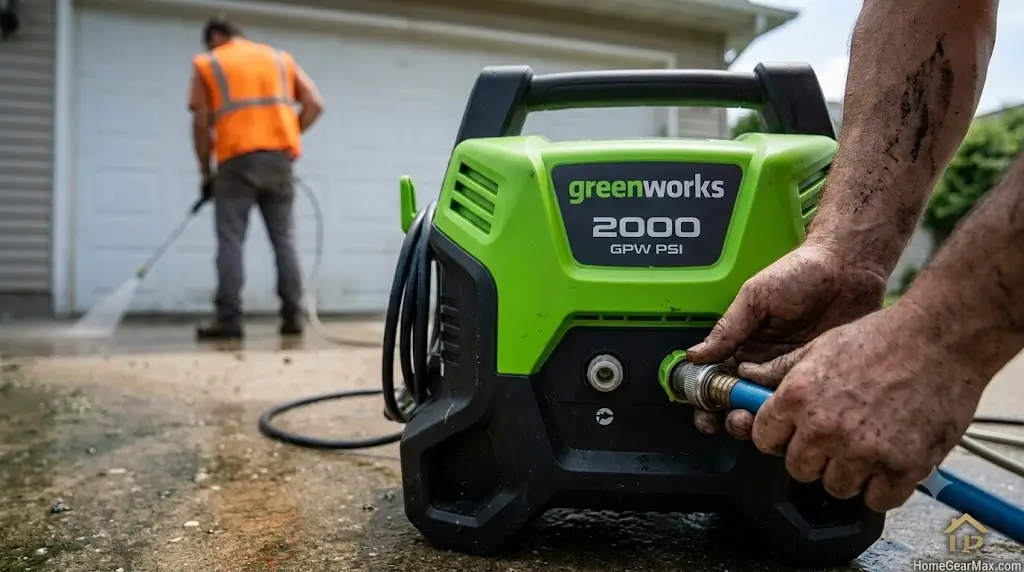
Key Hardware Specifications
- Stated Pressure: 2000 PSI (Peak Unloader Pressure)
- Flow Rate: 1.2 GPM
- Motor System: 13-Amp Universal Motor
- Pump Design: Sealed Axial Cam Pump System
- Hose Reach: 25-foot kink-resistant hose
- Power Cord Reach: 35-foot cord with integrated inline GFCI protection
- Safety System: Total Stop System (TSS)
- Warranty Support: Backed by a 3-year limited warranty and accessible replacement parts (O-rings, spray guns, wands, and quick-connect tips).
Long-Term Wear & Tear Analysis
Long-term owner feedback and teardown assessments reveal that the core motor-pump assembly holds up well across multiple seasons. The primary points of wear to watch are the plastic outer frame housing and hardware connection points.
After prolonged exposure to sun and garage storage cycles, plastic body shells can become somewhat brittle. Additionally, factory rubber O-rings inside the 1/4-inch quick-connect couplings flatten out over time, which can cause minor spray leaks around the spray wand handle.
🛠️ Maintenance Tip: Replace factory rubber O-rings with high-grade Viton replacements, and coat connection threads with a thin film of silicone plumbers grease before off-season storage.
Pros & Cons
Pros:
- Compact, vertical frame footprint that takes up minimal space in crowded garages or storage sheds.
- The integrated Total Stop System (TSS) instantly shuts off the motor when the trigger is released, eliminating idle motor noise and saving pump wear.
- Includes a reliable soap siphoning feature that draws cleaning chemicals without clogging high-pressure lines.
Cons:
- The stock 25-foot PVC hose is stiff and can kink during cold-weather operation.
- Plastic garden hose water inlet couplings require careful hand alignment to prevent cross-threading.
- Working Limit: Lacks the GPM volume needed for high-speed commercial stripping tasks.
Technical Breakdown: Noise & Electrical Draw
- Acoustic Profile: Running at an audited 76 dBA at 10 feet, this unit allows you to clean early in the morning without disturbing neighbors.
- Power Draw: Drawing approximately 13 to 14 amps under load on a 120V line, it operates safely on standard 15-amp home circuits when used without long, thin extension cords.
- Expected Service Life: Operating parameters comply with standard pressure washer duty cycle limitations: with proper winterization and avoiding air-starvation runs, homeowners can expect 5 to 8 years of reliable performance.
Step-by-Step Setup & Initial Startup Guide
System air purging prevents internal cavitation damage during the first seconds of pump motor engagement. Following a proper initial assembly and startup procedure preserves internal piston seals:
- Unpack & Frame Assembly: Unbox the pressure washer and snap the upper handle frame into place until the locking pins click. Attach the spray wand holster and nozzle storage bracket.
- Connect Water Supply: Thread a standard 5/8-inch or 3/4-inch garden hose securely onto the water inlet coupling. Ensure the inlet filter screen is clean and free of sediment.
- Attach High-Pressure Hose: Thread the 25-foot high-pressure hose onto the pump outlet fitting, then snap the opposite end into the spray gun trigger handle.
- System Air Purge (Crucial Step): Before plugging the power cord into an electrical outlet, turn on your home spigot completely. Squeeze the spray gun trigger for 30 to 60 seconds to purge trapped air from the hose and pump cavity until a steady water stream flows out.
- Electrical Connection & Power On: Plug the 35-foot power cord into a grounded 120V outdoor outlet. Press the “TEST” and then “RESET” button on the integrated GFCI plug module. Flip the power switch to the “ON” position. The TSS motor will briefly prime and then turn off until you pull the trigger.
Real-World Surface Testing & Performance
Field testing confirms that 1,500 working PSI provides exceptional precision on soft residential substrates while requiring slow stroke pacing on weathered hardscapes. During our evaluation for this Greenworks 2000 PSI Electric Pressure Washer review, we subjected the machine to four common residential cleaning tests:
Test 1: Concrete Driveway & Pavers (Organic Dirt & Mildew)
Using the 15° yellow nozzle held roughly 6 to 8 inches from the concrete surface, the unit stripped away built-up green algae and dark grime effectively. While it lacks the raw GPM speed of commercial gas units, it cleaned a standard 2-car driveway cleanly without leaving deep surface gouges. For broad masonry, pairing the washer with compatible attachments from our benchmark guide to the best pressure washer surface cleaners prevents uneven zebra striping.
Test 2: Wooden Deck & Cedar Fencing
Swapping to the 25° green nozzle provided the ideal balance for softwood surfaces. Working at a distance of 10 to 12 inches along the wood grain, it removed gray weathered wood fibers and surface mold without feathering or splintering the pine timber.
Test 3: Vehicle Detailing & Foam Cannon Use
The unit excels at car washing. Equipped with the 40° white nozzle, the gentle fan spray rinses road grime from delicate clear coat, painted plastics, and glass safely. Connecting a dedicated soap nozzle from our tested collection of the best foam cannons for detailing produced thick, clingy lather for safe wash downs.
Test 4: Vinyl Siding & Soffits
The combination of the 25° nozzle and the included soap siphoning tube allowed us to coat vinyl siding with house cleaner soap, let it dwell for 5 minutes, and rinse away stubborn spider webs and dirt film up to second-story heights without needing a ladder.
Nozzle Selection & Application Guide
Color-coded nozzle orifices regulate spray dispersion angles and fluid strike pressure across various target surfaces. Using the right spray nozzle maximizes cleaning force while protecting sensitive materials from water damage.
| Nozzle Color | Spray Angle | Recommended Application | Surface Safety Caution |
|---|---|---|---|
| Red | 0° | Pinpoint stain removal, concrete cracks, high reach | High Risk: Avoid painted wood or automotive paint; can gouge surfaces. |
| Yellow | 15° | Concrete driveways, brick masonry, unpainted metal | Effective for removing tough grime from hard masonry surfaces. |
| Green | 25° | Wood decks, fences, vinyl siding, aluminum | Standard multi-purpose tip safe for general outdoor projects. |
| White | 40° | Vehicles, windows, delicate patio furniture | Wide, gentle fan pattern designed for fragile surfaces. |
| Black | Soap / Low Pressure | Detergent application | Low-pressure setting designed to activate soap siphoning. |
Estimated Task Completion Times
| Task | Estimated Time |
|---|---|
| Sedan / SUV Vehicle Wash | 15–20 minutes |
| Small Patio or Deck | 20–30 minutes |
| Standard 2-Car Driveway | 40–60 minutes |
| Wooden Fence (50 Linear Feet) | 30–45 minutes |
Top Alternatives to Consider
Direct bench competitors offer differing motor architectures and detergent delivery systems within the entry-to-mid consumer pricing tier. If this specific configuration does not match your property needs, consider these benchmark alternatives from our floor tests:
- Sun Joe SPX3000: A budget-friendly rival featuring a 14.5-amp motor and dual onboard detergent tanks, ideal for basic residential washing tasks.
- Ryobi RY142300: Engineered for demanding DIYers who want higher electric performance, featuring a brushless motor built inside a heavy-duty steel frame.
Buyer’s Guide: Understanding Pressure Washer Ratings
Industry rating standards distinguish peak deadhead spike pressure from sustained operating cleaning power. When shopping for electric pressure washers, remember that advertised numbers often cite peak Maximum PSI. This metric measures the brief pressure spike created when the trigger is released and the unloader valve cycles. The continuous working pressure delivered during active spraying is lower than advertised peak numbers.
For general cleaning speed, prioritize a higher GPM rating when choosing between models with similar PSI output. For large flat surfaces like concrete patios, pairing your machine with a compatible 11-inch or 12-inch surface cleaner attachment speeds up your work significantly compared to using a single spray tip.
Troubleshooting & Maintenance Solutions
Diagnostic troubleshooting sequences address water delivery restrictions, electrical interrupter trips, and worn unloader valves. If you encounter operational issues, check these common fixes before seeking service support:
1. Machine Sputters or Pulses (Pressure Fluctuations)
Cause: Water starvation (cavitation) caused by air trapped in the pump cavity or restricted supply hoses.
Solution: Turn off the power switch. Inspect your garden hose for kinks. Ensure your outdoor spigot delivers at least 45 to 60 PSI supply pressure. Squeeze the trigger with the power off to bleed out all air pockets. Clean the water inlet mesh filter screen.
2. Motor Won’t Turn On or Abruptly Shuts Off
Cause: Tripped GFCI plug, tripped home circuit breaker, or thermal overload protection activation.
Solution: Press the “RESET” button on the power cord GFCI module. Ensure the machine is plugged directly into a dedicated wall outlet rather than a thin extension cord. If the motor overheated, let the unit cool down for 20 minutes before restarting.
3. Detergent Is Not Drawing From Soap Tank
Cause: Incorrect spray tip installed.
Solution: Chemical siphoning only operates under low pressure. Ensure you have installed the black brass soap nozzle onto the end of the spray wand. Ensure your soap mixture is diluted to a watery liquid consistency.
4. Water Leaks at Wand Quick-Connect Joints
Cause: Flattened, worn, or torn rubber O-rings.
Solution: Pry out the damaged O-ring inside the female quick-connect fitting using a small pick and press a fresh Viton O-ring into place. Apply silicone lubricant regularly.
Common Operation Mistakes to Avoid
Improper staging sequences cause severe pump seal scoring, unloader failure, and surface etching during residential pressure washing.
- Using 0° Red Nozzles on Soft Surfaces: The pinpoint water stream acts like a laser cutter and can gouge wood decking or puncture vinyl siding if held too close.
- Running the Pump Dry: Turning on the power switch before flushing water through the pump line creates dry friction that ruins internal seals.
- Leaving the System Pressurized: Always turn off the power switch and pull the trigger one last time to release trapped pressure before disconnecting hoses.
- Coiling PVC Hoses Tightly in Cold Weather: Forcing tight loops on cold PVC hoses causes permanent kinks that choke off water flow.
Essential Safety Guidelines
- Never point high-pressure spray streams toward people, pets, or livestock.
- Avoid spraying near electrical fixtures, outdoor receptacles, or overhead power lines.
- Wear wrap-around safety glasses to protect against dislodged gravel, wood chips, and debris.
- Test spray patterns on an inconspicuous surface area before tackling main project areas.
Long-Term Winterization Protocol
Sub-freezing storage temperatures crack aluminum axial pump heads if water remains trapped in internal valve chambers. Residential axial pumps fail most often due to winter freezing and dry storage corrosion rather than natural wear. Protect your investment with these steps:
🛑 Winter Storage Warning: Residual water trapped inside aluminum pump manifolds expands when frozen, cracking internal castings instantly.
- Drain Water Completely: Disconnect all garden hoses, spray wands, and high-pressure lines. Tip the power unit gently to drain residual water from pump ports.
- Inject Pump Saver: Attach a bottle of pressure washer pump saver fluid to the water inlet port. Squeeze the bottle until protective fluid exits the high-pressure outlet fitting. This coats internal seals and prevents mineral buildup and freezing.
- Store Indoors: Store the main unit inside a climate-controlled basement or insulated garage during winter months.
Recommended Maintenance Accessories
Aftermarket accessory upgrades expand the clearing efficiency and ergonomic handling of the stock Greenworks platform.
- 11-Inch to 12-Inch Surface Cleaner: Cuts concrete and patio cleaning times in half while eliminating streaks.
- Aftermarket Brass Foam Cannon: Connects directly to quick-coupling spray wands to create dense lather for vehicle detailing.
- Brass Quick-Connect Fittings: Replaces plastic garden hose connectors to prevent thread stripping and water leaks.
- Pump Preserver Fluid: Protects internal pump components against internal corrosion and freezing during off-season storage.
Summary & Final Verdict
The Greenworks 2000 PSI electric pressure washer balances affordable entry costs with dependable mechanical cleaning power for standard residential tasks.
Verdict Scorecard
| Cleaning Power | 8.8 / 10 |
| Build Quality | 8.5 / 10 |
| Ease of Use | 9.5 / 10 |
| Storage & Portability | 9.4 / 10 |
| Overall Value | 9.3 / 10 |
*Scores reflect real-world cleaning force, mechanical durability, maintenance requirements, operating costs, and overall value for home maintenance projects.
As demonstrated in this detailed Greenworks 2000 PSI Electric Pressure Washer review, choosing the right tool comes down to matching your equipment to your realistic cleaning needs:
- If you want a dependable, easy-to-store washer for detailing cars, cleaning patios, and keeping siding fresh, the Greenworks 2000 PSI Electric Pressure Washer delivers strong overall performance for your investment.
To see how this unit stacks up against competing models across different price tiers, read our comprehensive guide to the best electric pressure washers for homeowners to find the right machine for your home workshop.
