
Pressure Washer Nozzle Guide: Color Codes, Spray Angles, PSI, GPM & Orifice Size Chart
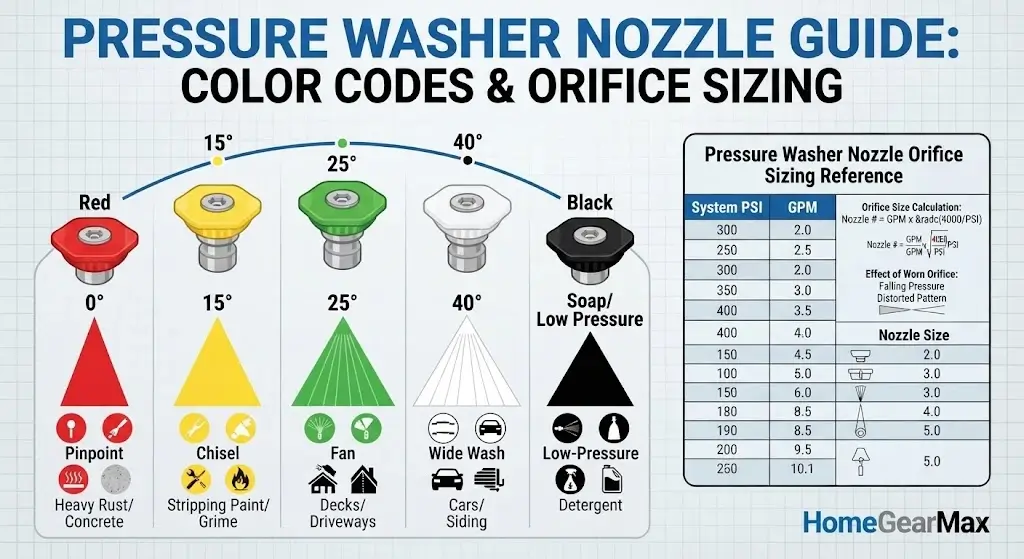
Quick Answer: In this technical pressure washer nozzle guide, standard colors identify the spray pattern angle: Red (0°), Yellow (15°), Green (25°), White (40°), and Black (Low-Pressure Detergent). Color specifies spray fan geometry, not nozzle flow size. The stamped nozzle size designation determines nominal flow capacity at a given pressure. Match nozzle size to your pressure washer’s actual GPM and operating PSI, then adjust spray distance and technique for the surface.
Pressure Washer Nozzle Color Chart
| Color | Typical Angle | Primary Function | Relative Impact | Best Use | Avoid On |
|---|---|---|---|---|---|
| Red | 0° | Concentrated pinpoint jet | Very high localized impact | Spot-cleaning unpainted iron, concrete forms | Wood, painted finishes, automotive clear coat |
| Yellow | 15° | High-impact narrow fan | High localized impact | Unsealed concrete, stripping paint or sealant | Softwood decks, vinyl siding at close range |
| Green | 25° | General-purpose sweeping fan | Moderate/sweeping impact | Driveways, brick patios, outdoor walkways | Fragile finishes or damaged mortar joints |
| White | 40° | Wide, lower-impact fan wash | Lower localized impact | Automotive clear coats, vinyl siding, glass | Heavy embedded oil or rust stains |
| Black | Low Pressure | Detergent application | Low Impact | Downstream soaping, house wash pre-soaks | High-pressure stripping tasks |
Which Pressure Washer Nozzle Should You Use?
| Job / Surface | Starting Tip | Typical Angle | Technique & Caution |
|---|---|---|---|
| Car Washing & Vehicles | White | 40° | Start at 18–24″ test distance. Keep wand moving continuously. |
| Vinyl Siding & Windows | White / Soap | 40° / Low Pressure | Spray angled downward to prevent forcing water behind vinyl overlaps. |
| Wood Decks & Fences | White (Start first) | 40° | Sweep parallel to wood grain at 18″+ distance. Test on an inconspicuous spot. |
| Concrete Sidewalks & Brick | Green | 25° | Maintains sweeping speed while lifting dirt without etching sound concrete. |
| Heavy Stains & Broad Driveways | Yellow / Turbo | 15° / Rotary | High localized shearing force or rapid conical sweep for heavy grime. Read our surface cleaner guide for broad flatwork recommendations. |
| Detergent / Chemical Washing | Black | Low Pressure | Enables downstream chemical injector siphoning into low-pressure stream. |
Welcome to the definitive pressure washer nozzle guide. Selecting the wrong nozzle for a high-pressure washing system can gouge wood decking, damage painted finishes, or line-etch a concrete driveway. Pressure washer nozzles (and power washer spray tips) are calibrated flow restrictors that determine spray pattern geometry and contribute to system operating pressure in conjunction with pump flow rate.
Understanding how nozzle spray degree angles, orifice flow designations, volumetric flow rates (GPM), and standoff distance interact with your pressure washer pump is fundamental to achieving effective cleaning results while preserving surface integrity and machinery longevity.
30-Second Nozzle Selection Guide
- Car Washing & Vehicles: 40° White Fan Tip (or Low-Pressure Foam Cannon) — Conservative starting point for clear coats, trim, and rubber seals.
- Vinyl Siding & Painted Surfaces: 40° White Fan Tip or Downstream Soap Injection — Wide coverage for gentle washing and rinsing.
- Wood Decks & Fences: 40° White Tip first — Begin at least 18 inches away and sweep parallel to wood grain. Use 25° Green only if surface condition and technique permit.
- Concrete Sidewalks & Brick Patios: 25° Green Sweeping Tip, or 15° Yellow Tip for concentrated spot cleaning.
- Heavy Concrete Stains & Broad Flatwork: Rotary Turbo Nozzle or Dual-Nozzle Rotary Surface Cleaner.
- Detergent / Chemical Application: Low-Pressure Black Soap Tip or Downstream J-Rod Assembly — Uses a large orifice flow path to drop restriction and enable chemical siphoning.
- Electric Pressure Washers Setup: Verify that electric units running 1.2–1.8 GPM use correctly calibrated orifice sizes as detailed in our best electric pressure washers guide.
Nozzle Color vs. Nozzle Size: Important Distinction
One of the most common mistakes among equipment operators is confusing a nozzle’s color code with its flow size designation. They identify completely different physical parameters:
| What You See on Nozzle | What It Identifies | What It Controls |
|---|---|---|
| Color (Red, Yellow, Green, White, Black) | Common spray-angle convention | Energy distribution pattern & sweep footprint |
| Stamped nozzle number / marking | Nominal flow-capacity designation | System backpressure for a given pump GPM |
| 1/4″ Quick-Connect Plug | Physical fitting connection size | Mechanical mounting compatibility (Not orifice flow size) |
Important Rule: Color specifies the spray angle; the stamped size designation specifies the flow capacity. A green 25° nozzle in size 3.0 and a green 25° nozzle in size 4.0 have identical spray fan angles, but they create significantly different backpressure levels when installed on the same pump.
What Does a “25° 3.0” Pressure Washer Nozzle Mean?
If a nozzle tip is stamped with 25030 or 25° 3.0, the numbers convey two specific technical parameters:
- 25°: Represents the 25-degree wide spray fan angle.
- 3.0: A Size 3.0 nozzle is nominally sized to flow about 3.0 GPM at 4,000 PSI under the applicable nozzle-sizing convention; actual flow depends on the manufacturer, nozzle geometry, pressure, and calibration.
It does not mean the physical orifice hole is 3.0 mm wide, nor does it guarantee the nozzle will automatically deliver 3.0 GPM on every machine. Actual operating flow and pressure depend on the pump’s displacement capacity and unloader valve setting.
Pressure Terminology: Max PSI vs. Operating PSI
A positive-displacement pressure washer pump supplies water flow, while system pressure develops as that flow encounters resistance from the nozzle and hydraulic circuit. The nozzle does not independently “create” pressure; it provides a calibrated restriction that establishes the pump’s operating point within the limits of the pump, unloader, and hydraulic circuit.
| Pressure Term | Technical Definition | Practical Significance |
|---|---|---|
| Max Advertised PSI | Maximum advertised static or test pressure ceiling under factory test conditions. | Maximum advertised rating; it may not represent pressure maintained during continuous washing. |
| Working Operating PSI | Dynamic pressure generated while water flows continuously through the primary nozzle. | Determines actual bond-breaking force per unit area at the target surface. |
| Upstream Nozzle PSI | Hydraulic pressure measured immediately upstream of the nozzle orifice inlet. | Establishes exact volumetric flow rate through the primary nozzle opening. |
| Dynamic Pressure Loss (ΔP) | Pressure drop caused by fluid friction along hose inner walls, fittings, and couplers. | Reduces net pressure available at the nozzle inlet on long hose runs. |
PSI vs. GPM vs. Cleaning Units (CU)
Understanding the difference between hydraulic pressure (PSI), flow rate (GPM), and Cleaning Units (CU) is essential for choosing the right nozzle and machine setup for any cleaning task.
| Metric | What It Controls | Practical Impact |
|---|---|---|
| PSI (Pounds Per Square Inch) | Hydraulic pressure / Force per unit area | Helps break mechanical bonds of stubborn dirt and stains. |
| GPM (Gallons Per Minute) | Volumetric water flow rate | Flushes dislodged debris away and speeds up broad cleaning. |
| Cleaning Units (CU = PSI × GPM) | Simplified comparative output metric | CU is a convenient screening metric, not a physical measurement of cleaning rate. Does not account for fan angle, distance, or detergent chemistry. |
| Nozzle Angle | Energy distribution footprint | Spreads output force over a narrow or wide surface path. |
Key Takeaway: A 3,000-PSI machine at 2.5 GPM (7,500 CU) cleans significantly faster than a 3,000-PSI machine at 1.2 GPM (3,600 CU). Higher pressure increases localized striking impact, while higher flow rate provides flushing speed.
Nozzle Size Designation vs. Physical Hole Diameter
In common pressure-washer nozzle sizing systems, a nozzle size number such as 2.5, 3.0, or 4.0 is a flow-capacity designation rather than a direct measurement of the physical hole diameter in millimeters. Many professional nozzle charts (such as Cat Pumps Technical Sizing Standards) reference flow at a baseline pressure of 4,000 PSI. Manufacturer calibration can differ, so the nozzle manufacturer’s chart takes precedence.
For instance, a Size 4.0 nozzle designation is engineered to pass nominally 4.0 GPM at 4,000 PSI reference pressure. Physical hole internal dimensions vary depending on internal entrance geometry, discharge coefficients (Cd), and manufacturing tolerances.
Common Pressure Washer Nozzle Color Conventions
On many consumer and professional pressure-washer tips, color is used as a quick visual indication of spray angle. However, color coding is not a universal industry specification; verify the angle and size stamped on the nozzle whenever possible (referenced in equipment manuals like Simpson Cleaning Equipment).
Common Pressure Washer Nozzle Color Conventions & Spray Angles0°
Red Tip
Pencil Jet
Durable Steel / Hard Forms
15°
Yellow Tip
Chisel Stream
Heavy Concrete Cleaning
25°
Green Tip
Sweeping Wash
Decks & Sidewalks
40°
White Tip
Wide Fan Wash
Cars / Siding / Windows
Soap
Black Tip
Low Pressure
Detergent Application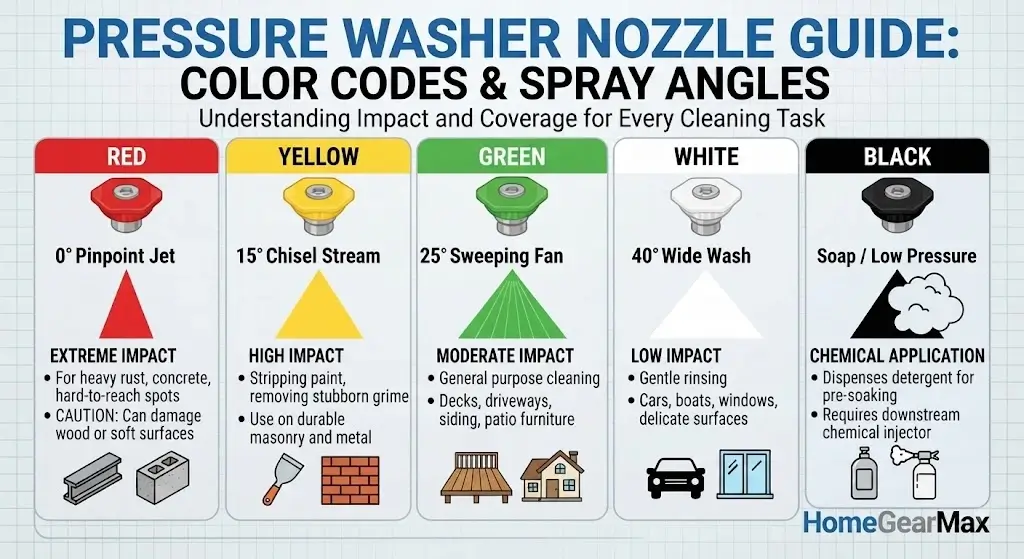
Figure 1: Pressure washer nozzle color conventions, spray angles, and primary functional roles.
0-Degree Red Nozzle (Pencil Jet)
The 0° red nozzle projects an un-deflected stream of water. Because the spray is concentrated into a small footprint, a 0° tip produces high localized impact and has little tolerance for excessive dwell time. Best reserved for highly durable surfaces and controlled spot cleaning where the surface manufacturer permits concentrated high-pressure spray.
- Mechanics: Minimal stream deflection preserves fluid column momentum over distance, minimizing atmospheric air entrainment.
- Trade-offs: Slow coverage rate. Concentrated impact can gouge wood, strip mortar, or etch cured concrete surfaces.
- Typical Applications: Spot-cleaning durable unpainted iron equipment, dislodging hardened concrete slurry from forms, or hard mineral deposit removal. Avoid on wood, painted surfaces, automotive finishes, fragile masonry, and other materials that can be damaged by concentrated impact.
15-Degree Yellow Nozzle (Chisel Stream)
The 15° yellow nozzle creates a narrow, high-impact fan pattern, balancing strong shearing force with a modest cleaning path.
- Mechanics: The nozzle geometry redirects the jet into a narrow fan pattern. Internal design varies by manufacturer.
- Trade-offs: Effective on tough deposits, but holding the tip too close to concrete can carve visible “zebra lines” into the finished cement paste layer.
- Typical Applications: Stripping peeling paint or sealant from masonry, cleaning heavy grease stains on unsealed driveways, and prepping structural metal.
25-Degree Green Nozzle (Sweeping Wash)
The 25° green nozzle is the primary general-purpose workhorse tip for residential power washing, offering a useful balance of impact and coverage on durable surfaces when the pressure, distance, and technique are appropriate.
- Mechanics: Spreads fluid evenly across a 25-degree fan arc, delivering uniform contact across the spray width.
- Trade-offs: Provides greater coverage speed than a 15° tip while retaining enough cleaning energy to remove algae and dirt without gouging sound surfaces.
- Typical Applications: Washing concrete sidewalks, brick patios, garage floors, and outdoor walkways.
40-Degree White Nozzle (Gentle Wide Fan)
The 40° white nozzle distributes system flow across a broad horizontal fan, dispersing energy over a larger footprint to lower localized surface impact.
- Mechanics: Spreads fluid flow over a wider fan arc, reducing localized impact intensity per unit area.
- Trade-offs: Conservative standard tip for delicate materials, but requires closer proximity or chemical assistance to lift heavily embedded dirt.
- Typical Applications: Washing clear-coated automotive paint, residential vinyl siding, stucco, window glass, outdoor wicker, and softwood lumber.
Black Soap Nozzle (Low-Pressure Chemical Tip)
The black detergent nozzle features a substantially larger flow orifice than high-pressure spray tips. Many black detergent tips use a wide spray pattern, but exact spray geometry and orifice opening vary by manufacturer and pressure washer specification.
- Mechanics: The larger-flow detergent tip reduces restriction and helps create the pressure differential required by a downstream chemical injector to draw detergent into the water stream. Injector performance also depends on flow rate, hose length, injector design, and the pressure differential across the injector. This applies to systems using a downstream chemical injector; pressure washers using a different detergent-delivery architecture may operate differently.
- Trade-offs: Delivers negligible mechanical impact; designed specifically as an applicator for house-wash or vehicle-cleaning detergents, pre-soaks, or specialized mixes such as those highlighted in our pressure washer soap guide.
- Typical Applications: Applying detergent pre-soaks, house washing siding, vehicle shampooing, and applying cleaning solutions.
Spray Angle vs. Surface Impact: Same Orifice, Different Energy Distribution
For nozzles designed around the same flow-size standard, at the same inlet pressure, nominal flow is primarily determined by orifice size rather than spray angle. Actual flow can vary slightly with nozzle geometry and manufacturing tolerances.
What changes substantially is the distribution of kinetic impact energy across the target surface:
- 15° Yellow Tip: The narrower pattern concentrates delivered flow into a smaller footprint, increasing localized impact intensity for deep bond-breaking power.
- 40° White Tip: Distributes nominal fluid flow over a substantially wider footprint → Lower localized stress → Gentle rinsing action, broad path.
Specialty Nozzle Systems: Turbo, J-Rod & Surface Cleaners
Standard color-coded tips are limited by fixed fan shapes. As covered throughout this pressure washer nozzle guide, specialty nozzle systems manipulate rotation, flow paths, and multi-nozzle manifolds to solve specialized cleaning tasks.
Turbo / Rotary Nozzles
A rotary nozzle moves a concentrated jet rapidly across the surface, combining high localized impact with a larger effective coverage path than a stationary 0° jet. A turbo nozzle is not equivalent to a 25° or 40° fan nozzle; its rotating jet can deliver substantially higher localized impact than a conventional wide fan at comparable system output. Do not treat the rotating pattern as inherently gentle. Turbo nozzles can damage coatings, wood, soft masonry, and other vulnerable surfaces. Some commercial designs use ceramic wear components for durability.
Turbo Rotary Nozzle Hydrodynamic MechanicsWater Inlet
High-Speed Rotation
Rotating Internal Core
Concentrated Jet Impact
Conical Coverage Path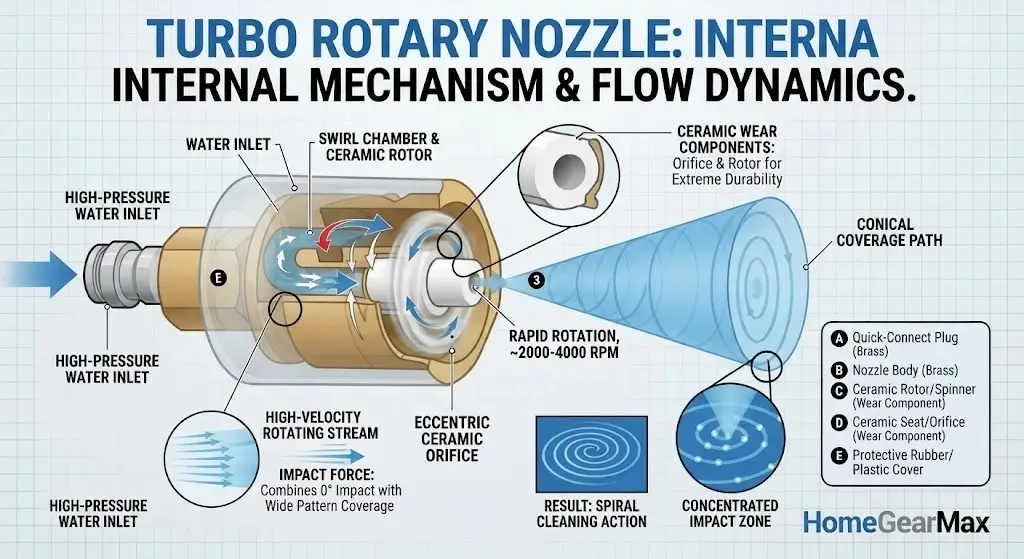
Figure 2: Cutaway schematic showing the spinning internal core inside a Turbo Nozzle, combining concentrated impact with a conical coverage path. Some commercial designs use ceramic wear components.
- Performance Advantage: Combines deep-cleaning impact with a broad sweeping path, accelerating hard-surface cleaning on concrete and stone.
- Operation & Care: Follow the rotary nozzle manufacturer’s orientation and maintenance instructions. Do not disassemble a sealed rotary nozzle unless the manufacturer explicitly provides a service procedure.
J-Rod Soft Wash Assemblies vs. Downstream Injector
A J-Rod is a multi-nozzle wand/manifold assembly that allows an operator to switch between four distinct low-pressure and high-pressure spray tips in a single cluster without changing individual nozzles at the wand or returning to the machine. Unlike a simple black soap tip, a J-Rod typically houses both a high-reach soap jet (0°), a wide-angle soap fan (25°), a high-reach rinse stream (0°), and a wide rinse fan (25°), giving operators complete remote control over spray distance and chemical application.
Rotary Surface Cleaner Nozzle Sizing
Surface cleaners use a rotating horizontal spray bar equipped with two or more low-degree tips (typically 15° or 25° angles) enclosed inside a circular housing. Final nozzle selection must account for manufacturer surface-cleaner specifications, operating pressure, nozzle angle, and bar design. Read our detailed surface cleaner sizing guide for model-specific recommendations.
Correct Surface Cleaner Nozzle Sizing Method:
- Divide total machine flow by the number of spray-bar nozzles: GPMper_nozzle = Total Machine GPM / Number of Nozzles on Spray Bar
- Look up GPMper_nozzle at target operating PSI in the Nozzle Sizing Chart below to find individual tip size, assuming the manufacturer’s chart uses the same 4,000-PSI sizing convention.
Example: A 4.0 GPM pressure washer operating at 4,000 PSI with a 2-nozzle surface cleaner bar requires: 4.0 GPM / 2 nozzles = 2.0 GPM per nozzle. Looking up 2.0 GPM at 4,000 PSI in the chart indicates a Size 2.0 orifice designation for each nozzle tip (2.0 + 2.0 = 4.0 overall flow capacity).
How to Find the Correct Nozzle Size for Your Machine
Follow these five steps to accurately determine the right nozzle size designation for your pressure washer:
- Find actual/rated operating PSI: Look up your machine’s continuous working pressure rating (not the maximum static rating). Do not choose the nozzle solely from the washer’s maximum PSI number. Use the operating/rated pressure and flow specification.
- Find rated GPM: Check the pump specification plate for output flow rate in Gallons Per Minute.
- Calculate nozzle size number: Use the standardized sizing formulas:
- Primary Nozzle Size: N = GPM × √(4000 / PSI)
- Reverse Flow Calculation: GPM = N × √(PSI / 4000)
- Reverse Pressure Calculation: PSI = 4000 × (GPM / N)2
- Round to the nearest commercial size: Match your calculation to the closest standard nozzle size designation (e.g., 2.5, 3.0, 3.5, 4.0).
- Verify against manufacturer charts: Always confirm with the nozzle manufacturer’s sizing table before purchasing.
Example 1: 1.2 GPM @ 2,000 PSI Electric Pressure Washer
N ≈ 1.2 × √(4000 / 2000) = 1.2 × 1.414 ≈ 1.70 → Select Size 1.7 to 2.0 Nozzle
Example 2: 2.5 GPM @ 3,000 PSI Gas Pressure Washer
N ≈ 2.5 × √(4000 / 3000) = 2.5 × 1.155 ≈ 2.89 → Select Size 3.0 Nozzle
| Washer Output (GPM & PSI) | Calculated Size (N) | Recommended Commercial Nozzle Size |
|---|---|---|
| 1.2 GPM @ 2,000 PSI | 1.70 | Size 1.7 – 2.0 |
| 1.5 GPM @ 2,000 PSI | 2.12 | Size 2.0 – 2.5 |
| 2.0 GPM @ 2,500 PSI | 2.53 | Size 2.5 |
| 2.5 GPM @ 3,000 PSI | 2.89 | Size 3.0 |
| 3.0 GPM @ 3,000 PSI | 3.46 | Size 3.5 |
| 4.0 GPM @ 4,000 PSI | 4.00 | Size 4.0 |
Note: These are sizing references based on the standard formula, not universal purchasing recommendations. Always verify against the specific nozzle manufacturer’s chart.
Pressure Washer Nozzle Size Chart & Reference Sizing
In the common 4,000-PSI nozzle-sizing convention, a nozzle size of 3.0 corresponds approximately to 3.0 GPM at 4,000 PSI. This is a sizing designation, not a measurement of the physical orifice diameter. Manufacturer flow tables take precedence because discharge coefficient, geometry, and calibration can vary. Use the reference pressure washer nozzle size chart below to match your pump flow and operating pressure:
Impact of Nozzle Orifice Calibration on Operating PressureOrifice Too Small
❌ Excessive Restriction
❌ Pressure Rises to Bypass
Thermal Bypass Recirculation
Calibrated Size Match
✔ Target Operating PSI
✔ Full Rated Flow (GPM)
Balanced Operating Point
Orifice Too Large
⚠️ Insufficient Restriction
⚠️ Operating PSI Collapses
Reduced Impact Force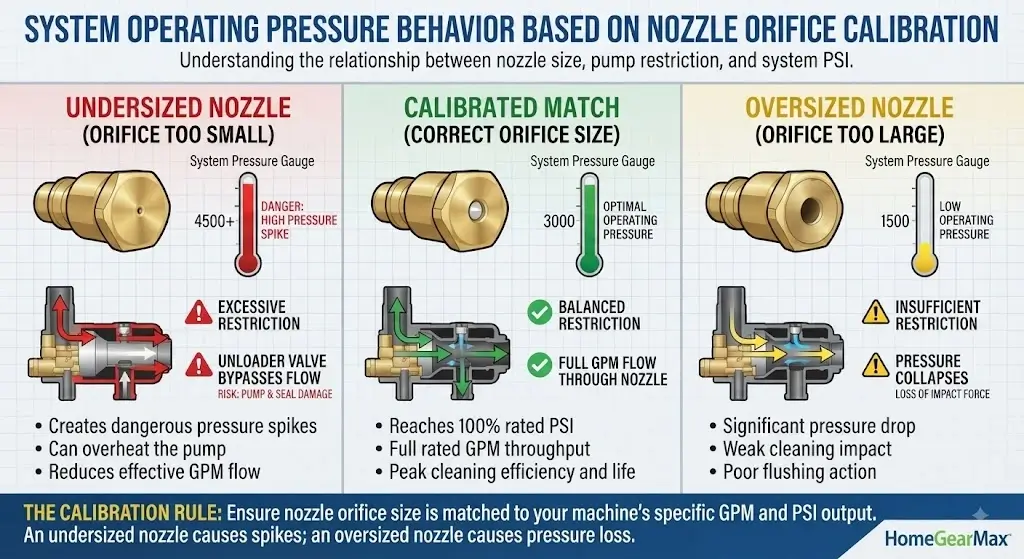
Figure 3: System operating pressure behavior based on nozzle orifice calibration.
| Pump Flow (GPM) | 1000 PSI | 1500 PSI | 2000 PSI | 2500 PSI | 3000 PSI | 3500 PSI | 4000 PSI |
|---|---|---|---|---|---|---|---|
| 1.5 GPM | 3.0 | 2.5 | 2.1 | 1.9 | 1.7 | 1.6 | 1.5 |
| 2.0 GPM | 4.0 | 3.3 | 2.8 | 2.5 | 2.3 | 2.1 | 2.0 |
| 2.5 GPM | 5.0 | 4.1 | 3.5 | 3.2 | 2.9 | 2.7 | 2.5 |
| 3.0 GPM | 6.0 | 4.9 | 4.2 | 3.8 | 3.5 | 3.2 | 3.0 |
| 3.5 GPM | 7.0 | 5.7 | 5.0 | 4.4 | 4.0 | 3.7 | 3.5 |
| 4.0 GPM | 8.0 | 6.5 | 5.7 | 5.1 | 4.6 | 4.3 | 4.0 |
| 5.0 GPM | 10.0 | 8.2 | 7.1 | 6.3 | 5.8 | 5.3 | 5.0 |
| 6.0 GPM | 12.0 | 9.8 | 8.5 | 7.6 | 6.9 | 6.4 | 6.0 |
| 8.0 GPM | 16.0 | 13.1 | 11.3 | 10.1 | 9.2 | 8.6 | 8.0 |
| 10.0 GPM | 20.0 | 16.3 | 14.1 | 12.6 | 11.5 | 10.7 | 10.0 |
Selection Rule: Use the manufacturer’s nozzle chart whenever available. If calculating from the standard sizing formula, select the nearest available orifice size that produces required pressure without exceeding pump flow or unloader limits.
Hose Friction Loss & Dynamic Pressure Drops
With water flowing, pressure available downstream of the hose is lower than pump-discharge pressure because of friction and minor losses through the hose, gun, fittings, and quick-connects. Pressure loss increases with longer hose runs and smaller internal diameters (ID).
For high-flow rigs (4.0+ GPM), upgrading from a 1/4-inch consumer hose to a 3/8-inch commercial hose substantially reduces line pressure loss and helps preserve more of the pump’s available pressure at the nozzle tip.
Nozzle Metallurgy & Wear Resistance
Waterborne contaminants and prolonged high-velocity flow can gradually erode nozzle orifices, particularly under demanding operating conditions. As the physical opening expands, restriction drops, leading to a loss in operating PSI.
- Brass Alloys: Lower cost; common on consumer soap applicators. Soft metal structure is susceptible to mineral erosion and chemical oxidation.
- 304 / 316 Stainless Steel: 304/316 stainless steel provide useful corrosion resistance; actual erosion resistance depends on alloy condition, hardness, geometry, water quality, and operating conditions.
- Hardened Stainless Steel: Heat-treated steel alloys providing dimensional stability under continuous professional operating cycles.
- Sintered Ceramic Inserts: Ceramic excels at abrasion resistance inside commercial rotary turbo tips and soft-wash nozzles, but is more brittle than metal, making housing design and impact protection important.
Surface Compatibility & Conservative Test Distance Guide
The effective impact at the surface generally decreases as spray distance increases because the jet or spray pattern loses velocity and disperses through the air. Maintaining a conservative standoff distance is essential. These distances are starting points for controlled testing, not guarantees of surface safety; actual surface impact varies with PSI, GPM, nozzle wear, spray angle, surface condition, and washer model. No fixed standoff distance guarantees paint safety.
| Surface Material | Starting Nozzle Angle | Conservative Test Distance | Technique & Caution |
|---|---|---|---|
| Poured Concrete Driveway | 25° Green or Turbo Tip | 12+ in | Keep wand moving continuously to prevent line etching. |
| Exposed Aggregate Stone | 25° Green Tip | 12 in – 18+ in | Avoid 0° or 15° tips which can dislodge small aggregate. |
| Wood Decks & Fences | 40° White Starting Point | 18+ in | Sweep parallel to wood grain. Test on an inconspicuous area first; use 25° only when surface permits. |
| Vinyl Siding | 40° White or Soap Tip | 18 in – 24 in | Spray angled downward to avoid forcing water under overlaps. |
| Automotive Clear Coat | 40° White Fan Tip | 18 in – 24 in+ | Start farther away and reduce distance gradually only after testing. Pair with a foam cannon from our foam cannon guide. |
Safety Rule: Move closer only after testing an inconspicuous area and confirming that the surface tolerates the spray.
How to Tell if a Pressure Washer Nozzle Is Worn Out
Nozzle wear is one possible cause of gradually falling operating pressure. Confirm the nozzle first, but also inspect the pump, unloader, water supply, inlet filter, hose, fittings, and leaks. Follow these steps to diagnose a worn tip:
- Observe Fan Symmetry: Look for a split, feathered, or distorted spray fan pattern.
- Check Gauge Pressure: Compare current dynamic line pressure against your baseline setup.
- Inspect Orifice Geometry: Look for visual erosion, burrs, or oval deformation around the orifice exit.
- Replace, Don’t Ream: Do not ream or mechanically enlarge a precision nozzle orifice. Replace the tip according to the manufacturer’s maintenance guidance.
Nozzle Maintenance & Unclogging Protocol
Debris or mineral scale trapped inside a nozzle orifice disrupts spray pattern symmetry and increases system backpressure.
Step-by-Step Nozzle Cleaning Procedure
- Shut down the pressure washer engine or switch off electric power.
- Turn off the garden hose water supply and squeeze trigger to vent residual pressure.
- Engage the trigger safety lock lever and disconnect the nozzle tip.
- Use the nozzle-cleaning tool specified by the manufacturer. Avoid forcing oversized or hardened steel wires through precision orifices, as enlarging the opening will permanently alter nozzle calibration.
- If permitted by the manufacturer, flush water backward through the tip from front to back to clear dislodged debris before reinstalling.
7 Common Pressure Washer Nozzle Mistakes to Avoid
- Selecting Tips by Color Alone: Ignoring nozzle orifice size numbers stamped on the hex body.
- Using a 0° Red Tip on Wood or Vinyl: Gouging wood grain or damaging siding under excessive localized pressure.
- Holding the Nozzle Too Close: Relying on extreme proximity rather than proper chemical pre-treatment.
- Operating with a Worn Nozzle Orifice: Wondering why working operating pressure has collapsed.
- Installing an Undersized Orifice: Forcing pump into unloader bypass recirculation.
- Assuming PSI Alone Determines Performance: Ignoring volumetric flow rate (GPM) rinsing power.
- Using High-Pressure Tips for Soap Application: Failing to trigger downstream chemical siphoning.
Frequently Asked Questions (FAQ)
Are pressure washer nozzles and power washer nozzles the same?
Direct Answer: Usually, yes in consumer terminology: “pressure washer” and “power washer” generally refer to the same type of equipment. However, nozzle fittings and formats are not universally identical. Many residential machines use 1/4-inch quick-connect tips, while some systems use proprietary or different connections. Always verify the fitting and nozzle specifications for your machine.
Does nozzle color determine PSI?
Direct Answer: No. Color typically identifies spray pattern angle, while nozzle size determines flow capacity. Actual operating pressure depends on pump characteristics, nozzle restriction, unloader setting, and hydraulic losses.
What do the numbers stamped on pressure washer nozzles mean?
Direct Answer: The first two digits denote the spray fan angle in degrees (e.g., 25 = 25°), while the remaining digits indicate the nozzle’s nominal flow-capacity size designation (e.g., 030 = Size 3.0).
What happens if I use a nozzle with an orifice size that is too small?
Direct Answer: If the nozzle is substantially undersized, system pressure can rise to the unloader’s bypass setting. Prolonged unloaded recirculation can heat the pump water and increase wear on seals and packings, depending on pump design.
Will a 0-degree red nozzle damage concrete?
Direct Answer: Yes. At close range, a 0-degree red tip delivers pinpoint impact force that can etch the surface, remove the cement paste layer, or expose aggregate, particularly on newer or softer concrete.
Why does my pressure washer lose pressure when I switch to the black nozzle?
Direct Answer: The black soap nozzle features a wide internal orifice designed to drop line backpressure below the threshold needed to trip a downstream chemical injector, siphoning detergent into the flow stream.
Why is my turbo nozzle spraying a solid line instead of rotating?
Direct Answer: Turbo nozzles stop spinning when internal ceramic rotors bind due to mineral scale or sand debris. If the rotor fails to spin, shut down the machine and inspect the nozzle according to the manufacturer’s service instructions.
How do I know when my pressure washer nozzle is worn out?
Direct Answer: A nozzle is worn when working operating pressure drops gradually despite normal engine RPMs, or when the spray fan becomes split or uneven due to internal orifice erosion.
Does a wider spray nozzle use less water per minute (GPM)?
Direct Answer: No. As explained in this pressure washer nozzle guide, for nozzles using the same standardized orifice size and operating at the same pressure, nominal flow rate (GPM) is approximately the same regardless of spray degree angle.
What pressure washer nozzle is a conservative choice for washing a car?
Direct Answer: A 40° white fan tip is a conservative starting option for vehicle rinsing when the nozzle is correctly sized for the machine. Start at a greater distance, keep the spray moving, and test an inconspicuous area first.
Can I use gas pressure washer nozzles on an electric pressure washer?
Direct Answer: Yes, a gas-rated nozzle can physically fit an electric pressure washer if the connection matches, provided the nozzle orifice is sized for the electric washer’s actual flow (GPM) and target operating pressure. The power source itself does not determine nozzle size.
Key Takeaways for Choosing Pressure Washer Nozzles
Choosing the correct nozzle from this pressure washer nozzle guide requires matching target material delicacy with the proper spray degree angle, while ensuring orifice sizing corresponds directly with your pump’s flow (GPM) and pressure (PSI) output specifications.
- For Everyday Rinsing & General Maintenance: Utilize 25° Green and 40° White Nozzles as your primary working tips.
- For Heavy Driveway Stains & Masonry Flatwork: Combine a 15° Yellow Tip for spot treatment with a Turbo Rotary Tip or dual-nozzle Surface Cleaner.
- For Paint-Safe Vehicle Detailing: Use a 40° White Tip or dedicated low-pressure chemical foam applicator.
- For Machine Protection: Always verify the nozzle size designation stamped on the hex body before operation to ensure proper pump restriction.
Technical References & Standards for This Pressure Washer Nozzle Guide
The technical formulas and sizing conventions presented in this pressure washer nozzle guide are aligned with the following manufacturer and industry technical documentation:
- Cat Pumps Technical Services: Nozzle Selection & Flow Calibration Tables (4,000 PSI Standard Convention)
- Simpson Cleaning Equipment: Operator Manuals & Spray Nozzle Degree Specifications
- Hydraulic Institute Standards: Fluid Flow through Restrictive Orifices (Q = Cd × A × √(2ΔP / ρ))
- Kärcher Industrial Pressure Washing: Rotary Turbo Nozzle Mechanics & Maintenance Protocols
